It is doubtful whether Dylan has ever read Wagner’s Judaism in Music — in which it is argued that Jewish musicians are essentially bricoleurs, only capable of “nonsensical gurgling, yodeling and cackling.” Nevertheless, Dylan’s gloriously imperfect and constantly mobile singing voice, and his boundless ability to mix musical styles, eerily correspond to Wagner’s stereotype of ‘the Jew’ as aesthetically and culturally impure.”[1] Dylan’s music is, in Murphy’s words, “littered with tiny rippling echoes of this giant national storehouse of folk ballads, hymns, Civil War songs, country folk blues, urban electric blues, country and western, bluegrass, dust-bowl folk, tin-pan alley, Broadway, gospel, jazz-beat, crooning, Tex-Mex, big band, rhythm and blues, pop music, reggae, rap — and all the rest.”[2]
Dylan freely appropriates other people’s melodies, chord changes, rhythm patterns, and tonal and textual phrases. These pepper his works. … [Dylan] adopts musical masks, styles, and personas. He is a great mimic. But he is also unmistakably Mr. Dylan whatever he does.[3]
The radical hybridity of Dylan’s music and lyrics has a family resemblance with his “comrade-in-arms” Jimi Hendrix who rationalized his ambivalence towards both Blackness and America through the nomadic ideology of the gypsy – a symbol of his mixed racial and ethnic heritage:
In Dylan, Hendrix recognized a kindred traveler, another musical itinerant who rationalized his own ambivalent identity through music. … Hendrix and Dylan — gypsy and hobo — navigated a musical passage of self-invention that led them into borderlands where musical styles, idioms, and traditions overlap.[4]
Advertisement
Race and Ethnicity on Highway 61
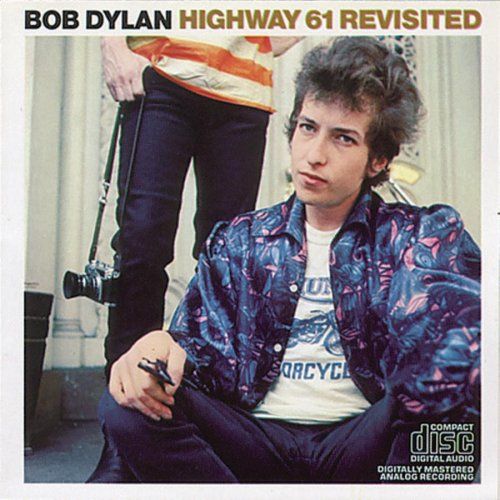
Highway 61, which is used in Dylan’s album title and in the title of a song on the album, runs north from New Orleans to Dylan’s home state of Minnesota. It is known as the Blues Highway — the route out of the South taken by large numbers of African Americans on their way to Chicago. Stratton describes “Like a Rolling Stone” and the whole of Highway 61 Revisited as “Jewish blues”:
The particularly Jewish feeling of disillusion and the loss of a moral compass pervades the album. … ‘Highway 61 Revisited’, the song whose title returns us to the Blues Highway, begins with a verse about God’s testing of Abraham in Genesis, in the Torah, the Jewish part of the Bible. … In the biblical narrative, God orders Abraham to sacrifice Isaac. When it is clear that Abraham will perform this deed, an angel stays Abraham’s knife-hand. Jewish interpretations of this story have mostly understood God’s instruction as a way of testing Abraham’s faith and loyalty. In Dylan’s retelling, there is no reprieve. God commands Abraham to kill his son, and threatens retribution if the deed is not carried out. We need to note the semantic shift here. Dylan’s God does not ask for a sacrifice; he asks for a murder, a killing. When Abraham queries where the killing should be done, God tells him on Highway 61. The resonance here, again, is the Holocaust, often considered to be the most overwhelming test of Jewish faith. Indeed, like the victims of the gas chambers, in the Genesis narrative Isaac was to be burnt. Holocaust, with its meaning of ‘a burnt offering’, is a term used to translate Isaac’s query to his father about where the lamb was for the sacrifice as well as to describe the Nazi genocide. In Dylan’s placing of the sacrifice on Highway 61, listeners bring the blues understanding to the Jewish experience.[5]
Al Kooper comments in his Britannica article that Dylan’s image anno 1968 had changed: “with shorter hair, spectacles, and a neglected beard, he resembled a rabbinical student.” In a 1968 interview with Toby Thompson, Dylan’s mother emphasized that “there’s a huge Bible open on a stand in the middle of his study. Of all the books that crowd his house … that Bible gets the most attention. He’s continually getting up and going over to refer to something.”[6] Doubtless, Dylan’s identification with Judaism is complex and ambiguous. Meisel claims that the idea of the Christian Dylan was already in place at Newport in 1965, well before Dylan’s actual conversion to Christianity in 1979.[7] Stephen J. Whitfield, however, emphasizes Dylan’s Jewish (transgressive?) identities:
Formally satisfying rabbinic rules of inclusion, remaining a Jew in the halakhic sense, he has been ecumenical — sometimes expressing in lyrics and interviews attitudes that cannot be considered Jewish, sometimes offering tantalizing affirmations of that very identity. He has shattered the difference between the Jew and the Other as though the historic boundary between them had never existed, and thus leaves dangling, fragile and unstable, what the historian of Jewish identity might well despair of resolving.
On the surface, “Like a Rolling Stone” (1965) is a song written as an attack on a woman by whom Dylan felt betrayed. According to Stratton, however, “the song was triggered by Dylan’s emotional reaction to the Jewish disillusion with the promises of White American society coupled with the growing cultural awareness of what was coming to be known as the Holocaust.”[8] Whitfield writes that Dylan celebrated his son Jesse’s bar mitzvah in Jerusalem and vaguely affiliated for a while with the Lubavitcher Hasidim (a racialist sect with attitudes of being qualitatively different from non-Jews). Whitfield continues to remark that the Infidels album (1983) offered something unexpected:
‘Neighborhood Bully’ constitutes a capsule history of the Jewish people itself. Spitting out the song rapidly, in a tone of ironic bitterness, he blended a millennial history of unjust persecution with an unnuanced defense of a beleaguered Israel. It could have been a Likud campaign song.
Dylan as countercultural Trickster
Murphy (p. 57) quotes Dylan, saying that “Truth was the last thing on my mind, and even if there was such a thing, I didn’t want it in my house.” Hence, deception, deceit, misidentification — “the losing and finding, reversing and inverting, hiding and confusing, masking and revealing of identity” — are essential to any Dylanological analysis.
Bob Dylan is always what he is not. Conversely, if not perversely, he is also always not what he is. He is a great impersonator — always two people at one time, a double act. An endlessly deliciously wickedly bifurcated identity is the nature of a great comic character — and a niggling intuition of that … also raised the ire of his Newport audience. Yes he was a protest singer, but a singer of comic protest songs. ‘Maggie’s Farm’ is a classic of the type. Such songs can have a very serious edge. But they are not serious in an earnest, faux-tragic way. They are not solemn or serious in that thin-skinned, moralizing, pompous way that invites, indeed positively demands, satire. Satire is where Dylan began. His first compositions were topical songs laced with aw-shucks humor and surreal wit — low absurdity essentially. Then he gradually upped the ante, moving into ever-more sophisticated terrain.[9]
What is achieved in Dylan’s case is “comic chaos” — a “quantum effect” — by making “affirmations and denials in the same breath”. Hence, Murphy’s description of Dylan’s music as “comically quantum”:
The greatest of his songs are peppered with quantum tonal effects — tones that are one thing and another at the same time. Bob Dylan will tell you that his songs are simple, but of course he is an aw-shucks kidder. In fact, his songs masterfully exploit the resources of tonic-dominant harmony — with their endless modulations, shifts back and forth, between keys and major and minor triads. He also often mischievously undermines the tonic in favor of tonal ambiguity. He’ll oscillate harmony between the tonic and the subdominant, or start (say) a stanza with the submediant rather than the tonic, or engineer inconclusive cadences because he approaches them indirectly (say by way of the subdominant of the subdominant). Harmonic modulation and various kinds of harmonic equivocation lend his music its characteristic spooky timeless mythic quality. Dylan also utilizes the quantum resource of indeterminate pitch. He will often deploy tonal wobbles — notes that equivocate — by fusing the sharpened notes of the tempered scale with the flatter notes of pre-Renaissance or non-European modal scales — creating false relations. This is the musical version of talking out of both sides of your mouth — little quantum leaps in which shaper and flatter versions of the same notes coexist in the same music space or at least their coexistence is implied.[10]
Murphy points out the ambidextrousness of comic truth: ”It is a truth that is a lie at the same time.”[11] Dylan’s music — filled with truth as contradiction — fits into the cultural logic of complementarity:
This ambidextrousness applies to all aspects of his music — tonal, lyrical, instrumental, and vocal. Vocally, he half sings, half talks. Oftentimes this approximates something that is neither speech nor singing strictly speaking but rather a mordant creaky growl — a rasping, scratching hoarse vocal rumble. … And it is not just the timbre of the voice that makes us sit up and pay attention. It is also the phrasing — the odd emphases that Dylan gives to words or syllables — emphases placed where you’d least expect them. And then there is the way he elongates vowels — stretching conventional short sounds into long elastic unexpected elocutions. ‘What you would least expect’ is the comic desideratum. The comic mode is built on exquisite sharp-edged double coding. Arthur Koestler [The Act of Creation] called it bi-sociation. Kenneth Burke [On Symbols and Society] called it incongruity. No matter what it is called, Dylan does it effortlessly. A long time ago — in the nineteen-sixties — when, with witty aforethought, he announced ‘I embrace chaos’, Dylan was not declaring his love for social transgression or political anarchy but rather for comic pandemonium.[12]
Murphy, thus, portrays Dylan as “the quintessential joker man” with an “ear for witty musical quotation” — “a musical chameleon, an evasive, shape-shifting, identity-changing, metamorphosing character.” His lyrical imagination is filled with “dark paradox and witty contrast”. Despite its leftist connotations, Dylan’s music — like Seinfeld’s sitcoms — essentially communicates an ethic of political apathy. Dylan qua comic artist is an impostor who, of necessity, despises engagement: “Comedy is a function of distance — of seeing things one step removed.”[13] Like a comic artist, Dylan plays with the expectations of the audience – “who loves him as much as he despises them … and who can love him only because they misunderstand him”[14] – causing pandemonium, “as smug, senile and simpering judgments are turned upside down.”[15]
Concluding Remarks
In summary, Dylan is part and parcel of the culture of critique that has come to dominate academic discourse and the arts: Undermining traditional certainties by promoting indeterminacy, irrationality, ambivalence, identity bricolage and relativism.
Dylan’s case is a reminder of the multiple affinities between early 20th-century avant-garde movements and “postmodern” developments. Schoenberg’s radical disciple John Cage (1912–1992) employed the principle of complementarity in his rejection of the classical form based upon rational relationships among ordered tones. Cage saw music in the juxtaposition of noise/sound and silence, i.e. (as in Bohr’s complementarity and Ionesco’s anti-logic) as a contrast of “hitherto irreconcilable elements result[ing] in the undermining of the very heart of traditional ‘logical’ epistemology, the subject-object dichotomy.”[16] Christopher Lasch suggests that Cage puts forward a musical aesthetic in which musical sounds “are experienced as equivalent to any other kind of sound”.[17]
Lemert (p. 67) notes that this style of thought can be seen in many 20th-century intellectual and artistic movements, avant-garde ideas and cults: relativity theory, complementarity and Heisenbergian indeterminacy, absurdism, surrealism, expressionism, Cubism, Dadaism, atonalism and experimentalism. Lawrence Wilde, with reference to the parallels with expressionism, claims that Dylan in the early 1960s succeeded in fulfilling Adorno’s task of negating the values of the existing society. Dylan, as the original expressionists, “creates a novel relationship between content and structure in order to jolt the recipient towards an emotional confrontation with prevailing conservative values.”
Furthermore, Dylan’s Jewish middle-class discontents bear resemblance to the Cabaret Voltaire of the Dada movement, starring Marcel Janco and Tristan Tzara, who — through their notoriously rebellious gestures — “sought to deconstruct the conformist mentality that celebrated war and upheld bellicose nationalism.”[18] The chaotic and cacophonous atmosphere of the Cabaret Voltaire was purposefully cultivated by the Dadaists, who “celebrated the irrational, invited irony and rejected all logic in order to attack the warmongering power structures and their so-called ‘rational’ cultural codes.”[19]
Similarly, in “Ballad of a Thin Man” and “Desolation Row” on Highway 61 Revisited, for example, Dylan employs “a complete reversal of the roles of the respectable and the damned. In these songs the underworld of the rebels and freaks is the liberated, sane place to be, and the world of the conservatives is shriveled, hypocritical and in decay.” “Desolation Row” presents a “decentering” vision, reversing the normal relationship between center and periphery, between mainstream and alternative worlds.
Iain Ellis (p. 14) points out that the subversive wit of art movements like surrealism, dada, pop art, and situationism is indelibly imprinted on the work of rock humorists like Dylan. In the style of “superiority” humor, he used humor as a countercultural weapon for social change. Superiority humor tends to elevate the appearance or the actions of one individual or group over those of another and generate amusement at the misfortunes of others.[20] Bernard Saper lists 6 generalized types of specifically Jewish humor,[21] the first of which seems to be a pertinent description of Dylan’s superiority humor: “Assuming superiority, particularly in intelligence, wisdom, and virtue; besting of bigots and adversaries; psychologically beating the (alleged) out-group persecutors at their own game.“
Dylan’s “comic militancy” and deconstructionist qualities apparently bear a “family resemblance” to cultural critics like Karl Kraus in the center of Vienna’s “satiric vortex”, or, in another context, Franz Boas smuggling irony into scientific discourse. Kraus asserted that the trivial contains apocalyptic implications, and devoted many pages to moralistic discourses on minute matters of grammar and syntax.[22] Boas’s writing, taken as a whole, “has a kind of abusive perversity”, according to Arnold Krupat; he was engaged in “a kind of abysmal ironic vision”, showing “a real delight in his ability to expose or deconstruct … generalizations that could not stand up to his aggressive ironic scepticism.”[23]
Significantly, Dylan conflates speech and song (in a 1965 interview he claimed that “There would be no music without the words”). Schoenberg, likewise, devised a style of vocal recitation called Sprechstimme, designed to be neither speech nor song but some hybrid of the two. Similarly, Wittgenstein (in Philosophical Investigations) stressed the musical aspects of normal speech, emphasizing that speech is a special case of music, i.e. both speech and music are games with sounds. Likewise, Ernst Bloch (in Geist der Utopie, 1918), who mixed music, religion and Marxism “into a heady brew of revolutionary romanticism”,[24] transforming music into words (word-music). Despite the lack of evidence for any direct genealogies, Otto Weininger’s dictum that Jewishness (Judentum) is a tendency of the mind is starting to look intriguing.
Piero Scaruffi (pp. 33, 69), judges Dylan as the single most influential musician of the 1960s, turning music into a form of mass communication. Unsurprisingly, his legacy, his brand of targeted social satire, can be traced “in all subsequent protest youth cultures, whether in the hippie and punk movements, or even segments of hip-hop culture.”[25] There is, for example, a striking continuum extending into the hard rock-influenced rap music of the Jewish trio Beastie Boys (a hip-hop/rock group consisting of Michael Diamond, Adam Yauch and Adam Horovitz), the first non-African-American rap group to popularize rap for a White audience, releasing their first album in 1986. The Beastie Boys started out as a post-punk hardcore band (a White-coded genre) cooperating with possibly the only contemporary African-American hardcore band, Bad Brains.[26] They signed with Def Jam, whose co-founder Rick Rubin produced their debut album, Lincensed to Ill.
Once again, we have an example of Black-Jewish fusion within the Black-White binary — a ‘black-face’ imitation of a New York African-American accent (i.e. street slang). Once again, we have a musical style with chanted (“rapped”) rhythmic/rhyming speech. Stratton compares a track on Licensed to Ill, ‘Paul Revere’, with Dylan’s “talking blues” in ‘Bob Dylan’s 115th Dream’ and ‘Maggie’s Farm’ (released on Bringing It All Back Home, 1965) — “perhaps the closest Dylan came to precursing rap.”[27]
Dylan personifies the process of post-World War II Jewish Whitening in a time when American Jews were discursively and culturally constructed as White. In this process, Jews were also considered to have qualities that placed them outside of Whiteness. Hence, the description of Jews as a boundary case — both insiders and outsiders,[28] and Billig’s evaluation of Dylan as “an outsider posing as a dispossessed insider”.[29]
As a comic artist — whose comic mode is built on sharp-edged double coding — he is a tease who “openly debunks and hounds the audience.”[30] His (predominantly die-hard leftist) Ur-audience, who loves him as much as he despises them, can help to explain the Dylan enigma through the following no-nonsense description:
This audience has all the comic intellectual vices — pomposity, obsession, zeal, and so on. As the picaro moves on down the road, you can see him vicariously hitting these numskulls around the head — telling them: don’t think twice, it’s alright, but you’ve wasted my precious time. Occasionally they yelp in complaint — yet they come back for more, because he is their hero — and they really do not understand who he is. They are clueless.[31]
References
Albright, Daniel. Music Speaks: On the Language of Opera, Dance, and Song. Rochester (NY) & Woodbridge (UK): University of Rochester Press, 2009
Bryan Cheyette, ”On the ’D’ Train: Bob Dylan’s Conversions,” in Corcoran, Neil (ed.). Do You, Mr. Jones? Bob Dylan with the Poets and Professors. London: Chatto & Windus, 2002
Clarke, John R. Looking at Laughter: Humor, Power, and Transgression in Roman Visual Culture, 100 B.C. – A.D. 250. Berkeley, Los Angeles, London: University of California Press, 2007
Dettmar, Kevin J. H. (ed.). The Cambridge Companion to Bob Dylan. Cambridge & New York: Cambridge University Press, 2009
Ellis, Iain. Rebels Wit Attitude: Subversive Rock Humorists. Washington, DC: Soft Skull Press, 2008
Holt, D. & Douglas Cameron. Cultural Strategy: Using Innovative Ideologies to Build Breakthrough Brands. Oxford & New York: Oxford University Press, 2010
Knight, Charles A. The Literature of Satire. Cambridge: Cambridge University Press, 2004
Krupat, Arnold. Ethnocriticism: Ethnography, History, Literature. Berkeley, Los Angeles, Oxford: University of California Press, 1992
Lemert, Charles. Durkheim’s Ghosts: Cultural Logics and Social Things. Cambridge & New York: Cambridge University Press, 2006
Meisel, Perry. Blackwell Manifestos: Myth of Popular Culture: From Dante to Dylan.
Hoboken, NJ: Wiley-Blackwell, 2009
Murphy, Peter & Eduardo De La Fuente (eds.). Philosophical and Cultural Theories of Music. Vol. 8. Leiden & Boston: Brill, 2010
Oring, Elliott. The Jokes of Sigmund Freud: A Study in Humor and Jewish Identity. Philadelphia: University of Pennsylvania Press, 1984
Oring, Elliott. Jokes and their Relations. Lexington: The University Press of Kentucky, 1992
Papanikolas, Theresa. Anarchism and the Advent of Paris Dada: Art and Criticism, 1914 — 1924. Farnham & Burlington, VT: Ashgate, 2010
Scott, Derek B. Musical Style and Social Meaning: Selected Essays. Farnham & Burlington: Ashgate, 2010
Slobin, Mark (ed). American Klezmer: Its Roots and Offshoots. Ewing, NJ: University of California Press, 2001.
Stratton, Jon. Jews, Race and Popular Music. Farnham & Burlington: Ashgate, 2009
Whitfield, Stephen J. “Enigmas of Modern Jewish Identity”; Jewish Social Studies, Vol. 8, No 2/3, Winter/Spring 2002, pp. 162 — 167
Zak, Albin J. III, “Bob Dylan and Jimi Hendrix: Juxtaposition and Transformation ‘All along the Watchtower’”, in Journal of the American Musicological Society, Vol. 57, No. 3 (Fall 2004), pp. 599 — 644
http://campus.queens.edu/depts/english/dylan_goes_electric_the_newport_.htm
http://perrymeisel.blogspot.com/
[1] Bryan Cheyette, ”On the ’D’ Train: Bob Dylan’s Conversions,” in Corcoran 2002, 225
[2] Peter Murphy in Murphy & De La Fuente 2010, 52 — 53
[3] Murphy, 54 — 55
[4] Zak, 637 — 638
[5] Stratton 2009, 100 — 101
[6] in Zak 2004, 622
[7] Meisel 2009, 159
[8] Stratton 2009, 98 — 99
[9] Murphy in Murphy & De La Fuente 2010, 61
[10] Murphy, 63
[11] Murphy, 58
[12] Murphy, 59
[13] Murphy, 62
[14] Murphy, 51
[15] Murphy, 60
[16] Lemert 2009, 69
[17] cited in Murphy & De La Fuente, p. 100
[18] Papanikolas 2010, 4 — 5
[19] Papanikolas 2010, 84
[20] Clarke 2007, 4
[21] Bernard Saper, “Since when is Jewish Humor not Anti-Semitic?” , Semites and Stereotypes, pp. 83 — 84
[22] Knight, Charles A. The Literature of Satire. Cambridge: Cambridge University Press, 2004, 259
[23] Krupat, Arnold. Ethnocriticism: Ethnography, History, Literature. Berkeley, Los Angeles, Oxford: University of California Press, 1992, 89 – 99
[24] David Roberts, ”Music and Religion: Reflections on Cultural Secularization”; De La Fuente & Murphy 2010, 80 – 83
[25] Ellis 2008, 74
[26] Stratton 2009, 105 – 108. Stratton cites Rick Rubin’s co-founder of Def Jam, African-American Russell Simmons: ”I mean, when I grew up I was bussed to a Jewish school and I didn’t know why the WASPs … would chase me into this one particular area of projects … and I didn’t know why this one group of White people were chasing me and this other group were protecting me. But it was because I was a Jewish co-op. (laughter). So I have a relationship with them.”
[27] 2009, 125
[28] Stratton 2009, 110, see also Biale, Galchinsky and Heschel, ‘Introduction: The Dialectic of Jewish Enlightenment’, in Biale, Galchinsky and Heschel (eds), Insider/Outsider: American Jews and Multiculturalism (Berkeley: University of California Press, 1998), p.5
[29] cited in Stratton 2009, 126
[30] Murphy & De La Fuente, p. 50
[31] ibid, p. 51






The Joys of Jihad: Islamentable, Isatrocious, Isbetrayal
Nordics versus Implicit Jews in "The Switch"
When Heidi went to Heaven 


From the other thread, on Part One:
Thing is, even when he had a promising melody (even if indeterminate because of his singing style) his tunes were never so catchy when he did them. It took the White man’s musical sense to make Dylan tunes really musical, and catchy. For that reason most Dylan hit songs were done by other bands with White membership:
“Turn, Turn, Turn” and “My Back Pages,” and “Mr. Tambourine Man” finally became beautiful when done by White-heavy groups like The Byrds or others. You’d hear the hit by these bands and love that. You’d hear Dylan’s version and be disappointed, like “wth?” Gentiles chiseled his squirrelly melodies into something solid and catchy. They applied the harmonies, guitar textures — and often much more musical and elaborate chord structures — that made them what they were. (Dylan never wrote harmonies for his songs. ) So most of the hit-songs of Bob Dylan, done by others that originally filled his coffers with royalties, have little similarity to the sound of Bob Dylan. White musicians had a fascination with his odd lyrics; they supplied more of the art.
I can only credit Dylan for being able to turn an “interesting” phrase, most of the meaning obscurer than a bedbug. The only lyric of his I don’t find pretentious and unpleasant is “My Back Pages.” I sort of like how it’s covertly mocking hippies.
Forget the rest. I find “Lay Lady Lay” and ‘Just Like a Woman” just creepy, and his “Oh Sister,” apparently a paeon to brother-sister incest, horribly creepy. (“Not since Dylan’s “Oh Sister” has incest sounded so good.” Christian Schaeffer, Riverfront Times.”)
I mean, Yipes, folks.
Anyway, if I were a song writer (well, I am) I’d prefer to create lyrics with a little clarity, plus potential for moral or cultural uplift of my people. Who can sing a Bob Dylan song in a group of friends — even Jews present — and not feel either silly or queasy?
Great post. But just for the record, “Turn! Turn! Turn!” was adapted from the Book of Ecclesiastes and set to music by Zimmerman’s hero Pete Seeger in 1959.
” ‘My Back Pages,’ and ‘Mr. Tambourine Man’ finally became beautiful when done by White-heavy groups like The Byrds or others.”
That’s true. And the only Dylan song I ever really liked melodically , “Time Passes Slowly”, was beautifully done by Judy Collins. Lyrically, the song can come across as a somewhat cryptic put down of white rural culture, but it’s a good tune. I don’t know if Bob ever recorded it. Thankfully, if he has, I’ve never heard it.
“Oh Sister” references the (Jewish) Family Romance, basic to Freudian psychology. Pure self-reference here. Overall, EREK’s essay is as good as anything I’ve ever read about Robert Israel Zimmerman, aka “Dylan”. Have to quibble about some of the technical-harmonic analysis tho: Zimmerman never even learned to read music, he did it all “by ear”. So the odd harmonies, rhythms, etc., are simply an artifact of this technical incompetence. Overall, in terms of both destructive musical “technique” and (verbal-poetic) “inspiration”, Zimmerman-Dylan is thus the epitome of Jewish subversion. Had not the music rackets by the early 1960s already been long-locked down by the Jews, I doubt if this peculiar person would ever have been heard from. The Tribe elevates its own.
Jews will always play the counter-culture. Only a small % of Jews I have met are a sort of ‘traditional’ conservative. But your forgetting, most of the ‘top’ blues bands were English boys, enamored with American Blues. Bill Wyman of the Rolling Stones only got in because he had money, that is, Amps, and Cigarettes. He was more into Rock, not real Blues. Peter Townsend would be the biggest Jewish star, Robby Krieger of the Doors, Ringo of course, but Paul ragged on him alot. David Bowie has some talent.
Now, it you look at all the ‘Goth’ weird 70′s groups, Alice Cooper, Iggy Pop, Twisted Sister, alot of Jews in those groups.
Neil Diamond, Carol King, Carly Simon (Dad:Simon & Schewster) are some of the ‘normal’ Jewish influence.
As far as Classical music goes, after Beethoven, the Jews took over classical, especially the 20th century. That may be why most classical music stations suck. Baroque music is all you need, through Beethoven. After that, its all downhill.
“Baroque music is all you need, through Beethoven. After that, its all downhill.”
Obviously, you don’t listen to Wagner. While his operas may be overly long, the music, without the libretto, is stunning by its complexity – multiple layers complementing each other.
There is no doubt composers like Liszt, Bizet and Strauss were “honourary’ Jews by being close to or married into Jews, their music is closer to Beethoven than Gershwin.
I’m in agreement with MajikFireHornet re: Dylan’s technical incompetence (too true), in general Murphy’s analysis seeks to blind with bullshit, but to anyone who actually understands the technical terms he’s employing it doesn’t hold water,. Dylan’s music writing is brutally primitive and crude; as for Jimmy and his ‘Jewish’ Townsend crap, that’s just a big English nose he’s sporting!
Pete Townshend isn’t Jewish… he was exposed to a lot of so-called ‘Jewish music’ by his father, a jazz club musician who achieved a modicum of show biz success. His parents were Catholics.
Great articles! Very illuminating. Never thought of Dylan as a comedian.
Maybe I am just lucky, but I always figured Dylan as weird, unmusical, and some kind of scammer like lots of pop artists. Then I discovered that he was a jew. Finis.
That so many Whites have been charmed by this ugly and insolent jew testifies to our cultural and personal degradation. I just posted on the Scruton piece by KM including Scruton’s other piece on opera and Shocking the Bourgeoisie… jew thru and thru..the modernists, psychoanalyists, commies, sex fiends and assorted jews on cocaine and hatred.
I feel your sentiment Joe. I was floored the first time I realized that my personal concept of “cool” had actually been artificially constructed via a tribe stratagem meant to not only degrade, but ultimately destroy me. It is a sick memory to boot, indeed. I think this is another reason why we haven’t “woken up” yet. People are proud and therefore hate to think that they have served as humongous pawns their entire lives.
-In this context, past arguments based on passionate emotion become nothing more than, “you making a jackass out of yourself” once the truth is revealed in regard to American power and who has it versus who doesn’t.
Systemic and Joe Webb hit the nail on the head ! It hurts to realize that you’ve been pawn most of your life.The destructive parasitic jew thrives on social degradation.No wonder Zimmerman was such a big star.
|
Bob Dylan was treated like a complete unknown by police in New Jersey when a resident called to report someone wandering around the neighbourhood
http://www.metro.co.uk/showbiz/720276-police-fail-to-recognise-bob-dylan
|
|
Bob says, “Everybody must get stoned.”
Translation:
“Hey White kids, use drugs and ruin your lives. It’ll be great!!!”
|
I like the fact that he called for a portion of the AID to Africa to go to American farmers who were losing their land to the banks. I like Knocking on Heaven’s Door as well. Even though he looks like he just stepped off of an Assyrian bas-relief, he doesn’t come off as a typical obnoxious Hymie to me.
A couple corrections in above posts – Pete Townshend isn’t Jewish and Turn, Turn, Turn isn’t a Bob Dylan song.
Dylan has talent and was influential. In his younger day his voice could even carry a tune – not so much anymore. I think he has been surpassed by certain musicians he influenced, like Bruce Springsteen, Neil Young or Tom Petty. I wouldn’t read too much into his lyrics. If the lyrics are obscure enough, but the words sound good together, fans will attach their own meaning, as evidenced by some of the quotes from Dylan chroniclers in the article. I like a few of his songs, although I seldom if ever put on a Bob Dylan album anymore.
But when is comes to subversiveness or degeneracy, Bob Dylan would be a shining light or a drop in the ocean compared to what Jewish Hollywood produces in movies, TV dramas and sitcoms. Jews take pride in their over-representation in scientific endeavor, but their greatest over-representation is in schlock culture.
well i’ve always liked billy the kid, so when i was a youngster and i first saw bob dylan in the movie pat garrett and billy the kid i thought that was pretty cool. old alias could throw a mean knife.
plus he released a christmas album. i think it was last year or maybe the year before, though most people i know didn’t much care for it, i thought it rocked. hearing bob dylan sing o come all ye faithful was pretty cool in my book, a bob dylan shout out to Christ the Lord is okay by me. i really liked the little drummer boy too.
as he reaches the end of the journey that is this crazy existence called life, i can’t help but think it takes real guts for him to sing about Christ in these largely secular modern times.
plus he gave every penny he made off the christmas album to feeding poor american families. in my humble opinion, that goes along way towards making up for any sins he commited in the past.
I agree with Chad; I used to have a fascination for the man and his music and despite his eccentrics I have never felt that Dylan was in any way hostile to White culture, and has respectfully embraced certain aspects like Christianity and Country & Western. For that and other merits I can forgive him sins like the silly “Hurricane”…
If you do a cost benefit analyisis: I doubt a christmass album and some charity gets anywhere near atonement for the damage done over the decades.
A no talent bum. End of discussion.
The only ‘real’ music for White people is the older Country Music, say up until the point when Sumner Redstone, aka, Murray Rothstein bought CMT out and started trying his level jewish best to subvert, pervert, and transform it into one more vehicle to push race mixing, multi-culturalism, degeneracy and rampant promiscuity into the sole remaining segment of White society (The sacred Southland) in order to pollute and destroy it, like his tribe have done to every other part of White culture.
Wasn’t Paul De Man, like, “the Pete Seeger of Postmodernism,” a gentile who embraced the new (aprés Sartre ) French commie kulturkampf? And didn’t Isiah Berlin say, “Marxism is just Judaism in a hurry” ? In reconsidering this essay and it’s comments it just dawned on me that Prof Knutsson has just used French Marxist legerdemain (Postmodernism) to “deconstruct” Dylan. How Jewey!
Dylan converted to Christianity a while back and Mick Jagger was asked on TV at the time about the prospects of a similar Demascene experience. Jagger’s response was curious in so much he assured all his (and presumably Dylan’s) fans that Bob had “gone back to being a Jew again”. Information which must have come as a relief to the watching millions. Does anyone still listen to the Rolling Stones? I doubt it. As for Dylan, nobody under the age 35 could recognise one of his tunes.
Never caught the passion about Dylan that some others did. In the Sixties I recall him being hated as much as loved. I was in between, far more enamored by other acts. The Kinks’ social commentary and melodies were enough. One should listen to ‘Village Green Preservation Society’ (1968), ‘Arthur’ (1969 and better than the Who’s ‘Tommy’!) or even ‘Preservation Acts’ (1974) . They celebrate tradition, English style, vignettes that satisfy, etc. while allowing Ray Davies to be Showman. David Bowie once said, paraphrasing, “If you think I’m good on stage, I don’t hold a candle to Ray Davies.” No one in rock has done more to wed acting with music than Ray D.
Jimi Hendrix, whose music was very different from the aforementioned albums, once said the Kinks were the best of the British Invasion bands by far. I believe that, tho perhaps not by far. Hendrix WAS the Gypsy, Davies the raconteur/troubadour! Gentle Giant was Renaissancy rock and three of the members were apparently Jews – the Shulman brothers. Re Pete Townshend: he once clobbered Yippie Abbie Hoffman with his guitar when Hoffman suddenly seized the mic on stage to yell “Free John Sinclair!” “This is MY gig!” roared Pete.
Jimmy: “…through Beethoven.” While what you say re a 20th C Jewish take-over of classical music is true, and while I love Mozart with a passion, I listen to Stravinsky, Ives, Bartok, Prokofiev, Shostakovich with equal pursuit. The Jew Isaac Stern is my all-time fave violinist. If nothing else, hear his version of Lalo’s “Symphonie Espagnole” and Bruch’s “Violin Concerto #1!” Perfection.
Great article.
Bob Dylan the deceiver. He always tried to project a sort of contempt for his audience in one way or another. Contempt towards fans at concerts or the media (during press conferences) or the leftist critics of his apathetic political activism.
Yet he always showed up for the concerts and the press conferences. Still kept writing the protest songs. During the 1980’s and ‘90’s, he always seemed to be trying to recapture the public’s attention with failed comeback after failed comeback. He craved the limelight while trying to make his public believe he despised it. It wasn’t until he entered “living legend” status that he regained some of his former glory he had during the ’60’s, however.
I always have to laugh when “reclusive” celebrities have enough posed photos or video of themselves to fill a library. In Scorcese’s documentary (which I saw a portion of on PBS), they showed considerable footage of Bob writing songs in the loft he shared with Joan Baez. A cameraman filming your songwriting…sounds pretty reclusive, doesn‘t it?
It seems to me that Dylan’s great talent wasn‘t for music, but opportunism. He sensed the growing dysfunction in American society and capitalized on it. He made his audience “love” him by “despising” them, which sounds a lot like the dysfunctional love you see in dysfunctional relationships and families. Julian Lee touched on aspects of this in his excellent comments.
I see parallels between Dylan’s music and Jackson Pollack’s art – one part mystery and one part fraud, and it’s within the mystery that you find the fraud. Pollack wasn’t jewish, but immersed himself in jewish culture and patronage (Lee Krasner, the Guggenheims.) Popular art and music were to the late 20th Century what snake oil was to the late 19th Century.
“In the style of “superiority” humor, he used humor as a countercultural weapon for social change. Superiority humor tends to elevate the appearance or the actions of one individual or group over those of another and generate amusement at the misfortunes of others.”
That sums up Dylan perfectly.
Thanks, Jim. Your reference to his “living legend” status seems important. Very few competitors are still breathing.
Excellent essay! My negative and critical opinions of Mr. Zimmerman are now stronger than ever, and I feel even more duped for having had once admired him and his songs.
One of the things that really stands out to me in this article is Mr. Zimmerman’s condescension, contempt and snobbery, which, in retrospect, were fairly obvious things. That such a person (and I know that there were and are many of them) would write and sing songs of protest and social instruction makes me a little ill.
Here, I will mention John Prine, yet again. Often, especially during his early years in music, Mr. Prine was considered, by many, to be “the next Dylan.” In no small part, this had to do with his folk-style and singing, and that a good number of his songs were filled with relevant politcal and social observations. However, the similarities end there. Listening to Mr. Prine’s records and live recordings, one can tell that the man has a great amount of affection for his people, culture and country. That makes his work dealing with social/political criticism all the more poignant.
Post Script:
This may seem off-topic, but the above outstanding article alluded to it.
Is it not a little strange that “The Holocaust” narrative started to get pushed, in earnest, right around the time of the The Six-Day War? From that time to the present, during which Israel has showed little ambivalence about showing the world its true face, “The Holocaust” has become more and more pervasive. Strange, indeed.
No, big “holocaust” narrative push began in the early 1960s, with Eichmann Trial, and that greatest of all Hollywood-Zionist cartoons, Exodus. And not at all strange. By late 1960s, German “holocaust” reparations were already beginning to run out, and the Zionists needing a new source of external funding for Israel. So they put the bite on US Jews, and on America. .
MajikFireHornet,
You are absolutely correct to point out that that “push” was there from an earlier time. Perhaps I should have used a different qualifier other than “in earnest.” However, there is no doubt that, by the late ’60s, those efforts were dramatically increasing– conveniently coinciding with the ever greater outrages being commited by “The Chosen People” of our dear friend, Israel.
Have to agree the Byrds and The Band made Dylan songs much better. Byrds live version of “Wheel’s On Fire” is above and beyond
Look at Judy Collins singing in an America only 4 years after the passage of the 1965 Immigration Act that opened the floodgates to the 3rd world
JUDY COLLINS – “Someday Soon” 1969
http://www.youtube.com/watch?v=w70-1b9SCj0
I never could stand Bob Dylan, except for that one song “Subterranean Homesick Blues”, because it had a catchy beat. But the performer that annoys me the most these days (well for the past 20 years) is Bruce Springsteen.
He has been treated as a demi-god by the media since the beginning. Wasn’t he proclaimed a god at age 25? He has always played the endless “America is bad” music and I assume that is why the Left loves him so much.
Now, Springsteen is much more talented than Dylan to be sure. Some of the music is nice and has a bouncy beat, but I personally can’t stand him as a person, even worse than Dylan, because Springsteen is put forward as some kind of blue collar voice for America.
Now I do know people that like Springsteen. And I never miss an opportunity to mock him. Oh, and Bono is almost as much a creep.
Springsteens antecedents are Dutch though mainly Irish and Italian. He attended a Catholic school. I don’t think he can be counted as a negative influence.
Interestingly Bob Dylan’s performance in the 1985 Live Aid famine relief concerts generated controversy for his comment:
“I hope that some of the money…maybe they can just take a little bit of it, maybe…one or two million, maybe…and use it, say, to pay the mortgages on some of the farms and, the farmers here, owe to the banks…”
In his autobiography, “Is That It? ” Geldof was extremely critical of the remark; he states:
“He displayed a complete lack of understanding of the issues raised by Live Aid…. Live Aid was about people losing their lives. There is a radical difference between losing your livelihood and losing your life. It did instigate Farm Aid, which was a good thing in itself, but it was a crass, stupid, and nationalistic thing to say.”
I suspect Dylan, not being “White” either didn’t have a clue; Ethiopians, White Americans all the same to him or in his senility he just wanted to ingratiate himself with sods of US dirt, the next big sensation or was he truely compassionate. The inconsistancy like this makes the whole culture of critique exuding from this man mercurial.
Understandably Irish fellows like Bono, Geldof trying to do something about the famine of subsistance farmers from crop failure is understandable given Irish history and Chocktaw Indians. Bono unlike Geldof seems more irritating; debt relief soon turns into taking money from poor white people to give to 3rd world kleptocrats so that banks can make more loans. It just seems like another walk down “White guilt alley”.
Oh yes, I didn’t mean to imply Springsteen was Jewish, I just don’t care for him and he was put up as a huge “man of the people” type by the media. It seems like Springsteen has pushed multiculturalism pretty heavy … a black band member who was probably gay. And again, every single song he wrote was bashing the US one way or another … and never for any good reason.
I will say, we may be interpreting everything Dylan did in the worst possible light and excusing some pretty bad behavior by White Gentile rock stars. In fact, some of the very worst influences (Madonna) have been White.
There is no implication that countercultural activism (in the broad sense) is a purely Jewish phenomenon. Schoenberg’s disciple John Cage, for example, is mentioned in the article.
My apologies for including “Turn, Turn, Turn.” I was trying thinking up some songs that other bands covered, that slipped in. Here’s a more proper list of some of the better known songs prettied up by others:
Mr. Tambourine Man
My Back Pages
All I Really Want to Do
Blowin’ in the Wind
Others could be mentioned. “My Back Pages” (by the Byrds) is the best example showing an uplifting musicality Dylan himself lacked. But then, he prides himself on being a songwriter above all. I note that the number of artists who have ‘covered’ B. Dylan songs is astounding, almost unbelievable. Yet few of them had hits that way. It’s almost like he’s been a cult. You have to hand it to the guy that he’s prolific. Having other people do your songs, by the way, is a huge income source if they get heavy play. The songwriter can get royalties for radio play, etc, even if he had nothing to do with the production. In fact, for that reason it’s a money-loser for an artist to do one of his songs. The huge number of Dylan song covers, it seems to me, has more to do with a clubby, homage convention of many artists than the greatness of the songs themselves. You can’t say he’s not been admired by other songwriters.
I remember having an old “Mott the Hoople” album from England (the one with the M.C. Escher art on it). I remembered being disappointed that it was devoted to Bob Dylan songs, and even the singer (Ian Hunter) imitating his style of singing. To this day I can’t recall a single tune from any of those covers, so bland and depressing were they.
The phenomenon of the so many singers imitating Dylan’s vocal manner — from Jimi Hendrix to Tom Petty — is another wonderment.
Not buying it. David Bowie, the “thin white Duke” who flirted with facism did more than his fair share of appropriation, mimicry, and shifts in identity. Mick Jagger, Robert Plant, et. al. appropriated the hell out of black music, and they’re gentiles. Next.
“Someday Soon” is an Ian Tyson song. From my perspective the hippies were a West Coast phenomenon. Herb Caen, the San Francisco (Jewish) journalist who’d coined the word “beatnik” also coined “hippie”. The Charlatans, the house band at The Red Dog Saloon in Virginia City Nevada, ruled the roost in San Francisco in 1965. Like Joe Webb pointed out, there was a difference then between hippies and radicals. Bob Dylan and Lou Reed were leather clad East Coast parvenues. The Beatles and The Rolling Stones were arrivistes, too. When George Harrison showed up on Haight St. in l967 he was tricked out Carnaby St. paisley like a tourist. My little brother brought Dylan’s first LP home and played it for me. I thought he looked like a dyke and his singing stunk. Since then, like most of my generation, I consider him (and Leonard Cohen) a gifted living legend. I wish more super Jews could find it in themselves to buck what Tim Leary called the “genetic memory” and boycott Israel.
Saying that rock music is just “black music appropriated” is a canard. (Jews especially love saying it, I note.) But show me even one song by Led Z. that resembles noting more than the simplistic 3-chord stuff of the blacks. There’s really no black Kashmir, Immigrant’s Song, or even “Good Times Bad Times.” (At least I never heard any black bluesman play a riff quite like that, or such a musical rock chorus.)
White rock contained a far more sophisticated melodic ideal, chord structures, and other elements that can only be called European. The musical heritage mined by the Beatles was primarily the singerly, melodic heritage of Europe (one that included values of vocal harmony, not much seen in the crude early Black music.)
What happened with rock is that Whites took the basic European musical substrate and added spices to it from various places, including Black music. Whites tend to do that, just as the English language contains words from many nations, and their metropolises have restaurants from every cuisine. Even the electrification of the guitar, tube amps, and the like were a White creation. But the black influence was basically a spice, which consisted of a few things:
– The bent note
– Some higher pitched vocals
– A bit of excessive volume
But the larger substrate White rockers worked in was totally European. In pure musical terms there is no “Black Led Zepellin” much less a “black Beatles.” People say the same thing about Eric Clapton, etc. But show me the black “Badge,” “Layla,” etc. The White rock catalog was loaded with creative musical STRUCTURE that was not found in Black blues/rock.
Next.
Kashmir
http://www.youtube.com/watch?v=sfR_HWMzgyc
Lol! (I think he raised his hand in a half sun salute once, as mere promotional provocativeness, as usual.) Not to have to defend the culture-rotter David Bowie, but saying that the coke-addled self-promoter “flirted with fascism” is like saying some body “flirted with Christianity” by being an extra in “Ben Hur.”
Let’s be honest and dump the “White men stealing from blacks” canard. D. Bowie was certainly a musical original. I can’t think of anybody on the landscape that he mimicked musically, except for (at first) the folky, singerly traditions of Europe. Then he brought in elements of Rock. (But it was White rock. His “Sold the World” album was a bit of mimicry of the White rock group Cream, which was different than the sound of black bluesman. Yet it was so unique few even thought of Cream.) Nobody’d ever written a track like the title track. Most of Bowie’s recordings and compositions were outstandingly original. This is the only way he achieved success notwithstanding an obtuse and offputting moral persona.
Tell me what “Life on Mars” has to do with “appropriation of black music” or of anybody even in White rock? (It’s overwhelmingly European, musically.) Show me anybody else’s “Alladin Sane” (don’t even bother with black artists). Show me the black “Starman” or the black “All the Young Dudes,” or the black “Drive-In Saturday.” There is nothing at all out there in the same musical class as these compositions. A few loud guitar honks or bent strings doesn’t change that fact. I can’t think of a single black artist who’s music sounds like that of David Bowie. In his heydey he was very strong for original melody, which was never a strong value in Black music. In fact, his melodic tendencies owed more to the charming British sense of melody than to anything else. The album where Bowie tried most overtly to imitate black music (Young Americans) was one of his worst and least loved.
Culture-bending rockers often minimized themselves while they paid homage to blacks. But that can stand aside from objective analysis of their music. Even the Rolling Stones, though they tried so hard to imitate black music, couldn’t the their European musical instincts that produced some of their best recordings.
I detest what Bowie brought to the masses morally, and his disgusting race-mixing fetish. However, the man wrote music like a European. Upon any objective analysis (including contrary to whatever he may claim) it owed far more to European sensibilities than to blacks.
I think the notion of “a drop of black blood makes you black” (a valid notion ) has been incorrectly applied to music and culture (by the very “progressives” who find that idea repugnant in a genetic context.) If any type of music has any black influence, blacks such as Wynton Marsalis militantly claim it as their own.
Jazz and blues are almost always sung in English (or some absurd corruption of it) and played on European intruments such as piano, saxophone and trumpet. The first jazz composer was Scott Joplin, but Joplin’s biggest single influence was John Philip Souza. Nothing like blues or jazz ever developed on it’s own in africa.
That being said, I hate most blues music, most modern pop music and like only certain variants of jazz. Among the best of the jazz composers/bandleaders were Bix Beiderbecke, Tommy Dorsey and Glenn Miller, but they’re never properly acknowledged among modern jazz historians.
[ Let’s be honest and dump the “White men stealing from blacks” canard. ]
Ok ,
Blacks owe far far more to whites than the reverse , and this includes musically .
Jazz was promoted because blacks can’t read or write music . So they give them a horn and a drum and then let them monkey around with it and call it music . lol
You’ll notice in much of the classic rock , even from decades ago , that they just had to throw in a few black ‘dooo wop dooo wop’ back ground singers , just so’s they could get some blackie in there .
Pop music today is just unbelievable . They take some decent white tune of yesterday and add some black oooga booga rap grunts and squeaks and ” a beat ” then they play it over and over and over on the radio til it pollutes the air waves .
Jimi Hendrix was over rated to Nth degree . He was black , and that is what made him ” a star ” . They probably bumped him off and pillaged the loot like they do to so many blackies that they use and throw away .
You’ll note that guys like Dylan live to a ripe old age .
Let’s quit wasting terabytes on the likes of Bob Dylan. Have a look at the greatest nonclassical singer of all time, the one and the only Roy Orbison. And some experts in the classical music field do consider him the equal of the great opera singers. They lose their words trying to describe his talent. And he did his own arranging and orchestrating.
John Lennon, Elvis Costello, kd lang, Bruce Springsteen, Elvis Presley and countless others in the music field regard him as the greatest popular artist who ever lived. A whiter than white boy from Wink, Texas.
I don’t know, ‘Lay Lady Lay’ is a pretty catchy song.
http://whiteid.com/In_Praise_Of_The_White_Singing_Voice.html
There are White singing values, and they have dominated our music. Blacks specialize in tearing them down (or queering them up, more like), and the Jews have imitated that, then promoted it in Jewish or White artists. Bob Dylan likewise seemed to have a decided policy to avoid affirming any of the White singing values or their musicality — sustained notes; fidelity to melody, open-throatedness, upper ranges unstrained and untorn, plus supported by a virtuous belly with power to spare, and the great priority on vocal Tone.
Now and then, Dylan stepped outside of his boycott on all those singing values, and created a singerly song. When he did, White people liked it and made it a hit. “Lay Lady Lay” was one of these, made possible by chain smoking.
You’re likely enjoying 1) the melody, and 2) the excellent production by the producer (including the selection of reverb, use of pedal steel, etc.) Also, Dylan’s chain smoking had by that time provided his voice with a little bit of bass and smoke-tone. Sure, that’s all nice.
What I first noticed in Lay Lady Lay was a singer symbolizes vocal affectation trying a new and queer vocal affectation. You don’t notice the weird, whistle-voice thing he’s doing? Like he’s trying to close up his throat and sing through a little crack at the top of his throat? Obvious vocal affectation annoys me unless it’s supposed to be humorous. The way he sings Lay Lady Lay, so strange voiced, it’s like he’s making fun of the whole country.
Then the lyrics: Bidding some female to “lay across my big brass bed.” The listener processes: What is their relationship? He calls it “my brass bed.” So ahe owns the bed and the furnishings and not her. That creeps it up further as it implies an older man of means preying on a younger woman who may be down and out. She apparently doesn’t live with him: Though he call himself “your man,” he must invite her to “stay awhile” and lay herself across his brass bed. So the songs about casual sex; sex piled atop a weak, indeterminate, and unequal relationship. The syrupy sweetness of the musical production makes it all the more to my ears. One more insidious mind injection for moral collapse at back then.
Add lyrics like “his clothes are dirty but his hands are clean” in that strange whistle voice — and I’m creeped out. “Lay Lady Lay” is hippie liberation-come-homeless alley life, set to sweet music.
He needed White producers and sidemen to produce the sweet music part. Dylan himself, say on a home studio, never could have produced that recording.
Hey, Julian, I was so happy to see what you had to say about the Great O on your site and its analysis of white vs nonwhite music. Wonderful reading.
Yes, Roy Orbison’s voice is a fine example of White singing ideals that have been developing in the European centuries for centuries and only recently took a sharp turn into something else via melodic British lads getting fascinated with the hysterics (the “scream”) of black performers like Little Richard.
One of those values is the ability to sustain a note and sound good, which is actually a harder thing to do than continuous undulations, triplets, hystrionics, and emotional affectation (the black “soul” approach). Orbison personifies that sustained-note value.
Another was to be able to go high without the harsh sound of strain. Orbison exemplifies that. That vocal value soothes and elevates rather than just provoking attention and agitating, as with sharper, hyperactive singing.
A third value was Tone with a capital T. That is often sacrificed now in straining at unnatural ranges, in particular, we hear little of the natural male tone potential anymore. It’s in tone that the singer transmits a spiritual reality. Tone is an expression of the inward spirit of the singer and even their personal state and karma. Beauty of voice tone is a karmic inheritance. Tone can move us as listeners the very most. We as Europeans long knew that, but it’s almost forgotten. Compared to other pop singers, Orbison was like a God of Tone. But he was from a more civilized and spiritual time, so he was not as appreciated as much as those who drew the attention more with shrill vocals that borrowed the kinesthetic of a domestic quarrel or a fight outside a bar.
Greg Lake, Andy Williams, and others are cited as embodiments of these vocal values at that article:
In Praise of the White Singing Voice
http://whiteid.com/In_Praise_Of_The_White_Singing_Voice.html
But the examples are endless. The singing values mentioned above were never much in evidence among blacks. Black vocal influences were an interesting incursion (spice) into that elegant substrate of European vocal values. We love change and difference. That article analyzes that further.
It amazes me how little intelligent writing goes on relative to the voice, singing, and vocal styles!
They started with black face singers and then ray charles and all of the high pitched type of black singers . So as they would be non threatening to whites and at the same time to get blacks “in ” musically .
Fast forward to today where black gangstahs are low pitched with threatening grunts and whitey singer is effeminate and probably gay .
These days , you will notice that blacks get the low frequency sexually charged drum beat , even in terms of instrumental back beat , and whites are largely relegated to higher pitched effeminate sounds and voices and themes in popular music .
When I mentioned Ray Charles I mean he was an early black pioneer ” color barrier breaker” because he was blind and therefore non-threatening .
Same could be said of the later Stevie Wonder .
Saw Dylan in person on the street in Greenwich Village few years ago. Man, he is scary looking; Nosferatu-esque. Tall, gaunt, wild hair and a countenance of a psychopathic killer or deranged child molester. Something is definitely wrong with him.
Tall? By Jewish standards, maybe. He is 5’6″.
Jimmy: Ringo…not Jewish
http://www.jewornotjew.com/profile.jsp?ID=85
Saying that rock music is just “black music appropriated” is a canard. (Jews especially love saying it, I note.) But show me even one song by Led Z. that resembles noting more than the simplistic 3-chord stuff of the blacks. There’s really no black Kashmir, Immigrant’s Song, or even “Good Times Bad Times.” (At least I never heard any black bluesman play a riff quite like that, or such a musical rock chorus.)
White rock contained a far more sophisticated melodic ideal, chord structures, and other elements that can only be called European. The musical heritage mined by the Beatles was primarily the singerly, melodic heritage of Europe (one that included values of vocal harmony, not much seen in the crude early Black music.)
What happened with rock is that Whites took the basic European musical substrate and added spices to it from various places, including Black music. Whites tend to do that, just as the English language contains words from many nations, and their metropolises have restaurants from every cuisine. Even the electrification of the guitar, tube amps, and the like were a White creation. But the black influence was basically a spice, which consisted of a few things:
– The bent note
– Some higher pitched vocals
– A bit of excessive volume
But the larger substrate White rockers worked in was totally European. In pure musical terms there is no “Black Led Zepellin” much less a “black Beatles.” People say the same thing about Eric Clapton, etc. But show me the black “Badge,” “Layla,” etc. The White rock catalog was loaded with creative musical STRUCTURE that was not found in Black blues/rock.
Next.
Well said , Julian Lee
Some of the comments here are utter garbage, that make me think, no wonder “whites” are on the downhill as some here lament. For one thing there are many great black musicians, who were on a level of genius comparable to anything “whites” have managed in modern times. In rock, Hendrix stands out, a major influence on many whites, and as a player myself I grasp his genius more than perhaps many here (hear his Woodstock improv for brilliant impromtu riffing on Bach’s Passacaglia in C minor amongst many other themes and styles). Also his version of Dylan’s All Along the Watchtower is definitive and classic. Prince also is noteworthy. Many of the jazz greats were black, including in bebop, pioneered by blacks, which technically was (and is) too complex for many whites to master (including myself). I know many of the white musos mentioned here would be disgusted as I am by the tone of some of the commentary. Neanderthal Klansmen can crawl back into their holes, they don’t represent whites generally or anything good about Western culture, and just whine and whinge about problems their own ancestors and kind created, if blacks were so inferior, then you shouldn’t have brought them here to undercut white labor and stoke civil conflict in the first place. Now that you have, get over it. Pathetic.
One of those values is the ability to sustain a note and sound good, which is actually a harder thing to do than continuous undulations, triplets, hystrionics, and emotional affectation (the black “soul” approach).
I can not stand the black type vocals where they continually undulate … If I have used the term correctly .
It is like the black singers are moaning and whaling to remind us how bad they have it because they are black and entitled to whine forever . ( and they will as you might know )
It’s political correctness in music and it is often added to great white rock music including Pink Floyd . I see that one poster here , ( who might have mistakenly thought that this is a forum for PC morons ) , has swallowed the musical guilt . This PC indoctrinated poster even spews out garbage with a reference to the white guilt – black slave thing . Truly pathetic.
Many of the jazz greats were black, including in bebop, pioneered by blacks, which technically was (and is) too complex for many whites to master (including myself).
Well , I think you stick to speaking for yourself .
Prior to the arrival of Europeans , sub Saharan Africans had not even mastered the technology of the wheel . They carried heavy stuff on their heads . I say this just for a little perspective .
That’s an interesting point about being able to hold a note and sound good over time. So, some of this much touted “creativity” we hear about in jazz and other black dominated music, is really their inability to do what white players do, and doing something clever by changing constantly. That makes sense. I’ve heard black musicians say they couldn’t do what classical musicians do.
I do like some black music, but I’ve never felt it rose to the level of genius.
More half witted cliches from certain morons (term used against me first) who cannot say anything without spewing bile to mask their (also) anti white ignorance and spite. For one thing inflecting notes within the harmony is in fact more difficult than simply sustaining them, which latter much black music also does, ie gospel and its african equivalents, or again the guitar of eg Hendrix and Prince. And vibrato tremolo etc (“undulation”) are techniques also widely used for centuries in Western music – anyone who knows anything about music knows that these things are universal techniques not limited to this or that “race” or culture, though certain styles may emphasize one or another.
I’m pro European (by which I don’t mean EU socialism), gun rights, life and liberty etc, and I argue against most conventional historical narratives that have been promulgated to the disadvantage of true white/European interests (see the article on Jews in Holland for an example) How “PC” is that? I’m so “PC” I stick to my own opinions even when they clash with the platform of this or that wing or party, so long as the facts are on my side.
The wheel is a bit off topic, it wasn’t really of much use in the jungle anyway, and whites have most of their early technological inheritance from afro-semitic civilizations anyway. Plus it’s pathetic for people who themselves have invented nothing to boast of the inventiveness of their own group whilst vilifying others. Just for a little perspective, mind you. And my comments on the slave trade were 100% true and accurate, name one thing which was not if you can (I know you can’t that’s why you didn’t).
The genius of much black music has been admitted and celebrated by many whites including musicians far more qualified on the topic than the negative posters here. “White” music is also replete with genius, in proportion to its longer development on a complex level, but parts of it owe a lot to black music as admitted by many of those mentioned in comments here also, and ultimately music is music, color is of little importance. There’s something sick about trying to poison even the idea of art with gutter level racism, and most white musicians would agree with me.
“There’s really no black Kashmir, Immigrant’s Song, or even “Good Times Bad Times.” … But show me the black “Badge,” “Layla,””
Third Stone from the Sun, Bold as Love, Burning of the Midnight Lamp, 1983 , Voodoo Child, Wind Cries Mary, Little Wing etc. Jimmy Page said Hendrix was the best of them all, and he knew what he was talking about. Clapton has said the same. And that they owe what they did to black bluesmen. Wow, you have got a lot to learn.
The wheel is a bit off topic, it wasn’t really of much use in the jungle anyway,
LOL , yeah , good point ! I guess in Europe roads just appeared out of thin air and hence the need for the wheel !
Plus it’s pathetic for people who themselves have invented nothing to boast of the inventiveness of their own group whilst vilifying others. Just for a little perspective, mind you.
Actually , just for a little perspective , I have made some small contribution to technology advancement in the plastics industry .
Thanks .
And my comments on the slave trade were 100% true and accurate, name one thing which was not if you can (I know you can’t that’s why you didn’t).
To re- hash the black slave-white guilt thing is anti -white . Simply because it has been used and abused completely one sidedly to the point of complete inaccuracy . Did you miss that ?
Anyways , I am not going to deal with you point for point . It’s been done and it is too tiresome .
This is one sidedness is the theme of your posts and I have no interest in taking them apart , because it has been over done and it is tedious . I’ll leave you to them .
Actually the wheel and roads did not originate primarily in Europe anyway, they came from the middle east originally – developed in the main by afro-semitic civilizations as noted previously, like so many other essential technologies. Despite one might add that people had inhabited Europe for hundreds of thousands of years previously – so the black Africans were not that far behind on that score anyway. And you do know that genetically modern man originates in Africa too don’t you?
Your alleged plastics contribution may or may not be worthwhile, depending on various things. You may have furthered some small aspect of technology, as have people all over the world, but you didn’t invent it.
If you have read my post elsewhere on the slave trade you would see that I start with saying it’s a fair point that the “guilt” is shared, and the history mixed. However the white run component of the trade was still vicious and exploitative also, and not in the interests of most whites, many of whom were exploited almost as badly often by the same whites who engaged in slavery. What is more having established the historical fact of black immigration (even if involuntary) there’s now no getting away from it, and no point aggravating conflict over it.
My posts are less one sided than yours, which seem to be unformly anti whichever racial group you don’t like, and arguing against that is indeed tedious, and should be unnecessary, there are better ways to spend our time.
Overreaching when it comes to making an otherwise important point can be just as bad as making an erroneous point. “Exaggeration,” someone said, “is an honest man’s lie”.
My point exactly.
I know there is some good black music . But taken in total it’s greatly over hyped .
Also , how can a white person enjoy black music when that white person is wise to how jews have used blacks as part of their war on gentiles ?
There’s a lot of good black music. Some is over hyped, eg hip hop, but some white pop is the same.
As for enjoying it, it’s a question of the merits of the music as music. Some may have been employed roughly as you say, by some few, but the same applies to many things, eg classical music, dominated by jewish conductors and violinists etc at times – does that invalidate it as art? And whites have been used against whites, nation against nation etc, by various groups (not just “jews”). Does that render them all null and void? What is more, I don’t think it’s that simple – musicians are mostly in it for the music (and associated perks), not some cultural war, which they generally have little or no grasp of or interest in – even Dylan I don’t think has some deliberately specifically anti-gentile thrust to his work, and would see himself as simply representing a certain liberal point of view (with religious influences) that anyone can share. He may have had a somewhat corrosive effect with regard to certain aspects of traditional Western culture, though one singer can only do so much, but in some ways it was justified anyway, white society was a little too hidebound and unthinking in those days, eg the idiotic manner of the intervention in Indochina and the fight against Communism generally. It had to be opposed, but not like that (unnecessary mass death and destruction). And jews are pretty divided amongst themselves, the religious ones often despise the liberals and vice versa. The main problem is too much (negative) influence by a few, not influence at all, which is sometimes justified and positive, and you have to be able to distinguish the two, otherwise you are just going to either stay on the fringes or go down the drain the same way as the Nazis.
otherwise you are just going to either stay on the fringes or go down the drain the same way as the Nazis.
Well , in closing , I think you must have missed another biggie ! …
” The Nazis” are not going away . They are probably the most vilified group in all of history . They live on big time in our culture . They are not ” going down the drain ” . There is a reason for this , and it should be a teaching moment for you .
So, some of this much touted “creativity” we hear about in jazz and other black dominated music,
I believe the “creativity” of Jazz music is that it is much less structured and it is a kind of chaos in music . Chaos is actually very complex , and it seems to draw in the more sophisticated musical ear . I think that it tends to be the musical snobs who are spell bound by jazz because it’s like a chaotic puzzle . The same way intellectuals are attracted to the lunacy of leftism … it allows them to excercize their intellects in trying to rationalize the irrational and to use as many $5 words as they can muster to do so . Jazz is anti-rational and anti-western and so it has been promoted .
Well I mean the Nazis as a living cause, not a propaganda tool as you do (and to that extent I agree – we get 100 times the Nazi-prop as we do Commie prop from Hollywood et al – at least) . Clearly as far as they themselves are concerned, they are long defunct – despite the thousand year boast.
As for jazz, there is actually quite “rational” structure to most of it (except ‘free’ jazz), being based on “standard” tunes, the improvisatory side is more wide-ranging (“chaotic” as you put it, though in fact it’s still meant to stay within the underlying harmony and rhythm – not that it always does). I don’t mind it though it’s rather monotonous after a while, but it represents a certain historical era and atmosphere well enough.
You’re entitled to your opinions but music doesn’t seem to be your strong point – I’d advise against making sweeping judgements about the music itself based more on personal feeling or tendentious socio-political (let alone racial) interpretations than objective or broad knowledge of the subject. A degree of criticism is fair enough, someone like Dylan has set himself up for it by his own approach, and there are aspects (even jazz snobbery) that bear pointing out, but there’s no use or point in going overboard, as another poster has noted.
Jews do not control the river of life. It is true they may try to shape it but the river moves with or without them. The blending of black and white music is an example. Elvis is still the King of rock and roll and blended black music with white. Chuck Berry did the same from a black perspective. Neither were Jewish. The civil rights movement was coming but Jews pushed it harder. Does anyone think the south would be as it was in the 30′s today. It is the ability to see the river coming that gives all leaders an edge. The river of the 60′s was change and most got caught up in it. Dylan was a poster boy for the left but then left folk to the dismay of most radicals. He brought a surreal sense to rock and roll with metaphors and non sense lyrics.(don’t follow leaders watch the parking meters). He is a rebel among Jews and his conversion to Christianity just proves this. This may also explain why he gets little mention in the MSM. This song when ya gonna wake up says it all Adulterers in churches and pornography in the schools
You got gangsters in power and lawbreakers making rules.
There’s a man up on a cross and He’s been crucified for you
Believe in His power that’s about all you got to do.
see all lyrics at http://www.azlyrics.com/lyrics/bobdylan/whenyougonnawakeup.html
@Jupiter:
Ray Davies is as camp as a row of tents … great role model!
Great article on Dylan.
I would love to see some more analysis of the sixties cultural revolution and the people behind it.
I grew up in the late sixties and followed Dylan and the Rolling Stones mostly.
Like most teenagers of that era I was searching for some kind of meaning and I thought I found it in Dylan’s lyrics.
Thinking back on it, I am always rather amused by the irony that it was actually Dylans lyrics and the search for meaning in them that eventually opened my eyes to the far more inspiring voices of Tyndall, Yockey, Pearce, Simpson, MacDonald … not to mention the genius of the little Doctor and the man he so admired.
Soon after that I distinctly remember throwing my entire collection of Dylan and Rolling stone albums against a brick wall and smashing them to pieces …
I have never regretted doing this … sort of like smoker throwing his last cigarette into the trash can … a cathartic experience.
I think this kind of analysis of Dylan and his like is truly helpful in trying to understand how an entire generation was misled and why …
I have read [jew watch, perhaps elsewhere] that Ringos mom was jewish.