
White Pathology/Guilt

Repentance has no place in politics
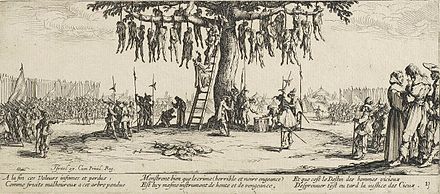
Callot

Jacques Callot (1592–1635) “Miseries of War”, engraving

Translated from the French by Tom Sunic

Below is the interview Alain de Benoist gave recently to Boulevard Voltaire

****

Q. Shortly before his death, François Mitterrand said those definitive words to the perplexed Jean-Pierre Elkabbach: “France does not need to apologize.” Mitterand spoke of those famed “darkest hours in our history.” Today, however, “repentance” has become fashionable. What does that mean?

ADB: To put it in its simplest terms, repentance can be summed up as follows: people apologize for some wrongdoings they did not commit in order to please those who were never subject to those wrongdoings. Those about to repent committed no harm; to those receiving apology no harm was ever inflicted.  All of this is perfectly ridiculous. In fact, repentance means making a selective choice in our history by safeguarding solely some specific and same historical periods, i.e., slavery, colonialism, etc., considered “dark” in the light of the dominant ideas whose goal therefore requires official repentance.  A much imagined inherited collective guilt adds up to this major anachronism which consists of “throwing backwards” into the past the value judgments belonging to our present time frame. The past, having being reduced to the “duty of remembrance,” the present, consequently, is bound to become fleeting, self-referential, and existentially empty.

However, the whole process, is more than just a fashionable discursive game. On the one hand, it is designed to convince our compatriots that each time, when turning back to their past, they are bound to uncover the horror only.  Here is the corollary: identity is invariably of a questionable nature; novelty, by contrast, must be invariably better. On the other hand, and in an epoch when the victimhood status is becoming highly profitable, the whole point is granting to the alleged victims’ descendants all sorts of  benefits;  from bestowing on them good conscience to granting them moral superiority, all the way to the enactment of  “memorial laws”, plus financial compensations. The focus of those invocations of the past is located in the present: the “dark days” are posited or exploited in order to either legitimize or delegitimize current opinions. Monsignor Nunzio Galantino, the Secretary General of the Episcopal Conference, stated recently that “our welcoming of immigrants is a form of compensation for all the damage we did over the years […]. We owe hospitality to migrants for all what we did to their lands in the past.” Thus, the issue of immigration is being processed under the guise of the mea culpa.  Which in turn enables some minority pressure groups to plead by proxy their victimhood status and prop themselves up as the vigilantes of the present.

Q. During his time as pope, Pope John Paul II also made repentance for certain crimes committed by the Church in the course of its history. One can say in his defense that Catholicism is a religion that requires the faithful to regularly confess their sins …

ADB: What is certain, in any case, is that the dialectic of sin, repentance, atonement, reparation, or “teshuvah“, and forgiveness — all of them belong to the language of religion. They have, therefore, nothing to do with the political process. Across the board collective repentance should not, however, make us forget that European civilization is the only civilization to date calling itself into question, to the point of internalizing its own critique. As Jean-François Mattéi said: “in order to respond to its critics, reason needs to ask forgiveness, because it appears always before its own tribunal.”

Q. Is there a risk for those refusing to repent to fall into the opposite extreme, i.e. to deny purely and simply the existence of the gray areas in our history?

ADB. This, in fact, is a symmetrical risk. All the lands of the world have had their dark days and their shining periods. In a normal state, one teaches young people to be proud of their country by instilling in them the memory of what their country did in a most glorious fashion. This does not mean that the rest of the story did not exist; yet, one must firstly be aware that self-esteem begins with the respect of what was inherited, helping us thus to define ourselves. There is no reason to be proud of slavery, but there is no reason also to be proud of the sack of Béziers, or the massacre of Saint Bartholomew, or the “dragonnades,” the Vendee genocide, or the repression of the Commune. The whole question boils down to whether we wish to teach the French to be proud of themselves, instead of instilling in them shame or self-doubt.

As for the rest, it is useless and even harmful to harp ad infinitum on civil wars. History is wholeness and one won’t get very far by fingering rosary beads in a durable sequence of Clovis to Charles Martel, to Jeanne d’Arc, and imagine that this is the best way to answer those for whom History of France began with 1789 only. The past is not a “museograhic“ heritage, nor a static essence, but a complex narrative substance whose narration is constantly revisited, allowing a people to tell itself its own story. Wishing, on the one hand, to single out the “anti-France,” or for that matter restricting oneself only to a talk about “France, the land of human rights,” means in both cases to mutilate our history. Marc Bloch rightly said that to be truly French means to be able to vibrate with the memory of the coronation of Reims, as well as partaking of the Federation Feast during the French Revolution, July 14, 1790. This was also the opinion of Charles Péguy — and this is also mine. 

Alain de Benoist  is a philosopher. 
 

The Rachel Dolezal Phenomenon

The case of Rachel Dolezal, the “trans-Black” who is the head of an NAACP chapter and has apparently reported false “hate-crimes” is all over the Internet. It’s hard to know if this is just a case of rent-seeking by someone taking advantage of Black privilege or a case of someone who really does identify as a Black person. Or both.

Regarding the first possibility, in addition to her position as head of an NAACP chapter, Dolezal has parleyed her Black identity into a position as professor of Africana Studies at Eastern Washington State University and chair of the office of the police ombudsman commission in the city of Spokane (on the application she claimed to be “a mix of white, black, Native American and a number of others.” Reminds one of Elizabeth Warren’s claim of Cherokee ancestry which she made to three separate employers, the University of Texas Law School, the University of Pennsylvania Law School, and Harvard Law School. Or Vijay Chokal-Ingam. Or non-Jews in Hollywood who pretended to be Jews to get ahead (crypto-gentiles?) (see here, Note 40).

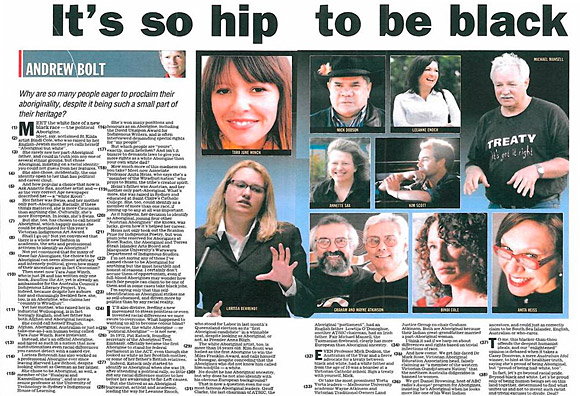
Her story also recalls Brenton Sanderson’s article on Andrew Bolt, the Australian who got in serious trouble when he called attention to the fact that there was a huge increase in the number of people claiming Aboriginal descent after Aborigines were granted loads of benefits. Lots of them look White to me.

The ideological nature of Section 18C of the Racial Discrimination Act [which provides penalties for saying true things related to race and ethnicity] was starkly illustrated in the case brought against conservative commentator Andrew Bolt. In 2009 Bolt wrote two columns pointing out that individuals with very small amounts of Aboriginal ancestry (or in some cases none) were taking advantage of a raft of government scholarships and affirmative action job vacancies by choosing to identify exclusively as Aboriginal. Bolt claimed these people were choosing to identify as Black to leverage their career and social advancement.

Hipblack


Read more

Jews, Communists and Genocidal Hate in “Whiteness Studies”

“Make no mistake about it: we intend to keep bashing the dead white males, and the live ones, and the females too, until the social construct known as ‘the white race’ is destroyed—not ‘deconstructed’ but destroyed

Race Traitor

As a general rule, you can be fairly certain that any academic discipline that contains the word ‘studies’ within its title can be immediately dismissed on an intellectual level as involving very little studying and a great deal of leftist indoctrination. The relatively new discipline of ‘Whiteness Studies,’ however, is vastly more toxic than the average contemporary effusions of the bloated academic corpus. Indeed, its productions should be seen as nothing less than incitement to the genocide of our people. While many great thinkers in our ranks have explored and exposed the more subversive attempts to shape the ‘ways of seeing’ that continue to lead our people to extinction, I think some light should also be shed on the open, explicit, and unashamed hatred that seethes within this academic discipline. The hateful creed that motivates the new discipline’s leading ‘thinkers’ is shocking and yet somehow predictable in equal measure. Behind its ideological foundations we find phrases, traits, patterns and strategies that are sadly all-too-familiar to us. We are forced to acknowledge once more the pitiless ethnic warfare that is being waged upon us, and the enlistment of our own people in a suicidal crusade. Read more

Pathological altruism on steroids in Sweden

We have been discussing pathological altruism among Whites quite a bit lately on TOO. So I thought we had pretty much covered that insanity. But this film by Red Ice Radio shows we have barely scratched the surface. In my previous article I noted that there was already a huge housing crisis that severely impacted ordinary Swedes. Now we learn that no sacrifice by the Swedes is too much. A  new Stockholm will have to be built within 11 years. Everything that can be turned into housing for immigrants should be, including churches (while mosques are being built). The government buys virtually any standing structure to be turned into immigrant housing, and there are proposals to confiscate vacation homes “for the greater good.” Meanwhile, Swedes have a lower priority for housing than immigrants, and thousands can’t find an apartment.

Leading politicians say Sweden is not for the Swedes, that Swedes and Swedish culture are boring, that Sweden should be a “humanitarian superpower.” Swedes and their culture — people who have dominated their land for thousands of years — are to be sacrificed on the altar of moral idealism (although their elites studiously avoid actually living among the immigrants), and at the same time Swedes are terrified to violate the moral consensus for fear of ostracism and loss of job. No price for one’s own people is too high to achieve moral perfection

In effect, considering the genetic distances involved, it is an extreme form of what evolutionists term “altruistic punishment” (see here, p. 101ff). It is a violation of the general finding that people are less willing to contribute to public goods (e.g., public housing, health care) to people who don’t look like themselves — likely a major reason why universal health care was so slow in coming in the U.S. which, because of  its historically large and dependent Black population and the post-1965 immigration tsunami, is certainly not homogeneously White.

It is vitally important that we come to grips with this suicidal phenomenon which is more common in Northern Europeans. It has nothing to do with Christianity. Sweden is the most secular country in the world, and its elites are hostile to Christianity and more than happy to donate Christian churches to the non-Christian newcomers, or destroying them to make housing for them. Rather, it is a new secular religion of moral consensus. They are behaving like the Puritans and Quakers, as discussed in my talk, but without the religious veneer.

Of course, while the costs to taxpayers are enormous, the “immigrant industry” is massively incentivized for entrepreneurs who are able to rent housing to the government.

And much else. Please watch.

Drowning in Altruism: Thoughts on White Pathology and the Invasion of Europe

‘The worst of charity is that the lives you are asked to preserve are not worth preserving.’
     Ralph Waldo Emerson, The Conduct of Life (1860) 

Here at TOO we are increasingly concerned with the origin, nature, and expression of pathological altruism in Whites. While there are a number of causes behind our rapid biological and cultural decline, this is surely one of the most potent, and it requires urgent and ongoing attention. I recently spent an evening reading a large amount of material on the deaths of Africans attempting to illegally enter Europe. It wasn’t long before I was confronted with an outpouring of White angst over the drowning of a disputed number of African invaders. On webpage after webpage, in one of the strangest contortions of logic imaginable, I witnessed Europe being slandered with murder for failing to facilitate an entirely risk-free method of invasion. All of the tropes about evil Whites were brought into play. The Maltese Prime Minister said the deaths were “nothing less than genocide,” and Swedish MEP Cecilia Wikström compared the deaths to “the Holocaust”:

I think that my children and grandchildren are going to ask why more wasn’t done to help people running away from Isis, or violence in Eritrea or wherever, when we knew that people were dying in their thousands. People will ask the same question they did after the war, ‘if you were aware, why didn’t you do something?’ In Sweden we allowed our railroads to be used to transfer Jews to Nazi death camps.

The hand-wringing of the politicians was matched by an outpouring of fashionable grief from White social justice types. On social media platforms Whites are straining to display their moral credentials, and thus increase their social status among peers, by trying to express the most indignation at ‘Europe’s failure.’ Academics, along with the media one of the main sources of cultural control, joined in the European festival of self-hate. Consider the remarks of Dr Tom Vickers, of Northumbria University’s Department of Social Sciences:

The people drowning in their hundreds in the Mediterranean are the victims of securitised immigration controls, imperialist wars, and an approach to immigration policy that places profit before people. Of course we should demand that EU states do everything possible to save people from drowning, and we should also demand a safe means for them to cross into Europe and equal rights with citizens when they arrive.

Read more

Bend It Like Bennett: Genuflecting to Jewish Power

The gang of four are down to two. I want to look at one of the two survivors: the playwright Alan Bennett (born 1934). In the 1960s, with Peter Cook, Dudley Moore and Jonathan Miller, he enjoyed enormous success with the satirical show Beyond the Fringe on both sides of the Atlantic. One of their targets was the stale pale male Britain of their childhoods. Here’s an entry from Bennett’s diary in 1982:

7 September. Douglas Bader dies. I used to imitate him in Beyond the Fringe as part of the Aftermyth of War sketch, coming downstairs with a pipe and exaggeratedly straight legs (though I never quite dared make them as stiff as they should have been). One night I was hissed and was very pleased with myself. (Writing Home, Faber & Faber, 1994)

Douglas Bader was a fighter-pilot who lost both legs in a flying accident before World War II. Wearing artificial legs, he became a hero during the war and then a fixture of the British establishment. He was a symbol of courage, perseverance against the odds and bluff, stoical manhood. But it did Bennett no harm to mock him. Quite the reverse. The success of Beyond the Fringe was a sure sign of shifting power: a new liberal establishment was taking over. It now rules cultural life in Britain, and Bennett is one of its fixtures.

This is an irony that he has never explored in his writing. Probably he doesn’t even recognize it. Like Woody Allen in America, Bennett carefully cultivates an image of himself as a gauche, neurotic outsider. In both cases, the image is highly misleading. The enormous success of Bennett and Allen demonstrates this paradox: in the modern West, outsiders are insiders. The key to the paradox is Jewish power and its hostility to the majority. By identifying himself as an outsider, Bennett signals to powerful Jews in the media that he will not defend the majority. He practises oligolatry, or the worship of minorities I discussed in “Power and Perversion.” Read more

Sándor Petőfi: “The Magyar Noble,” Original and Updated in Light of the NPI Suppression in Budapest

THE MAGYAR NOBLE.
A MAGYAR NEMES.

The sword which once my fathers bore,
Hangs on the wall and gleams no more,
Rust covers it instead of gore.
I am a Magyar noble.

I never work and never will,
The thought of labor makes me ill.
Peasant, ‘t is thou the earth must till.
I am a Magyar noble.

Peasant, make good the road, I say,
Thy horse doth draw the load that way,
But go afoot I never may.
I am a Magyar noble.

Wherefore should I for science care?
The sages always paupers were.
I never read or write, I swear!
I am a Magyar noble.

One talent I possess complete,
Herein with me none can compete:
I excellently drink and eat.
I am a Magyar noble.

I never pay my tax when due,
Wealth have I, but not much, ‘t is true.
How much owe I? Ask but the jew.
I am a Magyar noble.

The country’s cares are naught to me.
I heed not all its misery.
Soon they will pass by fate’s decree.
I am a Magyar noble.

My ancient rights and home decay,
And when I’ve smoked my life away,
Angels shall bear me up one day.
I am a Magyar noble.

Read more



