
Feminism and Women on the Right (Part 1)
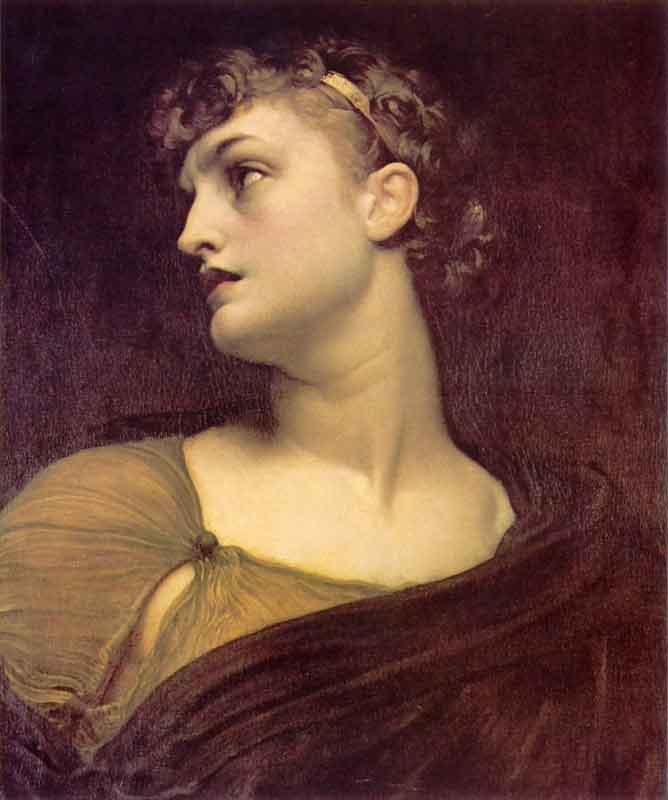
Antigone, by Frederic Leighton
Antigone, a young woman in Sophocles’ drama was sentenced to death by Creon, the king of Thebes, for breaching the law of the land. Her “historical revisionism,” her individualism, her free spirit bordering on stubbornness, prompted her to challenge the positive laws of her times. She viewed divine laws of justice and her own moral integrity as more important than her own fleeting lifespan.
I know all too well I’m going to die—
how could I not?—it makes no difference
what you decree. And if I have to die
before my time, well, I count that a gain.
When someone has to live the way I do,
surrounded by so many evil things,
how can she fail to find a benefit
in death? (460-520)
Be it in European mythologies, be it European sagas, be it in real social and political life, White European women have always displayed an extraordinary amount of free will and bravery, which is not to be observed in any other race, culture, or civilization. In Homer’s Iliad goddesses share the same plight as their male counterparts; play the same tricks as male gods, often disputing the whims of their male companions. Never, ever does the reader get an idea of gods’ “sexism”, or “machismo”, nor does one read about the abuse of their female companions; nor, for that matter, does one encounter goddesses who desire to question their womanhood.
One thing has remained rock solid in either pagan or Christian West: Every White male, every White female, be he or she of higher or lower birth, knew very well where his or her place was. The idea of promiscuous egalitarianism or gender swapping was considered an abnormality. It is only with the appearance of strange Oriental beliefs and their secular offshoots, Marxism and Freudianism, followed after WWII by pathological feelings of guilt for being born White, that a strange verbal construct and a bizarre concept of “feminism” came into vogue. Feminism soon turned into an ugly drama with far reaching social and political consequences for both men and women all over the West.
Feminist and Marxist theoreticians over the last fifty years have produced torrents of books describing traditional White women as proverbial men’s slaves or kitchen attendants. The feminist liberal Marxist drivel has lead many White women to believe that because of their inferior social role they needed to make a radical change in their own biology and their behavior. As a result, many historical examples of White women as political decision makers, as warriors, as artists, as thinkers, have been shoved aside, forgotten, or deliberately covered up. Modern authors or scholars tackling critically the issue of modern femininity vs. feminism from the other side of the ideological spectrum have rarely had a chance to voice their side of the story.
Feminism vs. Femininity
Doctors, biologists, psychiatrists, and of course, modern sociobiologists are better able to decipher the unique nature of woman than countless leftist and feminist authors who usually take their wishful thinking for scientific truth. Research on sex differences within an evolutionary framework shows that men and women have many differences that are understandable within the evolutionary theory of sex.
Fiirst, the concept of feminism is very vague. It embraces legitimate rights of women to be treated like human beings, but it frequently denotes self-denial of women’s biology and a radical ideology of male bashing. It would be useful to apply sexual profiling to study the psychology of modern self-proclaimed feminists, particularly in American and German universities, and then raise a simple question: What are the motives of these feminist authors? The bottom line for an uninitiated White male should always be to ask a simple rhetorical question: Are White “emancipated” women today happier than their female predecessors one thousand years ago? If so, why do White women today marry more and more into non-White gene pools whose cultural and racial heritage ignores the very concepts of women’s rights and femininity?
Everything depends on one’s point of view on women’s claims. From the perspective of a rocket scientist or a military aircraft pilot one gets a different picture of a would-be liberated woman than from a point of a view of a mother tending to a large family. And so on. At the extreme, one might contemplate the famed German psychiatrist and philosopher Julius Möbius whose book, Über den physiologischen Schwachsinn des Weibes (On the physiological feeblemindedness of the woman), wreaked havoc in feminist circles in the early 20th century.
Accordingly, not only is feeblemindedness among women present; it should also be a necessity. It is not only a psychological fact, but also a physiological postulate. If we have a woman who accomplishes her maternal profession — in that case she cannot have the brains of a man. When feminine abilities develop in the same manner as among men, in that case her maternal organs atrophy, and then, what we have in front of us is a worthless hermaphrodite.
A woman becomes a woman only by virtue of contrast and comparison to her male companion, whom she may perceive either as a threat or a lover. Without the Other there cannot be the Same. These principles of “complementary polarity” can equally well apply to different races: one becomes proud of his own race only when acknowledging the uniqueness of each race. The main point here is that it is only through their respective differences that men’s and women’s complementarity can be achieved. In the rejection of the recognition of Alterity lies the entire modern political drama, which only spurs standard left-wing invectives about alleged White racism, sexism, and the so-called “anti-Semitisms”—themes of exclusion usually ascribed to Whites only. A well-known sociobiologist from France, close to the “European New Right,” Yves Christen summarizes this dilemma in the following way in his book L’égalité des sexes; l’un n’est pas l’autre. (Gender equality; one is not the other);
This is the reason why one must overcome the embittered and demanding feminism in order to be able to espouse femininity based on the recognition of values inherent to each gender (in the same manner as negritude does not deny the difference but only affirms it as a fundamental principle), which have nothing to fear from affirming their respective identity. This is the reason why the study of differences, or better yet the study of the differential relationship between the two sexes, is of such overriding importance (p. 141)
Mighty Women
Messing with powerful vestal priestesses in ancient Rome was a serious offense punished by death. In ancient Rome, despite its patrilineal legal foundation, common to all old European tribes, the spiritual and political power of young vestals knew no bounds. They embodied the very symbol of racial heritage and were viewed as the guardians of home.
Over the next two millennia the political role of women in European civilization was noteworthy. Among countless women rulers one can encounter a few who, even according to our modern standards, held more political power in their hands than many of their female successors in our times.
The blonde and fair skinned Queen Isabella the Catholic of Spain, in the late 15th century, threw out Jews and Muslim Arabs from Spain and literally changed the course of history on the European continent. Then came Catherine de’ Medici, the Italian-born French regent queen with enormous political power. Mid-eighteenth century continental Europe was under the spell of the Hapsburg empress, Maria Theresa, who had 16 children and who was greatly revered by Flemish and Croat mercenaries long after her death.

Maria Theresa in 1727, by Andreas Moller
The list of mighty White women is endless; it goes on and on all the way to the prudish, stern looking queen Victoria of England, during whose times England reached her imperial zenith.

Queen Victoria in 1887
It was largely the Semitic religion of Judeo-Christianity with its concept of sinfulness that brought about the rift between woman and man that subsequently led to the subordinate role of women in the Christian West. However, one must make a sharp distinction between the Christian North and the Christian South. Even today, in highly secularized and disenchanted West, one can easily spot, particularly in the countryside of the more “pagan”-Protestant European North, such as Scandinavia and northern Germany, how women differently express their social status compared to women in the Southern or Eastern Europe. Consequently, various feminist movements that sprang up in Europe and the USA at the turn of the twentieth century had a different agenda and can be only studied separately within a different racial, socio-historic and religious context.
Enjoying equal voting rights or basking in the splendor of a well-paid job does not necessary mean that the modern emancipated woman is automatically spared from mistreatment inflicted by her violent male partner. One may sometimes justly feel sorry for the burdensome past of the more domesticated, household-bound women in the Christian Southern or Eastern Europe. However, one must also bear in mind that pathological feelings of loneliness, such as experienced by many modern White emancipated American and Northwestern European women, are unheard of among Amish women in Pennsylvania, or among peasant women in today’s Russia or Eastern Europe. What good is it to be free if freedom means facing rapidly encroaching old age and the absence of all community?
As a German “national-feminist” scholar “ Sigrid Hunke wrote, due to the polarity brought about by the Judeo-Christian religions, man, very early on, was designated to become the expert in reason and intellect, whereas woman became relegated to the hearth and to the realm of maternal feelings, taught to serve her man only. “And men or women who did not match the characteristics of their respective roles were forced to suppress their nature or turn themselves into “unmanly” or “unfeminine” laughing stock. (Sigrid Hunke, „Die Zukunft unseres unvergänglichen Erbes in Mann und Frau“, Elemente, July 1987.)

Sigrid Hunke
Unknown in the modern feminist and academic establishment today, Hunke, along with countless German women, was a prominent academic with close ties to the intellectual circles of the SS in the Third Reich. Under the tutorship of the famous German racialist scholar, Ludwig Clauss, her academic prestige, particularly in the study of Islamic religion and Arabic civilization, was so highly praised that early post-WWII German diplomacy could not shrug off her expertise and reputation. Short of a better label one could possibly describe her today as a “racial”–feminist,” or a “national feminist”. As was to be expected, her name, along with those of thousands of other White European and American women, scholars and activists of the same ilk, fell into oblivion or was shoved into the proverbial category of the “Nazi woman.”
To be continued.
Tom Sunic (websites here and here) is author, translator, former US professor in political science and a member of the Board of Directors of the American Third Position. His new book in French, La Croatie; un pays par défaut? and the other, Postmortem Report: Cultural Examinations from Postmodernity, prefaced by Kevin MacDonald, have just been released. Email him.


Comments are closed.