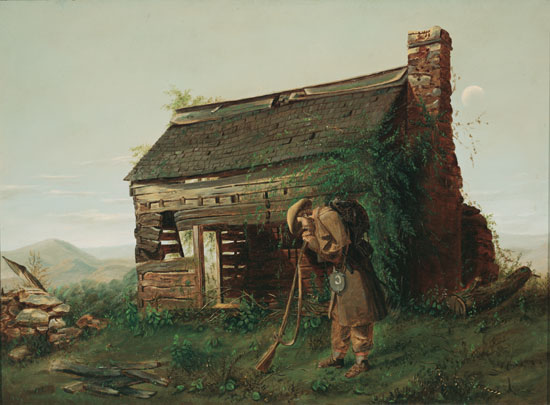
Mosler’s “The Lost Cause” – demonstrating the destroyed home of a returning CSA soldier after the war’s end
Up until recently it has been very difficult to combat the Northern domination of the press and its ability to manipulate public opinion both here and abroad. This was true in the 19th century and even more so in the 20th when Jewish forces joined the radical left in America, rallying around the press and other media industries. However, the Internet now offers us the opportunity to get out from under these stifling controls. And I predict that this will result in a gushing fountain of information reinforcing the dignity of the Southern Point as a central component in the development of White American racial consciousness.
I am thrilled to see the integrity and success of The Occidental Observer as an online phenomenon. Yet I have noticed a general dearth of articles about the Southern Tradition and I hope that perhaps I can at least begin to fill that gap as well as attract others who know more than I about the subject. We should really get something going in this direction.
I hereby pick up the gauntlet that Tom Sunic recently threw down in his article, “Which Way White Man, Part 1”:
It remains a great mystery why White American nationalists today are not more attuned to the cultural heritage of the antebellum South. If eloquently framed, it could prove to be powerful cultural artillery for safeguarding White racial identity. Southern Agrarians of the mid- thirties of the 20th century were erudite scholars from all fields of social science and literature and in many respects their aesthetic and political visions surpassed those of their contemporaries in Europe, the so-called European national-revolutionaries or national-conservatives. Instead, the image of Southerners as toothless hicks is still widespread — courtesy of not just liberal scholars but also of many lazy Whites. The South had never experienced the egalitarian steamroller of the French revolution and therefore it had been able to retain some parts of the old European mediaeval values better than Europeans themselves.
And again, in his book Homo Americanus: Child of the Postmodern Age, he suggests, “Probably now, in the open field of postmodernity, some of their traditionalist Southern legacy could be restored and used as a weapon in future culture wars”(174). Oh, Tom, if you only knew the scope of what you were pointing towards.

Postmodernity emphasizes the impotence of the scientific technocratic state as well as Reason as an end unto itself and encourages us to reexamine previous models. Southern thinkers were aware of this early on. Indeed, John Crowe Ransom’s introduction to the Agrarian Symposium, “I’ll Take My Stand,” offered an essentially postmodern paradigm as early as 1930, which rejected modernism and reaffirmed the eternal conception of a culture that continued to abide by the land, if not in fact, then at least in sentiment. Gone With The Wind, after all, was the most romantic and internationally popular film of its day, and has only recently been surpassed by the blockbuster phenomenon. Postmodernity also encourages us to think mythically and to realize that even the secular atheistic scientific explanation of the world is bedeviled by unknowns that perhaps will never be adequately answered by the rational mind (see Stephen E. Flowers, The Magian Tarok, ix–xi).
In addition to Sunic’s gauntlet, another influential White nationalist writer, Michael O’Meara, tossed out a similar dare in “Against the Armies of the Night: The Aurora Movements,” when he concluded his article, saying,
One wonders, then, if a right worthy of the designation will ever intersect an America willing to fight “Americanism” and its shadow-casting Armies — in the name of some suppressed antiliberal impulse in the country’s European heritage.

Well, gentlemen, let us now begin to make our way towards this mother lode. Perhaps one of the most significant Southern thinkers was Donald Davidson (not the philosopher). He was the unsung leader of the Fugitives and Southern Agrarians and an outstanding Traditionalist who was also a talented poet, critic, and English professor at Vanderbilt University for over 40 years. Davidson’s sphere of influence was wide and subterranean. Like John Crowe Ransom, a fellow English professor at Vanderbilt, he also taught Robert Penn Warren, Cleanth Brooks, Allen Tate, Louise Cowan, Richard Weaver, and Mel Bradford just to name a few, and he was the stalwart impetus behind a variety of famous symposia and literary movements that had far-reaching implications in the American academy of letters.
According to Davidson, in a prophetic lecture given in 1958, entitled Counterattack, 1930–40 — The South Against Leviathan:
Behind this sensationalism was a deeper hostility, a more thoroughgoing animus. What lay back of it was something broader than sectional disagreement or political and economic rivalry…It was the total design of the attack that we had to discover, and above all the premises on which that design was based, and the end that it had in view…The quarrel over slavery and the western lands had somehow obscured more vital issues. The South had fought in a good cause, but the world could always be made to think it fought for the wrong reasons. We did not want to make that mistake again…The conflict crossed sectional lines, and was nation-wide. It was in fact world-wide.…I believe we would now be justified in defining the so-called Agrarian Movement not only in terms of its first gropings and tentative beginning, but also in terms of its ultimate broader direction and general fruitfulness of application. For brevity, I might call it the cause of civilized society, as we have known it in the Western World, against the new barbarism of science and technology controlled and directed by the modern power state. In this sense, the cause of the South was and is the cause of Western civilization itself. (In Donald Davidson, Southern Writers in the Modern World. University of Georgia Press, Athens, 1958, pp.44–45)
So, as if Calhoun’s deep political theorizing didn’t suggest it adequately, we can also see here from a more contemporary position that the South’s struggles over the past two centuries arguably involve metaphysical categories. The regional conflicts were much more complex than a simple case of evil Whitey wanting to beat on the poor downtrodden Black man.
Davidson’s work digs pretty deep. In one of his collections of essays, Regionalism and Nationalism in the United States: Attack on Leviathan, he develops the concept of a dynamic conflict between the Immoveable Bodies and Irresistible Forces in the United States. Davidson identified the more liberal Northern heresies with the Irresistible Forces and the land-bound Traditionalism of the South and the West with the Immoveable Bodies. We will frequently come back to this thought.
The Agrarians are an excellent point of departure for our discussion because they, more than any other 20th-century intellectual movement, not only developed the Southern Point but situated it deep in the American psyche in such a way that many of us are completely unaware of its presence. (Ever heard of New Criticism?) And part of the reason for this is because the South had a highly cultivated literary intelligence that arguably rose like a phoenix in the wake of the tragedy of the Civil War. The death of the body signified the birth of a spirit that had, up until then, been gestating in the statesmen mode of the planter aristocracy’s brightest men. Subsequently, this “spiritual virility” made significant gains on its Northern rival who became totally ensconced in material acquisition and the corner it had on manufacture and industrialism, having left its faux-idealistic Transcendentalist/Abolitionist anchorings for the profit motive and the exploitation of a continent as well as the defeated peoples below the Mason and Dixon line, White, Black and Red. One got Truth, the other got Power.
The South thus gained the depth that only an experiential appreciation of Tragedy could give. And it was this knowledge of Tragedy, humbling and debilitating as it was, that informed a very different type of Westward expansion, quite opposed to the ego-driven materialism of the robber barons.
I was headed out down a long bone-white road, straight as a string and smooth as glass and glittering and wavering in the heat and humming under the tires like a plucked nerve. I was doing seventy-five but I never seemed to catch up with the pool which seemed to be over the road, just this side of the horizon. Then, after a while, the sun was in my eyes, for I was driving west. So I pulled the sun screen down and squinted and put the throttle to the floor. And kept on moving west. For West is where we all plan to go someday. It is where you go when the land gives out and the old field pines encroach. It is where you go when you get the letter saying: Flee, all is discovered. It is where you go when you look down at the blade in your hand and see the blood on it. It is where you go when you are told that you are a bubble on the tide of empire. It is where you go when you hear that thar’s gold in them-thar hills. It is where you go to grow up with the country. It is where you go to spend your old age. Or it is just where you go. It was just where I went. (Robert Penn Warren, All the King’s Men, 405–406).
Kevin Macdonald identifies the wide-ranging Jewish led reform movements of the twentieth century with what he calls the Culture of Critique. This networked phenomenon was (and still is) working towards uprooting and diluting the dominant Anglo-American hegemony in the United States in the name of some utopian multicultural paradise (oddly out of step with its apartheid Israeli project…hmmm?). Interestingly, Macdonald did a review of an academic book on American Transcendentalism, where he suggested that the Puritan/Transcendentalist of the nineteenth century was the chink in the American armor, providing fertile ground for the 20-century Jewish-led movements of cultural devastation and was therefore complicit and partly responsible for the massive Third World immigration deluge that we currently face.
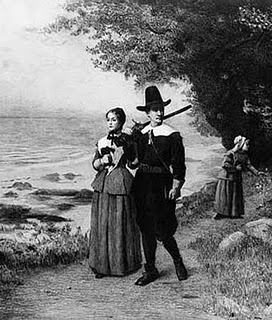
Transcendentalism was a movement entirely untouched by the predominantly Jewish milieu of the twentieth-century left in America. Rather, it was homegrown, and its story tells us much about the sensibility of an important group of White intellectuals and perhaps gives us hints about why in the twentieth century WASPs so easily capitulated to the Jewish onslaught on the intellectual establishment. Based in New England, Transcendentalism was closely associated with Harvard and Boston—the very heart of Puritan New England.
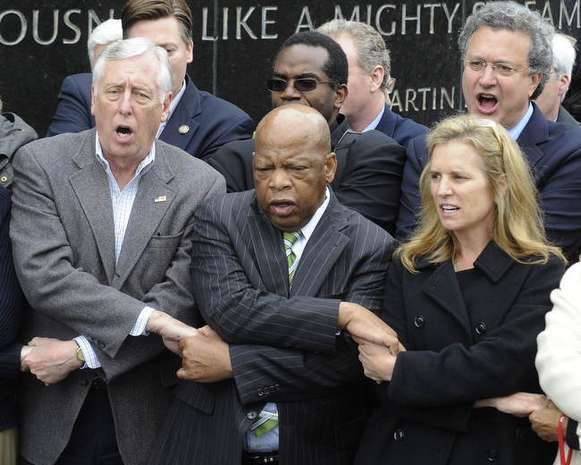
That strange brew might be summed up pretty well by the recent photos of Kerry Kennedy (Catholic, WASP?? What does it matter anymore?) with Morris Dees, Ralph Cohen, (both of the SPLC) and others standing together in solidarity at a gathering of Civil Rights activists in Montgomery, Alabama.

Being a Southerner myself as well as someone who tended to identify with knights errant and the cavalier tradition rather than the dorky and solemn pilgrim fathers and their strange secular religiosity and mercantile ways, I decided to follow up on this mythos as I got older. After I finished undergraduate school, I spent a fair amount of free time delving into old historical society libraries and dusty attics. And I ended up gathering a considerable amount of lore. Check this from Edward Pollard’s 1866 text, The Lost Cause:
In the ante-revolutionary period, the difference between the populations of the Northern and Southern colonies had already been strongly developed. The early colonists did not bear with them from the mother country to the shores of the New World any greater degree of congeniality than existed among them at home. They had come not only from different stocks of population, but from different feuds in religion and politics. There could be no congeniality between the Puritan exiles who established themselves upon the cold and rugged and cheerless soil of New England, and the Cavaliers who sought the brighter climate of the South and drank in their baronial halls in Virginia confusion to roundheads and regicides. (Edward Pollard, The Lost Cause, 1866, Ch. 2)
And this from Robert Catlett Cave’s The Men in Gray:
Appomattox was a triumph of the stronger in a conflict between the representatives of two essentially different civilizations and antagonistic ideas of government. On one side was the South, led by the descendants of the Cavaliers, who, with all their faults, had inherited from a long line of ancestors a manly contempt for moral littleness, a high sense of honor, a lofty regard for plighted faith, a strong tendency to conservatism, a profound respect for law and order, and an unfaltering loyalty to constitutional government. Against the South was the power of the North, dominated by the spirit of Puritanism, which with all its virtues, has ever been characterized by the pharisaism that worships itself and is unable to perceive any goodness apart from itself; which has ever arrogantly held its ideas, its interests, and its will to be higher than fundamental law and covenanted obligations; which has always “lived and moved and had its being” in rebellion against constituted authority; which, with the cry of freedom on its lips, has been one of the most cruel and pitiless tyrants that ever cursed the world; which, while beheading an English king in the name of liberty, brought England under a reign of oppression whose little finger was heavier than the mailed hand of the Stuarts; and which, from the time of Oliver Cromwell to the time of Abraham Lincoln, has never hesitated to trample upon the rights of others in order to effect its own ends. (Robert Catlett Cave, The Men in Gray, 1911, 7)
And from Richard Weaver’s The Southern Tradition at Bay:
As piety respects the mystery of nature, so ethics, the restraining sentiment which we carry into the world of our fellow beings, respects the reality of personality. It is well if our code of ethics has a religious origin, so that its power to impress derives from some myth or some noble parable. Its purpose, in any case, is to lead everyone to a relatively selfless point of view, and to make him realize the plurality of personalities in the world. Above all, it must insist upon the rightness of right and keep in abeyance the crude standard of what will pay.
The South has maintained an astonishing resistance to the insidious doctrine of relativism and empiricism.
Personality can develop only in a humane environment, and nowhere in America has this distillation of life flourished as in the South. Its love of heroes, its affection for eccentric leaders, its interest in personal anecdote, in the colorful and the dramatic, discounted elsewhere as charming weaknesses, are signs that it reveres the spiritual part of man. It has instinctively disliked, though it has by now partially succumbed to, the dehumanizing influence of governments and factories. Individualism and personality are making a stand — perhaps a Custer’s last stand in the South.
Civilization is measured by its power to create and enforce distinctions. Consequently there must be some source of discrimination, from which we bring ideas of order to bear on a fortuitous world. Knowledge and virtue constitute this source, and these two things, it must be said to the vexation of the sentimental optimists, are in their nature aristocracies. Participation in them is open to all: this much of the doctrine; but the participation will never occur in equal manner or degree, so that however we allow men to start in the world, we may be sure that as long as standards of quality exist, there will be a sorting out. Indeed, we are entitled to say categorically that unless such standards are operative, civilization does not exist, or that it has fallen into decay. That no man was ever born free and no two men have ever been equal, is a more sensible saying than its contrary. To the extent that the South has preserved social structure and avoided the creation of masses, it has maintained the only kind of world in which values can long survive. (Richard M. Weaver, The Southern Tradition At Bay: A History of Postbellum Thought. Arlington House: New Rochelle, N.Y., 1968; 36)
And I could go on and on.
In the day and age of visual media’s flash and glam, history can be an awfully dry subject compared to cinema and the dynamic interactive immersions that computer games and programs can offer. It is true that, as Marshall McLuhan suggested (p. vii), the youth of today live “mythically and in-depth.” Thus, it is more effective to deal with archetypes because scholarly details obscure general trends or movements and are, to be quite frank, boring. We identify with the archetypes at an emotional level. And what we are looking for is Allen Tate’s “knowledge carried to the heart.” We need inspiration. We want to believe.
All legends, all mythology and all myths, all founders of religions and all religions themselves look forward to their luminous resurrection, and the heroes are jostling at our doors to enter.
-Abel Gance
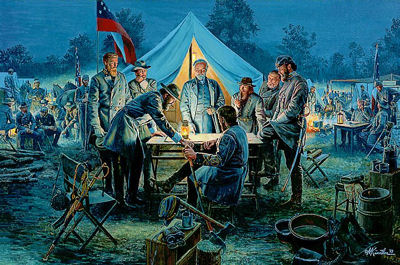
So, once we can recognize differences in inclination between the founders of the Massachusetts colony and the Virginia colony which would inevitably clash and to this very day, contend for control over the federal mechanism of the United States. By identifying these older roots behind the contemporary malefactor with a certain type (certainly not indicative of all individuals from that area), we can begin to turn the tide by contrasting him with another type. Once we realize that we are still under the hypnosis of a flawed and unrealistic regional myth turned national and subsequently global, we can fight back with another myth; one based on experience, truth (at least as far as we can perceive it), and the highest heroic aspirations of our people.
In the final chapter of The Lost Cause, Edward Pollard made this prescient remark:
There is but one conclusion that remains for the dispassionate student of history. Whatever may be the partial explanations of the downfall of the Southern Confederacy, and whatever may be the various excuses that passion and false pride, and flattery of demagogues, may offer, the great and melancholy fact remains that the Confederates, with an abler government and more resolute spirit, might have accomplished their independence.
This reflection irresistibly couples another. Civil Wars, like private quarrels, are likely to repeat themselves, where the unsuccessful party has lost the contest only through accident or inadvertence. The Confederates have gone out of this war, with the proud, secret, deathless, dangerous consciousness that they are THE BETTER MEN, and that there was nothing wanting but a change in a set of circumstances and a firmer resolve to make them the victors. To deal with such a sentiment, to keep it whipped, to restrain it from a new experiment requires the highest efforts of intellect, the most delicate offices of magnanimity and kindness, and is the great task which the war has left to American statesmanship.
Would it be strange, in a broad view of history, that the North, pursuing a policy contrary to what we have indicated, and venturing upon new exasperation and defiance, should realize that the South has abandoned the contest of the last four years, merely to resume it in a wider arena, and on a larger issue, and in a change of circumstances wherein may be asserted the profit of experience, and raised a new standard of Hope! (p. 729)
Who can doubt anymore what tack the victorious Northern polity has chosen?
Ultimately, in response, we would do well to keep the faith and head towards what the great Southern political philosopher, Richard Weaver, referred to as the “metaphysical dream.” This foundation underlies Western civilization and the future hope to which Pollard referred and is the thing which must, in the end, overcome the present paradigm. And I would be so bold as to say that the American South is a pregnant mother. Robert E. Lee died with the sword of George Washington still in his possession.
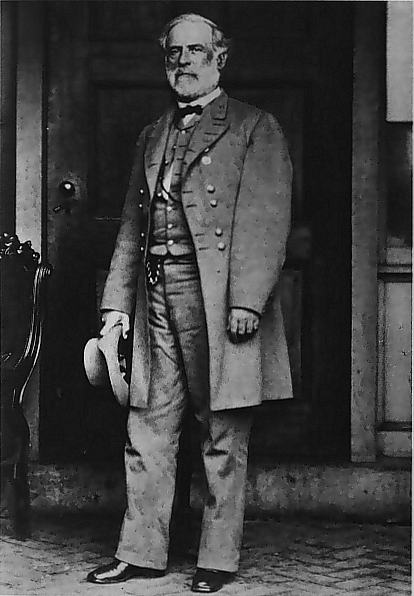
In the final lines of Davidson’s immortal poem, “Lee in the Mountains,” we have an image that evokes a hidden god who will manifest in the fullness of time. The image is reminiscent of the Barbarossa myth that Frederick will awaken and return from his slumber under the Kyffhauser mountain to destroy the unjust and inaugurate another Golden Age. This myth is the great legacy that Europe holds out to an America worthy of the name. And, of course, the West still awaits the return of her once and future king:
Young men, the god of your fathers
Is a just and merciful god
Who in this blood once shed on your green altars
Measures out all days
And measures out the grace
Whereby alone we live
And in his might he waits
Brooding within the certitude of time
To bring this lost forsaken valor
And the fierce faith undying,
And the love quenchless,
To flower among the hills to which we cleave,
To fruit upon the mountains whither we flee,
Never forsaking his children and his children’s children forever,
Unto all generations of the faithful heart.

But I’ve gotten ahead of myself with all this spell-casting. For now, let’s just stick with the Southern Point. Do you get it?






Facing the Future as a Minority


It would be spiritually uplifting to know where the ideas and dreams of the Old South were being incubated in these sad and soulless times. As one tours the South and sees the Strip Malls, Casinos and Pawnshops and compares them with their equals in the North and Northeast, one wonders if there is an actual “South” anymore; other than this term meaning only a place on the map. One of the main perveyers of this vulgarizing and homogenizing of much of our daily lives was started in Bentonville, Arkansas! You can’t get any more deep in the south than that! People may argue over old Sam’s origins and the alleged, Levantine origins of his wife, but I haven’t seen a whole lot of resistance on the part of southerners to this “lowest common denominator” way of life. We can only hope that the ideas of Robert E. Lee and others are still burning brightly somewhere and that we can look forward to a future of renewed cultural and spiritual enlightenment.
You’re right, Rod. In many ways the South has succumbed to the LCD materialism of the cities and the capitalist way.
But the main point of the article is to assert that over the course of American history, it has been the South, and the South alone as a coherent regional force in the United States, who has asserted that race counts.
Even if a flag is on the ground and is well-nigh trampled, it doesn’t mean that future soldiers can’t pick it up and fight back.
The Benson gang LOVES the invaders from Mexico.
Just like another couple of good old boys from Arkie land:
Bill Clinton and Mike Huckabee.
The Birth of a Nation was made in 1915, one of the true innovations in film. A few years ago the jews in Hollyweird changed the name of their highest award from the DW Griffith Award to the DWA thus barring from mention the man who changed history of entertainment in ways still not fully understood, in the same way that the innovations by Lene Riefenstahl, such as the rolling camera, changed the way film was done. These two CREATORS are tossed on the dustbin of history but not their TECHNIQUES oh no the jews love the tools, the gifts of the Aryan Two.
Just thinking about what Lincoln and Sherman et al and all those Yankees who LUSTED after good Aryan blood, and I say this as a Yankee by birth but not by spirit, is to have seen the DEVIL in action. This is the curse of our people, how easily we are set brother against brother. We saw the same thing in WW2, all those good boys, Yankee and Rebel alike, foaming at the mouth to slay the greatest team that was ever on the field for our race. I recall sitting with a friend and his father and he recounting to me how they were marching German POWs to a camp and they would take the butts of the M1 Garands and smash the German prisoners in the back of the head. HONOR, oh yeah, they didn’t have an idea in their heads of what that meant, they only lapped up jewish propaganda.
The SOUTH better RISE again and so with it the Invisible Empire, otherwise, ADIOS WHITEY.
If anyone in Civil War America, north or south, was a worthy successor of the Puritans, it was Stonewall Jackson.
Agreed. I don’t think we’d really lost the war until we lost Jackson. And if he’d been in command the South would have brought the war to the North much sooner than Lee’s futile effort, and I suspect, with far more effect.
I don’t go for all of this “Moonlight & Magnolias” nonsense either. Not that I didn’t spend much of my youth knowing & dating girls from Radford, Mary Baldwin, and Mary Washington etc. etc. LOL. ;)
Many, if not most of the Confederate leaders were graduate engineers. Many were railroad engineers, and not the type who drive the train.
One of Stonewall Jacksons greatest engineering feats was moving 19 or more railroad engines, and 300 rail cars and parts, as much as 120 overland by road to where they could be put back on Southern railroads.
Even with modern equipment moving a railroad engine 120 miles over dirt roads, and questionable bridges would be no small trick.
Can you think of the headaches Lee must have had organizing meals to go for 60, 70, 80 thousand men not counting horses & mules?
Jefferson Davis was a college graduate, and then he went to West Point to study engineering after college.
According to Cooper, my favorite biographer of Davis, Jefferson Davis had indoor plumbing, that he designed himself for Davis Bend in the 1850′s.
Weaver’s reference to eccentric leaders certainly applies to Jackson.
erratum typed Benson meant Bentonville.
The family of Wal-Mart had a MEXICAN as their CEO he drove it down into the ground removing choices of products etc so they now have a WHITE MAN, Mike Duke trying to undo the damage:
“former U.S. CEO Eduardo Castro-Wright”
I get it. The South (Southern Point of View) will rise again. The SPOV means fighting the North (liberalism, Zionism, multi-culturalism etc) and making America into the SPOV, a White nation, a nation of White European people, by WEP and for WEP. Preserving, defending, protecting and reclaiming White European way of life. We’re all Rebels now.
Love this article and I’m going to find all of the books and links referenced in it and read them. Thanks Sir Tristram.
The article is meaningful to me because it appeals to my spirit, it stirs my feelings about the Rebel army, my love for the South and of Southern knights fighting for everything held dear by Southern people.
In order to appeal to other White people in America we can style White Nationalists as knights and heros rather than talk endlessly about stats, illegals, Zionism, jew control etc.
Thank you, Barbara. I’ve enjoyed your comments. The Southern Point is simply that race counts as a legitimate consideration in the affairs of civilized human beings.
Also, I’m interested in heroic archetypes because that is what moves people.
I think you got that. Maybe others will too.
on heroic archetypes –
“We offer the following as an eternal truth. Only through the instincts that preserve the species, whether they are heroic virtue or shrewdness, have states been created. Heroic virtue produces true Aryan, working, civilized states while shrewdness produces Jewish parasite colonies. When instincts in a race or a state are overrun by economics, the economic structure itself releases the causes that lead to defeat and oppression.” AH
Sir Tristram,
You touch on so many themes, that one does not know where to start commenting. I will start with just two of these themes.
The whish you and your colleagues express for the return to a more predominent White culture, in terms of national presence, and I guess as a general orientator of policies and values, economics and culture.
This wish is legitimized by the sense of majority and origination. Yet, Sunic, whom you quote as a great author, explained in part 2 of the article you quote, that the idea of one great white majority does not exist, it is a dream. There is no uniform white european-american monolithic culture as such. On this basis, he criticizes the attemps of white activists holding this perceived view, to utilize certain strategies, such as mimicry. Yet, he appears to tolerate and be apologist for certain groups demonstrating mimicry patterns of behavior.
Mimicry is simply a strategy. It is a learning tool in the hands of the young, it can be a desarming tool in the hands of the adult. It is a way to psychologicly disarm your opponent and to learn from him. You become his mirror by which his actions have no grip since they hold the appeareance of being employed on himself. Sunic appears compassionate for jewish mimicry of the majority behavior yet condems micmicry by the majority of jewish strategic actions such as self-victimization.
His solution, surprisingly, is to balkamize white culture, yet he suggests the possibility of strategic association with jews politically. (really???) It leaves me speachless…Is it not exactly what we have now. Balkanized subgroups of a minoritist political system. It does not appear to work wonders for white culture.
Now, lets address the nullifycation strategies. I will have to read more on this subject, but at first glance, it appears to simply offer to switch one minoritism system for another. Multicutural minoritism replaced by State minoritism. Would that be better for all, or again, just a few, even if those few are not the same as now.
I note your critic for the deadly scientific culture that from your observations is identified as the root of our ills. Yet, I differ in this perspective, but it may be due to our own understanding of what culture is and what science is. Human beings as well as societies are essentially cultural entities, I agree with this. But I often make the remark that what the current minoritism system proposes and imposes is too cultural and not scientific enough, yet my remarks never get traction and people only understand that I mean that we should not be or be less cultural.
In fact, my critic or remarks have to do with transactions. As agents in our societies we transact product and services and information. The nature of these transactions have progressively carried an excessive cultural tone rather than a scientific one. When we transact, the essence of the transaction should be based on science, not be cultural, our measure of the content should be objective, not subjctive. The product or service itself may carry more or less culture or science, but the transaction must be scientificly based. Otherwise, what primes is exactly what you yourself criticize, which is relativism created on the bases of subjectivity, manipulation, appearances, perceptions, pathos, etc…
For me, not enough thought si given to the economic context of all the general situation, not only is this essential, but it is at the root of any possible solution and only with it can we identify strategies that do not imply automatic armed conflicts.
I still love reading your stuff, and will extend my reading base thanks to your propositions. My reflexions on this whole subject are still in their infancy.
Thank you,
Denys
Thanks for your thoughtful insights, Denys. I haven’t completed reading the second part of Tom’s article yet but I plan on it. So, I’m not really following you on this mimicry element. On the surface of it, I don’t think we need to mimic anyone. More than anything, I think we need to resuscitate our spirit which depends on the activation of certain archetypes.
The point of the article (and it is just a brief survey) is that the South has historically asserted that race counts in the United States and that this consciousness is deeply woven into the fabric of the region’s political/philosophical thought, art, music, literature and also its group folk soul at a thousand different points. And also, that it has stood in stark contrast to the Puritanical judaic spirit that currently dominates our political discourse and the media.
I am not advocating a full rejection of the scientific method, just that it occupies its proper spot and fulfills its legitimate function, facilitating a culture that respects the land rather than exploiting it.
As far as the logistical economic issues go, I would encourage you to explore some of the essays that ensued the I’ll Take My Stand symposium in 1930. Subsequent symposia focussed on these aspects. The poet agrarian Wendell Berry, in some ways, is a good example of a latter day Agrarian whose simple economic style is worth “mimicking.”
More than anything, I think that what we need most desperately are leaders with their heads on straight who are willing to take on the odds of the dragon.
No matter how much the system gets corrupted, the Constitution destroyed, our financial futures annihilated, etc, a popular leader who carries the hearts of the people can turn the tide, in a flash.
Conservative dreams of reconquest relegated to the Internet fringe.
Since we are getting into some of the old South pity party stuff. Why is it that none of the women, who graduated from what were the finest Southern women’s colleges, have accomplished nothing politically for the cause.
These women were intelligent, well educated, in many cases wealthy, and or well connected to old Southern leadership & money. Yet, they are absent from politics, and the media.
Look at the women leaders in the US, they have mostly been Jewish, Roman Catholic ethnics, or limo liberals from New York & New England.
The Southern woman has done nothing for the White race she was educated to serve.
Corporate limo liberal Republicans like Libby Dole don’t count. LOL.
Southern women are not much encouraged to be political activists. At one point my daughter was leaning heavily in that direction; the outcome was that my son-in-law, totally mainstream minded, absolutely forbade it because of his business. I can’t honestly say I was all that happy about it either.
With this whole business of the Old South, I discovered some years back that in general, white planters’ families who after losing most of their wealth during and after the war, gave up the agrarian ideas and moved into commerce, law, medicine, and such, are still the prosperous families around. Those who refused to give it up rode the Old Plantation idea into bankruptcy and poverty. Remaining loyal to an idea who’s time is past is no virtue.
@ Whiteawake
What you are saying about old Southern money is true. There is a lot of it, and it has been growing hair for years in all sorts of businesses.
There is much to be said for keeping a low profile, you protect your business, you avoid frivolous lawsuits, and, bad press that way.
By the same token, it’s going to take a few or more White Joan of Arcs to save the nation, but, one or two will, in all probability get burned at the stake.
Sorry, I can no longer accept the romanticized view of our history — because of overhwelming facts.
Southern newspapers, Southern leaders, Southern documents, Southern speeches, Southern laws, Southern sermons at the time all screamed for the spread of slavery, or promised war.
Jefferson Davis own writings — Alexander Stephens own speeches — and even the Southern Ultimatums, demanded slavery be spread, under threat of war.
Some allege that it was about “protecting” slavery. Not really — it was about the EXPANSION of slavery, against the will of the people in the territories.
Everyone knew it at the time — and the Southern leaders bragged about it. Southern Ultimatums, issued by Southern leaders in March of 1861, articulate this exactly.
The Richmond Enquirer, March 23, had headlines “THE TRUE ISSUE” and reported Five Ultimatums by Southern leaders in Montgomery. All five of the ULtimatums were about the spread of slavery.
I don’t encourage a romanticized view of history that ignores or intentionally distorts facts. But, by the same token, I won’t go to the other extreme of demonizing a previous generation through the lens of a modern sensibility. Loud political proclamations from all sides asserting a thousand different things can be pieced together from the time of the Civil War. There are Northern quotes about the need to exterminate every white man, woman, and child in the South.
My point is essentially that the South has stood up for and defended white culture on the North American continent. Are we guilty of excesses? Absolutely. But we are not alone in this guilt and, again, I could cite another thousand accusations demonstrating the moral degeneracy of the Northern “do-gooders.”
To a degree, the finer details of history are useless and boring. Myth is the reality that moves our hearts. The Lincoln Myth is just as romantic as the Lost Cause Myth. Even science cannot explain the origins of the world rationally.
The real difference between the regional myths, however, is that we weren’t claiming to speak for another people or to liberate them or to save them while simultaneously profiting from the enterprise and destroying another civilization. And how could we speak for another? I think this is a lesson the United States still has to learn.
American by Birth, Southern by the Grace of God. That’s the spirit. That’s the Southern Point of View.
What if every White person on Earth felt that they are White by the Grace of God. The result would be a willingness to fight for what is rightly ours rather than passively give it away and be destroyed.
Capitalism, international corporations and the One World Order will be the death of us. Going back to the land, local White business, White family farms and White communities and White culture are the only way for us.
Not made in China Walmart or Con Agra engineered frankenfood or diversity.
No, there was was never any chance of the South attaining final victory. I think suggestions to the contrary are envisioning a discouraged North quitting the war rather than being forced into surrender. That scenario assumes that the South could have easily exhausted the political will of the North.
However the issue of slavery was not the underlying reason for the North’s implacable opposition to an independent South ( the Southern Agrarians had that right). Once independent the South would have inevitably formed alliances with European powers and become a real existential threat to the US; thus the North would have been determined to destroy the Confederacy even in the absence of the slavery issue.
Fascinating article. My perspective is from the belly of the beast of the Puritan/WASP/Jewish power center.
I think that what Middle America needs to do is study the Northeast oligarchy, and then compete with them.
Right now Middle America is failing to compete with the Northeast oligarchy because of anti-intellectualism, apathy, and low investment parenting. All our problems start with raising millions of White American children in front of the TV, instead of doing what the Asian and Jewish oligarchy families do:
http://online.wsj.com/article/SB10001424052748704111504576059713528698754.html
I’m not advocating a direct copy of Chua’s whacky methods, but I include this article to show you what you are up against. Chua’s husband is Jud Rubenfeld, and they are both professors at Yale.
What I advocate is something along the lines of:
http://robinsoncurriculum.com/
Homeschooling with a math and science approach. If you can’t homeschool, you can at least provide supplementary education. I do math with my kid for about 3 hours a week and it made all the difference.
Middle American kids who are raised in front of the TV don’t even begin to compete with the Rubenfeld-Chuas. They don’t even try. We need millions of White American kids from places like Kansas and Idaho who are competing for the spots with Rubenfeld-Chua kids. Here’s more of the people we are up against:
http://www.nytimes.com/pages/fashion/weddings/index.html
We are smart enough to compete with them. We just have to get off our butts and do it.
One of the easiest and most worthwhile things one can do for his children is throw out the tv. When it comes on you are allowing a congregation of professional jew and black activists full access to your children. For every useful thing they learn they will probably learn 10 which are useless and even harmful.
If one can’t do that as an example of standing up for his beliefs, how can he expect children to buck the tide?
This is an interesting position. I want to follow up on your links. Thanks. No doubt a certain portion of the population needs to wade out and study the methodologies of our traditional enemies. I have lots of friends from Alabama who have succeeded rather well as investment brokers up in NYC.
Indeed, it really is a question of strategy and one that has been tossed around for a long time. Do we fight back by joining the rat race or by focussing on other more worthwhile activities? Do we go to the cities and open up a shop across the street from “Rubenfeld-Chua” or buy up some more acreage on the hinterland, cultivate our personal gardens and flick a big bird to the aristocracy of paper and patronage that is already going to fall flat on its face because of its own interior corruption. It’s hard to say. Land is still better than money. And there are millions of people in the heartland of the US who couldn’t give a flip for what those fools on Wall Street are up to. Give a bad man enough rope and he’ll hang himself. We’ll see who has more stamina in the end.
I had a thought while I was looking at the Weddings and Celebrations pages. You can see their jobs like:
Uggh, I could never do jobs like that. I’d go crazy. A lot of us probably would. Then again, those jobs produce nothing of value. Maybe the economy that supports them will implode, and they’ll have to find a line of work that produces something of value, and pays significantly less.
Pine away for the south all you like – but the reality would have sucked unless you were a rich plantation owner, or part of his family. They controlled it all and our white ancestors who died for their sins were little better off than the negro slaves sharecropping dirt. President Johnson hated the planter class as much as you would have if you had to kiss their boots. The descendents of the planter class should be the ones bearing the brunt of all the affirmative action programs, not the trying to be successful white man, decended from regular folks who now has no country left to believe in anymore.
Land was cheap, it cost cents per acre.
This article is indicative of why racially-conscious whites get nowhere politically. While Jews have a culture that encourages the acquisition of money and power in the financial, legal, scientific, and media industries, whites fantasize about a nice life in the countryside digging holes in the earth and growing crops for a living.
Did Jews get to where they are today by reminiscing about the past and being content with working on farms? No, they got to where they are today by bolstering their verbal IQs and deliberately taking jobs where they can directly influence the lives of non-Jews. How do whites expect to reclaim the soul of the west if they aim to become serfs and farmers while all the important jobs belong to Jews?
The world is only going to get more complex and information-driven, and those who are suited only for manual labor will be left out and replaced by machines. Wealth and power, more than ever, are determined by brainpower and innovation. Unless whites stop fantasizing about going back to an agrarian society and start picking up textbooks, there’s no hope for them.
Farming today is highly mechanized, computerized, and soon will be robotic.
Ask any “real” farmer he will tell you he spends the majority of his time working on his machinery.
Although, someone still has to clean out the barn, those little bobcat tractors make that a lot easier.
To sum it up there are niche markets for various types of foods, but, farming today is a capital intensive highly technical industry.
Farming is a business, that requires knowledge of taxes, budgets, books and general business practices including marketing.
Today, Silas is cutting deals over his computer uplink while the tractor runs off of the gps. LOL
Not sure what you’re talking about here. This article is not about “digging holes in the earth and growing crops for a living.”
It is about the fact that race counts and that the South and West in the US harbor a certain type of fighter that has the mettle and the wherewithal to smash the Northern and Jewish grip on our country.
There is a line in the movie, No Country for Old Men (Coen Bros. from the Cormac Macarthy novel).
“When Sir and Mam are gone, it’s all over.”
Having been in the South a couple times, last in Kentucky for a few days in October driving around, folks are very friendly. Indeed it was Sir, and Honey, etc. They know the blacks, and they know the mexers.
To some degree this has to do with smaller towns, rural life,
@ Joe
This is more like “Fletch Lives”. A very under appreciated movie starring Chevy Chase.
“There is a line in the movie, No Country for Old Men”
Well America is now NO COUNTRY FOR WHITE MEN
Nice article, and yes, the SPOV can be examined for redeeming aspects. But it seems to me that real change can come about only if even such a point of view becomes acceptable. Everyone here is so full of praise for the internet and how there might be this blossoming of White consciousness just around the corner.
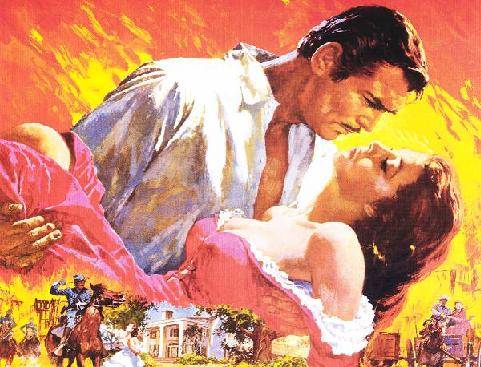
But writing blogs under assumed names, writing self-congratulatory notes and using the poster-shot from a Hollywood movie as the best example of Southern chivalry and golden-age is pathetically ineffective.
Who here has the guts to use their real-name and start a circle of like-minded individuals in their neighborhood to gently discuss and intellectualize the white-cause. I live in KY, held up by many as a bastion of Southern-ness, and I attend numerous block parties in my neighborhood. All the chatter I hear is about football, this show or that, sales at Target, or how busy mom is with all the piano lessons and ballet classes that little princess has to attend.
The fact is if I ever brought up white nationalism to any of my neighbors (all white), they would shun me at best, and run scared at worst. So we just hide and hide, and hope that the anonymity of the internet will one day unleash a real revolution. Sorry, but phantoms can never deliver a revolution. Only real people, with real ideas espoused in the public sphere can do that. The approach taken my some of the writers here (use of pen names) and 100% of the commenters can only lead to one thing – continued fringe status with nary of hope of making a whit of difference.
Kevin MacDonald, the editor here, has the balls to risk everything, and so he’s taken seriously. But the same can’t be said of others here, cowering and frothing at the mouth, going on and on about a mythical golden era. Our enemies see this as a pathetic last gasp of a dying moribund civilization. Who knows, they might even put us out of our misery by censoring Google and Youtube. Oh wait, it’s already happening.
Take care people.
Raj, you make some very good points. But I suspect you have not had the experience of rousing a lot of ire without having anyone to depend on but yourself. Without some good backing saying the things which need to said in a broadly public way can bring down the horde on you in ways you could probably never imagine. Suicide is counter-productive.
We need the backing of groups we can depend on when we’re attacked; that involves not just people with courage, but also people with money. Until we have that I believe it’s best to involve yourself pretty much to people you know who just need encouragement and education to come to our viewpoint.
I hear you there, Raj. But I would have to disagree with your general slant and your “pathetically ineffective” cut-down. I use a pen name for theatrical effect. It’s a way to create a distinctive rhetorical position and flair. In this case, I am trying to develop a perspective that has a certain chivalric edge that people in the South and the West and Europe readily identify. Honestly, I have nothing to lose and am just an average joe with a sub-par job that doesn’t match his education and enough dreams to fill a cosmic carnival tent. And that’s not very interesting. But Sir Tristram, well, he’s ’bout near immortal, unbeatable, and full of surprises.
If you want to discover my true identity, follow up on my blog, send me a message, and we can talk man to man. In my own sphere of personal action, I’ve taken considerable stands on white advocacy that have cost me a lot on some fronts. I was the only white man to protest an African-American monument in Savannah that needlessly reminded viewers of disgusting details from slave trading ships. Cops warned me about getting beat up and I took direct heat from a pack of Black Panthers who surrounded me yelling “Black Power” as loud as they could into my ear. I didn’t move an inch. But I don’t need to go much further into that here. Every man has to take the chances that he feels that he can afford.
I play to mythic archetypes. A poster-shot from Hollywood was not the thesis of the article but is useful because it invokes a certain nostalgia that can ignite people to act in the present. Many of us today are disgusted with modernity and seek glimpses of older traditions through a variety of media. These are reference points meant to establish a broader perspective of white advocacy over the course of American History. The idea of the white South is a last bastion of sorts.
This isn’t a political platform. I’m not asking you to vote for me. It’s a point-of-view and a position borne from years of study. Let it be.
Let’s find what we can in each other that facilitates a constructive identity.
Raj, What you say “Our enemies see this as a pathetic last gasp of a dying moribund civilization” is quite true for our civilization is dying. Identity Christians describes this phase as Jacob’s Troubles and what the secular Guillaume Faye would, I think, describe as the catastrophe required to get people motivated. So be of good cheer, keep your head down for the moment and it will all work out.
Fr. Sandy, Whiteawake – Thank you for responding to my post, and not taking it as being negative or critical of the ’cause in any way.
Others here, esp. the esteemed editor, has pointed out the existence of very rich Whites (Bill Gates foundation, Warren Buffet) who, if they chose to, could easily ignore mainstream sensitivities and support the cause of the Caucasians caught up in the multi-cultural, affirmative action mess we call America. But alas, they haven’t chosen this path, and all indications are that they won’t.
So if the richest and most influential among us avoid this cause, one can reasonably conclude that it’s not because of fears of losing one’s job, money, etc – all consequences of Jewish pressure. These individuals have enough money to start their own network, or just buy up market-outstanding shares in any number of mainstream media outlets to assume full editorial control that would rival the NYT’s ethnicity-laced bias. So what gives then? Is it that the cause is itself to sinister-sounding as to give people the creeps? Or is the individualism of the white race that makes its members view any attempt to tribalize its causes as un-white, in and of itself? But faced with growing tribalism across the world (see Pat Buchanan’s erudite article on VDARE.COM), does the European-American have a choice but to be tribal?
Someone other than a “Raj” on TOO needs to publicly ask this question.
Warren Buffet is an interesting case. He his mentor at Columbia was Benjamin Graham (Jewish), and he also gave the keys to his kingdom to a Jew, who proceeded to humiliate him publicly. He also was married to a radical feminist and lived in a polyamorous relationship for 25 years.
All of his bluster about driving a Cadillac and living in the same house since 1954 is a spurious performance meant to ingratiate him to the Midwestern armchair capitalists who fawn all over him.
The jew did not humiliate him. The jew did what came naturally to many a money runner, and front ran Berkshire trades that he persuaded the king to take, and got caught, and had to go. He was given the option to resign, as a courtesy.
What does one do with a lesbian wife that will cost you 30 billion to divorce?
You don’t think that reflects on Buffet’s judgment? It seems to me that Buffet is a man very much concerned about how the average white American thinks of him. He believes he is one of our enlighteners .
CI doctrine in a nutshell: WORSE IS BETTER
Excellent series so far!
If I may ask one question, what importance do you place on Judah Benjamin (if any)? I’m not a Southern historian and can’t evaluate him. Was he an active member of the the Culture of Critique?
I’m glad you mentioned Judah Benjamin. And this is a fascinating subject and one germane to the larger scope of TOO. There is no doubt that Benjamin was a powerhouse in the Confederacy. He occupied multiple posts in Jefferson Davis’ cabinet and the Confederate administration. Davis was even criticized for his long-standing endorsement of a Jew in such a high-ranking position. Davis, despite many shortcomings, was a man of his word and knew Benjamin’s caliber to be considerable.
And after the war, Benjamin succeeded in getting away to Britain and living out his life writing legal theory as a barrister. I don’t think he made off with the lost gold of the Confederacy but if anyone could’ve he would’ve been the one (sorry, I just had to stick that one in:). No, but, for real, I had a buddy who studied law in England a few years back who told me that to this day they still teach Benjamin’s legal theories to aspiring lawyers in the UK.
I don’t consider Benjamin to be a part of the “Culture of Critique.” He enlisted his considerable intellect in the service and defense of a Traditional order (The Old South) and was an adept public servant till the end (at least as far as I know).
If anyone else has any more info about this, I would love to hear it. Benjamin was famous for his acerbic wit and realpolitik logic.
Judah P Benjamin was a patritotic Southerner who identified with the Cavalier tradition. When suggesting a Seal for the CSA he placed the Cavalier tradition as the focus, writing:
“It would do just honor to our people. The cavalier or knight is typical of chivalry, bravery, generosity, humanity, and other knightly virtues. Cavalier is synonymous with gentleman in nearly all of the modern languages… the word is eminently suggestive of the origin of Southern society as used in contradistinction to Puritan. The Southerners remain what their ancestors were, gentlemen. ”
Becasue Benjamin was obviously born Jewish, there has been a load of guff written about the CSA, which seems to have been a block in considering what contribution the Southern culture could make in welding an American culture in contrast to whatever Amercians call the crap their system presently vomits over the world.
However, Benjamin’s parents rejected Orthodoxy and were early adherents of Reform Judaism, which does not embrace the Talmud. Judah’s mother traded on a Saturday, which bothered her Orthodox neighbours rather. Benjamin went to Synogogue but a few time in his childhood then quit. He was buried as a Crhistian and had married a Catholic.
Becuase he was of Jewish descent all manner of nonsense had been written about him being a “Rothschild agent” and even a “Rothschild relative” (Guy Carr, Pawns in the Game), who indebted the South to the Rothschilds. Wrong.
He managed to get one loan out of Erlanger at what he regarded as usury, after much negotiation. The South’s diplomacy with both England and France failed, and Benjamin recalled his reps in disgust, on which Davis concurred.
No Rothschild loans were made to the South. The support the CSA got from England was from a specific small firm that was headed by a Southerner. Hardly indicative that the CSA was bonded to international finance.
Most importantly, the South issued their own credit, “Graybacks,” like Lincoln did with the Greenbacks. They repudiated the international banking system; while, despite the Greenbacks, the North continued to be close to plutocracy.
The much referred to Russian fleet coming to the North, as a getsure of the Czar’s fraternity with Lincoln in combatting Jewish finance is more bunk, although one that was exploited by Northern propaganda, which persists. The ships’ arrival had no relevance to the Civil War.
These matters are documented in an essya I wrote for Counter Currents website. They do not seem to have been evocative of much interest.
Thank you, KR Bolton, for that interesting post. I’m going to follow up in Counter Currents. I know that Benjamin remained friends with Davis until the end. You’ve evoked my interest.
Apart from any trendy leftist ideological leanings, super-rich race traitors like Gates & Buffett don’t support White survival because it would get them ostracized from the power circles they move in, which are crucial to maintaining their wealth & social status. They know full well that the media/financial/academic jews determine what’s acceptable and what’s forbidden – due to the abject surrender of an earlier generation of complacent & cowardly WASP “leaders” just like them.
So much easier to be showered with jew/pinko hosannas for blowing their billions to ensure a future for African cannibals.
“The South thus gained the depth that only an experiential appreciation of Tragedy could give.”
Love that line and this article.
If you think of the South as one of the most important subspecies of White, and then imagine a blossoming renewal there. Of course not for slavery, but for, at least in part, not being enslaved and extinguished, a renewal partially triggered by the empty banal horrors of the very same grim stultifying strip-mall capitalism written about by another reader/writer here. And then if there were similar renewals among Whites elsewhere, and that these communities could then begin to align and point in the direction of victory, it would be something that the world has never seen. And, as with so many profound historical turning points, like, yes, the fall of the Soviet Union, it will seem laughably impossible until everyone starts to agree that it was laughably inevitable.
That’s very well put. Yes, I think the South has a key role to play in facilitating white racial consciousness at a global level because it is uniquely close to Leviathan, understands the way in which this peculiar monster was originally programmed on the North American continent, and has already paid out considerable blood in staving off his incursions. We don’t need to be afraid. Our ancestors bled so that we could speak. And we owe it to them to do so boldly. In fact, I would say that the South has a sword (we’ll call it Leviathan-bane, eh?) that could do the Beast in if properly wielded. If nothing else, her contributions to future diplomatic efforts based on her own political legacy (not what she has been teased to embrace more recently) might have a “Metternichian” effect on facilitating positive global alliances with true foreign friends rather than crude wars of conquest based on nefarious ulterior motives.
But you’re right. Sometimes things seem so impossible until someone or a group that knows, forgets all the odds and the hopeless calculations and the incommensurate heights and the unfathomable depths and just speaks their mind, the truth, and conveys the simple wisdom gained from experiential observations in the real world. And then it seems so obvious.
Speaking from a European perspective, I’d like to hear who would top your reading list of Southern thinkers – the leading two or three that is – and hopefully you will address this at some point. I see you mention Professor Macdonald’s critique of the American Transcendenalists. Are the St Louis Hegelians on your radar? – or are they too far North, or West, for your purposes, you’ll have to pardon my US geography. I don’t go in for the idea of ‘postmodernity’, but I do agree with revising the received view of who is worth reading and the quotes you give make that case – we should start with Richard Weaver, or Donald Davidson then?
Yes, of course, I know that I run something of a tightrope with the postmodern rhetoric. A lot of my paleo-conservative mentors are probably cursing me but I have a unique angle on it that seems to work for me and maybe will resonate with others. My essential emphasis is on a consciousness that has gone through and gotten over the secular deifications, disassociations, and abstractions of Modernism, is able to explore the panorama of history with a detached objective eye not bound by any ideology, and enjoys embracing the power of myth in a neo-baroque manner.
I’m not really familiar with the St. Louis Hegelians so, I couldn’t speak to you there. St. Louis is Missouri which is border state which is anybody’s game these days. A lot of different thinkers have come out of Middle America. Check out the movie by Ang Lee a few years back called “Ride With the Devil.” It takes up some of the border fighting in that area during the Civil War (if you are interested in the geographic space) and gives a solid glimpse at older Southern perspectives. Lee got criticized for making that movie. Classic example of a talented foreigner wandering up on a subject that he interprets in a politically incorrect way because he doesn’t know how he’s “supposed” to think about such things.
But back to your question. The leading two or three Southern thinkers -
1) John Calhoun
2) Donald Davidson (remember, not the philosopher)
3) Richard Weaver
That’s a good list to start. All of them have considerable writings available, though some of Davidson’s poetry books are unfortunately out of print. But hey, with Amazon, you can get it all.
Thanks, I will take up your recommendations, perhaps South at Bay. I await your next instalment with interest.
I should probably toss M.E. Bradford in there, too, because of his exceptional ability to connect the dots of history and his rather contemporary impact. He was another one of Davidson’s students. His story is also interesting because, in some ways, he represents the point at which the Republican Party betrayed the true conservative rejuvenation that it had been receiving from the fallout of the Southern desertion of the Democratic Party during the 60s. Bradford was handpicked by the Reagan administration to be the chairman of the NEH but when some of his negative writings on Lincoln came to light, the neo-conservative elements of the party ousted him for William Bennett. The bitter hatred between the paleocons and neocons thus was exacerbated.
But beyond that, Bradford’s plutarchian lives of the Founders, “Founding Fathers” and series of rhetorical essays on the Constitutional Convention, “Original Intentions” are outstanding glimpses of the first American generation that verify the general Southern position. He’s an extraordinarily adept scholar and did much to cement the centuries long case against these boys pending adjudication with the Ancients of Days. Ha ha.
And these suggestions are more from a political/philosophical/cultural angle. The aforementioned writers convey an overarching vantage. But there is also a diffuse literary quilt that is eloquent and altogether apart from self-conscious political, racial, and social considerations and way too vast to cover adequately here. In my personal opinion, the great American novel, if there ever was one, is “All the King’s Men” by Robert Penn Warren. And, again, he was another one of Davidson’s pupils. Allen Tate said that RPW was the brightest mind he had ever met. Later in life Davidson became critical of Penn Warren’s mixed social and political positions on race. But his literary mind and creative imagination are absolutely spectacular and without compare.
I would also encourage you to explore New Criticism as it was developed and advanced by John Crowe Ransom, Cleanth Brooks, and Robert Penn Warren. The way that this literary phenomenon saddled itself into American academia during the 20th century is a true testament to the power of Southern men and women of letters.
hope this helps.
“…It would be spiritually uplifting to know where the ideas and dreams of the Old South were being incubated in these sad and soulless times. As one tours the South and sees the Strip Malls, Casinos and Pawnshops and compares them with their equals in the North and Northeast, one wonders if there is an actual “South” anymore…”
Many real Southerners live under the radar, I do assure you. It needs to be said that, in response to what this author states —”the South is a pregnant mother”— that its many hateful detractors have done everything possible to effect abortion and miscarriage. From South Florida to Atlanta to the Raleigh and beyond, they have “flash-bombed” area after area with massive movements of Yankees, mostly Catholics and Jews from the Northeast, who know nothing of the “country” they have been in for only a relatively few generations, or onto which shores they’ve just gotten off some boat or another.
In some cases, the number of such people bussed in (one wonders if its just a natural extension of the school bussing, lol), actually exceeds the number of local Southerners, and this happens quickly (in under five or ten years, and involves in the tens of thousands of people). Ostensibly, they are brought to work in some new “development,” s/a in the old “company towns.”
For instance, the Raleigh NC area produced “Research Triangle Park,” for such people, as well as the H1B visa and mexicans who come in tow. The town of Cary is now called “Concentrated Area of Relocated Yankees.” Southerners in such places live under a sort of cultural seige, complete with the lovely yankee prejudices and ignorance of people born and bred on movies s/a Deliverance or Harry Potter or whatshisnames List or Mandingo or whatever.
This is Envy in action. People slowly getting a whiff of their own raw deal, the guttedness of their own heritage, poverty of knowledge, and so on. They hate Southernerness b/c the Southerners are still a people. And they try to co-opt everything about it, and pretend it is theirs, as if that will make them part of “the people” too.
But they have to find their own life, their own history, their own heritage. Tons of yankees in the South adopt a Southern accent, for instance, and sound as stupid as Hillary talking about her Birmingham days.
Right now, the story of the South is the under seige-ness of the flash-bomb of yankees. That is what the real South is going through.
You see the strip malls and the results of flash-bombing the south with jews and catholics from new york. Many southerners have been pushed and moved out to what seem “less desirable” towns on the outskirts of where they lived before. The yankees hire their own and the mexicans.
But this, too, is part of our story, part of what they have done to us, not separate at all from post war “reconstruction.” In fact, the yankee and foreign CO-OPTION of Southerners as merely “racial” as GOOD FOR YOU, and your own cause, is a part of us, also.
We are more than the yankees. And we are more than your own cause, also. We are history, literature, oral history, and so on.
Around me, some public employee-yankees just asked me to go to a “tea party.” It is just funny!! It is an anti-tax rally. Why would people who never actually paid taxes, not really, consider themselves “conservatives,” and go to an anti-tax rally?
By the constitution, most yankees could not even exist. Their paycheck would vanish. The people who have silently had to pay for them, and their developments, and stuff, would be able to keep their own money and have things for themselves again.
The Yankee ethos was, and always will be, extortion and lies. No one cares whether the left extorts by guilting and shaming our heritage. Or whether the “right” extorts by terrorizing and reminding us how much we need a “strong military,” and endless alerts, and disaster scenarios, and etc.
Without the north, the whole extortion apparatus would evaporate. But the north, also, seems to some degree “in the blood.”
People in the South were never conquered by Rome, not really. The KKK used to burn crosses (I heard) b/c they could be seen from village to village, up high on the hills, when the Rome “christians” were coming to kill us.
From Ulster through the plantations, to our early German colonist relatives, to the Virginia planter groups, through the south and appalachia— these are the public enemies in your television shows and so on.
Strip malls don’t gut Southern people, nor does the hate that yankees so unconsciously drop (with their endless unschooled ignorant tv-guide nyc mentality)—
When they flashbomb with northern ignorance— it’s just like old times, in some ways. It will only further bind the Southern people.
The foreign strip malls are merely one more in an ongoing attack on our sensibility! Blest be the ties that bind!
Thanks, Anne, for your thoughtful and heartfelt comments. I can tell that your Southern spirit is alive and thriving!
@ Anne
I’ve heard Cary called a “Containment” Area for Relocated Yankees”.
Just like I’m sure you know what a “halfback” is. Half way back to New York. LOL.
It is kind of discouraging when a big Southern owned & operated corporation like Lowe’s pushes Spanish signage & language wherever they go.
“…The Southern woman has done nothing for the White race she was educated to serve…”
You’d be amazed. No one is more vilified, or shut out. There are no Protestants in nyc (4%), much less are there Southern Protestants (real Southerners). Maybe they are just in places other than where you look. This is an astonishingly wrong comment. Or maybe you just don’t know anything much about movement history?
@ Anne
I compare the women of my generation, with the women of grandmother’s generation—should I say more. ;)
Let me say, that I am disappointed that the educated, and connected Southern women of my generation have done so little to turn back the very trends you mention.
Where are they in actual practical real world politics, or in the media???
If you graduated from Radford, or Mary Baldwin, or one of the other fine Southern women’s colleges please correct me with a practical example.
@ “history writer”
“…Sorry, I can no longer accept the romanticized view of our history — because of overhwelming facts….the south wanted to expand slavery…” blah blah…
Well, history writer— if you throw the baby out with the bath water, and allow people who hate you, and who will always hate you, to define your whole culture, your ethos, your gestalt, your totality (whatever word you wish to put on it) as “about slavery,” then you aren’t worthy of the south, anyway.
Put that in your pipe and smoke it.
The history of our art, our writers, our poets, our wars, our trajectory to the country, our foods, our oral tradition, our gardens, our flowers, not to mention my personal beauty and charm, lol— is so, so much more!
The job now for the South is to TEACH and tell all the fleeing yankees (who have destroyed even more cities AGAIN about their mistakes from the southern point of view.
This has been the greatest protestant error, generally.
They DO NOT correct other people. They let them die by their own swords. They let them collapse by their own weight. They prefer to WATCH while others lack of integrity and thus hypocrisy surface. They prefer to WATCH while lies make their way to light, on their own steam. They watch while others fall in the holes they dig, and to see how character flaws (their sins) take them down.
But this is a time when they are so infiltrated that, unless they explain what is wrong in the thinking of the incoming populations, they will ultimately lose and with little other place to go.
Many Americans –of this type and there are still tens of millions— would prefer to give away this country (u.s.) and GO ELSEWHERE, to simply start over in the life they like to lead, and leave this to become the Brazil or Balkans that the others have created.
Instead, they should explain their way of life. They should start talking. They should show the others how they are producing the very problems they profess to fight—
Some say protestants do it this way often b/c they “cover for sin,” and the reference used in the Bible Belt is Noah’s drunkeness being covered and his son’s backing away from him.
In reality, this is probably more Anglo-Saxon and military. Why ever enable your stated enemies (and everyone in america hates them)— by letting them know their vulnerabilities, weaknesses, and endless flaws are SO VISIBLE. Later, you may wish to use this against them.
Better to dissimilate entirely. But this is another funny thing. They say they are “honest,” and “truthful.” yet they are among the most flawless when it comes to dissimulation.
At any rate, they should state their case. Should state the direct effect of the grotesque propaganda against them, how it makes them feel, who it makes them hate, and so on.
The others have a right to know how they are affecting the children of the founders and the south. There is almost a one-to-one correlation between these two groups. Most who fought in the confed had families in the revolution as well. They are not nobody–indeed!
“…Speaking from a European perspective, I’d like to hear who would top your reading list of Southern thinkers…
Here’s from wiki under Southern literature: “…Today the American South is undergoing a number of cultural and social changes, including rapid industrialization and an influx of immigrants. As a result, the exact definition of what constitutes southern literature is changing…”
The assault on the South now is very intense, as this implies—huge influxes of paid-for, bussed-in, alien populations. They mean for this to break the south, once and for all. To end it’s culture (broadly speaking).
This is why I said the Southerners should do the unthinkable— and simply try to educate them. Southern “hasbara.”
While you asked for “thinkers,” I hope you try to read some literature from there. The South seems less about “thinking” than about a cultural way, about the effects on the mind and heart of aliens in one’s midst, of the depth of Biblical and bible-based tradition and testimony, of being “in the skin,” totally one’s self and totally with God, simultaneously.
The heart of “Southern Whiteness” is GOD. One must be utterly white, b/c that is what ONE IS. How God made it. To deny that is to deny God. And so, what IS must be that God made it that way.
Whiteness is –at root, in this way– Religious. –not to be transcended but to be lived as God made you, (whatever He has made you).
The others do not get this. They see “God” as meaning for them to transcend what they were born as— not to move THROUGH it. To deny, not grow within.
This is the main difference.
Faulkner, maybe.
Faulkner doubtless had incredible powers of observation and description. Sadly, what he chose to write about was the very worst of Southern culture; rarely did he venture to note anything positive. He found the old south in the throes of falling apart and chose to focus on that aspect and, like any culture coming apart, it wasn’t a pretty picture.
Hi, all! I’m a native of Michigan, from a small rural agrarian community and of Scots/English/Welsh and German extraction, and thoroughly northern–as were our Celtic and Germanic forebears. I much prefer the crisp, cold of New England/PA/the Great Lakes to the sweltering summers and brown, snow-free winters of the South, though I now live in Northern Virginia, uncomfortably close to that statist Babylon on the Potomac. I agree with Tristram’s thoughts on the hypocritical transcendentalists, but is not the main point of differing conclusions here really based upon relative proximity to the blacks? The abolitionists only knew blacks who were able to mingle with them in the north, i.e. more intelligent, freed individuals such as Douglass, et al., while southerners encountered the obvious inferiority of intellect daily. Now that we’ve seen our northern cities turned to unlivable west African nightmares of poverty and violence, whites know, instinctively, or are at least increasingly I think coming to the realization of the lack of average capability to function/compete in a civilized society which plagues blacks, despite the constant propaganda to the contrary. It is all about experience, is it not? I wish the South had never brough the damned slaves here, but understand the antebellum system such as it was. I think the Roundheads/Cavaliers metaphor is not too apt–I am the son of Swabian and Scottish peasants, I embrace the coolness of the natural white habitat, and would largely disdain the plumage and finery of the landed southern aristocracy–this does not make me a New England Puritan. The men who settled the old Northwest and mined the copper, cut the logs, and worked small farms before the 20th century are hardly more similar to Boston Brahmans than to Appalachians or the non-slave holding farmers who filled the ranks of the Confederate Army. The great tragedy of the War was that the South’s principled stand for agrarian, local control cannot be separated from the heinous institution of chattel slavery. Again, I would send them all on a one-way Carnival Cruise right now if I could, but is this sectionalism really an effective message for unifying whites today? Thoughts please!
What you’ve learned about the average intelligence of blacks is an astute point of observation on your part. In watching and talking with some of them, I often feel it’s very unfair to expect “normal” behavior; so many lack even the intelligence to make good ditch diggers. Their leaders are selling them a load of manure and they’re too dumb to realize it.
I understand your problem with the sectionalism, but you just have to put it in historical perspective. It’s not meant to be against whites anywhere who see the situation as we do.
Very intelligent comments, sir. The point is mainly that if we sift through American History, the Southern section stands out as the one who through force of circumstance had to stand up and defend white culture on the North American continent. What I am trying to say is that beyond the criticisms of controlling or exploiting blacks there was a legitimate consciousness that “race counts in the affairs of civilized human beings” that permeated the white South’s actions. If we assume this, as our starting point, instead of other over-recycled accusations coming from an axe that’s still grinding, then things begin to take on a different light.
The South, as a group, came to realize early on, that whites needed to actively secure their interests regardless of other competing groups, else they would fall prey to the very ills that we complain of today. So, I disagree that the principled Agrarian stand runs totally contrary to the “heinous institution of chattel slavery.” First, we must be careful not to crucify previous generations with our modern sensibilities. At the time of the war, slavery was being slowly phased out all over the civilized world. And this was for basic economic reasons much more so than any moral ones. Machines were being developed that could logistically be substituted for much of the harsh manual labor aspects of agriculture. And let’s not forget that Plato (along with many other revered western and eastern intellects) had slaves and that in every significant period of Western history up till modern times direct servitude was a component of civilization. The North had been just as guilty, if not more, for bringing the Africans over. Remember, they were the predominant mercantile group with the shipping industry. I’ve gotten into this in some other replies. We can argue over the initial wisdom of bringing Africans here in the first place until our faces are blue and there is enough guilt in all quarters (African chiefs included). Fact is, is that they are here, and represent powerful ammunition for the Culture of Critique.
Also, I don’t mean to say that all yankees are evil little puritans and all southerners brave valiant cavaliers. I mean to activate the general archetypes because in some ways we can still see the dynamic differentiation between the two in the political arena. There’s a certain identity between the pharisaism of the Puritan action in America that has bonded rather well with Macdonald’s vision of the jewish led Culture of Critique. So, I merely try to contrast this contemporary fact by resurrecting an older heroic antithesis.
Davidson, as an English professor, spent his summers teaching at the Breadloaf school of English at Middlebury College in Vermont. He was very good friends with Robert Frost and corresponded in a friendly way with many intelligent Northern writers(H.L. Mencken included). Indeed, he tried to pull out and polish off the “old Adam” from each section because he knew that they could still come together against a larger common enemy, in the future. He wanted the regional genii to come alive again and fight together. I would recommend that you look up Davidson’s essay “Still Rebels, still Yankees” which addresses this basic kinship.
And the great tragedy of the War was that it was ever fought at all. Who can imagine what we could’ve worked out instead of slaughtering some 700,000 of our best and brightest?
@Kievsky: Fascinating article. My perspective is from the belly of the beast of the Puritan/WASP/Jewish power center.
I think that what Middle America needs to do is study the Northeast oligarchy, and then compete with them…”
NYC is only 4% wasp. Where, exactly, is this supposed Jewish/Puritan thing? Jews hate Northern European wasps. Obviously. Probably more than any other type besides the Ulsterites. I’ve known plenty of people who worked in NyC, very well educated, smart wasps. The place is alien to them, they do not wish to compete with aliens and they leave. It’s like Columbia U. during the Frankfurt School. Eventually Columbia actually offered scholarships to wasps (a very funny concept) thinking they might come back. Middle Americans find that way of life repulsive. Many of them have nothing to do with Puritans, much less the types that live in “centers of power” now. You sound as if you really believe middle Americans are truly the idiots shown on t.v. You should not fall for it. The main idea they are really communicating is that they do not really want to share the country or be involved in it. They are hoping, seems like, that some form of increasing Balkanization can happen and they can be kept separate from the post-civil-war government, and also wwII.
Also, they are getting pushed further. Many are essentially Anglo-S. While many people on forums s/a this will read a poem like Kipling’s “when the saxon began to hate,” they don’t really hear it. A lot of middle Americans stare at t.v., count themselves lucky to not have to interact with the trash they see there, and decide if they’ve been shut out of the government their real forefathers made, fine. Many of them never cared for the other main populations either –catholics and jews— and now, since you’re integrating with Mexico, they say things s/a “if we have to deal with mexicans, we don’t deal with ANY catholics.”
The northeast illusion is that there was ever a melting pot. Middle Americans just have increasingly less interest in what the other populations have done, and the trend and talk is just to leave the country. Let the “newcomers” lead. Everyone hates the U.S., so who WOULD want their name on it??? They feel lucky to be off the hot seat in the troubles they didn’t make. Let the others ones bear responsibility for the country THEY did create.
@ white awake “…[Faulkner] He found the old south in the throes of falling apart and chose to focus on that aspect and, like any culture coming apart, it wasn’t a pretty picture…”
True, but the slow and ongoing dispossession of the south did become it’s story after the war. There are so many writer’s in whom that is seen. But there was a genuine Southern voice there. Now, the perception is propaganda, movies s/a Deliverance–no voice, but a demonization, even a dehumanization.
Whatever Southerners must say it must be from themselves, and about their reality. Now, it’s further dispossession. A loss of any remaining wealth. The neo-Scallawags and carpetbaggers of the “new south,” the mexicans “buying it all up cheap.” How could people treated this way have real loyalty to the conquering government? Why are northerners so shocked to find so much of the population “cut off,” or “not involved?” The north and south, whether in europe, or the way it played out in the “north” and “south” in the u.s., with the same conflicts, and in fact, the same people to some degree, has not been settled. Many not directly in “power” increasingly sympathize with the south, or wonder about the road not taken, s/a this article indicates. As they always said, God will be our Vindicator. It seems to be true.
@ Sir T “…The North had been just as guilty, if not more, for bringing the Africans over….”
I’m sure you know much history, but this made me think of the Emma Lazarus case, lol. Where is the discussion of that family? Of their treatment of slaves in Louisiana!? No—the “hungry angry tired” poem is on the statue of liberty but no one knows about their slave mistreatment case, and so on!
From the Jewish Publication Society’s Emma Lazarus in her World (watch how the blame is attempted to be shifted to her anglo-sounding partner, but it was a multi-generational business relationship) In fact, obviously, Ny businesses used their own plantations in the south to feed whatever their core business, in Moses Lazarus’s case, the booze business:
“We know little about Emma’s parents’ personal or social lives; her father’s business associations are another matter, however. It has been a long-standing assumption that Moses Lazarus was a respectable businessman whose wealth earned him an enviable position in the community. But…his business partner…was a man of questionable character who, like Lazarus, nevertheless achieved a prominent place in New York Society.
“Moses Lazarus and Bradish Johnson became partners in 1845…Their business was listed as “Rectifier of Spirits…”
“Bradish…an absentee slave owner, [of the Louisiana plantation that was growing the sugar cane for the booze] spending at least six months of the year at his residence on Fifth Avenue in Manhattan. In that city, he established a distillry and an adjacent dairy on Sixteenth Street. The dairy was the object of notoriety in January 1853, when it was exposed in a pamphlet by John Mullaly. The findings were summarized in a New York Times article entitled “Death in the Jug.”
“Attached to large distilleries in New York were ‘vast cow-stables’ where the animals feed was the swill produced in the distilling process. Johnson who was reported to have owned one of the largest such businesses…boarded 2000 cows [fed on the booze swill].
…The process of milking the cows was so careless…that the milk was dangerously contaminated. The result for the children of New York was tragic. Some 8000 children died each year, at least half of whom were less than one year of age…We have found [says the author] nothing to suggest that Johnson was ever prosecuted for his dairy, but at that time Johnson and Lazarus had been in business for at least eight years.
“Although he was an absentee slaveholder during the Civil War, Bradish Johnson played a significant role in Louisiana’s reentry into the Union in 1863. He was a member of a group of conservative Unionist slaveholders who were ready to repudiate Louisiana’s secession but earnestly hoped to preserve slavery. For that purpose, he was one of three men who traveled to Washington to petition Abraham Lincoln…”
“Johnson’s plantation in Louisiana was as disreputable as his dairy in New York. In April 1863, Major General Nathaniel Banks received a report from the Office of Negro Labor about plantations… On the plantation owned by Bradish Johnson [partnered with Lazarus] …they complained that rations were ‘unfairly curtailed,’…and [the overseer] was …’lecherous toward their women…’
“It seems obvious that Moses Lazarus was untouched by his partners’ attitudes and actions [Oh really!]… the New York Business Directory lists Johnson and Lazarus as sugar refiners until 1885. Lazarus is listed in the New York City Directory as a refiner in 1884-85. His son Frank is listed in 1885-86 as a member of the firm, as is Bradish Johnson, Jr.
“What was the effect of Moses Lazarus’ business relationship on his daughter? As we know, Emma Lazarus was associated professionally and socially with a group of artists and writers defined by their gentility and refinement…”
From Emma Lazarus In her World, by Bette Roth Young, 1995, The Jewish Publication Society, p. 48-49.
So— let’s rephrase:
While Moses Lazarus is seen never to be TAINTED by his relationship with Johnson in this book—they were IN BUSINESS FOR FORTY-FIVE YEARS, and lived near each other in Manhattan, and their SONS —Emma’s BROTHER– joined THE BUSINESS, TOO.
They killed 8000 NYC kids a year with tainted milk, were called down by the Office of Negro Labor for slave abuse, in getting the sugar cane they needed for their distillery, a cottage business that had them keeping cows in Manhattan and killing tens of thousands , even infants, with the tainted milk, and theyeven traveled to Washington, on behalf of their slave plantation business in Lousiana, to get Louisiana back in the Union WITHOUT giving up their SLAVES.
The Zionist, Emma, wrote for American Hebrew, titles s/a “Judaism versus Christianity.”
From her poetry collection called Songs of a Semite:
“What oceans can the stain remove
From Christian law and Christian love?”
From “ The Banner of the Jew”:
“Let but an Ezra rise anew
To lift the BANNER OF THE JEW [her caps]”
“She wrote three essays on Jewish themes for the Century and fifteen for American Hebrew.”
(P. 52-53)
This is the danger of letting others write our narrative–even when it might seem useful at the time–in the case of Lazarus we were stupid enough to carve the narrative into stone!
Well, Anne, I wasn’t aware of the Emma Lazarus case. Thank you for enlightening me. There are probably many other such discrepant contradictions masquerading about on the surface of ill-deserved lily-white reputations. There have been many hands in the cookie jar. Southerners used to make the joke that the yankees came down south in such a self-righteous rage with the change still jingling in their pockets from the profits their grandparents had made from the slave trade.
I enjoyed reading about the Lazarus jewess, I never knew anything about any of that history.
There is one thing that would turn this around for us. We need a cable news channel. Without it we may as well be talking to a brick wall.
Now there’s an idea! Slogan: “Don’t like our channel? Tough, turn it off!”
Ha. Then we could turn Leary’s mantra to our purpose:
Tune in, turn on, drop out
I agree with Westmoreland, I wouln’t push the Roundhead/ Cavalier thing too much. It smacks of the Latin is superior to Teutonic or Norman to Saxon b.s. Though I’m a Southerner { my grandma was a Stratford Lee} I believe the cold climes of the Pacific Northwest is more conducive to the Anglo-Saxon ethos than Missisippi ” It’s hot, Africa hot!”. Also, Barbara, if we had someone with the kale of Gates we could set up a radio station in one state. The Establishment would go berserk but people would listen, if we did it right.
Like I said before, it is a generalization based on the perception that the primary malefactor that we are facing today demonstrates characteristics reminiscent of the self-indignant puritan and it’s “chosen” ally. We combat this by contrasting it and magnetizing something from another more “knightly” direction which perhaps finds its most fruitful descendant in the American frontiersman, who the South readily identified with because of its proximity to the frontier. Remember that the Old West or the First West was Georgia, Alabama, Tennessee, Kentucky, and Ohio. Calhoun had sincerely hoped for a sectional alliance between the South and the Midwest which could have effectively held the powerful Eastern Establishment in check. Unfortunately (for us) the midwest tied itself to the Northeast and it was only with the mettle of those midwestern frontiersmen (Grant, Sherman et al) that the north was able to accomplish its purpose. But these days, I have a feeling that a man like Grant and probably even Sherman, would be on our side. This is a subject for more studied future development.
I believe the comparison is abstract enough not to be tied down to classic Latin/Teutonic types of arguments.
If we could find a way to take advantage of local cable access channels we could create a network of channels across the nation.
The North West territory, won for the U.S. by a Virginian, was slave free. They hated the planter class for mingling with the Africans and trying to bring them in their midst. They hated Abolitionists for the same reason. The New England Puritan money-grubers were even more guilty , but the slave trade was in the past and the planter class right before their eyes. As for Grant & Sherman, they were typical stupid soldiers with no inkling of what they do. Grant thought the war with Mexico was immoral while he had no reservations killing white men. His great-great grandson, Ulysses Grant Dietz, is a homosexual activist for same sex marriage. I understand what you are doing, thanks for writing them. Write more of them please.
It’s all good. I hear what you’re saying.
American press, Hollywood, Wall Street, Senate, Congress and the White House – are all controlled by Jews, directly or through their Zionist Christian agents. The living example is while the US is facing its highest debt in history and over 46 million Americans cannot afford necessary medicare – the lawmakers and the Jewish Lobby is telling the taxpayers that they got to keep funding the already rich a parasite state of Israel.
http://rehmat1.wordpress.com/2011/04/27/israel-the-rich-parasite-state/