
Adaptive Barbarism: Politics and Kinship in the Iliad, Part 2
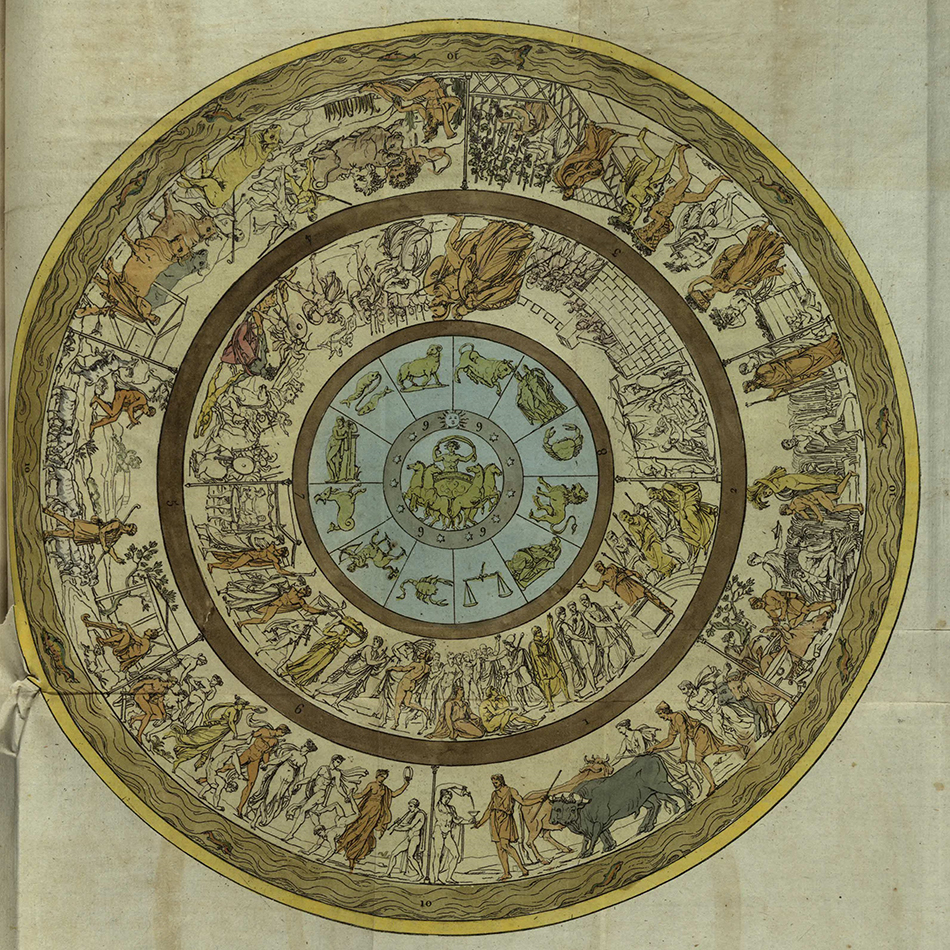
Shield of Achilles
Part 1 of “Adaptive Barbarism”
Patriotism: For Family and Fatherland
An attractive feature of the Trojans, however, is their patriotism. The Achaeans fight for loot, honor, and the glory of their names and families. The Trojans’ allies fight for gold. But the soldiers of the city of Troy itself are fighting to save their families and fatherland from a grim fate. When exhorting his troops to abandon their doubts and drive the Achaeans in the sea and burn their ships, Hector cries: “Fight for your country — that is the best, the only omen!” (12.281). This famous line was often cited by Greeks in later ages as a splendid sentiment, inspiring them to defend their cities even against overwhelming odds.
Hector later urges his comrades to fight and die for family and fatherland:
So fight by the ships, all together. And that comrade who meets his death and destiny, speared or stabbed, let him die! He dies fighting for fatherland — no dishonor there! He’ll leave behind him wife and sons unscathed, his honor and estate unharmed — once these Argives sail for home, the fatherland they love. (15.496)
As the last line suggests, while the Achaeans are fighting for glory and plunder rather than patriotism, they too are moved by a deep love and longing for their country and kinsmen far away.
Elsewhere, the soldier Glaucus shames his Trojan allies for giving ground instead of taking the corpse of Patroclus, Achilles’ dearest friend, with them: “If the Trojans had that courage, that unswerving courage that fires men who fight for their own country, beating their enemies down in war and struggle, then we could drag Patroclus back to Troy at once” (17.155). A Trojan later goads Achilles: “We have fighting men by the hundreds still inside her, forming a wall before our loving parents, wives, and sons to defend Troy — where you rush to meet your doom” (21.585).
Among the Trojans, the fate of family and country are one. There is a famous and touching scene of Hector with his wife and infant son, before battle, knowing full well their fate hangs in the balance. Homer shows us the intertwined fates of King Priam’s city and family by showing us, in graphic detail, the painful deaths of many of his sons in battle.
Familial and patriotic sentiment are not unknown to the Achaeans either, although this is less apparent in this expedition. Wise Nestor, in council, faults those who foment civil conflict as failing both family and nation: “Lost to the clan, lost to the hearth, lost to the old ways, that one who lusts for all the horrors of war with his own people” (9.65). Later, Nestor, “Achaea’s watch and ward,” sought to inspire the troops to fight by appealing to thoughts of their families:
Be men, my friends! Discipline fill your hearts, maintain your pride in the eyes of other men! Remember, each of you, sons, wives, wealth, parents — are mother and father dead or alive? No matter, I beg you for their sakes, loved ones far away — now stand and fight, no turning back, no panic. (15.660)
The War Community
The Iliad has immortalized a primordial vision of the community at war. The men must act as one, or perish. In war especially, the individual’s fate is bound up with the community with the full understanding that they share a common fate, no matter his personal inclination. As Homer says of good Axylus:
Diomedes killed off Axylus, Teuthras’ son who had lived in rock-built Arisbe, a man of means and a friend to all mankind, at his roadside house he’d warm all comers in. But who of his guests would greet his enemy now, meet him face-to-face and ward off grisly death? (4.12)
Both Troy and Achaea are shame cultures. The warriors are often gripped by fear and, when overpowered, pathetically beg for mercy from their enemies. Against this natural sentiment, the commanders frequently shame their comrades to fight, or threaten them with force. The Achaeans also require “a heavy fine” from those who refuse to serve (13.670).
The ideal is unity in combat, something the Achaeans excel at. Homer portrays the order and discipline of the archaic phalanx: “all his comrades came in a pack with one will, massing round him, bracing shields to shoulders” (13.490). Later Homer compares the soldiers to a stone wall, in a famous passage:
Hearing the king’s command the ranks pulled closer, tight as a mason packs a good stone wall, blocks on granite blocks for a storied house that fights the ripping winds — crammed so close the crested helmets, the war-shields bulging, jutting, buckler-to-buckler, helm-to-helm, man-to-man massed tight and the horsehair crests on glittering helmet horns brushed as they tossed their heads, as the battalions bulked so dense. (16.215)
Iliadic Politics: Kingship and the Good City
One may draw political insights from Homer’s ideal of kingship and his portrayal of the failures of the Achaean alliance and the city of Troy. Each king being sovereign, the Achaeans are divided whenever any king’s virtue fails. Agamemnon takes Achilles’ war-bride Briseis, failing to respect Achilles’ status as the best warrior, while Achilles’ pride and wrath drive him to let the Achaeans fall to the brink of oblivion. The Trojans, for their part, are paralyzed by a corrupt Council of Elders, which has failed to order Paris to return Helen. In both cases, there has been a failure to enforce what would be a fundamental principle of the Greek polis: the subordination of individual interests to those of the community.
There is no good kingship without an accepted hierarchy. Among the Achaeans, there is relative equality between kings — aristocratic egalitarianism — and each is meant to be treated according to his respective qualities. If anyone feels dishonored, there is strife. Subjects must respect their kings, under penalty of violence. When lowly and ugly Thersites mocks Agamemnon and the Achaeans, Odysseus beats him into silence with his scepter, prompting general laughter. Odysseus again describes best the Achaean aristocratic ideal of kingship:
Whenever Odysseus met some man of rank, a king, he’d halt and hold him back with winning words: “My friend — it’s wrong to threaten you like a coward, but you stand fast, you keep your men in check! . . . The rage of kings is strong, they’re nursed by the gods, their honor comes from Zeus — they’re dear to Zeus the god who rules the world.
When he caught some common soldier shouting out, he’d beat him with the scepter, dress him down: “You fool — sit still! Obey the commands of others, your superiors — you, you deserter, rank coward, you count for nothing, neither in war nor council. How can all the Achaeans be masters here in Troy? Too many kings can ruin an army — mob rule! Let there be one commander, one master only, endowed by the son of crooked-minded Cronus with kingly scepter and royal rights of custom: whatever one man needs to lead his people well.” (2.188-206)[1]
The kings however are not tyrants: they are expected to welcome legitimate criticism from their peers and even tolerate a good deal of backtalk. Diomedes counters Agamemnon’s proposal to flee Troy, saying: “I will be first to oppose you in your folly, here in assembly, King, where it’s the custom” (9.30). Nestor tells Agamemnon:
Great marshal Atrides [i.e. son of Atreus], lord of men Agamemnon . . . you hold sway over many warriors, vast armies, and Zeus has placed in your hands the royal scepter and time-honored laws, so you will advise them well. So you above all must speak your mind, and listen and carry out the next man’s counsel too, when his spirit leads him on to speak for the public good. Credit will go to you for whatever he proposes. (9.85)
Troy is evidently governed by similar values in this respect. Polydamas, a Trojan warrior, often contradicts Hector, saying on one occasion:
Hector, you always seem to attack me in assembly, despite my good advice. Never right, is it, for a common man to speak against you, King, never in open council, god forbid in war. Our part is always to magnify your power. Well, once again I am bound to say what I think best. (12.210)
There is in Homer an equation of piety with civility, and a sense of reciprocity between the king and his people. Achilles, Agamemnon, and Hector are all described as “shepherd of the people.” The place by the ships where the Achaeans “hand down their laws” is the same where they have “built their altars to the gods” (11.805). The impious, be they kings or not, are harshly punished by the gods. Homer speaks of terrible storms in which
Zeus flings down his pelting, punishing rains — up in arms, furious, storming against those men who brawl in the courts and render crooked judgments, men who throw all rights to the winds with no regard to the vengeful gods (16.385)
Amidst Achaean barbarism and Trojan relative decadence, there is the famous Shield of Achilles described at the end of Book 18, which the smith-god Hephaestus has forged for the hero. On this, Hephaestus has made the image of “two noble cities filled with mortal men” which seem to portray a political and social ideal beyond the war. The great elements of life and death are there. There are weddings and wedding feasts, and young boys and girls court each other with elaborate dancing and gifts, ensuring the renewal of generations. The king watches over from his palace, while people hunt or work in the fields, vineyards, and herds.
In the City at Peace, there is a quarrel in the marketplace between two men “over the blood-price of a kinsman just murdered. . . . The crowd cheer on both, they took both sides, but heralds held them back as the city elders sat on polished stone benches, forming the sacred circle.” Hence, the enmity of blood feuds and the passions of the mob are constrained by law. The City at War, however, is besieged by enemies, but “the people were not surrendering, not at all.” The citizens even organize a counter-raid, killing enemy shepherds. Thus the city is prepared to fight ruthlessly for its own survival, even if innocents must die.
After Achilles defeats Hector in battle, Priam enters the Achaean camp to recover his son’s corpse. The hero and the king meet and weep together, sharing in compassion in their common tragedy. Achilles’ empathy makes him rejoin the world of men, pride and wrath are met with empathy, and the Greek city may be born — a city no doubt destined one day to decay like Troy. The flawed heroes Achilles and Agamemnon, with their overweening pride, seem to give way to wiser and more moderate kings, Nestor and Odysseus, who find the words for social harmony.
Conclusion
The Iliad is thus a poem about the tragedy of vital barbarism and decadent civilization, ascending from one, falling from the other. This is a common enough interpretation. William Merritt Sale writes: “the poem is about the tragic growth of Achilles and the tragic death of Troy.”[2] Bernard Knox argues that Homer’s epic long resonated with the Greeks as a great warning:
The Trojan War was stamped indelibly on the consciousnesses of the Greeks throughout their history, immortalized in lyric poetry, in tragedy, on temple pediments and painted vases, to reinforce the stern lesson of Homer’s presentation of war: that no civilization, no matter how rich, no matter how refined, can long survive once it loses the power to meet force with equal or superior force.[3]
The Iliad embodies the primal values which enabled our Aryan ancestors, thousands of years ago, to conquer the European continent, replacing the native egalitarian hunter-gatherer cultures with ultimately stronger militaristic and aristocratic cultures. These cultures gave us not only the lights of ancient Greece, but also the power of the Romans and refounding of Europe by the Germans during the Middle Ages.
The values of the Iliad, as I hope to have shown, are highly adaptive, being focused on pride in one’s lineage, kinship as central to identity and entailing reciprocity and solidarity, subordination of individual interests to those of the community, the intertwined loves of family and fatherland, and finally the glorification of conquest and honor. These values, though often brutal, enable one’s people to triumph, and surely that is also part of the tragedy Homer was trying to tell. Certainly, the Iliad does not present a genuine group evolutionary strategy, as embodied by the racial purity laws of the Jewish Tanakh or the eugenic dreams of Plato. Homer’s epic reflects a more instinctive and atavistic psychology and way of life enabling the triumph of oneself and one’s kin.
The European patriot Dominique Venner considered the Homeric poems to be “the European Bible.” The lessons of the Iliad indeed are as relevant today as ever. Unfortunately, one can share Ricardo Duchesne’s pessimistic assessment that loss of manliness and ancestral values are part of a natural cycle of civilization, decadence, and collapse. Indeed, given our unprecedented degree of comfort and miseducation, Western men today are of an unbearable and unheard of effeminacy. As a natural result, our people is steadily declining and being physically replaced by other peoples, less gifted by the yardstick of civilization no doubt, but who have kept that instinctive barbarian vigor. This is a fatal encounter, for as Achilles tells Hector in rejecting a pact: “There are no binding oaths between men and lions — wolves and lambs can enjoy no meeting of the minds” (22.265). There may, inevitably, be hard times for the European peoples ahead, but, as the saying goes, hard times breed hard men.
[1] Socrates reportedly loved to quote this passage. Xenophon, Memorabilia, 1.2.
[2] William Merritt Sale, The Government of Troy (Washington University, 1994), p.74.
[3] Knox, “Introduction,” in op. cit., p. 37.




Comments are closed.