
Mark Rothko, Abstract Expressionism and the Decline of Western Art, Part 3
Brenton Sanderson


Abstract Expressionism and the Culture of Critique

Abstract Expressionism was disproportionately a Jewish cultural phenomenon. It was a movement populated by legions of Jewish artists, intellectuals and critics. Prominent non-Jewish artists within the movement like Jackson Pollock and Robert Motherwell married Jewish women (Lee Krasner and Helen Frankenthaler). Willem de Kooning defied the trend, although he generally had to ingratiate himself with the overwhelmingly Jewish intellectual and cultural elite focused around the journal Partisan Review which was ‘dominated by editors and contributors with a Jewish ethnic identity and a deep alienation from American cultural and political institutions.’[i]

It was an art movement where the culture of critique of Jewish artists and intellectuals, frustrated that the post-war American prosperity based on Keynesian foundations had prevented the coming of socialism, turned inward and instead “proposed individualistic modes of liberation.” This mirrored the ideological shift that occurred among the New York Intellectuals generally who had “gradually evolved away from advocacy of socialist revolution toward a shared commitment to anti-nationalism and cosmopolitanism, ‘a broad and inclusive culture’ in which cultural differences were esteemed.”[ii] Doss notes how this ideological shift manifested itself among the post-war artists who became the Abstract Expressionists:

As full employment returned, New Deal programs were terminated — including federal support for the arts — the reformist spirit that had flourished in the 1930s dissipated. Corporate liberalism triumphed: together, big government and big business forged a planned economy and engineered a new social contract based on free market expansion… With New Deal dreams of reform in ruins, and the better “tomorrow” prophesied at the 1939-1940 New York World’s Fair having seemingly led only to the carnage of World War II, it is not surprising that post-war artists largely abandoned the art styles and political cultures associated with the Great Depression.[iii]

The avant-garde artists of the New York School instead embraced an “inherently ambiguous and unresolved, an open-ended modern art … which encouraged liberation through personal, autonomous ‘acts’ of expression.” The works of the Abstract Expressionists were “revolutionary attempts” to liberate the larger American culture “from the alienating conformity and pathological fears [especially of communism] that permeated the post-war era.”[iv] Rothko claimed that “after the Holocaust and the Atom Bomb you couldn’t paint figures without mutilating them.” His friend Barnett Newman remarked that if people only read his paintings properly “it would mean the end of all state capitalism and totalitarianism.”[v]

Advertisement

In 1947, Adolph Gottlieb, declared that

today when our aspirations have been reduced to a desperate attempt to escape from evil, and times are out of joint, our obsessive, subterranean and pictographic images are the expression of the neurosis which is our reality. To my mind … abstraction is not abstraction at all … it is the realism of our time.[vi]
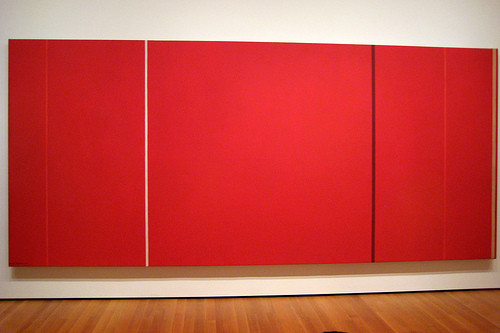
A Barnett Newman "Verticist" painting

At the heart of Abstract Expressionism lay a “vision of the artist as alienated from mainstream society, a figure morally compelled to create a new type of art which might confront an irrational, absurd world” — a mentality which was in complete accord with the outlook of the alienated diasporic Jewish artists and intellectuals at the heart of the movement who viewed the traditional White Christian society around them with implacable hostility.[vii] MacDonald notes that the New York Intellectuals “conceived themselves as alienated, marginalised figures – a modern version of traditional Jewish separateness and alienation from gentile culture. … Indeed [Norman] Podhoretz was asked by a New Yorker editor in the 1950s ‘whether there was a special typewriter at Partisan Review with the word ‘alienation’ on a single key.’”[viii]

During the 1950s Jewish artists and intellectuals chaffed against the social controls enforced by political conservatives and religious and cultural traditionalists who limited Jewish influence on the culture, “much to the chagrin of the Frankfurt School and the New York Intellectuals who prided themselves in their alienation from that very culture.” This all ended, together with Abstract Expressionism as an art movement embodying the alienation of the New York Intellectuals, with the triumph of the culture of critique in the 1960s, when radical Jews and their allies usurped the old establishment, and thus “had far less reason to engage in the types of cultural criticism so apparent in the writings of the Frankfurt School and the New York Intellectuals. Hollywood and the rest of the American media were unleashed.”[ix]

In his exposition of the political significance of the widespread Jewish involvement in modernism Cantor noted that “something more profound and structural was involved in the Jewish role in the modernist revolution than this sociological phenomenon of the supersession of marginality. There was an ideological drive at work.”[x] This ideological drive was the urge to subject Western society and culture (deemed a “soft authoritarianism” fundamentally hostile to Jews) to intensive and unrelenting criticism — in the process of which they spawned a massive literature of cultural subversion throughout the post-war period. Quoting Philip Rahv (a onetime PR editor), MacDonald points out that: “Modernism encouraged ‘the creation of moral and aesthetic values running counter to and often violently critical of the bourgeois spirit.” “What is modern literature if not a vindictive, neurotic, and continually renewed dispute with the modern world?’ Such pronouncements on the critical potential of even the most abstract art reflected the views of the Frankfurt School theorists Adorno and Horkheimer, the latter of whom noted that ‘An element of resistance is inherent in the most aloof art.’”[xi]
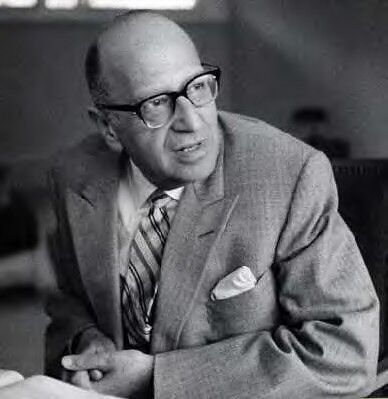
Max Horkheimer

There was “a great deal of influence and cross-fertilisation between the New York Intellectuals and the Frankfurt School.”[xii] These intellectuals promoted modernism in art at least partly because of its apparent compatibility with expressive individualism, but also because it was seen as being capable of alienating people from Western capitalistic societies. For Frankfurt School intellectual Walter Benjamin the purpose of modern art was to spread the kind of cultural pessimism that would bring on the revolution, insisting that “To organise pessimism means nothing other than to expel the moral metaphor from politics.” His colleague Willi Munzenberg saw the role of the Frankfurt School as being “to organise the intellectuals and use them to make Western Civilisation stink. Only then, after they have corrupted all its values and made life impossible, can we impose the dictatorship of the proletariat.”

Clement Greenberg and the New “American” Art

Clement Greenberg was the most influential theorizer and promoter of modernism in America during the middle years of the twentieth century. His advocacy helped to bring about the institutionalisation of Abstract Expressionism and to secure the dominance of American Modernist art in the immediate post-war period. Greenberg “made his reputation entirely within what one might term a Jewish intellectual milieu” including as ‘a writer for PR, managing editor of Contemporary Jewish Record (the forerunner of Commentary), long-time editor of Commentary under Elliot Cohen, as well as art critic for The Nation.’[xiii] Greenberg’s Jewish identity was strong, and he once avowed that “I believe that the quality of Jewishness is present in every word I write, as it is in almost every word of every other contemporary Jewish writer.”[xiv] Furthermore, he pointed out that “it is possible that by world historical standards the European Jew represents a higher type than any yet achieved in history.”[xv]

Greenberg’s later rejection of Pop and Conceptual Art led to a period in which his writings and his preferences were dismissed by those who aligned themselves with the views of rival Jewish art guru Harold Rosenberg. This arose from what was perceived as Greenberg’s dogmatic advocacy of abstraction, and his distaste for commercial popular culture — what he called ‘kitsch’ in one of his most famous essays “Avant-Garde and Kitsch” (1939) which was his response to the destruction and repression of modernist art in National Socialist Germany and the Soviet Union.[xvi] “Avant-Garde and Kitsch” made Greenberg’s name as a critic and led to his direct participation in the world of cultural journalism as an editor of Partisan Review.

It is not hard to detect an underlying concern with anti-Semitism in Greenberg’s famous essay. There was a general understanding among both the Frankfurt School and the New York Intellectuals that “mass culture — whether in the USSR (both groups were anti-Stalinist), National Socialist Germany, or bourgeois United States — promoted conformism and escape from harsh political realities; it ‘offered false pleasure, reaffirmed the status quo, and promoted a pervasive conformity that stripped the masses of their individuality and subjectivity.’”[xvii] By contrast, avant-garde art had the potential to foster the type of subjective individualism that could disconnect the masses from their traditional familial, religious and ethnic bonds —  thereby reducing the salience of Jews as an outgroup and weakening the anti-Semitic status quo within these societies.

In his essay Greenberg downplays the culturally critical potential of avant-garde art, and instead seeks to account for the ubiquity of “kitsch” in totalitarian societies by stressing its usefulness in ingratiating a regime with the masses — a practice that, he informs us, will only cease when these regimes “surrender to international socialism.” He writes:

Where today a political regime establishes an official cultural policy, it is for the sake of demagogy. If kitsch is the official tendency of culture in Germany, Italy and Russia, it is not because their respective governments are controlled by philistines, but because kitsch is the culture of the masses in these countries, as it is everywhere else. The encouragement of kitsch is merely another of the inexpensive ways in which totalitarian regimes seek to ingratiate themselves with their subjects. Since these regimes cannot raise the cultural level of the masses — even if they wanted to — by anything short of a surrender to international socialism, they will flatter the masses by bringing all culture down to their level. It is for this reason that the avant-garde is outlawed. … Kitsch keeps a dictator in closer contact with the “soul” of the people. Should the official culture be one superior to the general mass-level, there would be a danger of isolation.[xviii]

Greenberg’s thesis here is not without validity. Indeed one of the striking features of modern Western life under a Jewish cultural hegemony has been an all-pervasive popular culture of Hollywood that is supersaturated with the rankest multi-cultural and multi-racial kitsch. Despite the repeated real-world failure of the utopian vision being relentlessly endorsed, this form of easily assimilated kitsch (seasoned with liberal doses of sex, violence and schmaltz) works very well to brainwash the great bulk of White people and avert even the mildest forms of rebellion.
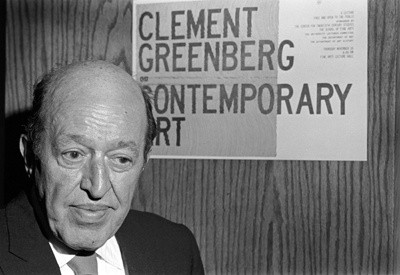
Clement Greenbert

Kitsch works for the Jews of Hollywood for the very same reason it worked for Hitler and for Stalin. This is because kitsch is defined by efficiency of communication, while the avant-garde alienates some viewers “simply because this was an inescapable by-product of their formal experiments and of their rejection of kitsch.”[xix] Barlow notes that, for Greenberg,

kitsch worked to maximize effect, while the avant-garde sought to address cause. Both commerce and totalitarian regimes sought maximum penetration of controllable information. They required the culture of kitsch. Mass culture will almost inevitably be kitsch, as passive consumers will comprehend accessible effects more readily than the self-conscious explorations of cause. Only in a truly socialist society will mass culture transcend the psychology of passive consumption. Despite important differences between the two men, Greenberg’s attitude to popular culture is close to that of Theodor W. Adorno.[xx]

Like Greenberg, Adorno initially directed his attack not against the high culture of Western civilization, but against the “mass culture” which warred with it – a “secondary emanation of authority” which was an inescapable product of capitalism. For Adorno, nothing was more abhorrent in the mass culture of America than its music. “For him the new sounds, riddled with cliché and kitsch, were not art but ideology – the sweet pill of false consciousness that numbs the senses of the working class.” The owners of the means of communication (the capitalist class) are sovereign in this debased musical culture. Under socialism, Adorno implied, all this fetishism would be swept away and the emancipated proletariat would be whistling the ideology-free music of Schoenberg and Webern in the streets.[xxi] However, as Scruton notes, this aspect of Frankfurt School’s critical theory was later to change fundamentally:

Since the Frankfurters came as exiles to America, there to pour scorn on their hosts, the culture of repudiation has taken another and more home grown form. Instead of focusing on the ‘mass culture’ of the people, it now targets the elite culture of the universities. It is indifferent, or even vaguely laudatory, towards popular art and music, seeing them as legitimate expression of frustration and a challenge to the old forms of highbrow knowledge. Its target is the culture in the sense that I have been defending it: all those artefacts that have stood the test of time, and which are treasured by those who love them for the emotional and moral knowledge that they contain.[xxii]

Unlike his rival Harold Rosenberg, Greenberg was never to embrace this new critical paradigm.  In “Towards a Newer Laocoon” (1940) he articulated his famous claim that resistance to kitsch requires that art “emphasize the medium and its difficulties,” adding that the history of the avant-garde is one of “progressive surrender to the resistance of the medium.”[xxiii] Greenberg argued that the vision of the Abstract Expressionists was characterized by a “fresher, opener, more immediate surface,” offensive to standard taste. He related this quality to a “more intimate and habitual acquaintance with isolation,” which was, in his ethnically, morally and culturally particularistic view, “the condition under which the true quality of the age is experienced.”[xxiv]

Greenberg’s dismissal of Harold Rosenberg’s account of Abstract Expressionism as “action painting” was based on his view that Rosenberg’s claim implied that the active process of painting mattered more than the result – that one chaotic combination of drips and splodges was as good as another. For Greenberg, Rosenberg’s theory gave the green light to charlatans whose work was no more than “stunts.” Such stunts certainly came into prominence with the rise of Pop and Conceptual art during the 1960s as many artists embraced Rosenberg’s claim that the moment of “performance” could itself be art. This aspect of the art scene in the 1960s earned Greenberg’s contempt, but as Barlow points out, “could all too easily be interpreted as the conservative critic whose time had passed – the modern equivalent of Ruskin’s attack on Whistler.”[xxv]
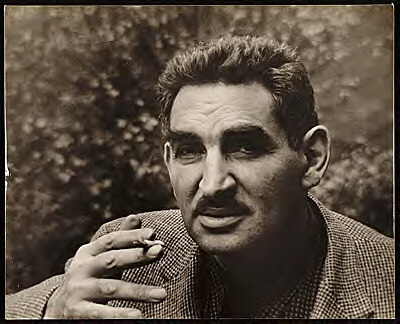
Harold Rosenberg

It is somewhat ironic that Greenberg, an ethnocentric Jewish Trotskyite, in his staunch defence of Abstract Expressionism and Post-Painterly Abstraction, and rejection of the “pre-emptive kitsch” of Pop Art, Neo-Dada and Conceptual Art, was pushed into the role of artistic neo-conservative by Rosenberg. While the Abstract Expressionists that Greenberg had championed had been intensely eager to break with the figurative art of the Regionalist painters, their work (owing to its highly abstract nature) lacked the more overtly ideological form of the art that replaced it. This should, however, never obscure from us the fact that the rise of Abstract Expressionism coincided with the Jewish takeover of American high culture, and the deposing of the old WASP establishment.

The new establishment shunned the traditional Western preoccupation with beauty and instituted a cult of ugliness that has tainted Western art ever since. Indeed, an art that emerged as a direct response to the “alienation” of Jewish artists and intellectuals in America at mid twentieth century ushered in an art of ugliness and alienation for everyone. In effect, they succeeded in making all of America and the West as alienated as they were. With the rise of Conceptual Art in the sixties we saw the emergence of an art that (like the Social Realism of the thirties) wore its culturally-critical heart on its sleeve, and unambiguously sought to engender in its White audience an individualistic disconnection from the traditional reinforcers of White ethnocentrism and group cohesion — to create what Georg Lukacs called “a culture of pessimism” that reflected “a world that has been abandoned by God.” Noting the extent to which they succeeded in this endeavour, Scruton observes that the degradation of Western art and culture “was not an inevitable consequence of cultural decay, but a willed gesture of repudiation.”[xxvi] He points out that

it is a law of human nature, confirmed by social revolutions throughout modern history, that old authorities, when they fall from their eminence, are instantly trampled on before being kicked aside. We should not be surprised, therefore, to discover that sacrilege and blasphemy have been such important ingredients in ‘Young British Art’.[xxvii]

The cult of ugliness: “A Thousand Years” (1990) by Damien Hirst

Israel Shamir aptly summarizes the process of degeneration that occurred when he notes that “in the beginning, these were works of some dubious value like the ‘abstract paintings’ of Jackson Pollock. Eventually we came to rotten swine, corrugated iron, and Armani suitsArt was destroyed.[xxviii] The result of this degradation has been to erode European cultural confidence and make Western societies, in the eyes of their increasingly atomized White populations, essentially “unlovable” and not worth defending. The new “art” has worked effectively to impair the racial and cultural immune systems of Whites, and represents an important front in the general post-WWII drive to transform relatively homogeneous White nations into the type of multi-racial, multicultural (and therefore presumably Holocaust-proof) societies in which Jews can pursue their self-interest in relative safety — free from the threat of any hostile reaction from a large and cohesive bloc from among their White host population.

REFERENCES

Barlow, P. (2003) Key Writers on Art: The Twentieth Century, Ed. By Chris Murray, Routledge, London.

Cantor, N.E. (1994) The Sacred Chain – The History of the Jews, HarperCollins, New York.

Darkmoon, L. (2009) ‘The Plot Against Art – Part 2,’ Occidental Observer: http://www.theoccidentalobserver.net/2009/09/the-plot-against-art-part-2/

Doss, E.L. (2002) Twentieth-Century American Art, Oxford University Press, USA.

Everitt, A. (1974) ‘Abstract Expressionism’ in Modern Art – Impressionism to Post-Modernism, Ed. By David Britt, Thames and Hudson, London.

Greenberg, C. (1939) ‘Avant-Garde and Kitsch,’ At:  http://www.sharecom.ca/greenberg/kitsch.html

MacDonald, K. B. (1998/2001) The Culture of Critique: An Evolutionary Analysis of Jewish Involvement in Twentieth‑Century Intellectual and Political Movements, Westport, CT: Praeger. Revised Paperback edition, 2001, Bloomington, IN: 1stbooks Library.

MacDonald, K.B. (2009) ‘Review of Thomas Wheatland’s ‘The Frankfurt School in Exile’ Part II’, Occidental Observer: http://www.theoccidentalobserver.net/articles/MacDonald-WheatlandII.html

Scruton, R. (2005) Modern Culture, Continuum, London.

Scruton, R. (2007) Culture Counts – Faith and Feeling in a World Besieged, Encounter Books, New York.


[i] Macdonald 1998/2001, p. 211

[ii] Ibid. p. 212

[iii] Doss, p. 124

[iv] Ibid. p. 130-131

[v] Dempsey, p. 190

[vi] Doss, p. 128

[vii] Dempsey, p. 188

[viii] MacDonald 1998/2002, p. 212

[ix] MacDonald 2009

[x] Cantor, p. 303

[xi] MacDonald 1998/2002, p. 216

[xii] Ibid. p. 212

[xiii] Ibid. p. 211

[xiv] Ibid. p. 213

[xv] Ibid.

[xvi] Barlow, p. 149

[xvii] MacDonald 2009

[xviii] Greenberg

[xix] Barlow, p. 152

[xx] Ibid. p. 150

[xxi] Scruton 2007, p. 70

[xxii] Ibid. p. 73

[xxiii] Barlow, p. 150-151

[xxiv] Everitt, p. 256

[xxv] Barlow, p. 151

[xxvi] Scruton 2007, p. 98

[xxvii] Scruton 2005, pp. 86 & 94

[xxviii] Darkmoon, 2009

Share:
  • Print
  • Digg
  • Facebook
  • Twitter

47 Comments to "Mark Rothko, Abstract Expressionism and the Decline of Western Art, Part 3"

  1. Felix Grubel's Gravatar Felix Grubel
    September 25, 2011 - 12:59 pm | Permalink

    I am sick to death about being whined to about Jewish alienation.

    If Jewish “artists” and “intellectuals” feel alienated, then they need to put the blame where it belongs: On their “holy” men who for the 3,000 years of their existence have told them non-Jews are two-legged animals and that the worst of them is better than any of the goyim.

    If they don’t like the society in which they live, let them pack up their camels and hie themselves off to a people not yet on to their crooked scams. I’m sure the natives will be happy to see them go. The Jews need them a lot more than they need the Jews.

  2. me's Gravatar me
    September 25, 2011 - 2:00 pm | Permalink

    Israel Shamir aptly summarizes the process of degeneration that occurred when he notes that “in the beginning, these were works of some dubious value like the ‘abstract paintings’ of Jackson Pollock. Eventually we came to rotten swine, corrugated iron, and Armani suits. Art was destroyed.”

    Great stuff B. Sanderson, I would love to see follow up articles by you and L. Darkmoon – we know the problem – it has been explained and articulated by you , Darkmoon, Shamir, … but what’s the solution?

  3. Chris's Gravatar Chris
    September 25, 2011 - 2:15 pm | Permalink

    A related and very interesting discussion:

    The Sunic Journal: Interview with Elizabeth Whitcombe

  4. Franklin Ryckaert's Gravatar Franklin Ryckaert
    September 25, 2011 - 2:23 pm | Permalink

    @me:
    What’s the solution?Not difficult:don’t buy their art,don’t visit their galleries. Start your own galleries,promote your own artists, but in all of this consistently exclude Jews (they will surely try to infiltrate you).Whites have created nearly all cultures on earth,can they not recreate their own?

  5. alex dihes's Gravatar alex dihes
    September 25, 2011 - 2:36 pm | Permalink

    I’m a Jew and a connoisseur of Art.
    From the point of view that purpose of Art is to offer a reflection of Life — the Abstract Expressionism is not art at all. It is a mask to hide lack of talent.

  6. Rehmat's Gravatar Rehmat
    September 25, 2011 - 2:48 pm | Permalink

    The Zionists are always in the front line to protect the ‘freedom of speech’ as long as it doesn’t criticize Jews, Zionism or Israel. Be it anti-Christian movie (Da Vinci Code, The Ten, etc.) or the Cartoons mocking Christians or the Danish Cartoons insulting the Prophet of Islam (pbuh), anti-Islam movie Fitna or anti-Islam DVD Obsession. However, when it comes to criticism of Zionist entity, Zionism or Judaism – the same champions of ‘freedom of speech’ have the habit of kicking their bottoms and crying on top of their voives: “Anti-Semitism, Anti-Semitis!!” The world saw it after French scholar, Roger Garaudy published his book The Founding Myths of Israel; release of Mel Gibson’s movie The Passion of Christ; publication of Dr. Norman Finkelstein’s book ‘The Holocaust Industry’; publication of Mearsheimer and Walt (both Jewish writers) book ‘The Israel Lobby and US Foreign Policy’; publication of Jimmy Carter’s book Peace not Apartheid and the recent revelations of Israelis and Jews involved in human organ trafficking – are a few examples of how the Zionist creeps become paranoid when they face the truth.

    http://rehmat1.wordpress.com/2009/09/04/virgin-mary-painting-irks-zionists/

  7. Tom's Gravatar Tom
    September 25, 2011 - 3:23 pm | Permalink

    @alex dihes:

    Yep. The Jews will be in, and, out of Modern Art, and onto their next crypsis & reinvention.

  8. Tom's Gravatar Tom
    September 25, 2011 - 3:38 pm | Permalink

    @Franklin Ryckaert:

    There seems to have been somewhat of a Jew-White Gentile divison between the New York Action Painters. But, the way I read it the White Gentiles took the Jews as part of the landscape they were dealing with, rather than trying to exclude the Jews.

    Connor Dirk, might have some thoughts on this, because he caught part of the Cedar Bar scene.

    Jack Kerouac, poet & painter, who was part of that scene, and a close pal of Franz Kline gives one that impression. Kerouac’s sketch of of very Jewish Allen Ginsburg with a douchebag hung around his neck comes to mind. LOL.

  9. Connor Dirk's Gravatar Connor Dirk
    September 25, 2011 - 4:47 pm | Permalink

    @Rich Pearson.

    Toward the end of the comment thread for Part I of this series I left a message for you, replying to a comment you had made. Perhaps you have not revisited the board.

  10. September 25, 2011 - 5:57 pm | Permalink

    Interesting piece, but it doesn’t seem to have much to do with Mark Rothko.

  11. Tom's Gravatar Tom
    September 25, 2011 - 8:01 pm | Permalink

    @Connor Dirk:

    You were asking about my knowledge of Hitler’s art.

    I’ve never seen an actual Hitler work of art first hand. Although, I may have seen a work first hand that was attributed to Hitler, but, lacked a Provenance.

    One thing I noticed about Hitler, that is almost unique to Hitler are the pink skies he sometimes painted. The only other artist who painted a pink sky in the same powerful manner is Camille Pissaro.

    It is remotely possible that Hitler may have encountered Pissaro, and picked a tip up from him first hand. Or Hitler may have seen Pissaros works and liked his skies.

  12. Edward's Gravatar Edward
    September 25, 2011 - 8:07 pm | Permalink

    @me: we know the problem – it has been explained and articulated by you , Darkmoon, Shamir, … but what’s the solution?

    At first, the problem appears too large to be fixed. However, close examination of causes provides a road map to the solution.

    avant-garde art had the potential to foster the type of subjective individualism that could disconnect the masses from their traditional familial, religious and ethnic bonds — thereby reducing the salience of Jews as an outgroup and weakening the anti-Semitic status quo within these societies.

    The solution requires do what Jewish propaganda has insisted can never be done. Turn back the clock. That is, unload each of the errors that has been drilled into our collective consciousness over the past several decades. Rebuild the “traditional familial, religious and ethnic bonds.”

    The result of this degradation has been to erode European cultural confidence and make Western societies, in the eyes of their increasingly atomized White populations, essentially “unlovable” and not worth defending. The new “art” has worked effectively to impair the racial and cultural immune systems of Whites

    It is not enough to insist that Whites defend themselves for the sake of evolutionary correctness. White youth must be retrained to see their people and traditions as “lovable” and worth defending.

  13. me's Gravatar me
    September 25, 2011 - 8:25 pm | Permalink

    @Rehmat:” Mearsheimer and Walt (both Jewish writers)” – both are nordic/west european gentiles.

  14. Trenchant's Gravatar Trenchant
    September 25, 2011 - 8:31 pm | Permalink

    “frustrated that the post-war American prosperity based on Keynesian foundations had prevented the coming of socialism”

    Keynesianism didn’t bring post-war prosperity. Winding down the war economy did, much to the consternation of the Keynesians. The Marshall plan’s success in postwar Europe is also a myth as big as the holocaust.

  15. Volksverhetzer's Gravatar Volksverhetzer
    September 25, 2011 - 8:37 pm | Permalink

    “For Frankfurt School intellectual Walter Benjamin the purpose of modern art was to spread the kind of cultural pessimism that would bring on the revolution, insisting that “To organise pessimism means nothing other than to expel the moral metaphor from politics.” His colleague Willi Munzenberg saw the role of the Frankfurt School as being “to organise the intellectuals and use them to make Western Civilisation stink. Only then, after they have corrupted all its values and made life impossible, can we impose the dictatorship of the proletariat.””

    I understand a little bit better why the Dimmu Borgir video was chosen as a featured video after reading part three.

    I do find it ironic that the Jews in many ways managed to destroy beauty in western traditional music and art, only to see it being reborn with artists that started creating beauty from ugliness, in order to escape kitschy mass produced commercial music.

    Since Black metal is an acquired taste, I find it better to post some piano covers of some famous songs this time around, so that non-fans can understand that it is more to it than blastbeats, growling and shrieking guitars.

    Dimmu Borgir – Progenies of the Great Apocalypse – Mustis Unplugged
    http://www.youtube.com/watch?v=4s88vxHjWrs

    A medley of various black metal songs played on the piano.
    http://www.youtube.com/watch?v=0sKbcSd3DXg

    A piano cover with vocals.
    http://www.youtube.com/watch?v=Zu94YJvAQOc&feature=related

  16. Trenchant's Gravatar Trenchant
    September 25, 2011 - 9:17 pm | Permalink

    Government spend in 1944 circa 48% versus 18% in 1946. Full employment and burgeoning economy confounded Keynesians, full of dire presentiments.

  17. Pierre de Craon's Gravatar Pierre de Craon
    September 25, 2011 - 10:23 pm | Permalink

    I am second to none in my admiration for Mr. Sanderson’s work here at TOO, but it is truly a shame that his reference list for this series of articles fails to include Tom Wolfe’s The Painted Word (1975). It’s brilliant, it’s devastating, and best of all, it’s short! Read it, laugh, and learn.

  18. Henry Baxley's Gravatar Henry Baxley
    September 25, 2011 - 10:42 pm | Permalink

    The false Gods of Democracy, Diversity, and Equality, Have destroyed society…The Jews just happened to be there with their carpet bags doing what they do best…sticking together!
    With all due respect for an excellent article. It wasn’t accomplished by infecting our brains with visual filth (though that was certainly part of it)
    Only after a people have been dumbed down by the inexorable effects of Democracy would they become willing to accept Diversity. And only after they became deracinated by Diversity were they then ready to swallow equality. And at last when they are totally beaten and confused they are ready to buy ANYTHING! From Rothko or anyone else!
    This is why our new order (if we survive) must be based on Natural Law…NOT Democrazy or any other crazy

  19. Trenchant's Gravatar Trenchant
    September 25, 2011 - 11:16 pm | Permalink

    @Henry Baxley:
    Hear, hear. Egalitarianism is a poisonous and flawed notion.

  20. teutonic1's Gravatar teutonic1
    September 25, 2011 - 11:19 pm | Permalink

    As a creative person, I find this kind of art offensive. I can’t even look at it. I can draw, and I find the notoriety of these so-called artists insulting.

  21. De Maistre's Gravatar De Maistre
    September 25, 2011 - 11:26 pm | Permalink

    The existence and tolerance of this decease may appear to lend some weight to the leftist project. Indeed, people are, at first sight, apparently infinitely malleable and can be made into believe anything if they perceive that their peer-group believe same thing.

    Deeply disturbing. However, this is only exploitation of pre-existing structures such as the structure of a peer-group. These freaks cannot create structures, only exploit existing ones. Hence, the creation of a real elite and furnish it with a superior immune system against these ills is the project with capital p.

    Awareness of the infection is of utmost importance and, indeed, must be in the catechism of coming generations.

  22. Mike M's Gravatar Mike M
    September 26, 2011 - 12:10 am | Permalink

    This is just a friendly warning for folks not to fall into the trap of believing the false paradigm of avant garde vs kitsch.

    Kitsch has generally been associated with commercial art and the avant garde is generally considered a Communist reactionary movement to advertising. Ugly and deformed works are often considered avant garde simply because they could never be used in Capitalist consumer advertising campaigns.

    Avant garde and kitsch falsely pretend to be opposed to each other while actually working simultaneously as propaganda vehicles dismantling ALL distinct cultures on earth. Capitalist art (kitsch) elevates low culture while vulgarizing high culture to create a single homogenized middle culture. This is why advertising has been so effective at making consumers all over the world want to dress the same, eat the same foods, drive the same cars etc. Communist art (avant garde) demolishes distinct cultural barriers by breaking down social taboos and “pushing boundaries” etc. The degenerative cultural effects resulting from this false paradigm are not limited to Western Civilization but are attacking all cultures in the same way.

    In summary, avant garde and kitsch are not opposed to each other. Instead, they work together as propaganda tools to demolish distinct cultures while simultaneously creating a single homogenized planetary culture that can one day be ruled by global governance.

  23. Connor Dirk's Gravatar Connor Dirk
    September 26, 2011 - 1:23 am | Permalink

    We have been glad to see this series of articles which takes the reader beyond mere expository detail of individual works into serious analysis of the movement by its contemporaries. Critical statements quoted make no concessions to easy reading and stimulate the mind with a high standard of excellence.

    The period covered was of substantial duration, challenging in its complexity. Brent Sanderson is to be congratulated on his choice of subject and the steady drive with which he has made his point.

    The term Abstract Impressionism is used as though interchangeable with Abstract Expressionism, which is not the case. Pop art and Conceptualism were more antipathetic to Abstract Expressionism than an extension, and constituted distinct, well-defined developments within themselves. Both were, however, satirical of the establishment, and shared with Abstract Expressionism a spirit of rebellion.

    It’s worth noting, as I have said before, that every new movement in art expresses a degree of disaffection. This might be likened to a son’s assertion of independence from the father. In order to break new ground and establish autonomy, each generation declares its independence from the preceding. This amounts to perpetual fertilization of culture, manifesting the most basic law of creation – flux.

    Proof of this principle of displacement may be verified, for example, in the progression from Romanticism> Naturalism>Impressionism>Post-Impressionism>Fauvism>Cubism, etc. So this spirit of radicalism is not the sole province of Judaism, though in the case of Abstract Expressionism and subsequent schools in New York the Jewish influence has undeniably been a major factor. But the point I wish to emphasize is that this component does not invalidate the aesthetic validity of these works.

    Individuals who take up the very trying life of an artist are first artists, and only secondly, philosophers. Intelligent, sensitive human beings do not dedicate themselves to creating disorder. No matter his political persuasion, an artist is always practicing design, a reasoned arrangement of color, form, texture, etc., regardless of how subversive his spirit. An artist, by nature, cannot survive on “ugly,” despite occasional bewilderment of the viewer.

    There have always been artists whose message portrayed unpleasant aspects of life. Witness: Pieter Bruegel, Hieronymus Bosch, James Ensor, Francis Bacon, (my preferred of all artists.) In 1917 the Dada master, Marcel Duchamps, submitted to the Society of Independent Artists the first “Conceptualist” work of art ever – a urinal entitled “The Fountain.” In 1917, mind you, and unrelated to Jewish anarchy.

    Fact is, the Talmudic influence in this country has afforded valuable experience for the native population…a certain drama and storminess awakening us to the reality of evil. The fact that, ironically, we have also acquired a mountain of beautiful art is merely incidental. The challenge before us now is one of defanging the monster which is Judaism.

    The endless recitation of ills has reached a point of sufficiency. It is time to begin laying out a plan for annihilating the beast. If the reader pauses to consider the horrors of the Bolshevik Revolution – so recently recounted right here at TOO – and the immediacy of ZOG, he can have no doubt of the urgency which confronts us. It is time to lay down the knitting, end the idle chat and ACT. It can begin right here at Occidental Observer.

  24. Trenchant's Gravatar Trenchant
    September 26, 2011 - 1:24 am | Permalink

    This series by Mr. Sanderson on Jewish influence on art has been excellent, ditto the discussions on the blogs.

  25. Connor Dirk's Gravatar Connor Dirk
    September 26, 2011 - 6:46 am | Permalink

    @Tom: Tom, please note the post I left in reply. It deals with the subject you’ve discussed here, but I didn’t direct the comment directly to you, as I thought the links might be of general interest.

  26. Connor Dirk's Gravatar Connor Dirk
    September 26, 2011 - 6:54 am | Permalink

    In dialogue with another reader here I mentioned that Adolf Hitler had been a painter. This is a detail with which some are not familiar. Here are some links I thought would be enjoyable. The first is a portrait of Hitler. The moustache should be viewed as something an artist would do. Friedrich Nietzsche’s moustache was even more unconventional, but different.

    http://www.museumsyndicate.com/artist.php?artist=12

    Here is another portrait image, partially tinted. What a handsome man.


    http://thebookmann.blogspot.com/2009/01/feinin-adolf-hitler.html

    This is a small collection of Hitler’s paintings. His absorption with architecture reveals a manful preference for mass and strength. None of them are to my taste except for the nostalgia they afford, but there are a couple which interest me, depicting the dining room in a period building. In any event, it is clear from his prolific work, this guy was in love with painting. An ordinary man with many interests and demands on his time would never have found the time for so many illustrations. No doubt, most of this content was reduced to rubble by the end of the war. Heartbreaking.

    http://images.search.yahoo.com/search/images?_adv_prop=image&va=paintings+of+adolph+hitler&fr=slv8-tyc8&tab=organic&tab=organic&b=57

    You see, I have never felt the Fuhrer to be the repository of all evil, particularly in view of what was done to Germany during WWI and afterwards. It is common knowledge that he endeavored to relocate the Jewish people to another region, but they were recalcitrant.

    From the time of the Balfour Agreement, Zionist plans for an Israeli state had developed apace, but the chief obstacle was a contingent of hardcore, German Orthodox Jews who were opposed to the plan. Apparently Hitler gave the Zionists a carte blanche to deal with the problem as they chose. You know, wherever they are, Jews function as though they are a nation apart. The “holocaust” was a process by which Zionist Jews removed the obstacle to their plans. It was a Jewish action against Jews. Needless to say, the Fuhrer’s impasse with the Jews might have been resolved. In recent times statesmen in Israel have declared under their breath, Hitler really deserves a statue in Tel Aviv.

    Here is a touching film sequence from the days of the Third Reich. Observe what a beautiful man Hitler was, a true patrician. The features of his face were smooth and untroubled as those of an infant. Of particular note is the brief sequence at the end, when the Fuhrer passes before a column of young boys, likely his Youth Army. Notice the way he pauses at length before each one, intensely searching his face, peering into the very soul of each. How many men would be capable of such loving concern? John F. Kennedy said, “Adolf Hitler was made of the stuff of legends.”

    When I was in New York twelve years or so after the war, one of these fine boys, all mature and dapper, became a major figure in my life. Oh, with what sadness he spoke of the last days.

    http://www.youtube.com/watch?v=cCCbvtoY3dQ&NR=1

  27. Connor Dirk's Gravatar Connor Dirk
    September 26, 2011 - 7:31 am | Permalink

    Sorry the links on my post do not connect. The second one, in fact, does. Went through all the right motions. I think it’s probably because each page was part of a larger collection. Probably too circuitous a route.

    The urls are correct and will carry you there, but you will have to copy and paste them into the browser. IT’S WORTH THE TROUBLE.

    We need a preview option.

  28. me's Gravatar me
    September 26, 2011 - 8:18 am | Permalink

    @Pierre de Craon: I second the painted word, also , see “The Rape of the Masters” about art ‘historians’ critiquing paintings Sargent =incest for example. I wonder if the people touting this stuff really belief it, or just see it as a necessary belief. Either way, its amazing to see what hundreds of millions of dollars, and hundreds of books, ‘scholarly’ journals, are spewing out every year, trying to undermine beauty. Leftists/marxist/Frankfort school has taken every virtue and turned it on its head.. I am still baffled why they continue to be successful.

  29. Junghans's Gravatar Junghans
    September 26, 2011 - 9:59 am | Permalink

    This has been a most excellent series of articles by Mr. Sanderson. He should be encouraged to continue with his research and writing on this remarkably destructive aspect of Jewish cultural distortion. It would also make a great monograph on the subject of cultural subversion, if published by T.O.O.

  30. Tom's Gravatar Tom
    September 26, 2011 - 10:44 am | Permalink

    One little final word on Rothko.

    You may not like Rothko as an aggressive highly political jew, but, as I mentioned earlier without naming it Rothko’s use of interference bands in his paintings is unique.

    If you notice there is a boundry are between the colors in many Rothko paintings were the colors merge with each other. Rothko painted these boundry areas or interference bands.

    Here’s a little Wiki piece that explains the basics of interference:
    http://en.wikipedia.org/wiki/Interference_(wave_propagation)

    Light & wave propagation a/k/a interference is one of those areas that psychologists have spent considerable time studying in the past.

    As I’ve suggested to Dr. MacDonald in the past a study of Jews like Rudolph Arnheim who have probed the psychology of the visual might be productive.

  31. icr's Gravatar icr
    September 26, 2011 - 1:16 pm | Permalink

    Dirk,

    I’ll bet that bit was a lot funnier when Mel Brooks first schlepped it across the stage a few generations ago.

  32. Pierre de Craon's Gravatar Pierre de Craon
    September 26, 2011 - 2:15 pm | Permalink

    @me: I appreciate your suggestion of the Kimball book, since he is an author for whom I have a deep distrust—he has been involved with New Criterion, a neocon front, since its inception—and hence I would not normally look at anything he wrote unless it came with a recommendation from a reliable source. (Even a broken clock is right twice a day, of course, and sometimes nothing is so important as getting the right time, whatever the source of the information!)

    Anent your comment “I am still baffled why they [pseudoscholars] continue to be successful,” since I worked for almost thirty years in the publishing racket, I can actually do a pretty good job of addressing your bafflement, but it’s a long story and will have to wait for another day. The short version is that there are untold millions of dollars of taxpayer-supplied cash available to academic sources and institutions—notably university libraries—and a substantial portion of that cash goes to the virtually mechanized, rote purchase of essentially everything published by a hundred or so politically correct publishing racketeers. (Professor MacDonald could probably tell us all precisely how the library-acquisition program of the California state university [read: mind-control/indoctrination] system works if he cared to.)

    That is to say, just as gullible white art lovers spend millions on vulgar and ugly New York school canvases, so do white American taxpayers fund the miseducation and corruption of themselves and, far worse, their children.

  33. Pierre de Craon's Gravatar Pierre de Craon
    September 26, 2011 - 2:18 pm | Permalink

    @Mike M: “[A]vant garde and kitsch are not opposed to each other. Instead, they work together as propaganda tools. . . .”

    A very sage reminder.

  34. mari's Gravatar mari
    September 26, 2011 - 7:37 pm | Permalink

    I always heard that Pollock’s marriage was arranged and that the wife was paid by his sales agent to put up with his physical abuse.

    Story was that Pollock was a falling down passed out drunk from morn to night. He was too incapacited to paint or whatever his splatters was called.

    So the marriage was arranged. She got lots of money, became his heir when his liver gave out and became well known in artistic and intellectual circles.

    Not bad for a few bruises.

    Polluck was such a drunk that he could not stand or sit in a chair. So the agent developed his technique.

    A canvas on the floor, some pots of paint and some sticks of various sizes. Polluck would dip the sticks in the paint and spatter them over the canvas for a few hours until he passed out.

  35. Abe Goldstein's Gravatar Abe Goldstein
    September 26, 2011 - 9:27 pm | Permalink

    Putting up that picture of Clement Greenbert qualifies as anti-semitism in my book. Who wouldn’t hate that ugly mother *&%(*&%*&^????? That is the worst nose I’ve ever seen! Be honest – did you people photo shop that thing?

  36. Franklin Ryckaert's Gravatar Franklin Ryckaert
    September 27, 2011 - 1:32 am | Permalink

    @Abe Goldstein:
    Mr.Goldstein,I am sorry to say but many Jews look themselves as caricatures of Jews.That saves you the trouble of drawing one,you simply publish a photograph.
    If you want to see more,go to http://www.jewishfaces.com.I hope that will not make you a “self hating” Jew.

  37. Arkoz's Gravatar Arkoz
    September 27, 2011 - 8:29 am | Permalink

    My great-uncle was one of the Modern Art Painters of the 21st century.

    In the family we have a fun little secret….he was a child prodigy and his paintings before he was 40 are brilliant. Absolutely beautiful. Sketches of European forests and castles, breathtaking nudes etc etc.

    But then he began losing his eyesight…..but he didn’t want to give up the career….so he moved to the US and joined the modern art scene….and churned out some really fun Splatter Crap. I think you can buy some postcards and copies online :)

    Somewhere…in some rich person’s house…is a modernistic portrait of Me :)

    Anyways…..everyone in the family knew that it was simply because he could no longer see :) Blind as a bat.

  38. Anglo Saxon's Gravatar Anglo Saxon
    September 27, 2011 - 1:33 pm | Permalink

    I posted a comment on this same topic here at TOO about 5 or so months back. But, I think it is appropriate I now repeat.
    __________________________________________________

    Taken from BBC News, Monday, 20 June, 2005, 15:43 GMT 16:43 UK

    Three abstract paintings by a chimpanzee named Congo have been sold for £12,000 – after being given a price tag of just £800.

    The animal art, painted when the chimp was three, went under the hammer on Tuesday at auction house Bonhams in central London.

    [...]

    The three works were bought by US modern art enthusiast Howard Hong.

    Bonhams said there had been a “fantastic” amount of interest in the paintings, which had been sold as one lot.

    [...]

    Morris, author of The Naked Ape, had attempted to understand “chimpanzees’ ability to create order and symmetry as well as to explore, at a more primeval level, the impetus behind our own desires for artistic creativity,” auction house Bonhams said.

    His encouragement led to Congo producing about 400 drawings and paintings in the late 1950s which were received by the art world with a mixture of scorn and scepticism.

    Piss Paintings

    However, Picasso is believed to have framed one of the chimp’s works on his studio wall after he received it as a gift, while Miro was also said to have owned one.

    “I would sincerely doubt that chimpanzee art has ever been auctioned before,” said Howard Rutkowski, director of modern and contemporary art at Bonhams.

    He added: “I don’t think anybody else has been crazy enough to do this. I’m sure other auction houses think this is completely mad.”

    Also in the sale is one of Andy Warhol’s famous Piss Paintings.

    To create the works he put copper paint on canvas, placed them on the floor and invited his friends and colleagues to urinate on them.

    Dated 1979, Bonham’s gave it an estimate of between £35,000-£45,000.

  39. Abe Goldstein's Gravatar Abe Goldstein
    September 27, 2011 - 9:06 pm | Permalink

    @Franklin Ryckaert: No, it doesn’t make me self hating, but I didn’t realize that the Columbine shooters were jewish – is that really accurate?

  40. Free Thinker's Gravatar Free Thinker
    September 27, 2011 - 10:53 pm | Permalink

    Fantastic trilogy , enlightening in many directions , thank you , my subscription is well worth it .

    Also it is great to be amongst people who are allowed to pick and eat the forbidden fruit of our Zionist controlled civilization . When one reads/watches mainstream news media , journals etc , I rarely do anymore (get RSS feeds from any news service in the world [try Peoples Daily Online , for a balance view ! ] on Firefox–Sage addon to skim the happenings without being subjected to the insulting propaganda and intimidating brainwash ).. there is an huge hole in the analysis because the Zionist/Mason rulers have created media invisibility , so the real causations of events is invented ! It becomes absurd trying to have a conversation with a brainwash middle class fool who worship at ‘the victims’ alter and so are unable to see (discuss) that their Intellectual Identity is infact a Zionist construction ! If ever there was a propaganda constructed society , we now live in it . Goebbels eat your heart out !

  41. Free Thinker's Gravatar Free Thinker
    September 27, 2011 - 11:02 pm | Permalink

    I wonder if the revolution is still continuing . By creating expensive Wow factor Art Galleries , the scene is set for Idol worship , the Bilboa , Sydney Opera House , draws the people from miles around as would have Stone Hinge in its day .They come to oggle, to be awed , in a sense to worship and this sets the scene for hushed silence when these young middle class dupes are Wowed by urine , feces and blank canvas and the endless stream of gimmicks called ‘art’ that are supposed to make the young viewer gaze the navel–an effective tool of subversion .
    What I suppose most of the readers of this sight find so very objectionable about the Jewish onslaught it that have set themselves apart from this criticism .And they have twisted the legal system with Hate Crimes legislation to prevent reverse overt public Criticism of Jewish Culture (note the lack of TV doc’s regarding the USSR ) , which would be a heavy critique of their religious books and Jewish social organization and Jewish influence on Western History . The Invisibles . I have said it before and I’ll say it again . This is a con job . The cry of victim is no different from the faking a sickie or pouring smoke suppressant into the oil of an old car before flogging it .
    And what we view happening in the the European Foundered countries is the middle class cultural deracination and its replacement with multicultural government imposed quotas and the endless competition for toys and territory as a part of multi-ethic resource competition . Communism through the back door . A middle class society (TV generated ) in a constant state of alienation .Easy friendliness is replaced with hyper competitive en-guard transactions between classes and races .Where the first greeting is suspicion or a blank wall . Do I exaggerate ?

  42. Anglo Saxon's Gravatar Anglo Saxon
    September 28, 2011 - 8:32 am | Permalink

    @Free Thinker: You may be ‘free’, but you still have some proper ‘thinking’ to do. I would suggest your intellectual rehabilitation is still not complete because you still have Hitler, Goebbels, and “the Nazis”, et al, on the brain.

    Goebbels eat your heart out.

    Please wake up and realize Goebbels was made necessary by the earlier, Talmudic Judaefication of the Weimar Republic.

    The German people had to be awoken and stirred by NSDAP propaganda lest they would never have climbed out of the slave pit of despair they had been pushed into by the machinations of Jewish international bankers and financiers acting without morals or scruples throughout the 1920s. Are you aware that by the late Twenties, some Germans had been reduced to eating grass??? Do you have any idea of the extent to which one of Europe’s greatest cities — the Prussian capital of Berlin — had been taken over, lock, stock, and barrel by so-called ‘Jewish’ characters whose genes originate from somewhere in the grasslands of Central Asia?

    Why don’t you demonstrate you actually have balls and testosterone by openly associating what is happening now in the human cattle ranch known as the UNITED STATES OF AMERICA — and in much of the rest of Western Europe — with what happened under Bolshevism during the first 12 years following the October 1917 revolution?? That is the correct comparison to make, in contrast to sounding off silly sound-bites about a principled man named Joseph Goebbels.

    Forget about your Goebbels obsession (i.e., stop slagging off the noble Germans!) and start learning about Soviet Propaganda. By a long chalk, it is far more sinister and anti-human than anything produced in Germany under the Third Reich.

  43. September 29, 2011 - 1:29 am | Permalink

    I recall seeing Helen Frankenthaler’s garbage canvases hung in various building lobbies during my NYC bike messengering years; wasn’t aware that she was also a “minder” of a non-Jew artist as well, but it fits the pattern. In visual art, the Jews identified one of the main symbolic integrations of white, western civilization and almost totally destroyed it. In music, though, they have not been nearly as successful. The Schoenbergian 12-tone empire of ugly noises collapsed at about the same time as the Tribal global communism project, and a fair amount of genuinely “communicative”/serious music is being written these days by anglosaxon composers…and even a few Jews. I have no ready explanation for the differing degrees of Jewish subversive success in the two symbolic realms, but it’s clearly there. Perhaps it’s because, having some degree of musical facility to begin with (vs. having none with visual) – e.g., Mendelssohn, Bloch, Mahler – the Jews felt slightly less hostile and so their assault was – though still tremendously destructive -eventually less successful.

  44. Ciaran's Gravatar Ciaran
    September 29, 2011 - 8:44 pm | Permalink

    @me: It’s because Whites have taken a powder. We’ve ceded the field. Shame on us. That Dirk guy is right. We must get back in the game. On our terms.

  45. Free Thinker's Gravatar Free Thinker
    October 1, 2011 - 8:41 am | Permalink

    MajikFireHornet , I think that a visual medium is more easily wanked about than music . One looks and concludes . Music requires more ambiguous digression that the ignorati would loose interest in . The other thing about Jewish Artistic involvement is that having the technical skill as in memory capacity doesn’t imply the artistic talent . Talent is the x-factor the inspiration that memory can’t create . Prokofiev is the same : His first Sym is interesting and the rest are boring techniqual constructions much like that Gilbert and Sullivan of the Classical world Mahler–boring and others often tedious . If these Composers weren’t Jews they would have been long forgotten .

  46. Pierre de Craon's Gravatar Pierre de Craon
    October 7, 2011 - 12:57 am | Permalink

    @Free Thinker: My research confirms what my brain and memory already knew: Prokofiev wasn’t Jewish (and that’s just for starters).

    Even a “free thinker” oughtn’t to play fast and loose with the facts, don’t you agree?

  47. who+dares+wings's Gravatar who+dares+wings
    October 8, 2011 - 2:44 am | Permalink

    A welcome and well reasoned examination of a slippery subject. There is no “s” in Duchamp. Jackson Pollock died in an auto accident not of liver failure. He was a binge drinker, but he never drank while he painted. His wife, like Motherwell’s, was a prolific and wildly successful artist in her own right.
    Arthur Koestler gave Walter Benjamin the morphine tablets that killed him. Benjamin was a self medicating manic depressive recreational drug user. He may have accidentally just OD’d in Portbou and his Marxist pals mythologized it as a suicide for the victim bonus. Connor Dirk’s comments indicate an understanding of the difference between artists and art culture (the business of art). This is one is a keeper:

    “Individuals who take up the very trying life of an artist are first artists, and only secondly, philosophers. Intelligent, sensitive human beings do not dedicate themselves to creating disorder. No matter his political persuasion, an artist is always practicing design, a reasoned arrangement of color, form, texture, etc., regardless of how subversive his spirit. An artist, by nature, cannot survive on “ugly,” despite occasional bewilderment of the viewer.”

2 Trackbacks to "Mark Rothko, Abstract Expressionism and the Decline of Western Art, Part 3"

  1. on September 25, 2011 at 10:40 am
  2. on September 27, 2011 at 12:24 pm

Comments are closed.


