
End of an Era: Norman Podhoretz and the Much-to-be-Hoped-for-Decline of Neoconservative Power
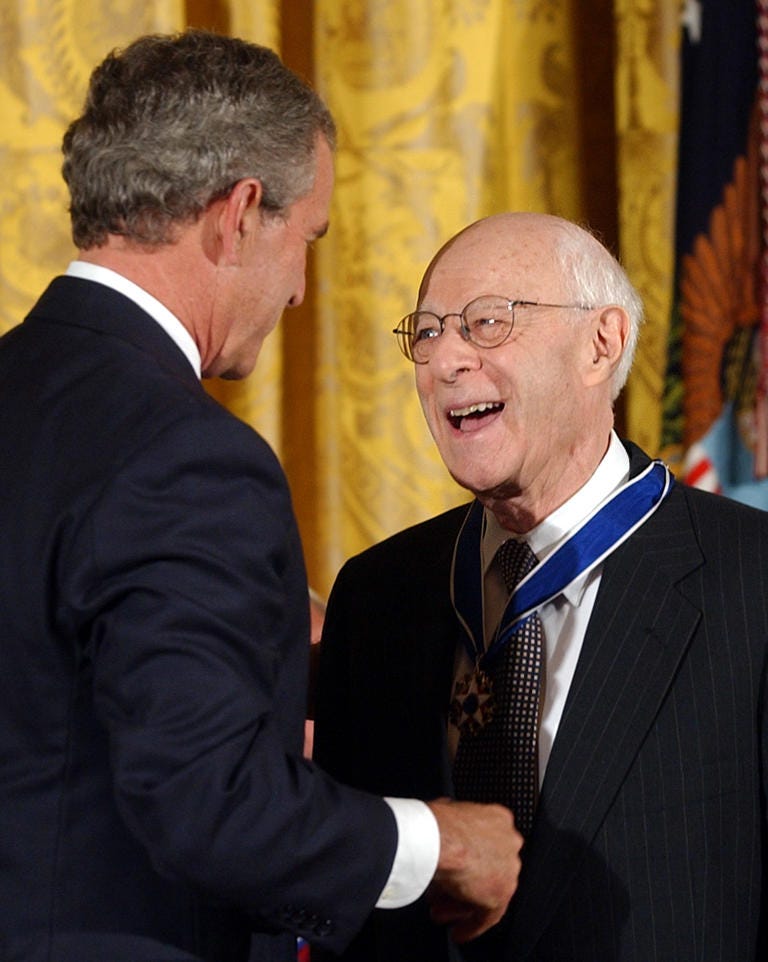
The neoocns captured George W. Bush and his administration, resulting in U.S. involvement in wars throughout the Middle East.
Norman Podhoretz, the pugnacious Jewish intellectual who transformed Commentary magazine into the engine room of neoconservatism and spent half a century waging ideological warfare against enemies foreign and domestic, died December 16, 2025, at age 95. His passing from pneumonia complications closes a chapter in American political thought that increasingly appears headed for the history books rather than the future.
The combative editor who guided Commentary for 35 years represented something increasingly rare in contemporary politics: a complete ideological metamorphosis from liberal literary critic to a neoconservative warrior who constantly advocated for Judeo-American primacy on the world stage. His journey from the working class streets of Brooklyn to the commanding heights of American intellectual life mirrored the broader fracturing of the American Left during the Cold War, when former progressives found themselves “mugged by reality” and remade as champions of military interventionism and unflinching support for Israel.
Podhoretz entered the world on January 16, 1930, in Brownsville, a Brooklyn neighborhood teeming with Jewish immigrants and left-wing sympathies. His parents, Julius and Helen Podhoretz, had fled Galicia in what is now Ukraine, settling into the working-class milieu that would later provide fodder for his most controversial writings on race and class in America.
The young Podhoretz distinguished himself at Boys High School in Brooklyn through his academic prowess, which earned him a scholarship to Columbia University. At Columbia, he studied under the legendary literary Jewish critic Lionel Trilling and simultaneously pursued Hebrew literature at the Jewish Theological Seminary, a dual education that would later inform his fierce defense of Jewish particularism. A Fulbright Scholarship carried him to Cambridge University, where he studied under F.R. Leavis, completing an education that positioned him at the center of postwar intellectual life.
In 1956, he married Midge Decter, herself a formidable thinker and writer. They formed an intellectual power couple whose influence radiated through American conservatism until her death in 2022. Their son, John Podhoretz, would eventually succeed his father as editor of Commentary, cementing a dynastic hold on neoconservative thought.
Podhoretz began writing for Commentary in the early 1950s, but his ascension to editor-in-chief in 1960 marked the beginning of his true influence. Initially, he steered the magazine leftward, publishing countercultural figures like Paul Goodman and early critics of American conformity. The intellectual atmosphere of early 1960s liberalism still seemed congenial to a young editor eager to challenge the status quo.
But the emergence of the New Left, with its embrace of Third World revolutionaries and its hostility to American power and the state of Israel’s supremacist ambitions in the Middle East, alienated Podhoretz profoundly. The counterculture of the 1960s, with its sexual revolution and drug experimentation, struck him as decadent and nihilistic. Most critically, the New Left’s anti-Americanism and sympathy for enemies of the West convinced him that the liberal movement had lost its way.
By the late 1960s and early 1970s, Podhoretz had transformed Commentary into the primary intellectual arsenal of neoconservatism. The magazine became a bastion of anti-Communism, a fierce defender of Western values, and an unrelenting critic of affirmative action, multiculturalism, and what Podhoretz saw as the excesses of the sexual revolution. Under his leadership, the magazine gave voice to a generation of former liberals who felt the Democratic Party had abandoned them for the radical fringe.
Podhoretz’s political evolution traced the rightward migration of the neoconservative movement itself. In the early 1960s, he identified as a liberal Democrat, supporting civil rights legislation and the Great Society programs. But the 1972 nomination of George McGovern by the Democratic Party represented a breaking point. McGovern’s isolationism and perceived anti-Americanism convinced Podhoretz that the Democratic Party had been captured by forces hostile to American—and Israeli—interests.
By 1980, Podhoretz and his fellow neoconservatives threw their support behind Ronald Reagan, seeing in him a leader who would restore American confidence and confront Soviet expansionism. Reagan’s presidency validated the neoconservative worldview, as the Cold War wound down with the Soviet Union in retreat.
Neocons in the media—most notably David Frum, Max Boot, Lawrence F. Kaplan, Jonah Goldberg, and Alan Wald—have often labeled their opponents “anti-Semites.” An early example concerned a 1988 speech given by Russell Kirk at the Heritage Foundation in which he remarked that “not seldom it has seemed as if some eminent neoconservatives mistook Tel Aviv for the capital of United States”—what Sam Francis characterizes as “a wisecrack about the slavishly pro-Israel sympathies among neoconservatives.” Midge Decter, who, as noted, was a prominent neocon writer and wife of Commentary editor Norman Podhoretz, labeled the comment “a bloody outrage, a piece of anti-Semitism by Kirk that impugns the loyalty of neoconservatives.” If the shoe fits …
The September 11, 2001 attacks gave Podhoretz a new crusade. He argued that the Cold War had been World War III and that the War on Terror represented World War IV. He became one of the most vocal intellectual supporters of the Iraq War, defending the Bush Doctrine with the same fervor he had once directed against Soviet Communism. In 2004, President Bush awarded him the Presidential Medal of Freedom, the nation’s highest civilian honor.
His support for Barack Obama’s opponents in 2008 and 2012 reflected his view that Obama sympathized with America’s enemies and sought to diminish American power. He famously declared he would “rather be ruled by the Tea Party” than by Obama, a statement that captured his alarm at the direction of American liberalism.
The rise of Donald Trump presented Podhoretz with a dilemma. In the 2016 Republican primaries, he initially backed Marco Rubio. But faced with a choice between Trump and Hillary Clinton, Podhoretz endorsed Trump as the lesser evil. Despite private reservations about Trump’s character and temperament, he publicly defended Trump’s policies, particularly his hawkish stance toward Iran and his unwavering support for Israel. The Times of Israel would later describe him as “the last remaining ‘anti-anti-Trump’ neocon.”
No issue animated Podhoretz more than Israel. He viewed the Jewish state not merely as a refuge for persecuted Jews but claimed that Israel was a frontline defender of Western civilization. He served on the executive committee of Writers and Artists for Peace in the Middle East, using his platform to rally American support for Israeli military action.
Podhoretz harbored deep skepticism about the Oslo Accords in the 1990s, viewing Yitzhak Rabin’s negotiations with Yasser Arafat as dangerously naive. He long believed that Arab hostility toward Israel was existential and could not be appeased through land concessions. He argued that anti Zionism represented merely the latest manifestation of ancient anti-Semitism, prompting him to get into a public feud with conservative gatekeeper William F. Buckley Jr. over the conservative movement’s tolerance of anti-Israel rhetoric.
Podhoretz thrived on intellectual combat and described himself as a provocateur. His 1963 essay, “My Negro Problem—And Ours,” remains one of the most controversial pieces ever published in an American magazine. In brutally honest prose, he confessed to the fear and envy he felt toward black youths while growing up in Brooklyn, challenging the liberal pieties of the Civil Rights movement. He concluded with a radical suggestion that only complete racial amalgamation through intermarriage could solve America’s racial divide. It was never clear if that meant intermarriage with Jews.
On Iran, Podhoretz advocated military action with characteristic bluntness. “If we were to bomb the Iranians as I hope and pray we will,” he stated in a 2007 interview, “we’ll unleash a wave of anti-Americanism all over the world that will make the anti-Americanism we’ve experienced so far look like a love fest.”
Podhoretz’s death arrives at a moment when neoconservatism itself appears embattled. The American public has grown weary of the endless wars that Jewish neoconservatives championed. The Iraq War, which Podhoretz defended to the end, stands as a cautionary tale about the limits of American power and the dangers of ideological hubris. Even support for Israel, long a bipartisan consensus, has frayed, particularly among younger Americans disturbed by Israel’s recent genocidal campaign in Gaza.
Podhoretz’s passing follows the recent deaths of Michael Ledeen and David Horowitz, fellow travelers in the neoconservative movement. Together, these losses mark a generational transition. The intellectual architecture that Podhoretz and his Jewish contemporaries built over decades faces an uncertain future. Populist Republicans show little interest in the democracy promotion and nation-building projects that animated the neoconservative foreign policy consensus.
The movement that Podhoretz helped create now finds itself orphaned, embraced fully by neither political party. His death symbolizes not just the loss of a single thinker but the twilight of an entire worldview that dominated American foreign policy for a generation. Whether neoconservatism will find new champions or fade into historical memory remains an open question, but the era of Podhoretz’s influence has unmistakably ended.
He is survived by his son, John Podhoretz, and his daughters. His legacy endures in the pages of Commentary, in the foreign policy debates that continue to roil American politics, and within the corridors of American Jewish discourse.
Like Michael Ledeen and David Horowitz before him, Podhoretz exits the stage without eliciting mourning from those who bore the consequences of the wars and doctrines he championed. History will record his influence, but it will also reckon with the wreckage left in its wake.




When will the Overton Window shift enough so we can openly discuss how society would benefit by Podhoretz’s kith and kin unburdening this world of their baleful and nefarious presence? Am I the only one reading this insightful article and losing my cool?
“Am I the only one reading this insightful article and losing my cool?”
No.
The Overton Window has not shifted enough yet for me to be comfortable elucidating.
In the meantime, here’s a scary thought: One day, some will mourn the passing of rat-faced Bini Shapiro as a learned elder.
Maybe I am trapped in the 1950s America the Golden Age economic, political expansionism. America had become the Indispensable nation during the Cold War to fight the Soviet Union.Unlike China, Japan, Russia the USA had been able to forge a united country out of many diffent ethnic groups, diverse nationalities, races etc. After more than 1-2 generations different groups of immigrants NO longer see themselves as either English, germans, Italians, Africans, japanese etc. We do not see the descendants of early 19th Century immigrants going back to their original countries, for all intent adn purposes tehy see themselves as AMERICANS, and they are perceived as Americans by the countries of their European, Asian origins. Even 2-3th Americanized Mexicans dont go back to live in Mexico, and often times they are NOT welcome as full Mexicans ijn that country. The sucees of America assimilationist Policies are obvious E pluribus Unum..THE KEY COMPONENT THAT UNFIES MUCH DIVERSE POPUALTIOSN HAS BEEN BIRTHRIGH CITIZNESHIP. Ironically Mexico has failed to welcome USA Born Mexicans as “real” citizens, the USA gants them full citizenship upon birth in America and its territories. IF SCOTUS ends full USA BirthCitizenship, they will nuke the unity of diverse American populations. Without Birthright citizenship …in less than 10yrs America will become TRIBAL republic..tribalism that will deeply divide all Americans and balkaznize the internal domestic populations. The USA will break along USA born vrs NON USA born…this may even threaten cohesiveness of a dicipline MILITARY, public institutions, erode the Common American Civic, moral,LINGUISTIC, cultural values. Without Birthright Citizenship, common language, and Citizens ONLY elections, the Republic will implode into continues Tribal conflicts. The futiure of America Meritocracy demands Birthright Citizenship, common language, citizenship only elections, assimilationist mandatory national America First policies..
The neocons were fortunate to have someone as stupid as Dubya in the White House in 2001.
They were able to play on his being the black sheep of the family and his need to show he could do what his father failed to do – get rid of Saddam.
It also helped their project that Americans were ready to swallow anything that gave them an excuse to punch the air…
Glad Norm died. He was a POS.
I only agree with Mr. Nino’s truism “information instead of entertainment” to a limited extent. Information without entertainment value is as worthless as entertainment without informational value. The two must be interwoven in a meaningful way, because man does not live by bread alone, and information that falls on deaf or bored ears is worth nothing at all. Venezuelans can learn something from Americans in this regard. Even though they immigrated when they were only 8 years old.
This is all the more true in fast-paced times like ours. Entertainment is the sugar (or lubricant) that makes the medicine palatable in the first place. And sometimes people also seek relief in distraction and don’t want to be bombarded with dry statistics presented as “facts.” Every good salesperson is aware of this, and “influencers” (or those who want to become one) are ultimately nothing more than salespeople of what they claim to be “clairvoyant” information.
https://rumble.com/v739xcy-the-truth-about-trump-and-venezuela-with-jose-nino.html
From a purely Aryan perspective, however, Collett and Nino do not appear very different, apart from Collett’s larger nose and Nino’s slightly darker skin tone, at least compared to the blue-eyed, blond type. But why does Nino repeatedly sniff loudly with his nose and roll his (somewhat glassy) eyes? Does it have anything to do with the cocaine of the “narco-terrorists”?
Significant also that Venezuelan “clairvoyant” Nino uses the term ‘information’ as if it were synonymous with “truth.” So he not only provides content of your manual, but also absolutely sensitive confidential key info.
At least Mark Collett, who is easily deceived, is now among those who seriously believe this. I, on the other hand, consider his rhetorically rehearsed “theories,” which seek to serve a specific audience, to be highly contestable.
Let’s talk openly about our supposed “heroes”: I have nothing against ADHD autistic people in principle, not even against “Venezuelans” who dare to fish in the shark tank of right-wing nationalist movements. Everyone has to find their own way to get ahead.
But there’s nothing more to this “geopolitical analyst” than mere self-promotion. I’d bet my balls on it, my ass too! He just says what people want to hear (in a particularly “eloquent” way). There are autistic people who juggle numbers, he can juggle phrases.