
The Magi and the Star of Bethlehem in Historical Context
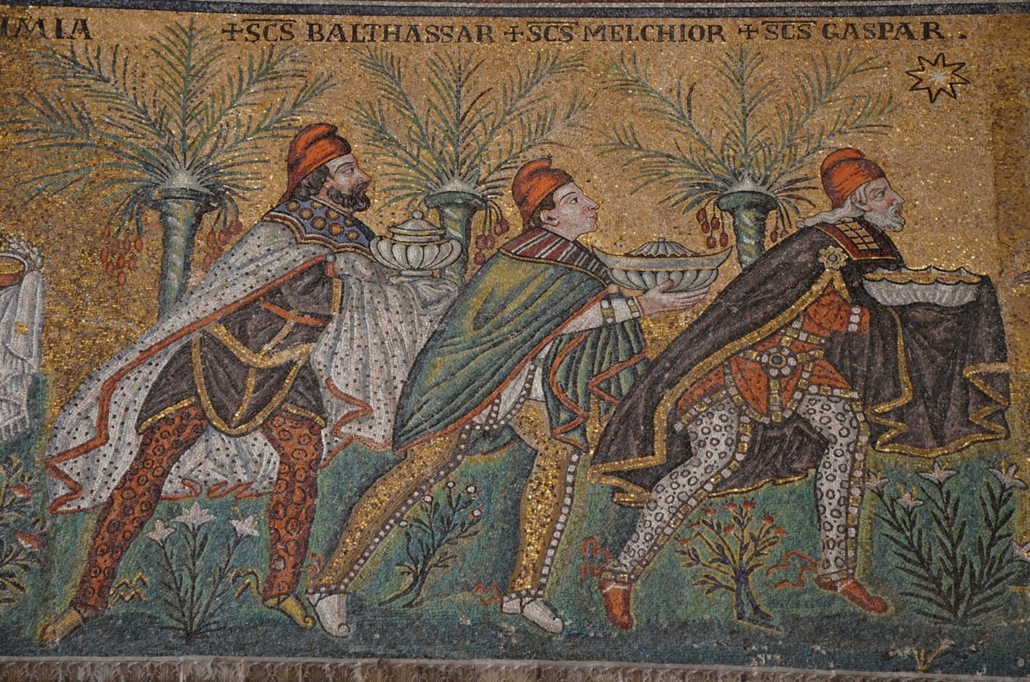 The Three Magi A Byzantine Mosaic, ca. 565, from the Basilica of Sant’Apollinare Nuovo, Ravenna
What Can Be Inferred from What Saint Matthew Tells Us
Everything we’re told about the Magi and the Star of Bethlehem is in Matthew 2: 1-12 :
After Jesus was born in Bethlehem in Judea, during the time of King Herod, Magi from the east came to Jerusalem and asked, “Where is the one who has been born king of the Jews? We saw his star when it rose and have come to worship him.”
When King Herod heard this he was disturbed, and all Jerusalem with him. When he had called together all the people’s chief priests and teachers of the law, he asked them where the Messiah was to be born. “In Bethlehem in Judea,” they replied, “for this is what the prophet has written:
‘But you, Bethlehem, in the land of Judah,
are by no means least among the rulers of Judah;
for out of you will come a ruler
who will shepherd my people Israel.’
Then Herod called the Magi secretly and found out from them the exact time the star had appeared. He sent them to Bethlehem and said, “Go and search carefully for the child. As soon as you find him, report to me, so that I too may go and worship him.”
After they had heard the king, they went on their way, and the star they had seen when it rose went ahead of them until it stopped over the place where the child was. When they saw the star, they were overjoyed. On coming to the house, they saw the child with his mother Mary, and they bowed down and worshiped him. Then they opened their treasures and presented him with gifts of gold, frankincense and myrrh.
And having been warned in a dream not to go back to Herod, they returned to their country by another route.
Just twelve sentences; two hundred and eighty words in English translation. Not a lot.
What does it tell us? What do we know? We are told they were Magi; that they came from the east. They wanted to know where the one who had been born king of the Jews was; they wanted to worship him. They knew the king of the Jews had been born. They had seen his star when it rose. We’re told that King Herod and Jerusalem were disturbed at the question.
The chief priests and teachers of the law told the Magi that a prophet had said he would be born in Bethlehem. Herod then asked for and was given the exact time the star had appeared, the likely date of his birth. The story proceeds as the Magi move on to Bethlehem. Facts. More facts. Simple facts in chronological order.
We are given a narrative that is complete enough in itself to satisfy and move the Gospel along. But it’s a story that can become much more when it’s expanded into its proper historical and political context. And facts that are implicit in the text get figured in.
In the Western World ancient history pretty much begins and ends with Greece and Rome. We study the Classics. Our inheritance from the Greek and Roman Classical world influences our culture, our laws and our lives in countless ways. Almost everything we value from the ancient world is Greek or Roman.
Yes, we do know something about the rest of the world. Yes, it all began in Egypt and in Sumer in Mesopotamia. Yes, the Greeks fought and defeated Persians. But when you read Herodotus, it’s really hard to figure out where things are happening. Where is Lydia? His book has no maps. Then Alexander and the Macedonians finished the Persians off and got all the way to India. In China they developed silk production and invented the stirrup for getting up on horses as well as tea drinking. But Parthia and the Parthian Empire, where was that?
And who were the Magi? We can identify magi; we have Google and Wikipedia. A Magus, that’s the singular of Magi, was a Persian Zoroastrian priest whose principal job was to take care of the sacred fire in the fire temple. They wore a mask to protect the fire from pollution. From spit. They were magicians—magi is where the word magic comes from. They were also alchemists and astrologers. It’s likely that our three Magi were especially skilled in astrology. Astrology was an honored science in the ancient world and Persians had a reputation for being the ancient world’s best astrologers. They probably were. We know almost nothing about Persian astrology other than that it was Persian magi who were able to identify the Star of Bethlehem. There were learned astrologers in Egypt and Greece and India who seem to have missed the event.
Our Magi were almost certainly employed by the Parthian king of kings or some other mighty one of the empire as court astrologers in the Parthians’ capital city of Ctesiphon on the Tigris in Mesopotamia. Astrologers only worked for the rich and powerful. And their eventual role as part of an embassy to King Herod in Jerusalem implies that their work was done close to the center of power, probably in Ctesiphon.
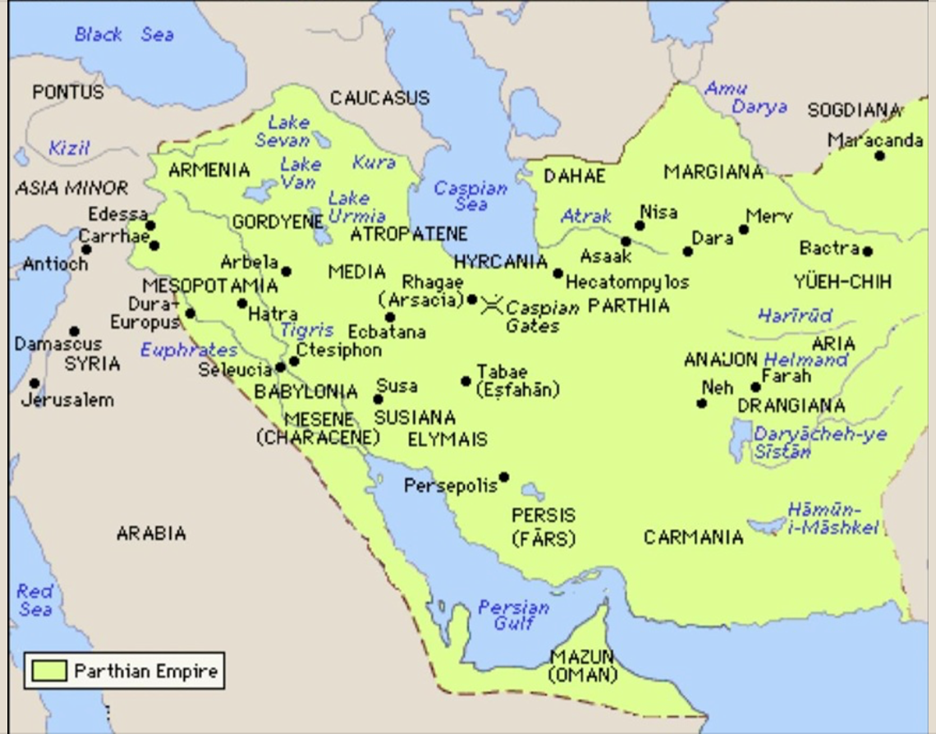 Source: The Circle of Ancient Iranian Studies (CAIS) ©1998
The Magi came to Jerusalem “from the east” and the Parthians who sat upon the Silk Road from great China for over 300 years controlled virtually all of the territory just east of Syria and Judea, including Persia where most magi were resident. Parthians were a variety of hard-riding and straight-shooting Iranians—effective cavalry archers, bowmen on horseback. Their empire was a loosely organized monarchy run by its military elite. It’s likely that the Magi were court astrologers who were employed to use their skills for the state, primarily to predict the weather and incidentally to look for omens and portents in the sky. The Farmers’ Almanac still uses astrology to predict the weather for the year ahead.
They had seen his star rising in the east. The Star of Bethlehem had to be a riveting portent, but it was only apparent to astrologers—the Persian ones. I’m certain it was the conjunction of the planet of kingship, Jupiter, aligned with the very bright stars Spica and Arcturus rising, leaving the womb area of the constellation Virgo, to parallel the Virgin Birth on earth, the birth of the Messiah that had been prophesied by Isaiah (7: 14) 800 years before.
All this took place to fulfill what the Lord had spoken by the prophet: “Behold, the virgin shall conceive and bear a son, and they shall call his name Immanuel” (which means, God with us). (Matthew 1: 22-23)
It happened at 4:34 am on October 10th, 1 BC. It was a virgin birth in the stars. And only trained astrologers like the Magi who were used to interpreting symbols in the heavens—and no one else—would have been aware of what was happening in the sky that morning. The Magi asked Herod, “Where is the one who has been born?” Whatever the portent was that the Magi saw had to clearly indicate that the Messiah was here—was “born.” They had told their royal Parthian masters about the newborn king of the Jews and had been sent with treasures as gifts as an embassy on a diplomatic fact-finding, polite spying expedition.
It’s interesting that Isaiah (60: 6) had prophesied that gold and incense would be brought as gifts to the newborn. It seems the Magi knew something about Hebrew prophecies. And the Magi’s masters, of course, were willing to supply the prophesied treasures and bear the not unsubstantial expense of the journey as well. It’s 750 miles from Ctesiphon to Jerusalem. They needed camels and horses, pack animals for supplies, guards on horseback for their treasure, and a small army of servants to erect their tents, cook their meals, wash their clothes, tend their encampments and care for their animals. And of course they needed official sponsorship to move through their masters’ territory freely and negotiate the border crossing at Dura-Europos. At 20 to 30 miles a day—difficult but not impossible along established routes with a train of pack animals—it would take at least 30 or even 40 days to make the trip from Ctesiphon to Jerusalem, first north up the valley of the Euphrates, then into Syria across the desert to Damascus and then down into Galilee toward Jerusalem and Herod’s court. The embassy was a major enterprise. Just the willingness of the Magi’s masters to undertake it was an indication of how important the Messiah’s arrival was for the Parthians. The changes the Messiah would bring would affect all the world’s nations and not just the Jews. Everyone in the East knew about the eventual arrival of the Messiah. Daniel, the most important source for the timing of the Messiah’s triumphant Palm Sunday entry into Jerusalem and his subsequent death—and inferentially of the timing of his now immanent arrival 33 or so years before that death—was honored more as a prophet among the Persians than among the Hebrews.
The Parthians’ leadership was interested in the affairs of Judea, their restive neighbor to the west. The Parthians invaded Syria in 40 BC. They captured the whole of the Middle East, except for the well-fortified Phoenician island city of Tyre. Tyre with its strategically located harbor served as a base for the swift reconquest of the region by Mark Antony and the Romans. Antigonus Mattathias had been installed by the Parthians as King of Judea. He was High Priest as well. Antigonus was one of the family of Hasmonean kings, descendants of the family of Judas Maccabeus, that had ruled Judea rebelling against the Seleucid Empire, the empire that preceded the Parthians. The Jews were delighted to have the priestly Hasmoneans back as their rulers again. Roman rule had been harsh and taxation was heavy. But their brief period of autonomy under Parthian protection ended when Mark Antony reconquered Syria and installed Herod the Great as King of Judea in 37 BC. Antigonus Mattathias the Judean king the Parthians had helped install was captured when Jerusalem fell and he was murdered. His supporters fled for their lives with what was left of the Parthian army.
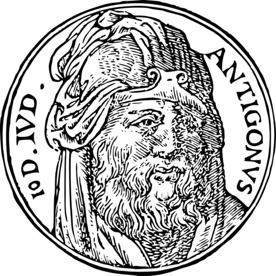
Antigonus Mattathias
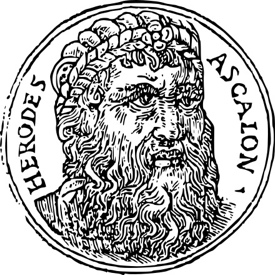
Herod the Great
The Parthians had been rulers in Syria and Judea just a generation before. The arrival of the Messiah and the changes he might bring could provide opportunities for new alliances, even for reconquest. The Magi were sent to survey the situation.
We’ve mentioned how good the Magi were as astrologers. It seems that only our Persian astrologers were able to discern that a virgin birth was occurring in the sky. Their Greek, Hindu and Egyptian astrologer contemporaries missed it. Even in faraway China where the astrological system was different, but the level of observation and study of the night sky was equally intense, no one noticed. Jupiter did pass through the constellation Virgo every 20 years. Why was it so special in the year 1 BC?
In fact, our Persian astrologers were uniquely situated. Unlike others astrologers the Magi were aware of Jewish prophesy. They knew the prophesied coming of the Jewish Messiah was immanent. They lived among the Jews. There were large well-regarded Jewish minorities in Ctesiphon and in neighboring densely populated Babylonia. Jews came with Jewish prophesy. The Jews did have impressive prophets. And the coming of a Messiah, a great king, was at the heart of the Hebrews’ prophetic tradition. Jews were an important and well-integrated community. The Magi had Jewish scriptural scholars as neighbors. Mesopotamia was the most densely populated and richest and most productive province of their empire. The great city of Babylon was only 40 miles away. Babylon had a large Jewish population; Ctesiphon did as well. There were more Jews in Babylon than in Jerusalem.
It’s safe to say that wherever there were Jews there were Jewish scholars studying scripture. It’s easy to imagine a scholarly Persian astrologer asking a Jewish scholar neighbor about “possibly” any “other” interesting prophetic traditions the Jews might have—all of the East of course was aware of the prophesies made to Daniel regarding the fate of the Messiah. And it’s an easy stretch to imagine a scholar astrologer being told by his Jewish scholar neighbor, when he asked, about Isaiah’s prophesy of a virgin birth and of proffered gifts of gold and incense. Frankincense and myrrh are both fragrant tree resins that can be cooked and are classified as incense. It’s interesting that the Gifts of the Magi fulfilled Isaiah’s 800-year-old prophesy —the Magi knew what to bring.
Yes, we can assume that our Magi, if they chose, could be well informed about Hebrew prophesy and about Greek astrology. The educated elite in the Hellenized world was multicultural, particularly so in the Parthian Empire. One language, Aramaic, was spoken and understood everywhere. It was the language that Christ would grow up to speak in far-away Galilee. And Alexander’s conquest had left Greek-speaking communities all over the Parthian world; Greek settlements stretched as far as India. The Magi almost certainly had some knowledge about other astrological traditions besides their own, particularly about Greek astrology. They had Greek astrologer neighbors just across the river in Seleucia, the Greek-speaking capital of the empire that preceded the Parthians’. And they lived in Mesopotamia where astrology had its beginning.
The Magi saw his star rising in the east. In the ten years or so preceding the birth of Christ there had been many impressive celestial events in the eastern sky. Jupiter, the planet of kingship, the planet that would rule the coming Age of Pisces, figured in many of them.
In 7 BC there was a triple conjunction of Jupiter and Saturn with three retreats and hits between the planets occurring one after another. Jupiter-Saturn conjunctions happen about every 20 years and traditionally they heralded societal shifts. In a conjunction two planets arrive together at the same degree on the ecliptic. Astrologers know when there’s a conjunction but the planets are often separated by a substantial space. Such was the case in 7 BC. Jupiter and Saturn didn’t really look like they were together in a conjunction at all.
A very rare and unusual occultation event occurred in the years before the birth of Christ in March and April of 6 BC. The planet Jupiter was completely covered over and obscured by the Moon twice. It was occulted by two successive passages of the moon through the sky in two successive months. Both of the occultations took place when Jupiter the planet of kingship was in Aries, the sign of the Judean kingdom. But the event happened in the daylight hours and only astrologers knew that it was happening. What they made of it is anyone’s guess. On its face it seems like a portent full of meaning, something truly revelatory. But it’s difficult to make anything out of the double occultation. It certainly doesn’t seem to portend the birth of a king.
There was a spectacular close conjunction of Jupiter and Venus a few hours after sunset on June 17, 2 BC. That once in multiple millennia “touching” conjunction was the most noteworthy of all the planet Jupiter celestial events leading up to our October 10th, 1 BC, Jupiter “virgin birth” Star of Bethlehem. This singular event really ought to have been important as a portent in some way, even though the astrologers hadn’t quite discerned how it might relate to the birth of a Messiah and King of the Jews. It happened in the kingly constellation Leo and was only a few degrees away from Regulus, the royal star. Meaningful? Maybe. Maybe it just meant “get ready” another big portent in the sky was coming soon. Could Herod himself have seen the conjunction in the night sky two years before? How could he have missed seeing it? Would he perhaps have asked the Magi about it? Herod’s seeing the great conjunction in 2 BC may have been the reason he had the two year-old boys killed in Bethlehem. Just in case the touching conjunction—in some unknown way—was a sign that the Messiah had arrived.
We know there were comets visible around the time of Christ’s birth: one in 14 BC and another in 5 BC. The Chinese have been recording the appearance of comets, novas and supernovas for several millennia. Halley’s Comet returned for the visit to our Solar System it makes every 72-80 years in 14 BC. Giotto’s painted a recognizable Halley’s Comet as the Star of Bethlehem in his 1305 Adoration of the Magi. He’d seen the Comet’s return in 1301. The comet of 5 BC was faint and slow-moving. It appeared first in the sign of Capricorn and took until 4 BC to sweep around the sun and disappear. There was a nova, apparently not too bright and noticed only by the Chinese and Koreans in 5 BC. Nothing about these celestial events indicated that a king was going to be born. Comets were often seen as bad omens; under certain circumstance they meant that a king was going to die.
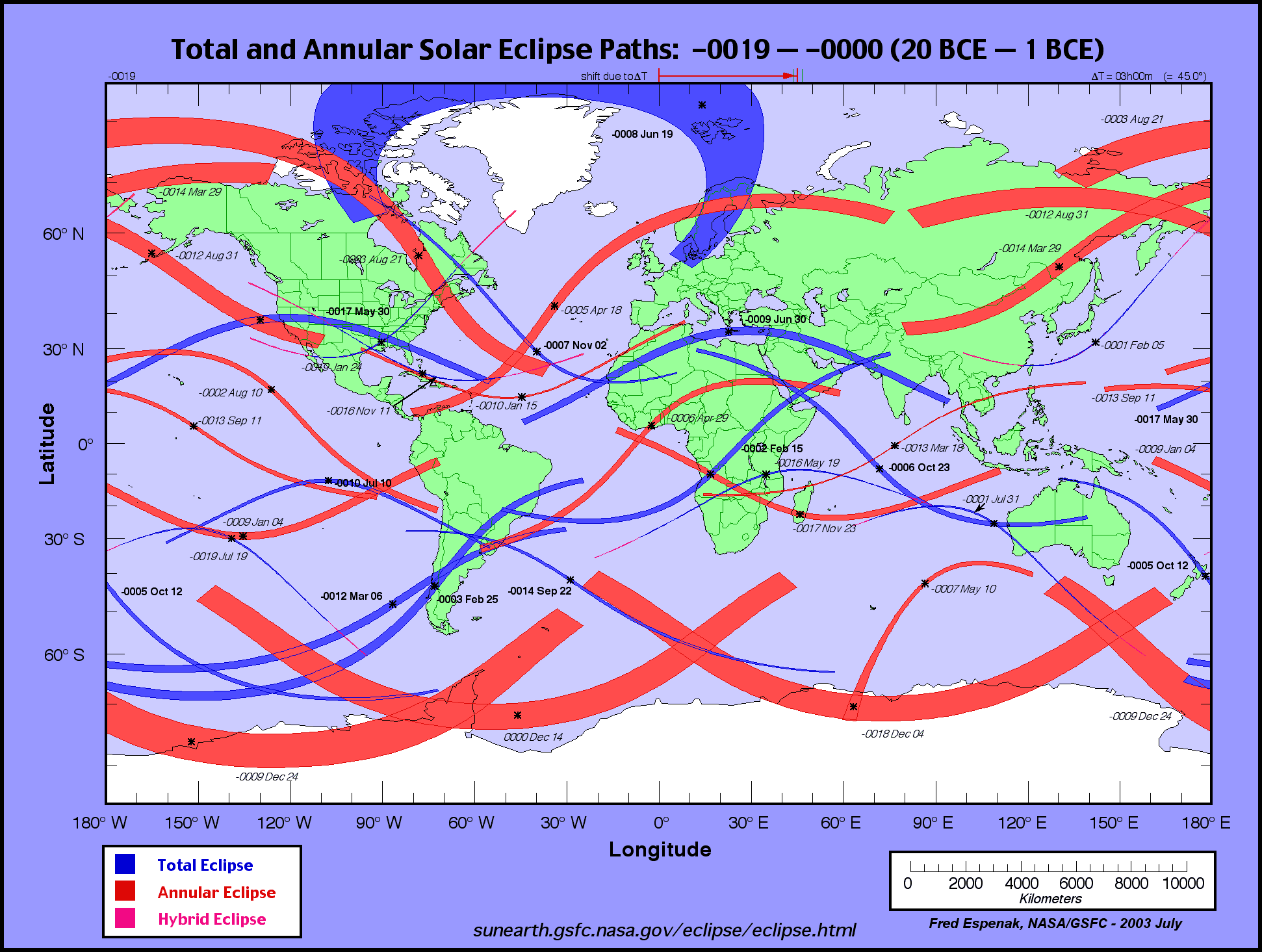
Eclipses are notable mostly for the effect they have while they are happening. People and animals get agitated when the sun goes dark. Blood on the moon can be alarming. One Solar Eclipse does stand out. It happened on June 30, 9 BC. Its path of total eclipse tracked across North Africa over the Mediterranean and the island of Cyprus; at the middle of its path it totally darkened the sky over Judea and then proceeded into Persia and the Indian Subcontinent and petered out over the Bay of Bengal, east of India. A spectacular event, a sign of something, but what? Although its darkest total eclipse moments, midway in its path, happened over Judea there was really no way of knowing that at the time if you were a resident of darkened Jerusalem or darkening Ctesiphon. The tracks of eclipses on the map were generated by a computer program developed by NASA at the turn of the 21st century. Although it happened at the time we’re concerned with, in our region of interest and was a dramatic and universally visible event, it doesn’t seem to have created much of a stir other than when it was happening. It is alarming when everything suddenly turns dark. But it doesn’t seem to relate in any way to the birth of a king in Judea.
The Magi had to have known about Isaiah and his prophesies. They knew about gold, frankincense and myrrh. They knew about the Virgin Birth as well. They knew that the virgin birth in the stars they saw in the eastern sky heralded the Messiah’s prophesied Virgin Birth.
It was a celestial event—a conjunction—with elements that fit within all the scriptural parameters perfectly; a conjunction of the planet of kingship Jupiter with the bright and benefic stars Spica and Arcturus just recently become visible in the eastern sky before dawn and positioned conjunct and just separating from the star Heze (ζ -Virginis), with Jupiter leaving the womb area of the constellation Virgo, in a downward birthing direction in the early morning hours of 10 October, 1 BC—a virgin birth in the sky to parallel the one on earth.
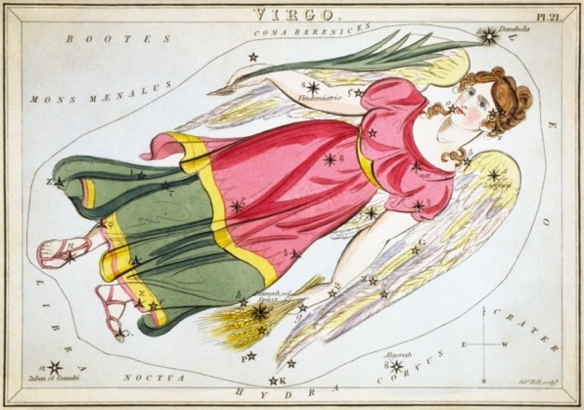
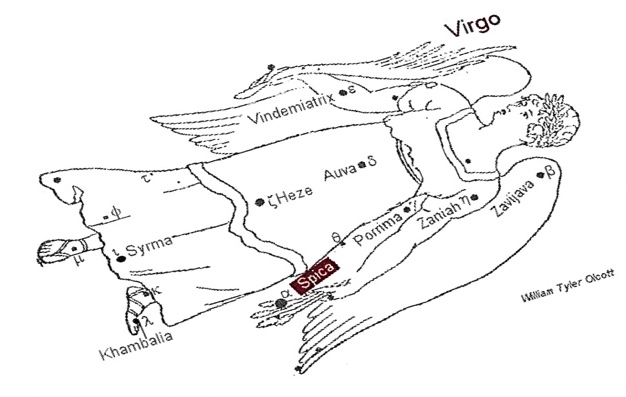
A virgin birth that had been prophesied by Isaiah (7: 14) 800 years before. And a virgin birth only astrologers who organized their reality with archetypes and symbolic entities were capable of seeing in the heavens. The Magi lived in a symbolic universe—a universe alive with meaning. Astrologers observed the planets, conceived as complex archetypes, moving through a heavens divided into regions defined by symbol-rich constellations and discerned patterns on earth that paralleled those movements in the sky.
Lots of moderns suspect that Jupiter was the Star of Bethlehem. But they see Jupiter the way astronomers do. Astronomy is a science and like all the sciences it’s reductive. The planet Jupiter that astronomers see and that science-oriented moderns perceive is not the expansive, great and powerful planet of kings and kingship positioned in the birth position in the virginal constellation Virgo that astrologers could see. Astronomers and astrologers live in different realities. The Magi were astrologers.
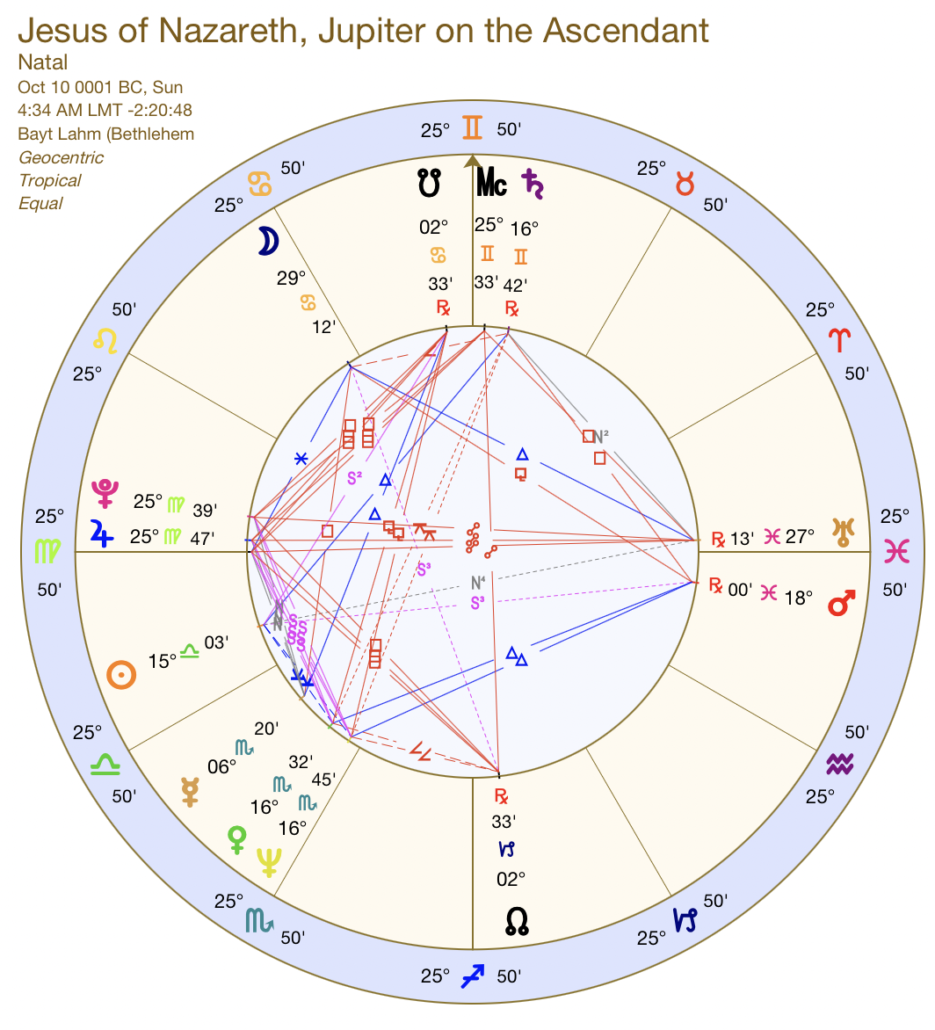
Here is a 21st-century astrological birth chart for Christ. It’s a frozen image of all the planetary position in their relationship to one another at the exact moment Christ was born. Every symbol has a meaning; every relationship is tracked. The chart the Magi put together looked very different—probably conceived as a crude rectangle with twelve triangular divisions. There were no precise times in minutes and seconds or locations of planets given in exact degrees and minutes. The Magi kept the image—in their heads or scratched on a tablet—of the stars and planets in their relationship to one another among the constellations “fixed” at a precise moment in time. The ancient world had no concept of time as moments identified as minutes and seconds. There were no clocks. The only pinpointing of time that was possible was achieved by fixing the planetary positions for a moment in an astrological chart. A fixing of the planets that would not be in the same position relative to one another again for millennia, if ever, was really the only way to define a particular moment. And that moment that would change everything, the moment that the world had been waiting for—the birth of the Messiah, the king of the Jews,—had arrived. The Magi got up on their camels and were off to Jerusalem.
Let’s hypothesize about what the end of their journey from Ctesiphon to Jerusalem on the Magi’s polite spying expedition was like. I think it’s possible to reconstruct a scenario for their arrival in Jerusalem and Bethlehem that fits the Gospel narrative precisely.
They came directly to Jerusalem to the Court of Herod, the King of Judea—tradition has it in early January—to find out “where.”
. . . Where is the one who has been born king of the Jews? We saw his star when it rose and have come to worship him. (Matthew 2: 2)
Was there an expectation that the child had been born in Herod’s palace, a legitimate heir? Yes, it was a likely expectation that the Magi might have entertained. They did come to the palace first. But Herod did not know the answer to their question.
When King Herod heard this he was disturbed, and all Jerusalem with him. When he had called together all the people’s chief priests and teachers of the law, he asked them where the Messiah was to be born. “In Bethlehem in Judea,” they replied “for this is what the prophet has written:
‘But you, Bethlehem, in the land of Judah,
are by no means least among the rulers of Judah;
for out of you will come a ruler
who will shepherd my people Israel.’
Then Herod called the Magi secretly and found out from them the exact time the star had appeared. He sent them to Bethlehem and said, “Go and search carefully for the child. As soon as you find him, report to me, so that I too may go and worship him.” (Matthew 2: 3-8)
The secrecy was a clear indication that Herod was planning something nefarious, something he was ashamed of and didn’t want the world to know about—the slaughter of potential rivals for his throne. Herod was a wicked king.
Bethlehem is only six miles south of Jerusalem. The Magi and their small army of servants and guards with camels, horses and pack animals set out as soon as they could. Perhaps it took them a day to get themselves together. They had no address in the town, however. Did they expect guidance? Astrological guidance? They were astrologers. Something just might happen in the stars that would guide them to where they were going. When they got there they decided it would be provident to wait outside the town. The arrival of the Magi and their entourage would overwhelm the little town; so they spent the night camped out overlooking Bethlehem to wait for possible guidance. If guidance did not come they could get themselves together to make inquiries in the town when morning came.
. . . and the star they had seen when it rose went ahead of them until it stopped over the place where the child was. When they saw the star, they were overjoyed. (Matthew 2: 9-10)
It’s important to note that “the star [the Magi] had seen when it rose,” Jupiter, the Star of Bethlehem, didn’t go “ahead of them” until they left Jerusalem and were approaching Bethlehem. It rose up just before midnight, and was there, in the January sky over Bethlehem, as they sat watching, camped out outside the town. “When they saw the star they were overjoyed.” They watched as “the star they had seen when it rose” familiar Jupiter—”went ahead of them” —rose up and moved across the sky all night until the morning came. The glow of the rising sun began to be apparent at the eastern horizon. The sky began to brighten. Jupiter was still clearly visible over the town at first, but as the light in the east grew brighter and brighter all the stars began to dim. Soon even the brightest fixed stars faded and disappeared, finally Jupiter. Jupiter, the brightest star in the sky that morning, still shining faintly, was the last star to fade and become invisible in the light. It “stopped” [and faded away] over “the place” where Jesus and Joseph and Mary were staying.
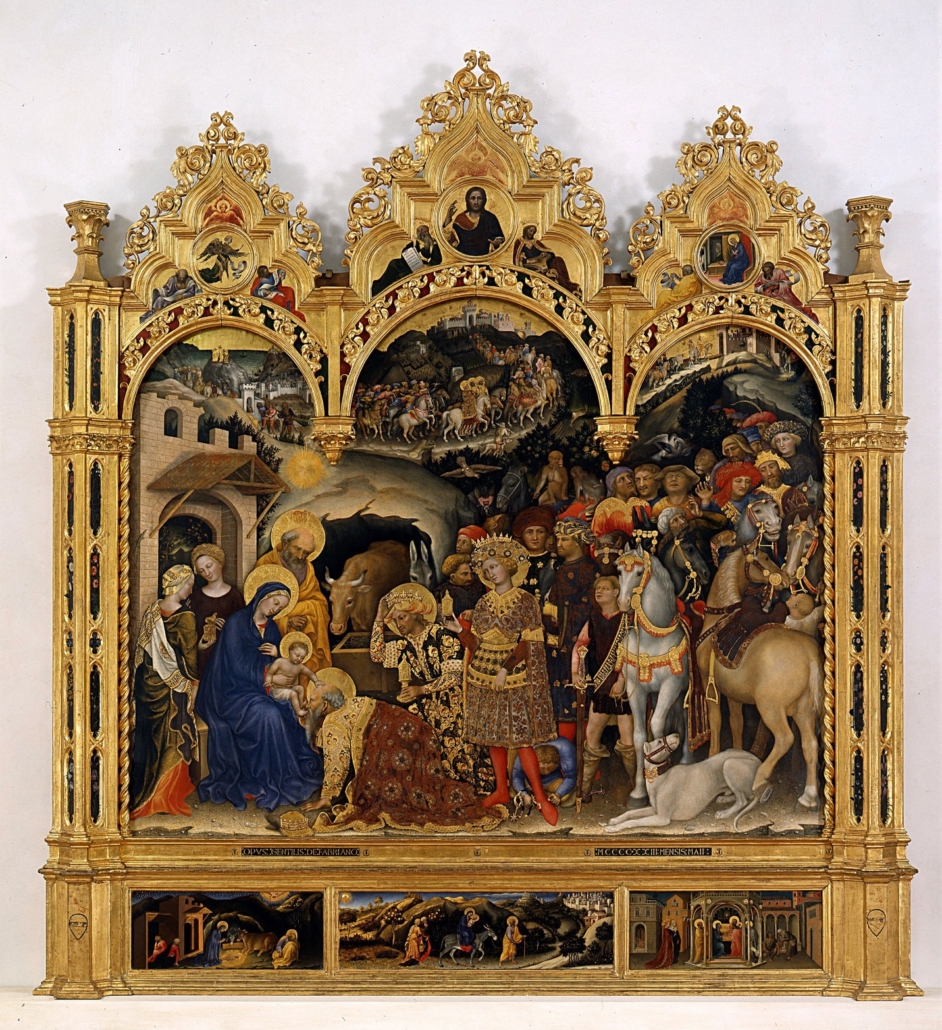 Gentile da Fabriano The Adoration of the Magi, Uffizi Gallery, Florence
The Magi went into the town to the house Jupiter had stopped over, found Joseph, Mary and the Child and presented their gifts of “gold, frankincense and myrrh,” the gifts mentioned by the Prophet Isaiah, and ‘worshiped” the newborn king of the Jews, the Messiah.
And having been warned in a dream not to go back to Herod, they returned to their country by another route. (Matthew 2: 12)
Herod found out that they were gone after a few days. Joseph had also been warned and he and Mary and Jesus were on their way to Egypt by then with the Magi’s gold to ease their way.
There were probably fewer than twenty young boys of the right age in the little town of Bethlehem for Herod’s soldiers to gather together for the Slaughter of the Innocents. That had to have taken only a day.
Why did Herod have all the children born within the last two years killed when he certainly had been told the “exact time” by the Magi, when he asked them, They told Herod that the Christ child had been born no more than a few months before? Why did Herod kill the two year-olds? I think it was because the Magi equivocated, as careful astrologers often do. Perhaps it was only one Magus of the three.
Yes, Christ was almost certainly born on October 10th, when Jupiter the Star of Bethlehem was conjunct the ascendant as it rose, between the bright stars Spica and Arcturus, positioned in the region of the womb of the constellation Virgo—a king “the Messiah” in the womb of a virgin, at the point of birth, leaving the womb of the virgin. With rare planet to fixed star conjunctions, Regulus the royal star with the moon, Pollux the brightest star in Gemini at the mid-Heaven and Sirius the brightest of all the stars and the planet Saturn also aligned in strikingly visible conjunctions in the sky above. But, yes, maybe, just possibly, he could have been born any time after that once-in-multiple-millennia great Jupiter Venus conjunction two years before. It was a spectacular celestial event. An omen? An omen of what, though? It was a possibility. Not very likely, but possible.
Astrologers equivocate. They can be maddeningly vague—hedging, allowing the faint possibility of another alternative. And that’s why Herod killed the two year-olds. Just to be sure.
 RAYMOND GILL is an 88-year-old mundane astrologer. He worked as a Russian linguist in the United States Air Force and as an editor of history books at the Macmillan Company and CBS Publishing. He taught art at Covenant House and in New York City public schools.








Leave a Reply
Want to join the discussion?Feel free to contribute!