
Race and Social Justice in South Park
South Park, begun in 1997 by writer-directors Trey Parker and Matt Stone, is one of the most successful and highly acclaimed sitcom series today. In 1999 the creators released a popular South Park feature film, and there have been a variety of video games based on the series. It is worth examining the social and political messages of such a major cultural phenomenon, particularly around what are becoming the most prominent issues today – those of race and “social justice.”
The most recent South Park games are two similar computer RPGs, developed under the creative control of Parker and Stone and released in 2014 and 2017. Both were very well-received, and the most recent title, South Park: The Fractured But Whole, is worth analyzing as the latest major installment in the South Park franchise.
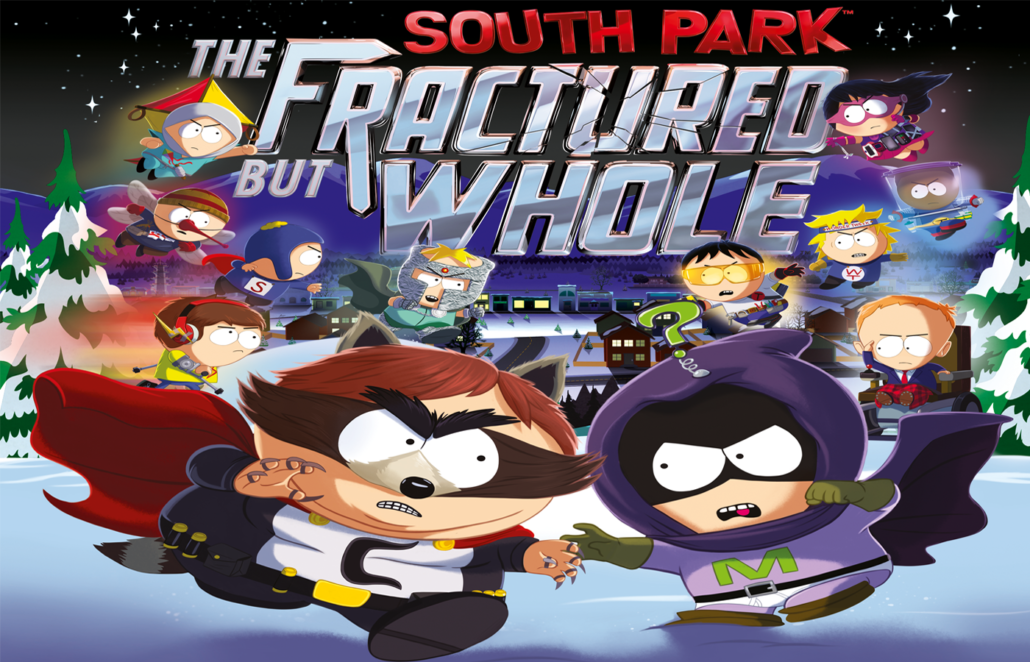
The Fractured But Whole, like its predecessor The Stick of Truth, takes place in the town of South Park and features characters from the television series. Lampooning narcissism is one one of the main themes of the show, and one of the main characters is Eric Cartman, an obese and manipulative bully with a grandiose view of himself. In the latest game, Cartman positions himself as a daring crimefighter called The Coon, who along with his young superhero allies aims to rescue a missing cat named Scrambles. The hero, known simply as New Kid, completes a wide variety of quests while fighting alternately alongside Cartman’s team and a rival group of superheroes.
Race becomes an issue at the very beginning of the game when the player chooses their difficulty level. This is indicated by skin color; choosing a darker color means you will acquire less money and some characters will speak to you differently. However, the most important aspect of game difficulty is combat, and the player can change this independently at any point in the game. The player can also change his skin tone at will after a certain point in the story. Race is thus not as much of a handicap as it initially appears; it is possible that this was a hint by the developers about the exaggerated outrage over “racism” in society.
One of the few major Black characters in the television series or the game goes by the name of Token Black. The name is a reference to “tokenism,” the practice of including a few non-Whites to superficially demonstrate an “inclusive” spirit. The term is generally used to criticize Whites for not making sufficient efforts at racial integration in the eyes of minority activists. Token is surely a token in this sense; he is the only Black student at South Park Elementary and shows no apparent cultural differences with the White students. He speaks flawless white English, has no criminal tendencies, and his family is wealthier than any of the families of his White peers. To their credit, the producers do not imply that such assimilation into polite society is the norm for Blacks; there are few other Black characters in the game, and they include a prostitute/stripper and a pimp.
Unfortunately, the game reflects the stereotype that police are racially biased against non-Whites, arresting or attacking them for little or no reason. The player takes an assignment from the police to break into Token’s house and assault his father, as they falsely allege he is a drug kingpin. In one room in the police station, the player can see a bar graph on the wall depicting categories of arrests. Most of them are for petty offenses, another reads “racial profiling,” and the largest bar is for “no reason.”
These “racists” attempt to deny at least twice that they are prejudiced, only to be proven wrong by immediate circumstances. At one point the lead detective Sergeant Yates attempts to explain to the children that although they may be hearing things in the news about police being “racist and bigoted,” they have nothing to worry about. He is interrupted by another officer yelling “spook” and firing his weapon, barely missing Token.
In another scene the children come upon a cult devoted to Shub-Niggurath, a horrible deity from H. P. Lovecraft’s short stories. The cult members are policemen, led by Sergeant Yates. Yates denies being “racist,” even trying to deny that H. P. Lovecraft was racist before another cultist corrects him, but admits that they have been feeding the Blacks they arrest to the hungry creature. They explain that she only likes dark meat. The only way to defeat the monster is to feed the White officers to her; this “anti-racist” act makes her ill to the point of death.
To its credit, the game does mock social justice activists in the character of PC Principal. The new principal of South Park Elementary was introduced in the television series as a macho bodybuilder who verbally and physically abuses students while reciting social justice dogma. He is part of a social justice fraternity whose members drink heavily and engage in casual sex; it is suggested that this is the true aim behind their “woke” rhetoric.
The player in The Fractured But Whole receives training from PC Principal on microaggressions – seemingly innocuous statements which are creatively misinterpreted as “bigoted” insults. The principal gives the example of “Mr. Yamashiro is actually a good driver;” it implies that other Asian Americans are not good drivers, and “the use of Mr. is offensive to persons of third gender.” PC Principal trains the hero to respond to microaggressions in combat with an extra attack, which he refers to as “[doing] PC work.” This reinforces the idea that “social justice” is only a rationalization for antisocial impulses.
Social justice fanaticism is also lampooned when it comes to transgenderism. In one scene, the hero goes to the guidance counselor’s office and is given the option to choose his gender. When he indicates that he identifies with the gender he was born with, Mr. Mackey feels the need to call his parents. The counselor is obviously concerned and informs them that “you don’t always need to go with the first hand you’re dealt.”
Matt Stone’s mother is Jewish, which gives South Park more leeway to mock Jews than gentiles would have. Jews were portrayed in the earlier 2014 game as a separate class of hero, alongside fighter, mage and thief. The Jew in this context parodies a common mentality among real-world Jews – when they are seriously injured or suffering from various temporary negative conditions in combat, their attacks become more powerful. The implication is that they gain strength from a sense of victimization, and even that they depend on victimhood to prevail in conflict.
Kyle Broflovski, one of the main characters, is Jewish and has a stereotypically hysterical mother named Sheila. In the present game, he is unhappy to learn that his even more Jewish cousin Kyle Schwartz is visiting. Schwartz has terrible eyesight along with numerous imagined health problems and is constantly complaining in a very unpleasant tone of voice. After being defeated in two battles, he promises to help the hero and his associates, and he repeatedly appears in combat, but always finds a reason to flee almost immediately.
Mexicans are used in combat in a manner which emphasizes that they are hapless servants exploited by unfeeling Whites. Butters takes on the persona of the evil Professor Chaos and the hero is required to defeat both him and his accomplice General Disarray in battle. He begins one such encounter in an enormous “machine” constructed out of Mexicans wrapped in tinfoil. Other battles involve two Mexicans in a cardboard box serving as an unconvincing “robot,” or simply unenthusiastic “minions” who comment that they are only doing this for the money. In either case they speak largely in Spanish to emphasize their alienation from their employer and the wider society. The minions are obviously expendable; Professor Chaos can summon an unlimited number of them until he himself is defeated.
Of course, this characterization does not necessarily mean sympathy for further immigration from Mexico; if the immigrants are in such an uncomfortable condition here, it is no great kindness to let more of them in. But both the show and the game mock critics of immigration as ignorant “rednecks” who cannot even properly pronounce the phrase “they took our jobs.” A gang of such people attack the hero when they find that Butters, at that point his ally, has been employing immigrant minions.
The game makes an interesting point about the paranoia and denial of personal responsibility which is so rampant today, both among social justice activists and in the wider society. Cartman directs a conspiracy to add cat urine, which in the South Park universe has mind-altering qualities, to the local supplies of drugs and alcohol. His intention is to increase crime in the city so that he can blame this on the current mayor and be elected mayor himself. The hero’s parents, who use marijuana and alcohol heavily, are constantly in conflict with each other throughout the game, for which they partly blame one another’s substance abuse. But at the end of the story, Cartman’s plot is revealed and the townspeople resolve to get “clean drugs and alcohol from the next town over,” after which the feuding parents reconcile. The sarcastic implication is that it is not drug and alcohol abuse which cause problems in people’s lives, nor the unhealthy mindset behind these behaviors, but simply a malicious conspiracy beyond their control.
Although it deserves credit for criticizing the contemporary extremes of social justice fanaticism, the latest South Park game does not entirely reject the mindset behind it. It supports the “woke” stereotype that Whites – both police and clownish “redneck” hooligans – have a mindless hatred for non-Whites and immigrants. Parker and Stone have described their views as “middle of the road,” and if this is indeed the midpoint in the political spectrum, we have a long way to go before a sane view on race becomes the norm.




“…we have a long way to go before a sane view on race becomes the norm.”
Does anyone see any solution other than a complete separation followed by an official divorce?
Anything else at this point is simply going to be more of the same.
The learned helplessness of Battered White Syndrome.
The jewmasters are not going to let the White Christian sheeple majorities acquire ownership/control/sovereignty ( ie. dominion ) of the sheeple breeding pastures .
Hence , the USA Guerilla Civil War has just recently left out from the starting gate .
In other words, the game is both things to both sides: good for sales. Once on a roll, we’ll be paying personally once again for being incrementally re-educated against our own interests through miniscule, imperceptible changes. Identical to the overall Game !
And not through the medium of music, literature or art, but through the medium of games and the comics. We have been reduced to crane our necks to look upward, to get a glimpse of the top of the gutter.
The infantilization of American Culture ( if that’s quite the right word ) continues apace.