
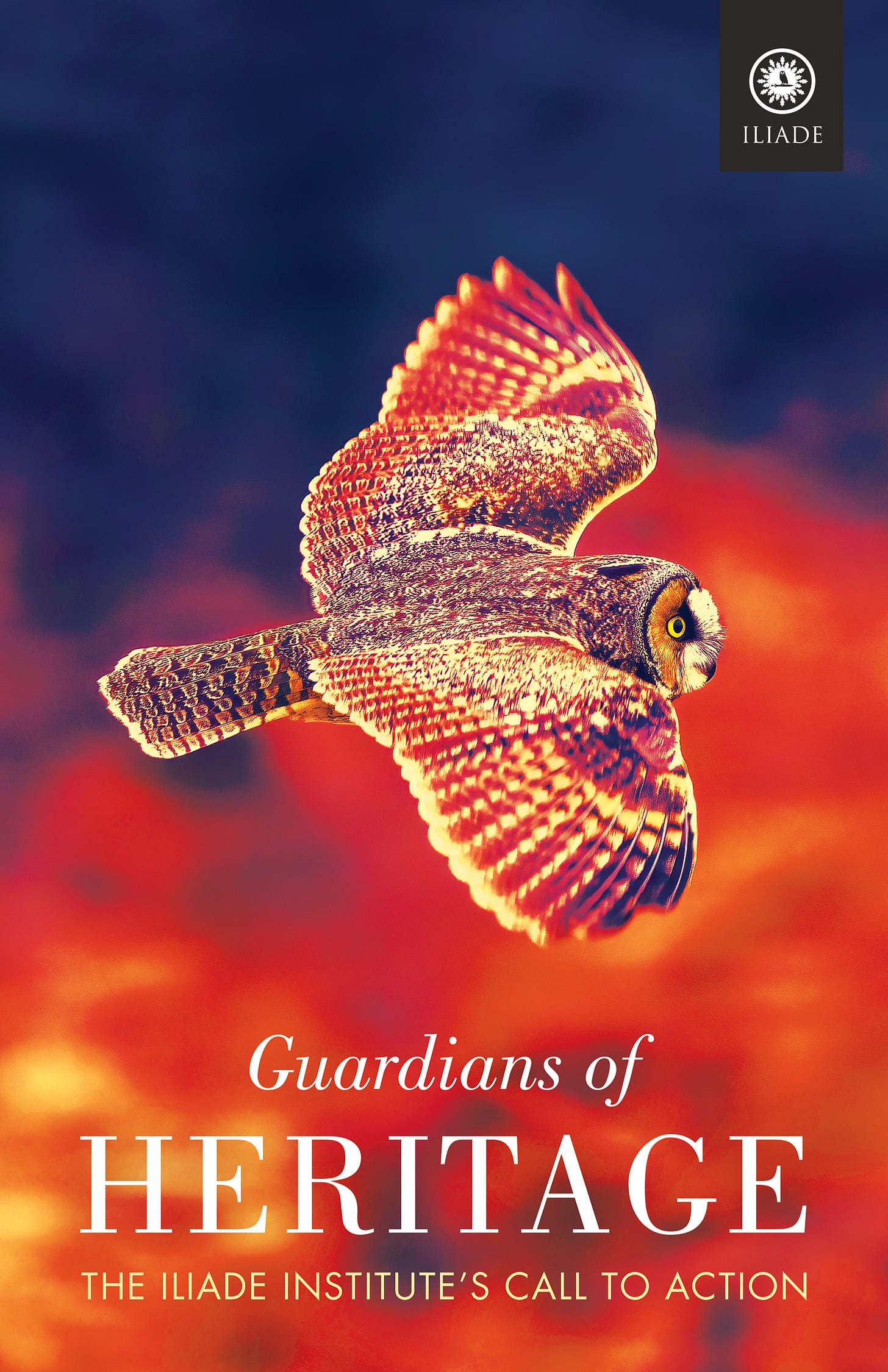
‘Guardians of Heritage’: A Clarion Call for European Identity

In an era marked by rapid globalization and cultural homogenization, Guardians of Heritage is a thought-provoking manifesto that seeks to rekindle the flame of European identity. This compelling work by the Iliade Institute presents a passionate argument for the preservation and revitalization of Europe’s rich cultural heritage.
For those of you who have been living under a rock for the past decade, the Iliade Institute is the new torchbearer of the European New Right (ENR) in the 21st century. They continue the legacy of great thinkers like Alain de Benoist, Guillaume Faye, Giorgio Locchi, and, especially, Dominique Venner — to whom this book is dedicated.
The book is divided into three main sections: “Roots,” “Being in the World,” and “Becoming.” Each chapter builds upon the previous, creating a cohesive narrative that explores the multifaceted nature of European identity and its significance in the modern world.
Roots: The Foundation of Identity
The authors begin by addressing the fundamental question of human identity, challenging the notion of “abstract man” prevalent in modern liberal discourse. They argue convincingly that our biological, familial, and cultural roots are integral to our sense of self and cannot be discarded in favor of a universalist ideology.
The section on family lineage is especially poignant, highlighting the importance of intergenerational bonds in preserving cultural heritage. The authors make a compelling case for the family as the “bridge that links nature and culture,” a perspective that offers a refreshing counterpoint to increasingly atomized modern societies.
Being in the World: Living European Values
The second part of the book explores how European identity manifests in daily life, from our relationship with nature to our political and economic systems. The authors present a vision of Europeans living in harmony with their natural environment, advocating for a form of ecological thinking rooted in local traditions and landscapes.
Their critique of consumerism and the commodification of culture is particularly incisive. By contrasting the ethos of “being” to “having,” the book challenges readers to reconsider their priorities and embrace a more authentic mode of existence aligned with European values.
The discussion on technology is notably balanced, recognizing both its potential benefits and its capacity for alienation. The authors propose a thoughtful approach to technological progress that maintains human agency and cultural continuity.
Becoming: Shaping the Future of Europe
The final section of the book is perhaps its most inspiring, outlining a vision for Europe’s future that is rooted in its past but not bound by it. The authors call for a “conservative revolution” that seeks to reinvigorate European culture and identity in the face of globalizing forces.
Their emphasis on community-building and education as key strategies for cultural preservation is particularly noteworthy. The book offers practical suggestions for fostering a sense of belonging and transmitting cultural knowledge to future generations.
The authors’ vision of a renewed Europe as a “continental power with a special calling” is ambitious and thought-provoking. It is a revisitation of geopolitical propositions, like those from previous ENR thinkers, arguing for a civilizational empire as opposed to the petty nationalisms of yesteryear. While some readers may find this perspective challenging, it undeniably offers a compelling alternative to the prevailing narratives of European decline.
Final Thoughts
Guardians of Heritage is a tour de force of cultural introspection, offering a passionate defense of European identity that is both timely and contentious. It remains a vital contribution to the ongoing dialogue about European identity. Its willingness to tackle thorny issues head-on, even at the risk of controversy, is commendable in an era often characterized by intellectual timidity.
The authors’ call for a “conservative revolution” is perhaps the book’s boldest proposition that will undoubtedly resonate with those who feel lost and hopeless in this rapidly changing world. Much in the same vein of thought as the German Conservative Revolution movement of the interwar period, it raises complex questions about the nature of progress and the feasibility of reclaiming past cultural paradigms in a globalized age.
Guardians of Heritage is not a book that will leave readers unmoved. It is a clarion call, a philosophical gauntlet thrown down in the public square. Whether one emerges from its pages inspired or incensed, the intellectual journey it offers is undeniably profound.
In an age where discussions of identity often devolve into reductive sloganeering, this book offers a nuanced, if provocative, exploration of what it means to be European. It challenges readers to grapple with their cultural inheritance, to question the prevailing winds of globalization, and to consider the price of forgetting one’s roots.
The authors have crafted a work that serves as both a mirror and a window — reflecting the anxieties and aspirations of many Europeans while offering a view into a possible future shaped by a renewed sense of cultural confidence.
Ultimately, the book’s true value lies not in the answers it provides but in the questions it provokes. It compels us to ask: What aspects of our heritage are worth preserving? How do we maintain cultural distinctiveness in an interconnected world? And perhaps most crucially, how do we honor our past while building a better future?
Guardians of Heritage may not be the final word on European identity, but it is certainly a powerful opening statement in a conversation that will shape the continent’s future. It challenges, provokes, and ultimately enriches our understanding of the complex tapestry that is European heritage.




Some light in the tunnel.
Europe, like the nations within it, are artificial cartographical constructs. Race and sub-racial differences, along with their languages and the multitude of dialects within them, are geographical realities.
As a Y-chromosomatic, Konigsberg descend, Prussian with mitochondrial DNA smatterings, added over centuries of migrations, all the way from Northern Tyrolea to Western Russia, I take mild offence at being lumped together with Slavs or Britians based on the present general behavioral characteristics of both these peoples.
Similarly, I doubt that Slavs or Brits worth their salt would take kindly to being lumped together with Portuguese or Sicilians.
Likewise, Swedes and old stock, landed Icelanders would most likely be loathe at being lumped in with Finns.
That being said, all the above ethno- linguistic sub-races, along with the rest of the multitude of other distinct races of people on the planet, share one common problem; – the insidious, psychopathological Jew.
Theirs is only a unique talent for deception and destruction of life in the quest for hedonistic enslavement…, something that nature itself strives to avoid with every breath of its being.
Notwithstanding, from an erthno-geographical perspective, “White meat” and their ancestral homelands have been Jew directed onto the menus of every non–White on the planet.
It matters not whether they are Hassidic, Lubovitching, secular, or any other of the multitude of sects they ascribe to themselves,- as they dance with glee over the seemingly victorious path towards the impending erasure of White meat worldwide,- they are only a hare’s breath away from Trump’s ability to forge common cause among non-Jew humanity’s leaders in uprooting and neutralizing these insidious Jew maniacs.
Their revelries are little more than the insane cackling laughter often witnessed when one of these Jews is cornered into an intellectual dead end by a Commons inquiry or a Congressional hearing.
Let them dance, for even though Ronaldo is not a Brit he can kick a plastic explosive through the crack of an open window better than a British geneticist can inject a taylor made virus through a keyhole opening or a German mechanic can drive an Unimog into a crowd of revelling Dancers…, to say nothing about what a tribe of machete wielding Congolese tribesmen could do.
The emphasis is not on amalgamation but diversification and recognition of the unique role that every group can contribute in the quest to end the viral Jew.
Some evidence of this “dancing with glee” at the destruction of the host that provides the economic support in general and military support for the ME entity? How much Jewish literature do you study?
Obviously an Ulsterman cannot be “lumped” in with a Ukrainian, or a Norwegian with a Greek, but all of them can appreciate the science, music, architecture and philosophy created by Europeans of all countries. On the ethnology of Europe one can consult Julian Huxley, Eugen Fischer, Fritz Lenz, Carleton Coon, Arthur Kemp, Luigi Cavalli-Sforza, Kevin MacDonald and John Baker. If Welshmen, Spaniards or Austrians want our continent of Europe protected from Afro-Asian invasion or Chinese domination, and unite in this common cause, good luck to them all!
@ English Patriot
I would add Ricardo Duchesne and Dienekes Pontikos to the list. The ancient biology studies evolve, but the cultural heritage of the western Indo-Europeans stares you in the face, from Shakespeare to Dante, Arago to Tesla, Magellan to Amundsen, Bach to Chopin, etc.
Gorgeous writing.Thank you Roy”.
There is no single European identity. What ails Europe is a direct consequence of its “values”.