
Barnes Against the Blackout, Part 1 of 2
2424 words
“In short, there is no unique or special case against Nazi barbarism and horrors unless one assumes that it is far more wicked to exterminate Jews than to massacre Gentiles. While this latter value judgment appears to have become rather generally accepted in the Western world since 1945, I am personally still quaint enough to hold it to be reprehensible to exterminate either Jews or Gentiles.”
—Harry Elmer Barnes
INTRODUCTION
Anyone still questioning the relevance of World War II revisionism to politics today should realize how often our liberal, globalist elites not only invoke World War II, but also ignore, suppress, or besmirch revisionism. Whenever a mainstream personality invites a revisionist on his program, he gets swiftly rebuked and called a Nazi not only by the Left but also by people presumably on the Right. Recently, Jewish commentator Mark Levin invoked the massacre of German civilians during World War II to justify the ethnic cleansing of Gaza. Clearly, whenever someone questions the authority of our liberal elites, they fire back with World War II. Since Adolf Hitler and the Nazis represent the most extreme form of evil and since globalist liberalism is the ideological opposite of Nazism, any form of oppression and aggression by globalist liberals is justifiable—as long as it is aimed against so-called “Nazis.” And if you happen to be against liberalism or globalism these days, it’s only a matter of time before you get dubbed a “Nazi.”
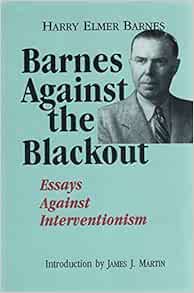
Historian Harry Elmer Barnes understood this perfectly over seventy years ago and promoted revisionism in the face of eerily similar oppression and backlash. Nine of his most incisive essays on the topic—written between 1951 and 1962—are collected in Barnes Against the Blackout, which was published by the Institute for Historical Review in 1991. Several important themes run through these essays. First, Barnes wishes to proselytize revisionism, and does so by constantly referencing and summarizing the great American works of revisionism of his day. These include:
- American Foreign Policy in the Making, 1932-1940 (1946) and President Roosevelt and the Coming of the War, 1941 (1948) by Charles Beard
- America’s Second Crusade (1950) by William Chamberlin
- The Roosevelt Myth (1948) by John T. Flynn
- Pearl Harbor: The Story of the Secret War (1947) by George Morgenstern
- The Tragedy of Europe (1940-1945) and Makers of War (1950) by Francis Neilson
- Design for War (1951) by Frederic Sanborn
- Back Door to War: The Roosevelt Foreign Policy 1933-1941 (1952) by Charles Tansill
 Given the suffocating interventionist hysteria of the time, major publishers declined to publish these volumes despite how many of them had been written by prominent, well-respected historians. Either the publishers were ardent interventionists themselves, or they feared backlash from anti-revisionists who wielded great power in America, just as they do today. Except for the Neilson volumes, which were self-published, these works found only two small publishing houses brave enough to publish them: Regnery and Devin-Adair.
Two later volumes which Barnes discusses often are The Origins of the Second World War (1961) by AJP Taylor and The Forced War (1961) by David Hoggan. (See part one of my three-part review of Hoggan here.) These prove to be slight exceptions to Barnes’ America-centric approach since Taylor was British, and, although Hoggan was American, his work was only available in German at the time.
Another crucial theme running through Barnes Against the Blackout is the presentation of the evidence for revisionism. How do we know the official war narratives are less correct than what the revisionists offer? Barnes is never shy about sharing this information—and there is a lot of it. As with many essay collections from a single author about a single topic, there’s much overlap. And that’s okay. It’s never too much of a good thing revealing how President Franklin Delano Roosevelt “lied the United States into war.”
Describing exactly how the establishment suppressed revisionism in Barnes’ day emerges as another important theme. Barnes focuses on it most in his first two essays, both published in 1953: “Revisionism and the Historical Blackout” (which also serves as the first chapter in his collection Perpetual War for Perpetual Peace from the same year) and “The Court Historians Versus Revisionism.”
Barnes’ final theme is also his most speculative: extending revisionism into the Cold War and postulating how it might avert a nuclear Armageddon. Here is where we find Barnes at his most stunningly prescient but also were he winds up, in spots, to be somewhat dated. Through it all, he utilizes George Orwell’s 1984, which never fails to produce a parallel for whatever point Barnes wishes to make. He explores this novel’s uncanny mirroring of reality in the book’s final essay, 1952’s “How ‘Nineteen Eighty-Four’ Trends Threaten American Peace, Freedom, and Prosperity.”
Barnes Against the Blackout is also interesting for it seemingly negligible treatment of the Jews. Barnes says very little about them directly. However, this amounts to what I call an anti-theme because any reader familiar with Jewish power and supremacy can fill in the blanks where Barnes could have opined about the Jews, but didn’t—or at least didn’t seem to. This adds an extra layer of meaning to Barnes Against the Blackout.
THE EVIDENCE
The evidence for World War II revisionism which Barnes compiles appears in two distinct yet related branches of history: Pearl Harbor revisionism and Western European revisionism. For the former, he relies greatly on Tansill, Sanborn, and Morgenstern, and demonstrates how the U.S. not only goaded the Japanese into attacking as a “back door to war” against Japan’s ally Nazi Germany, but also knew where the attack would occur and approximately when, thereby outraging the American public into supporting military intervention. Barnes believes this “constituted one of the major public crimes of human history.”
The major facts line up as so:
- Roosevelt floated war with the Japanese as early as 1933 during one of his first cabinet meetings.
- The U.S. aided and encouraged Chiang Kai Shek to fight against the Japanese in China during the 1930s.
- Days before the Pearl Harbor attack, Roosevelt ignored Japanese Prince Fumimaro Konoye’s peace overtures which proposed humiliating concessions for Japan in return for “a little time and a face-saving formula.”
- In early 1941 Ambassador Joseph Grew had clearly warned that Pearl Harbor would be the likeliest point of attack. Despite agreements from Washington, US forces at Pearl Harbor remained unprepared for it.
- Secretary of War Henry Stimson stated on November 25, 1941 that, “the question was how we should maneuver them [the Japanese] into the position of firing the first shot without too much danger to ourselves.”
- The US had intercepted the “East Wind Rain” message three days before the attack, which clearly signaled Japanese intentions. Yet Admiral Husband Kimmel and Lieutenant General Walter Short, who were responsible for Pearl Harbor, were kept in the dark about it.
Barnes presents most of this information while piercing holes in the specious logic of pro-interventionist works written by what he calls “court historians.” The two most relevant to Pearl Harbor are Herbert Feis, who wrote The Road to Pearl Harbor (1950), and Basil Rouch, who wrote Roosevelt from Munich to Pearl Harbor (1950). Barnes demonstrates how these historians either ignored, distorted, or misconstrued the above evidence. His point is clear: if the notions of Pearl Harbor being a surprise attack and Roosevelt’s naïve innocence about it were lies, there’s no telling what other lies had been told. It turns out there were many.
As for Western Europe, the facts are equally damning, if perhaps more voluminous. All of them cannot be included a single review, but the points Barnes most often bangs home include:
- The diplomatic history of the 1930s, as collected by Taylor and Hoggan, shows that Adolf Hitler did not want war and did what he could to avoid it.
- The diplomatic history also reveals that Hitler had made reasonable requests to Poland regarding the “international” (yet very German) city of Danzig; yet Polish leaders refused to negotiate at the urging of Lord Halifax in England who had given Poland a “blank check” assurance of English military support against Germany.
- In his last report as Chief of Staff in 1945, General George Marshall had claimed that Hitler “far from having any plan of world domination, did not even have any well-worked-out plan for collaborating with his Axis allies in limited wars, to say nothing of the gigantic task of conquering Russia.”
- Hitler had allowed tens of thousands of British troops to escape at Dunkirk “to promote peace sentiments in Britain.”
- Hitler had excellent reasons to invade the Soviet Union since the Soviets had “practiced sabotage, terrorism, and espionage against Germany, had resisted German attempts to establish a stable order in Europe, had conspired with Great Britain in the Balkans, and had menaced the Third Reich with troop concentrations.”
- Documentary evidence, such as “The German White Paper” found by the Germans after their conquest of Poland, demonstrates the extent to which American ambassador William Bullitt had assured Poland of American military support in the event of war with Germany. This was corroborated by Czechoslovak president Eduard Benés who claimed in his autobiography that on May 29th, 1939 Roosevelt himself had assured him that if war broke out in Europe, America would join the fight against Germany.
- The Lend-Lease program, the “Destroyer Deal” between Britain and the United States, the secret Tyler Kent documents, and Roosevelt’s 1941 meeting with Winston Churchill in Newfoundland offer circumstantial evidence that Roosevelt had clear belligerent intentions well before war was declared.
As with Pearl Harbor, Barnes often presents this evidence while reviewing books written by court historians. The most prominent of these is The Struggle Against Isolation, 1937–1940 (1952) by William Langer and SE Gleason. Despite never proclaiming Hitler’s innocence, Barnes repeatedly stresses that the man’s sole responsibility for starting the war is a complete falsehood—a falsehood which is the foundation of all post-1945 politics. In his 1962 essay “Revisionism and Brainwashing,” he states with characteristic flourish:
It is unlikely that there has been any vested interest in dogma, opinion, and politics since the birth, death, and resurrection of Jesus Christ equal in intensity to that built up around the allegation that Hitler was solely responsible for the outbreak of war in 1939.
One interesting side note: Barnes implies more than once that it was Hitler’s actions in East Asia rather than Europe which truly antagonized Roosevelt. This contradicts some of Barnes’ other claims about Roosevelt’s opposition to Hitler vis-à-vis Europe. Take, for example, this paragraph from the essay “Rauch on Roosevelt”:
Indeed, it was only in 1938, when Hitler recalled his military mission from China, where Nazi officers had been directing the forces of Chiang Kai-shek against the Japanese, that Roosevelt became actually hostile to Hitler in his policies, whatever the previous rhetoric. Right down through the Spanish Civil War, Mr. Roosevelt condoned when he did not favor, most of Hitler’s policies. Even as late as August, 1939, it appears from the Nazi Soviet Relations that Roosevelt was inclined to put nothing in the way of Hitler if he abandoned support of Japan, sent his military back to help Chiang, and delivered arms to the Chinese.
This is an interesting conundrum considering that Barnes brings up Benés’ recollection from May 1939 in the same essay.
THE BLACKOUT
Barnes spills a lot of ink outlining the ways in which revisionism was suppressed and marginalized after 1945. This often resulted from mainstream historians either having vested professional interests in perpetuating the “good war” myth of World War II—since they themselves promoted it while it was happening—or they sought the wealth, fame, and opportunity afforded to academics who adhered to the official narrative of the war.
In “Revisionism and the Historical Blackout” Barnes enumerates the following methods of suppression:
- Excluding revisionists from official documents, while allowing state-approved court historians free access to them
Barnes describes how revisionist historians had been barred from viewing many sensitive documents and in some case had had their own notes confiscated after viewing the ones they were allowed to see. Barnes concedes that Charles Tansill did ultimately view more documents than other revisionists, but Tansill did not enjoy the free reign of information afforded to court historians like Langer and Feis.
- Intimidating publishers into not publishing revisionism
Barnes describes how political pressure groups not only ensured that revisionist volumes would not sell, but made it clear that publishers releasing such material would face business-crippling backlash. Barnes recalls how a major publisher explained this to him despite his personal sympathies towards revisionism. Libraries, book clubs, and nationwide periodicals also contributed to this blackout. Barnes mordantly notes that the post-1945 “Blackout Boys” outdid the Nazis in suppressing honest intellectual inquiry.
- Ignoring revisionist works that do get published
Barnes demonstrates how the majority of revisionist works simply did not get reviewed in important mainstream publications—or when they did, as with the case of Charles Beard, they received either cursory attention or were maliciously panned. It almost goes without saying that this silent treatment was not afforded to court historians, whose works received ample praise everywhere. Barnes relays the following recollection from journalist Oswald Garrison Villard to illustrate his point:
I myself rang up a magazine which some months previously had asked me to review a book for them and asked if they would accept another review from me. The answer was, “Yes, of course. What book had you in mind?” I replied, “Morgenstern’s Pearl Harbor.”
“Oh, that’s that new book attacking F.D.R. and the war, isn’t it?”
“Yes.”
“Well, how do you stand on it?”
“I believe, since his book is based on the records of the Pearl Harbor inquiry, he is right.”
“Oh, we don’t handle books of that type. It is against our policy.”
- Smearing revisionists personally
Barnes offers several examples of ad hominem attacks upon revisionist historians by the “Smearbund,” as he calls them. Often “isolationism” itself became a slur, as if labeling a person thusly were reason enough to dismiss him. More often, however, reviewers would attempt to ruin a revisionist’s reputation by imputing some evil or underhanded motive rather than argue the facts. Barnes notes how reviewers used phrases such as “bitterly partisan” or “blind anger” when describing Morgenstern while ignoring their own partisan anger. He also notes how one reviewer attempted to discredit Beard because he was hard of hearing and lived on a farm. One reviewer freely admitted to lambasting The Forced War without having read a word of it.
To be concluded in Part 2.




“I am personally still quaint enough to hold it to be reprehensible to exterminate either Jews or Gentiles.”
Jews do not seem to have the ability to live peacefully with other people and there is apparently no “off” switch.