
The Politics of the Myth: The Quest for the Double and Death
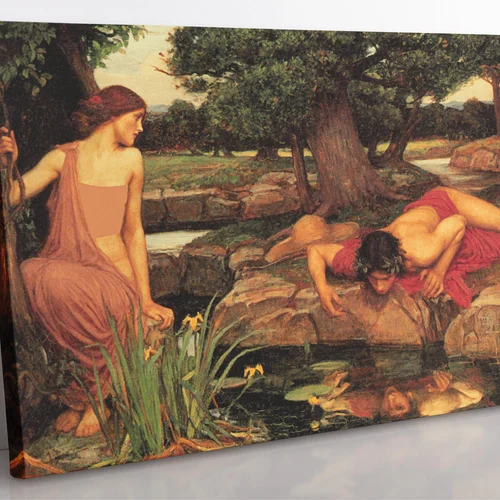
John W. Waterhouse, Echo and Narcissus, oil on canvas (1903)
This brief essay, structured in three short sections, aims to show how mythical figures from the Roman poet Ovid’s Metamorphoses can help us better grasp our distorted political self-perception. There is no scholarly consensus on a definition of the ancient Greek term μῦθος (“mythos”). Scholars approach the origin and meaning of diverse myths often from divergent angles. Most, however, agree that “the myth stands free from time. … Myth makes history possible, but history does not reach it.” [i] By contrast, modern political myths carry a far clearer meaning—though politicians of communist or liberal persuasion avoid this term when spouting their own mythical narratives. One could critically point to the liberal and communist myths of “economic progress,” the myth of “human equality,” or the myth of the “multiracial society … or the “myth of the end of history.” So far, the word and the idea of “myth” has had far greater traction among nationalist politicians and scholars. One could cite here the Italian Fascist leader Benito Mussolini who declared in a speech in 1922: “We have created our myth. Myth is a faith, a passion. It is not necessary that it be a reality. … Our myth is the Nation, our myth is the greatness of the nation.”
Ancient Greek myths, however, served a timeless and ahistorical purpose and could be told and retold at any time and in any place. Some scholars view Greek myths merely as storytelling that explains the origins of the cosmos and recounts the adventures of gods, heroes, and demons. Others, by contrast, regard Greek myths as little more than quasi-allegorical literary devices—comparable to sagas, proverbs, legends, or riddles. Myth, in their view, is just a “verbal gesture,” the manifestation of the inevitable: something fateful that cannot be rationally explained—but neither avoided.[ii] We are what we read—and what we hear…
What we can say with certainty, however, is that Greco-Roman myths—or, for that matter, all ancient European myths, sagas, fables, or fairy tales regardless of their surreal content—had a strong didactic purpose. They were intended to offer moral guidance to the community while issuing stern warnings: do not transgress communal norms; do not try to compete with gods; do not pretend to be something you’re not. Almost all ancient Greek myths caution against hubris, a concept we might today popularly rename into wishful thinking or a morbid desire to become one’s own superior Double.
Judging ancient European myths through the lens of the linear conception of historical time, shaped by the Semitic legacy of Judeo-Christianity, inevitably leads to a false understanding of myths. In simpler terms, applying the Christian and its latter-days Communist concept of time as a one-way lane heading toward earthly or heavenly paradise or the “end of history” is the wrong way to grasp ancient Greek myths. Understanding myths requires first and foremost the skill to step out of historical time altogether. Or to put it simply: myths tell us how to explain the world, whereas modern political myths exhort us to change the world—often with catastrophic results.
One might shrug off ancient Greek myths today as outdated products of a storyteller’s imagination, or as the sign of his intoxicated mind. Fair enough. Yet why do we continue, even more than two thousand years later, to identify with Homer’s mythical heroes from his epics, the Iliad and the Odyssey? Why do we love to read J.R.R. Tolkien’s works, or enjoy watching techno-scientific pseudo-myths embodied in Arnold Schwarzenegger’s movies? A century ago, scenes from the movie Terminator would have appeared as an amusing fantasy tale; today, those scenes seem all too real, likely to terminate our lives in a nuclear conflagration. One could also consider the mythical scenes in the horror novels of H.P. Lovecraft, whose prose tells us far more about our demonic self than we are willing to admit.
As a framework for my essay, I am drawing on—and at times paraphrasing—the novelists, poets, and philosophers whose works are well immersed in the spirit of Greek myths and who can be classified as “pagan-traditionalist-postmodern or archeo-futurist” authors. I’ve limited myself to mythical figures from Ovid’s Metamorphoses only, because they graphically illustrate our often-weird urge to shapeshift ourselves into our fantasy Double. [iii] When these mythical analogies of ours—together with the grotesque wannabe doubles of our leftist or liberal politicians or communist world-improvers—are projected into modern times, the political future of Whites looks quite grim.
The Myth of Free Will
Free will—or “free choice,” an expression popularized by a fanatic thinker of North African descent, later known as St. Augustine — has consistently inspired false hopes among Christians. Hopefully, and eventually, future behavioral geneticists and racial scholars will have the final say on the philosophical drivel of free will. Why are we never at ease with our hereditary or God-given, home-bound boundaries, always searching instead to become—or to surpass—our neighboring higher Other?
Greek gods punished severely those who tried to impersonate them, as we see in the immortal Titan Prometheus, the cousin of Zeus. For his transgression—stealing fire and giving life to mankind—Zeus chained him to a rock for all eternity. The tragic fate of the immortal rebel Prometheus, along with many other strong-willed mythical figures, poses a haunting dilemma for all of us who pride ourselves on having free will. Under adverse historical circumstances, free will can fail a White man spectacularly, or get him branded a war criminal by hostile posterity. Thousands of well-meaning, strong-willed Western politicians, after savoring the bliss of success for a fleeting moment, have sunk into the memory hole of vilification.
Worse yet, free will must sound like a cruel joke to a high-IQ student or a decent, well-mannered aspiring politician if he is plagued by physical or verbal deformities—or tortured by hereditary dread of exposing himself on the world stage. A high-IQ craftsman—the mythical Daedalus—and his wax-winged son Icarus, or the chariot-driving demigod Phaethon, kept pushing their free will to the utmost limits of the universe—only to trigger the wrath of supreme god Zeus and disintegrate into thin air. Likewise, a contemporary Western politician, who is smart, well-educated, strong-willed, with high-IQ, inevitably confronts “Invidia” already discussed on TOO as —raw jealousy—from his closest friends. The duplicity of his supposedly friendly political or academic milieu is best captured by the modern pagan, death-affirming philosopher Emil Cioran: “If we could see ourselves as others see us, we would vanish on the spot.”[iv]
The Myth of the Echo-Chamber
Hence a reason for our politicians—in order to secure the steady flow of their paychecks—to play the game of self-deception, or to don the grotesque mask of their faked Double. Indeed, the US Congress or the EU Parliament resembles a vast echo chamber, where narcissistic politicians regurgitate empty words straight out of the former communist Soviet textbook. The mythical nymph Echo springs to mind here as the perfect template of modern liberal Newspeak. Her misfortune was engineered by the jealous goddess Hera, Zeus’s wife, who could not tolerate the big-mouthed nymph’s covering up Zeus’s sexual escapades. Hera punished Echo by stripping away her power of speech, condemning her to repeat only the last few syllables to be echoed around. Things grew even uglier when the now half-mute Echo fell madly in love with the self-obsessed hunter Narcissus, who deemed himself way too handsome to accept the passes of the horny, lovesick nymph Echo. Total communication breakdown ensued. The parallel is glaring with today’s main stream media verbal echoes such as “hate speech,” “antisemitism,” “racism”, “white supremacism”—parroted by Western lawfare inquisitors.
Cases of contemporary free-speech suppression can be traced to multiple ancient Greek myths, and they apply with striking precision to the study of our modern surveillance society. Ovid describes the mythical tyrant from Balkan Thrace, King Tereus who was married to the Athenian princess Procne, yet lusting all the time after her sister Philomela. He raped Philomela in secret, then cut out her tongue so she could never reveal the crime to her family and the city of Athens. The bloody tale of Tereus, one of Ovid’s most horrific crime scenes in his epics Metamorphoses, best applies to the verbiage of our ruling class which hides behind the guise of “protecting free speech”. What comes to mind is the case of the wealthy pervert Jeffrey Epstein, along with countless other double-faced modern politicians, who know deadly well how to reduce their victims to speechless, frightened and mute species.
The Myth of White Self-Delusion
Over the past fifteen hundred years, Whites have shown a classic split personality: fierce, pagan-Hellenic-inspired will to power bordering on arrogance on one hand, and on the other, the grovelling Christian-inspired drive to “take the knee” in front of racial outsiders. One encounters these arrogant characters in Ovid’s description of the mythical queen Niobe, who bragged in front of the goddess Leto about her multiple progeny, as well as the satyr Marsyas, who thought he could outplay the god Apollo with his flute. The gods punished severely their arrogance.
The myth of modern White guilt stems from the Christian dogma of self-denial, which has inflicted for centuries huge damage on Whites’ self-perception. It is far too convenient to criticize or ridicule Jewish myths of world creation and their secular avatars in World War II victimhood status. But why ridicule Bible-inspired Jewish victimhood while at the same time embracing the myth of the immaculate conception of the Jewish virgin Mary or the serial shapeshifting adventures of the metamorphic conman St. Paul—still regarded by many White Christians as the bulwark of the Western civilization? The foremost expert on Homeric gods and myths, still quoted as the standard reference in studies of myths, Walter F. Otto, wrote long ago: “The Christian world has developed an extraordinary mastery in this practice of self-abasement.”[v]
The craving to overreach oneself or to metamorphose into a cherished Double or surreal supermen is a major trait of most White nationalists. Many wallow in deliberate self-delusions, eternal false hopes, and a pathetic drive to become imaginary heroes in an abstract White homeland. They could learn a lot from Ovid’s epics and countless other writers who portray delusional individuals.
White activists and many fine White scholars are well aware of the coming doomsday scenario caused by racial replacement. But who can guarantee that in the much-craved White homeland perpetual harmony will ensue? The track record of European history is one of bloody wars. The savagery of the recent war between two closely kindred European peoples—Serbs and Croats—dwarfs tales of African cannibals or the cruelty of the Greek tyrant Phalaris, who locked his dissidents in a brazen bull and roasted them alive. The ongoing savage war between two similar European peoples—Ukrainians and Russians—does not bode well for sustaining the myth of a White homeland. The answer to the future lies in the stars…
Notes and further reading:
[i] Robert de Herte, « Les mythes européens », Eléments, (fall 1984); p. 2.
[ii] André Jolles, « Mythen », Einfache Formen, (1930 Darmstadt: Wissenschaftliche Buchgesellschaft, 1969), pp. 91-125.
[iii] Ovid, The Metamorphoses, Translated by Henry T. Riley ( London: George Bell & Sons, York St., Covent Garden, and New York, 1893).
[iv] Emil Cioran, The Trouble with Being Born, Transl.by Richard Howard (New York, Arcade Publishing) p.44.
[v] Walter F. Otto, Der Geist de Antike und die christliche Welt (Bonn: Verlag F. Cohen), p. 69.




Tom is such a brillant erudite writer and post european thinker.He conflates Pauline-churchianuty wirh Christ. an understabdable but fatally erroneous and trendy mindset.Anti-Christians never…see they.serve The Big Jewish Satan s on this. Still apart from Dr.Sunic s achilles heel- nemesis ..of conflating Christ…wirh pauline churchianity. he is,always an enjoyable illuminating.fascinating ..read.* Tom!— Hvala ti! Bog te bogoslovio. Sdravo.Bok.Bok.Ciao! Dovidzenia…
What version of ‘christianity’ doesn’t have the works of ‘Paul’ as a part of their Bible? How big is this denomination? As for anti-Christians being ‘satanic’, that’s been the gibberish that ‘christians’ have been espousing since Day One. Your whole position is ‘Everybody I Disagree With Is Satan: A Petulant Child’s Guide To Politics and Religion’.
There’s no significant difference between the jewishness of ‘christianity’ and ‘churchianity’. It’s just a fake distinction offered up as a cope.
Oh oh, Alan je Hrvat. oO
I am probably not smart enough to understand the point of this article.
Nevertheless, fools rush in:…state the main point, illustrate what it is with an example or two, and proceed to how a correction of, in the case of White Nationalism, our errors can be addressed , in plain English, and offer a correction.
Myth and poetry are not plain enough to deal with WN’s problematics. For example, Trumpstein is a fool, a tyrant, a low brow, a cunt grabber, a capitalist pig, a Jew Tool, and a betrayer of White interests, despite his persona as a
White savior . Caligula has been offered up by Unz as a Trumpstein “double” if that isn’t too farly fetched, too literary.
Our several wanna-be Leaders who have failed to measure up to what a leader should be , seem to be just human, all too human, in the general sense of ego excesses. We have our good intellectual leaders, not to name them here… but we do not have Political leaders. Perhaps it is premature to expect political leaders to emerge. A leader must have followers, and so far our Internet personalities don’t measure up…one ego after another falling by the wayside.
Trumpstein is a disaster and has led the country to a massive defeat in the pending mid-terms. Someone with some gravitas (like Douglas Macgregor) has to show up. Macgregor is too old for anything but a 2028 contest. And he does not seem to have much of a following. We probably need to suffer a huge defeat in the next two elections, for anything to develop politically.
A major military defeat and major depression would prepare the ground for something new. With Israel wiped out without nuking us would help a major realignment of US politics.
DID or Disassociative Identity Disorder affects about one and one-half % of Europeans and USA folks. No mention of other cultures on line. It includes severe symptoms like schizophrenia and appears to be pretty disabling. It is also controversial and some professionals are skeptical, etc. It used to be called Multiple Personality Disorder. So, the scientific validity of DID is questionable.
The Double, in pop culture movies/literature is thus , shall we say, problematic. In Tom Sunic’s first paragraph he calls “racial equality” and other democratic claims to be “myths.” Then he states in paragraph 2, that Ancient Greek
myths are the true myths and that the myths of racial equality are false because they have no explanatory power.
To call both types of belief “myths” is not helpful. The generally accepted view of our democratic beliefs in race equality, etc. should be called “ideology” as they often are in political discourse. Sunic then proceeds to discuss ‘myths’ of free will, and then free speech suppression as “democratic” in character, Christian obsession with self-abasement, and on the other hand, Greek/Hellenic inspired heroism and will to power. This I think he classifes as our Western Civilizational Double, a profound contradiction to be sure.
St (Saul) Paul is introduced as a highly problematic contributor to Christianity, Sunic’s only remark on the Jews. OK
The West is thus , in Sunic’s term, “craved” or driven by emotional desperation, by the contradictions in the twofold nexus of Christianity and its Double, the Hellenic will to power/heroism. In his penultimate paragraph he states that …
“The craving to overreach oneself or to metamorphose into a cherished Double or a surreal superman is a major trait of most White Nationalists…many wallow in self delusions…a.pathetic drive to become imaginary heroes, in an abstract White Homeland.” He continues and advises WNists to read Ovid and others who “portray
delusionary individuals.”
Well, first, the Double is very questionable as described above..in psychology. It is more probable that ” most” white Nationalists have no such Double affliction, an imaginary literary trope. They and myself, have long ago got rid of any subservience to Jews, Christianity, and Liberal ideology and racial equality. We have no conflict in ourselves with any of this nonsense.
Sunic never, in my reading experience, criticizes Zionism or the Jews. If anybody harbors a Double Complex, it is probably Sunic himself, trying to integrate his ancient Hellenistic wisdom with current replacements of Whites in the West…thereby actually moving toward Asian fatalism.