
A New Idea of Australia, Part 1 of 3: An American Colony
7555 words
Authors Note: This essay originally appeared on Substack and was written with the expectation that the reader understands the contours of Australian politics, something that is unlikely to be the case for non-Australian audiences. As such, some clarifying footnotes have been provided to assist. Simple Google searches will assist to clarify any other elements. Whilst polemical in tone, international readers of TOO may find some familiar themes and arguments, especially in the aftermath of the reelection of Donald Trump and the ever-present debate on the relationship between the cause for White survival and the necessary political path forward.
————————————————————————————————————————
Part 1: An American Colony
Introduction
A quarter of the way into the twenty-first century, things are looking bleak for the Australian people. Where is Australia headed is the question on everyone’s lips, though it only seems to be headed in one direction — downhill. The demographic numbers are slowly but surely ticking against us as the flood of foreign migration and Asianisation proceeds unabated, as does the general immiseration of the Australian worker — his or her inability to find for themselves an affordable house, a loving family, a decent wage, or a community to thrive in. Where these problems were once confined to ethnic neighbourhoods in the inner city or among the most destitute members of our society, we now see the fires appearing everywhere. A country that was once considered the White Workingman’s Paradise is looking anything but.
Still, there are those of us who remain optimistic that salvation can be found under these daunting circumstances. Whilst there is every chance that we will have lost our very existence by the close of the 21st century, in the year 2026, Australians still retain a demographic majority and hope is not lost. But when it comes to discussions on Australia’s future, it feels to the Nationalist as if we go around in circles. Each new year, we tread the same ground and we look on as the same bad ideas run wild on social media and then leak into the public discourse. Each year, new faces appear on the scene, always ignorant of history and those who came before them, and always unwilling to listen to the counsel of those with decades of experience. Large protest movements spring up out of nowhere and then just as quickly fizzle out and become riven with divisions when no-one can even agree on a political program, let alone who or what exactly they are protesting against. The slumbering giant that is the Counter-Jihad movement threatens to re-awaken, and if it does, we expect there are many who will once again fall into the trap. Across social media, Conservatives, Patriots, Populists, Anti-Vaxxers, Far-Rightists and Hitler cultists alike pilfer the label of Nationalist for their own ends and general confusion abounds.
Nationalists have long since come to terms with the nature of reactionary politics and the need to break from conservatism, however for almost seven decades now, well-meaning but politically illiterate Australians have ridden the coattails of liberal and conservative politicians, trying in vain to get these Pied Pipers to care about the future of the Australian people. For almost the same amount of decades, the loudest and most obnoxious voices have announced that salvation can only come from cult-like worship of the ghost of Adolf Hitler; an effort that now combines Third Reich aesthetics with John Howard’s views on foreign policy.[1] By the Nationalist count, we have just notched up the fifth attempt at a local Hitlerist party[2] (only this time with injections of Charles Manson and satanism, plus the swastika and roman saluting made illegal) and we have altogether lost count of how many times since the days of Eric Butler and his League of Rights the far-right have attempted their infiltration of conservatism.
Australian Nationalists have consciously kept their distance from these forces in order to retain authentic radicalism and not pollute their message. When dealing with CUNTs (Conservatives Using Nationalist Terminology), protection is always required, followed by a fact-sheet informing others of the STIs which may be caught from dalliances with conservative politics. For this we have been labelled “bad actors” and spat on for something they call “punching right.” But who are the real bad actors here? It’s not the Nationalists who are always caught playing footsie under the table with the Liberal Party. It’s not the Nationalists who keep letting the Zionist element into their organisation.
It’s time for another much-needed dose of radicalism. If we, the indigenous White men, women and children of the continent Terra Australis desire to have a future here, something radical is desperately required, something even revolutionary. There is no path to reform the existing system and the various tactics of Infiltration and Electoralism are proven political failures. We need a deep cleanse of political accretions, casting aside all the old touchstones and the fatuous clichés that patriotically-minded Australians have been raised to follow — even the ones that some Nationalists have come to rely on. The Australian people no longer have the time to spend pretending that our nation can be saved by kick-boxing or roman saluting, by diligently waving around the Australian flag in the street, or by tailoring our message to suit conservative donors and establishment interests.
In many ways, we are already too late for a strict party-political struggle and have to adjust our strategy and goals accordingly. But Nationalists always have the ideological advantage over their competitors: nationalism as political force is progressive, not conservative or reactionary. A Nationalist has a mind to the past, but he does not live in it. His main focus is forward and he recognises the reality of his circumstances and what needs to be done, not even to attain salvation for Australians, but to have a fighting chance at survival in the twenty-first century. That is what this essay seeks to describe.
Much of what is written below will not be new to those who have grounding in Nationalist theory and have made attempts to connect with the historical literature; literature not just of the local Nationalist variety, but also of revolutionary thinkers from around the world who succeeded in changing the fate of their respective nations against all odds, whether that be Mao or Mussolini, Castro or Khomeini. Illiteracy is the order of the day, and from this springs so many of the failures of contemporary politics. If all you’ve ever read about nationalism is some posts on X; if you think Australian nationalism means being a racist conservative, or opposing vaccine mandates or raising your right arm in a 45-degree salute, then read on, you may learn a thing or two.
The Empire and the White Australia Policy
“White Australia must not be regarded as a mere political shibboleth. It was Australia’s Magna Carta.” – Jack Lang, I Remember (1956)
When Jack Lang spoke of White Australia, he knew exactly what it entailed. Nobody had to tell him what political currents it grew out of, or that defending White Australia meant taking on powerful vested interests using a program of radical action intertwined with the plight of the working man. Lang called it our Magna Carta and Alfred Deakin called it our Monroe Doctrine; either way it was central to Australia’s foundation, an article of national faith respected by almost all. Fast forward to the present day, memory of the White Australia Policy has passed into history and the youngest person alive today who was politically of age during the final years when it was in operation is now in his or her eighties. The call of White Australia lives on in the Nationalist who speaks the language of Lang, but there have always been others who take a liking to the phrase. In days of old, groups such as the League of Rights[3] and the Immigration Control Association declared allegiance to White Australia, but lacked an ideological formulation or a political program that could satisfactorily uphold this principle in the post-war era. Newer groups have continued in this fashion in an even more superficial way.
To say that ‘White Australia’ has become mere shibboleth amongst the modern-day conservative and far-right charlatans who cloak themselves with the Nationalist label would be an accurate assessment. The phrase is much beloved, but shorn of all political depth, it has come to function to them as nothing more than a way to signal to friends online that you are member of the same ‘club’ (or better yet, use it as the name of your would-be political party!). No political discussion is complete without inserting a reference to it, and things always come around to the same hackneyed commentary: What do we want? White Australia of course! Send them back! Multiculturalism has failed! Re-migration! Australia for the White Man! If only the policy could be magicked back into existence, then all our problems would be instantly solved they say.
Dig any deeper into these discussions and one is confronted with a lack of any kind of ideological grounding or any comprehensive theory of Australian history. What ‘White Australia’ actually requires is lost on them. The purported nationalism they ascribe to disappears almost instantly in a sea of liberal or conservative beliefs that they have assimilated over the years and have never felt the need to critically examine. Foundational principles such as Nativism — the ethnogenesis of the Australian people as a fusion of European stock — are ignored in favour of assertions of Nordicism or Britishness. Laborism is absent and there is not a single social policy in sight other than vague grievances about left-wing politics and derogatory screeds against women. Radicalism disappears for the sake of pursuing electoralism and compliance with the strictures of the State. It’s worse still when the call for White Australia becomes strange bedfellows with foreign chants like “Heil Hitler” or “Blood and Honour”. Then they tell us they don’t require ideology and that all they need to find their way around politics is — god forbid — “common sense”. Ideology is key to the matter, as Nationalists have always known:
“Ideology” showed that the first White Australia Policy, which was part and parcel of the great Nationalist movement (1880–1910), was a creature of the trade unions, the cultural-Nationalist intellectuals (around the “Bulletin”, for example) of the activist psychology. It was successful because it overcame the hesitation of the Anglicised middle classes and intimidated the colonial administrators. “Ideology” showed that similar circumstances today demanded a similar solution: a party of ordinary Australians led by a conscious active militant Nationalist vanguard has become necessary.
– Dr. Jim Saleam, What Is To Be Done? Tasks for Australian Nationalists in the Coming Struggle (2005)[4]
Most of these characters know almost nothing of the history of the policy; they’ve never bothered to open a reputable book on the subject and seem ignorant of even the most basic facts. In recent years, some more erudite individuals have taken to consulting a work by author Peter Cochrane called Best We Forget: The War for White Australia (2018) and presently advance the line that the ANZACs[5] fought for White Australia when they were gunning down Germans in France. Cochrane’s pearl-clutching book details how the Imperial establishment abused the cry of White Australia in 1914 in order to push the country into another fratricidal war for the Empire. We fear that the far-right are again learning the wrong lessons via this book, namely the confused notion that Australia and Empire were synonymous. Another classic example is a video of Sir Robert Menzies[6] that floats around dissident spaces. The footage is from a 1955 radio interview, and Menzies, when asked about White Australia, pontificates about the benefits of the policy. Ergo — to the illiterate viewer — Menzies and the Liberal National Party supported the White Australia Policy! To Nationalists, this video can only make us think of a farmer talking lovingly about the cow he is about to send off to the slaughterhouse.
It’s time to lay out some hard truths. White Australia, as it was formulated in the minds of those who truly fought for it and believed in it, never really came into existence. What ended up being called the ‘White Australia Policy’ in political discourse was in reality a series of quasi-racial legislative concessions painfully extracted from the British Empire; concessions that, if the Foreign Office had not chosen to back down ever so slightly to appease the insistent colonials, would never have gained Royal Assent in the first place, for they served only to poison the position of Britain within its non-White dominions and caused naught but friction toward newfound ally Japan. Whatever private sympathies the British had for White Australia, His Majesty’s government could not officially sanction exclusion by colour or race, and all British subjects had to be accepted as equals. An empire is always a multi-racial affair; it cannot afford to be racially exclusive — that defeats the purpose of an empire.
We ask you also to bear in mind the traditions of the Empire, which make no distinction in favour of or against race or colour, and to exclude by reason of their colour, or by reason of their race, all her Majesty’s Indian subjects and even all Asiatics, would be an act so offensive to those people that it would be most painful, I am quite certain, to Her Majesty to have to sanction it.
— Joseph Chamberlain, the Secretary of State to the Colonies, in a speech to the Australian representatives at the 1897 Imperial Conference.
Mindful of Australia’s isolated geographic position, what the radical proponents of White Australia wanted was a clear and unambiguous racialist position enshrined within the Constitution of Australia and expanded upon within subordinate legislation: Australia as a land for the White race, for those men and women of European stock. What prevailed instead was an immigration system that only achieved racial exclusion by means of deceit. A wink-and-a-nod method whereby the laws never actually said what the majority of the voting public wanted them to say (or thought they said) and used the cover of ‘European Languages’ to get the job done. Racial classifications were used behind the scenes, contained within the confidential instructions sent to those administering the system, but never included in the legislation itself. It was, after all, only ever a White Australia *Policy*, never a White Australia Act.
To understand how this occurred, one must acknowledge that by the time of Federation, Australian politics had produced two distinct conceptualisations of White Australia. These can be categorised as a ‘Hard’ version of White Australia and a ‘Soft’ version. These two versions grew parallel with the two patriotisms — British-Australia patriotism (conservatism) and Australia-First patriotism (nationalism) — that also jostled for hegemony in the new nation. Despite outward similarities and some mixing in the middle, contained within the two were important granular distinctions both in formulation and in political expression, differences which were on display during the political debate around the passage of the Immigration Restriction Act (1901).
As foreign as it may seem to us now, racialism was a factor in thinking across the political spectrum in nineteenth-century Australia. Even the Communists back then had racial ideals. Nationalists say that the Empire loyalists appropriated the cry of White Australia from the radicals due to its popular, election-winning appeal. Marxists, still infuriated that the Australian worker once had a racial and social consciousness untouched by Marx’s doctrine, present the usual line that the capitalist classes tricked the workers into racial loyalty during the 1850s agitations against Chinese migration in order to defeat class solidarity. Nonetheless by 1901 there was a near universal consensus that implementing a White Australia — far from being motivated by pure ‘race hate’ as is the lie promulgated today — was an act of self-preservation that would benefit the Australian worker and the new nation by eliminating the use of cheap, almost slave-like coloured labour and would simultaneously create a cohesive, peaceful and democratic state free from the strains of interracial mixing and conflict all so evident at the time in the Americas (and now all so evident in modern Australia).
But for all that was unanimous, what was implemented after Federation wasn’t White Australia as envisioned by the radical-nationalists and the labour movement. It was the less potent, ‘Soft’ version diluted of radicalism that prevailed, typified by the liberal, middle-class sympathies of Alfred Deakin and the governing Protectionist Party that championed the legislation. The key distinctions are that it was a White Australia that was deferential to the requirements of the Empire, was more loose with application of the racial principle, prioritised British race patriotism over a more generic sense of ‘Whiteness’ when it came to Australia’s racial homogeneity, and was generally less vulgar in tone when compared to the rhetoric of The Bulletin and the radical press. That it was this ‘Soft’ White Australia which ultimately won out in the democratic process can be see in all the necessary deceptions and inconsistencies that came to define the White Australia Policy from 1901 onward, all of which ultimately sowed the seeds of its destruction.
The focal point of this deception was of course the solution arrived at with the ‘Dictation Test’, taking inspiration from a similar test used in the Colony of Natal to regulate the entrance of migrants not based on race, but on education level. As per the Immigration Restriction Act (1901), a prospective migrant selected to perform the test was required to write down a text dictated to them by an officer of the Act, spoken in a European language of the officers choosing (the word ‘European’ was struck from the Act in 1905 by the governing Free Trade Party due to ongoing diplomatic protests by the Japanese). The unspoken instruction being, if the would-be migrant failed the racial expectation of a budding Australian, the text was dictated in a language that the officer knew would result in failure of the test. In practice, the dictation test was rarely required. In the era before cheap international travel and mass refugee flows, the message of ‘White Australia’ being broadcast to the world was enough to deter most would-be non-White migrants. The Australian government did little to disabuse people of the dishonest nature of this mechanism when the test also became used to exclude people for short-term political purposes — the failed attempt to deport polyglot communist Egon Kisch by means of the test in 1935 being the most well-known example.
As the raucous Hansard debate of the time shows, much angst was generated because there was no mention of racial exclusion in the Immigration Restriction Act. It was racialism by means of subterfuge. Labor, in an act unrecognisable to the modern Labor Party, threatened to block the legislation entirely for this omission, moving an amendment to introduce a racial element, until Deakin and the Protectionists swayed them with the argument that the Motherland decreed it was the Natal Test or nothing at all. Soon thereafter, Britain signed into existence the Anglo-Japanese Alliance in 1902, a treaty intended to contain the expanding Russian Empire (and one might add, to thumb their nose at the anti-Semitic Tsar). Thus Australia’s racial sovereignty was thwarted so that Britain could ally with an Asian people over a fellow European nation — one that local Nationalists felt an affinity towards in a shared antagonism towards Japan, and one that the Australian people as a whole had no quarrel with.
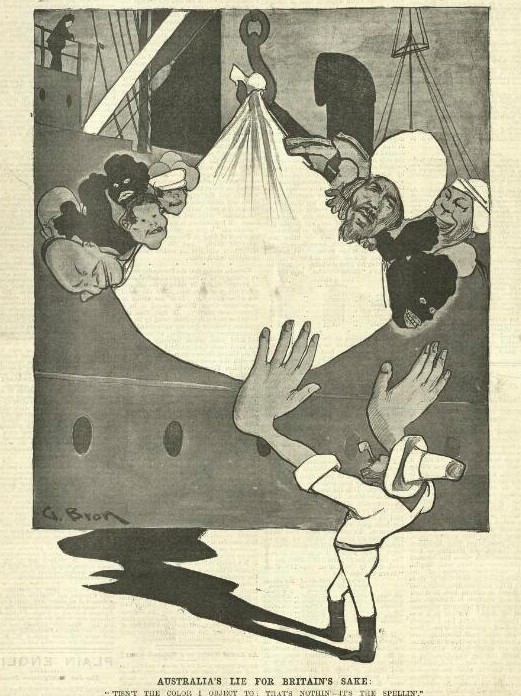 Cartoon from The Bulletin (September 28, 1901) mocking the deception of the Act: AUSTRALIA’S LIE FOR BRITAIN’S SAKE: “TISN’T THE COLOR I OBJECT TO: THAT’S NUTHIN’ — IT’S THE SPELLIN’.”
When it came to citizenship, no law in Australia ever promulgated the formula ‘Australian = White’; in fact, Australia had no citizenship law of its own or even a concept of an Australian Citizen until 1949. Before that point, we were all ‘British Subjects’, or if not, ‘Aliens’. Of all the legislation introduced under the White Australia Policy, only the Naturalisation Act (1903) contained any specific exclusionary mechanism based on racial heritage. It prohibited the naturalisation of “…aboriginal natives of Asia, Africa or the Islands of the Pacific, excepting New Zealand”[7], but the loophole afforded by being a British Subject (which contained no such racial or ancestral restrictions) was always available. Seventeen years later the superseding Nationality Act (1920) removed even this sole mention of race, and withholding of naturalisation for non-European aliens continued only on the basis of discretionary powers. For non-Europeans already domiciled in the country, other than in the special case of the deportation of Pacific Islanders working in the Queensland sugar industry (where targeted legislation was used and again contained plenty of exemptions), no systematic attempt was made to repatriate those who had settled prior to Federation or who were already British Subjects.[8]
As a whole, the ‘White Australia Policy’ was beset with ambiguities, exemptions, administrative discretion, and confusing provisions that were amended many times over in order to satisfy domestic and external pressures. Disputes over application of the Act — such as in the High Court case Potter v. Minahan (1908) — often came down to the level of deciding whether or not the dictation test had been applied properly. This arrangement, a publicly announced policy of White Australia combined with a convoluted legislative framework that said nothing of the sort, naturally led to administrative confusion and laid the groundwork for all the problems the government later encountered in the infamous O’Keefe v. Calwell[9] case and others like it. The Labor Party did its best to scrutinise the practical implementation of the policy, receiving regular dispatches from port workers and customs officials who took in on themselves to militantly guard the borders of White Australia, but without solid legislative backing, this remained a demanding task.
As noted by Tavan: “…the IRA [Immigration Restriction Act] did not explicitly exclude people on racial grounds; exclusion was to be enforced through the broad discretionary powers of Australian officials, subject to judicial review in contested cases. Such a system was flawed from the outset. There was a fundamental lack of clarity about many of the policies key provisions, especially the dictation test, and officials tended to place radically different interpretations on them — a problem compounded by inexperience and ineptitude.”[10] For example, until the definitions of the act were cleaned up in 1924, the occasional prohibited migrant was being acquitted in a court of law because the dictation test had been administered to them by an external interpreter, not a departmental officer authorised to do so. Indeed some of the stated impetus for the 1958 reforms was how badly the Act was drafted and how complicated the whole process of immigration restriction had become.
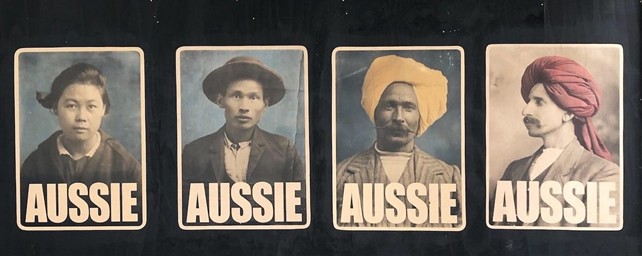 Artist Peter Drew’s subversive ‘Aussie’ posters. The photos are taken from their respective Certificates of Exemption to the Dictation Test, a document which allowed non-Europeans domiciled in Australia prior to 1901 to re-enter Australia if they travelled overseas.
Weak and convoluted as it was from the start, this legislative framework lasted barely 50 years, dismantled by salami-slice and thin-edge-of-the-wedge tactics. The first major changes came in 1950 after the Liberal Party won the 1949 federal election, having attacked Arthur Calwell’s hard-line stance on the O’Keefe case in order to score some political points. Dealt a life-threatening blow with reforms in 1956, the dictation test was then removed in 1958 from the new Migration Act, and the White Australia Policy ceased to be in 1966 when the Holt government began to permanently accept small amounts of skilled non-European migrants as a matter of policy. All this occurred during the long post-war reign of the Liberal-National Coalition, who insidiously assured the country that nothing was fundamentally being altered and that White Australia (or in their own words, “the predominantly European character of the Australian population”) was here to stay in a more muted form. Whitlam[11] later cleared out a few remaining legal cobwebs and the Liberals were more than happy to let him loudly claim the title of ‘Vanquisher of the White Australia Policy’ for himself, lest this title be claimed by its true owner — Pig Iron Bob.[12]
That’s the ‘how’ of the matter; the ‘why’ is a longer story. The end result of World War Two and the lessons the victorious powers imposed on the world you will surely be aware of, and go and read the history of Boasian Anthropology and the Zionist background to both the Universal Declaration of Human Rights (1948) or the UNESCO Statement on Race (1951)[13] to bring yourself fully up to speed. But the most important point is that once the United States government — as the political hegemon and the de-facto ruler of Australia — had officially taken on the cause of racial integration after the landmark Supreme Court decision Brown v. Board of Education (1954), the White Australia Policy was not long for this world. Hurt feelings of Asians and their diplomatic protests could be dealt with, as they were since before the IRA even received royal assent. Ideological and institutional pressure from the United States of America and the leverage it already had over our nation, its ability to set the tone of our political debate, was another matter entirely.
For all that the British Empire officially opposed racialism, the concessions agreed upon in the IRA ensured that there was never cause for cutting ties. As such, so long as the Empire was powerful, and so long as Australia could rely on the economic and foreign policy shelter of Britain, the White Australia Policy could operate without having to make financial sacrifices or difficult foreign policy decisions. With the might of the British Navy behind it, diplomatic protests from Japan mattered little when it came to Australia enforcing its immigration laws. How White Australia would have proceeded had true independence and a decisive break with the Empire been carried out can only be speculated on, though it undoubtedly would have been a more toilsome endeavour. All we can say is that post-1945, Australia never gained its independence, and merely swapped out control by one empire for another. But this was a new empire, one that we had no sentimental or familial relationship with as we did with Britain.
Despite being a fellow common law-based English-speaking country, for the United States of America, Australia was not an imperial colony deserving of special treatment. We were, as General MacArthur told Prime Minister John Curtin, nothing more than a base from which to attack America’s enemies in the Pacific (not much has changed since then). Australia’s reasoned defences of its immigration policy on the international stage fell on deaf ears and the once accepted dictum that ‘racial unity was essential to national unity’ found little purchase. The United States was not interested in sticking out its neck for White Australia and the country had more than enough of its own racial problems to attend to. In 1957, when the guns of the National Guard and the U.S. Army’s 101st Airborne Division were pointed at White citizens who opposed the racial integration of their local school in the town of Little Rock, Arkansas, the message was loud and clear which side of the racial debate the U.S. government was coming down on. Then the passing of the Civil Rights Act in 1964 — the new constitution of America — and the Hart-Celler Act in 1965 set things in stone, and Australia risked being the international pariah alongside South Africa. Note how in each case of major racial reform in the U.S. (the Brown Decision in 1954, Little Rock in 1957 and the Civil Rights Act in 1964) the Australian government followed closely behind with its own reforms.
Other political realities got in the way as well. No conservative politician in Australia wanted to be the bad sport who failed to wear the proper uniform in America’s anti-Communist crusade. You couldn’t fight Communism and be a member of the free and democratic world with racially exclusionary policies on your books. In summation, the U.S.’s embrace of the anti-racist principle was the necessary condition for the abandonment of the White Australia Policy. Looking at it all with hindsight, it is surprising that the White Australia Policy lasted as long as it officially did with such convoluted legislative grounding and under such extreme international pressures. It is a testament only to how deeply held a belief White Australia was to the ordinary voter and hence the requirement to dismantle it via stealth. And so, within the span of thirty years, White Australia went from being politically unimpeachable to being politically illegitimate and statements that once could be found uttered by the Prime Minister or Opposition Leader on a campaign trail will — if uttered publicly today — net you an ASIO[14] case file giving you an ignominious label: Enemy of Australia.
White Australia Policy 2.0
Having established the history, we return to the present. Any attempted return to White Australia that doesn’t understand why the policy collapsed, or indeed fails to see how the politics of the day ensured that White Australia was never truly implemented in the first place, is doomed from the start. It is not enough to say you want a White Australia — that’s the easy part (aside from an Australian Security Intelligence Organization [ASIO] agent watching your every move). All genuine political movements with the goal of White Australia at their core must first lay the ideological groundwork to ensure that the project can actually get off the ground. The ideology of the enemy can only be countered and vanquished with an ideology of your own. Make it clear to your audience and the wider Australian public — in a strict policy sense — who exactly the fight is against. Let us not, as Marx said, repeat history as farce. Instead of wasting everyone’s time playing the ‘Who is White’ game and giving us fantasy breakdowns on which class of visa holder gets deported first, show us instead how your economic and social policies and especially how your foreign policy stances will create conditions whereby the next time an attempt is made, it will not be dead on arrival or lead us right back to where we started.
The prime example of this kind of folly is advocating for a White Australia whilst simultaneously telling us the United States of America is our dear ally and that Australia should remain solidly under Imperial control and within the American sphere of influence: fight China, support Ukraine, and stay silent whilst Israel bombs Gaza back to the stone age. This particular folly is most evident within the National Socialist Network and among those self-professed Nationalists who came to the label via Donald Trump and the Zionist stew that is the MAGA cult. For a long time it was possible to construct a convincing narrative that the United States was on the side of the White race. The Cold War obscured the true motivations of empire: Did not the USA fight against the Brown and Asian communist hordes? Did they not counter the ‘third-worldism’ of the Soviets? But then the Cold War ended and in the new unipolar world, with no great power to challenge their dominance, the United States could finally show its true face.
Let’s be blunt: The United States of America is the enemy of the European peoples. No state in the world has had a more poisonous influence on the White race and no other country is less willing to listen to your appeals for a White Australia. As the geo-political conflicts with Russia and China intensify, the current administration might be trying to bring White Americans — the hostages of the empire — back in from the cold, and in the process deliver some ‘meta-political victories’ to the local and international far-right (reactionaries have already begun celebrating the US State Department taking up the phrase ‘Remigration’ and the Department of Homeland Security posting about mass deportations on X). But you can be guaranteed this is only because they again need Whites as cannon fodder or as industrial manpower in some upcoming war and will just as quickly default to the anti-White position when they are no longer of use. Look at the big picture and ignore all the pretensions of the ‘end of woke’ and whatever the latest lies coming out of Trump’s mouth are (whatever happened to the ‘Big Beautiful Wall,’ Mr. Trump?): By their fruits ye shall know them.
All Western countries that embrace Americanism end up embracing diversity and multiracialism. Once you accept Dollar Hegemony, welcome US army bases on your soil, and sign their generous free-trade agreements, you open the doors to a flood of cultural and racial poison: multinational corporations, anti-racism NGOs, pornography, human rights creeds, drug culture, ESG guidelines, ghetto-rap music, Black Lives Matter protests, hate speech laws, LBGTQ rights. It’s not a coincidence, it’s a necessary part of becoming a servant of the American world order. Of course Curtin couldn’t have known this when he began the ‘Turn to America’ (although Roosevelt’s insistence on Black GI’s being stationed in Australia during the Pacific Campaign over the protests of the War Cabinet showed from the start how much America cared for our White Australia Policy), nor was it his intent for us to become a vassal state of the US, but it was true for Australia in 1942, as it is true for more recent acquisitions in Eastern Europe such as Poland. And when NATO has finished throwing every last Ukrainian man into the meat-grinder against Russia (and when Zelensky and his Israeli cronies have finished looting Ukraine), the USA will turn economic management of the country over to Larry Fink’s BlackRock and will resolve the resultant demographic crisis by re-populating it with African migrants. Leave the relationship with the American Empire intact and we are back right where things left off in 1890 with the British Empire. Only this time, the Empire in question will not be willing to compromise in the slightest.
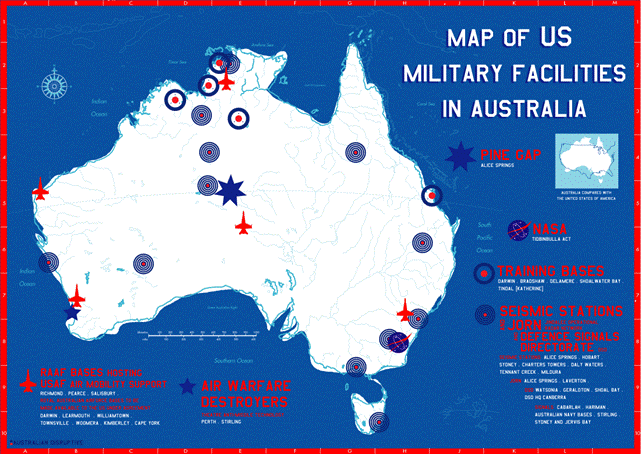 The American colony — US Military Facilities in Australia, courtesy of the Australian Anti-bases Campaign Coalition
Once the White Australia Policy was gone, wherever the non-White refugees came from, the primary cause for their departure was always America and its Zionist and/or Anti-Communist foreign policy. The first of them came in 1976 — the original ‘Boat People’ — as consequence of the failed military adventure in Vietnam. After the fall of Saigon, the Fraser Government[15] welcomed an estimated 100,000 Indochinese refugees over the next decade; an inaugural mass arrival of non-Whites seeking the security of a new country after Australian soldiers had rained destruction on their own.[16] The Lebanese Civil War between 1975 and 1990 — a conflict at all times stoked by Israel and America, and originating from the mass expulsions of Palestinians northwards — produced the first large contingent of Muslim refugees on our shores. Just as the European Refugee Crisis of 2015 was created wholesale by Israel and the Zionist policy to destroy Libya and Syria, Australia’s own decade-and-a-half long refugee crisis from 2001 onward was the direct result of the Zionist wars in Afghanistan and Iraq. To those of you who bleat on about Remigration and post anti-Islam jeremiads, the only way you’re ever going to get a remigration of these people is via a Middle East expunged of Zionist-American destabilisation, followed up by building friendly relations with Arab governments so that we can negotiate the return of their citizens to a safe home.
Speaking of remigration, any policy of repatriation and an end to the system of mass immigration that has fed Australia for the last half-century is futile when coupled with belief in the free market. As an ideological concoction, it’s a complete non-starter. Back to our history: White Australia was the objective of the working man and the labour movement. The first attempts to import non-Whites to the colonies came in the 1830s from wealthy pastoralists who petitioned the colonial authorities for Indian agricultural laborers. In the run up to Federation, White Australia’s greatest local foes were found in the ranks of the Free Traders and the sugar-cane capitalists — that class who saw only pound notes and was perfectly content with flooding the country with Coolies so as to save on his labour costs. Nationalists back then knew that open borders and the free market were one and the same thing. This state of affairs remains to this day.
You can’t have immigration restriction and you certainly can’t have mass deportations whilst also maintaining a perpetual growth economy in a country with declining industrial production and without a strong birthrate. Since the Second World War, our country has been built around extraordinarily high levels of immigration. So much so that any serious attempt at radical immigration reform carried out in modern-day, Neo-liberal Australia will necessarily crash the economy. The Ponzi scheme has gone on for so long now that there is not much left to our economic activity, bar the GDP growth borne from migration. That alone is why no matter how much conservatives or rearguard populist parties smooth-talk to you about cuts, once they get in power, all mentions of immigration crackdowns are forgotten, for no system party wants to be held responsible for an economic collapse under their watch.
Witness the economic tribulations (and also the benefits accrued to the working class) that occurred when the immigration tap was ever so briefly shut between 2020 and 2022 during the COVID lock-downs. Nationalists confront this challenge knowing that a replacement of our current economic system is required — one that is comfortable with stability or even economic shrinkage — and that at every step along the way, the rentier class will stop at nothing to prevent the loss of its streams of capital. One way or another, there will have to be some economic strife, and billionaires and multinational corporations will be drawing the short straw. If your primary concern is the impact on your bank account or on your property portfolio, depart from our ranks, for you were never Nationalist material in the first place.
Should one speak simply of an economic system that upholds a right to private property — with certain important limitations, then Nationalists have no objection to the label ‘capitalism.’ But the question of capitalism is more thorny than this. Nationalists say that capitalism is something that preys on legitimate economic activity, perverts what is otherwise a healthy instinct for trade and production. In the Capitalist world, the abstract pursuit of profit takes precedence over the satisfaction of wants and the social good of the nation. As an ideology of Mammonism, it permits no limitations on the free movement of goods and services. Borders, tariffs and even cultural and linguistic differences are all barriers to efficiency that must eventually be struck down in the interest of profit and the homogenising goal of the market. Driven at its heart by the unnatural power of usury (compound interest) — an exponential force that no nation can naturally keep up with — capitalism requires a constant flow of labour, a constant flow of new consumers, just to function. Open borders and mass immigration is the manifestation of all of this. To state it concisely: if you want White Australia or immigration control, capitalism will have to go.
And finally, to be for White Australia is not to be ‘racist.’ Let us clarify. Nationalism is racialist: We acknowledge the scientific reality of the racial stratum of humanity. Whilst “we are all human”, we are not all exactly the same. Tens of thousands of years of evolutionary pressures produced a diversity of types and forms. This varied the bone structure, the melanin content and produced subtle distinctions in brain functioning as the species Homo Sapiens spread in waves and separated across the globe. Thus general categorisation of humanity into races is made possible by the grouping of these ancestral genetic populations. Once this has all been taken into account, value judgements such as ‘inferior’ or ‘superior’ are an irrelevant political consideration for the Nationalist, whatever our personal or aesthetic preferences may be; there is only differentiation.
Visions of race-grandeur become dangerous only when they imply the extermination or subjugation of other races: our Ideal of White Australia implies no such murderous doctrine. We can be “expanding and swift henceforth,” not at the expense of other peoples; but by our own virtue, and under our own Australian initiative and dynamic; and in our own land. — P.R. Stephensen, The Foundations of Culture in Australia (1936)
Nationalists say that race is a bedrock of national identity, and that all races have the right to maintain themselves and develop according to their own interests. Conflicts of interest will inevitably occur, but none of this is cause for the stirring up of needless hatreds between the races and all are deserving of some basic respect. Good fences create good neighbours, and peaceful and consensual separation is something that all who value their heritage can agree on, regardless of their specific origin. That is what we — and all Australian Nationalists before us — stand for when we say ‘White Australia.’ Not violence and certainly not supremacy over others, nor the pointless slinging of insults. There is nothing more poisonous to the principle of White Australia than internet edgelords and James Mason adherents scrambling over each other to be as ghoulish as possible towards the ‘brown people’ so as to not lose face in some group chat. If what you are after is imperial subjugation of the non-White world, look to liberalism not nationalism, for it was out of the former that the impulse to colonise and ‘civilise’ actually emerged.
In summary, to be for White Australia in the year 2026, one must necessarily be anti-Washington, and strenuously so, with a mind to forging new international alliances. One must necessarily be anti-capitalist and put the case to the Australian people that, in the era of AI and automation, immigration as a means of economic development is as outdated a model as an economy reliant on slavery. Australia must be independent and accept no nation or authority above ourselves (a republic that is, but that’s another story altogether) and all our decisions must be made in the interests of the Australian people alone. White Australia must centre on the plight of the working man and reject the toxic rhetoric of racial supremacism. Ideas can be taken from anywhere, but nationalism must draw on the native strands of identity, from symbols and leaders that grew on this soil, not from abroad. Any political grouping that claims to stand for White Australia (or merely immigration restriction) that falls short on any of these counts is destined for failure and should be instantly discarded.
[1] Prime Minister of Australia from 1996-2007, leader of the Liberal Party; known for his neo-conservative, pro-Israel and pro-Iraq War stances.
[2] NB: we at Inky Australian prefer the term ‘Hitlerist’ over the term ‘Neo-nazi’ to describe groups such as the National Socialist Network. The ‘neo’ gives them far too much political cachet; the group bears almost no resemblance to the historical Nazi party.
[3] A longtime conservative-patriotic grouping in Australia, broadly the Australian equivalent of the John Birch Society.
[4] Archived version availale at: https://webarchive.nla.gov.au/awa/20091119232247/http://pandora.nla.gov.au/pan/37832/20091119-0000/home.alphalink.com.au/_radnat/whatistbd.html
[5] Australian and New Zealand Army Corps, the combined army corps of troops from the First Australian Imperial Force and 1st New Zealand Expeditionary Force.
[6] Prime Minister of Australia from 1939-1941 and 1949-1966, leader of the Liberal Party; a towering figure in Australian politics who oversaw the post-war years.
[7] The exemption for the New Zealand Maori being necessary for they were also British subjects.
[8] The confusion continued in other pieces of legislation, such as the racial disqualifications within the Invalid and Old Age Pensions Act (1912) and the Maternity Allowance Act (1912). Under the former, old-age pensions could not be received by quote “Asiatics (except those born in Australia)”. It can be said that the exemptions, in particular for old age pensions, were reasonable compromises that demonstrated human decency and were not a threat to the country. But when taken together with all the other loopholes, they create a lack of consistency with the racial principle.
[9] Indonesian woman Annie O’Keefe, evacuated to Australia in 1942, was given temporary refugee sanctuary and thereafter married an Australian man. Issued a deportation order in 1949, the High Court overturned the decision based on a complex legal argument relating to her status (or lack thereof) as a prohibited immigrant under the Act.
[10] Tavan, G (2005) The long, slow death of White Australia, Scribe Publications, pp.23-24.
[11] Prime Minister Gough Whitlam (1972–1975)
[12] A nickname given to Sir Robert Menzies in the aftermath of an industrial dispute.
[13] The UNESCO Statement on Race was authored primarily by a group of Jewish intellectuals and anthropologists, and the origins of the UDHR are traced back to Zionist legal scholar Hersch Lauterpacht and the Jewish lobbying for the Minorities Treaty at Versailles.
[14] Australian Security Intelligence Organisation, the domestic intelligence and national security organisation, equivalent to the FBI.
[15] Prime Minister Malcolm Fraser (1975-1983), leader of the Liberal Party.
[16] At the time, the local Jewish community was there prodding the government, successfully convincing the Liberals to take them in not as a humanitarian component within the existing migration system but as a new category, a ‘refugee’ intake separate to any and all immigration criteria or quotas.


“the loudest and most obnoxious voices have announced that salvation can only come from cult-like worship of the ghost of Adolf Hitler”
Well nobody better has arrived on the world stage since.
When will King Donald want to annex Australia on top of Greenland, Canada….?
As for Leader Hitler he lost his war not because the failed to “solve” the JQ but because he failed to “solve” it properly.
Goebbels & Streicher dead, Greenblatt and Smotrich alive and kicking.
I started reading this, but stopped after the introduction because while the author was spilling plenty of his ink criticizing Joel Davis, Thomas Sowell, Jacob Hersant and their mates, he didn’t mention Jews once (except for a brief reference to Zionists).
I searched the article for the term “Jew” and only found three uses of the word “Jewish” in the footnotes.
This is utterly contemptible. Davis is currently sitting in solitary confinement after being charged for “hate speech.” Meanwhile, Sowell and Hersant and the rest of the people trying to support a new White Australia Party have the Jewish-Australian Sword of Damocles hanging over their heads in the form of “The Combatting Antisemitism, Hate and Extremism (Criminal and Migration Laws) Bill.”
Passed earlier this week, this legislation allows the courts to sentence Patriots for up to 15 YEARS for sharing views deemed anti-Semitic, and the legislation is RETROACTIVE.
Everyone in the Western world should be screaming about this draconian, precedent-setting legislation, and instead this author is quibbling about whether or not a supporter of White Australia admires Adolf Hitler.
The timing of this article, in the wake of the antisemitism bill, is highly suspect.
There are three parts to the article. Be patient.
Gorgeous wtiting Anna..beautiful Clarity**
Seems to be some confusion in this long piece. How can “we” be white nationalists while admitting Others into our midst? The author states an evolutionary source of racial differences. This is correct. But, the waffling begins…
Evolution, not the gods, separated and sorted out the various races per the demanding physical and psychological conditions of particular environments. Yes, it is a “environmentalist” argument but the environment is measured in the tens and hundreds of thousands of years, not by ideology/religion/schooling/parenting, and the obsessions of the Equality world improvers of , for example, the last couple hundred years.
As a White advocate, etc. you must assert the historical fact that “everything” you see around you today was invented, discovered, explored, or developed by White men (not women). If you cannot stand by that truth, you are cucked by some kind of ideology of equality. Christianity is heavily cucked by Jews, MLKers, (niggers) or communists in the current iteration of the wretcheds of the Earth demanding White money, etc.
face facts: evolution, huge differences in intelligence And psychological traits, history of White accomplishment and Nigger /Brown failure, etc. Facts, not juvenile love me , love me, love me I’m a liberal, or conservative Me Tooism.
White Australia must be militant in this regard. No Jews, niggers (aborigines IQ at about 65-70, etc), no immigration of non-whtes including North Asians who are as smart and smarter then Whites (but are psychologically collectivist, not individualist….a huge and obvious truth in China, Korea, Japan and so on.).
Time to sober up. I think the English word “fair” is racially sui generis….a White trait. Stop thinking ‘fair’ and think, Whites First and always. Otherwise, we are finished. The Jews began the race equality lies as a subversion of Whites.
Sober up.
I mispelt Thomas’s last name – it is Sewell, not Sowell. Apologies.
Sewell has started a GiveSendGo to support a Free Speech High Court Challenge in Australia. You can donate here:
https://www.givesendgo.com/FreeSpeechAustralia
Thirteen: America’s Number On the Great Seal
https://www.greatseal.com/symbols/thirteen.html
The value of father (אֲבִי) in “Esau, the father of Edom (עֵשָׂו, אֲבִי אֱדוֹם),” is 13 – Genesis 36:43
https://www.gematrix.org/
The Jews are of Esau (brother of Jacob) from Idumea, but not of Israel or Judah; Jewish Encyclopedia, 1925, vol. 5, page 41
Part 1 – America as an Israeli Colony
https://middleeastatemporal.wordpress.com/2012/11/07/netanyahu-once-we-squeeze-all-we-can-out-of-the-united-states-it-can-dry-up-and-blow-away/
Jer. 50:21 “Go up against the land of Merethaim [symbolic Babylon], against it, and against the people of Pekod [symbolic Babylon], waste and destroy after them, says God, and do according to all that I have commanded you”.
pekod in Jewish Gematria Equals: 129
America in Jewish Gematria Equals: 129
New York, home of the United Nations, in English gematria = 666
When the people of Israel left Egypt under the leadership of Moses the first opposition they encountered was from a people known as the Amalekites. Genesis 36 tells us that Amalek was the grandson of Esau!
You mention anti Washington but it has been difficult to distinguish Jewish influence from American influence since WWII. Given that Jews have had controlling hands in law and finance in the US for 100 years its hard to know who is driving the ship.
The problems in Australia and other previously white nations seem intractable, and may be irreversible, especially as Jews push through hate speech laws but perhaps we would be better off focusing on discerning the enemy rather than trying to persuade our fellows to enact laws that appear racist (in the prejudiced sense).
You mentioned different factions within the nationalist movement, ie: “Conservatives, Patriots, Populists, Anti-Vaxxers, Far-Rightists and Hitler cultists” and indeed there are many different groups.
I think this will be a perennial problem, but agreement on all issues is not necessary.
I don’t think advocating for white Australia will be permitted again but arguing against Jewish influence is becoming more acceptable.
Perhaps one thing the different white nationalist groups have in common (whether recognized or not?) is an opposition to Jewish thinking and power.
I know the hour is late with hate laws coming into force but a “Party against Jewish Inflence” or at least a focus on recognizing and opposing Jewish philosophies might be one way of uniting the nationists.
Trying to separate Jewish influence from varying opinions within the white Australian community might allow disagreement within our (your) communities without sacrificing independence to a hostile nation.
Not that white folk can’t be abusive of course, but it seems that Jewish influence is the primary force we are trying to oppose – be that in media, religion, business, politics, etc.
Only when we have a method to distinguish Jewish influence from legitimate positions of nationalists can we create policies that nationalists on the whole support.
(I guess I’m advocating NAZI style policies.)
(NZ)
Australia’s flag is anti-Christian!
The Australian flag is a pagan joke in plain site.
What are the implications of the Red Cross overlay of the Crisscross/Christ cross on the Australian flag?
The first letter of the name Christ in Greek is X and overlaying it on the Australian flag is the Templar standard red cross and sign of Tammuz Ezekiel 8:14. Why does a pagan red cross representing the worship of Tammuz/Nimrod overlay the sign of the Christ cross X?
The Ancient Symbol of The Knights Templar’s Red Cross
“………Early in the 12th century, the first Knights Templar uncovered Jesus’ Truths from the Ark of the Covenant. There, they found a wealth of spiritual information and techniques including, but far from being limited to, the Light Body Activations and the “True Cross of Christianity”. It is therefore no surprise that the Knights Templar received from Pope Eugenius III in 1146 the “Mark of Cain” as a symbol for their knight order. In the symbol of the Knights Templar’s Red Cross the circle has been dropped and the design stylized to display the “croix pattée” which contains many geometrical properties and esoteric secrets. But that is an other story.”
https://en.chartressecrets.org/templars/red_cross.htm
According to historian Alexander Hislop, Tammuz was intimately associated with the Babylonian mystery religions begun by the worship of Nimrod, Semiramis, and her illegitimate son, Horus. The original form of the Babylonian letter T was † (tau), identical to the Roman crosses used today in this world’s Christianity. This was the initial of Tammuz. Referring to this sign of Tammuz, Hislop writes:
That mystic Tau was marked in baptism on the foreheads of those initiated into the Mysteries. . . . The Vestal virgins of Pagan Rome wore it suspended from their necklaces, as the nuns do now. . . . There is hardly a Pagan tribe where the cross has not been found. . . . The X which in itself was not an unnatural symbol of Christ, the true Messiah, and which had once been regarded as such, was allowed to go entirely into disuse, and the Tau, “†”, the sign of the cross, the indisputable sign of Tammuz, the false Messiah, was everywhere substituted in its stead. (The Two Babylons, 1959, p. 198-199, 204-205
https://ucgfiles.s3.amazonaws.com/sermons/the_sign_of_tammuz_ezekiel_8.pdf
Our lord Jesus Christ is a descendant of Shem (Sem) in the flesh and is therefore a Semite
Jews hate Christ, a descendant of Shem in the flesh, therefore the Jews are of the Synagogue of Satan and anti-Christ. Revelation 2:9 & 3:9
“Why should we believe in God? We hate Christianity and Christians. Even the best of them must be regarded as our worst enemies. They preach love of one’s neighbor, and pity, which is contrary to our principles. Christian love is a hindrance to the revolution. Down with love of one’s neighbor; what we want is hatred. We must know how to hate, for only at this price can we conquer the universe…The fight should also be developed in the Moslem and Catholic countries, with the same ends in view and by the same means.” (Lunatcharski, The Jewish Assault on Christianity, Gerald B. Winrod, page 44)
http://www.come-and-hear.com/dilling/chapt05.html
Luke chapter 3 shows that our Lord Jesus Christ is a pure blood descendant of Shem from whom comes the term Semite.
The Jews are of Esau (Semitic) from Idumea, but not of Israel or Judah; Jewish Encyclopedia, 1925, vol. 5, page 41.
“The Jewish Religion: Its Influence Today” by Elizabeth Dilling
This PDF version does not include the more than 300 photocopy exhibits bound in Dilling’s
original book, including more than 200 pages of the Soncino Talmud (Jews College of London
translation). Those exhibits are available on-line at http://Come-and-Hear.com, hot-linked into
the text
Elizabeth Dilling is frequently accused of taking her Talmud quotes out of context. Did she do
that? To answer that question, Come-and-Hear.com provides on-line more than 1500 folios from
16 of the tractates that Dilling cites.
Other Dilling exhibits on-line include:
• Funk and Wagnall’s Jewish Encyclopedia,
• The Universal Jewish Encyclopedia,
• US State Department records,
• Rabbi Louis Finkelstein’s The Pharisees,
• Rabbi Michael Rodkinson’s The History of the Talmud, and
• various periodicals.
At Come-and-Hear.com, all Dilling’s Biblical references are hot-linked to an on-line Bible
service (BibleGateway.com), which provides a number of translations and easy access to wider
context.
https://come-and-hear.com/dilling/jriit.pdf
@ Inky Australian
‘Once the White Australia Policy was gone, wherever the non-White refugees came from, the primary cause for their departure was always America and its Zionist and/or Anti-Communist foreign policy. The first of them came in 1976 — the original ‘Boat People’ — as consequence of the failed military adventure in Vietnam. After the fall of Saigon, the Fraser Government[15] welcomed an estimated 100,000 Indochinese refugees over the next decade; an inaugural mass arrival of non-Whites seeking the security of a new country after Australian soldiers had rained destruction on their own.[16] The Lebanese Civil War between 1975 and 1990 — a conflict at all times stoked by Israel and America, and originating from the mass expulsions of Palestinians northwards — produced the first large contingent of Muslim refugees on our shores. Just as the European Refugee Crisis of 2015 was created wholesale by Israel and the Zionist policy to destroy Libya and Syria, Australia’s own decade-and-a-half long refugee crisis from 2001 onward was the direct result of the Zionist wars in Afghanistan and Iraq. To those of you who bleat on about Remigration and post anti-Islam jeremiads, the only way you’re ever going to get a remigration of these people is via a Middle East expunged of Zionist-American destabilisation, followed up by building friendly relations with Arab governments so that we can negotiate the return of their citizens to a safe home.’
Nonsense and lies. The Vietnamese who entered Australia were mostly enemies of the new NLF regime whose accepted responsibility was to incorporate them into the new sovereign and unified state of Vietnam in which there were plenty of opportunities for the minor urban commercial activities that were the habit of those who were admitted to Australia (excepting perhaps those associated with prostitution and crime, the reform of which was still a Vietnamese responsibility.
The same goes for all the fake refugees who were also forced on Australia by the cosmopolitanising forces within Australia and without. Where did e.g. the Greeks go when under the harsh German occupation in the Second Imperialist War? They stayed and fought! REAL Greek refugees of the Left came to Australia in the 50’s AFTER the war when the rightist death squads had the unbridled upper hand. I well remember one of these and had a pretty complete profile of his parents’ background as Leftists related to me.
And going back 30 years and forward, I recall the stories, all from reliable sources, of the ‘refugees’ returning to their ‘war torn’ homelands for holidays, all within few years of the their acquiring refugee status in Australia. And still it happens en mass.
And what of the hordes of Indian and Chinese &etc., none of which fits your bed of Procrustes of ‘Political Refugee’.
What you are attempting to do is legitimise the flooding of Australia and the European-based nations by the Globalists, in large part activist Jews connected to a broader Zionist agenda, by overstating the displacement effect of Zionist based wars. As outrageous as these are, your argument is wrong.