
Panama’s Jewish Mayor and His American Allies
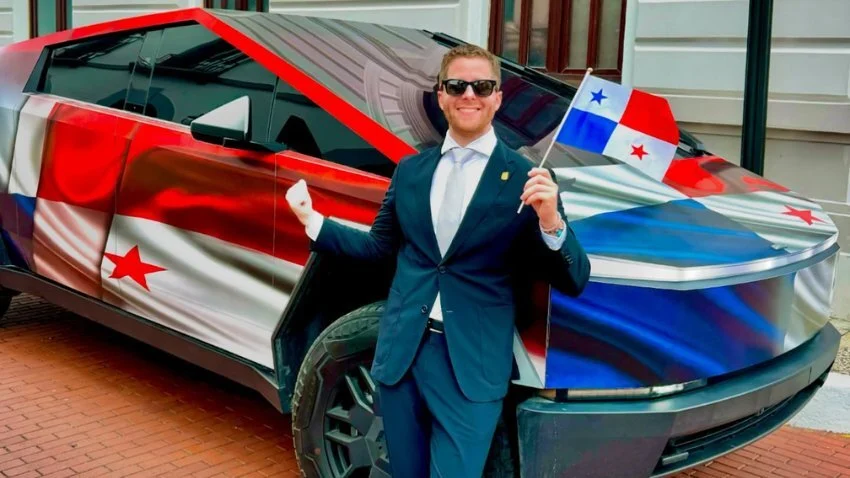
From Expat Money. Caption: Before politics, Mizrachi made waves as a tech entrepreneur launching encrypted apps, importing Teslas, and challenging Panama’s outdated systems with bold innovation
Who is Mayer Mizrachi?
The question seems straightforward enough. Born August 25, 1987, in Panama City to a Panamanian father of Jewish background and a Jamaican mother. Tech entrepreneur. Social media influencer. Mayor of Panama City since July 2024. The first Jewish person to hold that office and one of the highest-ranking Jewish elected officials anywhere in Latin America.
But the simple biography obscures a stranger story. Before the mayoral sash, there was a maximum-security prison in Bogotá.
Mizrachi’s path to City Hall ran through a Colombian prison. Around 2013 he founded Criptext, an encrypted messaging platform that he licensed to Panama’s government innovation authority. When the administration turned over, officials accused him of embezzlement and non-delivery. Mizrachi held that the contract had been honored and the new government had simply shelved the licenses. In December 2015, while passing through Cartagena, he was arrested on an Interpol Red Notice at Panama’s request and spent six months inside La Picota, a prison whose population included active cartel members.
Both the embezzlement charges and a separate 2023 money laundering inquiry were eventually dropped, the former shortly after he won the mayoral race in May 2024. He has always maintained that both proceedings were politically motivated, rooted in his family’s connection to former President Ricardo Martinelli, whose brother-in-law is Mizrachi’s father Aaron “Roni” Mizrachi.
Rather than treating the prison experience as a liability, Mizrachi turned it into the foundation of his political persona. “Any difficulty a person goes through in life will build their character,” he told PragerU in June 2026. “I do not feel sorry for anyone who is going through hardship. Anyone who goes through hardship and survives will become stronger and better because of it. I am proud I would not have been able to do that if it weren’t for the challenges that God put in front of me.”
That mythology fed directly into his campaign strategy. He ran as the “Chacalde”—a portmanteau of the Spanish words for jackal and mayor—and built his political brand entirely through viral social media content, bypassing conventional advertising and major donors. On May 5, 2024, he took approximately 32.5% of the vote and roughly 156,000 ballots, outrunning his nearest rival Edison Broce, who finished at 27.4%.
In office, the anti-establishment persona has translated into aggressive administrative cuts. He trimmed City Hall’s workforce from 6,500 to roughly 3,500 and drove the municipal budget from $325 million down to $230 million—the steepest reduction in the city’s history. “By all counts, City Hall is operating faster and better with more impact,” he told Politico.
The same appetite for disruption drives his economic proposals. He has floated letting ships pay Canal transit fees in Bitcoin and entered Elon Musk’s Boring Company’s Tunnel Vision challenge, which offers the winning municipality a free tunnel that can be used for freight, pedestrians, water, utilities etc. Panama City made it to the final 16 of 487 international entries—the only non-American finalist—before being eliminated from the competition. The comparisons to Elon Musk’s DOGE operation and Trump-era disruption politics are not ones he resists.
When New York mayor Zohran Mamdani proposed routing neglected private property into community land trusts, Mizrachi fired back with an open invitation: “Dear Millionaires/Billionaires, come to Panama—0% tax on foreign income. No inheritance tax. $300K investment gets you residency. USD economy, stable banking. Pro investment capitalist policy. We reward capital, not chase it out.”
His Jewish identity is not a private matter. Mizrachi comes from a family with strong Jewish-Jamaican heritage and stands as Panama City’s first Jewish mayor, a distinction that carries particular weight in a country whose Jewish community has produced two presidents. His surname “Mizrachi”—meaning “Eastern” in Hebrew—is common among Sephardic Jews of Middle Eastern and North African descent.
Panama’s Jewish community, estimated at 17,000 people, is the largest in Central America, sustaining over 50 kosher establishments, 10 synagogues, and day schools that enroll nearly all Jewish children. The country has had two Jewish presidents—Max Delvalle and his nephew Eric Arturo Delvalle—making it the only country outside Israel to have reached that threshold. The Jewish Federation of Greater Portland reports that Mizrachi has said “everything he does, he knows, reflects not only on himself but on the Jewish community of Panama and on Jews around the world. He feels that responsibility deeply—to serve the city with excellence and to honor his community by his conduct.”
His bond with Israel is tangible. When Israeli President Isaac Herzog paid a historic first-ever presidential visit to Panama in May 2026, Mizrachi met with him and posted afterward that “We will continue working on Water, Technology, and security projects. … And hopefully that direct flight” to Israel. Inside the Shevet Ahim synagogue, the main Sephardic Orthodox congregation at the center of his community, Israeli flags cover every wall alongside banners demanding the return of hostages taken in the October 7 Hamas attacks.
The same instincts that draw him toward Israel pull him toward Washington. Mizrachi’s appearance on PragerU with CEO Marissa Streit in June 2026 placed him squarely inside one of America’s most prominent conservative media platforms, and his statements there were unambiguous. “Panama’s inception begins—it was made possible as a country because of its alliance with the US,” he told Streit. “So literally, the connection between Panama and the US goes deeper than just shared interest. These are shared values.” Asked whether Panamanians resent the United States for the role it played in their country’s founding, he dismissed the premise entirely: “No. The relationship between Panamanians and Americans has always been one of friendship. And Panama is a prime example of when US intervention works.”
On the strategic importance of the Panama Canal, he pointed to the recent Strait of Hormuz crisis triggered by American strikes against Iran. “The Panama Canal matters more than ever to the US, to the world. Because we have a problem—the Strait of Hormuz. And that demonstrates how critical and important it is for the US to have influence and the support of the countries that control these global gateways, pathways.”
Mizrachi’s posture reflects a deeper national pattern. Panama remains the only country in Latin America that has never recognized the State of Palestine—a product of sustained U.S. alignment dating to the 1989 invasion that removed Manuel Noriega, ongoing American pressure over Canal governance under the Trump administration, the “Mulino Doctrine” of strategic lockstep with Washington and Tel Aviv, and a left-wing political current that runs considerably weaker than in Venezuela, Bolivia, or Nicaragua.
Panama voted in favor of UN Resolution 181 in November 1947, one of only 33 countries to support partition, and formally recognized Israel on June 18, 1948. The Panama-Israel Free Trade Agreement was signed in 2018 and entered into force on January 1, 2020.
The bilateral relationship carries shadows as well. Mike Harari, head of the Mossad’s special operations unit Caesarea, constructed and supervised Israel’s covert relationship with Panama’s military regime from 1968 onward. Manuel Noriega had trained with Israeli paratroopers, made five jumps with them, and wore his Israeli paratrooper wings on his uniform for years. When the United States invaded in December 1989, both men were on the target list. Noriega was taken into custody; Harari slipped out and made his way back to Tel Aviv.
The surveillance apparatus arrived through diplomacy. A 2012 meeting between President Martinelli and Prime Minister Netanyahu, in which the two discussed Israeli military and intelligence equipment, set the stage for Panama’s acquisition of NSO Group’s Pegasus spyware. Martinelli allegedly turned the technology against a wide sweep of targets—political rivals, business competitors, journalists, American citizens, and staff at foreign embassies— generating a criminal case that would follow him long after he left office.
Mayer Mizrachi’s journey from a Bogotá prison cell to the mayor’s office in Panama City is not just a personal redemption story or a colorful chapter in Latin American politics. It represents a much larger political project. Mizrachi plays his part by consolidating Jewish political power in a strategic nation that controls a global chokepoint, aligning with Washington and Tel Aviv, and presenting his community’s interests as synonymous with civic virtue.
Still, his rise is not an isolated event. It belongs to a coordinated push by world Jewry to extend its influence deeper into Latin America through the installation of philosemitic governments like Javier Milei’s Argentina and the use of Jewish-friendly diplomatic arrangements such as the Isaac Accords to make the region safe for Jewish supremacy. Mizrachi, by carving out a safe space for Jewish interests in Panama, acts as an agent of this broader plot, one that aims to ensnare the rest of the region under the Talmudic Serpent’s grip.




Jews, thru Black Cube, now have the ability to install anyone anywhere they please- no matter the candidate was a fraudster, no matter whatsoever.
It hits you hard that, despite statistically not existing in the world, they are everywhere, college lecturer, politics, intelligence, even on your local library board.
And it hits you even harder that nobody notices
I was going through an old ghost town in Washington yesterday that is unghosting. Real Estate signs everywhere by “yep you guessed it”. There is nowhere to run to.
Remember that cancer starts from just a few cells that statistically are too few to count, in the body. Diseases start from a tiny number of germ cells that again, are too few to count statistically.
Austrian painter tried to warn us.
Martin Luther too. He had jews nailed down 500 years ago.
It’ll be the standard Jew program. Poverty will increase wildly. Usury laws will disappear. Drugs will be introduced and they’ll have an area that’s like Kensington, Phila. Money will be siphoned off from, well, everyone and everything and sent to “israel”.
Birth rate will collapse and the Jews will bring in immigrants from the most crime-ridden and animalistic population they can find, probably some war-torn part of Africa.
And so on.
Way too many posts on this website with exclamations of woe, and too few with strategy and tactics.
Jews are in Panama because they know it’s a valuable piece of real estate that they should squat on. Any ship that passes through the canal must first gain permission, then pay a fee. Those things can increase Jewish leverage.
What should American patriots do about this? Well, the same thing that would be done if the Chinese or Iranians or any other hostile foreign power controls the canal. You could try to torment a revolution through intel agencies. If that doesn’t work, invade.
Jews must be treated as a hostile foreign power and cannot be allowed to control the canal.
Sure.
Everyone thought it was a good idea to put a bell on the cat, but none of the mice could figure out how to do it.
Please. They’ve been kicked out of many countries before. We can do it again. No need to listen to whiners.
The Bean People need to wake up more. They see jews as white.