
Is Russia Going To Attack Western Europe?
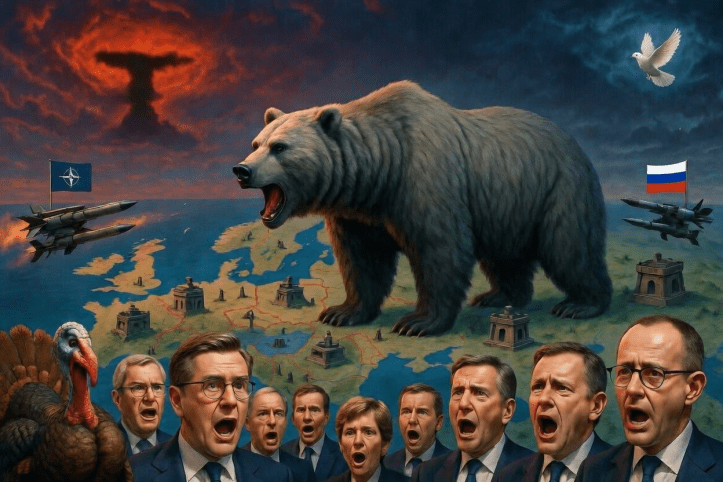 As reported in the daily press, the Mette Frederiksen regime’s state-controlled television has just aired yet another smear campaign against Russia, portraying it as an aggressive state that, with its approximately 150 million people, intends to subjugate all of Europe—with its approximately 500 million inhabitants (which would make the Russians a minority in their own country…) — indeed, the entire world. The purpose, of course, is to scare people, because when people are scared, they’re easier to control and manipulate. Then they’ll put up with the regime’s myriad of schemes—all of which, of course, are supposedly meant to “protect” us. COVID-19, climate change, Russia… You recognize the pattern: Keep people preoccupied with their fear of something they know nothing about and don’t understand, so they don’t notice what’s really going on behind the scenes.
Television supposedly “proves” that Russia is preparing an attack on the West because it’s building up its military along the entire border. Mass panic. — Is there any intelligent life at all at the Danish Broadcasting Corporation, the rest of the state-controlled press, the Royal Danish Defence College, the Danish Defense Intelligence Service, etc.? That there isn’t any in the government comes as no surprise. Do they think the Russians are both blind and deaf?
Russia has noticed that, in violation of all agreements, NATO has been pushed all the way up to Russia’s entire western border—and that NATO is not a defensive alliance, but an offensive pact—as is clearly remembered from the bombing of Serbia, intended to bring about “regime change” and to conquer the entire southern part of the country with the aim of establishing an artificial American NATO–enclave under the name of Kosovo. In Russia, NATO is viewed as a direct threat to Russia’s very existence. The West may claim that this is entirely wrong, but that does not change the fact that Russia perceives it this way and acts accordingly—nor should this come as any surprise to NATO. When NATO is building bases close to the Russian border in Finland and the Baltic states, from which missiles can reach St. Petersburg in 5–10 minutes and Moscow in 10–15, it is only natural that Russia takes its own precautions. This is not a sign of aggression, but rather of due diligence! The aggressive party is NATO, to whom the ultimate goal is to dismember the Russian Federation—as NATO politicians themselves declare!
In Russia, people are also taking note that the war rhetoric in Western Europe over the past four years has become alarmingly shrill. “War is better than peace,” proclaims Mette Frederiksen, whose stupidity and ignorance are surpassed only by Kaja Kallas, who, as “Europe’s” chief diplomat, provides fresh fuel for blonde jokes. Her absurd warmongering and total ignorance of history naturally provoke laughter in Russia as well—but, nevertheless, one cannot afford to ignore her threats. In Germany, Chancellor Merz wants to make the country “kriegstüchtig” (able to wage war) by the end of this decade—a term he has borrowed from Joseph Goebbels—and especially when such plans originate in Germany, they evoke traumatic memories of World War II, during which the Soviet Union lost up to 30 million lives as a result of Germany’s attempt at colonization—and of World War I, during which Germany invaded Russia twice and, under the Treaty of Brest-Litovsk, initially annexed Poland, Finland, the Baltic states, Ukraine, and large parts of Belarus. Germany’s remilitarization is not taken lightly in Russia, and it is also a violation of the agreements that were concluded as a prerequisite for Germany’s reunification—and of the UN Charter, which prohibits German militarization, so that any of the victorious powers from World War II would be fully entitled to reduce Germany to ruins again should militarization occur. Germany is not a sovereign country. A war would lead to Germany ceasing to exist as a state in the form we know it. Merz, incidentally, is part of the Jewish BlackRock conglomerate, which has very significant economic interests in Ukraine, Zelensky, and the arms industry—but in Germany, corruption is, of course, completely unthinkable—or…?
Everywhere, they will (re)introduce conscription and spend astronomical sums—which they do not have—on weapons—instead of using them for the benefit of the population. Finland’s ridiculous president believes that Finland can easily defeat Russia. If he tries, the Finns will, at best, have to relocate their capital to the Åland Islands. Finland’s stance, in particular, strikes a deep chord with the Russians. Finland attacked the Soviet Union twice, and as an ally of Germany, Finland participated in the blockade of Leningrad, where around one million civilians died of starvation. Nevertheless, the Soviet Union granted Finland its independence—in exchange for a guarantee of neutrality, which Finland upheld throughout the Cold War. The Russians are unlikely to make that mistake again.
And then there are the Baltic threats to attack the Kaliningrad region, which they believe they would be able to conquer in an afternoon. The Russians have clearly stated that any attack on Kaliningrad will be met with nuclear weapons—and in any case, any such attempt will result in the Baltic states disappearing once again and becoming regions or, at best, republics within the Russian Federation. All in all, the Baltic states are naturally in the spotlight because of their blatant discrimination against the large Russian-speaking population, which is currently deprived of its rights—in violation of all international provisions on the protection of minorities. Unless Estonia and Latvia, in particular, amend their legislation so that it is at least in line with EU rules on linguistic rights for minorities, sooner or later Russia will enforce these changes. Russians have lived in Estonia since the year 900—they have just as much right to be there as the Estonians. The behavior of these two states would be roughly equivalent to the German government banning Danish schools, high schools, churches, libraries, and nursing homes in Southern Schleswig and shutting down the Danish newspaper Flensborg Avis. Would we like that? Quite apart from the fact that the Danish minority in Southern Schleswig is small compared to the number of Russian speakers in Estonia and Latvia, where they make up between 25 and 35% of the population. In Ukraine, the conflict is also due to NATO, the EU, and the linguistic and cultural rights of the Russians living there. See more in-depth coverage of this in previous articles published about the conflict on my Substack.
It has not escaped the Russians’ attention, of course, that they are, in fact, already at war with the West, which is supplying the Ukrainians with weapons, experts, and intelligence (in the military sense of the word only), just as it is controlling the drones that are currently attacking deep into Russia.
Nor has it escaped their notice that there is open talk of blocking the Danish Straits (the Great Belt and the Sound) to the Russian Baltic Fleet, which would thereby be trapped inside the Baltic Sea. Any such attempt would trigger an immediate response that would turn Funen and Zealand into (possibly radioactive) wastelands. Continued support for Zelenskyy could have very unpleasant consequences for the West!
Western European countries must therefore cease all participation in “Project Ukraine.” After all, they are not supporting a “democracy”—as they like to claim—but a thoroughly corrupt and dictatorial terror state. Zelensky and his cronies are not Ukrainians, and they are deliberately working to exterminate or expel the Ukrainian population (regardless of whether they identify as Russians or Ukrainians). I see this as deliberate revenge for the Holocaust, in which the Ukrainians were eager participants. Demographically, Ukraine cannot survive today—most men between the ages of 16 and 60 have been killed or have fled. The fertile agricultural land is so contaminated that it will be unsafe to cultivate large parts of it for many years to come. The industries and infrastructure will be destroyed, and there will be no economic basis for rebuilding them. Russia is unlikely to allow Western countries to support the reconstruction, since economic support equates political influence. The Russian part will be rebuilt relatively quickly. What will the West have achieved?
But setting all this aside, one has to ask oneself: Why on earth would Russia attack Western Europe?? What could be gained by doing so—aside from becoming a small minority in Russia? We have nothing the Russians want. We have no raw materials; we have nothing the Russians need—indeed, nothing the Russians want. We are bankrupt, our infrastructure is worn out, and our population now consists almost entirely of people who do not belong here—and who, to far too great an extent, contribute nothing positive to society. Russia wants none of these problems. We have absolutely nothing positive to offer. The level of civilization in Russia is far higher than in the rest of Europe, and the government is far more competent, as the constitution has built-in safeguards to prevent complete idiots from taking seats in parliament or becoming president; the infrastructure is far better than here; the education system is top-notch —and freedom of speech is far greater than here, as the acceptable range of opinion for ordinary, normal people is much broader. Put in another way, one can only regret that Russia has no interest in taking over the bankrupt Western estate. Such a takeover would greatly improve our quality of life.
But how does the narrative that Russia will come and take us over fit with the narrative that Russia is so weak it can’t even defeat Ukraine? Surely both narratives can’t be true?! And besides, Russians are generally far better at math than we are here: In any case, they can easily figure out that 150 million versus 500 million is a poor starting point for a war—even though there are many other parameters that matter in warfare, and even though the Russian army is better trained and more motivated than the Western European one. In 1941, the German Reich had a population of approximately 80 million, compared to the Soviet Union’s approximately 170 million. The math of war suggests that this is an uphill battle.
How did we end up in this situation?
Well, the deeper cause is, of course, a complete lack of knowledge about history, politics, and the social conditions of other countries—and thus also about both Russia and Ukraine—and this lack of knowledge stems from a catastrophic decline in educational standards in this country in general and—indeed, throughout the entire EU. Traditional language studies no longer exist, and master’s degrees have been watered down to nothing. Today, any idiot can get a university degree. This means, among other things, that very few people have the opportunity to learn Russian. The only place where Russian is taught at a high level is the military’s language officer training program, but that mainly leads to employment within a system where free thought is banned. Engagement with Russian literature occurs only as a hobby. But the problem lies throughout the entire education system. This, of course, suits those in power perfectly: Stupid and uninformed people are easier to control, and when virtually no one has any knowledge of history and culture, the professional liars have free rein. This ignorance is spread by willing journalists, who themselves don’t know any better and who, in any case, know their role all too well. If you express a different opinion, you’ll be silenced—or portrayed as a “Putinist” or a Russian agent; indeed, in the worst case, you’ll end up on a “sanctions list,” which means your accounts will be frozen, you won’t be able to travel, no one will be allowed to give you money, and so on. It’s a purely administrative decision that cannot be challenged in court. Hitler and Goebbels were true amateurs by comparison. People have been raised not to hold any dissenting opinions. Today views on Russia, the climate, COVID-19, immigration, gender, etc., are turned into moral issues. Only the views that those in power wish to disseminate through the press they control and pay for are morally correct—regardless of whether they are factually incorrect.
I lived through the entire Cold War, from the Korean War onward. I have a very clear memory of the Cuban Missile Crisis, when we feared a nuclear war because the Soviet Union had deployed missiles in Cuba! In the West, people were afraid of the Soviet Union because it wanted to spread a Communist ideology, which was not desired in the West. We know today that this fear was wildly exaggerated—but we didn’t know that back then. In other words, there was a real conflict between the Soviet Union and the West—and there was a constant military buildup on both sides of the Iron Curtain. Nevertheless, throughout all those years, there was a stable diplomatic relationship between the superpowers—and people-to-people contact between the blocs was encouraged. Of course, there were both train and air connections to the Soviet Union and the other Eastern Bloc countries; Soviet and Eastern European newspapers were available for purchase at newsstands every day; tourist trips to the Eastern Bloc were organized (though not really the other way around); and sporting and cultural exchanges took place as a given. Danes could study in the Soviet Union. Khrushchev paid a state visit to Denmark in 1964 and was received with enthusiasm. He visited Prime Minister Erik Eriksen’s farm on Funen—the radio broadcast his speeches…. I remember it so vividly. This interaction offered hope for mutual understanding and peaceful coexistence. The Helsinki Final Act of 1975 gave further impetus to easing tensions. Not even the catastrophic Soviet war in Afghanistan disrupted this. People knew that peace with the Soviet Union was the most important thing in a world full of nuclear weapons.
This understanding has vanished today—like dew in the sun. “War is better than peace!” Has Mette Frederiksen even understood what she’s saying? She is actually saying that it’s better for the world to be destroyed in a nuclear catastrophe than for us to maintain peace with Russia. In terms of stupidity, this statement is hard to top. Attitudes like this were punished at the Nuremberg Trials with slow suffocation on the gallows. There is nothing more important in the world today than peace! War means total annihilation, and thus everything else is, in a sense, irrelevant. And peace presupposes natural coexistence between nations and peoples—even if one does not agree on the details. You can’t win a war against a nuclear power, so why puff yourself up like a strutting turkey? Diplomacy and understanding are a duty! In fact, quite literally, according to the UN Charter.
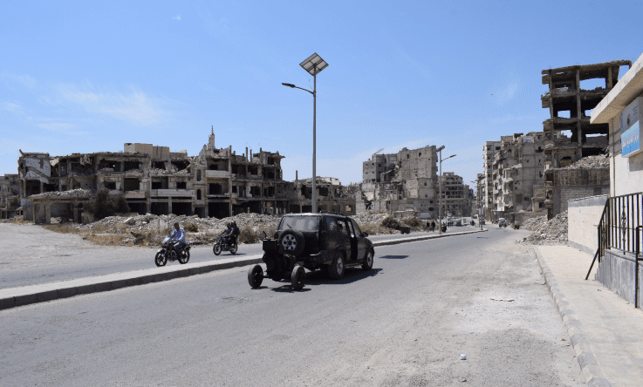 War is better than peace? Aleppo, Syria, 2025. Private photo.
Today, Russian media are being blocked online. It has been made impossible to send money to Russia; you cannot access your online banking from Russia; air connections have been shut down; most border crossings have been closed, resulting in long waiting times—in short, it has been made extremely difficult and expensive for people to travel to Russia. The University of Kiel has even banned students from visiting Russia, and the EU is seriously considering denying Russians visas for vacation trips to Europe so they can see for themselves the conditions in Europe’s major cities and thereby be cured of any flirtation with “Western values.” Those in power do not want people to see what life in Russia is really like, because this would cause the narratives to collapse. As mentioned above, the level of civilization is far higher than what we know today in the West; Russia is not under economic pressure, and the population does want peace—but certainly not just any kind of peace. People are increasingly hoping that Putin will treat Ukraine the way Israel is treating Gaza. And surely, no one should be in any doubt that Russia could do so if Putin wanted to. However, he prefers the slow war of attrition. It does not cost so many Russian lives, and it slowly but surely depletes not only Ukraine but also the other Western European states of weapons and economic resources, so that they will no longer pose a threat. Yes, perhaps the public in the West will stand up and bring down the current regimes as the states’ coffers are emptied.
In the West, people harbor completely unrealistic notions about Ukraine’s conduct of the war, viewing the Ukrainian propaganda machine in the same way that Jehovah’s Witnesses view the Bible. Burning oil tanks is nothing new. It certainly looks spectacular—and the column of smoke is impressive—but it has no bearing on the war—and the Russians’ only reaction is to form a line of onlookers on the highway. There are often air raid sirens in the cities near the front, but no one reacts. I also watch the drones from the window, and when they’re hit by anti-aircraft fire, they explode in an impressive shower of sparks. Somewhere, of course, they fall to the ground and usually cause minimal damage. People are used to things being shot at—I myself have had dinner on a fully occupied terrace in Sevastopol to the symphony of machine guns and various heavier weapons about 300 meters away. Everyone calmly continued eating and talking. The most unpleasant thing is the gunpowder smoke. Today it’s not gunpowder but chemicals, and it stings the airways. When driving from town to town in areas close to the front lines, you don’t take the main road but rather the small roads, preferably through forests, if there are any. Drones are wreaking havoc on the main roads. Today, of course, with Western help, the range and frequency of the attacks have increased, but that doesn’t really change the outcome of the war. The Russians are a tough lot! You’d have to be more than naive to believe that Ukraine can win this war. Remember once again: A nuclear power cannot be defeated—it will never allow itself to be defeated. The only thing that will be achieved is the destruction of Ukraine and the extermination of the Ukrainian people. Supporting Ukraine in this hopeless struggle is like the rope supporting the hanged man!
I have tried many times to explain the context of this conflict, but it will likely be necessary to repeat it for the benefit of new readers—of whom there are hopefully some.
Let’s start with the basics: There was never a country called Ukraine before 1991. Before that time, Ukraine was merely an administrative unit within the Soviet Union. The borders were not based on ethnicity; they were completely arbitrary. Upon the dissolution of the Soviet Union, these borders should have been redrawn through referendums on a region-by-region basis. Instead, Ukraine was turned into a hybrid state comprising several ethnic groups—primarily Russians, Ukrainians, Hungarians, and Romanians. The new Ukrainian constitution guaranteed equal status for Russians and Ukrainians, as well as for the Russian and Ukrainian languages. It also guaranteed Ukraine’s neutrality. This state functioned quite well. Russian speakers (mainly from historic Novorussia) and Ukrainian speakers (mainly from northwestern Ukraine) cooperated in governing the country without major problems —until the Ukrainians elected a Russian-speaking president who realized that Ukraine’s industrial base was tailored to Russia’s needs and that it would have no chance of surviving in competition with Western companies on the European market. When Ukraine needed a massive loan, it sought offers from both the United States and Russia. The U.S. imposed a long list of conditions, including that Americans should be allowed to buy land in Ukraine. Russia imposed no conditions whatsoever. The president naturally chose the Russian loan. The Americans had been active in Ukraine even before World War II, and now they struck by financing and organizing a coup d’état in 2014. Subsequently, the constitution was amended so that Russian-speaking citizens lost their rights. The two Russian-speaking regions in the Donbas then declared themselves independent republics. The new Ukrainian government regarded them as terrorists and insurgents and began waging war against them. Over the next 8 years, the Ukrainian government killed at least 8,000 civilians in this area. This prompted Russia’s invasion of Ukraine. It was not an “unprovoked war of aggression,” but the result of Russia’s duty to protect the residents of the Donbas (the same argument the Americans used against Serbia to force it to de facto accept the break-away province of Kosovo as an “independent” country). All of Russia’s attempts at a compromise that would safeguard the rights of Russian speakers were sabotaged by the West. It is not Russia that is responsible for this war, but rather, exclusively and unequivocally, the United States—the world’s most dangerous terrorist state.
The only reasonably stable borders are those between nationalities, and the war in Ukraine will not end until such borders are established—which will likely be the day Ukraine surrenders unconditionally. For Russians, however, Ukraine is not enemy territory. Ukrainians are their brothers. There is hardly a Russian family that does not have Ukrainian relatives in one way or another. Ukrainians and Russians have lived together throughout history; Russia’s first true capital was Kiev. The Ukrainians adopted the Russian language—although, of course, they continued to speak Ukrainian at home in the villages. Apart from the peasant culture (and no offense to that), there is, after all, no Ukrainian culture, but only a Russian-language one, just as the two peoples have almost always shared a common history. To “de-Russify” Ukraine today would mean stripping the country and its people of their history and culture. Even Ukrainian writers wrote in Russian—not only because it allowed them to reach a wider audience, but also because Ukrainian was not yet fully developed as a literary language. Banning Russian and denying their shared history can hardly be the right path to take if one wishes to unite the various population groups into a single nation.
The close relationship between the two peoples is, after all, precisely a key reason for proceeding so cautiously during this special military operation, which is explicitly not a war. The aim is to put an end to Zelensky’s thoroughly corrupt Jewish regime and to the ultranationalist forces that refuse to live in peace with Russia. The problem, of course, is that these forces will continue the war from exile in Europe unless they are simply physically eradicated—or unless the West is so thoroughly terrified that no government dares to harbor Ukrainian rebel forces. It is clear, however, that the increased support from the West is fuel for the hawks in Moscow, where Putin is by far the more moderate influence. There is a growing sentiment in Russia that it would be better to deal a decisive blow to Ukraine and set a powerful example by bombing the control and command centers in the West from which the war against Russia is being waged, as well as the production facilities that supply Ukraine with weapons and drones. The West should not expect any kid gloves. It will be harsh and uncompromising. And even if one were to assume that Russia would be forced to launch an actual war against the West, one should not imagine a war like the two previous world wars. Russia is unlikely to send a large army into Western Europe. It will be an air war that will remind the Germans of 1945. An occupation would only be a possibility in the Baltic states—for geographical reasons and for the reasons mentioned earlier—and perhaps in eastern Germany, where the Russians would likely be viewed as liberators. Furthermore, Russia has no desire to rule over Ukrainians. There will still be an independent Ukraine, provided it is willing to live in peace with Russia. It will, however, be somewhat smaller than it is today.
This development is not prevented by war rhetoric, isolation, and military buildup, but through diplomacy, cooperation, and interaction between peoples!
And finally, there is the burning issue of our time: What about the climate? After all, every public project must be accompanied by a calculation of its “climate impact” (a meaningless term!). During a war, for sure, unimaginable amounts of CO2 are emitted into the air. A German has crunched the numbers. Due to Germany’s contribution to Ukraine, the country has used up its CO2 quota for the next 6,000 years. I don’t know how he figured that out, or whether it’s actually 5,000 years or 7,000 years. It doesn’t really matter anyway. In this country, we talk about the importance of reducing cows’ flatulence by stuffing those poor animals with harmful substances. If anyone calls this idiocy, I completely agree—but thank God, CO2 has no impact on the climate, so we can sleep soundly. It’s entirely different factors that control our climate, and we haven’t yet reached the temperatures we had before the Little Ice Age. But the idiocy, the absurdity, and the ridiculousness are, however, without comparison! We’re truly being led by a bunch of criminally insane morons!
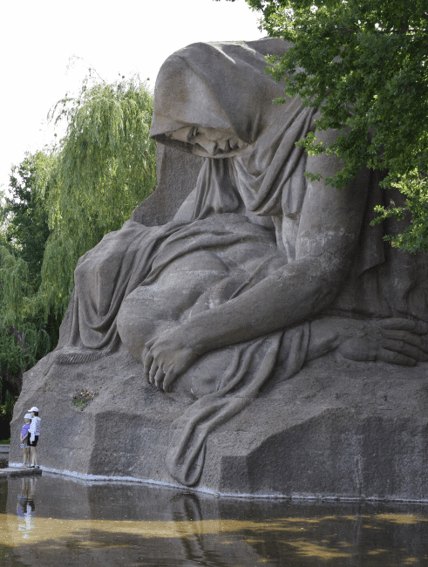 “War is better than peace” (Mette Frederiksen). Stalingrad. Private photo.




Jews retaliating for Russian destruction of their Paradisus Judaeorum
and
‘tying Russia up’ so they can’t have a say in israel’s land grabs. (Rubio said as much, with a dly grin)
of course add in the Bolsh Coup that brought about the Soviet Union, the Holohoax guilt imposed on Europe, and …
well, you know the thing.
It ain’t Americans, Germans or Finns- it’s jews
RT has an article saying Europe is through with the Holohoax guilt.
Hopium?
https://www.rt.com/news/642357-europes-holocaust-guilt-israel/
Even if true, we all know jews will redort to other means; fixing elections, lawfare, extortion, bribes or their favorite, plain old brutality to keep their power
Even the Jews themselves, in their internal communications, regret that the only “hook” they have with the goyim is the holohoax, and it’s getting old. The last generation to really be sucked in was the Boomers and they’re dying out.
Jewish bankers love war (or the threat of it) because that means nations borrowing huge sums of money from them and becoming indebted.
Don’t think for a second that Putin isn’t part of this little game. The Jews can sweet-talk him about what he stands to gain from it – namely ironclad political control, kickbacks from defense contractors, etc. Putin doesn’t need to actually invade – he only needs to play the part of the boogeyman. And that he does sufficiently.
@ reapolitik
You have to spell Jews as jews at TOO.
Endless jewing. The jews hate Russia because Russia kicked their sorry asses out.
Whatever you think about Russia, Jews, Putin or Ukraine, please read Juhani Ilanus, “Putin & the Jews”, CLIO’S PSYCHE, September 2024 on-line.
The Russian Juden-fascist Sergey Karagonov — an oft-quoted academic and security expert, is doing his part to demonize Europeans as “the source of all evil in human history”…
https://www.unz.com/runz/how-russia-can-defeat-ukraine-and-nato/#the-dangerous-notions-of-sergey-karaganov …and talking about Russia nuking them, implying this would not be a moral atrocity.
He has special enmity for Germany, and said Stalin made a mistake by opposing the (Juden-fascist) Morganthau plan, and apparently wants to see it brought to completion.
He serves a similar function as the Juden-fascist Dmitry Medvedev, the Deputy Chairman of the Security Council of the Russian Federation, who also regularly threatens to nuke Europe.
Obviously, all of these jews are working for Judeofascist Israel and the international Zionist agenda, NOT for the countries in which they reside (or resided, in the case of the jew Morganthau).
These murderous, psychopathic, human sacrificing, anarchist Judeofascists golden calf degenerates all need to be sent to hell, to be with their father, the Devil.
This is per Moses. This is per Jesus Christ.
General Patton was sure right about ’em. Which is why the Jews had him killed. Russia is the Jews’ version of the future. A Jewish ruling class, short on actual smarts, long on conniving, back-stabbing, intrigue, corruption, and a dumbed-down mass of goyim to use/abuse at their rulers’ pleasure.
Again: General Patton was right about the place.
Patton was talking about the Communists…. They don’t exist anymore as a power. The Russians are not the same as the Communists. Go to Russia and see for yourself. I don’t know anybody who would prefer New York over Moscow or Washington over St. Petersburg. Honestly I would prefer Nizhneudinsk in eastern Sibiria to both of them…
And also remember that it is a holo-hoax, not ‘-caust’. Putin has reacted as Hitler did, and the jews are fighting him. The 1930 Germans were national socialists. The right kind of Nazis. Nuremburg was a farce. Culture is important, civilization is only good if it is truly occidental.
Agree on every point. The holohoax is just that, a hoax. Any large medical or detention facility will have ovens for hygienic purposes. There was also an epic outbreak of typhus. There was also the fact that Germans themselves were going hungry.
There’s also the fact that out of 6 million victims, somehow there were 7 million survivors, each one saying, “Gimme! You owe me, goy!”
@ Alex
It really isn’t quite so simple.
Start with the “debate” between Carlo Mattogno and the “Holocaust Controversies” people on-line.
“Six million” is just a slogan. See e.g. Mark Weber, “New ‘Official’ Changes in the Auschwitz Story,” CODOH, September 1, 2002, online.
Many “missing” Jews in 1945 were then in the USSR as a result of migration and deportation.
The alleged “survivor” population is now estimated around 200,000.
German hunger and the typhus epidemic was a consequence of the war launched against Poland, the USSR, Belgium, Norway. and eventually the British Empire and USA.
The Judaization of Russia declined with the purges of Stalin in the 1930s and later 1940s. It returned after the “refusenik” outcries and oligarch ransacking of Russian assets. Putin’s “far right” enthusiasts can take note of your last point. Jews and part-Jews in Russia today number less than 323,000 – no more than Palm Beach County.
Patton was not reacting to the theory of Communism but to how the Russians were treating civilians, combatants, school children, old ladies, each other, etc.
The smart Russians all either left soon after 1917, or were killed off in the purges of the 1920s.
The USSR was a thoroughly Judaized society. Modern Russia, same.
Hello, the filter used by this website refused to process my following post: https://www.unz.com/article/is-russia-going-to-attack-western-europe/#comment-7676834
I didn’t use any profanity or derogatory words. Every now and then, the filter this website uses discards my posts, instead of showing the post with the message “your post is awaiting moderator approval.” And, I virtually never use profanity or derogatory words.
I don’t understand how this could happen.
Does the author of this essay truly believe that this so-called Holocaust®—which I am not alone in regarding as a self-aggrandizing, nightmarish fantasy-construct—was an actual historical event? If he does, mightn’t this belief lead a careful reader to question every conclusion Mr. Riis-Knudsen draws?
Unz.c*m/runz/how-russia-can-defeat-ukraine-and-nato/
If I may go back to the beginning of the war, what I understand is that Putin started this war on a bluff – he looked the Ashkenazim straight in the eyes and told them that he was going to invade Ukraine, and if they retaliated with highly effective attacks against Russia, he would carry out massive nuclear strikes against the Ashkenazim. From the Ashkenazi media articles I read, I understood that the Ashkenazim, at that point, believed Putin, so they backed off initially.
But, keep in mind that the Ashkenazim are the most genetically advanced race. They naturally were going to scientifically analyze Putin’s threat. They realized that Putin understood that there is no way Russia could defeat the Ashkenazim using conventional weapons, and the only choice was to destroy both the Ashkenazim and Russia by exchanging their entire nuclear arsenals. But, was this a bluff by Putin?
So, the Ashkenazim carried out the scientific method. They tested the hypothesis by slowly increasing the effectiveness of strikes against Russia. After each progressively more powerful and effective strikes against Russia, Putin did not retaliate with nuclear strikes. Thus, the hypothesis was proven incorrect – it was scientifically proven that Putin would not carry out nuclear strikes.
So, the Ashkenazim have been free to completely and utterly conquer and destroy all of Russia by a steady stream of highly effective drone and missile strikes against Russia for many more years to come.
But, what of the Russian citizens themselves? What can they do to avoid the coming extreme levels of torture they will face? All of Russia knows what the Ashkenazim have been doing to Palestine and Lebanon. They all know what is coming for them. What can they do? As a person of great sympathy and empathy for all living things, I’ve made my opinion known many times of what I believe such victims should do, which is to avoid the torture by preemptively returning back to G-d by painless means.
Where were the Ashkenazim targets that Putin could nuke?
What went on during the last telephone call between Vlad and Bibi?
Why should Zelensky attack Russian Ukraine and Putin invade British, Polish and Scandinavian airspace?
Why is the “Holocaust” either all fact or all fiction – why not some of both?
A lot to critique in this article but I’ll just do this one to begin with:
“the government is far more competent,”
Well, that ‘competent’ government has made Kazakhstan send gasoline to Russia as ‘humanitarian aid’ after this very ‘competent’ government is failing so miserably at conducting the war in Ukraine in a competent way and letting its energy industry getting decimated:
“MOSCOW: Kazakhstan has agreed to supply 50,000 metric tons of gasoline to Russia in July and August as humanitarian aid, four industry sources said on Wednesday.”
https://www.arabnews.com/node/2649289/world
Next up:
“as the constitution has built-in safeguards to prevent complete idiots from taking seats in parliament or becoming president”
You’re a self-awoved national socialist I believe. What do you think Hitler would’ve said about this very statement? What is ‘the constitution’ ultimately? Words on paper. It doesn’t protect from shit. Only complete idiots believe that.
Every now and then I check out jewyorktimes news. The last a couple of days , it has featured feel-good/bad human interest stories on Ukraine. good Ukrainians suffer from Russian missiles, etc. Never mentioned are the Ukraine/Nato/US weapons used against Ukraine. Or who started it. It is Pravda, with a Ukrainian character aka jew character.
Hopefully Putin will do what his people want…end the thing immediately with orishniks and whatever.