
The Concept of the Impolitical
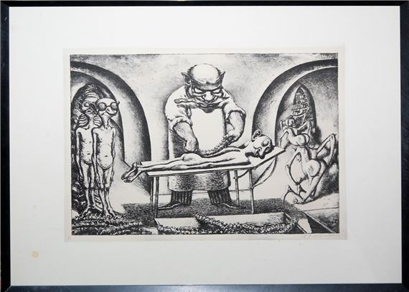 Paul Weber, 1951, “Rückgrat raus!” (Get the Spine Removed!) lithograph
When the political process degenerates into empty palaver—as is the case in the Liberal System—one might rightly call this process “impolitics.” There is no exact English equivalent for the French word “inpolitique,” a term coined by the political sociologist Julien Freund (1921–1993), a close associate of the German legal scholar Carl Schmitt. Widely used in French political theory, the term first appeared in Freund’s remarkable book Politique et impolitique ( 1987) (unfortunately never translated into English). Freund describes it thus: “the apolitical person is external to politics or takes no interest in it, whereas the impolitical person actively participates in political life but lacks judgment or skill in the exercise of his function, because he does not possess the sense of discernment.” One might simply say that impolitical decision-making is wishful thinking resulting in unintended, often catastrophic political results.
Impolitics is just one segment within a broader spectrum of counter-political concepts, including “antipolitics,” “transpolitics,” “infrapolitics,” and “patapolitics”—concepts widely used in French political theory. Beneath the mask of political processes, impoliticians hollow out authentic power politics, replacing them with hired experts preaching unintelligible administrative rules, using doublespeak, and delivering moralizing lectures. Impolitical decision-making among liberal politicians often uses as a cover the euphemism ‘governance.’
Politics implies the strict distinction between friend and foe, while impolitics represents a denial of any enmity. It thrives on grandstanding slogans rather than on a perception of objective political reality. Transpolitics goes hand in hand with impolitics—a term used by the late Jean Baudrillard to signal the end of politics altogether and its relegation to fictitious political scenarios. In books like Fatal Strategies, Baudrillard defines transpolitics through a simple paradox: “Everything is political; therefore, nothing is political anymore.” To this, in our modern digital era, we must add the pathology of ‘patapolitics’—a politician’s obsessive pursuit of imaginary solutions to crises, substituting political reality with algorithms and holograms. Hence the modern surge of self-proclaimed “experts” on social media and podcasts, including countless anonymous semiliterate individuals claiming to have unlocked the doors to the human predicament.
Patapolitics, as a segment of impolitics, captures absurd, imaginary scenarios in which algorithms and video games replace the politician’s search for answers on his cell phone. To cap it all off, impolitics often morphs into antipolitics, which signifies a rejection of the concept of the enemy and rests on the illusion that peace can be enforced by preaching good sermons—a common trait among US/EU leftists and DEI affirmative-action theorists. As Julien Freund points out, the key aspect of impolitics rests on the dangerous illusion that one can escape conflict by shrugging off the concept of the enemy. This is a deadly mistake. I do not need to choose my enemy; he will designate me as his enemy whether I like it or not. To put it more directly and closer to home: I may insist that I am not the enemy of Jews, yet it won’t help me if several Jewish agencies have already labeled me an antisemite. I may walk on all fours or bend over backwards with disclaimers that I am not a racist; it will still do me no good if hostile outgroups or individuals have already labeled me as a racist.
How do our modern politicians fit into the category of impolitics? One might suspect that President Donald Trump embodies to some extent an impolitical phenomenon. Despite the fact that he has strong intentions and undeniably some positive political instincts—such as his pardon of January 6 activists and closing down the border—in foreign affairs he appears trapped in a world crafted by his heroic delusions and/or dishonest advisers. Moreover, his political decisions are driven more by his business mindset than by some knowledge of the classics, ultimately stripping him of any grasp of the historical or political context. Instead, his transactional approach in foreign affairs frequently results in sudden reversals of his initial decisions—leaving both his supporters and his foes stunned, speechless, and searching for meaning.
When impolitics mixes with modern “videopolitics,” fake news floods everywhere—from daily news headlines to history books, especially when loaded with ideological narratives and surreal victimhoods. Add round-the-clock mediatization across a multitude of social platforms, and politics loses its meaning entirely. Politics becomes a farce: a grand spectacle in which mutual trust collapses and careerists and yes-men occupy the halls of power. Unlike sober-faced tragic figures such as Washington, Jefferson, or Bismarck, today’s leaders are perforce nothing more than clowns. On television and social media, they seem more focused on their dental implants than on the promotion of the common good. When one observes the body language of EU commissioners and their counterparts on both the left and the right in local parliaments, the conclusion writes itself: the West is finished—and this also marks the final death knell for the Liberal Order.
One can surely learn more about the danger of liberal impolitics by reading the classics than by studying all the political science treatises. The script of impolitics and patapolitics comes alive in Alice’s journey through Wonderland. Alice’s patapolitical wonderland features absurd rules where official power runs entirely on nonsensical syllogisms. Alice finds herself in a chaotic courtroom where the Knave of Hearts is on trial for stealing tarts. As the King attempts to run the proceedings, the Queen of Hearts completely skips due process and shouts, “Sentence first—verdict afterwards!” This was the author’s unintended blueprint for studying the later Soviet judiciary—and today’s liberal lawfare and its court proceedings against dissidents. This graphic gap between political reality and delusion is best illustrated in the work of German artist Paul Weber. His lithographs mercilessly satirize turncoats, spineless zealots, and citizens falling prey to grandstanding ideas or embracing new dogmas the moment the historical moment becomes ripe. Yet Weber had a hard time: disliked by National Socialist Germany, he was subsequently sidelined and distrusted by post-WWII Anglo-American world-improvers in occupied Germany..
Off, from, and for politics…
This brings up a classic dilemma: Should one trust politicians who live off politics, or those who live for politics? Trump is an idealist of sorts; to his credit, he did not need foreign money to launch his first campaign—unlike countless politicians whose entry into Congress or the EU establishment relies on the financial backing of powerful pressure groups. And in his second term he has transformed into the grifter-in-chief. Without rehashing Max Weber’s century-old theories, the tension between living off or for politics remains as vivid as ever. Many White nationalists and right-wingers—justifiably disillusioned with mainstream political lies—act as idealists fighting for a good cause, though their leaders, once in office, may turn out to be the exact opposite of what they expected. On the other hand, the majority of politicians in the EU and US political arena live off politics. They are opportunists who change their tune the moment a new political-cultural fashion arrives. Yet that very opportunism may offer a strange silver lining: they are less likely to start mass purges when a new order sets in, preferring to rebrand themselves as pragmatic realists.
Sometimes it is good to have a debauched and super-wealthy ruler presiding, because some of his wealth and lax mores may beneficially spill over to the poor. An ultra-modest politician can be lethal. The proto-communist revolutionary and lawyer Maximilien Robespierre lived a frugal, Spartan life, which did not prevent him from launching a widespread and lethal Reign of Terror in France. The nationalist Adolf Hitler was a modest man from a modest Austrian family, a strict vegetarian and early riser, yet his career ended in European chaos. The Roman emperor Marcus Aurelius, a famous Stoic celebrated by modern scholars as the very incarnation of the philosopher-king was known for his honesty and virtue; yet it is likely that Marcus Aurelius carried some recessive criminal genes, which he passed on to his son Commodus, one of Rome’s cruelest and most perverted tyrants. Seneca is still widely praised for his profound Stoic wisdom on moderation, yet his lofty philosophy of Stoicism did not prevent him from becoming the richest man in the Roman Empire.
This glaring contradiction exposes the ultimate all-too-human gap between preaching a multicultural society from an ivory tower and actually living it in real life. The communist Che Guevara lived simply and frugally, refusing personal glory in early revolutionary Cuba, yet his legacy keeps sparking daily Antifa thuggery across Europe and the USA. The list goes on.
When discussing impolitics, one inevitably comes upon great authors such as François de La Rochefoucauld, who observed that “what men call friendship is only a social traffic, a mutual exchange of interests, and a trade in which self-love always expects to gain something.” Much later in America a sharp observer, Ambrose Bierce went even further in denouncing the devilish nature of democracy, defining an elector as “one who enjoys the sacred privilege of voting for the man of another man’s choice.” Following the exhaustion of post-communist transitions in Eastern Europe, the populace is now growing sick of the liberal capitalist experiment and their corrupted elites. A deep current of nostalgia for order and a strong hand persists all over Europe and the US, making it only a matter of time before a breaking point hits us all. But what comes next? Ultimately, what difference does it make when one set of thieves loses their seats if the halls of power are simply refilled with more of the same? Plus ça change…




Mencken, Michels, Mosley, Machiavelli – the four Men of wisdom?
Dr. Kevin McDonald: I hope you consider reaching out to Spanish Scholars academics doing research on the subject of Jewish/Zionists/Israeli EXPANSIONIST policies intoLatin America. Zionists corporative conglomerates are electing Jewish Mayors, and pro Israeli politicians all over Latin America. They are building “unlawful” Jews only colonies, and taking over local state WATER rights utilities, and other key natural national resources..Such is the case in Mexico, Brazil, Argentina, Colombia, Peru, Central America etc.what’s their ultimate aim?
Yes, jews are taking S America big time, ZOG puppet Trumpstein bailed out Milei, the ZOG puppet, and multiple stories of some yype of right wing Zio creature coming to power in multiple S American countries, not to Mention the jewess in Mexico.
What is their aim?
They know kikeville’s days are numbered?
There is a saying: You may not care about politics but politics cares about you.
We have to be comfortable being political, bringing up obvious political realities, etc. Just tonight, well, earlier tonight, I got into quite the conversation with a guy at the bar in a local brewery; at one point he said only one group feels that things ought to be good and live-able for everyone, “The white people!!” and said he can’t go into it more because he’ll only get into trouble but that he knew everyone else works for themselves etc. This is a reasonable “liberal” guy in a reasonable “liberal” kind of beer bar in a reasonable “liberal” town. The Noticing proceeds!
We have to get political! Have a read here – if you can stand it – on how the “Jewification” of the US is going for us, and keep in mind, Uncle Adi talked about this back in the 1930s and 40s. Linky: https://old.reddit.com/r/AskReddit/comments/1vhs7gp/people_who_were_homeless_what_was_way_worse_than/
Wow Alex that homeless thread is an eye opening read.
What to do though? (((Globalization))) continues to destroy WE (white European) civilization. Political and governmental de centralization must be part of any effort.
Pericles is the source of the saying.
May I suggest, Alex, four books you should add to your library in your new home, two on major “non-Jewish” Jews and one from a “Jewish” non-Jew influencer, and another on Jewish influence, all jam-packed with information to interest you?
1. Julius Carlebach, “Karl Marx & the Radical Critique of Judaism” (1978) pp.480
2. David Bakan, “Sigmund Freud & the Jewish Mystical Tradition” (2024) pp.350
3. Bill Gates, “The Turbulent AI era is here…We need a Plan” (2026) Gates Notes On-line
4. Cesare G. De Michelis, “The Non-Existent Manuscript: A Study of the Protocols of the Sages of Zion” (2004) pp.420
Genuine German brand quality: cooked with hate, served with love (optionally, other way around). Those who want to be “loved” are despised; only those who want to be feared have truly earned respect. Many foes, much honor (Frundsberg).
A new star is rising in the firmament of the fashion world: “Germany” finally has another promising “fashion czar” to celebrate. Following in the footsteps of gays like Joop, Mooshammer, Lagerfeld, and Glööckler—comes Julian Daynov.
“Neudeutsch,” however, is not a Bulgarian homo with painted fingernails in a faux leather trash bag (erotic appeal quite limited), but a form of mockery of the compulsive use of “Anglicisms”. The number of views still leaves much to be desired!
https://www.youtube.com/watch?v=C_Sa3L32HDw
https://de.zxc.wiki/wiki/Neudeutsch
https://www.perplexity.ai/search/016f8a26-8363-4f15-83fc-bf74168d1bf9
The designer entered wearing a coat that appeared to have been assembled from three discarded deckchairs and the emotional residue of a failed marriage.
“This is not clothing,” he said. “It is a critique of clothing.”
Nobody asked what it was a critique of, because the answer was probably capitalism, masculinity, or trousers.
His assistant carried a handbag shaped like a municipal recycling bin. It cost €4,800 and contained one lip balm, two receipts, and the designer’s unprocessed grief.
“The collection is called Post-Human Tenderness,” he explained.
“Why?”
He looked wounded. “Because Beige Things for People Who Have Stopped Trying was already taken.”
Yoden (not to be confused with Juden) Lhatoo from Hong Kong wants to overcome the “grammar Nazi” within himself to make “English” even more nonsensical, arbitrary, and chaotic than it already is.
He sees this as a great advantage for global democratization. We can see firsthand how Virus Americanus is wreaking havoc in his brain. His greatest role model is “Scott-German” Zionist Orange Don.
https://www.scmp.com/opinion/hong-kong-opinion/article/3364711/reflections-reformed-grammar-nazi
On the whole, as is almost always the case, I fully agree with the thoughtful and intuitive observations of the excellent formulator and stimulus provider Sunic. Just reading his name tells you it’s going to be a text worth reading.
However, Hitler, in his private life, was not an early riser but a late riser—apparently an unintentional error in the details. Also, the “A.” before Paul Weber should not be omitted, as his first name was Andreas (there are many Paul Webers).
His dark, nightmarish, single-theme lithographs, with their pinpoint precision and archetypal memorability, seem to stem from the collective subconscious. “Das Gerücht” (“The Rumor”) and “Der Denunziant” (“The Informer”) are particularly famous.
https://www.artsy.net/show/sylvan-cole-gallery-a-paul-weber-lithographs-and-drawings
Weber portraits “Perfidous Albion”
https://pierangelo-boog.blogspot.com/2016/06/a-paul-weber-britische-bilder-erster.html
https://pierangelo-boog.blogspot.com/2016/06/a-paul-weber-britische-bilder-zweiter.html
But Füssli was earlier https://en.wikipedia.org/wiki/The_Nightmare
Grotesque about this is that it’s precisely these cosumerist self-proclaimed “leftists”—whom Weber portrayed as spineless—who appropriate his without any knowledge of his “national-revolutionary” background (that’s the system’s intention), because they believe they see in them an “indictment of fascism.” Until they are forced to apologize.
https://en.wikipedia.org/wiki/Widerstand_(magazine)
https://en.wikipedia.org/wiki/R%C3%A9volution_nationale
They themselves are so intellectually immature that they fail to realize that the issue of cowardice is a universal theme for humanity and one that affects them in particular. Terms like Betreutes Denken (“guided thinking”) and Gratis-Mut “free courage” best characterize their warped ideological outlook. Pure “Bescheuertheit” (“crackbrainhood”).
By the way, the technique of lithography was invented by the German Alois Senefelder. The fact that he was born in Prague doesn’t make him a “Czech,” Mr. Carlsen.
https://www.youtube.com/watch?v=tRcnD2HdUSI
https://en.wikipedia.org/wiki/Alois_Senefelder
The typically ideologically biased smear campaign against this gentleman by Bolshevikpedia sounds as if there might be something worth reading and learning about hidden behind it.
https://de.zxc.wiki/wiki/Werner_Beumelburg
Starting with book printing (lithography is merely a subcategory), one can generalize: at its very core, the German essence strives to make the world recognizable, comprehensible, understandable. Enlightenment through truth.
The American-Jewish essence renders the world unknowable, blurred, distorted. It blurs boundaries, order, familiarity, logic. The great troublemaker who is bringing down the white race sits across the Atlantic, an appendage of British inbreeding.
To put it another way, the amorphous mass (or whatever that’s supposed to “represent”) known as “America” is still in its infancy ethnically. Whereas we in Europe have long since established an order. “Democracy”-wise, of course, they’re light-years ahead of us.
But we can already picture very clearly what that looks like (and how it ends!). After all, the Jewish “God” personally watches over them! They are thus the “nation of God,” including the Jews who govern and rule them.
More words. Lordy, Lordy, just what we need, more useless words
Important to know: A text is all about words; that is its essence. Projecting one’s own uselessness and lack of substance onto others is not a sign of independence, yet, indeed nothing more than completely superfluous. Texts are texts; they are not instruction manuals for planning and acting out one’s own life.
Hi Herbie, I take it that you are going after me. OK, just tell us what the hell is good about another word like “impolitical?” here today , gone tomorrow. I like Humpty Dumpty’s ” a word means exactly what I say it to mean, nothing more, nothing less.”
Brevity is the soul of wit…who said that?
Liberals are fools and ioften ntentionally foolish to ensnare the hopeless. Take Ron Unz….he is a Liberal who worships Words like racial equality. Ditto Tucker. The word Equality is itself a linguistic snare, suggesting that there is actually something Equal in anything about human beings. The only equality in humans, is identical twins, and the experts say that because of oddities of biology (that I do not understand), identical twins are Not absolutely identical. This may account for the very small differences in identical twins as well as nourishment, and babies getting dropped on their heads, like those who like words like “impolitic.” George Orwell spent a fair amount of time wrecking liberal cliches, etc. and ridiculing fakery and pretense.
Keep it simple and use normal everyday words as much as possible. Take Douglas Macgregor who is probably brilliant. He speaks in simple terms and covers a huge amount of ground. No ‘impolitic’ for Doug. By the way. Macgregpr in ’28.
Furthermore, recalling Ron Unz’s remarks some time ago, that he immersed himself as a young man reading the holy writ of the jewyorktimes every day for years….. Remind you of anything? This is rabbinic mindedness. Pour over Words from the Torah of Jewry and their willing executioners…White wannabes ambitious for Jobs from dajews, and anxious candidates for acceptance into the higher ranks of jew servants…house niggers, not field niggers, etc.
“Impolitic” suggests another psychologically interesting syndrome, that of auto immersion in general…in any reigning orthodoxy that demands total compliance .
Today, for us in the Last Days of US/Israeli/Nato ideology, it is Totalitarian Liberalism, which in Europe any transgression of its Race Equality laws will land you directly in jail. Remember the US years around year 2000 when “Human Potential” groups like LIfespring and EST (real jewish of curse) humped and bumped their way for several years, leaving Whites even more besotted and embarrassed mebbe.
Of curse, jews get excused for hating the Arabs and Persians, but Whites must submit to muzzies and jews or else the whip cracks and cuts deep.
Orwell’s 1984 was premature in its time except for its Communist realism, but is now swollen in size due to its incubation for years in the Beast belly of Liberalism, aka US conservatism overhauled by jews….Neocons, etc. Communism a la USSR, did not have the subtlety of luv everybody Liberalism which has no class enemies, just wicked Racists, Thus Christian Luv, as per Tucker Carlson, is much more of a threat to the , ahem…, brilliant Whites who have invented, etc. everything.
Whites must luv niggers, beaners, jews, and all the freaks even of our own race….trans, queers, and so on. ( yesterday in the news the Burning Man Festival is nigh in Nevada compleat with, get this…free fucking in a special arena open to All. We are democrats! Freedom Now! Of curse this is a White event since White Expressive Individualism includes all cumers, I wonder what might develop if a special dispensation is provided for Oakland niggers to be shipped into Burning Man just for the Free Fuck event…all paid for of curse, by White Burning men and ladies, especially the ladies.)
Well…..Depression, real War, stagflation, nigger/beaner revolt per budget extreme cuts due to ‘no more free money’ is staring us in the face right now like a tiger burning bright in the night, while the media refuses to acknowledge it. Nothing to see here folks, just move along, and read your catechisms in jewyorktimes. and take a drive in the country, relax.
What you read about jews-in-the-news in Gaza/West Bank, is just a temporary outlier in jewish behavior, brought on by anti-semitism. Everything is going to be all right.