
Creating a new “American” Art
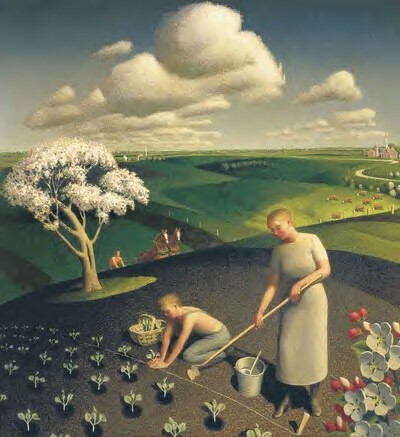
Before the rise of Abstract Expressionism, the American art scene after World War I was defined by two main currents. The first were what one might call the Regionalists (e.g. Grant Wood, Thomas Hart Benton and John Steuart Curry) who used their own signature styles to portray the virtues of the hard-working rural American population. In the second group were the artists of Social Realism (e.g. Ben Shahn and Diego Rivera), whose work reflected urban life during the Great Depression, and reflected a preoccupation with international socialism.
Neither of these two schools was interested in abstract art. Despite the leftwing view of the social realists, both groups held rather conservative attitudes on figurative representation. Yet, even as these two styles dominated, the artists of the nascent New York School “met frequently at the legendary Cedar Bar, where they discussed their radical theses. They argued endlessly about the problems of art, about how to effect a total break with the art of the past, about the mission of creating an abstract art that no longer had anything to do with conventional techniques and motifs.”[i]
The Museum of Modern Art did not yet exist; the Metropolitan Museum tended to “look down its WASP patrician nose at modernism”; and the Whitney favoured exactly the kind of American painting young Rothko most despised: scenic, provincial, anecdotal, and conservative.[ii] For a Jewish outsider like Rothko, who in 1970 declared that he would never feel entirely at home in a land to which he had been transplanted against his will, urban America was his America.

But what was on the mid-town gallery walls was, for the most part, another America altogether: Big Skies, fruited plain, purple mountain majesty, the light of providence shining on the prairie. About that America Rothko knew little and cared less. Early on, he had the sense that America ought to offer an art that was as new and vital as its history; but he also wanted that art to play for high stakes, to be hooked up somehow to the universal ideas he was chain-smoking his way through. Just what such an art might look like, however, he had as yet not the slightest idea.[iii]
Terry Cooney points out how the New York Intellectuals associated rural America with “nativism, anti-Semitism, nationalism, and fascism as well as with anti-intellectualism and provincialism.” By contrast the urban was associated “with ethnic and cultural tolerance, with internationalism, and with advanced ideas.” A basic assumption of the New York Intellectuals was that rural America “with which they associated much of American tradition and most of the territory beyond New York – had little to contribute to a cosmopolitan culture” and could accordingly be dismissed by writers who, by examining all issues through this lens, could “mask assertions of superiority and expressions of anti-democratic sentiments as the judgements of an objective expertise.”[iv]
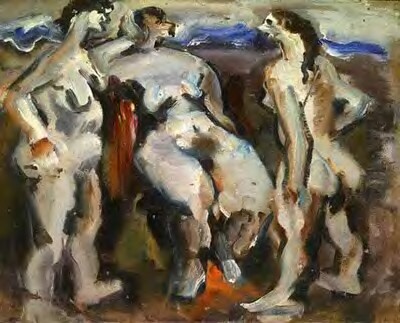
Rothko’s skill in rendering the human form was poor, as is evident in early works like Bathers of Beach Scene (Untitled) (1933/4). Schama admits as much, noting that: “When he [Rothko] stood in the Brooklyn classroom it all seemed so easy. He would tell the children not to mind the rules – painting, he said, was as natural as singing. It should be like music, but when he tried it came out as a croak. It’s the work of a painfully knotted imagination… No not very good.”[v]
Drawing on his boyhood training as Talmudic scholar, Rothko, in a speech in the mid-thirties on art education delivered at the Jewish Education Center in Brooklyn (where he began teaching in 1929) offered a quasi-philosophical rationale for the unimportance of technical skill by stressing “the difference between sheer skill, and skill that is linked to spirit, expressiveness and personality. … The result is a constant creative activity in which the child creates an entire child-like cosmology, which expresses the infinitely varied and exciting world of a child’s fancies and experience.” Rothko believed that one’s means of artistic expression was “unrelated to manual ability or painterly technique, that it is drawn from an inborn feeling for form; the ideal lies in the spontaneity, simplicity and directness of children.”[vi] Such grandiloquent pronouncements from Rothko were not unusual, with Matthew Collings noting that “Rothko was outrageously over-fruity and grandiose in his statements about art and religion and the solemn importance of his own art.”[vii]
This tendency on the part of Rothko prompted one writer to declare: “What I find amazing … is how a painting which is two rectangles of different colors can somehow prompt thousands upon thousands of words on the human condition, Marxist dialectics, and social construction.” He suggests that a good rule of thumb is “that the more obtuse terms an artist and his supporters use to describe a work, the less worth the painting has. By this definition Rothko may be the most worthless artist in the history of humanity.” Another critic humorously observed that:
Rothko needed to be fluent in rationalizing his existence and validating himself as a relevant artist to the average idiot who spent tens of thousands of dollars on paintings which could be easily reproduced by anyone with a pulse and a paint brush. Rothko… learned to garner attention to his paintings by getting into a frenzied drama-queen state and hysterically claiming that his works were deep, profound statements and not just indiscriminate blobs of color. They were expressions that rejected society’s expectation of technical expertise, actual talent and an artist’s evolution over time.
Lasha Darkmoon has noted the tendency of Jewish artists to set about redefining the very nature of artistic excellence to allow for their own technical inadequacies. She observes that: “Whatever Jewish artists were good at, that would be the art of the future. If Jews were no good at drawing, good drawing would no longer be necessary.” She cites Israel Shamir who notes that the “Preparation of these items [of non-figurative art] places no demand on artistic abilities. They can be done by anybody,” and that “such art is perfectly within Jewish capabilities.” Darkmoon elaborates:
In order to succeed in this difficult profession, the visually challenged Jews had to “bend art to fit their abilities.” It is as if, unable to excel at athletic prowess, the Jews had somehow managed to gain control over the Olympic Games and decreed that, from now on, sprinting and marathon running were no longer important. What really mattered was winning the sack race or the Spitting Competition — accomplishments, possibly, which Jews were particularly good at!
“The Jews were extremely ill equipped for their conquest of Olympus,” Shamir instructs us. “For many generations, Jews never entered churches and hardly ever saw paintings. They were conditioned to reject image as part of their rejection of idols.” In short, the Jews were visually handicapped. Trained in Talmudic dialectics, they were marvelous with words. They had a verbal IQ of 130. Their IQ for patterns and pictures, however, was dismally low: only 75.The Jews of course don’t wish to acknowledge this. To suggest that they tend to make lousy artists is anti-Semitic.
If Jews didn’t make more of a splash as artists in past ages, it is argued, it was because they were “held back” by their Christian oppressors. Unfortunately for the Jews, the great [Jewish art critic] Berenson will have none of this argument. “The Jews have displayed little talent for the visual,” he states tersely, “and almost none for the figure arts.” How, then, you might wish to know, are there so many Jewish artists around nowadays? To what can we attribute this fantastic efflorescence of sudden Jewish pictorial genius? The answer, we are told, lies in Jewish networking and hustling, Jewish predominance in the mass media, Jewish economic dominance of the art world, Jewish power, Jewish money.
Roger Scruton has observed how the presence of significant financial incentives served to hasten the death of traditional painting by “devaluing the fund of artistic knowledge and encouraging minor talents to dispense with the humility which might otherwise have caused them to study and emulate the masters.”[viii]
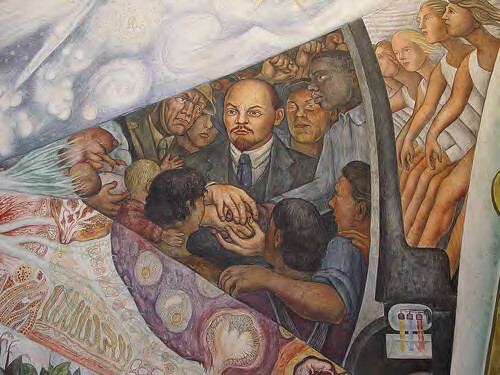
As well as self-interestedly seeking to redefine the nature of great art, Rothko often spoke out for the importance of “artistic freedom,” which in practice meant artistic freedom for those on the Left. He became involved in the famed 1934 incident between John D. Rockefeller and the socialist painter, Diego Rivera. This began when Rivera was hired to paint a huge mural in the lobby of the main building of Rockefeller Center, the newly completed showcase of the oil baron’s ideals. Shortly before Rivera completed his work, Rockefeller dropped in and saw that the mural had a defiantly socialist message based on a heroic depiction of Lenin. He ordered the removal of the mural, resulting in its destruction. After this incident, a group of 200 New York artists gathered to protest against Rockefeller, and Rothko marched with them.[ix]
In 1934 Rothko was one of the original 200 founding members of the Art Union and started the Gallery Secession, which was devoted to the newest artistic tendencies. A year later he became a member of the group who called themselves “The Ten” (the minimum number of Jews that can pray together). This unashamed exercise in Jewish ethnic networking was an opportunity for Rothko and his colleagues to engage in mutual admiration and promotion, and agitate in favour of “experimentation” and against conservatism in museums, schools and galleries.[x] Among “The Ten” were Ben Zion, Adolph Gottlieb, Louis Harris, Yankel Kufeld, Louis Schanker, Joseph Solman, Nahum Chazbazov, Ilya Bolotovsky and Marcus Rothkowitz. Gottlieb, in describing the group, later recalled: “We were outcasts, roughly expressionist painters. We were not acceptable to most dealers and collectors. We banded together for the purpose of mutual support.” The Ten acted as an alliance against the promotion of regionalist art by the Whitney Museum of American Art, which to them was simply too “provincial” for words.[xi]
For Rothko, “the whole problem of art was to establish human values in this specific [American] civilization.”[xii] The pronounced ingroup-outgroup mentality of “The Ten” was consistent with that existing within the Jewish intellectual movements reviewed by Kevin MacDonald in Culture of Critique, where he observes how Norman Podhoretz described the group of Jewish intellectuals centred around Partisan Review as a “family” that derived from “the feeling of beleaguered isolation shared with masters of the modernist movement themselves, elitism – the conviction that others are not worth taking into consideration except to attack, and need not be addressed in one’s writing; out of the feeling as well as a sense of hopelessness as to the fate of American culture at large and the correlative conviction that integrity and standards were only possible among ‘us.’”[xiii]
MacDonald notes, moreover, that within these alienated and marginalised Jewish groups was “an atmosphere of social support that undoubtedly functioned as had traditional Jewish ingroup solidarity arrayed against a morally and intellectually inferior outside world.”[xiv] Nonetheless, despite the ethnic superglue, there was tension within the Jewish milieu of “The Ten”, with Schama noting that: “Amidst the usual Talmudic bickering of leftist factions, the denunciations and walk-outs, Rothkowitz and his comrades were all burning to make an art that would say something about the alienation, as they saw it, of modern American life.”[xv]
Since the triumph of the culture of critique and the Jewish seizure of the commanding heights of Western high culture in the sixties and seventies, this pattern of Jewish ethnic networking has become an entrenched feature of the modern art establishment. Scruton observes how “the new impresario surrounds himself with others of his kind, promoting them to all committees which are relevant to his status, and expecting to be promoted in his turn. Thus arises the modernist establishment, which has dominated the official culture of Europe for the last three decades, and which shows no sign of loosening its grip.”[xvi]
For Rothko, like for most American Jews, the Second World War was a moment of universal moral crisis. He had only become an American citizen in 1938 and Baal-Teshuva notes that: “Like many Jews, he was worried about the rise of the Nazis in Germany and the possibility of a revival of anti-Semitism in America, and U.S. Citizenship came to signify security.” American entry into the war was exactly what Rothko wanted, claiming that it represented “an escape from narrow-minded isolation, a reconnection with the destinies of modern history.” Schama observes that
now Rothko and his painter friends – so many of them originally European Jews – wanted American art to go the same way. With European civilization annihilated by fascism, it was up to the United States to take the torch and save human culture from a new Dark Ages. It was not just a matter of offering safe haven to the likes of Piet Mondrian or [Picasso’s] Guernica, but rather the authentic American way – doing something bold and fresh, taking the fight to the enemy which had classified modernism as “degenerate” and had done its best to destroy its partisans. … The Nazis had art (as well as everything else) entirely the wrong way round. The modernism they demonized as “degenerate” was in fact the seed of new growth, and what they glorified as “regenerate” was the stale leavings of neo-classicism. Their mistake was America’s – and particularly New York’s – good fortune [!].[xvii]
This was a time when many American Jews were modifying their names to sound less Jewish. In January 1940 Marcus Rothkowitz became Mark Rothko. During the war years Rothko’s art changed too as he produced a series of surrealistic pictures inspired by Freud’s interpretations of dreams, C.G. Jung’s theories of the collective unconscious, and ancient Greek mythology. Nietzsche’s The Birth of Tragedy was an important influence at this time.[xviii]
Towards the end of 1943, all of the ethnic networking finally began to bear tangible fruit for Rothko. He befriended Peggy Guggenheim, “the most voracious patroness of American avant-garde art”, who had migrated to New York in 1941. Guggenheim’s artistic consultant, Howard Putzel, “convinced her to show Rothko in her Art of This Century gallery, where she had opened in 1942, during the low point of the war.”[xix] In January 1945, Guggenheim decided to put on Rothko’s first one-man exhibition at her gallery.[xx] In 1948 Rothko invited a coterie of mainly Jewish friends and acquaintances to view his new ‘multiforms’. The art critic and historian Harold Rosenberg “remembers finding these works “fantastic,” and called his experience “the most impressive visit to an artist” in his life.”[xxi] Dempsey notes that “both the critics and the artists themselves gave the works heroic, noble interpretations.”[xxii]
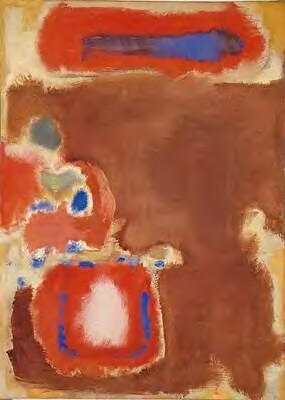
Rothko’s financial situation improved significantly in the early 1950s, by which time he had arrived at the style that defined his art until his death in 1970. The highly successful Jewish art dealer Sidney Janis signed up Rothko in 1954 and showed 12 of his works at his gallery in 1955. According to Baal-Teshuva, “this settled Rothko’s status as a protagonist of international importance in the postwar art scene.” This is ascribed to the fact that “Sidney Janis marketed Rothko’s paintings much more effectively. … and even during the recession of 1958 he was able to sell 13 paintings for more than 20 thousand dollars”—likely to other Jews. After this, Rothko’s art was declared a good investment by Fortune magazine, which led to his relationship with his now resentful colleagues Clifford Still and Barnet Newman deteriorating to the point where “they accused Rothko of harbouring an unhealthy yearning for a bourgeois existence, and finally stamped him as a traitor.”[xxiii]
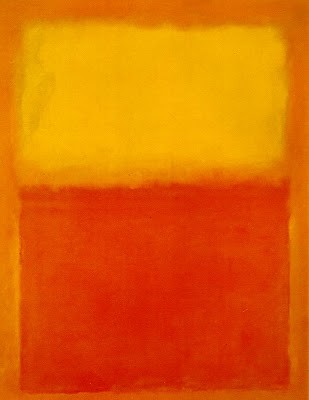
In 1958 Rothko received a contract to paint murals for the Four Seasons restaurant in the Seagram’s Building in New York. The man who approved the commission was Seagram’s American subsidiary head Edgar Bronfman Sr – who was to become President of the World Jewish Congress in 1981. The fee offered was $35,000 (a huge sum at the time). Rothko was, however, uncomfortable with the commission and the damage it might do to his bohemian reputation. Later he returned the money and asked for the completed murals to be returned. Nine of the “Seagram Murals” were permanently installed in a room at London’s prestigious Tate Gallery in 1970. These paintings are widely considered to be Rothko’s greatest achievement.
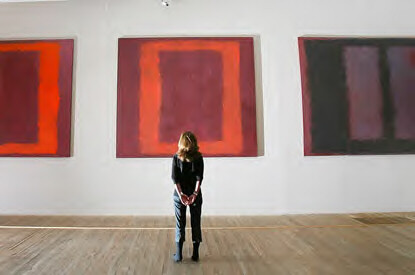
Opinions vary widely about Rothko’s work and legacy. While many within the Jewish-dominated art establishment hail him as a genius, others cannot believe that any sane person would pay tens of millions of dollars for what amounts to nothing more than a large, empty canvas occupied by two colors divided into separate rectangles by a third color. What is clear, however, is that Rothko’s career and posthumous reputation as an artistic giant have been, to a very great extent, the result of hyping on the part of the Jewish cultural establishment. Jewish role models play a very important role in fostering Jewish pride and group cohesion, and it has been a standard feature of Jewish intellectual life to actively construct Jewish geniuses by wildly exaggerating the artistic or intellectual significance of their work. This ethnocentric Jewish self-puffery is an important way to shape social categorization processes in a way that benefits Jews in two ways: by undermining traditional notions of the importance of painterly ability as a bedrock of the traditional culture of the West; and by undermining specific schools of art, such as Thomas Hart Benton and the Regionalists, that promoted positive and uplifting images of America for popular and elite consumption. This places Rothko firmly in the culture of the left that has been vastly predominant among Jewish intellectuals at least since the beginning of the 2oth century. Mark Rothko stands out as an egregious example of a figure who has been utilized by Jewish art critics and historians for these purposes.
REFERENCES
Baal-Teshuva, J. (2009) Rothko, Taschen, Cologne, Germany.
Collings, M. (1999) This is Modern Art, Weidenfeld & Nicholson, London.
MacDonald, K. B. (1998/2001) The Culture of Critique: An Evolutionary Analysis of Jewish Involvement in Twentieth‑Century Intellectual and Political Movements, Westport, CT: Praeger. Revised Paperback edition, 2001, Bloomington, IN: 1stbooks Library.
Schama, S. (2006) Simon Schama’s Power of Art, BBC Books, Great Britain.
Schama, S. (2006a) Simon Schama’s Power of Art, BBC TV Series, Great Britain. View at: http://www.youtube.com/watch?v=dJ8AIIAgYpg
Scruton, R. (2005) Modern Culture, Continuum, London.
Scruton, R. (2007) Culture Counts – Faith and Feeling in a World Besieged, Encounter Books, New York.
ENDNOTES
[i] Baal-Teshuva, p. 10
[ii] Schama 2006, p. 403
[iii] Ibid.
[iv] In MacDonald, p. 217
[v] Schama 2006a
[vi] Baal-Teshuva, p 24
[vii] Collings, p. 169
[viii] Scruton 2007, p. 89
[ix] Baal-Teshuva, p. 26
[x] Schama 2006, p. 405
[xi] Baal-Teshuva, p. 26
[xii] Schama 2006a
[xiii] In MacDonald, p. 217
[xiv] Ibid. p. 218
[xv] Schama 2006, p. 406
[xvi] Scruton 2007, p. 87
[xvii] Schama 2006, pp. 408 & 411-412
[xviii] Baal-Teshuva, p. 33
[xix] Ibid. p. 38
[xx] Ibid. p. 39
[xxi] Ibid. p. 45
[xxii] Dempsey, p. 190
[xxiii] Baal-Teshuva, p. 50






Facing the Future as a Minority


yours an darkmoon’s articles have been invaluable in documenting this- and its not a trivial matter by any means – a culture void of beauty, virtue and hope is doomed.
I think the jewish elite is desperate to establish the idea that they are ‘better’ than the old white christian establishment(s) they have replaced, thus the wild praising for richard meyer, and other ‘starchitect’ architecture, mahler’s 3rd rate symphonies.
One of the most clearly symbolic replacements is the entrance to the Brooklyn Museum. The mckim meade, white facade takes a back seat to the loud, garish modern entrance – at night you don’t even notice the old beaux arts part…
http://upload.wikimedia.org/wikipedia/commons/d/df/Brooklyn_Museum_June_2008_sunset_jeh.JPG
its all a big, loud show – like children screaming ‘we’re the best’ which, in comparison only reveals their inadequacy.
If you don’t understand and are not thrilled by Rothko’s exalted, brilliant, sublime works, it can only mean you are a churlish rustic, an ignorant rube, a red-neck yahoo, a provincial lout and probably a bigoted anti-Semite to boot.
The idea that the orgins of the Modern Art movement are Jewish is wrong.
The Modern Art movement really kicks off in the early years of the 20th Century in France. Although, it was almost a spontaneous movement in France, England, Russia & the United States.
None of the original American moderns were Jews to my knowledge. The Jews start to muscle into Modern Art in the late 1930′s by ethnic politics & ethnic solidarity.
Here’s an early White modern painter who made his home in California: http://en.wikipedia.org/wiki/Stanton_MacDonald-Wright
Rothko was a “Talmudic scholar,” but what the h___ is a talmudic scholar. Both Ivan Boesky and Jack Abramoff were “Talmudic Scholars” Does it mean a J_w versed in the passages of the Talmud that sanction lying, cheating and double dealing with gentiles? That is precisely what it appears to mean.
The adulation still heaped upon Rothko’s works (and Neil Simon’s plays) by the cognoscenti testifies to the continued relevance of “The Emporer’s new clothes” even today.
@ Tom. read the painted word. Doesn’t matter how it started, it matters where it went and where it ended.
Also read L. Darkmoon’s articles on this site..
@Tom:
also as the painted word points out its the CRITIC that became important, MORE important than the ‘art’. Askanazi have high visual, low spatial intelligence, so its not surprising they were attracted to writing rather than painting but when they are they are promoted wildly.
Another area they have completely taken over is art history – THEY get to ‘define’ the ‘meaning’ or ‘worth’ of old master paintings, often completely air brushing out the religious devotion or Christian themes..
Some on here would call this Jewish self-delusion in that Jews falsify things to themselves in order to maintain thier sense of importance and talent. This is wrong. The Jews are in fact the LEAST deluded people, and the most realistic. Jews know full well that their art is crap. The reason why they spew out ths propaganda is because they know the goyim are dumb enough to believe it. Not one Jew, know no matter how proud he is of his Jewishness, honestly believes Rothko is a world-class painter. They just get a kick out of all the dumb gentiles who buy into their nonsense. What was it Nietzsche said? Somone is only a genius if they can convince everyone that they are?
@me:
I own the book. LOL. Tom Wolfe is a humorist, and a social critic.
You can’t say the Jews haven’t worked hard at displacing White Americans in our own country. They have worked at it!
She is genius, is Lasha Darkmoon. I could never understand why the handicapped at recreation were suddenly Olympic material and then the answer pops up: It is as if, unable to excel at athletic prowess, the Jews had somehow managed to gain control over the Olympic Games and decreed that, from now on, sprinting and marathon running were no longer important. What really mattered was winning the sack race or the Spitting Competition — accomplishments, possibly, which Jews were particularly good at! Thank you, kind lady.
Rivera and his wife were both outspoken communists. Didn’t Rockefeller know this? So why did Rockefeller hire Rivera in the first place?
Let’s take this opportunity to give some exposure to the term for Jews parallel to the term WASP. And that term is WEJ, pronounced wedge, and stands for “white European Jew.”
One good acronym deserves another.
A large healthy tree takes all the light from other trees that grow underneath it, hindering them from developing into large trees themselves.
If you kill the large tree, then light is available for seedlings to grow large again.
It is the same with the arts, where Jews killing the western tradition, will make room for a new tradition to grow forth.
This is already happening in music, where what started as black metal is evolving into high art again, while it has already spawned new genres like neo-folk, Gothic metal and heathen religious music.
An example of new high art:
Dimmu Borgir with a classical choir and a symphonic orchestra.
http://www.youtube.com/watch?v=h5bfKQAPwHU
An example of new heathen religious music:
Wardruna : kauna
http://www.youtube.com/watch?v=jMV78a-G5xY
http://www.youtube.com/watch?v=7HMl81zRp4E
Homepage of the band:
http://www.wardruna.com/about/
These people also usually have real artwork on their covers and posters, and have in a way created a market for figurative art.
I like this guy, http://www.dvdandrea.com/ ,who tries to capture an essence of the band when he creates a poster or an album cover.
Thanks for the tip on Dimmu Borgir. It’s now the featured video at TOO. I’d be interested in people’s reactions to the video. One of the commenters on You Tube said it should be the national anthem of Norway. At the end, the crowd involvement made me immediately think of a military rally.
So why did Rockefeller hire Rivera in the first place?
oh i don’t know, why did they help fund the bolshivieks??
@KMac
The light & sound are right, but, those guttural vocals come off as almost a parody, or a mockery of Germanics-Nordics. Well spoken German is not guttural, it has an almost musical quality to it.
I commented earlier about an early Modern Artist from California named Stanton MacDonald-Wright,
http://en.wikipedia.org/wiki/Stanton_Macdonald-Wright
MacDonald-Wright came up with a modern art form called Synchromism, a merger of color & sound.
http://en.wikipedia.org/wiki/Synchromism
Is this where Disney got his idea for Fantasia?
frankly, I think the ‘heathen’ music is crap. like childish ‘fantasy’ art. to even refer to this as ‘high art’ is a joke.
@me:
Did you listen to it at all?
My guess is that you know nothing about classical music, nor anything about the more alternative newer music.
It seems to me to be a human law, that the less you know of a subject, the easier it becomes to classify and think you understand it.
What is the difference between your comment, and some anti racist saying race don’t exists and that everybody who thinks otherwise is stupid?
@me:
At the very least it’s an attempt to infuse modern culture with traditional culture, as opposed to using modern culture to eradicate traditional culture. Those Nordic metal bands are all about folk tales, mythology, and history. Nothing about hoes, pimping, or smoking weed.
Heavy metal started out as basically just a combination of blues and punk (both of which I dislike), but it’s evolved into a much more technically complex genre, especially in Europe. Yngwie Malmsteen, for example, can play Beethoven’s Fifth effortlessly on guitar. It may or may not be high art, but the music takes incredible technical skill.
This, however, does qualify as high art:
http://www.youtube.com/watch?v=Nx7vOb7GNBg
Anna Vidovic, one of the greatest guitarists in the world.
@Volksverhetzer:
The light & sound are right, but, those guttural vocals come off as almost a parody, or a mockery of Germanics-Nordics. Well spoken German is not guttural, it has an almost musical quality to it.
I commented earlier about an early Modern Artist from California named Stanton MacDonald-Wright,
http://en.wikipedia.org/wiki/Stanton_Macdonald-Wright
MacDonald-Wright came up with a modern art form called Synchromism, a merger of color & sound.
http://en.wikipedia.org/wiki/Synchromism
Is this where Disney got his idea for Fantasia?
Borgir’s Northern Night – national anthem?? To replace this: http://www.youtube.com/watch?v=u2v53KV00B4&feature=player_embedded
I don’t think so : )
Which reminds me, yesterday I heard Grieg’s Holberg Suite superbly performed by Mariss Jansons and the Oslo Philharmonic Orchestra.
I spoke to a friend today who recently returned from Norway. He said he paid $17.50 for a glass of beer in a pub! According to him, Norway has full employment (two jobs for most households) and a per family income of $8-12,000 US per month for average people, from which they pay income taxes and a 20% vat, but still get along fine, thanks to North Sea oil; the government is a partner in its development and production.
Back to Borgir, he and his group look very similar to German groups I’ve seen; obviously they have a message, but it’s almost impossible to understand what they’re saying.
It’s important to understand that much of what is considered to be classical Western Art is derived from the (Quattracento) rules of perspective in which a single vantage point is used to determine a vanishing point or multiple vanishing points on a horizon. The single vantage point is symbolic of the individual, and cultures and races that are more tribal cannot relate to the construction of artist works based around a single vantage point. In fact, some tribal cultures have been known to hang magazine pictures upside down on the walls of their igloos because they can’t tell which part of the picture is the bottom from the top. This is why many people from non-Western cultures can only create art that doesn’t derive perspective from a single vantage point. Quite simply, they have not yet evolved their own individual point-of-view so they can only relate to space from the multiple viewpoints of a group perspective. Since they see space differently, it’s entirely possible that a tribal relationship to space is what is behind much of the popularity for works by Rothko.
@volk
yes, i did. And yes, I know plenty about classical music, and to compare, say Beethoven’s Missa solemnis to this is just foolish, as foolish as comparing childish album covers of ‘fantasy’ art with buxom women w/ swords to Botticelli or Millais or even Lieghton
@volk
the whole idea of throwing out all of the western tradition and then developing some pseudo ‘neopagan’ (neo because it is not an authentic return to roots, nor would we want to go back to an age where human sacrifice and infanticide were moral norms) ‘culture’ (and that is a stretch of the term) is a dismal idea. ‘black metal’ and other childish, low iq ‘art’ forms is for man-children who have not grown up and are acting out some comic book fantasy. it is superficial and adolescent and lacking gravitas.
It cannot invigorate, let alone sustain, civilization. We need things with substance. I truly pity you if you really think this cuts it.
“Drawing on his boyhood training as Talmudic scholar, Rothko…offered a quasi-philosophical rationale for the unimportance of technical skill by stressing ‘the difference between sheer skill, and skill that is linked to spirit, expressiveness and personality.’ ”
An aesthetic/ethnic connection with Bob Dylan? Despite their reputation as excellent tailors in New York a century ago, jews mostly have a reputation for not being good craftsmen. An ineptitude for working with their hands or skilled labor. Part of striving towards a position of authority, I guess; someone else always does the heavy lifting. Don Rickles says when he wants to make love to his wife, he hires a contractor to walk around his bed a couple of times and give him an estimate.
@mike m. I don’t think western art is solely defined by perspective, which was ‘discovered’ by Brunelleschi . Certainly gothic art, and sculpture from the high middle ages, and early renaissance, is superior to anything in the non western world and identifiable as western.. and frankly I don’t think mechanical perspective is any way tied into individualism.
A more likely answer, concerning rothoko, is jewish networking, and low spatial and high verbal intelligence – which is common among askanazi. also, like muslims, they had heavy heavy taboos on representing the figure – so abstraction was natural – and there is no visual tradition in jewish culture to speak of- as it was and still is in Islam.
I find it tragic and almost funny that the flyover country white Americans whom the ruling elite despises most are also the ones who are most willing to lay down their lives for the regime.
@fender, sorry, heavy metal does not take ‘technical skill’ on anywhere close the level of say classical violinist. this is just silly to even being to compare the two.
it’s a reflection of the infantilization of white american males, who are all too ready to whip out elaborate dissertations about superficial pop music as if it were a ‘high art’ because they lack the attention span or intellectual capacity to contemplate anything else.
listen to /read crap and it effects your intellect and your soul. Try to hold a complex thought in your head while ‘thinking’ in the ‘language’ of a wigger. it can’t be done.
@tom Is this where Disney got his idea for Fantasia?
many people, especially, I think mathematically inclined people, ‘see’ color when they listen to classical music. It’s as old as the art form itself.
@me I totally agree about black metal or w/e, but when you get down to it Christianity’s roots as an Abrahamic salvation cult means it will always be at odds with Western identity in most ways, although it appeals to the West’s obsession with universalism. IMO we should strive to reclaim the great Greco-Roman tradition that combined civic duty and martial vigor with an inquisitive spirit and respect for the rights of the individual.
@jonathan, it wasn’t at odds at the great seige of Malta, or when Spanish drove out the Moors – in addition, Western Christianity folded in greek philosophy and virtues, so to toss it out means tossing out the western ‘christendom’ was and is the west, Achilles- a gay, petulant pagan was the ideal of the Greeks – compare that to the Christian Knight,, the Arthurian, – compare the pagan Diana to fair maiden of Christendom -that is our culture. it is a more refined, nobler culture than the neoclassical.
to reject it all would be back tracking.
Also, I don’t think, for example Martin Luther for example represents weakness. there is a reason that communists and leftists and present day marxists want to eradicate Christianity, removing Christianity leaves us utterly open to destruction. YES< it has been corrupted, just like our universities, just like our art, just like our literature.. but in its true form its in direct opposition to our enemies.
Sorry Kevin, but that music video…I don’t think so. The lyrics or theme might be interesting, but I doubt very seriously that they’re meant to appeal to anyone other than kids. I’m thinking they’re supposed to give the music a “mystical” quality. Yeah, right. In yiddish they call that “schtick.”
On the other hand, if this music provides an entry point for a few young white males, I’m all for it. Just don’t care to listen to it myself.
I agree Christianity was heavily influenced by neoplatonism, stoicism, and other Hellenic streams, and as such is more acceptable to the educated Westerner than other Eastern religions, but like you said today it isn’t really fulfilling its purpose as part of the fiber holding together our civilization. Maybe we need a second reformation of some kind that will (even unintentionally a la the first) lead to an intellectual rebirth.
@Kevin MacDonald.
Seemingly, music video has become a folk “art form” of our times. As with any type of artistic expression, providing fresh aesthetic experience is paramount. Within the modernist context, the prevailing mentality apparently dictates, the more radical this experience the better. It might be interesting to explore the reasons for this trend, but certainly it is to some extent market- driven.
In contrast to this, we might consider ancient Japanese art, where style remained relatively constant with only content changing. The Oriental tradition was subdued and refined, whereas Western art – under America’s sway – has become increasingly forward, brash and, some might say, offensive. But with the general diffusion of U.S. trends into Japanese culture – for better or worse – their art, too, is gradually being impacted.”
The Dimmu Borgir video is undeniably arresting, but I would never consider placing myself under the influence of “lyrics” which to the ear are incomprehensible. Being the sort who has never taken dissociative or deliriant drugs, I would surely fear for my soul, and feel I was taking a plunge into the demonic. No thanks.
This video gives the impression of a pagan Viking ritual – perhaps a military rally, as you suggest. “Northern” defines the region, “Forces” suggest threatening power, and “Night” seems to imply Satanism, or at best, barbarism. Certainly the forms, sounds, lights, colors and movements engage one’s attention, but the general perception is that of things forbidden and diabolical. Undoubtedly, paganism was like that, and its rites would be unnerving to the Christian spirit.
This musical statement might be consonant with a Cremation of Care ceremony at Bohemian Grove. Chilling, and not to be recommended. The qualities which have been carefully crafted in this video are those of darkness and threat, not light, freedom and joy.
Modernism was not an invention of American Judaism. The Armory Show of New York took place the same year Marcus Rothkowitz disembarked as a ten-year-old boy on Ellis Island – 1913. This was a epoch-making exhibition of European abstract art to that time, held in the old Armory Building on Park Avenue at 34th St. Prominent among artists displayed there were Pablo Picasso, Marcel Duchamp, Wassily Kandinsky and Paul Delaunay (one of my own antecedents.) The most controversial and denigrated painting on show was Duchamp’s “Nude Descending a Staircase” – surely the herald of modernism – breathtakingly novel, beautiful and exciting, the dissidence and shock of which cannot be exceeded.
When I discovered “The International Jew” – which I felt you underrated – the title, itself, gave me an instantaneous understanding of Jews which I had never possessed. Cry as we might, this influx of immigrants from the capitols of Europe shattered the darkness of our isolated, puritanical land and introduced a wide spectrum of progressive ideas from abroad which was long overdue. Doubtless the Armory Show resulted in part from the influence of American Jewry but the modern movement was born in France of an international mix of Gentiles. Abstract Expressionism was merely America’s contribution to an exhilarating stream of abstract expression which can only be termed “evolutionary.”
No doubt, the full array of Jewish psychopathy played its part in the process, but that does not invalidate a series of aesthetic discoveries which can only be considered ravishing and emancipating. In the end, these matters can only be validated by one’s aesthetic sensibility. But Art does not stand still anymore than Time stands still. I cannot avoid observing that minds closed to innovation merely continue an old and bygone provincialism. However this, too, shall pass, as the popular culture is dragged kicking and screaming into the… But let us clarify: this progression of ideas will NOT include Globalism, Communism or Zionism or anything of the kind.
Which obliges me to state that my view of Judaism and its mindless destructiveness may be even more condemnatory than your own. As Henry Ford’s editors were declaring almost a hundred years ago, “It is the most pressing problem of our times.” But for my part, the hour for tolerance and discretion has passed. It’s time for decisive and conclusive ACTION.
@me:
Heavy metal- symphonic and power metal in particular- attracts white people. It’s an implicitly white sub-culture, one of the few that’s allowed. This shouldn’t be overlooked. In fact I think it’s wrong to overlook it, even if it is low culture.
Metal bands from places like Finland, Norway, and Russia are often associated with the far right and what the media calls “racism.” Varg Vikerns, who fronted Burzum, is explicitly pro-White. The metal subculture is basically a lot of angry, young White males.
There’s a reason why none of these kinds of bands get media exposure over here– the last thing Jewish media moguls want is angry White youths listening to angry White music. What they want is Whites listening to Kanye West, Rihanna, Soulja Boy, and Lady Gaga. I guarantee you if the US had 20 bands like Hammerfall playing on MTV there’d be no immigration problem.
Apologies for a couple of typos in the last post. Also there is a sentence which should read, “…an epoch-making exhibition” rather than “…a epoch-making exhibition.”
Nix! With so many details it’s near impossible to get every “t” crossed and every “i” dotted. JaJaJaJaJa
@me:
You might know classical music, but I was correct about you knowing nothing about newer, more alternative music.
I was also correct in saying that the less you know of a subject, the easier it becomes to classify, and that it is very little difference between you and some anti-racist, saying that race is a social construct, when you say stupid stuff like playing black metal taking no skill, and ‘black metal’ and other childish, low iq ‘art’ forms is for man-children who have not grown up and are acting out some comic book fantasy. it is superficial and adolescent and lacking gravitas.”
FMPOV it is you who are childish, and not say Wardruna, who says this on their homepage:
“Sowing New Seeds, Strengthening Old Roots
Wardruna is a Norwegian musical constellation set out to explore and evoke the depths of Norse wisdom and spirituality. Musically Wardruna has its main focus on the cultic musical language found in the near-forgotten arts of galder, seidr and the daily acts of the cultic life, mixed with impulses from Norwegian / Nordic folk music and music from other indigenous cultures.
…”
http://www.wardruna.com/about/
@me: “I don’t think western art is solely defined by perspective, which was ‘discovered’ by Brunelleschi.”
You are correct, of course. One of the most striking things about Spring in the Country, the painting chosen by Mr. Sanderson to illustrate Grant Wood’s style, is that it looks for all the world like a conscious re-creation in modern terms of a fourteenth-century medieval manuscript illumination. The landscape features have significance that is far more thematic than representational in nature, and any perspective in evidence is strictly rudimentary. Note, too, the way that the structures on the far right at the horizon line resemble the distant cathedral or manor or donjon one would expect to see in a similar place in a medieval illumination.
I believe that what would have been seen by any contemporary of Wood’s who looked at that painting for the first time—any contemporary, that is, who wasn’t a New York Jewish intellectual with a loathing for whatever in Western Christian art he could even begin to understand—would have been the use of a technique and an aesthetic, ones that had been thought dead and buried for five centuries, put at the service of a vision of a timeless, quotidian activity viewed from an almost ritual perspective. Yet the vision itself is entirely up-to-date in both its subject matter and the graphic materials used to realize it.
In short, in its own way this Wood painting is as truly new and groundbreaking as, say, Stravinsky’s Rite of Spring, which similarly took traditional, recognizable, and completely tonal musical materials and manipulated them in a way that literally no one had imagined they could be manipulated. This kind of modernism in the graphic arts—head in the clouds, feet on the ground—had it been encouraged and nourished, would have made the twentieth century a greenhouse of artistic cultivation rather than a nuclear waste of artistic depravity.
@Tom:
@Tom
Or not. Why should we accept your “criticism” of our art? Why should we bother to listen to any criticism of our culture from the likes of you, who, let’s face it, is all about the JEWS, however much you pose as something else.
No one is fooled, “Tom” try a different angle. You’ve worn that one out.
@Jonathan:
Not anymore.
@Mike M:
Your idea that perspective in art is an expression of individualism in Western man is highly interesting and merits elaboration.To quote from you:
This is a profound insight and proves to be so true when you check it out with non-Western high cultures.None of those cultures be it Egyptian,Babylonian, Indian,Chinese,Japanese,Meso-American or Inca has evolved perspective in art and all of them are collectivistic societies.
Besides in art, individualism in Western man probably expresses itself in all elements of culture: individual rights, democracy,freedom of religion and opinion,monogamy etc. etc.It would be interesting to do a study on this subject highlighting the difference between Western and non-Western cultures as a function of the development of individualism.
@Jim “mystical” quality. Yeah, right. In yiddish they call that “schtick.”
…”Stonehenge, where’a man’s a man, and the children, dance to the pipes of pan” :)
@fender, I understand what you’re saying but if media mogulas adapted that music it would become, well like Marvel’s Thor and would not make a difference one way or the other. (because its superficial)
This is a profound insight with respect to mike m, i don’t think so. mechanical perspective might be a manifestation of western curiosity but there are lots of ‘hallmarks’ of western art- like naturalism, or the ‘ break’ in greek sculpture from the archaic (( with the rigid Egyptian like stance and ‘archaic smile to a more natural pose and expression) to the classical – the depiction of man standing naturally, realistically..
This Sanderson is an excellent writer.
“I guarantee you if the US had 20 bands like Hammerfall playing on MTV there’d be no immigration problem.”
Right. Like Norway, Finland, Sweden, etc…
@Rich Pearson:
Trying to pick a fight? LOL. The German language is not guttural. Yiddish is guttural!
Is Yiddish your mother tounge, “Rich”?
@Mike M:
I read this comment last night, and had to take my ancient copy of “Giesecke” off the shelf. LOL.
I would say that vanishing points, and horizon(s) have as much to do with western perspective as a single viewpoint, or a multi-viewpoint.
In the case of the eskimos the horizon would be very limited.
@Franklin Ryckaert:
Anglo-American artist David Hockney makes a strong case that realism & perspective in European art came about because of the use of the camera obscura.
“In the 2001 television programme and book, Secret Knowledge, Hockney posited that the Old Masters used camera obscura techniques, utilized with a concave mirror, which allowed the image of the subject to be projected onto the surface of the painting. Hockney argues that this technique migrated gradually to Italy and most of Europe, and is the reason for the photographic style of painting we see in the Renaissance and later periods of art.”
More about the Hockney-Falco thesis, http://en.wikipedia.org/wiki/Hockney%E2%80%93Falco_thesis
@fender:
“Heavy metal- symphonic and power metal in particular- attracts white people. It’s an implicitly white sub-culture, one of the few that’s allowed. This shouldn’t be overlooked. In fact I think it’s wrong to overlook it, even if it is low culture.”
That’s a good point. Arriving at an informed and well articulated opinion is a journey, not a single step. This music is kind of what Sweet Home Alabama used to be – an anthem, even if most kids aren’t quite sure what the anthem is really about.
Popular music is a powerful motivator among the masses – it’s been an entry point into some pretty negative behaviors and mindsets over the last 40+ years. Why not use it to give white kids a sense of community and self esteem? One problem with heavy metal, however, is that much of it has also celebrated some negative things over the years. That might change as it leaves the pop culture mainstream.
I cannot stand looking at Rothko. I actually see something in that blob, a smirking Jewish face who cannot believe he has duped so many people. I think he would probably exclaim, “See, the blob represents the primordial scream in the world of modernism, and you see what you want to see.” Being a bullshit artist, I doubt he could say anything else.
There was actually an episode of Mad Men, written by Weiner, where he made fun of Rothko. Even Jews realize how full of shit that guy was, but they still probably hold him up as an example of their ability to dupe just about anybody.
In the philosophy of aesthetics there’s an idea that beauty and truth are synonymous. When we look at the great works of art, and by great works of art I mean the ones that we objectively know to be beautiful because we cannot possibly view them as ugly, I think this theory has substantial weight behind it.
Art that is deliberately ugly we unconsciously know to be false. It requires a lot of mental gymnastics to overcome our instincts and delude ourselves. We’re all aware of Jewish attitudes towards goyim and their Will to Deception; I think a lot of this Jewish art is basically another deception. It’s false and ugly, and therefore not truthful. That’s just my two cents.
“In the 2001 television programme and book, Secret Knowledge, Hockney posited that the Old Masters used camera obscura techniques, utilized with a concave mirror, which allowed the image of the subject to be projected onto the surface of the painting.
This is what happens when people who can’t draw try to judge people who can. I suspect the reason that modernists and anti-western marxists latch on to this idea is that it undermines the idea that western artists had any special ability.
Tom if you knew ANYTHING about classical /academy drawing methods you’d know this level of finish and accuracy can be obtained by any competent, diligent student WITHOUT mechanical aid.
@Jim Popular music is a powerful motivator among the masses – it’s been an entry point into some pretty negative behaviors and mindsets over the last 40+ years.
agreed, and I don’t disagree @fender that its better than say a kid listening to rap, but its more like replacing Trotsky with stalin, replacing worse with bad.. its still bad, but not as bad as what it’s replaced.
In response to your request for comments on Dimmu Borgir I guess that is our future. My small brain is thinking that if Counter Currents and TOO are of the opinion that the BNP failed because they did not prepare the ground first by establishing an intellectual movement aka CC and TOO then these new rock bands are preparing the ground for our new future.
Through circumstances I took the opportunity to be an Episcopalian priest for seven years in one of those traditional churches but as Andrew Fraser wrote in The WASP Question be wary of the myth of American individualism (p211) and in the area of ethno religion and ethno culture I was an abject failure . The church decided to go multi-cult and I walked away as I could see I was totally ineffective. To paraphrase Greg of CC, “Don’t underestimate networking.”
The church has abdicated its power and is today of no consequence. Anglo Saxondom and Europe in general are in crisis. Groups such as Dimmu Borgir are laying down the groundwork for our new future.
From the racial point of view life is looking good.
@fender:
The Greek espoused the idea of the good,the true and the beautiful.The Jews exactly the opposite: the bad,the false and …the ugly. These three qualities or their opposites always go together.
@Franklin Ryckaert: its been said many times, but if art is a reflection of the inner soul – what does what it say about people who gush over lucien freud? Or the 12 million dollar stuffed shark.
Not only do they promote ugliness, they try to tell us that beauty if false and evil. What more needs to be said??
@Volksverhetzer: but I was correct about you knowing nothing about newer, more alternative music.
I listened to the video you posted, looked at the ‘album “art” (and i use the term loosely, and made my judgement. I have heard/listened to this garbage before, and seen plenty of horrible, adolescent ‘fantasy’ art, enough for a lifetime, in fact.
Please grow up.
@Volksverhetzer: the depths of Norse wisdom and spirituality.
Again, this is pseudo new age crap. Can you show me an ancient norse philosopher with the depth and insight of Aquinas, Luther, or Kierkerkard? Spare me. I once confronted one of these new age norse pagan types with the fact that nearly all pagan cultures engaged in human sacrofice and at the very least infanticide. I asked him, by what moral or theological authority could he say that it was wrong (after all he and you want to toss out 1500+ years of western theology) he said in effect, hey man, we can make our own rules. Yeah, exactly. You dont get it your’e making up your own ‘religion’ and to even begin to think it’s comparable to 1500+ years of western art, theology and tradition is laughable. like comparing your ‘black metal’ to classical music.
How old are you? If you’re over 16, I feel really sorry for you. In fact, I feel we should even expect more from our 16 year olds than this.
Professor MacDonald: Anent the video, if this “music” and these “artists” represent hope for the West’s future, then, as Dante put it, “lasciate ogni speranza, voi ch’entrate.”
If this is the best future on offer—dressed-up, amplified adolescent howlers clad in hoods and skins picked up secondhand from the backup group for a Britney Spears tour circa 2004—Western civilization has no future.
@Tom:
I do not deny the possibility of the influence of the science of optics on the development of perspective in art (from the 13th to the 15th century, especially in Italy).Still in those murals from Hellenistic times that have been preserved you already find traces of perspective,although it must be said not yet fully understood.Anyway they are a huge improvement to Egyptian art in which for example a square pond is depicted as seen from above and the trees on all four sides of it as lying flat on the ground pointing in all four directions.Seeing in depth is definitely a hallmark of Western art even if it’s completion was only achieved due to the development of optical science.I see this seeing in depth as typical for an intellectual attitude to the world.And intellectualism and individualism always go together (This actually needs further explanation.Briefly: intellect is the faculty of discrimination,of seeing differences.The basic difference in life is the difference between self and non-self.Therefore intellectual people are individualistic,they have a stronger sense of their separation from the rest of the world).
You could also see the co-evolution of the science of optics and perspective in art as a kind of synchronity : because Western man is intellectual and individualistic he developed optical science and perspective in art,both expressions of his “seeing-in-depth”.
@me:
This is mythology, not philosophy. To be fair, you’ll have to compare with Homer & co. Try Havamal, Edda, etc.
You’re right, and I’ve never understood this ‘black metal’ thing. It obviously has a subcultural appeal, but has no chance among mainstream Europeans.
@me:
C’mon, you can see the distortions caused by the camera obscura or other mechanical device in the works of numerous Renaissance artists.
I think everyone who draws, has had an occasion to use a projector, and learns about how they distort images the further you go from the center of the projection.
Or try realigning a projected image once the tracing, or the projctor has been moved has been moved. LOL.
Me, I draw, I sketch, and I doodle. I have a very good idea of what’s involved.
What Hockney is also saying is that the mechanical devices like the camera obscura helped the Renaissance artists understand the nuances of perspective.
The Renaissance artists were the rocket scientists of their day. Why wouldn’t they use technical breakthroughs?
I don’t know why this post is not going through but::
@Tom: You write Anglo-American artist David Hockney makes a strong case that realism & perspective in European art came about because of the use of the camera obscura.
‘came about’ is different from “helped understand the nuances’ but even then you are off –
Me, I draw, I sketch, and I doodle. I have a very good idea of what’s involved. that is very different from serious academic training which you don’t have. That’s likes saying ‘i fart around on the fiddle, so i understand Joshua Bell went through training” …
Here is a complete refutation of Hockeny’s nonsense:
(goodle “hockeny refuted” art renewal will come up, I don’t know why its not letting me post it)
There are plenty of living artists who can make freehand drawings with the accuracy that Hockney claims could only be made with a camera obscura.
Vermeer probably used one to transfer drawings, but its utterly useless in helping Vermeer achieve what we admire Vermeer for – tone, light, paint handling.
@Pierre de Craon:
Deserves a repost :)
@Tom: The Renaissance artists were the rocket scientists of their day. Why wouldn’t they use technical breakthroughs?
because they don’t help you develop your innate ability, once you understand how to draw, you find them more of a cumberance than a help.
Rockwell used photographs and projector, later in his career, but only a. after he had developed the ability to draw without them. b. ONLY as a means of increased productivity , not as substitute for the ability to draw, which, by definition cannot be developed using tools.
Dimmu Borgir is spitting on my Norwegian folk culture and history. Everything I see looks black and satanic! It is reminiscent of the Morlocks in the first Time Machine movie with Robert Taylo!. If you want to know something about traditional music from Norway you must listen to the melancholy sounds of the Hardanger Fiddle
http://www.youtube.com/watch?v=dwh345n1UgU&feature=related or traditional sung music like this:
http://www.youtube.com/watch?v=gPBEqpggN3Y&NR=1
Classical Norwegian music is Edvard Grieg:
http://www.youtube.com/watch?v=PAbwMGZtIsY
@me: Thank you, “me”.
I am attending to your continuing debate—now three against one, be it noted—and am quietly rooting for you from the sidelines.
@me:
“agreed, and I don’t disagree @fender that its better than say a kid listening to rap, but its more like replacing Trotsky with stalin, replacing worse with bad.. its still bad, but not as bad as what it’s replaced. “
When Kevin asked for feedback on the music video he’d posted, my criticism was how the music relates to me, which I thought might be representative of other folks around here. How it connects with kids or young adults, though – that’s another matter, and in that sense Fender is probably right.
But your comic book analogy is also right. The caricaturization of Nordic or Teutonic heroes has done little to instill ethnic or racial pride in white kids today. It’s all just more “entertainment.”
I don’t know, I spent years being interested in Celtic, Bluegrass and old-timey music, and there’s never been a shortage of people who look down on that stuff, so it’s probably not fair of me to do the same with heavy metal. I just don’t care for it personally.
Who would know Jewish nature than Israel Shamir, a former Jew who converted to Christianity. However, when it comes to cartoons, political, religious or plain pornographic – Jews got the Congress. Most popular comics, such as Superman, Batman, Spiderman, Captain Marvel, Captain America, Hulk and the Holocaust pornographic booklet series (Stalag) – were all created by Jewish comic artists…..
http://rehmat1.wordpress.com/2010/05/09/berlin-jewish-comic-exhibition/
First wave of Black metal started out as a protest against consumer society and it’s commercially driven music. Satanism was here mostly there to shock people, and there was no real philosophy at this time.
The second wave started in Norway, and is in many ways place specific.
Everybody in Norway at least, learn in school how Norway was christened by the sword, and while we usually learn that this was a good thing, there are also a large minority that think it was cultural genocide. This cultural genocide the black metal artists picked up, and incorporated in their music.
At first it was all about the hatred for Christianity that not only killed individual cultures, but forced it victims to love their servitude, seeing what was before the “light of the world”, (Jesus) as a world filled with utter darkness and despair.
The musical expression was still very much connected with satanism, with church burnings, and a reversal of good and evil, and a focus on the individual contra society etc.
It was after this phase, I think it becomes interesting, since it was not so hard for the more intellectually talented musicians to see conformity to a universal culture is an ongoing process, and not something that ended with Christianity’s introduction, They saw the socialists and the capitalists doing the same thing, for instance the socialists idealization of Negro music with jazz, instead of focus on folk-music. (Fjordman’s Jewish dad was one of the ultra-leftist pushers of jazz)
Musically they developed to incorporating folk music, traditional classical music, in an effort to conserve while they are creating something unique. This helped introducing fans to folk and classical music. I went this way, and it seems to me a lot more have done the same.
Storm (Satyricon) is a black metal project, but this particular song is about as traditional folk you can get.
http://www.youtube.com/watch?v=S8C3JGc6Lv0&NR=1
Kari Rueslåtten who sings it, have later made her own career, but it is still folk-based although she quit black metal.
http://www.youtube.com/watch?v=o-cjSJ-XyZs
To bring it back to art, Burzum’s use of Kittelsen’s art on all his covers, have presented his art to new crowds of metal fans.
Here some fan of both, have combined it to a tribute video.
http://www.youtube.com/watch?v=WZRmDUG2xMA
Here is another tribute to Kittelsen, but with music from Storm mentioned above.
http://www.youtube.com/watch?v=CjTNA4xYsv8
If anybody is interested “until the light takes us” is a good documentary about black metal, and can be seen at least with polish subtitles at youtube.
http://www.youtube.com/watch?v=3j_ZMD6TNGc
@me:
I’m not a braggart, but, I have had first rate academic & technical training.
That’s why I realize that Hockney is right.
If many of the Renaissance artist were not using some optical device—how do you explain the numerous optical distortions?
Maybe, people in Europe during the Renaissance had heads that were smaller than their bodies. Or heads that were out of proportion with their bodies? Or patterns on cloth & clothing that just had some shape shifting mechanism that caused them to distort themselves.
Don’t be such a blowhard.
@Tom: but, I have had first rate academic & technical training.
That’s why I realize that Hockney is right.
early you claimed “I draw i sketch, i doodle’ now you claim to have ‘first rate academic and technical training. How old are you, and where was this training, and in what specially was the training in?
There are plenty of people on the art renewal site (google “hockney refuted”, art renewal will come up) who have demonstrated the ability to draw accurately WITHOUT mechanical aid, who have proven hockney wrong and KNOWING how to draw WITHOUT mechanical aid, know that drawing WITH IT is a hindrance .
earlier you claimed Rothko’s washes and shades and can’t be duplicated – this is nonsense and an indication to me you don’t have classical training, but rather you went to some ‘art school’ to talk about ideas, and hence you like non-representational art. (you are 100% full of crap if you think Rotho’s paintings can’t be easily duplicated unlesss it some effective of a. fugitive color, b. yellowing or blackening, c. general aging (paint becomes more transparent over time d. change in the chemical make up of a pigment (for example, indian yellow is no longer made with cow piss from mango leaf fed cows (not that it was in Rothko’s time) .
let’s not beat around the bush – you are claiming technical ability – i sincerely doubt you can render the human figure accurately, and if you can’t do that, like hockney cannot- you cannot judge whether or not other artists can without mechanical aid.
In other words you lack of ability is not prove of other people’s.
The some renaissance artists made heads smaller , true, but often this was intentional (heroic proportions ) or a mistake but hardly proof of use or non use of a camera obscura.
For anyone who’d like to see hockney refuted (i can’t post the real url for some reason so here is the address:
at art renewal dot org :: /articles/2003/Hockney_Refuted/hockney1.php
It’s interesting to read reviews on amazon of hockney’s books – many ‘artist’ are so ‘relieved’ to find they are not the only ones who don’t know how to draw accurately without a mechanical device- in other words, it’s a convenient thing to believe for someone lacking the ability or determination to learn to draw accurately.
Tom claims he has training, but if he did, he would realize that hockney’s claim that accuracy could only be achieved with mechanical aid, is false. it’s self evident to anyone who knows how to draw.
The Dimmu Borgir video is pretty crude & ugly stuff.
Could it lead some young people in a helpful direction? Could it be a starting point on a journey leading them to an appreciation of the works of Caravaggio, & Bouguereau, & Anton Bruckner, & Jan Sibelius?
I have my doubts.
@me:
I still draw, sketch & doodle. LOL. I’ve done it all my life, and I like to do it. I also paint with acrylics, watercolors & do some multi-media stuff too.
I did do some oil painting in my teens & early 20′s.
Art Renewal what a joke. Who do you like at Art Renewal among living artists, Max Ginsburg, or Adrian Gottleib? What a sham & a scam. But they do have prints for sale of dead White gentile artists.
@me:
It wasn’t the accurcy, it was the distortion of the figures that Hockney noticed.
OK, Tom, you’re a troll. Officially. and you’re blatantly lying by implying that they only have jewish representational artists.
You obviously have no serious training and you can’t reply to the obvious refutation of hockney’s claims.. You’re a liar and troll tom, i am done talking to you.
troll Tom wrote: Art Renewal what a joke.
I invite everyone to go there, look at the paintings and see who’s right and wrong here. He’s calling a site a ‘joke’ that includes: Gerome, Leighton, Alma-Taeleda, Velasquez, Sir Thomas Lawrence, Turner, Sargent, gainsborough, reynolds, just about every great representational painter that ever lived and plenty of living ones.
Everyone, I suggest you just start ignoring this obvious troll.
@me:
“Again, this is pseudo new age crap. Can you show me an ancient norse philosopher with the depth and insight of Aquinas, Luther, or Kierkerkard?”
I can’t show any ancient Norse philosopher because Christians burnt almost everything pagan and heathen, as it was seen as sorcery and with only negative value. They even burnt people who knew runes as witches.
I can still show you a lot though. We have the eddas and the sagas to tell us about how our ancestors lived and how they saw their world around them. If you are interested you could go to the Northvegr Center, as they have a lot translated into English.
When it comes to religion we know for instance that there weren’t any professional priests to lie and scare the folk into giving them money so that they could go to heaven when they died. We also know something about how the heathen shrines looked, even though the Christians burnt them all, since the Stave-churches was built in the previous style
We also know that being too interested in religion was seen as female and homosexual, as a real man just dealt with the fate he was given without complaining.
So even if people like Aquinas, Luther, or Kierkerkard managed to think deep, they still peddled untruths about heaven and hell, and how you could be saved by Jesus if you followed their advice.
You also harp about heathens doing human sacrifice being evil, but for us heathens it is Christianity (Islam, judaism) that is evil, as it fools people into wasting the only life they have on following some non-existing gods commandments.
Back to wardruna that you call new age crap. I find them interesting not only because I like the music, but because they gave me new insights into the meaning of the runes and wyrd. For instance that the various runes was named after central concepts in Norse daily life and yearly seasons and how their world worked.
I don’t believe in anything supernatural, but I think wyrd is real as a good way to describe how all actions have consequences and how we humans are born into a world that we have very little control over.
Finally I want to say I am not particularly impressed with your debating style, where anybody who disagrees on some minor point compared to saving the white race, is treated as some mortal enemy that it is important to belittle as good as you can.
Culture can be rebuilt, the white race can not.
@Volksverhetzer
managed to think deep, not actually having read them, how could you know?
I can’t show any ancient Norse philosopher because Christians burnt almost everything pagan and heathen, unsubstantiated nonsense.
doing human sacrifice being evil, but for us heathens it is Christianity that you can even compare the two shows me you have a whacked moral compass, which comes from.. jettisoning (or your case, not knowing) the fabric that makes up our culture.
I can still show you a lot though No you can’t. To even pretend that they had any sort of philosophy or theology anywhere close to that readily available at a university (hm who founded those ? Christians) or monastery in even the high middle ages is nonsense.
that being too interested in religion was seen as female and homosexual yeah and ‘reading books is gay’ This is supposed to be a positive? And as mentioned, pagans had no problem with homosexuality. Or infidelity. or infanticide.
I don’t believe in anything supernatural i don’t know what you mean by this, but if you believe the world is basically material and only material and that we’re just here to replicate our DNA until the sun burns itself out, well, what’s the point??
Finally I want to say I am not particularly impressed with your debating style You posted childish music and compared it finest music our civilization has produced. you asked for peoples opinions, I gave mine. Better I tell you’re setting sail in a leaky boat than find out the hard way. I guarantee, this superficial nonsense cannot and will not sustain or even provide a point in the right direction to any thinking man.
@me: @Sandy:
I was just about to weigh in with a comment about the ARC when I noticed the debate had already begun.
The claims about jews being naturaly handicapped when it comes to visual-spacial intelligence made me think of the extraordinary preponderance of jews on the ARC website, among their “Living Masters”. Check out Jeremy Lipking and Daniel Gerhartz, for example. Lack of technical facility would not be an applicable criticism for any of these painters.
I think it’s work critiquing the Darkmoon-esque idea that modern art is essentially jewish, while conversely aryan art is the kind of thing that was favoured by Hitler.
Take a closer look at the ARC and you will see paintings that depict miscegenation and idealise blacks. Check out, for example Andrew Sterrett Conklin’s “Students with Laocoon”, Phillipe Farault’s “Zimbabwe”, or best\worst of all Stephen Gjertson’s “Asleep at Last”.
There’s a really simplistic meme getting around in the alt-right blogosphere which basically equates figurative, idealised rendering in art with traditionalist values. Conversely modernism as a whole is supposed to be about creating a culture of despair by deconstructing Aryan ideas of beauty, etc.
You get the impression that the people making these generalisations don’t really care about art or know much about individual artists or their works. Their whole agenda seems to be ideological.
@me
But he’s not done talking to you. Neither are the rest. Liars will defend Rothko fully conscious that it’s garbage, and will always attack real artists, because they are good.
Speaking of Art, I would like to thank whoever is responsible for the music video “forces of the northern night” It is a great production, and Dimmu Borgir may have unintentionally provided white people with a marching song, if you use a little imagination to see the message behind the lyrics. I am a little dissapointed that I had to go to youtube to find them, but the video is great.
As for Rothko’s trash, what can I say???
@Jal Nicholl:
I don’t care if the artists associated with ARC are European or Jewish. To me, those paintings rings false. Classical painting died a natural death because all of its forms and possibilities were exhausted. There was nowhere else to go. All that’s left, to paraphrase Spengler, is extension: taking old forms and ideas and dragging them out. That’s not real innovation, and the reason why we like Caravaggio is because his work was beautiful AND innovative.
To be honest I’d rather have nice-looking abstract art that’s honest instead of hollow classical paintings that do not reflect the world we live in. And yes there is plenty of nice abstract, non-representational art out there. David E Rowell, for example, turns seacoast photography into beautiful paintings.
@Olaf Rasmussen:
“Dimmu Borgir is spitting on my Norwegian folk culture and history. Everything I see looks black and satanic!”
It is black metal and is meant to be dark and satanic. :)
You saying Dimmu Borgir is spitting on your Norwegian folk culture and history, doesn’t change that Black metal music is Norway’s biggest cultural export article, nor does it change that Black metal artists are nationalists or that it has been a midwife for an increased interest in classical or traditional folk music among many metal fans.
It is also the same guy, Gaute Storaas, that have done the arrangement for Dimmu Borgir and Trine Thing Helseth.
http://www.youtube.com/watch?v=FwOrZgxdRQs
Vikingskog’s channel on youtube is a good example of metal interested people also liking and promoting traditional music:
http://www.youtube.com/user/Vikingskog
It is where I found heiemo og nykkjen
http://www.youtube.com/watch?v=Gf1RHyuuLnI
When you see the video, you will find a version of the same song by Helene Bøksle in the suggestion field, the artist the terrorist Anders Breivik used for his video.
http://www.youtube.com/watch?v=QSEUcIBCbLA
@Tom
“Who do you like at Art Renewal among living artists…”
Well, why should we confine our attention to “living artists?”
Why should we not wish to see justice done to the dead?
@me:
Are you sure about categorising Freud (Lucian) as a fellow-traveller of Damien Hirst?
It seems to me that the reason Freud is disliked so much by the Darkmoon-ites is probably his surname. I understand the aesthetic objection too. Some people are shocked by a nude painting of an obese woman, for example, so they accuse Freud of setting out to shock. And it’s true that he has a proclivity for painting a wide variety of human shapes, with a high degree of emphasis on the tactility of ther flesh. The same was true of Rembrandt.
Actually, I’m unsure of Freud’s merits myself. Sometimes the ugliness seems gratuitous; in others that seems a superficial reading of somthing that’s really about physicality of human existence.
But I want to stress that the ugliness/beauty dichotomy is not advancing this conversation. For one thing it’s not clear that certain people have thought about the difference between the aesthetic beauty we look for in art (and which encompasses Rembrandt’s painting of a beef carcass, for example) and the kind of beauty we find in a well-proportioned human figure.
@Volksverhetzer:
Sounds like a very interesting piece of information. Do you have any sources confirming his Jewish ancestry?
@Pierre de Craon:
It looks as if they are planting in the pavement outside of Toon Town. Stravinsky, as an at best moderately talented composer, may be a good visual analog, but as I’m not quite sure, I’d have to think about it more. All the same, the painting is not unpleasant, and certainly not grotesquely offensive to the spiritual sensibility.
@Pierre de Craon:
“In short, in its own way this Wood painting is as truly new and groundbreaking as, say, Stravinsky’s Rite of Spring, which similarly took traditional, recognizable, and completely tonal musical materials and manipulated them in a way that literally no one had imagined they could be manipulated.”
After thinking about it, I would point to Ives’ American collages instead of Stravinsky. The two were essentially contemporaries, with the former having a few years on the latter.
As far as the transformation of tonal material into something different, I would point to Wagner, particularly Parsifal, as an earlier and more sublime example.
@fender: To me, those paintings rings false. Classical painting died a natural death because all of its forms and possibilities were exhausted.
The possibilities are not exhausted anymore than tone and melody, myth or coherent story telling are exhausted. Are movies ‘exhausted to the point where we need to stop having humans depicted and coherently story lines? Is music ‘exhausted where tone and melody are no longer necessary? Or is the current culture are we just not up to the task?
The genres might have become ‘tired’ I agree, but you’re lumping an awfully wide range of painters (Sargent for example) together. Now realism is being revived – you have to understand that it was actually actively suppressed by modernists – literally blocking /preventing students from learning how to draw correctly-
@Jal Nicholl
there are all sorts of paintings mythological, Christian, secular, nudes, its not ideologically based. The point of about modernism is that skill went completely out the window, depiction was seen as false , and the power lay in the hands of the critic. Of course you need innovation and fresh approaches but that’s not all you need.
@Pierre de Craon “m” is not ‘me’ ;)
@Jal Nicholl: There’s a really simplistic meme getting around in the alt-right blogosphere which basically equates figurative, idealised rendering in art with traditionalist values.
well, after all the soviets rejected abstract /modern art and adapted social realism, this is nothing new.. but realism, unlike the abstract CAN become a powerful, invigorating force.
@Olaf Rasmussen: Spot on! black metal is a bad for the soul as the dismal gray world of a soviet housing project. Look at the brightness and color of how peasants used to dress, scandinavian midsummer festivals, etc. everyone give Grieg a listen, then (if you can stand it again) the ‘black metal’ ughh is there even a comparison….
Look at the paintings of Swedish artist Anders Zorn. http://www.anderszorn.org/
which is not to say that there can’t be folk songs or marching songs or ‘classical marches , but Dimmu Borgir – they obviously saw the movie spinal tap and took it seriously!
@Jal Nicholl:
Three Cheers for Jay!
My take on ARC is that they promote living Jewish artists, you mentioned a couple that I didn’t, and they do this by using dead White gentile Masters as a hook. It’s an old Jew game. Get the gullible in with a Sargent and sell ‘em a Ginsberg. Not that Ginsberg isn’t a technically proficent & possibly innovative painter.
The really funny thing is those here who have fallen for an old Jew game—it may not be strictly idology. LOL.
Did you know that Jack Kerouac painted?
@Volksverhetzer:
Actually, no less a figure than varg vikernes himself has condemned all this “metal” music as “guitar-based negroid.”
“White” music is not negro-rooted, Jew promoted [Alan Freed? Brian Eptstein? Abe Klien?] rock or backward-looking, recycled bourgeois “classical” [read Baron Evola: "Burn the opera houses!"]
Rock and “Classical” are no more White than this Abstract shite; Jew through and through.
Ask yourselves: what music is universally condemned by the Jew-critic establishment as boring and “no rhythm”?
Answer: “New Age Space Music”.
This is the true music of the XXI Century White Man and his Faustian task.
Black Ambient? Death Age?
Get some: http://www.burzum.com/burzum/music/
@fender:
If you read the comments, you can see that we have some really gullible characters here who couldn’t differentiate between a Ginsburg and a Caravaggio. LOL.
Everyone still does Caravaggio. Even me. I’ve used his general compositon in abstracts painted on telephone book pages.
@James O’Meara:
What kind of individuality is left if we all must like the same music, art, litterature?
I like some of Burzum’s music, but I’ll leave the Guru worshiping to the Jews.
I also think that Burzum’s apparent need to play opinion and taste police, reflect badly upon him, first because I already have a mum, and then since the guy he killed, tried to go for the same guru role Burzum still wants today.
My guess is that the same social impetus is behind Guru worshiping and monotheism, where little people can use their god or guru to reduce and get power over people who like to think for themselves and make their own judgments.
it’s not too much of a stretch to say that “Volksverhetzer” and James O’Mera ‘s ideals would create a culture where human sacrifice and sodomizing teenage boys, all set to very bad music, would become the norm. Count me out.
@Volksverhetzer: I know that many who are rightfully scandalized by corrupted and weak churchmen find it difficult to keep Christian faith these days. However, anti-Christian sentiment can result in destructive feelings toward one’s own Christian-founded society. It is not possible for society to start over. The would be Bolshevism. Western man advances by building on what he already has.
You said the old Pagans believed the Christians to be effeminate but you previously acknowledged that the Norse Christians defeated the Pagans militarily. It was the “berserker” strength of Christian Normans that enabled the First Crusade to succeed against such overwhelming odds. Many modernist forms of Christianity are effeminate but traditional Christianity breeds manly men and ladylike women.
You criticize Christianity for its submission to God and yet Paganism submits to multiple gods and demigods–usually with capricious and fickle personalities. The old Pagans sought advantage in battle by channeling marital energy from their gods. The Christians countered by invoking divine protection against demonic power. Neither side would have accepted an atheist as one of their own.
Many criticize Christianity because it is not explicitly racialist like Judaism. However, traditional Christianity is not explicitly anti-racialist either beyond adherence to universal principles of goodness, decency, and respect. Previous Christian-dominated societies would never have dreamed of importing third-world hordes into Europe.
Rejection of one’s ancestral culture is really a form of self-hatred. This is justified for Jews and Muslims but not for the heirs of Christendom–the highest civilization in the history of mankind. The Jewish propaganda in Western nations is a relentless attack upon Christianity. For instance, it is frequently claimed that the inherent antisemitism of Christianity is what led to the Holocaust. Many have fallen into the trap of self-hatred, including most notably liberals, but also conservatives, and yes even racialists. Breaking free of the Jewish mind-control grid is difficult but can be accomplished though the disciplined rejection of all sentimentalism.
@fender: To be honest I’d rather have nice-looking abstract art that’s honest instead of hollow classical paintings that do not reflect the world we live in.
what about the portraiture there, or landscapes? Within realism there are naturalists,
for those of you who say its a tired worn out ‘genre’ – do you tire at looking at the Alps? Do you, (james o’mera excluded)) tire, ever, at seeing a beautiful female? There are always fresh ways to depict such things in paint, ways that a photograph cannot capture.
That said, some of these paintings take ‘being there’ – seeing them in their size and true color, to appreciate, and still others, I would suggest require a better attention span than the typical Ritalin popping, video game playing adult male has these days.
Even those who don’t do those things, I can tell you from my own experience and many years of study, that as you develop your eye, (or your ear) what was once ‘boring’ becomes inherently interesting and what was once compelling seems trivial.
The best analogy I can think of is literacy- if you were to look at a great novel, say Dickens, Great Expectations, and try to read it, but only had a 3rd grade reading level and no cultural understanding, you would find it ‘boring’ likewise you would be entertained by a simple picture book.
now a simple children’s story, IF well written and if it had some substance, could still be a pleasure to read when you’re older – if only for nostalgia, but much of what you read and found compelling when you were less literate would not be.
Without meaning to personally offend, well, most of you, I would suggest that with study, the pleasure of much (not all, I find many artists just dont’ appeal to me, despite technical merit) of what you now find ‘boring’ would will become apparent.
but continuing to exhault mediocre, or even very bad, music and art will mean remaining as spiritually and intellectually undeveloped as a child w/ a 2nd grade reading level.
@me:
I would not cry if you were banned, since you obviously can’t behave like an adult and follow the comment policy.
My guess is that you are trolling, and trying to create division among the various pro-whites.
@Freki:
I can direct you to some pictures that are very convincing.Go to www,age-of-treason.blogspot.com/ (a good WN site in its own right), August 05,2011, article:Genocide excused,opposition blamed,Fjordman out, for a picture of half-Jew Fjordman himself.Then go to the comments of that article: Anonymus said,8/09/2011 09:37:00 AM,for two links to pictures of his very Jewish-looking father.I hope that will convince you.
@Volksverhetzer:
You do know James O’Mera is pro homosexual (he sees it as neopagan spartan thing) don’t you? I am not slandering him, just stating his policy, and clearly you tried to imply human sacrifice was morally relative. So how am I trolling? I am merely pointing out what you said. And as for your very bad, childish ‘music’ I am far from the only one who finds it superficial rubbish.
@me: I’m old and weary and none too well, my friend, but I can still tell two letters from one, thank heaven!
Thank you nonetheless for the clarification. Please keep up the good work!
@Edward:
“You said the old Pagans believed the Christians to be effeminate but you previously acknowledged that the Norse Christians defeated the Pagans militarily.”
The heathens won the battle, when they martyred saint Olaf.
The heathens knew they had lost the war though, and submitted to Norwegian Christians in stead of being invaded again and again by crusading Teutonic knights or other foreigners. It was not like they could withstand the whole of Christian Europe in the long run, and they also knew that once they became Christians, the wars would stop, and that they would be accepted as equals among the Christians nations of Europe.
Also by submitting to fellow Norwegians, they at least remained free men and got to keep their weapons. It is probably also what saved most of the lore, since it is harder to destroy something you understand and that your ancestors believed in.
The people in eastern Europe was not so lucky, as their new foreign and Christian overlords burnt everything.
If you read the Heiliand, you would see that the Christianity that they converted to, had White-christ as the conqueror of wyrd, and while I can see the appeal in that, I just cant believe it, nor the Jesus mythology they have in the present day churches.
http://en.wikipedia.org/wiki/Heliand
As I said, I am an atheist, but I think wyrd describe the human condition well. The closest I can get to religions feelings, is when I see the beauty of the seasons and the forces of nature. (I also know I share these feelings with many white Christians)
The troll “me” managed to make me angry with his insults, so I insulted Christianity back.
I am sorry about that, since the Occidental Observer is not the venue for it.
I usually feel no need to insult Christianity, as you guys have more than enough to handle, saving your own church from multiculturalism and leftist and Jews out to destroy it.
Everybody needs adversaries, as us humans just as much define ourself by what we are not, than what we are, so I rather keep them white and Christian, than brown and Muslims, or for that matter Jewish controlled.
Thank you so much for posting these wonderful Kittelsen art tributes; how eerily he communicates the cold, silence, darkness, and loneliness of Norway’s frigid climate and landscape, beautifully transformed by his imagination into works of art. I’ve already passed them on.
With respect to the Art Renewal Center website, in 2001, I copied and widely distributed pages from the Philosophy section:
http://www.artrenewal.org/articles/Philosophy/ArtScam/artscam.php
At that time there were only three Chapters. Revisiting today, I see that in 2005 Chairman Fred Ross added a chapter on Abstract Art, in which he discusses Rothko, among others.
http://www.artrenewal.org/articles/2005/Abstract/Ross.php
One can easily spend several happy hours there.
I posted a slightly different version of this John Curry performance of Grieg’s Nocturne recently:
http://www.youtube.com/watch?v=xFkRmLC8Stg&feature=results_video&playnext=1&list=PLD8453A9B0585CFF8
Note: If the music has been even slightly modified to accommodate the skater, please spare me the ad hominems; I know there are some here who have difficulty restraining themselves.
@Franklin Ryckaert: Perhaps the realism in Western Art was driven by the democratic impulse that keep the rulers close to the earth and so intouch with the cut and thrust of life and therefore the need to see the truth in things.
@Edward: You make some good points here and throw up some interesting questions . “It is not possible for society to start over. The would be Bolshevism. Western man advances by building on what he already has. ” Well, this is mostly true but ofcourse Islam and Christianity did this in there most fanatical phase . [ I wonder how many of the first Muslims were Jews ?] . Still to create something New the old has to be rejected , one way or another .It is difficult when we are young to have the historical view of having seen real change with gives us certainty as to the outcome . But this person Volksverhetzer is on the right path . One need to build from the root of things and tapping into the prechristian Icons and Gods is an excellent start .And it is even better that facts about these Gods has been lost as you can make them anew with a modern interpretation . To Volksverhetzer I would suggest reading T Cleary – The book of leadership and strategy . This is a is the the condensation of the best of Taoist thought and it has both a humanity and a superb realism . For something to be effectively to take root it needs a strong anchor and to find that anchor you need a deep understanding of people ,society , gov and this book has it .
@m: As you correctly note, I did write “new and groundbreaking,” with regard to both Wood and Stravinsky. I did not, however, call Wood or the painting in question great. (That is to say, I stand firmly by the letter of what I wrote.) The painting, I say again, stands as a striking rejection of five centuries’ worth of received opinion about the appropriate way to represent a general phenomenon—in this instance, spring planting—in what might with reason be called an iconic way. I am as certain as I can be that the informed art lovers among its early observers had no difficulty seeing what was conventional, what was odd, and what was so old as to be new again about it. In other words, whatever there is to be said of Wood’s iconography, I do not agree with your “Toon Town” characterization of it. (Is that a reference to the Roger Rabbit film, perchance? I only dimly recall it. As others have said, albeit with a sneer, I don’t get out much, and I am happy to say that I have seen but one film in a theater in this century.)
Something else I firmly believe—and have believed for getting on to fifty years—is that the early twentieth century was a period of astonishing artistic ferment and, more, genuine and profound artistic accomplishment. Think of Wood what you like; I remain convinced that the direction he tried to take might have borne much richer fruit had not the hypercommercialized (and vastly Jewish) art establishment not shut out any dauber not affiliated with the New York school or its many even less talented offshoots. (N.B.: One need not condemn all forms of abstraction to loathe Rothko and his ilk. Many of Braque’s cubist semiabstractions are truly beautiful; much of Picasso’s very finest work is cubist; some of Miró’s stuff has delighted me since I was an adolescent; and Matisse seems to me an artist fit to be mentioned in the same breath with the very greatest masters.)
As for Stravinsky, I don’t see how I could disagree with you more. He was a giant of musical creativity, the locus classicus of a great composer. (I carefully limited, you will note, the terms in which I likened him and Wood. ) Perhaps I should add that, music being one of the few things I know more than a bit about, I have an intimate knowledge of virtually every note he ever wrote, and I listen to him with profound pleasure as often as I do to Bach and Beethoven and rather more than I do to Monteverdi or Debussy. I cannot see in Le sacre—or for that matter anything else by Stravinsky that I can think of; certainly not Oedipus Rex or The Rake’s Progress—any similarity in means or ends to what Wagner was about in Parsifal. As Stravinsky bluntly said late in life to Paul Horgan (with specific reference to Tristan,) he had always loved Wagner’s music but feared its influence.
I know Ives’s music equally well, and since on at least one occasion he used the term dabbler of himself, I do not hesitate to accept it as, in the main, a fair characterization of him as a composer. Can one truly say that the bulk of his compositions produce more than a momentary effect? A couple of the violin sonatas, the Third Symphony, a handful of the songs (notably “in Flanders Fields,” a great song in aid of a wickedly belligerent cause), perhaps the quartets (though in fact I tired of them several decades ago), perhaps “The Unanswered Question”—what else did he compose that provides true and lasting musical sustenance?
In fine, and to avoid any possible misunderstanding, may I say that I am grateful for your comments and (of course) am pleased to be addressed, however much I may fail to concur with your own conclusions.
MOB
September 25, 2011 – 5:42 pm | Permalink
Your comment is awaiting moderation.
Volksverhetzer wrote:
To bring it back to art, Burzum’s use of Kittelsen’s art on all his covers, have presented his art to new crowds of metal fans.
Here some fan of both, have combined it to a tribute video. http://www.youtube.com/watch?v=WZRmDUG2xMA
Here is another tribute to Kittelsen, but with music from Storm mentioned above. http://www.youtube.com/watch?v=CjTNA4xYsv8
Thank you so much for posting these wonderful Kittelsen art tributes; how eerily he communicates the cold, silence, darkness, and loneliness of Norway’s frigid climate and landscape, beautifully transformed by his imagination into works of art. I’ve already passed them on.
With respect to the Art Renewal Center website, in 2001, I copied and widely distributed pages from the Philosophy section:
http://www.artrenewal.org/articles/Philosophy/ArtScam/artscam.php
At that time there were only three Chapters. Revisiting today, I see that in 2005 Chairman Fred Ross added a chapter on Abstract Art, in which he discusses Rothko, among others.
http://www.artrenewal.org/articles/2005/Abstract/Ross.php
One can easily spend several happy hours there.
I posted a slightly different version of this John Curry performance of Grieg’s Nocturne recently:
http://www.youtube.com/watch?v=xFkRmLC8Stg&feature=results_video&playnext=1&list=PLD8453A9B0585CFF8
Note: If the music has been even slightly modified to accommodate the skater, please spare me the ad hominems; I know there are some here who have difficulty restraining themselves.
@Franklin Ryckaert:
Hi Franklin – The purpose of using perspective in art is to create the illusion of depth. Artists that sympathize with collectivist or tribal cultures can still use elements of perspective in their work, but they usually reject or downplay the single vantage point. For example, they may use “overlapping” of objects to give the appearance of depth, or they might use knowledge of color perception and employ warm tones to advance and cool tones to recede. There are many elements of perspective that can be used with multiple vantage points but it is the single vantage point in particular that is only used in cultures that recognize the individual. The single vantage point is literally the weather vane used to determine the presence of the individual within the culture.
The connection between the use of the single vantage point and the presence of the individual derives from Media Theory. In Media Theory, all mediums are divided according to how they are perceived by the right and left hemispheres of the brain.
Visual space cultures are left brain dominant, while acoustic space cultures are right brain dominant. Literate cultures are left/visual while oral cultures are right/acoustic. The left brain is associated with linear/sequential mediums while the right brain is associated with nonlinear/simultaneous mediums.
Much of what is called “degenerate art” is really just art derived from acoustic space cultures. Yes, these are pre-literate or post-literate cultures so it fair to assume that literate civilizations in a left-brain dominated visual space culture will consider them threats. But visual space art is seen as threatening to acoustic cultures too, and that explains a lot of the hatred that tribal groups have for classical western technique. It is a threat to their oral space culture.
this website uses facebook tracking scripts.
@Pierre de Craon:
Pierre, this is excellent commentary and a crucial insight into where the Western tradition was going in the early part of the 20th century. It was indeed a time of great ferment. Here in Russia, the Silver Age was put to an abrupt and tragic end by the Bolsheviks. In Western Europe/USA, the tradition was rerouted much less dramatically but no less thoroughly. In both cases Jewish-led modernists had blood on their hands. (In Moscow, literally). As you said so articulately, what Grant Wood, Stravinsky and others were doing were simply participating in a centuries’ old conversation which managed to grow, expand, and explore new means of expression but nevertheless grounded in an understanding and respect for what had come before.
I have eventually come to give Balanchine his due for the very reason that he was working out of the tradition that he had inherited. He did not create art as a protest or parody of the tradition as became the norm in the modernist scene. He was honestly exploring new combinations based on established technique. I absolutely agree with you about Stravinsky, who as you know had a close working relationship with Balanchine.
But even as the arts flourished in the first decades of the 20th century, Europe was destroying itself from within. And I believe this decadence was nevertheless visible even if it hadn’t yet taken on the pathological dimensions that would come later with the likes of Rothko and co. The group of German Expressionist painters called “Die Brucke” (Heckel, Kirchner, Bleyl) epitomized this creeping urbanized decadence which is due more to the inevitable consequences of the Industrial Revolution than any Jewish sabotage.
@Tom:well his painting at least s of soemthing and is clearly interesting,compared to the rothko pieces which deserve retard award and doubtful if deserve any mention or considerastion at all ta da.
@Pierre de Craon:
“As Stravinsky bluntly said late in life to Paul Horgan (with specific reference to Tristan,) he had always loved Wagner’s music but feared its influence.”
He confirms Voltaire’s observation that the perfect is the enemy of the good.
RE; Ives—“what else did he compose that provides true and lasting musical sustenance?”
My point, perhaps not well pointed out, was Ives’ American connection that is more in keeping with Wood’s subject, in my opinion. I suspect you might agree with me when I state that Ives spent his musical life “perfecting” one particular form or style. I believe that his number four symphony, aesthetically his best and certainly worth owning, completed the project.
The Toon Town reference was from Roger Rabbit, but is actually highlighted by cartoon art of the 20s and 30s; not unlike the picture shown above. I do not mean it necessarily pejoratively, but only as a reference to a unique style.
@Mike M: That is a clear and interesting idea .This is an area that I haven’t know about and on reflection , quite fascinating . What if the symbolism that iconic constructive art (my description of art that is not trying to display ‘reality’ ) embodies a cultural meaning that its members chauvinistically adhere to as there tribal identity . They don’t object to different art because its wrong but merely because it is a competitor with their cultural meaning .
@Hooper: Thank you very, very much for your kind and extraordinarily sympathetic and insightful words. For several reasons, a proper reply would take me more time (and strength, too) than I have at this moment. The primary reason, may I say, is that your signally apt mention of Balanchine and Stravinsky is prompting me, even as I type, to reveal far more biographical information about myself than I dare to if I wish to avoid (as alas I do wish to—and indeed must—avoid) revealing my true identity to the mischievous and, yes, genuinely evil lurkers and spies who constantly monitor “racist” sites like this one.
Allow me one comment, however. I do not know, of course, whether you are a religious man. Whether you are or aren’t, you may have heard of Saint John Bosco (1815–1888), who, as the patron saint of editors (my work category for several decades), is someone I think on frequently. Whilst he lived, his day job was as a teacher of young boys, and he was unusual in ecclesiastical history in firmly believing that high secular culture (music, literature, painting and sculpture preeminently) was a mighty contributor to Christian civilization and, on the individual level, to readying the ground of the soul for acceptance of God’s promptings. I sincerely believe that, had he lived a century later, the Balanchine-Stravinsky collaboration would have been the touchstone of his apologia for art’s positive (indeed potentially sacral) place in a properly ordered human life.
(This coin has a flip side, of course. I have also frequently wondered whether St. John would have modified or discarded these views had he lived that century later. Frankly, I doubt it. I think, rather, that he would have fearlessly attacked both the corruption and distortion of artistic enterprise and those who were leading art into a hellish perversion of itself.)
Lastly, may I respectfully add that my sole disagreement with you concerns something in your last sentence; specifically, the reference to the “creeping urbanized decadence which [was] due more to the inevitable consequences of the Industrial Revolution than any Jewish sabotage.” Whilst I do not wish to exaggerate the extent of Jewish sabotage, I do sincerely believe that the truly responsible phenomenon for “creeping urbanized decadence” (how very well put!) was less the Industrial Revolution than the coincident and contemporaneous Enlightenment—a Jewish-led, Jewish-inspired intellectual movement if ever there was one—which was ready, willing, and able to deceive the deceivable many that the scientific and industrial revolutions’ primary lesson was that the Faith handed down by the Twelve was now officially and forever overdrawn at the bank.
Much more needs saying, but even this abbreviated reply is no longer truly short by any standard. Thank you yet again, Hooper. More to come from us both, Lord willing.
@m: You write, “He confirms Voltaire’s observation that the perfect is the enemy of the good.” Fair enough, sir. The next step down this road might well begin, however, with a debate about which of these men represents the perfect and which the good—or indeed whether both are describable with one term rather than the other. Another day, another forum perhaps.
Your point about Ives’s “American connection [being] more in keeping with Wood’s subject” is indisputable. I would still insist, though, that Wood—perhaps because, unlike Ives, he hadn’t made a fortune in the life insurance business—worked long and hard and consciously at an artistic vocation. Whether he ever accomplished as much as Ives is another question—a good one, albeit one about which reasonable men disagree.
Speaking of which, I am in only incomplete agreement with you about the Fourth Symphony. It does encompass far more artistic daring than the Third (which, as I implied above, I prefer) and thus can be an occasion for far more stimulating listening, especially in a live performance, where the array of performers, singers, and usually multiple conductors makes for quite an experience in and of itself. Yet, here as elsewhere in Ives (e.g., the cacophonous clamor at the heart of The Fourth of July), “making an impact,” I believe, trumps true composition, in the compono, componere sense. I think that the violin sonatas and the Third Symphony, each of which integrates the “startling” elements more completely into the work as a whole, are thus better examples of his work as a true artist.
Thank you for elucidating what you meant by Toon Town. Your point, quite a good one, is taken.
@Pierre de Craon: Thank you for elucidating what you meant…
And I thank you for an interesting and provocative series. Before one critiques art, one ought to have an aesthetic theory. Art may have many purposes and many designs (no pun). But in its highest manifestation art shows the way to transcendence, however that is understood.
The ancients realized that the highest art was divine (re: from the Muses), or inspired. There is nothing inspiring, and certainly nothing divine in what is being argued against in your series. I do not even want to call it art. The Rothko beach scene pictured is more akin to vomit than much anything else.
On another (but related) topic, please consider writing more about music (I remember your Mahler piece). Plato understood music (taken in a broader sense, it is true) to be perhaps the most important aesthetic concern confronting a regime. On a more common level (compare the two Muses, Urania and Polyhymnia, in Eryximachus’ speech in Symposium), the popular forms can say much about where we are, and where we are going as a group. I do not partake much, but one is not compelled to completely avoid the vulgar arts, the spell of Polyhymnia, but only show moderation in indulgence.
@Peters:
Hi Peters – Yes, that is exactly the point that I’m trying to make. People that haven’t developed an individual perspective relate to space differently. A good example of this phenomenon is something that happened when I was a very young child. My father took me on a short trip in my uncle’s private airplane. We took off the runway and I saw all of the buildings and roads on the ground get smaller as we flew higher into the air. At the time, I wondered why my Dad I weren’t getting smaller too. I thought that everything was shrinking and that I supposed to shrink too. The reason I thought that way was because I was too young to have recognized myself as an individual and didn’t understand that there was space between me and the ground. This child-like relationship to space is not much different than how many people in collectivist societies relate to space and it becomes known to us only when viewing the art that they create.
The difficulty with these types of discussions on art is that folks tend to focus on the content rather than the mediums themselves. They focus on the “figure” instead of the “ground.” But the ground in art is what actually determines the figure. Each medium has certain unique characteristics that ultimately determine the content that will be created, so I believe it’s more beneficial to analyze the mediums rather than their content. The medium is the message.
For example, if folks are only paying attention to the content of Wood’s work then they might be led to believe that it is supportive of Western Civilization because of it’s seemingly positive portrayal of simple rural American life. But if they were to pay closer attention to the medium itself and the lack of a single vantage point, then they might realize it is actually attacking the individual and promoting collectivism which is anti-Western. In many ways, the perverted perspective in Wood’s work is even more dangerous to the West than work like abstract “action painting” because it is much more insidious in it’s attack. Wood’s use of the traditional American archetypes as content can give a false sense of security to people that are focusing on the figure instead of the ground. Those that concentrate on the ground will be aware that the use of multi-vantage points is the medium that carries the true message which is anti-individual and tribal.