
Remembering Douglas Reed
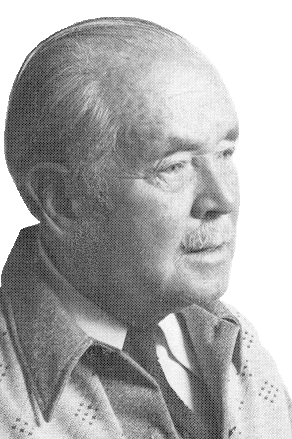
Douglas Reed
Douglas Reed (1895–1976), British author and journalist, was a penetrating and clear-eyed witness to the course of events in Europe and the West following the First World War. He served in the trenches in that war, and afterwards became a correspondent in the then-arising telephone news services. “I began to pick up the tricks of the journalist’s trade,” he writes in Insanity Fair, the book that made him famous. Insanity Fair was published April 1, 1938 and was a great success. Six months later Reed reported in a Postscript: “Now… on October 1st, I am sitting in Belgrade and read in my newspapers that the book is in its 28th edition and that it has been banned in Germany, and all around me is the tragedy that I have foretold you, the tragedy of faith betrayed… moving with gathering speed.”
There were few tricks either in his moral sense or his prose style. He possessed a rare capacity, seemingly extinct in journalists today, which was a refusal to be deceived. This is a character of the will rather than of the intellect. But he was intellectual astute and had a graceful and highly literary prose style. The titles of many of his works speak to this literary flair: Insanity Fair (1938), Disgrace Abounding (1939), A Prophet At Home (1941), Lest We Regret (1943), From Smoke to Smother (1948).
Reading several of these books — as I have been doing for the past few weeks — brought me into a special state of awareness. My state might be described as “feeling suspended in the historical-prophetic — or “being immersed in a series of ongoing novels-still-happening” or “witnessing events in their prophetic dimensions.” The brightness and clarity of the thoughts corresponded, in some mysterious way, to the brightness of the May air outside the Free Library in Philadelphia, where I was engaged in this reading. (The books, because of their condition, were not to be circulated. It was only later that I discovered a website in which many of these books are available in PDF format.
I would be reading Reed — and at the conclusion of a few hours, return to the world outside, whose very history and prospects revealed and resonated with his pages. In those moments I felt I was in a more-than-physical realm in which revelation and resonance surrounded me.
I was not exactly a stranger to Reed. I had read his book, The Controversy of Zion, which has been posted on the Internet thanks to the labors of a Danish researcher, Knud Erikson, at this link. After the publication of Far and Wide (1951) Reed’s books were all but banned by establishment publishers, according to a brief biography of Reed reproduced on Erikson’s website. Reed “provided readers with elegantly-crafted reporting and analysis based on seasoned but common-sense observations of the international scene.” The second sentence of the brief Wikipedia entry on Reed quotes the Times of London claiming that Reed was a “virulent anti-Semite” — certainly a charge guaranteed to ban his books. The Controversy of Zion is a history of the Jews from the earliest beginnings to the founding of the state of Israel and its history until 1956. Reed devoted much attention to the Jews. The quality of his attention might be painful at times — as light is painful at first when we emerge from a darkened room. But never hateful.
In The Controversy of Zion, Reed traces the beginnings of the people who became known as “Jews” to an incident recounted in Nehemiah 13:37 in what was then the Persian province of Judea. On a day in 458 B.C., there was read, by Ezra of the Levites, what was to become known as the Law. It decreed absolute severance of the people from others, it banned mixed marriages, and it spoke of a vengeful god: “And the people wept when they heard the words of the Law.” This was the start of a “racial creed, the disruptive effect of which on subsequent human affairs may have exceeded that of explosives or epidemics.”
To Reed, the setting up of a tribal god was already regressive as far back as 458 B.C., when the idea of a God for all mankind was beginning to work its way through society. It is important to recall that the tribe of the Levites was not the same people known to history as the ‘Israelites.’ Reed quotes a Dr. Kastein, an avid Zionist, who remarked that “[After the death of Solomon, ~ 937 BC] the two states [Israel and Judah] had no more in common, for good or evil, than any two other countries with a common frontier. From time to time they waged war against each other or made treaties, but they were entirely separate. The Israelites ceased to believe that they had a destiny apart from their neighbors and King Jeroboam made separation from Judah as complete in the religious as in the political sense… [Then, the Judahites] … decided that they were destined to develop as a race apart…. they demanded an order of existence fundamentally different from that of the people about them. These were differences which allowed of no process of assimilation to others. They demanded separation, absolute differentiation.”

This small racially exclusive Levite tribe was supported in the Persian province of Judea with the force of Persian arms. The founding of Israel with the arms and support of the British Government in 1917, is the culmination of a centuries-long pattern in which non-Jewish governments have furthered the goals of what Reed called the “heresy of Judaism.” Reed traces the “heresy” from its origins with the Levites through its metamorphoses to the later Pharisees, Talmudists, and Zionists. This was the core group that maintained its apartness from the rest of humanity, and acted as a constricting force when assimilative tendencies began to manifest in the mass of Jews.
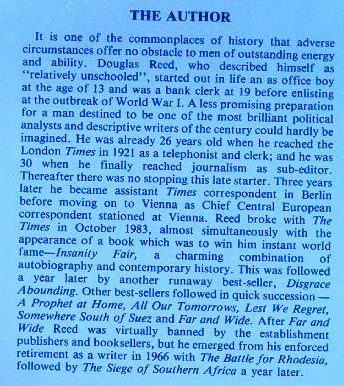
Biographical sketch of Reed accompanying The Controversy of Zion
I believe it is all but impossible to understand the world today without reading The Controversy of Zion, for modern Israel is indeed the result of the Judaic racial doctrine of a “law unto themselves.” The Jews, Reed wrote in A Prophet at Home, are the most complex people in the world and “to claim to know their inmost souls… is fatuous.” “It is much more difficult to define [them.] Dispersed throughout the world, they may themselves best be compared to a sphere of which the steel core is the body of fiercely intolerant, anti-Gentile Jews, while those qualities diminish as you work outwards toward the softer peel.” He believed the Jews of the world to be divided into three main groups: the first group, more or less assimilated, sees itself as mainly religious. The second group comprises the Zionists, with territorial ambitions. The third and last group comprise international Jews, “with boundless aims.” Promotion of the aims of Zionists and internationalists tended to be to the detriment of the first group.
For example, in the earlier books he spoke highly of those British Jews who, in 1917, resisted and opposed the Zionist ambitions, and who resented being lumped in with the Russian Jews who had spawned the Zionist movement. However, by 1945 as the Zionist State was being established with the force of British arms, British Jews had converted en masse to Political Zionism. Reed comments that they immediately turned against Britain once the Second World War was over.
In Lest We Regret (1943) Reed comments that the campaign for a Jewish home in Palestine was “the most stupendous press and political campaign in his experience.” In looking back over the intervening years, he notes that all that remains of the victory in the First World War was the “Jewish triumph” — that is, the Balfour Declaration of 1917 and the underwriting of the Jewish state by the government of Britain. The great victor of the Second World War was Communism, which brought in its wake the bifurcation of Europe. The two, Communism and Political Zionism, the two victors of 20th-century upheavals, bore down upon the time like pincers. “Both worked hand in hand and promoted each other’s aims during the next thirty years (whether in the third act they will separate and strike at each other, or appear to do so, is a revelation reserved [for later times.]”
He often returned to this theme: the difference between military victories and political defeats — or rather, military victory transformed into political defeat. Truly, the events following the First World War had “far-retching consequences — they make you sick.” The period 1918–1939 he calls “senile” — the decay of manners, the defacing of the countryside, the poor quality of new building, the “fantastic silences” of the English — which are “grotesque and inhuman.” These were the things enshrined as the result of the World Wars.
But Reed thought that the causes of the wars remained concealed: the practice of power wielded in anonymity, e.g., by ‘advisers’; the principle of unaccountability in politics; and the ‘exploitation of unemployment’ and the deference to ‘private enterprise’ which allowed for the shuttering of industries. The principle of unaccountability had enabled Parliament always to promise one thing and do its exact opposite; there seemed to be no difference in the political parties. In A Prophet At Home, 1941, he had seen it coming: “I had remained English; England had become alien; … [it] had the feeling of past participle.”
Sound familiar? Those were the days — I emerged from the Free Library into modern America, whose template, it seems, had been outlined, described, marked, and stamped by this prescient journalist some seventy years ago. We are in the third phase of the story of the triumph of Communism and Zionism after WWII. Communism disappeared suddenly and without fuss, to the consternation of planners and bureaucrats. But the Zionists are still going strong. They celebrated the end of the Cold War with the Neoconservative doctrine of US world hegemony.
The far-retching consequences continue, and Reed’s “third act” is still waiting to be detonated. Maybe it already has — financial catastrophe, Israel’s out-of-control aggression and the fanatical campaign against Iran. Too bad Reed isn‘t around to say “I told you so.”
Caryl Johnston (email her) writes from Philadelphia.
Editor’s note: This article originally appeared on TOO on June 10, 2010 but was lost in the shuffle when TOO got its face lift.




Comments are closed.