

Review: Julius Evola’s “The Myth of the Blood: The Genesis of Racialism”
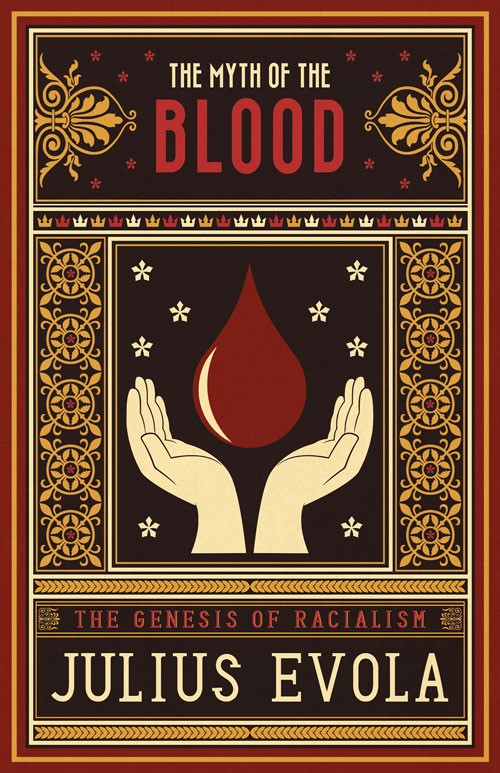
The Myth of the Blood: The Genesis of Racialism
Julius Evola
Arktos, 2018.
My history with Julius Evola is proof that first impressions aren’t everything. I was in my mid 20s before I picked up my first volume by the Italian philosopher – a nicely presented hardback edition of Revolt Against the Modern World. I’d considered ordering it after a number of recommendations from friends and associates, and was finally pushed to the purchase after viewing a typically excellent 2010 speech/lecture on Evola (titled “The World’s Most Right Wing Thinker”) by Jonathan Bowden. Whether it was the sheer hype that I’d been exposed to, my resultant exaggerated expectations, or simply the content of the text itself, in the end I was disappointed with the book. It hadn’t helped that, other than forays into the work of Nietzsche and Heidegger, I possessed a marked inclination toward the Anglo-American or analytic philosophical tradition. As I result, I developed a kind of prejudice against Continental philosophy (and Continental philosophers) as being typified by pretentious posturing, convoluted or repetitive arguments, and (among the later set) more than a whiff of Marxism. Ideologically speaking, Evola was, of course, light years from the likes of quack contemporaries like Jean-Paul Sartre. I could tell, as I made my way through Revolt, that, in between quasi-mystical musings, Evola had some extremely important thoughts to offer. In fact, it was a source of great frustration that, despite apparently having these valuable things to say, they were unnecessarily and unfortunately lost in the convoluted style and structure of the text. Somewhat ‘burned’ by the experience, I avoided Evola for a number of years — a move I now regret.
In the interval between my reading of Revolt and my later rediscovery of Evola, the Italian’s perceived importance in mainstream academia began to grow, aided by increased translation and reception of his work. The most significant two works of recent years are probably Francesco Germinario’s Razza del Sangue, razza dello Spirito: Julius Evola, l’antisemitismo e il nazionalsocialismo (1930–43) (Bollati Borlinghieri, 2001), and Paul Furlong’s Social and Political Thought of Julius Evola (Routledge, 2013), in which the author posits Evola as a major anti-Enlightenment thinker and, in the words of another scholar, “convincingly disposes of the claim made by [leftist and “antifascist” academic] Roger Griffin, and assumed by many others, that Evola is merely a philosopher of fascism, suggesting instead that he should be understood ‘within the context of European conservative thought since 1789’.”[1] Read more



