
Was America’s World War II ‘Crusade’ Worthwhile?
Was it really worthwhile to fight a destructive war so that Poland might be the victim not of Hitler but of Stalin, so that there might be a Soviet empire, not a German empire, in Eastern Europe, so that we should face not Japan but Stalin’s henchman, Mao Tse-tung, in the Orient? War and postwar emotionalism have inhibited a frank facing of these questions. But the tragic factual record of what happened to Poland, set down in this chapter, surely suggests that there is a case for a negative answer.
—William Henry Chamberlin
If forced to briefly describe America’s Second Crusade, William Henry Chamberlin’s revisionist account of Allied leadership during the Second World War, two words come to mind: sober accounting. In nearly every chapter, the author holds the United States and Britain to the standards they themselves had set for what they hoped to accomplish by defeating the Axis. Did they meet these standards? Were their proclaimed goals achieved? Was the world in a better place after the war than it was before? Surely such questions deserve honest answers.
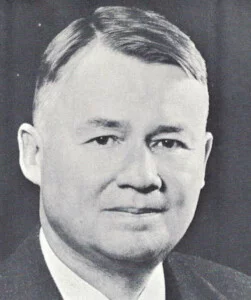 William Henry Chamberlin
Unfortunately, such questions were considered subversive when this book was first published in 1950, and many today still regard them as heretical. That’s why this dissident book failed to find a mainstream publisher, and why it has never been given the attention it deserves. The sidelining of this important work was part of a broader and largely successful effort to squash all voices that question the prevailing, “official” view of World War II. For any thoughtful and reasonably open-minded reader, this book makes a persuasive case for negative answers to the questions above.
The author begins by assessing how America’s first great “crusade” – in World War I – could have been avoided. It happened because this country’s elites were not honest with the people. In 1917, President Woodrow Wilson summoned Americans to war against Germany with idealistic and noble-sounding slogans and promises about making the world “safe for democracy.” That rhetoric disguised the very tangible goal of bailing out the beleaguered British and French, whose defeat would have meant defaulting on the massive debts they had run up to US banks and corporations.
Chamberlin also notes the tragic irony of how the First World War crusade for democracy, and the vengeful peace later imposed by the US and the other victorious Allied powers, led directly to the two great “undemocratic” political movements of the 1920s and 1930s: Communism and Fascism. He also compares the atrocities and other misdeeds of the Soviets and the Nazis, and concludes that – as millions in Central and Eastern Europe were to learn through bitter experience – conquest by one was hardly better or worse than conquest by the other. As he goes on to explain, this means that the US-Soviet alliance in the second “crusade” – World War II – did not produce a more righteous or benevolent world.
Chamberlin takes the reader from the sordid peace of the imposed Treaty of Versailles following World War I through the 1920s and 1930s to the much acclaimed “Atlantic Charter” of 1941 and the Yalta Conference and Potsdam Agreement of 1945 to support his thesis that America’s role in World War II was tragic and unnecessary. He also traces President Franklin Roosevelt’s underhanded and illegal machinations with British wartime premier Winston Churchill, and explains in detail how the US president had, in the words of writer and politician Clare Boothe Luce, “lied the American people into war because he could not lead them into it.”
Particularly shocking is how the US president matched his single-minded obsession with destroying Hitler’s Germany with a groveling appeasement of Soviet dictator Josef Stalin. Stalin’s record of deceit, bad faith, and brutality and oppression, which was much more checkered than Hitler’s, meant nothing to Roosevelt.
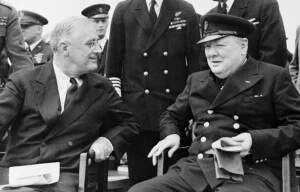
Winston Churchill and Franklin Roosevelt at their meeting in Auguest 1941 when they issued the “Atlantic Charter”
Regarding the war in Europe, Chamberlin’s makes these key points:
- Hitler, whom Chamberlin refers to as “treacherous, mercurial, unpredictable,” set his sights on expansion eastwards, not toward the west. Without much of a navy, Hitler’s Germany certainly posed no credible threat to the United States.
- Diplomatic records reveal that already by the late 1930s, President Roosevelt was committed to waging war against Germany. Furthermore, he lied about his bellicose intentions and found means both legal and illegal to bypass the Neutrality Act and other constraints against getting the US into another overseas war.
- With regard to the war in Europe, the US was neutral in name only from 1939 to the December 1941 Pearl Harbor attack. The “Destroyer Deal” with Britain, Lend-Lease aid to Britain and the Soviet Union, Roosevelt’s order to attack German U-boats, and much more, meant that the US was already a belligerent.
Chamberlin also devotes much attention to the looming conflict in the Pacific. With regard to America’s worsening relationship with Japan, the author stresses these points:
- From the late 1930s to the Pearl Harbor attack, the United States ever more aggressively bullied Japan, both diplomatically and economically, supposedly on behalf of China, although there was no vital US interest to do so.
- The US refused to seriously consider numerous Japanese efforts to reach agreement with Washington.
- Considering US conduct in the months and weeks before Pearl Harbor, and especially this country’s increasingly hostile measures against Japan, it is reasonable to conclude that President Roosevelt wanted, or at least expected, the Japanese attack which finally came in December 1941. In the words of Secretary of War Henry Stimson, “The question was how we should maneuver them [the Japanese] into firing the first shot without allowing too much danger to ourselves.”
Another important feature of this book is the author’s skillful detailing of how the US and the other Allied powers betrayed every one of the their own solemnly proclaimed war aims. The pledges and promises of Roosevelt and Churchill were so meaningless that one cannot help but question their purported motives for entering the war. As Chamberlin writes:
In his message to Congress of January 6 [1941], Roosevelt enunciated the Four Freedoms on which the world should be founded. These were freedom of speech and expression, freedom of worship, freedom from fear, and freedom from want. These were to prevail everywhere in the world. The Four Freedoms, together with the seven points of the Atlantic Charter, announced later in the year, were America’s war aims, the equivalent of [Woodrow] Wilson’s Fourteen Points. They still furnish a mirror by which the success of the Second Crusade may be judged.
The Roosevelt-Churchill Atlantic Charter – the full text of which Chamberlin provides – forbade all nations from ever seeking territorial aggrandizement or expansion, establishing tyranny, obstructing free trade and travel, inhibiting peace, exploiting labor, and resorting to force to get their way. Anyone even superficially familiar with world history since that 1941 pledge can readily appreciate just what a bitter joke the Atlantic Charter and the Four Freedoms turned out to be.
This flagrant betrayal of the principles and goals for which the US fought in World War II, Chamberlin explains, was inevitable given Roosevelt’s abiding trust in the Soviet dictator, and his unwillingness to leverage America’s massive military and economic aid to the Soviets to press for a better postwar world. As former US ambassador to Moscow William Bullitt later put it, Franklin Roosevelt was like a naïve wife who marries a man because she intends to change him – in this case, hoping to “convert Stalin from imperialism to democratic collaboration.” This Roosevelt (and Churchill) planned to accomplish by appeasing Stalin at every turn, even if that meant abandoning their principles as well as their friends and allies. The passages in which Chamberlin forthrightly shows how this was done are some of the book’s most stirring – and disturbing.
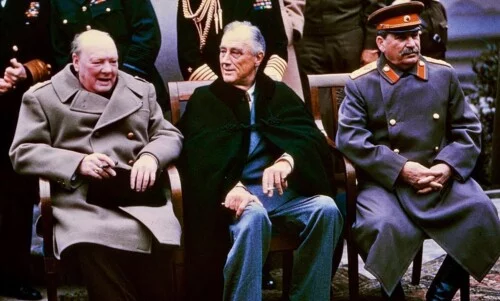 Churchill, Roosevelt, and Stalin at the February 1945 Yalta Conference
Britain declared war against Germany in September 1939 supposedly to defend the independence and freedom of Poland. But as Chamberlin points out, at the end of nearly six years of war, the British government abandoned the Poles to Soviet subjugation. After describing how Roosevelt and Churchill also abandoned anti-Communist forces in China and Yugoslavia, Chamberlin writes incisively that, “the betrayal of Poland was the crudest and most flagrant of the three, if only because Poland was the pretense for the whole crusade.”
Chamberlin provides a clear accounting of the ghastly atrocities committed by the Soviets in Germany and across Eastern Europe during and after the war. Millions were deported, murdered, raped, starved, and enslaved as Stalin expanded his empire. Roosevelt and his irrepressible deputy Harry Hopkins always preferred to overlook the brutal and imperialist polices of their Soviet partner. A factor in the president’s unwillingness or inability to grasp the obvious may have been his very noticeable cognitive decline during the final months of the war in Europe. As Chamberlin notes, Secretary of War Henry Stimson had to remind the doddering president that he had signed off on portions of the genocidal Morgenthau Plan.
Chamberlin devotes little effort to trying to explain just why Franklin Roosevelt thought and acted as he did. He briefly suggests that the president saw war as a way to get the US out of the Great Depression, something his much-hyped New Deal failed to do. Chamberlin also unflatteringly cites Roosevelt’s “jaunty, cocksure, sometimes flippant, self-confidence,” as well as his titanic ambition, his self-serving need for yes-men, and his general lack of concern for the millions of deaths he helped cause. At one point Chamberlin describes the Roosevelt presidency as a “personal dictatorship.”
Chamberlin makes only passing mention of Jews, and none at all about whatever role they may have played, as Jews, in shaping policy. He mentions Jews only as victims of mass slaughter during the war, and, once, with regard to their role in leftist agitation and financial speculation in Germany, which stoked anti-Semitism there after World War I.
All the same, Chamberlin does relate the role played by two Jewish agents for the Soviet Union who held important posts in the Roosevelt administration: Harry Dexter White, the principal author of the Morgenthau Plan, and Nathan Silvermaster, an economist with the War Production Board. Another pro-war, anti-German official close to the president was William Bullitt, a half-Jewish high-ranking diplomat. He helped the president circumvent the Neutrality Act and pull the US into war in Europe.
Particularly influential in Roosevelt’s inner circle was Henry Morgenthau, Jr., his Jewish Secretary of the Treasury, who nurtured a visceral hatred of the “Nazi” German people. Chamberlin relates how the president echoed Morgenthau’s anti-German vindictiveness in a communication to War Secretary Stimson. Secretary of State Cordell Hull complained in his memoirs that Morgenthau often overstepped his authority as Treasury Secretary to pursue his own agenda:
Emotionally upset by Hitler’s rise and his persecution of the Jews, he [Morgenthau] often sought to induce the President to anticipate the State Department or act contrary to our better judgment. We sometimes found him conducting negotiations with foreign governments which were the function of the State Department … Morgenthau’s interference at times misled some portions of the public and seriously impeded the orderly conduct of our foreign policy.
President Roosevelt with Treasury Secretary
Henry Morgenthau, Jr.
The most infamous example of the Treasury Secretary’s interference in US foreign policy was the notorious Morgenthau Plan. It required that Germany be cut up into several impoverished agricultural territories, in which all large-scale industry would be destroyed or seized by the victorious Allies, that Germans would be sent to other countries as forced laborers, and that all German assets outside of Germany would be confiscated. As Chamberlin writes (emphasis, mine):
It is no exaggeration to say that the Morgenthau Plan, if applied in its full rigor, would have been an undiscriminating sentence of death for millions of Germans. The area in which it was proposed to forbid all heavy industries and mining is one of the most urbanized and thickly settled in Europe. It would have been impossible to turn millions of city dwellers, accustomed to earning their living in factories, offices, and shops, into self-supporting farmers, even if land had been available.
After details of the Morgenthau Plan become known to the public, a wave of outrage forced its repudiation. Even Europeans friendly to the US protested that an impoverished Germany would inevitably also mean an impoverished Europe.
In writing America’s Second Crusade, the author benefitted from other important revisionist works that had already appeared shortly after the end of World War II, including George Morgenstern’s Pearl Harbor: The Story of the Secret War (1946), and Charles Beard’s two in-depth studies of Roosevelt’s duplicity in the lead-up to America’s involvement — American Foreign Policy in the Making (1946), and President Roosevelt and the Coming of the War 1941 (1948). The bibliography of America’s Second Crusade is a useful guide to mid-century independent American historiography.
This book does not merely expose liars and hypocrites in the halls of power. It distinguishes itself by challenging the American public to consider that the death, destruction, and trauma of the Second World War may not have been “worth it” in the end. Chamberlin is no sympathizer of or apologist for Nazism. But he is not afraid to measure the stated goals of Franklin Roosevelt and Winston Churchill against the objective historical record by which the question he poses might be answered. The arguments for America’s entry into the war, he concludes, ultimately come up wanting.
Originally post at the Institute for Historical Review.




The day will eventually come when the National Socialists are lauded more than they are vilified. Their positive achievements far outweigh their negative actions – most of which came during a brutal and ruthless war against soulless bolsheviki. Their greatest accomplishment was the elimination of usury as the basis for their currency. Once the debt-free mark was pegged to German Labor, the “economic miracle” swiftly ensued. In my opinion… THIS… was the main reason World War II was fought. The Rothschilds could not permit this successful example to seep out into any of their other debt-slave states. Had the Germans won, there is little doubt that the usury-based currencies around the world would have quickly died in favor of a system similar to what the NS had enacted.
Why no mention of a hollow cost in the biographies of Churchill, De Gaulle and others?
Good articles on the subject…
“The Truth About World War II Is Beginning to Emerge 74 Years Later Paul Craig Roberts”
and
“In Defense of National Sociualism by Will Luthr Pierce”
Democracy = jews get what they want and the goyim suffer.
WWI and WWII were ordered and organized to destroy the Kaiser’s German nation-state, destroy the German system of political economy, and annihilate the German people, period. This was British policy since ‘The Encirclement’, the informal, mutual agreement, known as the Entente Cordial, promoted around the several courts of Europe, France and Russia mainly and its not-so-secret Anglophile cabal in the United States. President Franklin D. Roosevelt wasn’t particularly enamored with the British, who, at one time, threatened war against the United States over terms being proposed within the 1922 Washington Navy Treaty. 10 years after the Naval Treaty, the United States was thrown into the Great Depression ignited by the Fed’s cooperation with the Bank of England’s gold standard scheme. The US had a Red Plan, against Japan, and an Orange Plan, against Great Britain, that drew up the warfare operations to be executed against either rival imperial system. FDR saw the opportunity to destroy the British, German, Russian, Japanese, French, Dutch, and Italian empires at once, creating the American Super Power.
There is a photo circulating where we see Mr. Churchill and the famous financier-speculator and President Wilson’s Chairman of the War Industries Board, Bernard Baruch, sharing the cozy back seat of a London cab. Baruch made over $400 million dollars before, during and after WW1. War is profitable. Too profitable for some, that peace is impossible. Baruch was also at President Roosevelt’s elbow as the indispensable advisor ordering the manufacturing imperatives for WWII.
The Soviet Union’s military power was developed, funded, and supplied by the bank, manufacturing and naval power of the United States. Of course FDR loved Stalin who took most of the brunt of the German offensive. What is not known was that the Nazi’s were a reaction to Bolshevism that had infiltrated every nation of Europe. The German Army was first seen as liberators in Poland, Ukraine, and many millions of Russians. Stalin was lucky the Russian people could be stirred to patriotism and fight the Germans under the threat of death. By the 1950’s Khrushchev era, from the Bolsheviks to the Soviets over 66 million Russians, most of them Christian, were killed, murdered, starved, buried alive, worked to death, frozen, gulaged, etc.
Now we see the invasion of the USA, starting almost a decade ago, as a forced relocation of the population pogrom, led by Soros organs; communist Woke forces, ANTIFA, and LGBQTURST, acting as infantry, on Main St. and yet no one can make the comparison to the same Immigrant Invasion warfare offensive, funded and armed by Wall St., magnate, Jacob Schiff of the last century, that eventually took over Russia. Interesting time we live in.