
Jailed for Putting Up Legal and Truthful Stickers on Lamp Posts
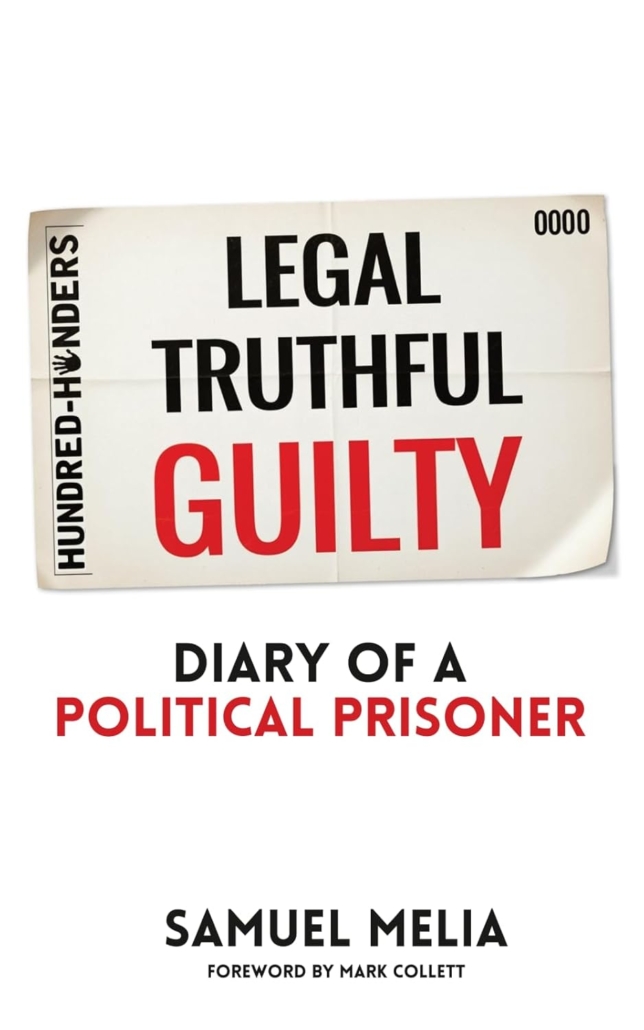 For American readers what I am about to write about the mother country may sound unbelievable, but, incredibly, it is true. In 2024, a young signpost maker and father of one called Sam Melia was jailed for putting perfectly legal stickers on lamp posts.
The leader of the Hundred Hands campaign and activist in a group called Patriotic Alternative, the then 34-year-old had designed a series of anti-immigration stickers to call attention to the fact that the English will soon be a minority in their own country and that Pakistanis have a tendency to groom and rape English girls. It was determined that the stickers were perfectly legal, if “extreme,” an assertion which makes you wonder if England is genuinely governed by the rule of law.
However, Melia had a jokey Hitler poster in a garage which he used as a gym during Covid, and his wife owned a copy of a book by Sir Oswald Mosley, the leader of the British Union of Fascists in the 1930s. Accordingly, it was decided that Melia must be motivated by a desire to “stir up racial hatred.” He was found guilty by a partially non-White jury and the judge made it clear that he would make an example of him.
One of the results of this Soviet-like show trial and imprisonment has been Melia’s poignant, fascinating and inspiring prison memoir Legal, Truthful, Guilty: Diary of a Political Prisoner. Beginning with the details of the “crimes” and the trial, Melia takes into the frankly jaw-dropping world of the English prison system. The first thing we realise is just how corrupt it is. The “screws,” though there are some good ones who are sympathetic to Melia’s plight (away from his pregnant wife and young daughter), seem to be, in effect, rather lazy people. They are perfectly content to permit the prisoners to run the prison, to develop their own hierarchy and even to sell drugs, as long as the situation doesn’t get too violent.
Socially skilled, and probably more intelligent than most of the prisoners on his wing, Melia is quite adept at climbing this hierarchy – in which the new currency is “vapes” – but, alas, they keep moving him to different wings or different prisons, so he has to start the process all over again. We also discover that almost everybody on the sex offender wing is Muslim but non-Muslims can, and do, sign up for special Eid feasts.
As a political prisoner, and one hoping for early release, Melia is subject to regular Maoist struggle sessions with a male social worker who is so deeply indoctrinated with Woke and so lacking in the ability to think that he and his type are concerned that Melia “thinks Black people aren’t White Britons.” The preceding, stresses Melia, is a genuine quote and he proves this by publishing the correspondence. Their aim is to “re-align Mr Melia’s mindset.” The chap from the anti-terrorist group “Prevent” concludes that Sam is no threat to anybody, but the torture of struggle sessions – in which Sam is logical and the man with power insanely tries to make Sam accept that black is white – must continue. At one point, the authorities are so cruel that they declare – though eventually change their minds – that his children cannot visit Melia in jail as his anti-Woke ideas might somehow lead a toddler and a baby into terrorism.
Melia’s story made me realise, more clearly than ever, how prison turns men into children. Having almost no agency, the slightest bit of power becomes extremely precious to your sense of self-worth and the smallest things matter hugely. Melia occupies his time making match-stick models and takes a massive amount of pride in them. Prisoners try to brag about their worldly success by displaying expensive tracksuits in their cells, just as children would show off their expensive and sought-after toys. You have to be careful, though, because some people in prison, like angry children, will destroy “anything nice.” The prison’s “mob” tends to control the canteen and uses this power to steal food for its members, such that ordinary prisoners are told that the hamburgers to which they are entitled have mysteriously already run out.
Melia muses that the problem with the British is that they are “coddled, fat, pacified and outwardly happy”, and the British are unlikely to seriously fight to get their country back until that is no longer the case. However, his memoir attests to just how self-defeating the system is. Melia is now regarded by many on the nationalist right as a political hero. He has been subjected to terrible psychological suffering – including a year on licence in which he was banned from all political activity and had to tell the authorities with whom he socialised as he was barred from meeting or contacting “far right” people – but the result is that he is more galvanized and prominent than ever.
Having read his book, I was left with many questions: How can they be so cruel? How can they be so unreasonable? My conclusion was that these people – so heavily invested in the regime – probably feel a bit like Eastern European government workers in the 1980s. On some level they know that something is about to change and it must not be allowed to change because, as happened in East Germany, the people will not easily forgive them for being the cowardly agents of a decadent tyranny.
My interview with Sam Melia can be found here:




From a racial standpoint, this is nonsense, since
both states belong to the same ethnic group.
https://www.gbnews.com/news/world/migrant-crisis-india-snakes-crocodiles-border-immigration-bangladesh
And a selfish cruelty. Now those poor snakes &
crocos have to waste their vital energy without
being allowed to eat the food they’ve earned.