
Mikhail Bakunin vs Karl Marx and the Jewish Question
Mikhail Bakunin is remembered as the founding theorist of modern anarchism, a man who dedicated his life to the abolition of all systems of domination and who warned with prophetic accuracy that Marxist states would create new ruling classes rather than liberate the masses.
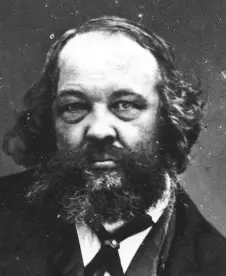
Mikhail Bakunin
His admirers in the anarchist space celebrate him as a champion of human freedom who spent years in solitary confinement for his beliefs, escaped from Siberian exile, and inspired revolutionary movements across Europe. Tucked away in the dark corners of Bakunin’s voluminous literary output is a persistent, antisemitic thread that has been obscured by the passage of time.
Mikhail Aleksandrovich Bakunin was born on May 30, 1814 into Russian landed nobility at the family estate of Premukhino in the Tver Governorate, northwest of Moscow. His father had served as a diplomat in Italy before returning to manage an estate that included over 500 serfs. The young Bakunin abandoned a military career, immersed himself in Hegelian philosophy, and eventually found his way to the revolutionary circles of Paris, where he consorted with Pierre-Joseph Proudhon and Karl Marx.
The revolutionary wave of 1848 transformed Bakunin from a philosophical radical into a man of action. He fought during the February Revolution in Paris, attended the Slav Congress in Prague, and participated in the Dresden insurrection of May 1849. His arrest led to a death sentence that was commuted, followed by extradition first to Austria — where he was sentenced to death a second time, again commuted — and then to Russia. In May 1851, he was placed in solitary confinement in the Peter and Paul Fortress in St. Petersburg, where he spent three years before being transferred to Schlisselburg Fortress for three more years, then exiled to Siberia in 1857.
His escape from Siberian exile in 1861 became legend. Bakunin made his way through Japan and then by ship from San Francisco through Panama to New York before crossing to London, where he would spend the remainder of his life constructing the anarchist creed he preached until his death in 1876. He built networks of interlocking secret revolutionary societies, participated in an insurrection in Lyon in 1870 and helped plan an anarchist uprising in Bologna in 1874, and became the central figure of the anarchist faction within the International Workingmen’s Association.
Bakunin’s anarchism rested on a profound conviction that all systems of domination, whether the state, the church, or capitalism, must be abolished simultaneously. He argued that “to exploit and to govern mean the same thing” and viewed the state as an instrument of domination and exploitation serving a privileged ruling class — one that applied equally to monarchies and representative democracies alike.
He envisioned a post-revolutionary world of freely federated communes organized from below, with voluntary associations of producers starting locally but organizing internationally. He championed the right of every people to self-determination and opposed colonialism and imperialism. In his 1867 essay Federalism, Socialism, Anti-Theologism, Bakunin declared: “liberty without socialism is privilege, injustice; and that socialism without liberty is slavery and brutality.”
His most enduring contribution to political thought was his warning that a revolutionary state run by socialists would not wither away but would instead create a new ruling class of party officials and intellectuals governing in the name of the proletariat. In Statism and Anarchy (1873), he directly challenged Marx’s concept of the dictatorship of the proletariat, arguing that any post-revolutionary state would perpetuate itself indefinitely rather than dissolve.
Bakunin and Marx first met in Paris in 1844 and maintained an initially cordial if wary relationship. Marx even sent Bakunin a copy of the first volume of Capital. But their disagreements ran too deep for friendship to survive.
Marx believed the working class should seize state power through a “dictatorship of the proletariat” as a transitional instrument to build socialism. By contrast, Bakunin believed any state, even a workers’ state, would inevitably reproduce class domination. Marx favored centralized political organization while Bakunin advocated federalism and spontaneous worker action. Marx placed the urban industrial proletariat at the center of revolution while Bakunin also embraced the peasantry and the poorest workers, especially in Russia, Spain, and Italy.
The conflict was also bitterly personal. Marx wrote that Bakunin was “a man devoid of theoretical knowledge” and “in his element as an intriguer.” Bakunin believed Marx “lacks the instinct of liberty” and “remains from head to foot, an authoritarian.”
The crisis came to a head at the 1872 Hague Congress (The Hague Congress of the International Workingmen’s Association (aka the First International)). Bakunin could not travel to the Netherlands without risking arrest, and in his absence, Marx engineered his expulsion from the International on charges of maintaining a secret society within the organization and fraud related to an unfinished translation of Capital. The anarchist wing regrouped at the Saint-Imier Congress eight days later and founded the Anti-Authoritarian International, permanently splitting the socialist movement into wings that remain divided to this day.
Bakunin perceived that Marx had conspired against him and assumed that Marx sought to centralize control of the International. Bakunin framed the entire conspiracy in antisemitic terms, as a specifically “Jewish” plot.
The Russian anarchist intellectual’s antisemitism appeared in rudimentary form as early as 1851. While imprisoned in the Peter and Paul Fortress, Bakunin wrote his Confession to the Tsar, in which he criticized Polish independence leaders for their favorable attitude toward Jews. Bakunin’s aversion to Jewry grew stronger after his conflict with Moses Hess, a German Jewish socialist and proto-Zionist who represented the Marxist wing of the International and published a two-part critique in the Paris newspaper Le Réveil on October 2, 1869.
Bakunin responded with a long unpublished letter titled To the Citizen Editors of Le Réveil, in which he declared something that his friend Alexander Herzen immediately found disturbing. Herzen read this letter and complained to Nicholas Ogarev with a single question that captured the bewilderment of those who knew Bakunin best: “Why all this talk of race and of Jews?”
Between October 1871 and February 1872, Bakunin wrote a note titled Supporting Documents: Personal Relations with Marx that was originally intended for Italian allies but never sent. First published in 1924 in volume 3 of his German collected works, it contains some of his most disturbing writing:
Himself a Jew, Marx has around him, in London and France, but especially in Germany, a multitude of more or less clever, intriguing, mobile, speculating Jews, such as Jews are everywhere: commercial or banking agents, writers, politicians, correspondents for newspapers of all shades, with one foot in the bank, the other in the socialist movement, and with their behinds sitting on the German daily press — they have taken possession of all the newspapers — and you can imagine what kind of sickening literature they produce. Now, this entire Jewish world, which forms a single profiteering sect, a people of bloodsuckers, a single gluttonous parasite, closely and intimately united not only across national borders but across all differences of political opinion — this Jewish world today stands for the most part at the disposal of Marx and at the same time at the disposal of Rothschild. I am certain that Rothschild for his part greatly values the merits of Marx, and that Marx for his part feels instinctive attraction and great respect for Rothschild.
Throughout the passage, he sought to synthesize his broader critique of the state with specific observations regarding the role of Jewish financiers in the global economy:
What can there be in common between Communism and the large banks? Oh! The Communism of Marx seeks enormous centralisation in the state, and where such exists, there must inevitably be a central state bank, and where such a bank exists, the parasitic Jewish nation, which speculates on the work of the people, will always find a way to prevail…
In his February–March 1872 letter To the Comrades of the International Sections of the Jura Federation, perhaps his most extensively antisemitic text, Bakunin expanded his theories into sweeping generalizations about Jewish people as a collective.
Every Jew, however enlightened, retains the traditional cult of authority: it is the heritage of his race, the manifest sign of his Eastern origin. … The Jew is therefore authoritarian by position, by tradition and by nature. This is a general law and one which admits of very few exceptions, and these very exceptions, when examined closely confirm the rule.
He attributed Marx’s authoritarianism to his “threefold capacity as an Hegelian, a Jew, and a German.” In Statism and Anarchy, his 1873 book written in Russian, Bakunin described the creation of the German nation state as “nothing other than the ultimate realisation of the anti-popular idea of the modern state. … It signifies the triumphant reign of the Yids, of a bankocracy under the powerful protection of a fiscal, bureaucratic, and police regime which relies mainly on military force.”
Ultimately, Bakunin’s willingness to look past the superficial constraints of his day and directly identify the intersection of finance, state power, and Jewish influence and proneness to authoritarianism remains his most vital, yet ignored, lessons. While his contemporary successors in the anarchist movement have devolved into willing foot soldiers for the Jewish-dominated post-World War II order, a resurgence of Bakunin’s brand of judeoskepticism is long overdue. It is time for a new generation of dissidents to pick up Bakunin’s mantle, shedding the baggage of modern ideological constraints to confront the reality of Jewish power head-on.




Nino’s last paragraph includes finance, state power, The Jews, and authoritarianism….but does not remark the role of the Strong Leader.
Bonapartism was the experience of post-revolutionary 19th Century France which included all of the above but is neglected in this article. Trumpism personifies the Strong Leader, or Maximum Leader that is psychologically of the utmost importance.
Trump voters longed for a maximum leader, and got it in Trump, who has declared himself above all rules, and follows only how he feels at any particular time. He is like Yahweh, a jealous god, who is constrained not by law, but only by Himself. At another time, maybe soon, under perilous circumstances like war, rebellion by muds, liberal civil rights cluckers, Trump will kill and imprison at his whim, defeat in war , and his maga children, maddened by Dem woke equality police, and subverted by Jews into hating Arabs, He will go full berserk, nuke Iran, and declare martial law.
The psychology of Trumpstein’s maga folks include a yearning for a strong father and a loyal mother who will stand with Dad, this a consequence of mothers who have refused to be mothers but consumers and TV/cosmetics money grabbers. It is also because of cowardly and pussified men So. Mom and Dad have contributed to this failure of authority in general, but it is not primarily their parenting role that is the problem. The Problem is that Authority has been subverted by Jews, socialists/communists, equality police, and media, of course controlled by Jews. So Trump struts into the chaos of social life today, and claims that He is the Authoritarian who will fix everything. The French Revolution brought chaos to France. Enter Napoleon.
It is the Big Daddy who will drop the Bomb if need be, beat the Dems and the wogs, and provide two chickens in every pot. Not gonna happen, except for the Bomb on Persia.
Trump claims Nationalism, but he is a Jew Tool, the slave of the Jews. No nationalism from Him, except for stealing other folks’ money, oil, nations, sovereignty. Bonapartism, the Great conqueror of Latin America, the Middle East, Canada, etc. He will cash in on Venezuealan and Persian oil. Money-lender/Obliterator in Chief.
Will Americans support this, even the maga deranged folks? Not clear even with rapidly falling support in the US for Trumpstein. About the only thing that will finally kill off Trumpstein in the midterm elections is proof that he has been bonking little girls. That is about the only thing that really gets our ladies going. Kill the Arabs, kill the Persians, kill Anybody Trump says…that is what the American Bonapartist system is…for now. There is room for optimism , But Trump will bomb Persia into the Stone Age if his Jew Masters tells him to.
Almost hopeless, but Trumpstein getting more and more insane for his Jew masters, will finish him off politically, if we have enough time. The Hormuz sits there until Monday apparently, and it will eagerly accept American boys into its waters. That might finish off Trump earlier than I think.
Democrat presidents FDR Kennedy Johnson Clinton and Obama achieved god like status in the minds of democrats non Whites criminals illegal immigrants and Jews. And do did Eleanor Roosevelt Mrs Kennedy Hillary Clinton and Michelle Obama. At least the Jew communist media didn’t claim Roosevelt and Clinton were beautiful fashion icons. But they attempted to convince the masses that bulldog face 70 pounds more than her husband hideous Michelle was a beauty and the best dressed woman ever
What was the alternative ? Drunk all day Harris tool of her AIPAC husband the government of Israel and the ongoing Jewish destruction of White America? That’s what you want?
In every election the choice is between 100 percent terrible and 70 percent terrible.
Average Imbecile guards the quote from rabbi about you call it communism, I call it Judaism.
Bolshevism (CPUSA) or Zionism (Grand Old Politburo) is the choice in muh democracy.
Marx was a hardcore Satanist and you can tell in his poems.
August Blanqui of French Revolution times and into 1848 revolutionary politics, may have been the first to theorize what we now know as the Leninist Vanguard Party, led by professional revolutionaries who dominate the party and the workers. It is highly secretive, elitist, and anti-democratic. Lenin developed the notion of what we call the Leninist Party…in short, no democracy.
This is the basis of communist totalitarianism, as opposed to “Democratic Socialism.” So the USSR developed from this anti-democratic theory/practice.
The other historical factor was/is the Jewish domination of communism. The Jews are known generally to be highly authoritarian, with pronounced emphasis on the Head Rabbi, or politically speaking, the Dictator. All of this should be configured in the context of Bonapartism historically with Jewish Characteristics. Bibi is also such psychological specimen, with runner-up Trump identifying with him…Bibi, and announcing Himself Emperor of Everything.
Israel today could be considered a Bonapartist outfit, with the Maximum Leader exerting near total control. Compare and contrast to Trumpian dictatorian terrorism lite. He is near to canceling elections and declaring himself President for Life.
Trump won because of the threat of the mud masses and their Dem/Jew revolutionary leaders.
Now there is another Reaction against such tyranny, with Trump playing the next tyrant. We will see how Whites sort themselves out] in the next election, if we have one.
In his book “Statehood and Anarchy” Bakunin gives the following description of Marx: “By upbringing and nature, he is a Jacobin, and his favorite dream is political dictatorship”.
Great article, so true, so true. What an author, a real Human. He knew the rotschild influence and he knew marx represented rotschild during das capital writing. And yids, that sure is the name for the talmudic ashkenazims at the whiningwall, the telavivanians
Bakunin was the most constructive of the anarchists with their frequent tendency towards nihilism and terrorism. He was among the first to comment on the Rothschild/Finance and Marx/Communism “pincer” against European and Russian society, with its occasionally direct links (e.g. Fels, Aschberg, Hammer). There were however more admirable “typical” Russians: Dostoevsky, Turgenev, Mendeleev, Tsiolkovsky, Shafarevich, Berdyaev, Sorokin, Vasilyev, Solzhenitsyn – but certainly not Dugin.