
FEF Files Complaint Against Department of Justice on Behalf of Austin Franco
FEF Files Complaint Against Department of Justice on Behalf of Austin Franco
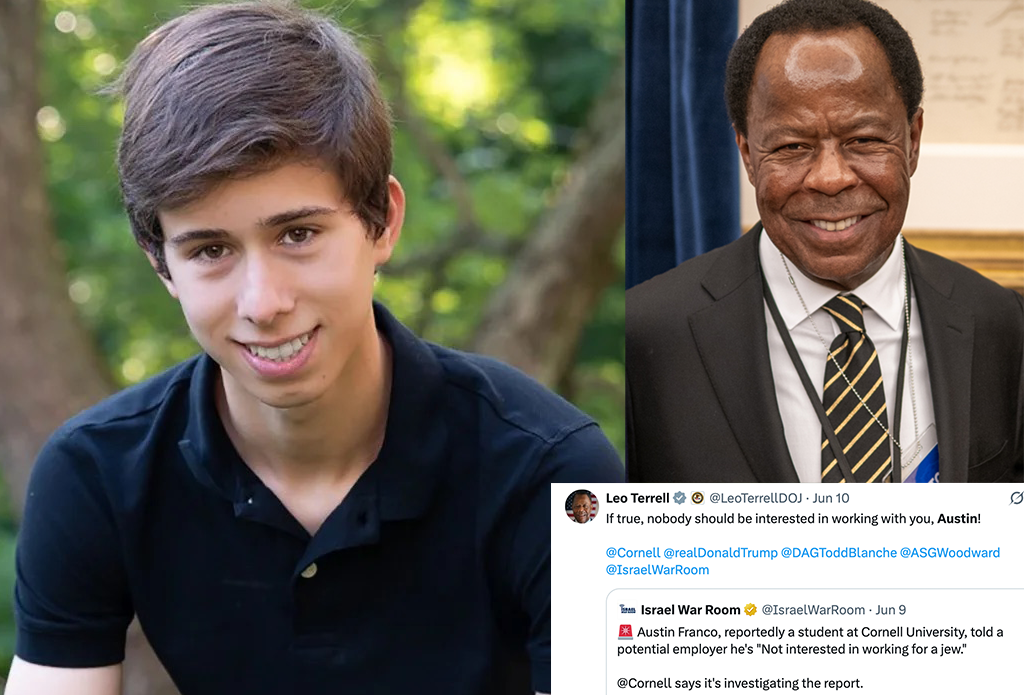
The Free Expression Foundation has filed a civil rights administrative complaint against DoJ official Leo Terrell on behalf of Austin Franco — and you can help!
As explained in the full complaint below, Mr. Terrell sought to blacklist Mr. Franco from all future employment. The reason? The young college student exercised his Constitutional freedom to not associate. One of this current government’s special ironies has been the repeated violations of civil rights by the DoJ’s Civil Rights Division.
Mr. Terrell used both his personal and government X accounts to harass Mr. Franco and to call on the public to make him “permanently unemployable.” The United States Supreme Court has condemned this exact sort of government blacklisting in Bantam Books v. Sullivan and NRA of America v. Vullo.
One of the key difficulties in attaining redress against federal officials for violations of Constitutional rights is the statutory framework. 42 U.S.C. § 1983 provides an avenue to sue state officials for Constitutional harms, but no parallel route exists against federal officials like Mr. Terrell. While a plaintiff may bring a complaint in what is known as a Bivens action, the Supreme Court hollowed out the First Amendment aspect of this method in their 2022 Egbert v. Boule decision.
The best forum, accordingly, to seek redress for Mr. Franco is a civil rights administrative complaint with the Office of the Inspector General. Here is where FEF’s supporters come in:
- Share the complaint on social media
- Contact your Congressional representatives and ask them to put pressure on the Office of the Inspector General to investigate the complaint
Be professional in your communications, but communicate. It is your right to petition the government!
See the full text of the civil rights complaint here (PDF LINK WILL OPEN IN A NEW TAB).
With you in the defense of freedom,




Freedom of non-association is a right worth fighting for.
Thanks for letting us know Glen.
Maybe it was here that I was looking at the history of “blockbusting” and found this on freedom of association. “Integration is the period between when the first blacks move into a community and the last whites move out.”
Some of the first HOAs were formed early in the 20th century in Los Angeles County, beginning with the Arroyo Seco Improvement Association in Pasadena founded around 1905 and the Los Feliz Improvement Association in Los Angeles founded in 1916. These were the children of deed restrictions in a new kind of planned subdivision, and they established the national legal precedent for zoning districts exclusively for upscale, single-family residences. Private restrictions normally included provisions such as minimum required costs for home construction and the exclusion of all non-Caucasians from occupancy, except domestic servants.
Early covenants and deed restrictions were agreed to in escrow by those purchasing in a development. In the early postwar period after World War II, many were defined to exclude African Americans and, in some cases, Jews. For example, a racial covenant in Seattle, Washington stated, “No part of said property hereby conveyed shall ever be used or occupied by any Hebrew or by any person of the Ethiopian, Malay or any Asiatic race.”[10] In 1948, the United States Supreme Court ruled such covenants unenforceable in Shelley v. Kraemer. However, private contracts effectively kept them alive until the Fair Housing Act of 1968 prohibited such discrimination.
________________________
The U.S. Office of the Solicitor General filed, for the first time in a civil rights case, an amicus curiae (“friend of the court”) brief in support of the Shelleys. The Solicitor General’s brief filed on behalf of the United States government was written by four Jewish lawyers: Philip Elman, Oscar H. Davis, Hilbert P. Zarky, and Stanley M. Silverberg. However, the Solicitor General’s office chose to omit their names from the brief. Deputy Solicitor General Arnold Raum, who was also Jewish, stated that it was “bad enough that [Solicitor General Philip] Perlman’s name has to be there, to have one Jew’s name on it, but you have also put four more Jewish names on. That makes it look as if a bunch of Jewish lawyers in the Department of Justice put this out.
Elman, Philip; Silber, Norman (1987). “The Solicitor General’s Office, Justice Frankfurter, and Civil Rights Litigation, 1946–1960: An Oral History”. Harvard Law Review. 100 (4): 817–852 [p. 819]. doi:10.2307/1341096. JSTOR 1341096. As quoted in Waxman, Seth. “Twins at Birth: Civil Rights and the Role of the Solicitor General”. Indiana Law Journal. 75: 1297, 1306 n. 53.