
Croatia for Rent
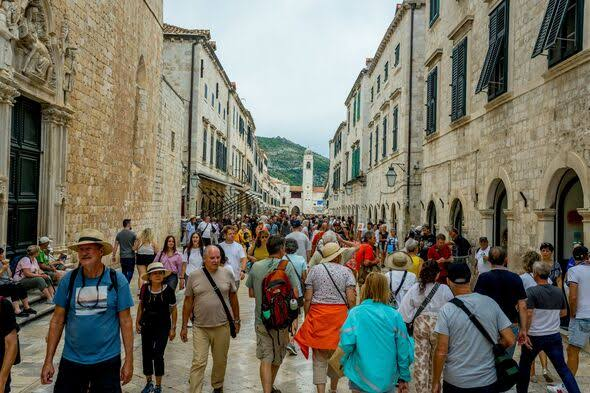 Dubrovnik, Croatia
Hailed as Europe’s safest tourist spot, Croatia isn’t just a relocation dream for many White nationalists; it’s also a haven for hundreds of thousands of lowlife Whites in search of unbridled holiday fun—a seasoned spot for seasonal drug consumption and high-decibel rock ’n’ roll. Recently, it also served as a privileged port of call for the LGBTQ+ cruise ship The Scarlet Lady, which docked in Dubrovnik after being denied entry to Turkey and Egypt.
Famed for its multiple sun-drenched nudist beaches and an easygoing Catholic populace that couldn’t care less about anyone’s lifestyle, Croatia prides itself on being a rare European White enclave. It successfully draws hundreds of thousands of aged tourists away from the claustrophobic, migrant-plagued coastal cities of the UK, France and Spain. Yet it also evokes the dystopian world of eternal youth seen in the movie Logan’s Run, starkly contrasted by the sight of decrepit British vacationers baking in the heat—the kind of people waiting out the twilight of their lives on Spain’s Costa Brava. Despite its natural splendor and a legal climate allowing all sorts of political and historical revisionism, Croatia evokes a darker capitalist underside reminiscent of The Lovin’ Spoonful’s 1960s hit, “Summer in the City”: “All around, people looking half-dead / Walking on the sidewalk, hotter than a match head.”
But the beauty of nature and free-speech latitude come at a price. According to the Ministry of the Interior, the number of legal non-European migrants in Croatia currently stands at 70,000–85,000, mostly construction and service-sector workers, coming mainly from Nepal, the Philippines, India, Egypt, Uzbekistan, and Bangladesh. In a country of less than 4 million citizens, this represents a staggering surge since its entry into the open-borders Schengen system. Most of these foreign non-White workers keep a low profile and, unlike rowdy testosterone-fueled North African youths in France or the UK, seem for the time being not to worry much about racial jokes made about them by local Croats. …
Balkan braggadocio
The obsession with making a quick buck has spiraled into a mania across Eastern Europe, and Croatia has dutifully followed suit. It is wrong to blame everything solely on migrants, as many young Croats simply refuse to work low-wage jobs. Ever since the breakup of communist Yugoslavia in 1991—which mainstream Croatian media still treats as the scapegoat for all the nation’s ills—a newborn capitalist Croatia has found itself in a different mess. How does one reconcile the petty graft and nepotism bleeding into every corner of society while loudly singing hymns to the glory of a free Croatia? The daily news of embezzlement scandals raises an awkward question: what exactly was the point of the military Operation Storm in August 1995 that launched the modern Croatian state into the world headlines? During the so-called Homeland War of 1991–1995, every inconvenient fact was brushed aside with the patriotic refrain that the real problems were the proverbial neighboring Serbs and the baggage of communism.
Today, however, the capitalist “free market” is showing a far more lethal face. The logic of imported capitalism dictates that the only way to get ahead is to outsmart and exploit one’s neighbors—and, on top of that, rent out property to tourists at exorbitant rates. One frequently hears Croats mouthing hollow slogans about national heritage and sacred historical memory, yet even the loudest among them are all too eager to cash out and sell their piece of the Dalmatian coast. If one steps into any restaurant or coffee shop in the coastal cities of Zadar, Šibenik, or Dubrovnik, one will likely spot a Croatian flag or a portrait of nationalist heroes on the walls, framed by an inescapable crucifix above the bar. The Croat owner, however, has figured out that it’s far more profitable to pocket the earnings by hiring underpaid Filipino or Nepali women than by paying a fair wage to a local Croat nationalist. Lurking behind the counter are tiny Filipina women serving cocktails and espressos, their heads barely reaching the edge of the bar. There are also thousands of low-key Serbian service workers waiting on patrons, pretending to forget the recent past or lingering resentments between them and their Croat hosts. But money talks—especially given that wages in non-Schengen Serbia are lower than in Croatia. The raw deal of supply and demand makes both sides momentarily forget their cherished victimhood narratives. Serb service workers keep their mouths shut and bend over backward to be extra polite, knowing that their different accent could result in a dangerous brawl. Gone is the balkanesque braggadocio that once characterized their behavior in the former Yugoslavia…
The free-market dogma serves the lie that everyone has an equal start—which naturally encourages the average Croat Ivan to try making some easy money, too. After all, if Ivan Six-Pack next door is scheming, why shouldn’t Nikola do the same? If neighboring Nikola managed to put up a mansion overnight for free or score a nice BMW, why shouldn’t Ivan give it a try? The greed for profit is tearing Croatia apart far more successfully than bygone communist Yugoslavia ever did. Refrains of the common good and solidarity have become laughable fairy tales for naive Croats. And if half the country is involved in murky financial wheeling and dealing, and if that kind of shady hustle has turned into national folklore, why shouldn’t Ivan or Nikola join in?
The Capitalist Fraud
It is high time to drop the long-standing myth that liberal democracy is the gold standard of governance. Liberal methods of surveillance are far more effective than old communist ones. In France and Germany, the ruling class is working overtime to keep sovereignist parties—like France’s National Rally (RN) and Germany’s AfD—from coming anywhere near power. Liberal democracy, that is, capitalism, prefers not to use the crude force of communism; instead, it simply neutralizes opponents with shut-up labels such as “fascists,” “right-wing radicals,” “ustasha,” or “neo-Nazis.” Old-style communist censorship has been replaced by a smoother, far more effective brand of total liberal control combined with creeping self-censorship.
In the shadow of much-vaunted party pluralism, elections are just another Western-imported joke in Croatia, echoing an EU script where every politician is paid to play dumb. Voting parties in and out is merely a rerun of the old-fashioned parliamentary scam. The difference between the largest opposition party in Croatia—the so-called leftist SDP—and the ruling, so-called rightist HDZ comes down only to the color of their ties and the brand of their shoes. Of course, the EU and its Croatian proconsuls like to stage the occasional chase after small-time grifters—such as recently indicted figures in the Croatian Olympic Committee—so the illusion of the rule of law can be upheld. Meanwhile, real, legalized, large-scale misappropriation of government funds is neatly packaged in patriotic slogans, “strategic investments,” and a fake concern for the people. Croatia has already been largely sold off to foreigners—from the banks to the energy sector.
Capitalism, just like communism, brings out the worst in people. More than a century ago, numerous writers thoroughly analyzed the destructive nature of the liberal system. Servility toward the EU, nepotism, and general thievery mixed with an obsession for equality are not just a Croatian oddity; they prevail all over the liberal West. Before lambasting figures like New York’s mayor Mamdani, or Michigan senatorial hopeful El-Sayed, or the popular communist mayor Elke Kahr of Graz (Austria), one must face a haunting question: why are communist ideas, in all their various shapes and forms, making such a comeback? What has the right wing actually done to combat this successful egalitarian pathology of rebranded homo sovieticus?
After the catastrophe of 1945, the fear of being taken for a ride by the government became deeply ingrained not only among most Croats, but also across the increasingly balkanized USA and Europe. An opportunistic mentality—namely, being more papal than the pope—has traditionally shadowed Croatian history, from Croatian royal cavalrymen and their killing sprees in Protestant town of Magdeburg in 1631 during the Thirty Years’ War, through the disaster of Croatian Wehrmacht volunteer units at Stalingrad in 1943, all the way to today’s obedient Croatian EU yes-men. Any honorable and honest Croat who refuses to take part in this liberal-capitalist game of thrones is publicly laughed at as a man of low IQ. As the old Croat saying goes: “Ki je benast, taj je naš” (“Our dimwit belongs to us”).
No wonder the loudest voices against corruption in Croatia today can be mostly heard among the progeny of people who built their careers in communist Yugoslavia through plunder, mass killings, and the eviction of “class enemies.” That is why the call to fight systemic thievery in Croatia—as well as across the EU and the US—remains pure fantasy. Which EU or US politician would be crazy enough to cut off the branch the entire capitalist system including his monthly pay sits on? Fighting communism without uprooting its liberal roots is a nonstarter.
Once, the popular sign along the Croatian coast was a hand-lettered placard reading “Rooms for Rent.” Today, at the border crossings, the time has come for the real one: “Croatia for Rent.”




What were the first NATO targets in Kosovo?
Ancient Serbian Monestaries.
Gen Wesley Clark, that’s what, an Anglo name or something, right?
Yeah.
The Balkan wars, don’t remember where i read it, TOO? were kicked off by U.S. State Dept jews, guaranteeing Bosnia assistantce.
In short, jews are behind all this.
Yep as I was reading this, I thought it all sounds awfully Kosher.
BTW “Charles Cather” on YouTube is an American who, through a many-years process, moved to Serbia and became a Serbian citizen. He can be interesting to follow. His review of a Serbian canned pea spread is pure gold, and I’m surprised he hasn’t become the pitchman for pretty much all canned Serbian spread products.
clark is the name of his mother husband his bioloogical father was named kann and was jewish
There it is.
“Clark’s father’s family was Jewish; his paternal grandparents, Jacob Kanne and Ida Goldman”
Supreme commander NATO bombing of Yugoslavia
So, Heidegger knew what he was talking about when he described capitalism and communism both as being forms of materialism…
Here’s something else he said: “Nur noch ein Gott kann uns retten.” The way things are going, it’s sometimes hard to believe otherwise…
“only A God can help us”. “ein Gott” (a god ) he said – not the God..He did not have Yahve I’m mind.
It’s a time bomb…The DSA or Democrats Socialist of America and their relationship with the official DEM party is like that movie where a beautiful woman suddenly realizes that she is pregnant his father’s killer’s baby. The fear and panic is spreading like wildfire, suddenly the DSA are discovering that they are carriying the AIPAC embryo since inception into politics and now their continuous success in NY NJ Seattle, LA, etc. is intimately tie to supporting AIPAC orders to support traditional DEM politicians that are anathema to the DSA glorious progressive agenda. So now the DSA winning candidates that a few days ago were chanting Free Palestine they must support the very same people, candidates that are financing the Genocide in Gaza the list of contradictions keeps growing, big corporate donors and slave migrant labor? vrs The American empoverish Working Class? . It looks like Luke Skywalker finally must duel with his worst enemy :Lord DarkVader, his own father. This “schism” which is wrecking internal havoc among DEMs, it seems that the GOP is incapable of exploiting generously such political mother lode. The DSA may turn out to be a blessing in disguise for the GOP/Midterms IF and only IF the GOP cares to use it wisely. Does the GOP understand the huge political opportunity? Do they care? or both the GOP/DEM must follow AIPAC orders…as well as the DSA must learn who is their Big Daddy…the Mack of the crew??
I’m pretty sure DSA is an ‘op’ to shove all the antisems types in, then discard like a Hefty trash bag.
It comes outa nowhere, using the uni-party apparatus, with their campaign managers, and is immediately the ‘foil’ being used by the GOP.
They even have a ‘communist caucus,’ if you needed any further evidence
Do they know or are they pretending to be ignorant.? The DSA holding big local conferences praising socialism/communists, with their walls plastered with Russian, Cuban, Chinese iconography etc. BUT once you begin asking questions about the INTIMATE relationships among European, Russian, Cuban Communists parties and the UK/American/JEWISH/Zionists BANKERS..they shut down the conversation why?? It is well known HISTORY that Lenin and other Russian communists enjoyed a golden exile in Paris/London with Jewish generous annuitie$…The Maoists main cadres collected huge payments via HongKOng. The DSA are deliberately hiding all relationship with Jews, many activists are blind to the fact that the DSA is advocating a Unitary one USA central WOKE govt. A fascist TECHNOCRACY which in the long run seeks to abolish ELECTIONS, multiparty system, parliaments etc..
Very interesting. The only thing I know is Trotsky (((Bronstein))) was put up in NYC and transitted to Russia just in time for the Bolsh coup thru multiple countries, something about a ‘sealed train’ was involved.
I’m completely on Tom Sunic’s side in everything he does. He’s already won me over with his knowledge of German and his otherwise very coherent and flattering writing style. But I think that in this article, which attempts to describe the situation in his homeland, he uses the word “capitalism” too often—a term I’ve always been wary of. We should banish this word from the traditional Marxist lexicon (unless Mr. Sunic is nostalgic for the old days of the communist Eastern Bloc). We should replace it with more apt descriptions such as “commercialism” and “consumerism.”
We can all agree that trade promotes our prosperity, but we should be careful not to fall in line with the social envy of communist propagandists. We Germans have always been capitalists! But not in the American sense, where anyone can plunder anyone else, where money is the sole measure of one’s modest horizons, but rather because the sale of goods is a fundamental component of any functioning economy. I am, however, a “communist” in the sense that I believe billionaires violate the dignity of the general public and should therefore be scaled back to the level of millionaires.
“The devil always shits on the same pile,” goes an old and eternally true German proverb. A commonplace piece of wisdom. Those who are already rich get even richer (and can eventually live off interest alone and, of course, “exclusive business connections”). But those who are already poor will, in the end, have even their last shirt taken away.
This is what social class research is all about. The American myth of “rags to riches”—that is, social mobility through relentless effort—is achieved by extremely few people. Money isn’t earned, isn’t made, isn’t “created,” but is ultimately inherited, generation after generation—and every truly wealthy person knows this.
Musk is now the first trillionaire, and that’s just the tip of the iceberg. He “earns” $1,000 in a second—that is, $60,000 per minute. When a single person possesses and has at his disposal for personal use more money than the GDP of entire countries, that is an obscene perversion of the idea of free trade.
One could certainly argue that if Musk weren’t a multibillionaire, he wouldn’t have been able to acquire Twitter—but that’s an absolute exception. In any case, I’m not aware of any similar examples. If there were a cap on wealth, a hundred multimillionaires could band together and acquire the platform.
The problem with the Western (or, if you will, “Anglo-Saxon”) form of capitalism is that there are no ethnic boundaries, and anything that brings in money can be sold—see, for example, pornography. Where there is demand, supply inevitably follows. And that’s where price speculation begins.
Of course, it’s debatable whether the positive effects of an “illiberal” ban on pornography would outweigh the negative ones, because presumably countless people who can be “kept quiet” with pornography would then increasingly try to stalk real women, harass them, or even rape them.
Furthermore, an illegal black market—a shadow economy—would emerge that would be completely impossible to monitor. The original form of capitalism might even be prostitution, which is also called “the world’s oldest profession” (practiced horizontally). In my opinion, the problem with capitalism is more a case of too much rather than too little. There is a constant oversupply of goods that find no market at all and have no social value.
That Germans have no problem with capitalism is evident from the fact that, despite all the ostensible criticism of its foreign policy, America has been regarded as a model worth emulating for 100 years. The American system was readily adopted by German immigrants, who implemented it in the best and most perfect way possible. Germans are therefore regarded in America as the most inconspicuous and quiet majority of white population.
The excessiveness in everything American most likely has a lot to do with the sheer size of the country. Everything is bigger than normal, from the Big Mac to the size of cars and homes. And its residents can’t even digest as much as they consume, as evidenced by their obesity. Thanks to all kinds of “service providers,” the food practically falls into their laps without them even having to lift a finger.
To what extent the “free market economy”—as it is practiced today almost without exception on an international level—undermines a society’s ethnic cohesion as its primary cause is a sociological question that has not yet been fully resolved. For capitalism, as seen in China or Japan, for example, is not necessarily synonymous with liberalism. It could therefore just as easily be combined with a nationalist concept that insists on the preservation and upholding of national interests.
‘Why does a Rabbi own porn hub;
A search will tell you either that one does not, he does but he actually doesn’t, or he bought it to reform it. If you are on Gab, you will see memes of all the Jews who own porn sites. Pornography is entirely a Jewish thing, not an American thing, foisted upon us.
Jews quite famously did the same thing during Germany’s Weimar era. That is why everybody was so happy to see the Austrian painter, this gets disappeared, and from what I know of modern germany, not something that can be discussed over the threat of imprisonment.
By the way, the term capitalist is not in Adam Smith’sWealth of Nations, the foundational work of Western economics. You can download it and do a control F word search, it is not in there. It also is a Jewish term, whoever was the next big economist, the name slips my mind, started using it. It’s rather another term that has no real definition. He was a jew.
So once again we see everything bad is Jewish