
The AfD vs the Uniparty: Forty-four percent and still shut out
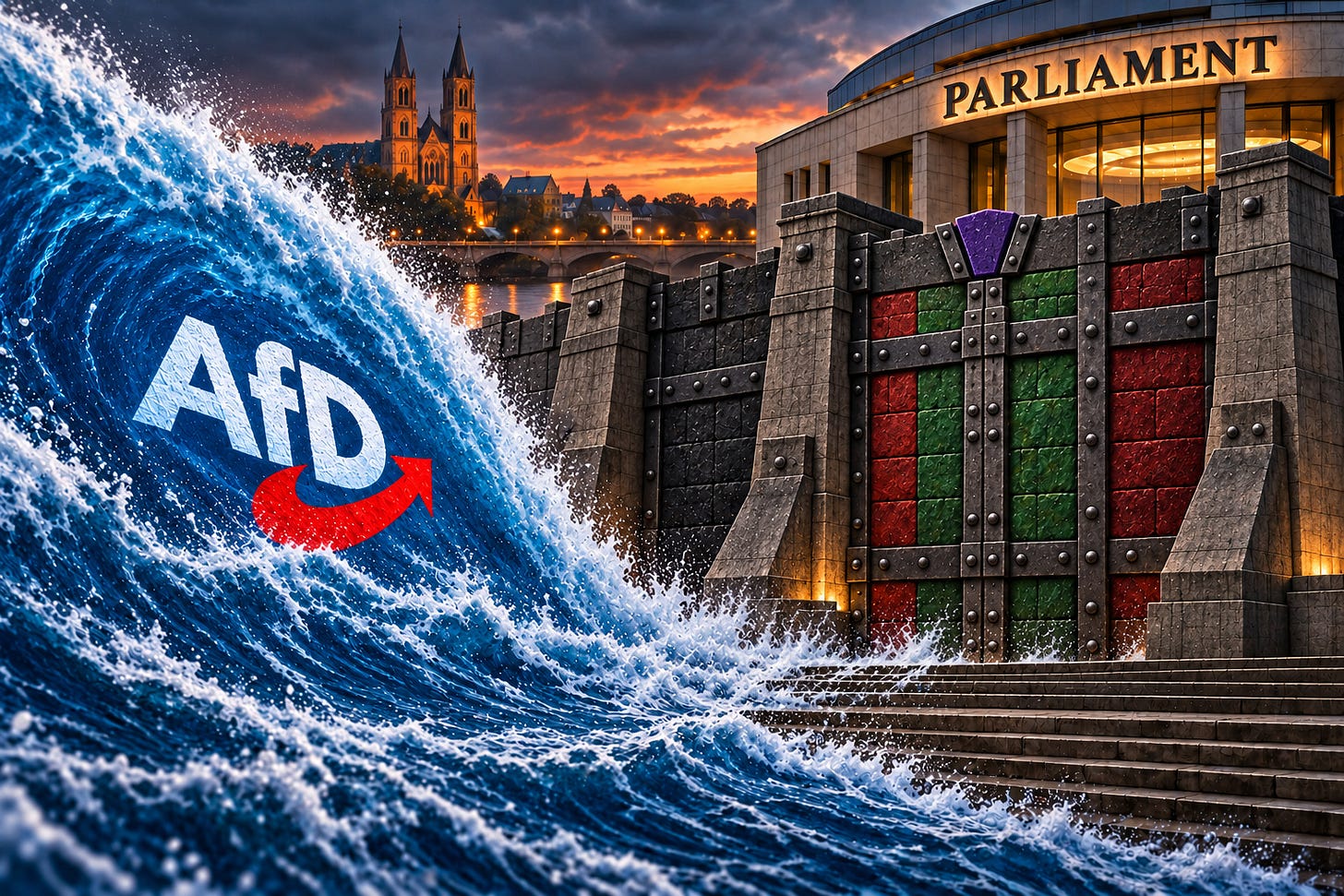
The AfD has won the election in Saxony-Anhalt by a margin that would once have settled any argument about who should govern. According to the latest projection, the party received 44.0 percent of the vote, more than twice its 2021 share. The CDU (Christian Democratic Union, Chancellor Merz’s party) collapsed from 37.1 to 17.8 percent. The SPD (Social Democratic Party) reached 9.1 percent, the Left 8.8, and the Greens 8.7. The BSW (Sahra Wagenknecht Alliance) crossed the threshold with 5.1 percent, while the FDP (the libertarian Free Democratic Party) disappeared from the state parliament with 2.4 percent. The AfD therefore finished more than twenty-six points ahead of its nearest rival and won almost as many votes as the CDU, SPD, Greens, and Left combined. Yet because it fell short of an absolute majority of seats, the parties it defeated may still keep it out of government. The election produced a clear winner, but the German party system may refuse to accept the political meaning of the result.
The numbers expose the true structure of German politics. On paper, Germany has many parties. In practice, it has two political camps: the AfD and everyone else. The CDU, SPD, Greens, and Left use different colors, slogans, and campaign posters, but when the existing order is threatened, they close ranks. Their disputes concern posts, budgets, and the speed at which common policies should be carried out. On the basic questions—mass immigration, the transfer of power to Brussels, sanctions against Russia, the climate program, public broadcasting, political surveillance, and the exclusion of the AfD—the direction remains the same. Governments change from SPD-led to CDU-led and back again, while policy moves along the same road. The voter may replace the driver, but the vehicle does not turn.
The coming struggle over the government of Saxony-Anhalt will make this plain. Current projections give the AfD 39 of the state parliament’s 83 seats. The CDU has 16, while the SPD, Greens, and Left each have eight. The BSW holds the remaining four seats. The CDU, SPD, Greens, and Left together have only 40 seats, two short of the 42 required for a majority. They will therefore need the BSW, either as a formal fifth partner or as an outside supporter of a CDU-led minority government. The likely result is a firewall administration stretching from the nominally conservative CDU to the post-communist Left, with the BSW providing the final votes or abstentions needed to keep it alive. The parties will call this a defense of democracy. In plain English, it means that five parties may combine to deny power to the party that won 44 percent of the vote and defeated the CDU by more than two to one.
The CDU will stand at the center of this arrangement, and its conduct will remove the last doubt about what it has become. A conservative party would regard a landslide for the AfD as a demand to change course on immigration, energy, national sovereignty, education, and public order. The CDU will instead seek support from the SPD, Greens, Left, and perhaps the BSW so that it can continue governing after losing more than half its voters. A party willing to depend on the Left in order to suppress a conservative electoral revolt cannot honestly call itself conservative. The CDU is now a radical left-wing party in conservative dress. Its function is to prevent the German right from gaining power while giving left-wing policies the seal of bourgeois respectability. It offers the language of order during election campaigns and the program of the left once the votes have been counted.
This is why the word “democracy” has acquired such a strange meaning in Germany. The AfD is allowed to stand in elections, but not to exercise power after winning them. Its voters may participate, provided their votes have no effect on the composition of the government. The larger the AfD becomes, the larger the opposing bloc must become. Former enemies are reconciled overnight. The CDU can govern with the Greens, the SPD can support the CDU, the Left can rescue both, and the BSW can supply the final votes. Principles presented as sacred before the election become negotiable after it. The only fixed principle is that the AfD must remain outside. The firewall does not protect democracy from extremism. It protects the established parties from electoral competition.
The BSW now holds the decisive position. BSW candidate Claudia Wittig has ruled out simply electing either AfD candidate Ulrich Siegmund or CDU candidate Sven Schulze for the post of minister-president of Saxony-Anhalt, while leaving the door open to cooperation with the AfD on individual measures. She has said that decisions should be made according to their substance and called it “completely undemocratic” to exclude the AfD entirely from government after such a result. That is more honest than the position taken by the other parties, but it does not go far enough. Voting with the AfD on an occasional motion cannot replace a government able to carry out a coherent program. The present projection gives the AfD and BSW 43 seats together—an outright parliamentary majority. The BSW therefore has a choice between making political change possible and helping the defeated parties preserve their rule.
Rejecting a direct coalition with the AfD would be a grave strategic error for the BSW. Its voters did not support it so that it could become an extra wheel on a government run by the CDU, SPD, Greens, and Left. They were drawn to the BSW because it rejected the war course against Russia, uncontrolled immigration, economic policies that punish workers, and the moral lectures of the liberal establishment. On these questions, BSW voters are much closer to the AfD electorate than they are to the Greens or the present CDU. It is therefore reasonable to believe that most would prefer a direct AfD–BSW coalition to any arrangement that keeps the old government system alive. If the BSW uses its four seats to uphold the firewall, it will show that its rebellion ends at the point where power begins.
An AfD–BSW government would contain serious disagreements. The parties differ on economics, social policy, and parts of their political traditions. But coalitions are formed between different parties when no single party has won a majority. The common ground is already broad: peace with Russia, limits on immigration, affordable energy, opposition to ideological instruction in schools, and resistance to rule from Berlin and Brussels. A coalition agreement could define these shared goals while leaving other questions open. Such a government would also respect the central message of the election: Saxony-Anhalt voted for a break with the existing course. A five-party firewall arrangement would do the opposite.
The choice facing the BSW is also a choice about its own future. It can prove that it is an opposition party willing to use power, or it can become another support beam for the system it claims to oppose. If it enables a CDU-led government, the old parties will praise it as responsible. Its voters may draw a different conclusion. They may decide that only the AfD is prepared to turn opposition into action. The BSW would then have preserved the firewall at the cost of its own reason for existing.
The AfD has not won enough seats to govern alone. That is the fact on which the entire establishment will now depend. But the rest of the result is just as clear. The CDU was crushed. The governing model was rejected. The AfD became the dominant party of Saxony-Anhalt, while the parties that excluded it survived only by gathering behind a common barricade. If they now form another government without Ulrich Siegmund, Germany’s supposed multiparty democracy will appear in its true form. There are two parties: the AfD and the Uniparty. On Sunday, the AfD won the election. The Uniparty may still take the government.
If you enjoy my writing, order my new book, The Fate of White America, here.




Good news that the BSW has not ruled out supporting AfD!
Can the election result be trusted? If accurate, it means that half the population voted for war with Russia and more immigration. This seems very unlikely.
Elections are frequently rigged.
Martin Sellner reports that 300k postal votes showed low AfD votes. If the postals are excluded, AfD won 51% of the in person votes.
MSM here insist on saying that this is the first time since WWII that an “extreme far right” party has won a state level election.
As for Hitler, I tend to ask myself questions like: How was it possible for an entire nation to throw itself at the feet of such a primitive, power-hungry idiot? What went wrong there? The answer to that question is quite simple: On the one hand, it stemmed from the incomprehensibly deceitful “Treaty of Versailles”—and, of course, on the other hand, from Prussia’s unfulfilled militaristic traditions and ambitions. Together, they produced an incredibly hellish concoction. But the two were also mutually dependent.
However, this is not an “anomaly,” but rather a natural response stemming from being constantly invaded and plundered by other neighboring nations (as indeed happened after both world wars). This is not an abnormality, but a reflex resulting from European territorial history. The brazen British and Americans can talk all they want—they’ve never had neighbors who could pose a threat. But thanks to their “liberalism” (and their permanent “military interventions”) that’s changing drastically right now.
“Hitler wasn’t an idiot! He could paint pictures that you’ll never be able to create in your entire life!” But, but the rest of it is, at best, pathetic. It’s practically built to self-destruct.
That just can’t work! You can’t go around using violence and expect everyone else to accept it without putting up a fight! Then he was simply the most brilliant idiot in world history.
I’m not saying that Hitler and his sleazy gang destroyed Germany. Through their incomprehensible prebubencent arrogance, they provided the destroyers of Germany with a PRETEXT to wipe out the GOOD and globally respected Germany!