
Pat Buchanan’s “Churchill, Hitler, and the Unnecessary War”
Churchill, Hitler, and the Unnecessary War
Pat Buchanan
2832 Words
There are various tacks revisionists can take when looking back at the Second World War. There are those who express net sympathy with the German cause; there are those who express sympathy with the Allied cause while exposing Allied misdeeds and skullduggery, and there are those who maintain that the war was a tremendous blunder and that it should never have been fought to begin with. With his 2008 book Churchill, Hitler, and the Unnecessary War: How Britain Lost Its Empire and the West Lost the World, Patrick Buchanan takes this third approach while offering his readers a characteristic black pill. So devastating was this war, and the world war which preceded it, that Western civilization was effectively destroyed as a result. Often Buchanan speaks of it in the past tense, as if there is no possibility of recovery. After all, he writes, “Western man suffered a catastrophic loss of faith—in himself, in his civilization, and in the faith that gave it birth.”
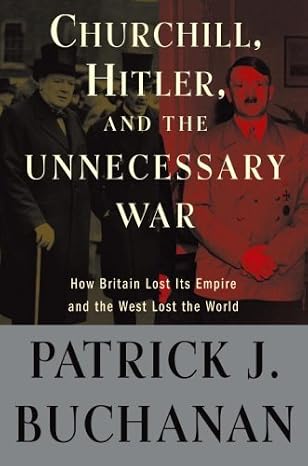
The purpose of this work is in part to guide the reader through the history of the first four decades of the twentieth century so we can better understand why these wars were fought and how they could have been easily avoided. Also, Buchanan is keen to bust the cult of Churchill, which places “the indispensable man” upon a pedestal and proclaims him the man of the twentieth century. Buchanan is a revisionist not simply because he rejects the “good war” myth of the Second World War, but also because by disclosing the sheer viciousness of Allied actions during both wars, he tips the scales of morality in favor of the Germans without ever having to say so. Buchanan relies on mainstream historians for his source material, such as William Shirer, John Toland, Richard Evans, Paul Johnson, Niall Ferguson, and many others. However, he also relies heavily upon revisionist or revision-adjacent works such as William Henry Chamberlin’s America’s Second Crusade (1950), Charles Tansill’s Back Door to War (1952), and AJP Taylor’s The Origins of the Second World War (1961). Sadly, Harry Elmer Barnes, David Hoggan, and David Irving were all overlooked in his bibliography.
Buchanan makes two assumptions off the bat which will challenge the prevailing narrative of the World Wars. One is that both were in fact European civil wars rather than wars of nation versus nation. This re-frames the conflicts intra-racially, and, many decades after the fact, kindles a sense of pan-European solidarity in readers who wish to regain the greatness that was once the West. Second, two profound sea changes in Western thought were responsible for these rifts to occur. One was Thomas Jefferson’s idea that “All men are created equal,” and the other was Woodrow Wilson’s doctrine of self-determination. In so many words, the West fell because Westerners abandoned race for liberalism. In Buchanan’s view, many of the blunders which led to both wars can be attributed to this, as well as to all-too-common human foibles such as vanity, power lust, and egotism.
One example was the secret 1904 “entente cordiale” between England and France, which stipulated that in the event of another Franco-German war, Britain would join sides with France right away. Buchanan stresses that the Liberal government in England concocted this scheme. Another was Kaiser Wilhelm’s efforts to build a great navy which would threaten Britain’s. At least, that’s how the British saw it, neglecting to appreciate how the Germans needed to be supreme in the Baltic Sea to protect themselves from Russia, which also had a navy. Buchanan also skewers the outdated doctrine of “balance of power” which compelled the British to oppose whoever proves to be the master of the continent, whether it be France, Spain, or Germany. As events grew more and more tense due to the Balkan crisis in 1914, Buchanan chronicles how one individual was perversely giddy at the prospect of war: the young First Lord of the Admiralty Winston Churchill.
As would be expected, Buchanan makes much of the punitive Treaty of Versailles and how it not only violated Wilson’s doctrine of self-determination but also “reinforced a spirit of nationhood” among the Germans. After the war, millions of Germans were displaced against their will under the authority of Frenchmen, Italians, Czechs, Poles, and other European ethnicities. This says nothing of the financial ruin the treaty imposed on a defeated Germany. Thus, with frustrated German minorities practically everywhere, Europe was turned into a powder keg. But Buchanan distinguishes himself with his pages on the starvation blockade, which perhaps more than anything else inspired resentment in the German mind. It was bad enough that by 1918, 762,000 Germans had been deliberately starved to death. It was not until July 12, 1919 that the blockade was lifted—eight months after the Germans laid down their arms that previous November. This killed approximately another 100,000.
The Germans felt utterly betrayed—and blamed America.
“President Wilson is a hypocrite and the Versailles Treaty is the vilest crime in history,” said the social democrat Scheidemann, who had brought down his government rather than sign. “If these are the peace terms, then America can go to hell,” said General Ludendorff.
Men who believe in the rule of law believe in the sanctity of contract. But a contract in which one party is not allowed to be heard and is forced to sign at the point of a gun is invalid. Germany signed the Treaty of Versailles only when threatened that, should she refuse, the country would be invaded and her people further starved.
And who was the “architect and chief advocate” of this inhumane blockade? Again, none other than the First Lord of the Admiralty Winston Churchill.
Buchanan adeptly summarizes the events which led to the Second World War, and he collates lesser known tidbits of history in with the greatest hits, so to speak. One interesting example includes how in the early 1920s, Churchill and others had urged the Lloyd George government to abandon its alliance with Japan in favor of the United States. During the First World War the two island nations made natural allies, but this was thrown over for a romantic “pan-Anglo-Saxonism,” and an alliance with the United States. This had the twin negative effects of greatly diminishing the Royal Navy’s reach in the Pacific as well as alienating the Japanese, which freed them up for their eventual alliance with Nazi Germany.
Of course, Buchanan guides us through more famous events in the 1930s which led to the Second World War. These include:
- The 1934 murder of Austrian Chancellor Engelbert Dollfuss at the hands of Nazi assassins
- The collapse of the 1935 Stresa Front, which confirmed British, French, and Italian opposition to German rearmament. A double-dealing Britain had signed a separate pact with Germany which allowed Germany to violate the Versailles limits on warships in return for its recognition of the Royal Navy’s supremacy. This ultimately isolated Italy from the Allies.
- The re-militarization of the Rhineland and the Anschluss, both of which Buchanan characterizes not as German aggression or a sign of things to come but as Germany reasonably reuniting its diaspora back into the Reich. Both were extremely popular moves among the Germans.
- The Munich Accord of 1938, which Buchanan also portrays as reasonable. He dismisses concerns that Neville Chamberlain appeased Hitler. He also describes how Wilsonian principles repeatedly conflicted with British self-interest. In the end, Chamberlain acted wisely when not interfering with Hitler’s actions in Czechoslovakia.
The brutal truth: The Sudeten Germans wanted to be reunited with their kinsmen and could not forever be denied. And as Britain now believed the decision to deliver them to Prague had been a blunder, why fight a war to perpetuate a blunder? …
Chamberlain had another motive in going to Munich. He believed the key to peace lay in addressing the grievances of Germany and rectifying the wrongs of Versailles, and he wanted to be the British statesman who restored Germany to its rightful position as a Great Power and converted her into a partner in peace. If this required the return of all German lands and peoples, should they wish to return, Chamberlain would facilitate it, if done peacefully.
So if by September of 1938 Britain and Germany were simpatico over the reincorporation of the Reich—including, as it turned out, the German city of Danzig which was within the borders of Poland—then what went wrong?
According to Buchanan, it was not any single person’s nefarious design. Rather, it was a tragic combination of ego, vanity, and other human foibles often experienced by men in power. But if there was one individual most keen on another European civil war, it was MP Winston Churchill, who flip-flopped on his previous hatred of the Bolsheviks and proposed an alliance with Stalin to oppose Hitler. Buchanan duly explains that by 1939, Stalin and the Soviets had already killed millionsof their own people, while the Nazis had done nothing of the sort.
As for Hitler, he gave in to arrogance as well as anger towards the Czechs—especially towards Czech foreign minister Eduard Beneš, whom he loathed. He behaved belligerently towards Chamberlain during their Bad Godesberg meeting, also in September 1938, and frequently lost his temper. It was clear he really wanted to, in his words, “smash the Czechs.” While not letting Hitler off the hook for his reckless behavior, Buchanan depicts this episode as Hitler’s spiteful vendetta against Beneš rather than his first step toward world domination. In fact, Buchanan demonstrates that when dealing with Poland, Hitler had been far more reasonable and patient; his attempts at bringing Poland into his Anti-Comintern Pact and his very generous overtures to the Poles regarding Danzig attest to this.
And as for Chamberlain, Buchanan agrees that he was correct to avoid war after Munich, yet he takes the much-maligned prime minister to task not just for his naivete in trusting Hitler not to want to incorporate Danzig into the Reich, but also for taking the aftermath of Munich so personally. When Hitler marched on Prague in March 1939, Chamberlain was humiliated and sought to save face. This, as much as anything else, in Buchanan’s view, is why Britain went to war. Yes, Hitler’s aggressiveness and his indulgent attitude towards Joseph Goebbels after Kristallnacht didn’t help. And yes, Polish intransigence and delusions of grandeur also didn’t help. But the “fatal blunder” was committed by Chamberlain when, under pressure from Lord Halifax, he issued a guarantee to Poland that Britain would intervene in case a German attack. This was the infamous “blank check,” and Buchanan goes on for many pages decrying it quite convincingly as the greatest blunder in history.
This is where a comparison with Hoggan seems warranted. In Hoggan’s 1961 work The Forced War, Lord Halifax is painted unambiguously as the main villain behind the Second World War. Using a multitude of primary sources—including many German language ones not appearing in Buchanan’s bibliography—Hoggan shows that Halifax was ready to guarantee Poland by August 1938, one month before Munich. In his footnotes, Hoggan points out how he contradicts AJP Taylor on this point. Hoggan also states that Halifax had concocted the Tilea Hoax—which purported that Hitler had designs on Romania—and believed that war with Germany became inevitable as soon as the Germans occupied the Rhineland in 1936. Hoggan also includes how in 1938 Halifax and Chamberlain had pushed for the production of thousands of long-range heavy bombers with the purpose of bombing German civilians. None of this appears in Buchanan.
Hoggan also delves into how American President Franklin Delano Roosevelt had egged the British on with their warmongering throughout the late 1930s, while Buchanan does not. Despite admitting that the FDR administration was “honeycombed with Soviet spies,” Buchanan gives the opposite impression.
Could Britain have relied on America had she defied Hitler?
In September 1938, the month of Munich, FDR disabused Europe of any such notion: “Those who count on the assured aid of the United States in case of a war in Europe are totally mistaken. … To include the United States in a Franco-British front against Hitler is an interpretation that is 100 percent false.” That month, America informed France that, in the event of war, America could not, under the Neutrality Act, transfer to her the warplanes she had already purchased. FDR’s message: This is your war, not ours.
Compare this to Hoggan, chapter 5:
Perhaps frustration and knowledge of the domestic obstacles confronting his own policy increased President Roosevelt’s fury. Jules Henry, the French Chargé d’Affaires, reported to Paris on November 7, 1937, that President Roosevelt was interested in overthrowing Hitler, but that the majority of the American people did not share his views. French Ambassador Saint-Quentin reported on June 11, 1938, that President Roosevelt suddenly blurted out during an interview that the Germans understand only force,” and then clenched his fist like a boxer spoiling for a fight.
And chapter 7:
Lipski and the other Polish diplomats were influenced in their judgment of this question at the moment by a report which had been telegraphed by Count Jerzy Potocki from Washington, D.C., on November 21, 1938. The Polish Ambassador was informed by William C. Bullitt, the American Ambassador to France who was visiting in the United States, that President Roosevelt was determined to bring America into the next European war. Bullitt explained to Potocki at great length that he enjoyed the special confidence of President Roosevelt. Bullitt predicted that a long war would soon break out in Europe, and “of Germany and her Chancellor, Adolf Hitler, he spoke with extreme vehemence and with bitter hatred.” He suggested that the war might last six years, and he advocated that it should be fought to a point where Germany could never recover.
Clearly, FDR had his hands dirty when it came to taking sides before the war had even started. That Buchanan doesn’t sufficiently explore this possibility comes as a bit of a surprise since historians Charles Tansill and William Henry Chamberlin, whom he draws from often, certainly do. The difference between The Forced War and Churchill, Hitler, and the Unnecessary War is that of scholarly history versus popular history.
And there is the question of why Winston Churchill suddenly became so virulently opposed to Hitler that he sought an alliance with the Soviet Union, the most murderous regime in history, in order to stop him. Since Buchanan ignores David Irving, the possibility that Churchill had been involved in a quid pro quo with Jewish financiers such as Henry Strakosch of the shadowy anti-Nazi group the Focus, never gets mentioned, even if only to be debunked.
None of this impugns the overall worth of Churchill, Hitler, and the Unnecessary War as a work of popular revisionist history. It would simply be impossible for such a work to cite Hoggan and Irving and still qualify as “popular” according to today’s censors. Further, perhaps the work would have been more accurately titled if Chamberlain’s name had been included in the title since it was Chamberlain’s blunder, according to Buchanan, that had sealed the fate of Western civilization. Still, Buchanan does excellent work dismantling the myth of greatness surrounding Winston Churchill, not merely by exposing his unwarranted truculence during both World Wars, but also by putting his amoral nature on display when he dealt with Josef Stalin. It seemed there was nothing he wouldn’t do for the communist dictator. Churchill appeased Stalin far more extensively than Chamberlain had ever appeased Hitler when Churchill “consigned one hundred million people to the mercy of Stalin’s butchers” both during and after the war—all because he didn’t want 350,000 Danziger to be reunited with Germany.
The aim of Churchill, Hitler, and the Unnecessary War, it seems, is to nudge the reader in the direction of Second World War revisionism. It was not a good or just war. It was not a necessary war. According to Buchanan, it was a tragic and devastating civil war which came as a result of human frailty and bad ideas mixed with the psychopathy found in men like Churchill, Hitler, and Stalin. While this is debatable, just the fact that Buchanan puts Churchill on a moral par with Hitler and both men far above Stalin is an excellent starting point for budding revisionists. Yes, Buchanan condemns Hitler when he can and dutifully brings up the Jewish Holocaust. But he places it within the context of the vast bloodbath that was the Second World War and demonstrates that in balance, communism was a far greater threat to civilization than Nazism ever was. Had Neville Chamberlain simply not issued that suicidal guarantee to Poland, the overall carnage would have been greatly reduced—for everyone, Jews and gentiles alike. That this would have led to Nazi Germany being the dominant power on the continent and the prime bulwark against the Soviet Union does not seem to bother Buchanan at all. Viewed within this lens, a nudge, thankfully, is as good as a shove.

The case for Britain staying out of war in 1939/40 was put conclusively then, and fully justified afterwards, by Oswald Mosley. The Russo-German Pact was another reason at the time.
However, in the eastern European theatre there was the problem of “a preventive war to prevent a preventive war”. Hitler had conceived an invasion of Russian territory for living-space and Stalin conceived an invasion of German territory to expand the communist system.
A balanced and thorough examination of the whole question has yet to be written, with a few writers from Peter Hitchens to Sean McMeekin paving the way. Hindsight is an empty virtue, but note that politicians, diplomats and generals are prisoners of “what if”s, disinformation and misleading memory at the time of their own decisions.
Men still resort to easily to war, and technology has made it more dangerous than it was in 1946 when the participants picked up the pieces of brick, bomb and bone from the last lot.
Irving’s “Churchill And The Jews” is still a lecture on YouTube as well as a book. “David Irving Books” is still online and while his books are not cheap, I think it’s a matter of get ’em while you can.
Daving Irving is fascinating anyway. If you watch/listen to his YouTube lectures you’ll get a lot of information and he’s quite an entertaining speaker also.
What really stuck with me is how he found out “references” and “experts” were circular things. One writer would come up with something out of thin air, then be cited by everyone else, then when someone new would come onto the scene and want to get to the bottom of things, he’d find everyone parroting this or that fact, and with some work, find that it’s all traceable down to one person who got there first and invented the “fact” out of thin air.
Irving learned German, worked a working-class job in Germany, and found people who had “been there”, Germans, who had largely clammed up when “experts” right after the war had showed up, generally with names ending in -stein or -berg etc., you get the idea, and conversely, they opened up to Irving because he had no axe to grind, no hatred of Germans, but was simply and honestly curious about the truth.