
What to read, Part 1
There is no such thing as rightwing vs. leftwing literature. There is only bad literature vs. good literature, with the definition of goodness vs. badness resulting from one’s own implicit cultural and racial baggage. For more than a half century, teachers and scholars have used public and academic discourse quite in line with the egalitarian White-hating dogmas, and reading lists for their students were constructed on the basis of those dogmas. Important novelists, key social scientists, and authors suspected of writing prose that goes against the stream of dominant political ideas, have either been swept aside or removed from the reading list. Their books, if ever mentioned, receive a critical, criminalizing, downgrading, or caricatured interpretation. Worse, if some of them trespass over the historiographic lines of self-censored behavior, as is the case with historical revisionists in Europe and the USA, they may lose a job or land in prison.
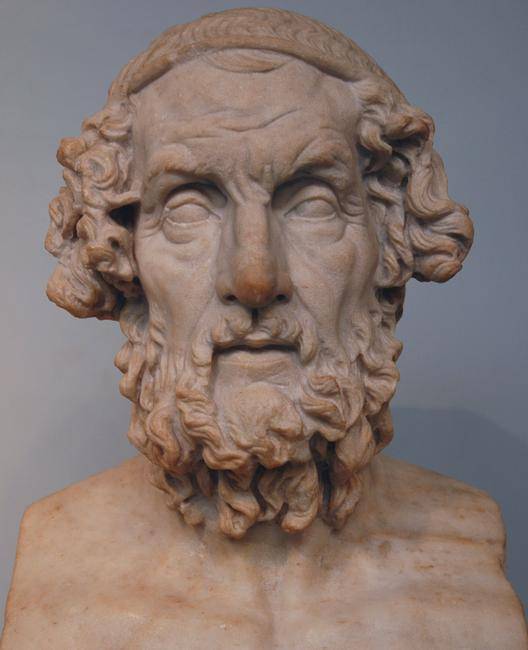
1. Literature: Homer and the Tragic
One can tell the author’s identity by his style and narrative. At the beginning of his autodidactic voyage, a young student should avoid authors whose style and syntax are boring, or whose main theme is difficult to grasp. A White student in the humanities should start with easy-reading classics first, such as Homer and the equally easy texts of fairy tales. Great writers love clarity of expression and do not hide their towering egos behind dangling sentences and obscure lingo. This is unfortunately not always the case with some prominent racialist and traditionalist scholars, especially in the field of social science. Many good social scientists often do not know how to frame their important ideas into simple language. Hence, it’s necessary for a student to read the classics first.
Homer is by no means children’s literature only. Nor are the fairy tales by the Brothers Grimm, Charles Perrault or Aesop. Homer, along with other classic authors from antiquity, is crucial for understanding the essence of the White man’s being: the inborn sense of the tragic and the will to power. Nowadays these notions in academia are labeled “cultural pessimism” and are squarely rejected by leftist and liberal professors who view them as symbols of violence and reject them as main pillars of fascist thought. This is not surprising. Whatever does not conceptually fit into the language of liberal college professors, modern book reviewers, literary critics, or TV opinion makers, must be labeled as “fascist.”
Homer is important because his epic poems The Odyssey and The Iliad tell us about the inner world of our ancestors. Granted, not even the best modern translations of Homer can capture the meaning of the original text, let alone the significance of the allegories used by our ancestors several millennia ago. Those ancient symbols and metaphors, taking the shape of a myriad of gods, demigods, centaurs, or other funny or scary creatures, have received today a distorted interpretation. However, Homer’s description of those surreal characters gives us at least a modest whiff of what our ancestors thought of themselves and how they conceived of the world that surrounded them. Their perception of the tangible world consisted of a rhapsody of images, in which every little twig in the woods and every rock on the beach had its divine, semi-divine or chaotic form, or had its own meaning of the sacred or the unsacred. Our ancestors’ mental focus was not the notion of “good vs. evil,” but rather the notion of chaos vs. order, and hence how to pull the world they lived in out of cosmic chaos and how to put together at least some semblance of a livable order. The primeval Indo–European notion of the dreaded chaos, a theme constantly resurfacing in Western literature, when transposed into the world of today, bears the name of decadence. Racial and social decadence have been viewed as the archenemies of the White man by all racialist-traditionalist-nationalist-conservative scholars.
It is false to assume that ancient Greeks, Romans, Germanic, Celtic, or Slavic tribes who once roamed the woods of northern Europe or gazed at the Mediterraneansun, were stupid and superstitious folks with low IQ, who presumably had to wait a few more millennia in order to grow into learned, enlightened and liberal individuals. Considering the mountains of mendacity, dished out daily in public schools, colleges and in public fora, especially in the study of history and race, our ancestors, were they to be miraculously resurrected today, would view us as superstitious and credulous folks, or worse, as a treacherous pack of cowards who believe in abnormal myths that defy any sense of transcendence and that belie any logical, empirical or forensic proof of the laws of nature. However, if we were to accept the well-grounded hypothesis that White peoples have undergone serious racial decline over the last century, we may submit the conclusion that in terms of both intellect and character, and in view of the loss of the sense of the tragic, they are worse off than their distant ancestors. This is more or less the underlying theme of all the books by all so-called racialist-traditionalist-nationalist-conservative scholars whom we have covered to some extent in the columns of TOO. At least we agree that over the last one hundred year, the proverbial White Man has willingly accelerated the process of his own social, moral and racial demise.
The modern concept vs. the ancient Image
Our ancestors were entirely oblivious to the notion of the concept, which has become today a mandatory methodological tool in the apprehension of the world we live in. The incessant drive to quantify everything, the obsessive search for causal relationships in every detail that surrounds us, be it sex or politics, has become our predicament. Mathematics has devoured the metaphor.
Myths and legends do not search for causal relationships. Their underlying sense of the tragic is woven into the Germanic sagas; it resurfaces all the time in ancient Greek dramas; it is a standard theme of ancient Roman thinkers. In plain English, the sense of the tragic means that even when a White man loses everything and is bound to perish, he must continue fighting to his last breath. The ancient figure of Prometheus embodies the will to power and the sense of the tragic, whose offshoots we have trailed over and over again amidst scores of European individuals who once sailed the seven seas or trekked in their covered wagons from the East Coast to the West Coast. We find plenty of those tragic, will-to-power, Promethean characters in the novels of Jack London and the stories of Ambrose Bierce and among many, many other racialist-traditionalist-nationalist-conservative authors. Our ancestors, with their sense of the tragic, similar to Homer’s mythical figure of Ulysses, never feared death. They never expected any gifts; neither from gods nor from men.
Homer is crucial literature for students and White activists wishing to learn not just how to put the world’s drama into a wider historical perspective, but also how to put themselves into perspective. A follow-up and a parallel reading to Homer may be J.R. Tolkien. His Hobbit is just another modality of Odyssey.
The will to power is falsely interpreted today as the will to subjugate other peoples. Wrong. Will to power means primarily learning the art of surpassing oneself in one’s own intellectual, military and professional endeavor. The works by social scientists, who are awkwardly and expediently dubbed as “revolutionary conservatives,” “nationalists,” “racialists,” “traditionalists,” or even “fascists,” have been written by self-introspective individuals haunted by the image that everything had its time span and that everything had to perish. But chaos needs to be prevented at all costs.
The Frankfurt School Jewish-Austrian born American child psychoanalyst, Bruno Bettelheim in a post-WWII re-educational effort to criminalize the White Man’s heritage, made a predictable Freudo-Marxian effort at providing a new interpretation of the notion of the tragic and of European fairy tales, very much in line with the efforts of his fellow psychoanalysts in different fields of social science. His later life as a professor, charges of abuse by some of his students, and his suicide in 1990, convey a picture of man who was the opposite of the baby talk man he claimed to be in his treatment of autistic kids. This tells us once again who has been in charge of academic discourse in Western education — and of the brainwashing the Whites. Wow, one wonders how to interpret the scenes from the Old Testament and the Deuteronomy (20:16–18)—texts replete with scenes of ancient Hebrew serial killings, which could easily qualify as hate speech today. Never, ever do we encounter such an open advocacy of such gory scenes in the Iliad and or in the European fairy tales.
The pain of reading novels may be caused by the reader’s awareness that many good novelists will never make it to the reader’s eye, nor to public eye. Thousands of good authors, from antiquity to postmodernity still remain unknown to a large audience. Likely, in some of their books there might be passages that may offer at a least a partial key to the riddle of the universe. Even if some of those authors make it eventually to the school syllabi or hit the prime time news, they run the risk of being interpreted according to the dominant egalitarian verities of our time. Even worse, when a historical and political cycle is over, with a new one beginning, some authors may end up condemned to oblivion, with some mediocre ones receiving all the glitz and glory. We have seen that after WWII, hundreds of scholars and novelists sympathetic to National Socialism (the Norwegian Knut Hamsun, the American Ezra Pound, the French Robert Brasillach, or the German Gottfried Benn), disappeared from the library shelves. Let us not forget that the Russian anticommunist novelist, Alexander Solzhenitsyn was not available for reading in Russia and in Eastern Europe until 1990. A young Russian student holding in hand a single copy of Solzhenitsyn’s “self- published” (“samizdat”) work was committing a criminal offense in the Communist System.
2. Literature: From Homer to Harold Covington
Talking about cycles of time juxtaposed one next to the other, including the characters grappling with the meaning of the tragic, one must mention the name of Harold A. Covington, a postmodern novelist whose works represent a good Bildungsroman for any White nationalist. Over several thousand pages, Covington uses the classic approach in the description of postmodern heroes who always try to surpass themselves — in the face of cosmic vagaries. However, the plots of his best-known war novels are not situated in ancient Greece or Rome, but in a balkanized and dying America. Covington is also an author of several historical novels whose plots revolve around 15th- and 16th-century Europe. His war novels, therefore, may be the reason why his message may be closer and more comprehensible to a modern reader than Homer and the ancient classics.

Comments are closed.