
Chad Crowley’s Substack:
Chad Crowley at Substack (“Undoing the Myth of the “Good War”) summarizes several important books on World War II: AJP Taylor: Origins of the Second World War; Gerd Schultze-Rhonhof: 1939: The War That Had Many Fathers; David Irving’s Churchill’s War, vol.1: The Struggle for Power; Patrick Buchanan: Churchill, Hitler and the Unnecessary War: How Britain Lost Its Empire and the West Lost the World; and David Lough, No More Champagne: Churchill and His Money. Here I post his section on Irving’s book, but the entire article is well worth reading.
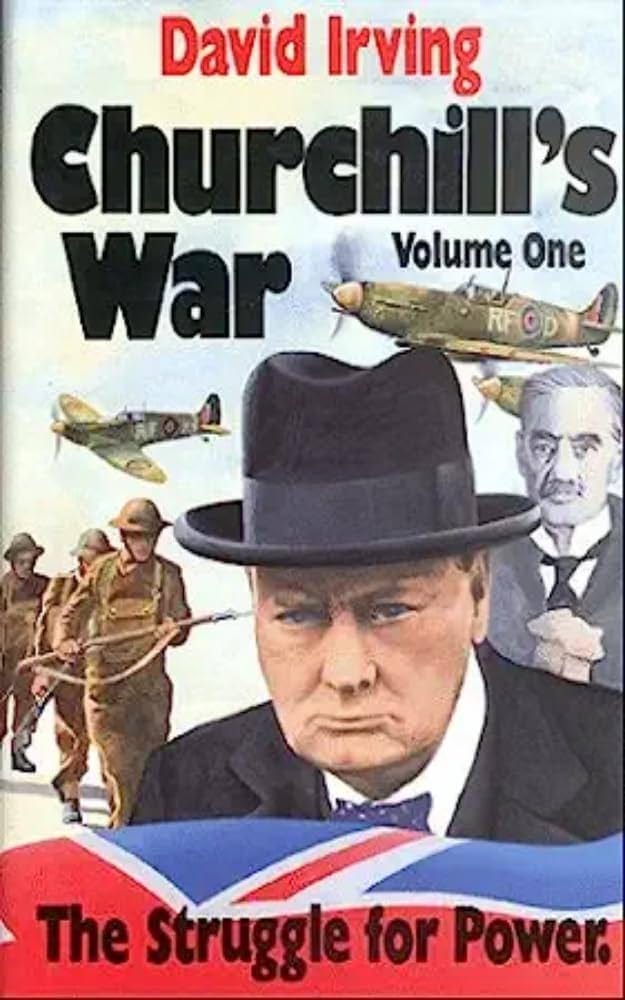
While most wartime histories paint Winston Churchill as the defiant savior of Western civilization, David Irving’s Churchill’s War (Vol. 1: The Struggle for Power) strips the myth to its roots and reconstructs the man from his own words, actions, and financial records. Drawing from private diaries, unpublished documents, and declassified archives across Europe and North America, Irving reframed Churchill not as the reluctant wartime leader thrust into history’s path, but as a calculating political outcast desperate to return to power, one who understood that war, above all, could restore his relevance.
Irving documented in detail how Churchill, largely excluded from political office after the First World War, was increasingly marginalized during the 1930s and reliant on private financial backing to sustain his lavish lifestyle. He was a man of letters, not a statesman, and depended heavily on income from newspaper columns, book royalties, and speaking tours—many of them sponsored directly or indirectly by interest groups eager to promote rearmament and confrontation with Germany. Irving’s research, drawn from Churchill’s unpublished financial papers and confidential correspondence, revealed a pattern of secretive and often foreign funding. Chief among these was Sir Henry Strakosch, a Jewish South African mining magnate who paid off substantial Churchill debts in 1938. This patronage helped keep Churchill solvent, and it aligned with his increasing hostility toward Germany, a hostility that suited the interests of his benefactors.
This financial dependency shaped his politics. Churchill, who once supported détente and praised Mussolini, pivoted sharply to championing intervention. Irving showed that Churchill used every diplomatic crisis—Abyssinia, Spain, Austria—as a theatrical stage to revive his public role. He fostered ties with Fleet Street editors, leaked documents to generate panic about German intentions, and used Parliament to position himself as Chamberlain’s most vocal rival. By 1938, Churchill had already opened unofficial channels of communication with Roosevelt’s inner circle, including ambassador Joseph P. Kennedy’s rivals, and urged the United States to resist neutrality in Europe. He was not merely awaiting a war; he was helping to engineer it.
Irving’s title refers not to the clash of nations, but to Churchill’s personal war for control of British policy. His rise was not the natural result of public demand, but the fruit of tireless private maneuvering. When Chamberlain resigned in 1940, it was Churchill, not Lord Halifax, who took power, largely because of his cultivated image as the voice of resistance and his backroom dealings with Labour and elements of British intelligence. Once in office, Churchill rejected every German peace offer, including the multiple proposals delivered through neutral channels in 1940 and 1941. These included full German withdrawal from Western Europe, restoration of Polish sovereignty (minus Danzig and the Corridor), and guarantees of British imperial holdings. Churchill refused to consider them. He insisted on total victory and unconditional surrender, even though Britain had no means to achieve such ends without American intervention.
The book also addresses Churchill’s psychological profile. Irving included testimonies from ministers, secretaries, and physicians, painting a picture of a man whose judgment was increasingly erratic. Churchill began each day with brandy, continued with whisky, and ended with champagne. His drinking was not social; it was habitual and heavy, bearing the marks of clinical alcoholism. Cabinet colleagues routinely commented on his inability to focus, his mood swings, and his detachment from material consequences. At the same time, he indulged in apocalyptic rhetoric and romanticized war as a stage for personal greatness. His belief in history vindicating him was not ironic, it was literal.
Irving also covered Churchill’s early approval of terror bombing. As early as 1940, long before the Blitz, he advocated for striking German civilian centers to break morale. He instructed RAF planners to maximize destruction and was briefed daily on the tonnage dropped and lives lost. This strategic shift, explicitly targeting civilian populations, represented a break from traditional rules of war and was, in Irving’s view, a moral decision for which Churchill bore full responsibility.
Churchill’s War was the product of a decade of archival research, including access to documents previously unpublished or unavailable to earlier biographers. It did not apologize for Hitler or endorse Germany’s policies. Rather, it asked whether the war was truly inevitable, or whether it had been maneuvered into existence by a man for whom war offered personal salvation.
Although Churchill’s War was not as immediately incendiary as Irving’s earlier Hitler’s War, it played a significant role in accelerating his marginalization within academic and media circles. While some reviewers acknowledged the book’s archival depth and provocative arguments, its central thesis—depicting Churchill not as a noble savior of the West but as a self-interested opportunist—fueled existing efforts to discredit him. A campaign was already underway to ruin Irving professionally, financially, and reputationally, and this work added further ammunition. As his research increasingly challenged the sanctified narrative of the war, especially regarding British motives and Allied conduct, the pressure to silence him intensified.
The most surreal phase of this campaign unfolded during Irving’s high-profile libel lawsuit against Deborah Lipstadt and Penguin Books in the early 2000s. Irving sued over Lipstadt’s characterization of him as a Holocaust denier and falsifier of history, but the trial became a show trial of his life’s work. A large legal team was granted full access to his personal archives. Tens of thousands of pages of handwritten diaries, private notes, and correspondence were subpoenaed and examined line by line, down to trivial marginalia and offhand remarks, in a sweeping effort to discredit him. Despite this unprecedented level of scrutiny, only a small number of factual errors were identified—fewer, in fact, than in many widely accepted academic texts. Nonetheless, Irving lost the case, was bankrupted, and a few years later was arrested and imprisoned in Austria for a speech delivered nearly two decades earlier.
As an aside, it is worth stating plainly: no other historian, perhaps in the entire history of civilization, has faced such sustained and coordinated censorship, financial ruin, legal persecution, professional ostracism, and exhaustive historical scrutiny as David Irving. At the height of his career, he published with major presses, was invited to lecture across the globe, and was widely praised for his unparalleled archival skill. His early books, such as The Destruction of Dresden and Hitler’s War, were once cited in mainstream academic and journalistic publications. But as his research began to challenge the sacred pillars of wartime memory—particularly Allied conduct, motives, and propaganda—he was systematically erased from polite intellectual life.
Whatever one thinks of his conclusions, the institutional force brought to bear against Irving speaks volumes about the fragility of official memory. Churchill’s War remains one of the most detailed and exhaustively documented accounts of Britain’s entry into the Second World War. Its arguments may be contested, but its sources remain, silent yet immovable.




Can a Chinese scholar with a rather high IQ, as an outsider, help us recognize connections that we ourselves are no longer able to see because we are overwhelmed by chaos? I consider this not only possible, but even likely.
The rest of his channel also seems worthwhile (e.g. his videos about the Vikings). He has a talent for making the seemingly complex visible through a simplifying approach. https://www.youtube.com/watch?v=o2Nq–qU9Kc
The major reduction of Irving to a financially disadvantaged Unperson is similar to the minor attack on Stephen Sizer. He has had his faults as an historian, and his own long-term bias, as noted by the obnoxious Richard J. Evans, but few could match his massive research efforts, generosity with discovery, competence in German, attractive narrative style, and tendency to documentary stunts. One paradox is the “suppression” of his unique biography of Goebbels despite its hostility to that gifted cripple and his antisemitism. Calling Irving a “Holocaust Denier” depends on the ambiguity of both words. He has made some silly and counter-productive “antisemitic” remarks in a couple of books and especially his website. His critique of Churchill’s policy after his failed visit to meet Hitler in 1932 is most valuable, his views indirectly corroborated by Martin Gilbert’s “Churchill & the Jews” (1980). His Focus Group material fleshed out the suspicions of the anti-war people like Mosley, Ramsay, Domvile, J. M. Murry & H. R. Williamson.
David.L.Hoggans The Forced War, When Peaceful Revision Failed, would have been another valuable addition to those books. The author goes into intricate detail about the origins of Poland and details the extraordinary lengths that Hitler went to in order to come to an agreement between Germany and Poland over the Danzig corridor issue.
Having being bombed repeatedly by the Allis, even after September 8, 1943 surrender, my family ha always considered Churchill a drunkard and a criminal.