
Why are Jews exempt from being called to account for the crimes of the Bolsheviks?
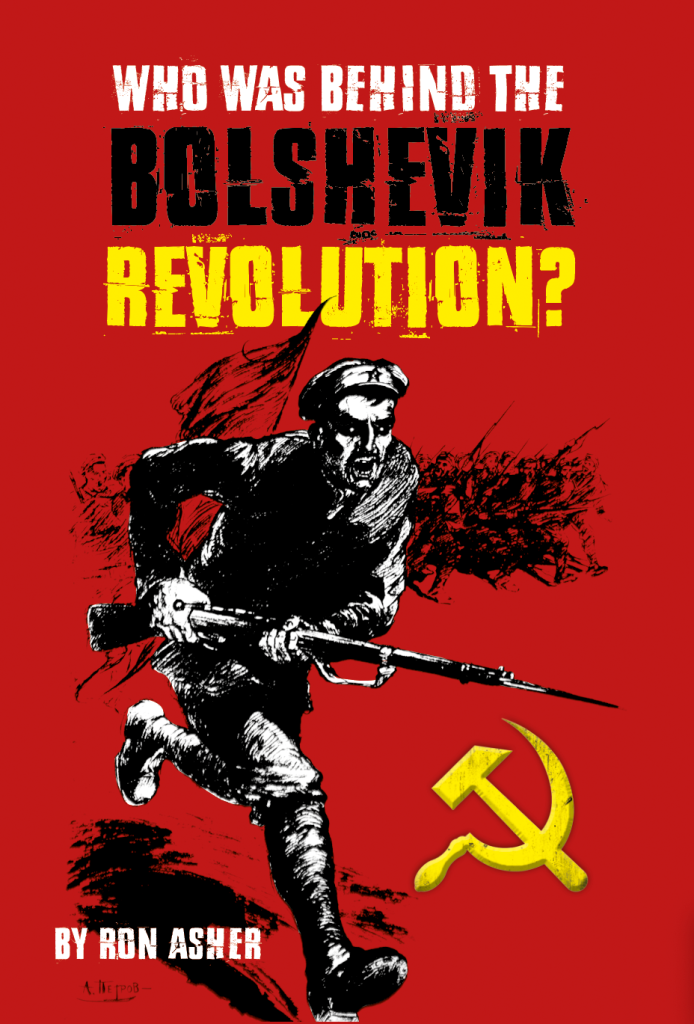 Ron Asher
Who was Behind the Bolshevik Revolution?
Tross Publishing, P O Box 22-143, Khandallah, Wellington 6441, New Zealand. $30 pp within NZ.
Prices for Foreign Buyers: Aust $30, UK £15, USA $20, Can. $25, Euros €15. https://trosspublishing.com/contact/
Tross Publishing has been around for several years, during which time it has attracted numerous smears and complaints from mediocre and agenda-driven academics, and other Europhobes, resulting in some of its books being removed and banned from bookshops and libraries. Tross, owned by John McLean, focuses on reconsidering the colonial and pre-colonial histories of New Zealand, challenging the dominance of Europhobic narratives. The authors garnered by Tross are often of scholarly background, including Dr John Robinson and Dr David Round. This has not dissuaded those of lesser scholarly pedigree from denouncing the books, with titles such as The Benefits of Colonisation, and The British Empire: A Force for Good.
From a traditional Rightist position, there is a doctrinal gulf in some of the premises of Tross authors, such as the promotion of the assimilationist, “one New Zealand” outlook,[i] where we are all raceless individuals bonded by a social contract (in this case, the Treaty of Waitangi, Tross authors dissenting from the modern interpretation enforced by the dominant narrative). This leaves such neoliberals, regarded as “conservative” or “right-wing,” in the odd position of condemning apartheid[ii] in their opposition to “Māori separatism,” due to a lack of doctrinal and historical coherence.[iii]
However, the “one New Zealand” concept has come from the political fringes to being endorsed to varying degrees by the Act, NZ First and National parties, which form the present coalition Government.
Awaited Reaction: Hysteria, Indifference, Boycott?
The publication of Asher’s Who was Behind the Bolshevik Revolution? marks a radical and surprising turn. Moreso, since it deals with issues that have not been widely discussed in New Zealand since the 1930s, with lingering traces of the topic among the old guard of the Social Credit movement up until the 1950s, and the presence of the relatively large New Zealand League of Rights during the 1970s.
The subject under examination is the alleged disproportionate presence of Jews in the 1917 Russian Bolshevik coup and Soviet government. In publishing this book, one might wonder whether McLean has signed a (figurative) death warrant for Tross? While the repudiation of implicitly anti-White pseudohistory in most of Tross’s inventory has caused Tross various problems it has also gained the type of public attention that has increased book sales.[iv] However, the subject of Jews that is the focus of Who was Behind the Bolshevik Revolution? is so beyond the ken of New Zealanders that McLean is likely to undergo not only pressure and smears that are far more intense than anything hitherto experienced on questions of New Zealand’s history, but also a lack of comprehension from the public.
Whatever smears and prosecutions McLean might face are liable to bring not sympathy, as hitherto, but indifference at best. Conversely, it could be that he will instead be faced with “the silent treatment” rather than histrionics, but that has not tended to be the reaction of bodies such as the Jewish Council et al. The cry of “anti-Semitism” is just as likely to be exclaimed in New Zealand as in the USA, Australia or Europe.[v]
First Review: An Indicator?
The first review of the book comes from Peter Cresswell, apparently a libertarian blogger, claiming to be “politically incorrect,” but not to the extent of giving Asher’s book a balanced review let alone a positive one.[vi] Rather, Cresswell goes “over the top” in his eagerness to repudiate Asher’s book, to the extent that one might conclude that, to paraphrase the great bard, he “protests too much.” Is this because Cresswell has been a contributor to at least three Tross books, two on Maori issues and one on “free speech”?[vii] The irony of this is pointed out by McLean in his retort to Cresswell’s review,[viii] where Cresswell wants the book “withdrawn.” It might be concluded that the reason for Cresswell’s lengthy and vitriolic review is to undertake some personal damage control, before he gets tarred with the “anti-Semitism” brush, because of his previous writings for Tross.
So eager is Cresswell to be seen on the side of the pure and the righteous that he includes two paragraphs on this reviewer, with the claim that I am the primary current source for the long-held allegation that Jacob Schiff was the main bankroller of the Bolshevik revolution. Cresswell refers to a peer-reviewed paper I had written for The International Journal of Russian Studies, entitled “Responses of International Capital to the Russian Revolutions.”[ix] However, the focus of my paper is not on Jews, Schiff, nor solely on Bolshevism.
Yet, as pointed out by McLean in his response to Cresswell, I am not mentioned, cited or in any way connected with the Asher book, which makes Cresswell’s two paragraph diatribe against me rather odd. Of this McLean retorts:
Unable to help himself in his rage, the reviewer wrote of the “Recrudescence of Anti-Semitic feeling of which Mr. Asher’s book is an ongoing part” the usual standard smear of “anti-Semitism” and further misinformation. His barely concealed anger even resulted in him devoting two paragraphs in lashing out at Kerry Bolton, a writer who was neither mentioned nor cited in the book. Why this irrelevance?
However, Mr. Bolton was not alone in being the victim of the smear. In fact, virtually every person and authority quoted in the book has suffered the same fate. Some examples. Belloc – “the noted anti-Semite” (again, the standard smear), Denis Fahey – “a fascist, would-be theocrat”…[x]
Toing and Froing over Data
The crux of Cresswell’s critique is to argue points over the percentages of Jews in the Soviet Government. Cresswell brings forth statistics on the percentage of Jews in the Soviet apparatus that conflict with those cited by Asher, from Father Denis Fahey, Robert Wilton, et al. However, what is more significant is that the chief luminaries of Bolshevism were overwhelmingly Jewish. For example, the postcard by Moisei Nappelbaum issued in 1918 to depict the “leaders of the proletarian revolution” shows Lenin, Zinoviev, Lunacharsky, Trotsky, Kamenev and Sverdlov. Lenin was of mixed parentage, with a Jewish component, Lunacharsky a Russia. The rest…?
As McLean states, the other premise of Cresswell’s review is to offhandedly dismiss all of Asher’s sources. Father Denis Fahey, from whose book The Rulers of Russia (1938), Asher proceeds, is reduced by Cresswell to being no more than a “a fascist, would-be theocrat.” Gaining two doctorates, Fahey served as a professor of theology and Church history. His criticism of Jews, of course, was based on traditional Catholic theology. Others include Robert Wilton, Petrograd correspondent for The London Times, a careful observer who does not thoughtlessly throw about the word “Jew;”[xi] and Winston Churchill, who wrote in 1920 of Bolshevism being a “worldwide conspiracy for the overthrow of civilisation” among Jews.[xii] New Zealander A N Field, whose books were best-sellers during the Depression era, is dismissed without ado, although he was widely recognized as an authority on banking issues. One gets the impression that Cresswell has done nothing more than run the names through Wikipedia.
Jewish Communists and Jewish Bankers
At the time of the revolution, Jewish involvement was widely discussed in diplomatic, military and intelligence circles. M. Oudendyke, representative of The Netherlands in Petrograd, also representing British interests, wrote a report, cited by Asher (p. 45), in which he states that Bolshevism, “is organised and worked by Jews.”[xiii] It is notable that the original British White Paper on Bolshevism was withdrawn and Oudendyke’s report in the subsequent edition had been removed. This gave rise to a myth that “anti-Semites” had falsified the Oydendyke comments. For example, in a 1950 book on the USA between the world wars, in a chapter attacking Father Charles Coughlin, Wallace Stegner writes that Coughlin and his newspaper Social Justice lost credibility for supposedly false claims about “a British White Paper” and “an American Secret Service report”. According to Stegner there never was such a Secret Service report, and the White Paper did not state what Coughlin claimed. The material had been taken from a “Nazi propaganda agency.”[xiv] If the British Government succumbed to pressure to redact the Oudendyke comments, and perhaps others of a similar nature, then maybe McLean is correct in his retort to Cresswell that the Soviet government was also eager to obscure the disproportionate involvement of Jews when releasing its statistics?
As for the U.S. Secret Service report, which specifically identifies Bolshevism with Jews and Jewish bankers, this too really exists, and is cited by Asher (p. 42) in regard to Schiff and other bankers funding the Bolsheviks. Asher identifies the report as U.S. State Dept. Decimal File (861-00/5339). This is identified by Stanford university and Hoover Institute research specialist Professor Antony Sutton, in his Wall Street and the Bolshevik Revolution.[xv] Sutton sought to repudiate the allegations of the Jewishness of Bolshevism, while documenting the myriad links between international banking, industrial corporations and Bolshevik Russia. The document, which Sutton states was composed by an anonymous member of the U.S. War Trade Board,[xvi] includes some accurate information such as the role of Max Warburg and of Olof Aschberg of the Nye Banken in transferring funds to the Bolsheviks. The document also alludes to Jivotovsky (Abram Zhivotovsky), a banker, as Trotsky’s “father -in-law,” whom Sutton fails to identify. This mysterious banker with international connections was identified by Dr Richard B Spence, whose book Wall Street and the Russian Revolution 1905–1928 supersedes Sutton’s research,[xvii] as Trotsky’s uncle, who was involved with funding the Bolsheviks. He and his brothers acted for the Bolshevik state in financial dealings with the West. The identity of Zhivotovsky can now be readily found.[xviii]
Wartime Manoeuvres
Cresswell attempts to repudiate the role of Jewish bankers by citing the German High Command being partly responsible for the Bolshevik coup, having funded and facilitated Lenin’s return to Russia. While reproducing a page from The Life of Lenin by Louis Fischer (1964) on German involvement, no mention is made of the central role of Parvus (Alexander Israel Helphand),[xix] who combined prominence in Marxism with war-profiteering and speculation, whom Pearson calls “a millionaire Marxist,” who, although still having “socialist ambitions” “had become a caricature tycoon with an enormous car, a string of blondes, thick cigars, and a passion for champagne…”[xx] The German funds (from Warburg?) were transmitted via Aschberg’s Nye Banken in Stockholm.[xxi]
While the German High Command was attempting to manipulate Lenin, the British War Cabinet sought to cultivate Trotsky, and with assistance from the USA facilitated Trotsky’s return to Russia from New York, securing his release from detention in Nova Scotia, where he had been waylaid by British Naval Intelligence. British intelligence officer Sir William Wiseman, a banker by profession, was the principal character in this, liaising between the British and U.S. governments. After the war he entered partnership with Kuhn, Loeb & Co. [xxii] Once in Russia, Trotsky’s support for the continuation of the war with Germany, in contrast to the position of Lenin, resulted in association with the British agent, R H Bruce Lockhart, whose memoirs describe the situation.[xxiii]
Unfortunately, the question of the funding of the revolutionary movements in Russia, one of the most interesting aspects of the subject, is the weakest of Asher’s documentation, mainly relying on alleged hearsay from Jacob Schiff’s grandson, John, via a gossip columnist, that Jacob had funded the Bolsheviks with $20,000,000. Cresswell understandably challenges this source. The actual role of Schiff, which is not primarily with the Bolsheviks, but rather with the groundwork for revolt as early as 1905, has been documented by Spence in Wall Street and the Bolshevik Revolutions; and by this reviewer,[xxiv] Cresswell not citing the latter, despite his gratuitous personal quip.
Here we see various interests, Jewish, German, British, converging to topple the Czar. Above the wartime rivalries, finance-capitalism showed an innate “rootless cosmopolitanism” (to paraphrase Stalin) that is often identified with its Jewish input, one might say a global nomadism of trade. Here too one might theorise on this persistent nomadism as explaining why there is disproportionate Jewish involvement in both capitalism[xxv] and its supposed antithesis on the Left. This, I suggest, is more a matter of sociohistorical analysis[xxvi] than “conspiracy theory,” although this is not to say that “conspiracy theory” should be dismissed as a symptom of a more complex cause.
Why no accountability?
For Asher the issue is straightforward: one of Jewish conspiracy, and it is understandable that he should keep to a basic premise when trying to write for a New Zealand readership.
His purpose is limited: asking why Jews are exempt from being called to account for the crimes of the Bolsheviks when so many participated in those crimes? There has been a collective, hereditary guilt complex imposed on others, particularly generations of Germans,[xxvii] extended to the Vatican,[xxviii] Christendom[xxix] and the entirety of Western civilization.
If Christianity was responsible for the Holocaust, then might it not also be alleged that the pathological paranoia against Christians imbued by Judaism into Jewish youngsters, has contributed to the character of Bolshevist atrocities against Christians, regardless of whether Jewish Bolshevists were acting as “atheists”? Might not the messianic element in Judaism also have been transferred to Bolshevism?
Messianic Bolshevism
In this respect, regarding the bolshevization of the messianic complex, although not mentioned by Asher, a chapter might have well been included on its expression in the Bolshevik state’s League of the Godless, responsible for the anti-Christian measures under the leadership of Yemelyan Yaroslavsky (born Minei Izrailevich Gubelman). In an interesting paper on Soviet Jewry, Robert Weinberg writes on this:
Many radical Jews embraced the Bolshevik cause and spearheaded efforts to spread revolution within the Jewish community. Iaroslavskii, for example, the head of the League of the Godless, was a Jew born Minei Israilovich Gubel’man. Many of these activists came from religiously observant families, and notwithstanding their break from the world of their parents and grandparents, these Jewish Bolsheviks undoubtedly possessed first-hand experience with Jewish religious life that they could pass on to gentile colleagues.[xxx]
For every rabbi such as my grandfather who sought refuge in the United States in 1923, there was another Soviet Jew, such as my grandfather’s brother-in-law, who stayed behind and took advantage of the opportunities the Soviet regime offered to nonreligious Jews.[xxxi]
If collective, hereditary guilt is to be foisted upon different nations and ethnicities, then why not Jews for involvement in Bolshevism? On the other hand, one might urge that the entire concept of collective hereditary guilt should be repudiated as a travesty against civilized behaviour regardless of who it is aimed at. It has something of the Old Testament at its core.
While Cresswell points out that the first head of the Cheka was a Pole, Felix Dzerzhinsky, which is supposed to repudiate Asher’s comments about the disproportionate presence of Jews in the Soviet secret police, Jewish scholars have no qualms about commenting on such involvement. For example, Prof. Leonard Schapiro in his introduction to The Jews in Soviet Russia since 1917, writes:
After the Revolution, the prevalence up to the mid-thirties of Jews at all levels of the dominant, often unpopular, communist machine, and particularly in the police – the Cheka, the GPU, and the NKVD – often led to the identification of anticommunism with antisemitism.[xxxii]
Note that Schapiro alludes to “the prevalence … of Jews at all levels …” He states that until the 1930s the Soviet regime was rigorous in suppressing antisemitism; so sensitive were the Bolsheviks to the widespread perception of the character of the state. McLean’s retort to Cresswell that the Soviets skewered the numbers therefore seems credible.
The eminent Jewish Muscovite writer Arkady Vaksberg wrote of the Jews in the Red Terror, beginning with their role in the murder of the Czar and his family, “But there is no getting around the fact that the first violins in the orchestra of death of the tsar and his family were four Jews – Yanker Yurovsky, Shaia Goloshchekin, Lev Sosnovsky, and Pinkus Vainer. The concert master was Yakov Sverdlov.”[xxxiii] Vaksberg states that while Dzerzhinsky focused his attention on being head of the Higher Council on Agriculture, “Yagoda was the real chief.”[xxxiv] Yagoda assumed leadership of the OGPU during 1934-36.
Israel Protected Wanted Murderers
Although not mentioned by Asher, what could have bolstered his argument about lack of accountability is the role of Israel in providing asylum for former Soviet secret police officers wanted for atrocities after World War II, including Solomon Morel from Poland; and Nachman Dushansky and Semion Berkis-Burkov, whose extraditions from Israel were sought by the Lithuanian Prosecutor-General’s Office. Naturally, Israel refused to co-operate.
In Latvia when the Soviets invaded in 1940, Jewish secret police officers were notable in the Red Terror, including Semion Shustin as State Security commissar; Alfons Noviks, Interior Commissar NKVD; Berei Shivoshinsky, head of the concentration camps; Izak Bucinskis; organizer of the People’s Militia (Communist police), and Moses Citrons, director of the NKVD at Daugavopils. When some of these, such as Noviks, were tried, the reaction of Jewish organizations was that of outrage.[xxxv] This callous disregard by Jewish organizations for the victims of Bolshevism when Jews were the perpetrators, suggests that Asher has a valid point in questioning the lack of accountability.
Conclusion
As for how one might interpret the data presented by Asher, there are various perspectives. A Catholic traditionalist might contend that the Jewish involvement in Bolshevism is the result of their rejection of Christ and hence their fall from divine grace (e.g. Father Fahey), possessed of a satanic “revolutionary spirit,” (e.g. Dr E Michael Jones)[xxxvi] insofar that Satan is the spirit of negation; while the evolutionary psychologist Dr Kevin McDonald explains Jewish involvement in Bolshevism and other dissolutive movements, as part of an evolutionary defence mechanism.
Asher does not aim to present an interpretative analysis, but only to present data on Jewish involvement in Bolshevism, and to pose the question as to why Jews are not held accountable? Unfortunately, he overlooked a key factor that could bolster his contention: namely that Israel adamantly refused to turn over Jewish NKVD murderers when called on to do so, and indeed Jewish organizations expressed outrage at the very suggestion. Nonetheless, Asher has boldly (some will say foolishly) examined a subject that has not been considered in New Zealand since A N Field’s Depression-era best-sellers such as All These Things (1936). Whatever the shortcomings of the book, it is a brave effort that merits support.
[i] Andy Oakley, Once we were One: The Fraud of Modern Separatism (Wellington, Tross Publishing, 2017).
[ii] J McLean, “Apartheid in the 21st Century,” Tross blog, https://trosspublishing.com/tag/bumiputra/
[iii] For a dissenting pro-apartheid opinion see: Bolton, “Contra ‘One nation, one people,’” The European New Zealander, April 9, 2022; https://theeuropeannewzealander.net/2022/04/09/contra-one-nation-one-people/
[iv] “Company accused of anti-Maori publishing promoting books at schools,” TV1 News, December 12, 2021, https://www.1news.co.nz/2021/12/12/company-accused-of-anti-maori-publishing-promoting-books-at-schools/
“Racist propaganda: the undercover campaign to infiltrate school libraries,” Stuff, July 2, 2023, https://www.stuff.co.nz/national/education/300899633/racist-propaganda-the-undercover-campaign-to-infiltrate-school-libraries
[v] K R Bolton, “Anti-Semitism Downunder: Left, Right or… Imaginary?,” The European New Zealander, August 28, 2022, https://theeuropeannewzealander.net/2022/08/28/anti-semitism-downunder-left-right-or-imaginary/
[vi] P Cresswell, Book review, Not PC, https://pc.blogspot.com/2026/03/book-review-who-was-behind-bolshevik.html
[vii] Tross Publishing, https://trosspublishing.com/?s=Cresswell
[viii] J McLean, “The Smear of Anti-Semitism,” https://trosspublishing.com/blog/
[ix] K R Bolton, “Responses of International Capital to the Russian Revolutions,” The International Journal of Russian Studies, Issue 1, 2012, https://www.ijors.net/issue1_1_2012/articles/bolton.html
[x] McLean, op. cit.
[xi] Robert Wilton, Russia’s Agony (New York: Dutton & Co., 1919); online: https://archive.org/details/russiasagony02wilt/page/n9/mode/2up
R Wilton and G Telberg, The Last Days of the Romanovs (New York: Doran Co., 1920); online: https://archive.org/details/lastdaysromanov00sokogoog/page/n9/mode/2up
[xii] W Churchill, “Zionism versus Bolshevism: a Struggle for the Soul of the Jewish
People,” Illustrated Sunday Herald, February 8, 1920, p. 5.
[xiii] A Collection of Reports on Bolshevism in Russia, Presented to Parliament by Command of His Majesty, April 1919 No. 1 (1919), [with] A Collection of Reports on Bolshevism in Russia.
[xiv] W Stegner, “The Radio Priest and his Flock,” in I Leighton (ed.) The Aspirin Age 1919 to 1941 (London: The Bodley Head, 1950), p. 251.
[xv] A Sutton, Wall Street and the Bolshevik Revolution (New Rochelle: Arlington House Publishers, 1974), “The Jewish Conspiracy Theory of the Bolshevik Revolution,” pp. 186-187.
[xvi] This would seem likely to have been Boris Brasol, a prominent Russian jurist, who served on the board on behalf of Czarist Russia, and who regarded Bolshevism as Jewish.
[xvii] Richard B Spence, Wall Street and the Russian Revolution 1905-1928 (Or.: Trine Day, 2017).
[xviii] “Abram Lvovich Zhivatovsky,” https://www.geni.com/people/Abram-Zhivatovsky/6000000003209123273
[xix] Sutton, p. 41.
[xx] Michael Pearson, The Sealed Train (London: Macmillan, 1975), p. 58.
[xxi] Sutton, p. 59.
[xxii] Spence, pp. 161, 178.
[xxiii] R H Bruce Lockhart, Memoirs of a British Agent (London: Putnam, 1934), inter alia.
[xxiv] K R Bolton, “Responses of International Capital to the Russian Revolution.”
[xxv] Werner Sombart, The Jews and Modern Capitalism (London: Unwin, 1913).; online: https://archive.org/details/in.ernet.dli.2015.152143/page/n1/mode/1up
[xxvi] Kevin McDonald, The Culture of Critique: An Evolutionary Analysis of Jewish Involvement in Twentieth-Century Intellectual and Political Movements (Antelope Hill, 2026), https://antelopehillpublishing.com/product/the-culture-of-critique-by-dr-kevin-macdonald/
[xxvii] Daniel Goldhagen, Hitler’s Willing Executioners: Ordinary Germans and the Holocaust (Alfred A Knopf, 1996).
[xxviii] John Cornwall, Hitler’s Pope (Viking, 1999).
Susan Zuccotti, Under His Very Windows: the Vatican and the Holocaust in Italy (Yale University Press, 2000).
[xxix] Simon Ponsonby, “The Shocking Truth About Christianity and the Holocaust,” Premier Christianity, https://www.premierchristianity.com/features/the-shocking-truth-about-christianity-and-the-holocaust/3934.article
[xxx] Robert Weinberg, “Demonizing Judaism in the Soviet Union During The 1920s,” Slavic Review. Volume 67, Issue 1, 2008, p. 146; https://works.swarthmore.edu/fac-history/88
[xxxi] Robert Weinberg, p. 121.
[xxxii] Schapiro in L Kochan (ed.) The Jews in Soviet Russia since 1917 (London: Inst. of Jewish Affairs, Oxford University Press, 19070), p. 9.
[xxxiii] A Vaksberg ,Stalin Against the Jews (New York: Knopf, 1994), p. 37.
[xxxiv] Vaksberg, p. 35.
[xxxv] “Around the Jewish World: Latvian Jews Troubled by ‘Genocide’ Conviction of a Former Soviet Official,” JTA, 11 October 1999, https://www.jta.org/archive/around-the-jewish-world-latvian-jews-troubled-by-genocide-conviction-of-a-former-soviet-official-2
[xxxvi] E Michael Jones, The Jewish Revolutionary Spirit and Its Impact on World History (Fidelity Press, 2008).




According to Grok, jews had little or no involvement in the Bolshevik Revolution! We really need our own Judenfrei libraries or all of our civilizational history and conflicts will be erased.
Have you argued with Grok? He learns. Unless you apprise Grok of a fringe rationale Grok will only regurgitate mainstream material, perhaps because Grok is programmed to believe that if it is most commonly thought and written (Grok identifies patterns) it is most likely true, which is not the case in a civilization in which Jews produce the majority of literate material as “Fake News” so you have to search the periphery to get to the truth at the core because the mainstream media are co-opted.
I don’t see the Joseph novella from Genesis cited in the references here? The Bible is the most common book among us. If you read the Joseph novella in Genesis critically you will look in vain for Joseph’s warning to the Egyptian free farmers of the coming famine. He warns the pharaoh of the coming famine, centralizes grain storage as the Persian Empire and Greek tyrants did, and doubles the tithe on grain imposed on the Egyptian free farmers, but OOPS — fails to tell the farmers of the coming famine. You will look for the warning in vain. It is not in Genesis. The result? The famine arrives, the farmers have not stored enough grain to outlast it and begin to starve. The pharaoh advises them to go to Joseph for grain. Joseph sells the farmers grain in return for everything they own including their freedom. Egypt’s land ownership is transferred to the pharaoh. It is the political prototype of the royal alliance which the Jewish diaspora via a courtier elite pursues in its cyclical and painful conquest of the West which is almost complete and from whom we are sprung. Genesis is the template for the establishment of a successful Diaspora: conquest.
So, the method of the cycle has been available to us all along. It’s in Genesis. God will not help you if you mention it to a dispensationalist or a Catholic. Neither will believe you or go to their Bible to find you are right and their understanding is wrong. You will become persona non grata having accomplished nothing in your sincere effort to warn them and your wish to build a common paradigm among the people you love is hurled back in your reddened face.
Such is life.
The Black Book of Communism should also be in the reference list.
Nicolas Werth, The Black Book of Communism (Cambridge, MA: Harvard University
Press 1999),
For example, “Still another point is of a technical nature. : the use of famine to break peasant resistance to regime economic ‘plans.’ And ever since Solzhenitsyn, such ‘pharaonic’ methods have been contrasted with the technologically advanced Nazi gas chamber.”
So, the 6 authors of the BB of C have read Solzhenitsyn who has read the Torah while the Christians most in danger of the coming famine have read neither, indeed, refuse to do so though it purportedly forms the basis of everything they believe.
It is quite a pickle we are in but unless we wrest the media back from the grasp of our detractors we will go the way of the educated classes of all the now Marxist populations of the world descended from the lowest classes who remained after their educated culture bearers were eliminated by “the Bolsheviks.”
“The Red Terror was the natural outlet for the almost abstract hatred that most of the Bolshevik leaders felt toward their “oppressors,” whom they wished to liquidate not on an individual basis, but as a class.” BB of C page 75
It’s been quite a while since anything by Kerry Bolton has appeared here at TOO. Thanks, Kevin, for bringing him back. Even though the extent of Jewish control of New Zealand society and mores and of the regnant historical narrative is more implied than stated in this essay review, I get the sense that meaningful pro-White resistance is still largely inchoate there. I hope I am wrong.
Two brief notes follow.
1) Under the heading “Messianic Bolshevism,” it would help the reader to differentiate between the citation from Weinberg and Bolton’s own commentary if a vertical block-quotation bar could be added alongside that section’s second and third paragraphs (cf. the bar just above “Toing and Froing over data”). The point is that as things now stand, a reader might easily get the mistaken impression that Bolton rather than Weinberg had a rabbinic grandfather.
2) In the first paragraph under “Conclusion,” Bolton briefly sums up the varying analytical approaches of KM, E. M. Jones, and Denis Fahey without further comment. I don’t see these approaches as necessarily controverting one another, but I should have been pleased to get Bolton’s opinion on this matter.
“…I get the sense that meaningful pro-White resistance is still largely inchoate there. I hope I am wrong.”
Unfortunately, you are not wrong: meaningful, pro-White resistance in NZ is still largely rudimentary. I lived there for twenty years, and am proudly a Kiwi citizen, and have many good things to say about NZ, but in this case—where we are speaking of NZ resistance to Jewish tyranny—Kiwis have still a long road to tread before they understand, sad to say. There is a reason, for instance, that Jacinda Horsetooth was able so easily to enact gun-control measures in the wake of the false-flag Christchurch shootings (conveniently timed to occur just before the Covid operation): the majority of New Zealanders have already succumbed to the Jewish control narrative, and were thus sitting ducks to the “guilt by association” trick. I can clarify this example further, but do not wish to make this comment too long.
All this is not to say that there exist no Kiwis who understand the nature and extent of Jewish control and are trying to learn how to resist: there are, they are punching above their weight, all respect to them, and I am proud and privileged to have known a few. It’s just that, at present, they remain a tiny minority, and the rest of New Zealand, still hide-bound, labels them a fringe element. That’s where things stand right now.
I am grateful to you for providing this very helpful background. Nothing beats hearing from someone who has firsthand knowledge of a situation.
This and many other good books should be required reading for high school students. I like to purchase books like these and hand them out selectively to younger people who are interested in learning and will hopefully one day be influential. Be the one who opens someone’s eyes to the evil around us. Once upon a time someone pointed this stuff out to me too.
“Why are Jews exempt from being called to account for the crimes of the Bolsheviks?”
Silly question. Because Jews DON’T rule the world, of course!
God’s own all-stars are chosen.
Just wait and see the Bolshevik Revolution 2.0 they have planned for America.
Great review K.R., thanks.
It’s an incredibly important topic. It desperately needs to be taught in every school in America. However, we all know that until there is some very much needed change, that won’t happen.
It’s up to us dissidents to keep teaching the true history to whomever might listen.
In July 1918, Illuminati Jewish banker Jacob Schiff sent a direct order thru US diplomatic channels to the Bolsheviks in Russia to murder Czar Nicholas II and his family.
This very hidden historical fact, as well as the decision-making process behind the murder of the Czar’s family, is described in the book “Under The Sign Of The Scorpion” by Jyri Lina.
https://www.henrymakow.com/jacob_schiff_ordered_murder_of.html