
The Remnant of Hereditary Slavery in Saint-Denis, France
The Basilica of Saint-Denis, north of Paris, in the French department of Seine-Saint-Denis in the Île-de-France region, is home to the royal necropolis of the Basilica of Saint-Denis, wihich houses the tombs of numerous Frankish and French sovereigns, from Dagobert I to Louis XVIII – including Charles Martel (as the joke goes, the Arabs were stopped in 732 at Poitiers by Charles Martel, but they returned in 737, i.e., in a Boeing 737).
We can only urge American or English tourists to visit the site for its recumbent figures and their astonishing stone draperies that could be mistaken for real fabrics; it is quite a thing.
We simply warn them that they shouldn’t be surprised to be the only White people there. Because the current events in Saint-Denis are no longer about the Kings of France, and not only because of the French Revolution, but rather because of the demographic revolution.
The big news in Saint-Denis is the election of a Black mayor, Bally Bagayoko.
This election sparked racist reactions, which the mayor complained about; anti-racist demonstrations were then organized in Saint-Denis – without much turnout, the odd thing being that most of the protesters were white (Not so strange after all, rather, it is a classic case of a guilt-ridden white man being subjected to compulsory repentance.).
Bally Bagayoko comes from LFi (La France insoumise), a radical left-wing party that advocates for immigration, racial mixing, multiculturalism, and Islam in France; the LFi is called “an Islamo-leftist party”, a party that aspires to the advent of the 6th Republic (today we live in de Gaulle’s 5th Republic).
Bally Bagayoko just forgot to tell us that he comes from the Soninke slave-owning tribe! He also neglects to mention that the divide between “nobles” (horon) and descendants of slaves (komo) not only persists in Africa (with leaders almost always being descendants of the horon), but that this divide has also been transposed into the Black immigrant community in France.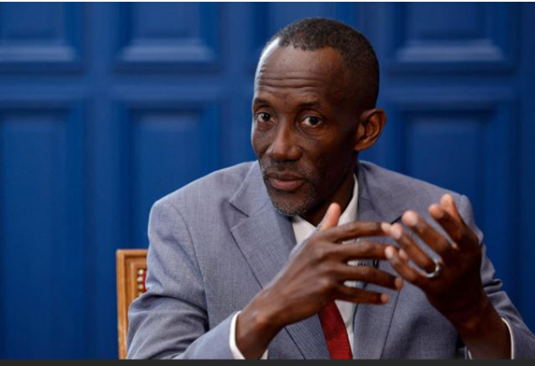 Mr. Bally Bagayoko, the new mayor of Saint-Denis, is of Soninke origin.
We provide below an automated translation of an article by Bernard Lugan on this subject.
Bernard Lugan is a historian and one of our leading Africanists who, for this reason, has notably taught in our military schools, Saint-Cyr and the École de guerre for senior officers. He was excluded because he was deemed far-right.
Before giving the floor to Bernard Lugan, and since the UN has just declared the transatlantic slave trade the most serious crime against humanity, a few quick clarifications on another aspect of the slave trade: the predominant participation of Jews in this trade.
1 – The American reader is probably aware that Newport, the main port for importing slaves into America, was nicknamed Jewport.
2 – Pierre Mendès France, Prime Minister from 1954 to 1955, descended from a Jewish family from Portugal who had settled in Bordeaux (adding “France” to his original name, Mendes), and in Bordeaux, this family was involved in the slave trade.
3 – The involvement of Jews in the Atlantic Slave Trade was so extensive that the first article of the “Code Noir,” a decree by Colbert intended to alleviate the suffering of Black people, was worded accordingly:
“We wish that the edict of the late King of Glorious Memory, our most honored lord and father, of April 23, 1615, be executed in our islands; in so doing, we enjoin all our officers to expel from our said islands all the Jews who have established their residence there, whom, as declared enemies of the Christian name, we command to leave within three months from the day of the publication of these presents, under penalty of confiscation of body and property.”
A quick overview of the Transatlantic slave trade
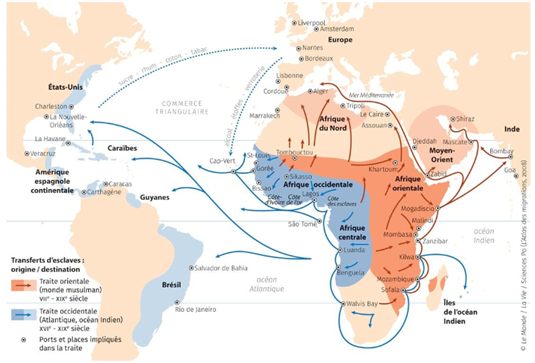
Atlas of Migrations 2008
Now, to read the Bernard Lugan’s article, his blog is « L’Afrique Réelle»
* * *

Mr. Mayor Bally Bagayoko, what if we talked about hereditary slavery among the Soninke?
Mr. Bally Bagayoko, the new mayor of Saint-Denis, is of Soninke origin. His family comes from the Koulikoro region of Mali. At the forefront of the revanchist, racialist discourse, the question “Where are you from?” has never been asked of him. Yet, it would likely be well received by someone close to La France Insoumise, given its origins in the Maoist and leftist circles of 1968. This question allows decolonial thinkers and the heirs of Foucault, Bourdieu, and Althusser to indict white men. For deconstructionists, this question means that all speech is situated—socially, politically, and historically—and therefore explains discourse and stances. This is what Anglo-Saxons have defined as “standpoint theory.”
So, where are you “speaking from”, Mr. Bally Bagayoko?
The answer is clear: from the Soninke world. A world with a very rich history, dating back to the Kingdom of Ghana, which emerged in the 8th century. A world in which slavery was not simply an economic system, but a comprehensive, imprisoning, and hereditary social structure, as demonstrated, among other things, by the books cited at the end of this overview. According to Claude Meillassoux (1975 and 1986), the Soninke formed a slave society in the truest sense, and Martin Klein (1998) showed that slaves represented between a third and a half of the population in many regions of Western Sudan.
The Soninke belong to the larger Mande group spread across present-day Mali, Mauritania, and Senegal (Soninke, Malinke, Bambara, etc.). Founders of the historical Ghana Empire which lasted from the 8th to the 11th century, the Soninke were essential players in the trans-Saharan trade networks of which the slave trade to the North African world was an important component.
But that is not the main point, because in the Mandé world, and therefore among the Soninké, the slave was not primarily intended for sale outside the ethnic group, tribe, or village, but rather to remain a permanent and dependent member of the family. This is why, in 1905, when colonization abolished traditional African slavery, this colonial legal decision did not end its social persistence; the servile status transformed into clientelism, that is to say, a “modernization” of the practice, which allowed it to survive.
Abner Cohen and Gibril Sankoh (1995) demonstrated that the Soninke were among the first West African migrants to France. However, and this is perhaps the crucial point, the emancipation of former Soninke slaves through emigration was merely theoretical, as social hierarchies persisted. In France, the divide between “nobles” (horon) and descendants of slaves (komo) remained, as it is the marker of a social and identity-based identification from which it is impossible to escape, since it is as definitive as gender. Slavery among the Soninke is thus a long-standing phenomenon, as social hierarchies endure.
Most Mandé societies exhibit a tripartite stratification. The Horon/Foroba are the free men, whether they belong to noble or common lineages. The Nyamakala are the members of the artisan castes. The Jon/Jongo are the slaves, now referred to as dependents. These affiliations are hereditary, except in cases of explicit manumission.
According to Cohen and Sankoh (1995), the Soninke case is one of the most rigid in the Mande world because the status of slave cannot be erased. It is indelible, since the descendants of slaves remain marked, even after their eventual emancipation. Marriages between Horon and descendants of slaves are forbidden, and descendants of slaves are excluded from positions of authority. We are therefore dealing with societies in which slavery has indeed been legally abolished, but in which its reality persists through hereditary ancestry. This status is less pronounced among the Malinke or the Bambara, peoples among whom social mobility is more frequent. But this is not the case among the Soninke.
However, the Soninke system, one of the most institutionalized in the Mandé world, is also found in the diaspora, which largely explains labor relations and electoral clienteles. According to François Manchuelle (2004), the Soninke case is even like a laboratory for the sociology of West African migrations. It would therefore be interesting to see how this reality is articulated around the new municipal team of Saint-Denis, given the strict endogamy that restricts social mobility among the Soninke people. This is all the more relevant since Cohen and Sankoh (1995) have shown that Soninke society is an exemplary case for observing the transition “from slave owners to employers of free laborers.”
Ultimately, Saint-Denis could serve as a laboratory for observing how, once transplanted to France, a former Sahelian slave society transformed into a labor migration society that abandoned none of its deep-rooted structures and traditions. This is a far cry from “republican assimilation”…
Sources
1848 : l’abolition définitive – Assemblée nationale
Décret d’abolition de l’esclavage du 4 février 1794 — Wikipédia
Was the Atlantic Slave Trade Really the Gravest Crime Against Humanity?
Nécropole royale de la basilique de Saint-Denis — Wikipédia
About NewPort /JewPort, here is an extract from an article by Claude Timmerman
“Four to five hundred thousand slaves shipped to the West Indies (the first were Irishmen deported as slaves to the Islands by the British) compared to at least eleven million transported in direct trade to continental America: the future USA on one side, Brazil and Colombia on the other!
In the USA, distilleries produced rum of questionable quality made from molasses, mainly imported from the West Indies, which was used as currency for the purchase of slaves.
The first distillery was founded in Newport at the end of the 17th century, and the port city soon had 22! An industry directly linked to the African slave trade: one only needs to cross-reference the lists of distilling industrialists and those of slave ship owners to be convinced of this.
In support of these claims, notwithstanding political correctness, we have the names of ships, captains and shipowners over three centuries and above all the manifests and bills of lading, in other words the official documents of the ships describing their cargoes and attesting to their owners.
In Africa, grain fermentation (particularly that of millet and sorghum, which produces beer known locally as tchouchouta, dolo, or tchapalo, depending on the region) was known and appreciated. A large-scale consumption of American alcoholic beverages, such as rum, quickly developed, paid for with slaves.
The port of Newport then became the North American nerve center of the slave trade with Africa.
The “King of Newport,” Duarte Lopez, also known as Aaron Lopez, ruled the North American slave market there for nearly thirty years, until the mid-18th century, contrary to current mainstream claims, particularly those supported by the latest version of Wikipedia…
We are talking about two to three million slaves imported into the USA during the single period of its activity!
History has recorded the names of the owners of Newport distilleries – where the alcohol produced was exported by the slave ships they outfitted and traded for slaves in Africa – who were clearly involved in the slave trade: Isaac Gomez, Hayman Levy, Jacob Malhado, Naphtaly Myers, David Hart, Joseph Jacobs, Moses Ben Franke, Moses Gomez, Isaac Dias, Benjamin Levy, David Jeshuvum, Jacob Pinto, Jacob Turk, Daniel Gomez, James Lucanan, Jan de Sweevts, Simeon Potter, Isaac Elizer, Jacob Ltod, Jacob Rodrigues, Haym Isaac, Carregal, Abraham Touro, Moses Hays, Moses Lopez, Judah Touro, Abraham Mendes, Abrabam All….
In the 18th century, according to American maritime records, of the 128 recorded slave ships that landed enslaved people in Charleston, 120 belonged to Jewish shipowners from Newport and Charleston. It’s understandable why some, undoubtedly with malicious intent, renamed the city “Jewport”…
Some American rabbis even openly claim that their community played a leading role in the slave trade!
We therefore refer those who believe that our remarks constitute a basic anti-Semitism (to which it is now fashionable to add “compulsive and visceral”) to the following publications:
– In the work of Rabbi Morris A. Gustein: The Story of the Jews in Newport (Carnegie Institute of Technology, Pittsburgh).
– To the monumental work in 4 volumes by Elisabeth Donan (not translated into French): Documents illustrative of the History of the Slave Trade to America. (Washington: Carnegie Institution of Washington, 1930 – 1935)
– In the work of Rabbi Ralph Lee Raphael: Jews and Judaism in the United States: A Documentary History – New York – Behrman House – 1983.
He emphasizes on pp. 14, 23-25: “Jews also took an active part in the slave trade in the Dutch colonies; indeed, the statutes of the congregations of Recife and Mauritius (1648) included a tax (Jewish levy) of five soldos for each Black slave purchased by a Brazilian Jew from the Dutch West India Company.”
And further on:
“This was no less true on the North American continent, where during the 18th century, Jews participated in the ‘triangular trade’ that brought slaves from Africa to the West Indies, where they were exchanged for molasses, which in turn was shipped to New England where it was distilled into rum for sale in Africa. Isaac Da Costa of Charleston in the 1750s, David Franks of Philadelphia in the 1760s, and Aaron Lopez of Newport in the late 1760s and early 1770s dominated the slave trade on the American continent.” (portraits below in the order they appear)
Needless to say, these books are now difficult to find, and Google, the LDH or the Licra are not exactly promoting them!”
To find out more
-Cohen, A ; Sankoh, G. S. K., (1995) Slavery, Emancipation and Labour Migration in West Africa : The Case of the Soninke. London.
-Klein, M.A., (1998) Slavery and Colonial Rule in French West Africa. Cambridge University Press.
-Lovejoy, P.E., (1983) Transformations in Slavery: A History of Slavery in Africa. Cambridge University Press (2e édition révisée : 2000 ; 3e édition augmentée : 2011.)
-Manchuelle, F., (2004) Les diasporas des travailleurs soninké (1848 1960). Migrants volontaires. Paris.
-Meillassoux, C., (1975) L’esclavage en Afrique précoloniale. Paris.
-Meillassoux, C., (1986) Anthropologie de l’esclavage : Le ventre de fer et d’argent. Paris.
Bernard Lugan




Thanks for a wonderful essay! A few decades-ago, I considered a run for the Mayorship of Newport but never entered my name. Not the first time I’ve defeated myself.
Many are on https://annas-archive.gl
Pls do DL and save, they’ll disappear totally otherwise
Perhaps, some day soon, America’s great philanthropic Jewish community will promote the erection of a National Slavery Museun in Newport R.I., and have the grand opening in conjunction with the annual Newport Jazz Festival.
That would be a fitting tribute to Jewry’s well known humanitarianism, as well as the vibrant wonders of America’s inter-racial “democracy “.
Thanks. It’s so frustrating to hear time and again (sur la temps?) about stupid white people screwing over the rest of us. The repeated actual examples of Jews being immoral scum, well they seem to excel at that; so that is just more data.
An African website slams Lugan for “making the ancestors speak when the living become too complex,” but that’s precisely what Black people do when they criticize white people today for having had slave-owning ancestors.
White people abolished slavery more than two centuries ago; the question is whether Black people have done the same in their own society.
–> And by the way, let’s not get bogged down in quibbling; let’s not lose sight of the fact that the real question Lugan is asking is: what are Black people doing in Europe anyway ?