
When Jews ran the Gulag
INTRODUCTION
Few people realize how very Jewish the government of the Soviet Union was in its first two decades. Given the realities of publishing in today’s world, those who wish to learn more could read numerous books, encounter a blizzard of unfamiliar Russian names, and never realize that many of the crucial figures were actually Jews. Anne Applebaum’s Gulag: A History is a great example of this phenomenon. Applebaum, a Jew, wrote almost six hundred pages about the Gulag, but mentioned the three Jews who headed it in the 1930s (Kogan, Berman, and Pliner) less than a dozen times, and never let the reader know that they were Jews. She did not discuss the administration of the Gulag, nor the men who staffed it. There is no “Jew” in her index, only “Jewish prisoners.” Thus, the only Jews in her “history” are victims; the fact that Jews ran the entire Gulag system and were responsible for the death of hundreds of thousands of people (and the terrible suffering of millions more) is whitewashed from the record. This is nothing less than a willful and severe distortion of the historical record, and it is replicated in so much of what was published on the Soviet Union.
This article aims to provide a modest correction. We will look at the three Jews who headed the Gulag in the 1930s, and their boss, the head of the NKVD, Genrikh Yagoda.[1] These four men—full-blooded Jews all—ruled over millions of prisoners who were treated essentially as slaves with no rights, and worked them, by the hundred thousand, literally to death. They ruthlessly sent millions of Soviet citizens into some of the harshest climates on earth to create cities and industrial complexes with little more than their bare hands. The goal was to develop the country’s natural resources and carry out a breakneck industrialization, to prepare for the next world war, the aim of which was to communize the entire world. The mortality and suffering were horrifying, but these malevolent figures evidently believed it was a worthy exchange for that perfect communist future. (Or, rather, they never cared enough to even make that calculation.)
The term “Gulag” is shorthand for Glavnoye Upravleniye Ispravitelno-Trudovykh Lagerey, or “Main Administration of Corrective Labor Camps.” This agency dates from 1930, well after the Bolsheviks erected the first camps in 1918. At this time all the camps were finally brought under a central organization, within the purview of the secret police. Historians estimate that eighteen million people were sent to the camps and that 1.6 million of them died, although some admit the true number of deaths could be far higher.[2] In the history of the Gulag there existed almost 500 major groups of camps, with the total number of individual camps rising toward 30,000.[3] The Gulag administration was finally abolished only in 1960, although some camps continued in existence. The structure and method of the Gulag in these three decades were largely established by the following four men:
GENRIKH YAGODA
Genrikh Grigorievich Yagoda was the highest-ranking Jewish secret police official in the history of Soviet Russia.[4] He headed the NKVD from 1934–1936 but was effectively in control for years before that. During his time in power, his policies and actions resulted in the murder (not “death”) of almost ten million people, with millions more enslaved in concentration camps. It is true that the real driver of policy was Stalin, but Yagoda freely chose to cooperate—participating in high-level policy-making—and implement the program. The Jewish people have never issued an apology for his actions, nor for any other Jewish Bolshevik mass murderer. (Rather, Communist criminals such as Salomon Morel and others find refuge from prosecution in Israel.)
Born in 1891 as Genokh Gershevich Yagoda, he grew up in Nizhni-Novgorod, his family closely associated with the Sverdlovs, with whom they were related.[5] Yagoda entered the revolutionary movement before the age of sixteen, participated in the October Revolution in Petrograd, and joined the Cheka. By 1920 he was a member of the ruling panel of the Cheka, the Collegium. Three years later he was second deputy chairman of the OGPU[6] and by 1926 first deputy chairman under Vyacheslav Menzhinsky, whose chronic illness placed Yagoda essentially in charge by 1929. During most of the 1920s Yagoda was deputy head or head of the important Special Department, which handled counterintelligence and surveillance of the entire country and all its institutions; it was a post that afforded him great power in the murky world of a secret police dictatorship.[7]
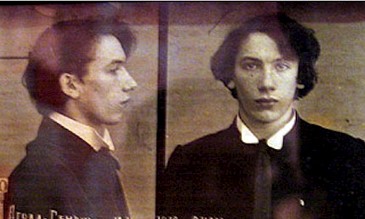 Yagoda as a dandified young revolutionary, age twenty, in a mug-shot from 1912. Yagoda was arrested in connection with a revolutionary bank-robbery, for which he had purportedly provided material for explosives. The senescent Tsarist government soon amnestied him, and he moved to St. Petersburg and married Yakov Sverdlov’s niece.
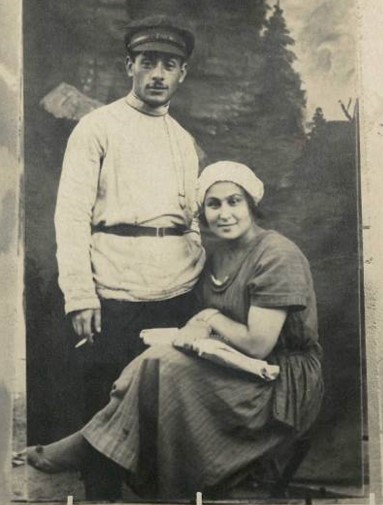 Yagoda and his wife Ida Averbakh in 1922. Yagoda was already a Chekist of very high rank. Two eastern European Jews—among hundreds of thousands—enjoying the trajectory from shtetl to power on a world stage. Ida became a state prosecutor in Moscow.
Since 1918 the concentration camp system had grown apace, and in April 1930 it was brought under a unified administration, the Gulag (within the main structure of the secret police).[8] Stalin had made the decision to utilize forced labor to develop the vast natural wealth of the country and spur industrialization, influenced by his secret police officers, who had been using prisoners to harvest timber in the north and touting their success. (The Jew Naftali Frenkel was instrumental in this development.)[9] Under Stalin, Yagoda worked closely with the heads of the Gulag—his subordinates—to form the economic goals of the massively expanded system of camps. One of the earliest major projects was the ill-fated White Sea-Baltic Canal, built in 1931–1933 at the cost of at least 25,000 lives. An even bigger undertaking, the Moscow-Volga Canal, followed. Both these enterprises were headed by a swarm of secret police Jews, under the overall command of Yagoda.
Another massive and lethal program he supervised was the collectivization of the farmers (1929–1933).[10] This involved skimming off the class of “kulaks,” supposedly wealthier farmers, and sending them to the Gulag or into internal exile—about two million people, of whom an estimated half a million died. Then the other farmers were forced off their lands and onto state-run farms, in order to regularize output and fuel industrialization. It was the destruction of the way of life of 120 million people. It culminated in the “Harvest of Sorrow” (1932–1933) in which the state—the NKVD—used famine to break the pervasive resistance to collectivization. Six to eight million died in Ukraine and other areas.[11]
In 1934 Menzhinsky died and Stalin made Yagoda General Commissar of the restructured security administration, the NKVD. His power was immense: the secret police, the Gulag, the border troops, special NKVD troops, the regular police, all-embracing surveillance. He accumulated great wealth at his three lavishly-decorated residences: foreign wine, clothing, guns, pornographic films, and cash.
However, Stalin wanted to get rid of Yagoda, who did not wholeheartedly support collectivization or the show trial of the Old Bolsheviks Zinoviev and Kamenev (August 1936), a crucial step in Stalin’s consolidation of total power.[12] Stalin was grooming Yagoda’s successor, Nikolai Yezhov, and wanted to break up the old leadership of the secret police. Thus, on 25 September 1936, Stalin demoted him to Commissar of Communications. For months Yagoda twisted in the wind, barely showing up to work, making paper airplanes when he did. Yezhov arrested ninety percent of Yagoda’s top men and brought in his own group, many of whom were Jews.
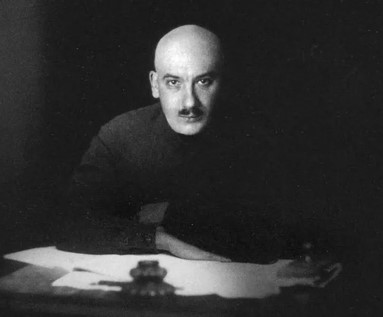 Yagoda at his desk in the early 1930s, apparently cultivating an aura. He was lauded in the Soviet press for his “success” in finishing the White Sea-Baltic Canal on schedule.
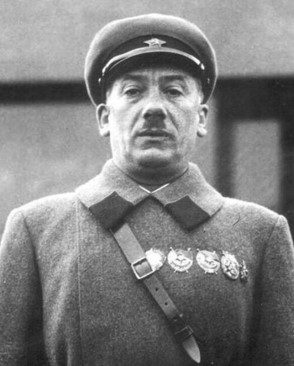
Yagoda as imperious chief of the NKVD, 1936. Despite the lofty decorations, his face clearly shows insecurity. The mustache has been trimmed into the then-popular “toothbrush” style, à la Charlie Chaplin. The uniform greatcoat is ugly and unimaginative, like virtually the entire Soviet aesthetic.
Finally, in late March 1937, NKVD officers took him into custody. Among the men who interrogated (and beat) him were numerous Jews.[13] Stalin ordered his investigators to concoct a vast fictional conspiracy and place Yagoda in the center of it: he was accused of spying for foreign nations, including Germany, plotting to assassinate Stalin, and poisoning several prominent people, including his predecessor Menzhinsky and the writer Maxim Gorky. NKVD interrogation teams put him through lengthy and exhausting rehearsals of his “guilt.” In his cell he “wept constantly [and] fought . . . for breath.”[14] He also made a highly revealing comment to one of his interrogators: “You can put down in your report . . . that I said there must be a God after all. From Stalin I deserved nothing but gratitude for my faithful service; from God, I deserved the most severe punishment for having violated his commandments thousands of times. Now look where I am and judge for yourself: is there a God or not?”[15] Yagoda was officially an atheistic materialist, but, like Stalin, the old religion seemed to be lurking in the unconscious spaces of his mind.
The third and final show trial, featuring Yagoda and Nikolai Bukharin, took place in March 1938.[16] Yagoda admitted guilt in general while disputing details;[17] no matter, he was shot anyway, despite a final plea for clemency—to be allowed to work as a laborer on one of his canals. Stalin exterminated practically his whole family: parents, wife Ida, siblings. His son, Genrikh, grew up in an NKVD orphanage, did five years in the camps, and later emigrated to Israel.[18] A fitting coda to the family story: in three generations they went from a (probably) observant Jew in a shtetl to a (nominally) atheistic, all-powerful Bolshevik commissar, to a deracinated elderly Jew in Israel, where the fourth generation might well become militant Jewish nationalists.[19] What a trajectory!
LAZAR KOGAN
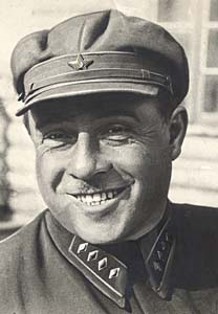 The cheerful reformer of mankind through (slave) labor.
Lazar Iosifovich Kogan was the head of the Gulag for two years (June 1930 – June 1932), the first of three Jews who consecutively held that post, and personally directed the construction of both the White Sea-Baltic and Moscow-Volga canals, at least up to August 1936.[20] Possibly a hundred thousand people under his control—in the camps and on huge forced-labor projects—died of malnutrition, overwork, and execution. He was a ruthless exploiter of forced labor who claimed he was doing it for their own good, and for a glorious future for all mankind.
Kogan was born in or near Krasnoyarsk, Siberia, in the family of a wealthy fur trader, in 1889. By 1905 he was a revolutionary (or a violent criminal—often the two overlapped) and in 1908 he was sentenced to death by a military court in Kiev for armed robbery and murder carried out in the company of purported anarchists.[21] The sentence was changed to life at hard labor because of his young age. He then served his sentence until the Provisional Government amnestied political prisoners after the fall of the Tsar, in early 1917. No lasting ill effects are recorded as a result of his sentence, unlike what befell his own later victims.
During the Russian Civil War he joined the Bolsheviks and served in the Red Army and the Cheka. He was head of the Special Department (Cheka) of the Ninth Army, handling counterintelligence and suppression of counterrevolution, which meant he ordered the execution of anyone viewed as a threat to Communist power. He held the same office for the Terek region in the north Caucasus, killing Cossacks and others en masse. Then he moved to Dagestan on the Caspian Sea and crushed all opposition there. In 1926 he became the assistant to the head of the OGPU troops and border guards, a considerable force. Then in June 1930 he became the head of the Gulag and his career as slave master began.
In 1930 the campaign of collectivization was filling the Gulag with new prisoners, and the NKVD was gearing up to align the camps with the economic goals of the regime on a more ambitious scale. The number of prisoners in the camps doubled in Kogan’s tenure, to over 370,000 in mid-1932.[22] The two aforementioned canals were initiated, and in November 1931 he took on the management of the construction of the White Sea-Baltic Canal. The following May he simultaneously took over the same position at the Moscow-Volga Canal. The next month, June 1932, he stepped down from leading the Gulag (Matvei Berman took over) but remained deputy head. He concentrated on building the canals that were viewed by the regime as so emblematic of the developing socialist society.
The White Sea-Baltic canal required digging 140 miles through a landscape “largely composed of sheer granite,” with very little machinery, which was expensive and relatively rare.[23] The workers did the vast bulk of the digging and building by hand, with shovels and wheelbarrows. Soviet publicists made much fanfare of the value of manual labor in redeeming criminals and making them fit citizens of the socialist state, and Kogan at least paid lip service to the idea. However, food supply and living and working conditions were usually awful, because of official embezzlement, negligence, and callousness, and workers died in droves. Rations were tied to work performance, with a drastic reduction to starvation level for workers who did not meet the overly ambitious production goals (Kogan and the other directors of the canal were desperate to finish on time to impress Stalin and expand their role in the economy). At least 25,000 and perhaps as many as 50,000 people died. They were often thrown in unmarked mass graves; many died in accidents, being buried in dams or falling into huge concrete pourings. The canal was finished on schedule (August 1933) and the top organizers were fawned over in the press and given awards.[24] Six administrators, all Jews—Yagoda, Matvei Berman, Kogan, Naftali Frenkel, Semyon Firin, and Yakov Rapoport—were given the highest state award, the Order of Lenin (along with two Russian engineers.)[25] Many of the prisoners and staff were then transferred to the Moscow canal.
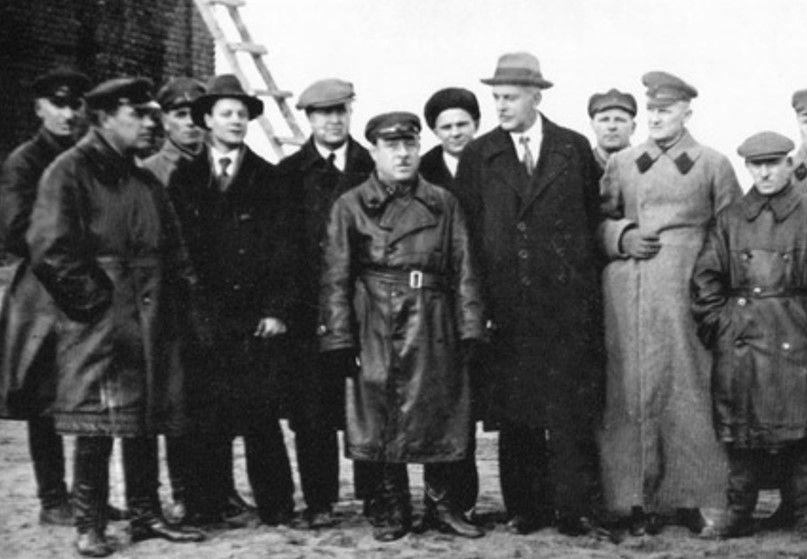 Kogan with a delegation visiting the building site of the Moscow-Volga Canal, circa 1935–1936. The diminutive Kogan sports a leather trench coat, center.
The Moscow Canal—linking the Moskva River in Moscow with the Volga river to the north—was even more ambitious, with an estimated 600,000 prisoners cycling through in the nearly five years of construction, although the maximum at one time was 195,000. The death-toll here was another 25,000–50,000 (anonymous mass graves are still periodically found along the line of the canal)[26] and 2,500 more prisoners were dispatched to the Butovo shooting ground and executed after the project was finished in July 1937.[27] By that time, however, Stalin had relieved the pint-sized Chekist of his NKVD posts and shunted him off to the Timber Commissariat (August 1936).
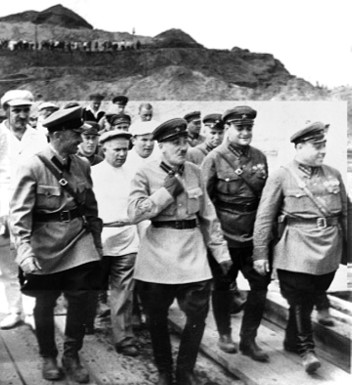 An inspection of the Moscow-Volga Canal. Yagoda is front-center, Semyon Firin is on the left, and tiny Lazar Kogan is far right. Nikita Krushchev, an official in the regional Moscow Communist Party, appears behind Yagoda in a belted white tunic.
Kogan was arrested in January 1938, accused of “having been, since 1930, a participant in an anti-Soviet terrorist organization operating within the NKVD system,” and sabotaging the timber harvest.[28] The Supreme Court of the USSR passed a sentence of death, and on March 3, 1939, NKVD executioners shot and buried him at one of Moscow’s secret execution sites, the Kommunarka shooting ground, reserved for high-ranking officials.
MATVEI BERMAN
Matvei Davidovich Berman, a short, stocky, red-haired Chekist, was chief of the Gulag from June 1932 to August 1937, with a million slaves under his absolute control, working on gigantic building projects all over Russia, in conditions so horrific they beggar description. At least 200,000 people died in the camps during his tenure. His name recognition is infinitesimal compared to the notoriety he deserves.
Berman was born in 1898 in the Chita district, east of Lake Baikal. His father owned a brick factory; his two brothers, Boris and Yuri, would also serve in the secret police. He joined the Bolshevik Party even before they seized power, then served in the Red Army. He entered the Cheka in August 1918 and became head of the Glazov City Cheka. After only a month, the twenty-year-old was expelled from the Party for drunkenness, but was soon reinstated, and went on to hold leading posts all over the Urals, the Far East, and Central Asia. He proved himself a very effective operator, exterminating anti-Soviet elements, suppressing rebellions, sending his agents into China to conduct sabotage and kidnap expatriate White Russians. In 1927 he became chairman of the secret police (then called the OGPU) over the entire Soviet Republic of Uzbekistan. His superiors obviously trusted him, and in July 1930 they named him deputy head of the Gulag. He was only thirty-two.
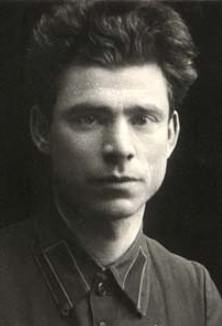 Berman as a young, rather severe Cheka commissar. The gaze is weirdly intense for a formal portrait.
Berman immediately took an active role in organizing the large economic projects assigned to the Gulag, beginning with the White Sea-Baltic Canal. He showed himself a ruthless exploiter of forced labor. He fired off memoranda demanding thousands of new slaves, carried out whirlwind inspections, and presided over the full transition of the Gulag to a major economic role in “building Socialism.” After the “success” of the White Sea-Baltic Canal, a number of huge initiatives were launched or expanded: the Moscow-Volga Canal, the Baikal-Amur Railroad, coal mining in Uzbekistan, the construction of the city Magnitogorsk as a center of steel production, gold mining in Kolyma, nickel mines at Norilsk north of the Arctic circle, and even the construction of the massive factories famous from the siege of Stalingrad: Red October and the Barrikady. There were hundreds of other enterprises, in every corner of the country, and in June 1932 Berman assumed total control over them, being named head of the Gulag, succeeding Kogan. In connection with these economic projects and the collectivization campaign, Berman supervised a vast expansion in the number of prisoners. By 1937 there were many groups of camps, all of them encompassing dozens or hundreds of smaller satellite camps. These groups had separate local administrations, so there were a large number of officials ruling over the prisoners, and Jews were well-represented among their number.
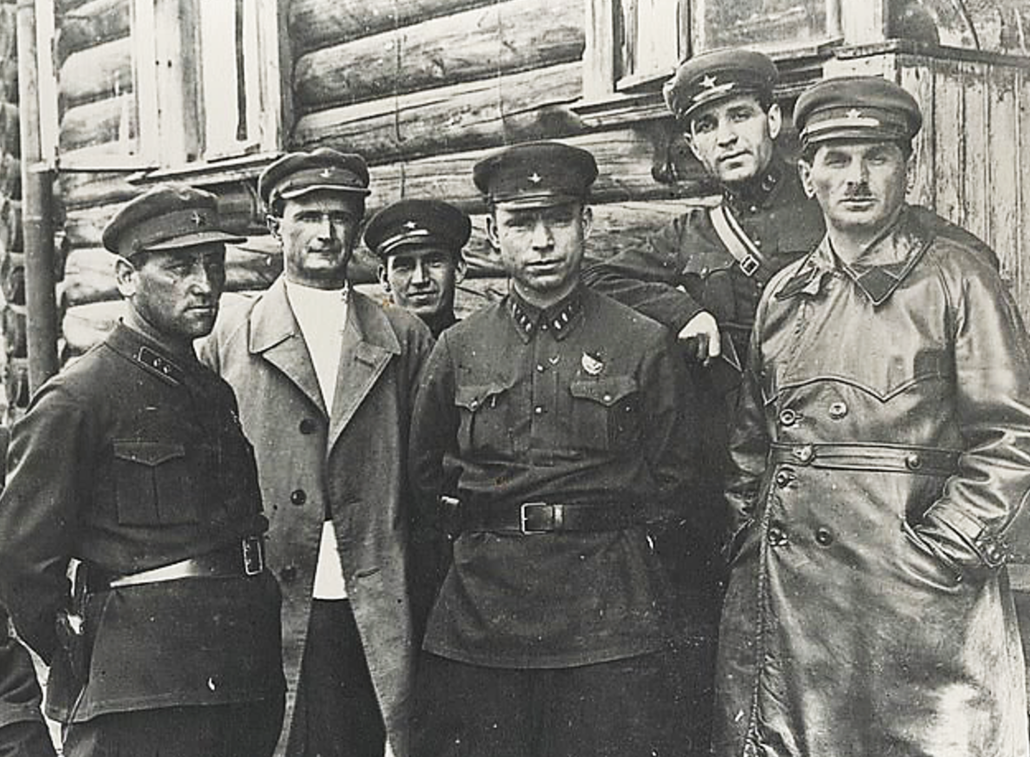 Berman visiting the White Sea-Baltic Canal construction site in 1932. He is inthe center, hands behind his back. Naftaly Frenkel is on the far right. Berman radiates self-confidence and menace. On the left is another Jewish chief of construction of a sector of the canal, Grigory Afanasyev who is mentioned below as the head of military construction sites and labor camps all over western Russia until 1952.
A particularly egregious exploitation of human life was the effort to extract gold from the far northeastern region of Russia, in the Kolyma River basin. Soviet leaders coveted the gold because it could finance the import of modern industrial technology, but extreme climatic conditions meant that free labor would never move there. They would have to use forced labor, and the basic infrastructure would have to be built first: roads, a port, settlements, etc. The effort began in 1931 with the founding of Dalstroy, the Far Northern Construction Trust, under OGPU control, to direct the venture. The following summer—just after Berman became head of the Gulag—Dalstroy began sending out steamers each packed with ten thousand carefully guarded people. When they arrived at present-day Magadan on the north shore of the Sea of Okhotsk, the bosses informed them that their living quarters—cheap barracks—would have to wait; they had to build the port and the town first:
With bare hands they constructed piers for ocean steamers, setting up caissons weighing many tons under the steep cliffs where the sea was 12 to 15 feet deep at the water’s edge. They cut broad roads through the stone, leading down to the piers. They built . . . a sawmill, a brickyard, a fish-salting factory, ship repair yards, a power station. They began draining the swamp and clearing the parts of the taiga adjacent to the spot selected for the future town, felling and rooting up trees. . . . They built houses for the administrative staff . . . for the GPU troops they built “cold-resistant barracks” with double walls filled in with sawdust . . . [yet] through the summer and late into the autumn the workers lived in huts made of branches.[29]
That autumn groups of workers were sent north to begin preparatory work for the construction of a road leading to the gold deposits (the road became known as “the road of bones”). That winter the death toll was great, but Gulag administrators were supplied with plenty of ships and people. They began sending ships through the Bering Strait to deliver workers to the mouth of the Kolyma River, which empties into the Arctic Ocean (one such ship, the Dzhurma, got stuck in the ice and arrived after a year’s delay without a single one of its 12,000 prisoners still alive).[30] These parties began building a road south to meet the workers moving north. That summer they managed to begin mining the placer deposits of gold. By 1939 there were 140,000 prisoners in the area and they extracted 53 tons of gold, thirty-five percent of total Soviet production.[31] The mining of the gold was eventually mechanized and 88 tons were produced in 1941. Needless to say, the conditions of work and life were even worse than elsewhere in the Gulag. The cost in human suffering, despair, and death is incalculable. Estimates of deaths range from 140,000 to a million. (The horror of Kolyma was so great that Robert Conquest, a very judicious researcher, in his 1978 book Kolyma put the death toll at three million people.) Berman is not on record as expressing regret or sorrow over the human lives lost.
In August 1936 Berman became head of the construction of the Moscow-Volga Canal; in September he became deputy head of the NKVD, under the new man Yezhov, who replaced Yagoda. In 1938 he was a deputy of the first meeting of the Supreme Soviet of the USSR. He was reaching dizzying heights, often the prelude to a fall under Stalin. On April 22, 1937 he escorted Stalin on a tour of the Moscow Canal, not long before its official opening. That August, however, Stalin removed him from his NKVD posts and made him Commissar of Communications, a radical demotion. Stalin, you recall, made the same move with Yagoda just a year before.
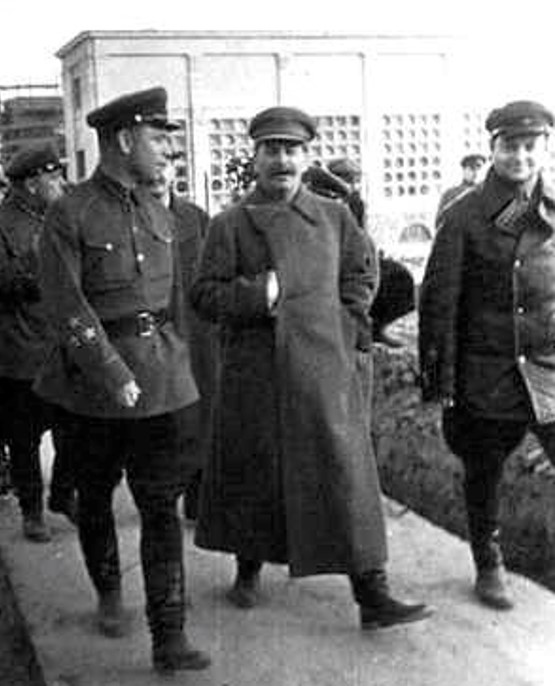 Berman (on left) escorting Stalin on a visit to the Moscow-Volga Canal, April 1937. Semyon Firin is on the right; within days Firin was arrested.
Stalin had Berman arrested in December 1938. Stalin had just called a halt to the sixteen-month crescendo of executions called the “Great Terror,” and Lavrenti Beria had replaced Nikolai Yezhov as secret police chief. Yet another purge swept through the NKVD, and Berman was caught in the trap. He was accused of leading a counterrevolutionary terrorist group in the NKVD, sabotaging the major projects carried out by the Gulag, and spying for Germany. Presumably he was tortured, but by March 7, 1939, it was over. He also was taken to Kommunarka and shot. Lazar Kogan had been shot there just four days earlier, and Berman’s brother Boris two weeks before.[32] The camp system and its projects continued on, however, growing ever bigger until the death of Stalin in 1953, largely on the lines laid down by Matvei Berman, one of the greatest slave-drivers in recorded history.
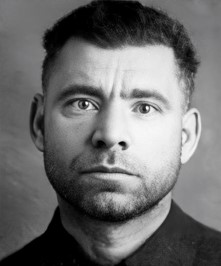 Berman in the hands of NKVD interrogators, his eyes moist, clearly struggling to process what is happening to him. The self-confidence is utterly gone, replaced by unconcealed anguish.
IZRAIL PLINER
Izrail Izrailevich Pliner was head of the Gulag from August 1937 to November 1938. This was the exact period of Stalin’s Great Terror with its 1.5 million arrests and 700,000 executions. Hundreds of thousands of unfortunates flooded into the camps. Immense economic endeavors utilizing Gulag labor continued apace, and more were initiated. Pliner did not last long in this post, but he perpetuated and expanded the inhumane regimen that his Jewish predecessors had established.
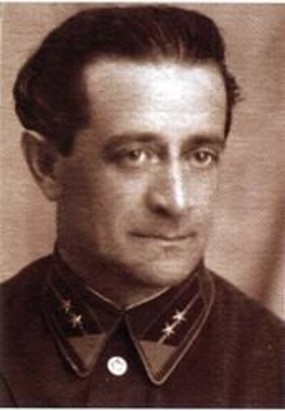 The clean-cut high-ranking Chekist.
Pliner was born in 1896 in what is now northern Belarus, in the Pale of Settlement. He worked in various occupations as a young man: brewer’s assistant, wagon driver, conductor on the railway, even fishing in Astrakhan. His family was religious and wished him to become a rabbi, but when the Revolution came, he plunged into the maelstrom. After the Bolsheviks took power and the Civil War began, he entered the Red Army, serving until 1926 in the supply services as quartermaster. In 1922 he entered the Communist Party. He transferred to supply roles for OGPU special purpose troops in 1926. He worked in the Moscow region and came to the attention of high officials; as a result, they tapped him as assistant head of the Gulag in February 1933, where he remained until he ascended to the head position in August 1937.
Pliner’s responsibilities as deputy head of the Gulag included supervising logistics and prisoner allocation to the various enterprises based on need. The camp population soared over the one million mark around 1936, and neared two million by the end of 1937. Pliner took measures to improve the function of the camps by ordering the release of sick and disabled prisoners, but the pressure to increase productivity prevented him from introducing a more humane regime. He, like his predecessors, urged camp bosses to drive the workers harder. In the circumstances—chaotic food supply, crowded camps, inadequate infrastructure—this meant that people were worked to death. 108,000 deaths were recorded in the camps in the year 1938; the real number must have been at least fifteen percent higher than that.[33] In 1937–38 there were also mass executions in the camps, part of the program of the Great Terror.[34]
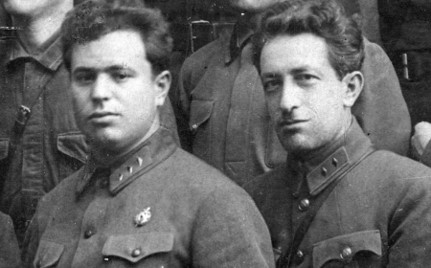 In a group photo alongside a somewhat chubby Matvei Berman, with an enigmatic expression. He is reminiscent of Jeffrey Epstein here.
From July 1936 to November 1938 he was also deputy head, then head of the NKVD Resettlement Department. Almost immediately he took charge of the operation to deport 175,000 Koreans from the Far Eastern border (adjacent to Korea and China) to the interior of Russia, to Central Asia. Stalin suspected the Koreans of disloyalty. Little was provided to help the Koreans resettle in the new areas, and mortality was significant.[35] Pliner was awarded the Order of Lenin for managing this great crime.
It was during Pliner’s tenure that the propaganda about redeeming criminals through labor was dropped. “As the political rhetoric grew more radical, as the hunt for political criminals intensified, the status of the camps, where these dangerous [counterrevolutionaries] resided, changed as well.”[36] Now the camps were full of deadly enemies of the state, who needed to be destroyed, not redeemed. The harder attitude was reflected in harsher conditions in the camps, and this became systematic, not merely informal. Rations were reduced, security was tightened. Correspondence was restricted and controlled. Prisoners, who had been called by their names or occupations, now became strictly a “zek,” short for the word prisoner: zaklyuchennyi. A group of prisoners became a “contingent.” Guards stopped calling prisoners “comrade,” which had a surprisingly baleful effect on the morale of the prisoners.
In the camps, “enemy of the people” now became an official term. . . . Women were arrested as “wives of enemies of the people” after an NKVD decree of 1937 made such arrests possible, and the same applied to children. Officially, they were sentenced as . . . “Member of the Family of an Enemy of the Revolution.” Many of the “wives” were incarcerated together in the Temnikovsky camp.[37]
The dislocations produced by the Great Terror damaged the efficiency and productivity of the camps. Prisoners with skills (who ran the camps to a large extent) were no longer trusted, or were killed off. The huge influx of prisoners produced chaos; 700,000 people poured into the system in 1937 alone.[38] That year and the next over 140,000 people died in the camps.[39] The economic output of the camps fell by about thirteen percent. In such conditions it was easy to get rid of Pliner.
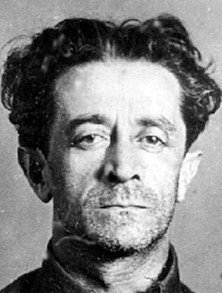 Pliner after his arrest. He still looks defiant, nostrils flared and lips pursed, but he knows what is coming.
Pliner was arrested on November 14, 1938, as part of the transition from Yezhov’s rule to Beria in the NKVD (Beria replaced Yezhov on November 25). He was accused of spying for Germany and participation in an anti-Soviet conspiracy in the secret police. On February 22, 1939, he was sentenced to death by the Supreme Court of the USSR, and the next day he was shot. It was a dangerous occupation, this Gulag business.
Pliner was the last Jewish head of the Gulag, but his ouster was not the end of highly-placed Jews in the central administration of the Gulag, nor in the huge number of camps and construction projects that continued through World War Two and into the 1950s. A few examples: Zinovy Aleshinsky was deputy head of the Gulag administration in 1939.[40] Yakov Rapoport headed a number of camps and construction sites up until his retirement in the mid-1950s.[41] Naftaly Frenkel was deputy head of the Gulag in 1941 and up until 1947 was head of the Main Directorate of Railway Construction Camps.[42] Grigory Afanasyev (pictured above) headed military construction sites and labor camps all over western Russia until 1952.[43] Alexander Usievich was deputy head of the Gulag in the 1940s and headed camps and construction projects until he retired in 1954.[44]
SUMMARY
If the faces and deeds of these men—and other Jewish Bolsheviks—sink deeply into the popular consciousness, a dramatic change in attitude toward the Jewish Question will become irresistible, much as the recent Gaza slaughter catalyzed a powerful reaction against the Jewish state and a growing appreciation of its genocidal imperative. Hopefully this article can help raise these four representatives of the Jewish nation to the profile they deserve, in the front rank of the greatest mass murderers of history.
These men were not simply mass murderers, however; their plan was global genocide. Communism from the beginning had worldwide ambitions, and these men strove to make that a reality. Had they gained such power, they would have exterminated everyone who stood out from the common mass of humanity. It would have been (and was, in Russia, for decades) a particularly monstrous program: kill everyone of worth so the rest could be enslaved. In this sense, the agenda of communism seems identical to that of Talmudic Jewry. Thankfully, Stalin eventually handed the state over to ethnic Russians, displacing the Jews, and Communist Russia lost much of its dynamism and lethal ferocity. Yet another form of secular Jewish messianism had run its course, leaving a husk of a host nation behind, profoundly scarred and traumatized.
These examples of Jewish mass murderers are not of merely historical interest. Realize that if ever an anti-White government came to power with unlimited power as was the case in the USSR, there would be no shortage of Jewish executioners ready and willing to engage in mass murder of the traditional American White majority. The hatred is already there—the holocaust perpetrated by a White, Christian society, the 1924 and 1952 immigration laws, the exclusion of Jews from Ivy League schools and Wall St. financial firms in the early decades of the twentieth century, etc.
From Kevin MacDonald’s review of Yuri Slezkine’s The Jewish Century:
Jewish involvement in the Communist elite of the USSR can be seen as a variation on an ancient theme in Jewish culture rather than a new one sprung from the special circumstances of the Bolshevik Revolution. Rather than being the willing agents of exploitative non-Jewish elites who were clearly separated from both the Jews and the people they ruled, Jews became an entrenched part of an exploitative and oppressive elite in which group boundaries were blurred. This blurring of boundaries was aided by four processes, all covered by Slezkine: shedding overt Jewish identities in favor of a veneer of international socialism in which Jewish identity and ethnic networking were relatively invisible; seeking lower-profile positions in order to de-emphasize Jewish preeminence (e.g., Trotsky); adopting Slavic names; and engaging in a limited amount of intermarriage with non-Jewish elites. …
Although the replacement of Germans by Jews was well under way by the time of the Bolshevik Revolution, a key consequence of the Revolution was the substitution of one Mercurian group, the Germans, by another, the Jews. The difference between the Jews and the Germans was that the Jews had a longstanding visceral antipathy, out of past historical grievances, both real and imagined, toward the people and culture they came to administer. Indeed, Russians on the nationalist right admired the Germans, at least up to World War I. For example, a statute of one nationalist organization, Michael the Archangel Russian People’s Union, expressed “particular trust in the German population of the Empire,”16 while its leader, Vladimir Purishkevich, accused the Jews of “irreconcilable hatred of Russia and everything Russian.”17
Jews disliked the Christian religion of the vast majority of Russians because of the antagonistic relationship between Judaism and Christianity over the
ages; Jews distrusted the peasants, who “fell from grace” (p. 140) with the intelligentsia after the numerous anti-Jewish pogroms, especially after 1880;
and Jews blamed the tsar for not doing enough to keep the peasants in check and for imposing the various quotas on Jewish advancement that went into
place, also beginning in the 1880s—quotas that slowed down but by no means halted Jewish overrepresentation in the universities and the professions. …The establishment of the Explicitly Therapeutic State was much aided by yet another Jewish intellectual movement, the Frankfurt School, which combined psychoanalysis and Marxism. The result was a culture of critique which fundamentally aimed not only at de-legitimizing the older American culture, but even attempted to alter or obliterate human nature itself: “The statistical connection between ‘the Jewish question’ and the hope for a new species of mankind seems fairly strong” (p. 90).
And when people don’t cooperate in becoming a new species, there’s always murder. Slezkine describes Walter Benjamin, an icon of the Frankfurt School and darling of the current crop of postmodern intellectuals, “with glasses on his nose, autumn in his soul and vicarious murder in his heart” (p. 216), a comment that illustrates the fine line between murder and cultural criticism, especially when engaged in by ethnic outsiders. Indeed, on another occasion, Benjamin stated, “Hatred and [the] spirit of sacrifice…are nourished by the image of enslaved ancestors rather than that of liberated grandchildren.”29 Although Slezkine downplays this aspect of Jewish motivation, Jews’ lachrymose perceptions of their history—their images of enslaved ancestors—were potent motivators of the hatred unleashed by the upheavals of the twentieth century.
As for the four men described above, providence ensured that they were made to suffer and die by at least some agency, if not directly in the name of eternal justice. All of them suffered arrest, the loss of position, family, and prestige. All of them suffered intense periods of torture, agony, fear, and the quandary of making humiliating confessions to preposterous conspiracies and crimes. Then, hoping till the end for clemency or the announcement that their arrest was all a big mistake, they heard the sentence of death, were hustled to the edge of a pit, forced to kneel, and felt the bullet exploding in the back of the head. No men were more justly executed, ironically by the very power that authorized their crimes.
NOTES
[1] The NKVD was set up in July 1934 as a new security structure, replacing the Cheka/OGPU: Narodnyy komissariat vnutrennikh del (People’s Commissariat of Internal Affairs). It didn’t cover internal affairs in the way that the U.S. Department of the Interior does; it was strictly a security body, overseeing in its various departments the secret police (GUGB or Main Directorate of State Security), the Gulag (Main Directorate of Correctional Labor Camps), the border guard and other troops, regular police and prisons, and the militia. The previous head of the secret police, Vyacheslav Menzhinsky, who had been ailing for years, died in May and Stalin promoted (after some hesitation) Yagoda to General Commissar of the NKVD.
[2] Wikipedia, “Gulag,” https://en.wikipedia.org/wiki/Gulag#Death_toll
[3] “The History of the Gulag” at https://gulag.online/articles/historie-gulagu?locale=en
[4] The basic information on these men has been taken from two works: 1) Евреи в НКВД СССР 1936-1938 (Jews in the NKVD of the USSR, 1936-1938) by M. Tumshis and V. Zolotaryov. 2nd edition, revised and expanded. Moscow: Dmitry Pozharsky University, 2017. 2) Евреи в КГБ: палачи и жертвы (Jews in the KGB: Executioners and Victims) by Vadim Abramov. Moscow: Izdatel Bystrov, 2006.
[5] The Sverdlovs and Yagodas ran a printing/engraving shop which they put at the disposal of the revolutionary movement. Movsha Sverdlov’s son Yakov was a dynamic Bolshevik and played a crucial, albeit short-lived, role in Lenin’s early government. Until his death in March 1919 he was arguably the third most important Bolshevik. Yagoda married the niece of Yakov, Ida Averbakh.
[6] The secret police in the Soviet Union was named successively Cheka, GPU, OGPU, NKVD, MGB, KGB.
[7] The Special Department later evolved into the famous SMERSH organization in World War Two.
[8] The Gulag was headed for a few months by the Latvian Teodors Eihmans, then Jews took over. From June 1930 to November 1938, Lazar Kogan, Matvei Berman, and Izrail Pliner successively headed the massive system of slave labor camps.
[9] The man who pioneered using camp prisoners as slave labor in the northern camps, the Jew Naftali Frenkel, also introduced the infamous method of feeding people according to the work they performed. He became one of the heads of construction of the White Sea-Baltic Canal. See Applebaum, Gulag: A History, 31-37 and 53-54. Applebaum does not identify Frenkel clearly as a Jew, claiming his origins were mysterious. They were not so mysterious as to obscure his Jewish identity. Frenkel went on to head other major projects, including the Baikal-Amur Railroad with its attendant group of Gulag camps. Frenkel was noteworthy in that he was never purged.
[10] Donald Rayfield called collectivization “an act of unprecedented monstrosity.” Stalin and His Hangmen (New York, 2004), 180.
[11] Yakov Yakovlev (real name Epstein) was the Commissar of Agriculture at this time. Solzhenitsyn called him, in reference to his role in collectivization, “the murderer of the peasantry.” The Jew Boris Bak was the head of the secret police in the Middle Volga region and collectivized that region. The Jew Filipp Goloshchekin was in charge of Kazakhstan and exterminated about forty percent of the population during this time. I could go on …
[12] When Yagoda dragged his feet in producing “confessions” that would prove a far-reaching conspiracy involving Kamenev and Zinoviev, Stalin phoned him and threatened, “Look out, or we’ll smash your face in.” Donald Rayfield, 251.
[13] Among their number were N. M. Lerner, V. M. Kursky, G. N. Lulov, M. M. Gerzon, M. I. Litvin, and Ya. A. Aronson. Tumshis and Zolotaryov, 67.
[14] Donald Rayfield, 287
[15] Simon Sebag Montefiore, Stalin: The Court of the Red Tsar (Alfred Knopf, 2004), 220-21.
[16] The “Case of the Anti-Soviet Bloc of Rightists and Trotskyites.”
[17] He quipped that had he been a spy, “dozens of countries could have closed down their intelligence services.” Donald Rayfield, 285.
[18] https://www.geni.com/people/Henrih-Averbakh/6000000064495308846
[19] Yagoda’s son Genrikh, who took his mother’s name Averbakh, seems to have had three children in the 1950s-1960s. The line of Yagoda perdures.
[20] The White Sea-Baltic Canal was in built between September 1931 and August 1933, and the Moscow-Volga Canal was built between September 1932 and July 1937.
[21] https://protivpytok.org/?page_id=1507 note 1.
[22] Estimates vary. I chose one I regard as likely.
[23] Applebaum, Gulag: A History, 62-64.
[24] Despite the canal being a failure. “In 1940 it was used at 44 percent of its capacity, and in 1950, only 20 percent.” Oleg Khlevniuk, The History of the Gulag: From Collectivization to the Great Terror (Yale University Press, 2004), 335
[25] Semyon Firin was a Communist since 1918 and worked in Red Army military intelligence in Western Europe in the 1920s. In 1930 he transferred to the OGPU, becoming deputy head of the Gulag and head of the labor camp whose prisoners built the White Sea-Baltic canal, and then the camp for Moscow-Volga canal. He was arrested just before the latter canal was finished, and shot in August 1937. Yakov Rapoport joined the Cheka in 1918 and headed labor camps and major NKVD construction projects, including the White Sea-Baltic canal, all over the Soviet Union from 1930 to his retirement in 1956.
[26] Cynthia Ruder. Building Stalinism: The Moscow Canal and the Creation of Soviet Space (I. B. Taurus, 2018), 72-73.
[27] Karl Schlögel, Moscow 1937 (Polity Press, 2013), 487.
[28] Tumshis and Zolotaryov, 357 note 38
[29] David Dallin and Boris Nikolaevsky, Forced Labor in Soviet Russia (Yale University Press, 1947), 119-20.
[30] Dallin and Nikolaevsky, Forced Labor, 128.
[31] Stephane Courtois, Nicolas Werth, et. al., The Black Book of Communism (1999), 205.
[32] Among the 6600 bodies buried at that site were those of Bela Kun and Yakov Yakovlev (Epstein), the Commissar of Agriculture during collectivization.
[33] Not all deaths were recorded; some camp commanders minimized deaths; and camp commanders often released sick prisoners at the point of death, to make their mortality statistics look better.
[34] Some examples: 1200 were shot in the Solovki camps in the north; 2000 in Vorkuta in the far north; 230 in one day in Belbaltlag, the camp that serviced the White Sea-Baltic Canal. The total number was obviously very great. Applebaum, 105-07
[35] The Koreans “had been highly regarded immigrants: some were Orthodox converts who had moved to Russian territory at the turn of the century after being threatened with beheading by the Korean emperor. Later waves were fleeing the Japanese, who colonized Korea in 1910. The Koreans had supported the Bolsheviks in 1917 . . .” Donald Rayfield, Stalin and His Hangmen, 371.
[36] Applebaum, 100.
[37] Applebaum, 102.
[38] Stephane Courtois, Black Book of Communism, 205
[39] Wikipedia, “Gulag,” https://en.wikipedia.org/wiki/Gulag#Death_tol
[40] https://nkvd.memo.ru/index.php/Алешинский,_Зиновий_Ильич
[41] Vadim Abramov, Jews in the KGB, 273-74.
[42] Tumshis and Zolotaryov, 640-41.
[43] Tumshis and Zolotaryov, 106-07.
[44] Tumshis and Zolotaryov, 627.




No movies about the 60 million killed by Bolsheviks?
Stalin did purge the nation wreckers eventually.
The Ukrainian prison that tortured Gonzalo Lira to death was certainly “cut from the same cloth” as are the Israeli torture centers. Really sick tribe.
Thank you for this information, however shocking it has been to read. Till now, I had had no idea that Lira died in a prison camp—i.e., I thought he had been executed in the field. He was a truly courageous man.
On a happier note, a big “welcome back” to Karl Nemmersdorf. He has been missed.
Interesting Churchill, of all people wrote Zionism versus Bolshevism 1920 laying bare the jews behind not omly the October Bolsh coup, but coups all around the world.
Today we have the same wanton slaughter in Gaza, W Bank, Lebanon, Iran- it never changes.
People likely have forgotten the USSR, let alone it’s jewish roots- but Gaza, and the dlaughter if little children like Hind 😢 are in popular knowledge.
‘jews are … contrary to all men’ has never been more true than when it was written 2,000 yrs ago
David Irving’s lecture, “Churchill And The Jews” is a good one, it’s on YouTube.
If Uncle Adolf had only been able to only take on the USSR he would have had the rest of the nations (minus their Jews) cheering him on. Churchill was basically owned by the Jews and well, we know how things went.
Our distorted viw of History comes from the Jewish run Media/Film/Academia/arts etc. BUT it is ironic that The Christian institutions and teh very church itself NEVER attempts to mount a a similar equivalent offensive counteroffesinsive. I grew UP in the Catholic Jesuit School System since primary school. I never once heard about the Tacitus, Herodotus, Spinoza, ancient accounts about the JEWS. I thought that Israel had always been a country until I read Josephus/Iraneous Roman vrs Judean wars, only then I understood that Jews had been expelled from PALESTINE on 70AD. Why is it that great Christian institutions, Scholars, academcis NEVER question, expose all the JEWISH LIES fictional accounts made up by jewish media about Universal History??? ..PD: The leader of the GOP in the USA Senate John Thune stubbornly refuses to pass the Save Act..because he says it is unnecessary. I am standing in line to cast my ballot in the CA elections…suddenly a pickup truck pulls over the curb and deposits hundreds of Mail in ballots in the metal box, without any checking, suprevision etc. it’s on your face fraud. What’s is the future of USA Elections: Rep Peter Massie from Kentucky was defeated by the AIPAC candidate named Liener not a resident of Kentucky. A purely synthetic AI generated candidate that never walked the precinct, no townhalls, no public meetings,no pressers, NO DEBATES, a multimillions AIPAC financed AI TV adds/media , mail in ballots, remote AI candidacy…which costs about $40Millions…and HE WON…
Great point, people don’t have a clue, you have to piece together everything on your own.
We here need to keep the abject ignorance of the average Joe in mind, while we’re talking pogroms in ancient Alexandria, 90% of people have no clue Epstein/Maxwell were jews, nor what they were doing
We need a vast education program. Joe Lunchbox needs to understand that those pictures of how Gaza looks now, will be his own neighborhood in 10 years if the Jews have their way.
IF the USA Congress approves and obeys the Israeli Zionists demand that the USA Defense Forces Merge and teh USA Millitary becomes under Israeli Superme Command..thene the USA soverignty is gone…and ALL the USA/World will become GAZA…
Articles like this are invaluable, thank you. I’ve always side-eyed Applebaum, knowing her ethnicity, and turns out I was right.
Many of prominent jews in my country are anti-communist, but they never ever mention who were Stalin’s all too willing executioners. Always the victims.
Applebaum’s husband Sikorski (non-jew) has recently said that Kanye West is not allowed on Polish soil, ever, because of his ‘anti-semitism’ and stated that ‘the place for fascists is in prison’. Or in gulag, I presume.
The Jew Filipp Goloshchyokin, who is not men-
tioned here but who had already been involved
in the murder of the tsar’s family, did not even
need gulags to starve 2 million Kazakhs to death.
The Wikipedia entry (q.v.) says Goloshchyokin was eventually “rehabilitated”.
The NS researcher Hermann Greife published a booklet in 1936 on Forced Labor in the Soviet Union, pointing out that almost all the chief gulag bosses were Jewish; this was translated into English and distributed overseas.
Applebaum’s “evasion” of the Jewish-communist aspect, noted previously on this site, is also notable in her “definitive” studies of the Holodomor and Stalin’s take-over of eastern Europe. She is non-committal on gulag inmate and death numbers, but clearly thinks they were lower than the earlier post-WW2 guesstimates by David Dallin, a Jewish expert on Soviet affairs.
Those statistics are still a matter of debate, but this is acceptable in scholarly circles – unlike the German KZ case.
The idea was not to *communize* the entire world but the very same goal that’s ongoing now, to *judaize* the entire world. An elite, the rest considered to be animals, to be worked to death, harvested for organs (am I the only one who remembers about 2 weeks ago, “Israel” pulling off some kind of world record for how many organs transplanted in a day, or something like that?)
The most interesting and important case being the US. Yes, it’s arguably the biggest economy on the planet, and all that, but as I’ve said, the colonization of what was to become the US and the founding of it as a nation was chaotic enough that somehow, the country lost the natural “immune response” against Judaism. Jews were allowed in from the first and now we’re seeing the results. We’re an outlier among OECD nations, with no national health care, education being extremely expensive, rates of death in childbirth, life expectancy, etc., are all more like what we call a “third world” nation.
These stats are about the goyim, of course. Jews are doing just fine.
I’ve just read yesterday that some California universities are selling donor bodies to Israel for military training.
Who was Telemachus Timayenis? And if he was
as notorious an “anti-Semite” as the Jews claim,
why isn’t there a BolsheWiki-article about him?
https://archive.is/5hBAW
https://archive.is/AGBfb
https://archive.org/details/theamericanjew
https://pdfhost.io/v/hcCcprp3te_Timayenis_-_Mr_Jacobs
https://threadreaderapp.com/user/Timayenis
https://timayenis.substack.com/archive
https://i.ibb.co/RpMxvFqk/american-idiotz.jpg
Between 1917 and 1987 hundreds of Jews were repressed, imprisoned or executed, by the Soviet communists on various charges, trumped-up or true – political dissidence, bourgeois ancestry, foreign allegiance, cosmopolitanism, economic crimes and religious offences. Gulag inmates of Jewish heritage who produced reports include Janusz Bardach, Menachem Begin (yes, him), Adam Galinski, Evgenia Ginsburg, Jerzy Gliksman, Elinor Lipper, Julius Margolin, Zvi Preigerzon, Alexander Weissberg, &c.
During WW2 Jews were moved from Poland, and also the Baltic states, into the Russian interior, and subsequently miscounted into NS “Final Solution” guesstimates, though probably not on the huge scale presented by the revisionist demographer Wilhelm Niederreiter . Official numbers of Jews in camps (not settlements &c) ranged only from 23,164 in 1942 to 9,530 in 1947. British officers who provided warfare aid at the Iranian border received skeletal children, both Polish and Jewish, ejected from the USSR. In 1953 the Jewish anti-communist Eugene Lyons asserted that prisoners who had survived both Nazi and Soviet camps said the latter were worse; this was certainly the case with Margarete Buber-Neumann.
After WW2 and again in the post-Stalin era Jews were imprisoned as Zionists, foreign agents, “refuseniks”, anti-Soviet samizdat publishers, swindlers, &c. The American Historical Review suggested, using (questionable) KGB data that between 1934 and 1953 around 1,054,000 died inside the gulags. This low figure was disputed by the well-informed Russian (NOT Jewish) Alexander Yakovlev in “A Century of Violence in Soviet Russia” (2012). One must nevertheless be cautious about flawed, occasionally misdated material offered by Avraham Shifrin, some of which will reminds objective readers of the hysterical morbidity and exaggerated statistics that typify too many “Nazi Holocaust memoirs”.
The Zionist effort to get skilled people out of the USSR during the Brezhnev-Gorbachev period was fairly successful and accompanied by the de rigueur campaign against “antisemitism”. About 3000 Jews were imprisoned along with non-Jewish sympathisers, Ukrainians and others; see e.g. Eduard Kuznetsov’s “Prison Diaries” & Natan Sharansky’s “Never Alone”. One of these prisoners was one Vladimir Slepak, whose experience of barnacles on the icy walls in a prison isolator was inflated as being trapped inside an iron maiden. “Tales” from Kolyma or Auschwitz, and elsewhere, always need a sceptical eye for gross exaggeration or intrinsic improbability.
Dispute about the numbers who passed through the Soviet gulags and deportation zones, and their fate, deserves meticulous objective scholarly research. The “Black Book on Communism” needs revision, and then fresh circulation in paperback.
Books relevant to this Article would include in my view:
1.Golfo Alexopoulos, “Illness & Inhumanity in Stalin’s Gulag” (2017)
2.Jeffrey Hardy, “The Soviet Gulag” (2022)
3.Ilse Johansen, “Surviving the Gulag” (2016)
4.Tomasz Kizny, “Gulag” (2004)
5.Paul Lendvai, “Antisemitism in Eastern Europe” (1972)
6.J. Otto Pohl, “Ethnic Cleansing in the USSR” (1999)
————-, “Socialist Racism” (2006)
7.Jack Posobiec & Joshia Lisec, “The Unhumans” (2024)
8.Lynne Viola, “The Unknown Gulag” (2009)
Reviews in specialist journals need to be considered.