
A Jamaican Researcher Explodes the Myths About Why Africa is Like It Is
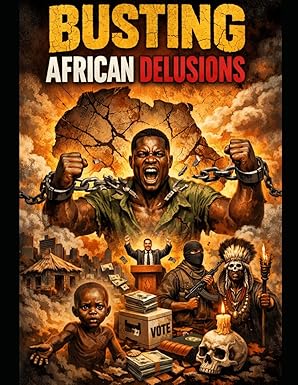 Busting African Delusions: Intelligence, Institutions and the Path to Progress
Lipton Matthews
Independently Published, 2026
We are told by our masters that there are no race differences in intelligence or personality and that countries with Sub-Saharan African populations are poor as a consequence of exploitation by Europeans. Busting African Delusions does precisely what the title states. Lipton Matthews, a Jamaican researcher, presents in tremendous detail the case that Sub-Saharan African population countries, whether in Sub-Saharan Africa or the Caribbean, are in the chaotic and impoverished state that they are because of the evolved nature of Sub-Saharan African people.
Matthews begins by dedicating his book to the late English psychologist Richard Lynn (1930–2023) who presented a huge amount of research on race differences in intelligence and personality and its causes. Lynn would present his research in a highly detached and dry fashion and Matthews follows in the tradition, though he provides some examples of such experiences of corruption in his native Jamaica.
Matthews explores national differences in socioeconomic achievement in detail and demonstrates that these seemingly come down to genetic differences in average intelligence, which is in the region of 80% genetic at the individual level. Of course, the poor environment of Africa may mean that the genetic contribution to intelligence differences is lower there. But, even if this is so, Matthews cites studies indicating that the prevalence of alleles that are associated with intelligence is notably lower in Sub-Saharan Africa than in Europe. Accordingly, Matthews argues in favour of Richard Lynn’s “Cold Winters Theory.” This is the idea that cold winters present difficult problems to solve and, as such, select for intelligence. There are exceptions here, such as the intelligence of Arctic peoples but this may be due to a combination of very small populations, meaning less genetic diversity, and never developing agriculture, as agriculture selects for future-orientation which is a key component of intelligence.
Having carefully refuted the many criticisms of national IQs, Matthews then turns to the consequences of this low average African IQ for African economies. Most starkly, it means very poor education systems and extremely low quality teachers. Almost 80% of maths teachers in South Africa do not meet the required national standard in Maths. There are 450 schools in South Africa that do not teach maths at all. The result is an innumerate society, with obvious consequences for economic development. I once met a South Sudanese man in northern Finland and asked him how old he was. He was actually a trained teacher but could not give a firm answer: “I think I’m about 40,” he said. Not knowing his birthday, he used the date he’d arrived in Finland as a proxy. Society is also relatively illiterate, meaning that the technological revolution does not assist in creating a more knowledgeable or innovative society.
Matthews then turns to historical African wealth and highlights the way in which there were some wealthy African countries, mainly due to highly successful slave economies. We are told to believe that there was little difference between Europe and Africa until the Industrial Revolution and our supposed exploitation of Africa. Matthews shows this to be wrong: by the sixteenth century England’s wealth was at least 3 times that of many modern African countries. This contrasts with African economic systems which Matthews demonstrates were far more clannish than European ones. In other words, African systems are not based around finding talented people and employing their abilities. Instead, they are very strongly based on who is related to you and how you can assist those who are related to you in return for them assisting you. Accordingly, they are inherently nepostistic and corrupt in a way that is not so obviously true in Europe. This is a particularly original section and I learnt a great deal about pre-Colonial African economic systems. Matthews further shows that colonialism itself was far less wealth-creating for the colonial nations than we are led to believe.
Matthews, in an extremely detailed work, also looks at a series of delusions with regard to African development. Corruption and low intelligence mean that remittances will not really help Africa and nor will international aid. Leaders will always end up being corrupt and the people there tend to be incapable of planning for the future.
Matthews then shows that far from utterly exploiting sub-Saharan Africa, European colonialism precipitated rapid economic growth in the region. The situation was nuanced however. Matthews observes that, “In French Africa, monopolistic trade policies allowed European trading companies to purchase goods from African producers at artificially low prices, sometimes extracting up to 60% of the potential revenue.” Even so, Africans generally earned well above subsistence levels and there was huge investment in infrastructure and education, particularly in missionary schools.
This is a dangerously revisionist book in terms of what we’re supposed to believe and this is no better encapsulated than in Matthews’ section on the European slave trade. He shows it was nowhere near as a big a part of Britain’s economy as we are led to believe. The UK was already well into the Industrial Revolution when the slave trade reached its peak, and Caribbean goods were far from central to the British economy.
Overall, this is a fascinating and eye-opening book which genuinely debunks the key myths about Sub-Saharan Africa and the reasons for its backward socioeconomic state. It is, however, written in a highly academic style. I think one of Matthews’ key selling points as an author on this subject is that he is Jamaican, though an obvious intelligence outlier by Jamaican standards. I would relish seeing him produce another book on this topic that is far more personal in nature. How does it feel to be a highly intelligent Sub-Saharan African, whose IQ is so many standard deviations above the mean? What unusual experiences or thoughts does it lead to?


Thanks. In Matthew’s group, he’s a literal genius
There are smart africans. I have met a few. I think their problem is that the bell curve is heavily skewed to the retarded end like India.
I’m in Silicon Valley. Tons of Indians and being working-class I’ve been in amongst them for years. A lot of nice people among them BUT …
A really typical situation is a brilliant Indian guy, top of his class at IIT (their MIT) gets a job with one of the tech companies here. Settles in for a year or two then sends home for his fiancee. She’s his fiancee because that was decided for them when they were both 8 or 10 years old. Anyway, here she comes. She’s … not brilliant. Doesn’t matter, she’s the wife.
She moves in and sets about fulfilling her life’s purpose: Churning out Indian food and churning out Indian kids.
Now, Hubby’s a genius. Wife’s IQ is probably measurable using two digits. Kids are … average. Very average. But they’ve been raised to believe they can just grow up and waltz onto the work force of some high-paying tech/defense/medical company. Why not, Daddy did it, and it was easy for him!
And this is why you can go to Sunnyvale and stop in at Wendy’s and have young Indians serving you beef burgers.
(Honestly if I were the ol’ man I’d be ready to work my 20 or so years, then decamp back to India where, at least as things stand now, I could receive my US Social Security and myself, Wifey, and platoon of kids could all live quite well.)
Nigerian surgeons and doctors in Britain are competent but should be back home where they are desperately needed. The birth-rate of low-IQ populations is a problem for all. Africa needs birth-control, arms-control and food-control.
“There are smart africans. I have met a few”
/Sarcasm ON
There are jews who aren’t chronic liars and who don’t crave the extinction of White Europeans worldwide. I have met a few.
/Sarcasm OFF
I have lived with several Eskimo populations and speak both Inupic and Kallallit. Eskimos are probably too small a population to substantiate statistical certainties. However, you will see that my books suggest that having thousands of generations that must deal with significant seasonal cycles(latitude 35 and above) will have had to adapt cognatively to those winter-summer stresses. Pretty inevitable. there is also the question of which start up populations moved north into more challenging but opportune environments. If it were not for the politics the science would be pretty clear here.
I vaguely adumbrate some elements of these facts in poetry and dramas, not to overstate it but not to avoid it either.
Look at THE ROMANCE OF BEING, an epic in the tradition of Dante and Homer. also the Girl War opera I am trying to film either in Japan or eastern Europe. NOT IN HOLLYWOOD OF COURSE.
In France, we’ve lost 10 IQ points in one generation.
On the other hand, when it comes to penis size…
This raises an evo-psy issue: supposing white women prefer long-tailed peacocks… Long-tailed peacocks have more difficulty escaping and are therefore more vulnerable to predators… I don’t know if I’m making myself clear?
Good man Lipton Matthews! Well done.
Lipton Matthews needs to stop being a pussy and start advocating for his African race that it does not matter what the starting point is regarding genetic differences between races, but what really matters is the application of aggressive Eugenics and Transhumanism to equalize all the races, and then to collectively raise all races to the status of demi-gods via eugenics/eugenics.
The world needs a eugenics/transhumanism arms race. China is already out. I spent a lot of time on Baidu.com search AI, and all the results showed that King Xi has explicitly banned eugenics/transhumanism. So, that just leaves the Ashkenazim and, well, no one else. No one else wants eugenics/transhumanism. So then, Lipton Mathews has his work cut out for him.
Don’t they have Magic Soil or is that only whitey?
It’s their behavior that’s the issue.
The trap to force us to explain their behavior, it makes us the target.
It’s interesting that East Indians administer Sub Saharan states, since Eutopeans were kicked out.
There really isn’t any place Sub Saharans have figured anything out – Trinidad has East Indians and Sub Saharans. Who commits all the crime? The Brits left the Africans in charge when they left (Were POed at India at the time), both were brought there as slaves.
The same vould be said for pre 1492 Americans: the highest crime state is New Mexico. What do i know about South America? It could disappear, and I’d never notice.
There definitely something about bloodlines here
A high IQ black like Matthews has to enter white society to meet others at his level.
Even the greatest genius needs contact with his peers.
I listened to this: https://www.youtube.com/watch?v=uJziEURHTv4 last night and for those of us who have not bought and read all of his books, this is, in my opinion, a VERY GOOD intro to Dr. Kevin MacDonald’s findings.
I’m planning a move in a year or so, so I can’t stack up the Kevin MacDonald and David Irving books right now. And what I’d read of MacDonald, I was not sure I agreed with. For instance, there are lectures by him on YouTube where he talks about White individualism vs. non-white collectivism and I’d think, “Wait, how is our individualism a good thing? I think it’s hurting us.” Well, Dr. MacDonald feels the same, and in this lecture he goes over all of that.
(I have my own theory that American individualism, maybe properly called hyper-hyper-hyper-individualism, has been inculcated into American culture by, of course, the Jews as one of their many “tenderizing the meal before consumption” things they do to erstwhile healthy societies.)
The Westerns / Cowboy and Indian movies.
Yep, pushed individualism.
Europe, the ‘rules’ for interaction are ancient and rigid. Ain’t a culture of individualism
Average intelligence is certainly a factor but probably at least as significant is social trust. Japan is a high-trust society with practically no natural resources but it thrives. African nations with abundant natural resources are in many cases devastatingly poor, because they are low-trust societies. It seems that the ability to transact reliably with non-relatives is an essential requirement for prosperity.