
1963 – 2002 From “The Vicar” to “Amen,” a Judeo-Franco-German story (how a Holocaust denier helped Gavras make his film)
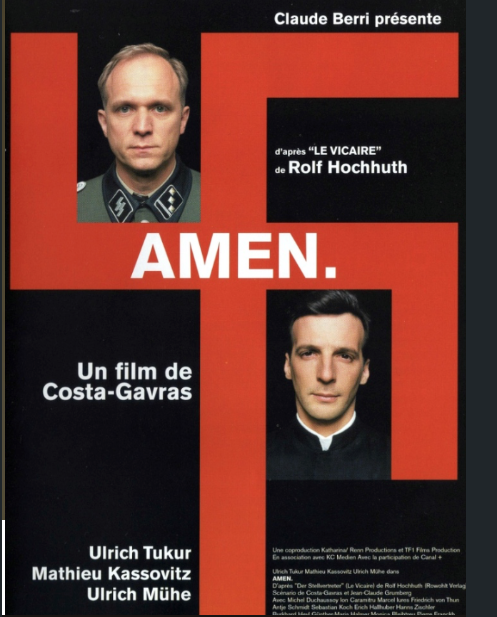
The idea for this article originated when, on May 18, 2026, I heard a rebroadcast of a 2002 interview of filmmaker Costa-Gavras by Marc-David Calvet on his show “Chants des toiles”, on the occasion of the theatrical release of his film “Amen”.
In this program, Costa-Gavras explains the importance of music in his films, especially for Amen, a film in which he chose not to show explicit images, letting the music engage the viewer to reconstruct the scene himself, based on what he himself had been able to learn about the Holocaust.
In other words, the conditioning is such that now only a few notes of music are needed for the entire unfolding of the Holocaust to play out in people’s minds.
And yet, as we will see with firsthand documents, it was a Holocaust denier who helped Gavras, the diehard Antifa, make his film!
1 – Wikipedia Data
Amen is a film directed by Costa-Gavras in an international Franco-German-Romanian co-production, released in 2002. It is an adaptation of the play The Vicar (Der Stellvertreter) by Rolf Hochhuth, criticizing the inaction of Pope Pius XII during the Second World War, particularly in the face of the persecution of Jews
The play premiered on February 20, 1963 in Berlin. It focuses on the unsuccessful efforts of a young Roman priest and Kurt Gerstein (with the historical figure, with whom Hochhuth takes many liberties).
Several critics have seen in the play as an attempt by Rolf Hochhuth to shift the blame for Nazi crimes from his fellow citizens to others, primarily the Pope, but also the Allied powers who chose to look the other way while the Holocaust unfolded. The hypothesis that the play was conceived by the Soviets to destroy the Pope’s moral standing has also been put forward, supported by evidence from the Vatican Archives.
The film follows the same vein; here is its synopsis:
During World War II, Kurt Gerstein, a German SS officer and chemist supplying Zyklon B to the extermination camps, sought to alert the Vatican to the genocide being perpetrated against the Jews. Ricardo Fontana, a young Jesuit advisor to the apostolic nuncio in Berlin, whose career showed great promise, listened to him. They travel to Rome, Ricardo believing that his father’s high-ranking position in the Vatican’s secular hierarchy would help convince Pius XII of the need for an unequivocal condemnation of Nazi crimes against the Jews. However, their efforts to stop the Holocaust find no support from foreign or religious authorities.
2 – Revisionist Objections
Accusing Pope Pius XII of passivity in the face of Nazism is absurd since, as Cardinal Pacceli (before becoming Pope Pius XII), he was one of the authors of the Encyclical Mit brennender Sorge, which in its paragraph 5 goes as far as to speak of a war of extermination (Vernichtungskampf).
On March 14, 1937, the Vatican had an encyclical by Pope Pius XI (actually written by Cardinal Pacelli, the future Pope Pius XII) read from the pulpit in all German churches, in German and not in Latin as was the custom. The Reich’s reaction in its note of April 12, 1937, for those who might not have understood, is very clear:
This is a truly clandestine and subversive action which aims to incite, or at least to push into passive resistance, German Catholics against the Reich, to undermine the unity of the country, to undermine the authority and legitimacy of the National Socialists, to turn the whole world against Hitler.
Regarding Kurt Gerstein, in 1985, the French revisionist Henri Roques wrote a doctoral thesis that dismantled the absurdities of Kurt Gerstein’s testimony. The thesis was so compelling that it was politically overturned the following year, in 1986, following the direct and public intervention of Jacques Chirac, then Prime Minister. The thesis has been translated into English; references can be found on CODOH.
3 – The behind-the-scene revisionist story: how the German play became a French film.
It was a Jew born in Germany on December 25, 1925 in Marburg and who emigrated to France in December 1935 with his family, who served as contact between Rolf Hochhuth and Costa-Gavras.
This Jew, who died in September 2021 at the age of 95, let us call him Isaac, the name he gives himself in his memoirs which he sent to me in March 2018, as being an “authentic document provided that certain surnames and place names are changed”.
In his memoirs, Isaac doesn’t mention Amen or The Vicar, but the name Hochhuth appears in this passage where we can already discern revisionist tendencies. And for good reason: Isaac wasn’t deported to the camps; he was conscripted into the Compulsory Labor Service, he worked in Vienna as a watchmaker, and no one bothered him, except perhaps the Allied bombers.
We were enjoying the warm caress of the sun after a cold bath when we heard a distant rumble that grew louder for perhaps twenty minutes, until it became deafening, while hundreds of white trails appeared in the sky to the west, at a very high altitude. It was a formation of bombers approaching the city of Johann Strauss and Freud. A spectacle just as Apollinaire would have liked to describe it when he composed his poems glorifying war: “God, how beautiful war is!” We were fascinated and couldn’t tear our gaze away from this gigantic hydra that occupied a large part of the sky. The first flying fortresses were approaching the suburbs, and anti-aircraft fire filled the air with its small white clouds.That day we only saw one aircraft go down. We could follow the explosions on the ground and we amused ourselves, yes, we amused ourselves, trying to guess which neighborhoods, which avenues, which monuments were hit. I couldn’t say how many planes participated that day in this act of war against the civilian population, but it wasn’t uncommon for these attacks on German cities to be carried out by several hundred, or even a thousand, aircraft. A truly Dantesque spectacle, described and highlighted in horror by the English historian David Irving and then by the German playwright Rolf Hochhuth in Soldiers (Le Seuil).
But by the time he was preparing the film Amen, Isaac had already embraced revisionism. Below, in chronological order, we present three emails in which he gradually reveals the inside story of the Amen/Gavras affair.
Email 1, dated January 8, 2007, original subject “the biter bit”, Sender: Isaac.
Forwarded on January 10th with the subject: “Hochhut excluded from the Basel Book Fair”.
The Basel Book Fair illustrated the absurdity of the anti-revisionists. The German playwright Rolf Hochhut, the most virulent denouncer of Auschwitz in his play “THE DEALER” in 1963, a subject recently revisited by Costa-Gavras in the film “AMEN”, although he has persisted and signed off on his exterminationism for 43 years, could not participate in this fair because he was considered a DENIALIST!
He told the Swiss magazine “WELTWOCHE” that the organizers had made it clear to him that there was no place for him in Basel. He is considered a Holocaust denier because he had spoken favorably of the British revisionist David Irving (he later recanted). He had merely acknowledged Irving’s qualities as a historian until he attacked sacred dogma. It had to be said: Could one imagine Robert Badinter among the ardent defenders of the death penalty?
This is also the case in Germany where a simple smile in the courtroom of the Zündel trial sends the president of the court into a complete rage!
Email 2, dated February 18, 2007, subject: “confidential Gavras”, original sender: Isaac
In this crucial email, Isaac reveals his letter to Costa-Gavras dated May 25, 2006.Dear Costa-Gavras
I acted as your intermediary and translator two or three years ago in your negotiations with Hochhuth. I enjoyed your film AMEN, as with all your films, primarily for its cinematic quality. You or your wife had hinted that you would invite me to the premiere, but there was only silence after my letter in which I mentioned the scruples that had assailed me when the author of The Vicar had requested my friendly intervention. I accepted without enthusiasm and carried out my request to the best of my ability.
I am writing to you again today because I want to believe that you are a man committed to justice and freedom. Your work bears witness to this. I had previously informed you of the conviction of Gilbert Dubreuil, author of *A Case of Defiance*, hoping that you would have been outraged by this injustice. Today I have learned that Ernst Zündel, a German-Canadian revisionist, has just been sentenced in Mannheim to five years in prison, the maximum sentence, for the same reasons as Gilbert Dubreuil.
Dubreuil’s work was simple, honest, objective, and well-documented, recounting a development somewhat similar to my own. After thirty years of Holocaust denial, including through Hochhuth, I took the time to educate myself, to read revisionist works in detail, and came to the conclusion that a genuine, open debate needed to begin, as the Iranian president dared to do. Ernst Zündel, like Dubreuil and many others, is an honest, upright, and rigorous man who strives only for accuracy, objectivity, and historical truth based on facts and scientific realities. He is not the first victim of this inquisition that stifles freedom of expression, freedom itself, and the most basic human rights. The repression is taking increasingly intolerable forms: economic strangulation, ruined careers, exile, and now prison. And no one dares to defend these courageous people, like Luther and so many others before them, who did not simply humbly say “e pur si muove” but who persist, despite insults, outrages, and brutality, in affirming something that seems true to them…..How can you, dear Costa-Gavras, a paragon of commitment to justice and truth, not engage, cautiously, in this revision of history… which cannot be long in coming, for there are people in the world who take the trouble to inform themselves, to read, to open their eyes to the most formidable mystification perpetuating the legend of the uniqueness of the so-called genocide, of the supposed will to exterminate a people by the Germans? It took me years to evolve and finally face the facts.
No one is safe from the vengeance of those who benefit from the lie, not even you if you dare to make the slightest allusion to the problem. Abbé Pierre was once demonized. Garaudy is still called despicable.
But one can still, in the name of human rights, demand the repeal of the Gayssot law which prohibits the revision of history and makes the Nuremberg judgment an intangible taboo, even if a large number of its claims have since been contradicted.
Dear Costa-Gavras, dear Madam, I no longer know what to say…Act as your conscience tells you….
There are no people more innocent than revisionists who are simply claiming what is the honor of the historian: the right to uncover the lies of history.
Email 3, dated July 7, 2014, subject: Hochhuth, sender: Isaac
This email reveals what was the reaction Gavras took in response to the letter Isaac had sent him. That is to say, none.
The Holocaust Tsunami
On February 20, 1963, in a still-divided Berlin, a pivotal event in contemporary history took place. At the Freie Volksbühne theater, a thousand privileged spectators attended the premiere of a play by a young unknown, “Der Stellvertreter” (The Vicar), which unleashed a tsunami whose waves are shaking us today more than ever. The author, Rolf Hochhuth, had unearthed among the testimonies from the war the account of an SS officer, Kurt Gerstein, describing an attempt at mass killing in a gas chamber, a prelude to the extermination of the Jews, as well as the steps taken by this fervent Protestant to inform the Vatican. He turned it into a drama denouncing the silence of the then Pope, Pius XII, who should have called out to the world against such an abomination. No one can fault the author for having used this text—in good faith—to make Germany feel guilty by stirring public opinion through political theater.
Having never understood why the Pope, who is said to be God’s representative on earth, had never forbidden any Catholic, under pain of excommunication, from bearing arms and participating in a war, I rejoiced to finally see the truth revealed. Was this not the message of Christ? Seeing a pope accused of failing in his papal duties, I rushed to Berlin and, paying little attention to the Jewish problem, wholeheartedly approved of the play’s premise. When it was performed in Paris a few months later at the Théâtre de l’Athénée in a translation by George Semprun, my heart swelled upon hearing the line criminalizing the Holy Father. Violent demonstrations were organized against “The Vicar” by the papologists to have it banned. It was all in vain. It was then that I met Rolf Hochhuth, whose translator I became. Lacking contradictory information, I shared the author’s thesis and the firmly established belief in the extermination of European Jews in gas chambers. And in all good faith. Which just goes to show how “good faith” can be destructive!
Since then, revisionists of all stripes have ruthlessly refuted the lie that had taken hold and gained momentum, thanks in part to Hochhuth. The thesis by researcher Henri Roques, devoted to the implausibilities of Kurt Gerstein’s confessions, definitively destroyed any remaining credibility he might have had. The play became historically obsolete. But the damage was done, and since then, the supposed survivors of this fabricated extermination have relentlessly reinforced the edifice of lies. It has poisoned all nations since the creation of the State of Israel. The teachings of this imagined genocide, now an article of faith, are spreading throughout the world. The more people become aware of the rigor of revisionist researchers and the irrefutable nature of their findings, the more intense the delaying tactics of those who profit from this treachery become.
To heighten our awareness of the dangers that threaten us, the British writer Orwell created a terrifying world. Hochhuth, for his part, created a nightmarish Auschwitz on stage, dramatic to the extreme, much like Perrault brought a legendary ogre to life in his fairy tales. Fortunately, the awakening brought us back to reality. Certainly, Jews, like Poles, Dutch, Norwegians, Lithuanians, GIs, British soldiers… and especially Germans and Russians, perished because of the bloody madness of a war founded on lies! A tragic massacre!
Costa-Gavras made a film based on The Vicar, placing Kurt Gestein at the center of the action. I acted as an intermediary between him and the author for the acquisition of the rights. I was a loyal interpreter and friend, all the while betraying my convictions. I simply asked Dr. Henri Roques to send his book to the director to clear it before he embarked on a risky venture. The film AMEN, alas, adhered to the accepted version. I later delivered my revisionist message to Costa-Gavras, who then ceased all contact. Such is the way of the world.
So, whatever one thinks of the Holocaust and Nuremberg, we hope that the reader will have appreciated this little piece of French revisionist history which we dedicate of course to the memory of Isaac.
And the reader now knows that it was a revisionist who helped convert the play into a film: we see who is open-minded, and who is not.




Thanks. The lies had gone around the world 500 times before Isaac started to tell the truth. And the jews used their $$ to destroy the truth tellers and seekers.
Maybe Hitler had some issues, made some mistakes, etc etc. But he was right about kicking the jew out of Germany.
What would be better: a person like Hitler or a person like Trump running the USA? It’s weimar usa at present, with hidden inflation.
Trump is “our most Zionist president”. He’s married his children into Jewish families, is surrounded with Jews, and does the Jews’ bidding.
That besides his pedophilia, many, many felonies, the fact that he led an insurrection, and his utter, utter, financial incompetence.
Herr Hitler every time!
And I, as a Buddhist who considers the Abrahamic “God” to be a preta and to be avoided, hope to live to see the swastika restored as the symbol of order, completeness, and peace that it is.
When I was a teenager our favorite unintentional comedy was the propaganda film Reefer Madness. I think the French film Survivre Avec les Lupes far surpasses this today (https://www.imdb.com/title/tt0962782/). Regarding the article, the idea that Germans would use time release bug pellets that needed to be heated for activation is really just comedy now.
Costa Gavras is 93 years old and still alive, I hope he reads TOO!
So, Isaac Adolphe Schlingelstein is Jacques Vecker.
But Jacques Vecker or Jacques Vicar?
Kids nowadays see the Gaza genocide occurring in real time- There is no debate as to what’s happening, and who’s doing it.
The perpetrators tell you verbatim that they’re clearing out the Palestinians.
Nobody cares what happened in Eastern Europe eighty years ago, it’s ‘old news,’ let alone taking any time to study it, argue about it.
There isn’t any context- despite frantic attempts to put it in our faces again and again. It just sounds cliche when kikes say ‘But me mum died in the Holly’
And that’s exactly what should occur- don’t debate, don’t bring up facts, don’t bring up authors, don’t say they deserved it, even.
Don’t give it any further exposure.
Just bring up Gaza, and don’t bother to even compare it to the Holly.
@ Frank
Not good enough to stop study or debate about what happened 80 – or 110 – years ago in eastern Europe to or by the “kikes”.
The Holocaust Myth is that the NS leaders planned and partly succeeded in gassing six million Jews, a fabrication embellished by false memories and demonstrable fictions. Peter Winter’s “The Six Million” is a useful single critique. The Myth is used to justify the existence of Israel, and to deflect or silence criticism of its policies and of various activities of Jewish people.
The Holocaust Reality is that NS leaders believed in a war against the Jews regarded as a criminal race of parasites, and liquidated many of them in the process by various methods. Jeffrey Herf’s “The Jewish Enemy” is one useful source of documentary evidence that revisionists tend to gloss over or disingenuously discredit.
Instead of a futile clash between bigots, there is some semblance of “debate” on the internet; see e.g.”Holocaust Controversies” vs Carlo Mattogno online.
Yes,yes,yes- the only people who ever took on the jews -or not- in the last 3k yrs was the Nazis- or not much, or maybe it was everybody, but how much?
You’re missing the point, jews have useful idiots endlessly discussing precisely what they want you to discuss.
Elaphantine Island?
1066?
General Order number 11?
Oh no.
And for sure don’t discuss what they are doing to Palestinians, to Lebanese, to Iranians, to Syrians.
The Hoax is dead, and you’re doing chest compresions live a madman, trying to bring it back
I’m in my early-mid 60s and growing up in the US, was essentially “raised” on the holly.
These days, I have more perspective. All large medical facilities, detainment camps, etc., had ovens. They were hygienic purposes. I believe David Irving, among others, analyzed these things and by the time you count in people emigrating, old people not coping well with leaving their homes, and an epic typhus problem, I’m pretty OK with the 270-odd thousand figure.
Plus, Jews will happily prey on other Jews if no one else is available. Jews were the “Kapos” and essentially ran the camps. Just as in “israel” today, the poor and weak are preyed upon in Jewish society. Thus you have cases like the one of a Jewish woman taken prisoner by the Palestinians on October e7, not raped, then was raped by her fellow Jewish “rescuers” when she was released.
The travesty and tragedy of Nuremburg needs to be common knowledge but I agree. Nobody cares about Nazi shrunken heads or if they do they think it’s cool.
The “shrunken heads” scam is an outstanding example of the meretricious material produced at the so-called war-crimes tribunals; ridiculous fiction mixed with fact for a propaganda spectacle. The revisionist “Holocaust Encyclopedia” is excellent on these now easy targets, but unconvincing on much more serious issues, such as the dismissal of the authentic Posen speech on killing Jewish children as Himmler just blabbing. Jewish propagandists have not helped their case with obvious nonsense, however gullible their own children and gormless goyim may be. It is quite true that people are tiring of “The Holocaust” and “Antisemitism” not only because of the Middle East carnage, but the existence if other ethnic conflicts around the world. I think some posts on this blogsite misread the Jewish opposition to immigration of anti-Israel groups and its recent reversal of outlook over wokery.
Very good remark from R-L B:
“At that time, the time of Jacques Vecker (Isaac Adolphe Schlingelstein…), Gilbert Dubreuil, Pierre Guillaume and of course Robert Faurisson, (and many others…), it was still possible to believe in the misunderstanding, in other words, we still wanted to believe in the misunderstanding despite everything.”
Robert Faurisson was not “infallible” like “Hitler’s Pope”, but he was an honest and courageous man, who suffered for his efforts. One of his best contributions was his analysis of The Holocaust as a quasi-religion. For many Jews it has replaced “G’d & the Torah” altogether, and the Chosen have become the Untouchable. It has also become a pivotal “icon” of the secular west, albeit losing some of its gloss thanks to Netanyahu’s wars. Nevertheless, it is slowly superseding the Christian faith, with the failed extermination of the holy people and the resurrection of their holy land replacing the crucifixion and resurrection of the god of the “New” Testament, which is blamed in turn for the “antisemitism” that “led to the gas chambers”. Incidentally, there are Jews who have also made observations like these.
Anyone who’s been watching my (boring) posts will know that I was actively pursuing the path of conversion to “Reform” Judaism to be sure but Judaism is Judaism.
I went to the services, sang the songs, did the holidays, etc. I took classes. Being the good goy* I am, I aced these too.
One of the things Jews, at least these Jews, agonized over, was that besides the story of the holly, they didn’t have much to mobilize people, not even their own people. Even they know everyone tires of this one-note samba eventually. It’s considered a real problem because other than the holly, they have no compelling story “proving” they’re good and worth being a member of, or supporting, etc.
Now, in the media, the real story is coming out. They are as endearing as syphilis or the smallpox virus. Whether Ben-Gvir style genocidaires, Reform-Jewish hippy dippy genocidaires, anti-Zionist Satmar genocidaires, nice liberal let’s-heal-the-world genocidaires, or Bob Dylan, noted stealer of Woody Guthrie’s work and even mannerisms, beloved by hippies and sending every shekel he can to “israel’s” genocidaires, they’re all, in the end, genocidaires.
“Saving” them is like saving the guinea worm.
But as the tired saying goes, do your own research. It’s all online. You can read the weekly Torah portion along with analysis from the Talmud, the Chabad creepos make this all easily available. It takes a year to go trough the Torah and it’s only 15 minutes or so a week.
You can study the 613 mitzvot, or good deeds. The 198th is a real hoot. Here’s saving you a search: https://www.chabad.org/library/article_cdo/aid/961572/jewish/Positive-Commandment-198.htm ponder this while you look at your credit card statement at 34%.
*OK ok I’ve kept y’all in suspense long enough. A few years ago, I took one of those DNA tests we’re all so fond of. The reason for this was, while my father was pure WASP as they get, relatives on that side in the DAR and all that, I had some real questions about my mother.
I know her side came out of Lithuania, and I know “the great intermarrying” really didn’t happen until the 60s and later, my parents being married in the 50s, and before that, people married within their own ethnic/cultural group pretty exclusively. So if my mother was a Lithuanian whatevertheyare, that whole side will have been Lithuanian whatevertheyares all the way back to the Old Country.
And there are/were some eyebrow-raising names in there. So I figured this is shit-simple, send off for a test. I suspected I might actually be Jewish. I had reason to suspect this, as I have the kind of golden tan that’s the envy of people in Newport Beach, where I lived for a while both as a little kid, high schooler, and middle-aged adult, and while they have to spend serious time in tanning beds or on the beach, mine comes with no effort at all. Ha!
But how do you get that golden color, out of Lithuania? The place is north of Poland, not exactly tropical. For better or for worse, I figured I knew the answer, and only needed the test to confirm it. I was convinced!
The test came back and I joked to my friends that I’m like Ivory Soap, 99 and 44/100ths pure, European. English-Scots on the paternal side, Lithuanian on the maternal. Nothing else.
That puzzled the hell out of me though, and it took a lot of digging around online to find out that a lot of Eastern Europe had all sorts of groups passing through, and I found discussions by vacationing Brits wondering about “yellowish” or “sallow” people in Lithuania. It turns out these are Lithuanian, or Lipka, Tatars.
They’re an interesting group. The first wave of them came into Lithuania and became useful as warriors and craftspeople, and actually helped defend Lithuania against later waves, as the first wave came before Islam started trying to conquer the world, and successive waves after.
I find is particularly funny that Cossack didn’t mean a particular group but was more of an occupational title. If you were warlike and used to riding a horse and shooting arrows and burning huts and stuff, Have we got a job for you. And so, there’s a chance some of my ancestors were the very Cossacks feared by Jews in the Polish-Lithuanian Commonwealth.
The anti-Catholic attack is blatant.
It refers to a vicar,
but the Vicar of Rome is simply the Pope.
The allusion is inevitable
The phrase “Hitler’s Pope” was quoted ironically from anti-Catholic sources. Most informed people know that the Pope is known as the Vicar of Christ. Faurisson wrote an account of Pius XII’s “revisionism”. The relationship between the RC Church and the NSDAP was not smooth. It might make an interesting article here, especially if it annoys Mr Frank who thinks we mustn’t discuss the events in Europe between 1933-1945, even though Israelis and their overseas lobbies use their version of events to “justify” what “they are doing to the Palestinians”, etc.
Fools rush in where angels fear to tread, and vice-versa, and the “Holocaust” (as it was called especially after the Six-Day war, in reference to holy victims sacrificed in flames like crematoria) is no exception, where “discussion” occurs. The books and articles on it must themselves exceed six million in English alone, never mind screen material.
But I would like to add my 2p of scepticism to this mountainous stack.
I well remember some films, such as “Shoah” with various odd and unlikely features (such as the hair-cutting of victims before they went into the execution room next door) and aimed at the Poles as much as Germans. Then there was Kitty Hart-Moxon OBE, who told viewers how she was sunbathing on a slope while Jews went into the nearby gas-chamber and came out as smoke at the other end; later she spotted a human tooth in the grounds which she showed her son. Another film described the row of cells occupied by war-criminals as the gas-chambers.
The prestigious Cambridge Perspectives in History published “The Holocaust” by Peter Neville which recommends as a survivor memoir Wilkomirski’s “Fragments” which is an impudent fabrication, and not the only one. Hugo Gryn’s account of his boyhood discovery of a gas-chamber in Auschwitz was another curiosity.
“Never Again” requires a constant supply of new angles or discoveries or plays – satirised as “I was Ann Frank’s Parrot”.