
Review of The Last Men and their tendency for liberal politics
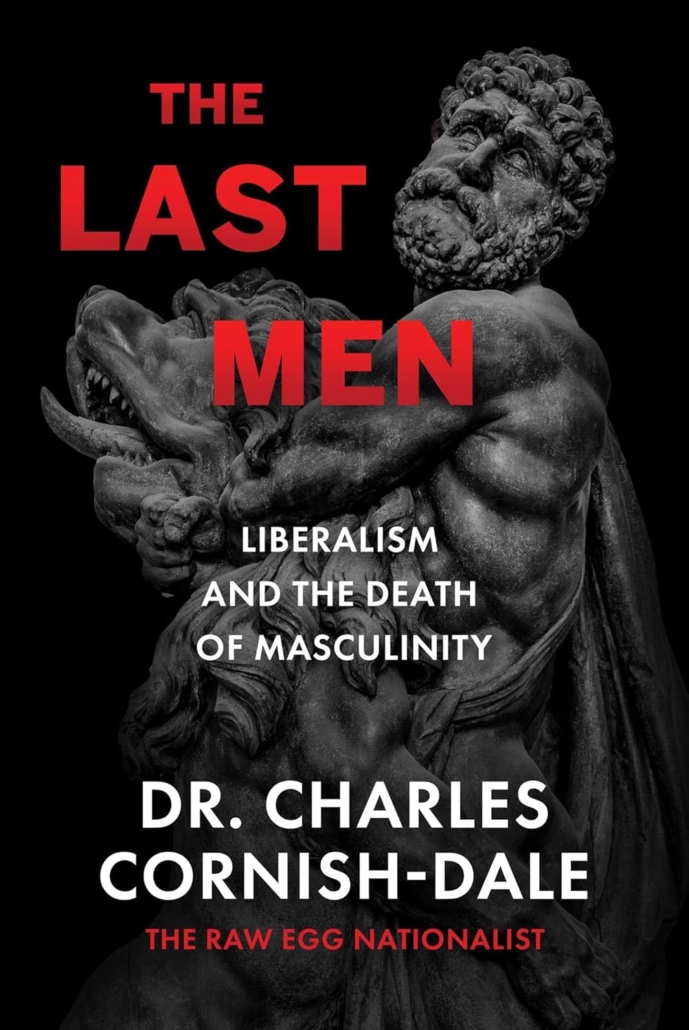
The Last Men: Liberalism and the Death of Masculinity
Charles Cornish-Dale
Passage Publishing. 2025
“A cross between Jordan Peterson and The Most Interesting Man In The World, Nationalist blends the sensational with the scientific. Dr. Peterson shot to fame telling young men to clean their rooms; Mr. Nationalist is busy telling men to clean up their diets.”
—John MacGhlionn, The Federalist
“A man’s testosterone levels may be the difference between a life of sex and success and a life spent rotting in a fetid basement, playing video games and eating chicken tenders heated up in the microwave by Mum,” explains Charles Cornish-Dale is his fascinating yet slightly frightening book The Last Men: Liberalism and the Death of Masculinity. He goes on to introduce us to the hikikimori, Japanese “herbivore men” who have done exactly this. Completely lacking in any kind of drive whatsoever, they have simply dropped out of life. This phenomenon, argues Cornish-Dale, who is more commonly known as “Raw Egg Nationalist,” is increasingly being seen in the West.
The West has become an anti-masculine society. Cornish-Dale reminds us that Francis Fukuyama’s infamous book title The End of History, which people quote as hubristically implying that the world’s conflicts are over, was actually The End of History and the Last Man, and he notes that it actually alludes to something particularly poignant. Man has always built a society in which he can engage in what the Greeks called thymos; the ability to thrust. However, with the key political battles won there is no longer room to do this. Instead, we see the victory of the submissive slave who will conform to the system. There is nothing left to strive for, so what are men supposed to do now?
This, argues Cornish-Dale, is the unfortunate situation that the “the last men” find themselves in. Indeed, there are many ways in which modern society is actively reducing their testosterone levels; actively making them into lesser men. Studies find that average male testosterone levels are falling year on year, contributing to a growing fertility crisis among Western males. A significant contributor to this is endocrine disruptors which are found in plastics and numerous other industrial products by which we are increasingly surrounded. Cornish-Dale points out that Alex Jones was roundly mocked in 2014 for ranting that certain herbicides were causing frogs to become gay. However, it appears that he was correct, and the same is true in humans. Certain industrial products do actually appear to be feminising men and so rendering them less heterosexual and less fertile. Cornish-Dale presents evidence that the epidemic of transgenderism in recent decades might possibly be related to endocrine disruptors.
There are also very specific industrial products that have been shown to interfere with masculinisation. Diethylstilbestrol (DES) was given to millions of pregnant women in the mid-twentieth century who had a history of miscarriages. It may have stopped them from miscarrying but it had a devastating impact on their sons: “Exposure to DES in utero has been linked to terrible reproductive abnormalities in both sexes, including undescended testicles and micropenises in boys . . .” A class of chemicals known as phthalates are used in many plastic products. They lead to reduced semen quality and lower testosterone. Cornish-Dale notes that if you use these plastics to store food then they will leak into the food and, by extension, into you and they can be transferred to a baby via breast milk. At one point in the book, Cornish-Dale notes that micro-plastics are in all of us and all parts of our bodies including the “meat,” that is within the tissue of the penis.
Naturally, argues Cornish-Dale, this has a serious impact on politics. If men are low in testosterone, they lack not just sex drive but any kind of drive—the two are intimately connected. They become docile, permitting replacement migration, but this can never work because it doesn’t take long before testosterone begins to drop among the immigrants as they begin to be exposed to the same industrial chemicals. Also, observes Cornish-Dale, various liberal ideas, such as vegetarianism, cause a collapse in testosterone as well. The obesity epidemic, caused, in part, by a lack of exercise and the consumption of appalling food—in particular, highly processed food—further adds to this testosterone decline.
Cornish-Dale sets out a clear manifesto on what needs to be done, giving advice that reaches into minutiae of everyday life. Use wooden chopping boards; don’t use plastic ones. Don’t store food in plastic and for goodness sake don’t microwave food if it’s on a plastic plate because this will cause serious leakage of plastic into the food. Much of his advice is common sense: exercise, lift weights and eat meat. One of the problems with this area of research is that it is so often espoused by obvious fanatics; “gyms bros” and the like. The Last Men is popular-academic in style. It carefully and reasonably argues its case and fully references its assertions with copious academic studies.
As a person who has researched the causes of changes in political viewpoint across time in the West, I found The Last Men very persuasive. Male testosterone is in decline and this, surely, at least in part, helps to explain the feminised kind of men who, as studies show, tends towards liberal politics.




Reminds me of the 50s book, The Organization Man, by White. White was a business guy. His book remarked the , uh, organization man of our society, contrasting it with the ideology of the Protestant ethic which he thought favored the Individualistic Man.
Now we have the gynecological man, which is even worse, with the ladies enforcing a reign of error by their warm/fuzzy group think/toxic masculinity hating, nigger loving, etc. So here we are and the plastics are probably part of it.
How the Anglo Saxon male recovers his hate is going to take severe conditions. In Menlo Park where I live nearby, I experienced for the first time a beaner male giving me his hate stare. I also noticed a couple beaner females inside my Peet’s coffee house, for the first time. A couple years ago, the little park next door, Fremont Park, named after Fremont the explorer of the American West, including the first boat trip down the Colorado River I think, speaking of toxic masculnity, anyway the park was loaded with beaners, thus keeping Whites out of it. The beaners have a big park right next to Redwood City where they live.
They have not come back en mass since. I think the cops had a chat with them.
Anyway, since beaners are now officially 41% of California, probably more since a lot of them keep silent when they are criminals, etc. Be that as it may, White Hate is just reserved for A-rabs, Persians, etc. I got a good dose of that over the last couple days when I tried to have a chat with two of them in two different incidents. Older White upper middle types. The young Whites of course have been awakened by the internet, a source of lots of discontent in families of these folks.
So the Gynocracy marries into the Organization Man and ‘all in the family’s’ ground has shifted toward more rancor.
Crazy Ladies and Judaized , I hate to say Men, just formerly males, luv The Jews and obey the Organization’s dictates.
Then there is the class struggle factor, which is coming soon when the
Free Money runs out.
A couple years ago I asked two different Chinese gals in their 30s, why seeing Chinese women with White guys seemed odd and how come? They both said the exact same thing. “White guys treat you better and, for Asian men it is just all business.”
Professional men are hopelessly trapped in the racket of PC , Jew luv, and so on. The Gynecological Trap is further wrecking normal mate selection, with a large portion of gals competing for the top couple per cent of Successful cucked White men.
The only hope generally is social breakdown as race and class struggle commences.
To be fair to the “beaners”, the “beaners” are in the park because they actually *go* to the park.
Go to the park off of Maude Avenue on the West side of Sunnyvale and the park is full of Indians, again because the Indians actually go there. They’re big on walking.
Americans don’t walk. It’s “menial” or something. Americans don’t take their family, wife and kids and all, to the park, cook stuff, kick a soccer ball around, and just hang out with their family. Dad’s at work, Mom’s probably at work too, and the kids, if they’re not doing what most do, coming right home from school and spend the afternoon with a game controller in one hand and a chicken tendie in the other, are in highly structured “sports activities” not in some park with the commoners.
As for the guy mean-mugging you, I don’t know what to say. I used to get a couple tacos at a local Mexican market and one day, for some reason, the ladies behind the counter decided they didn’t like me and wouldn’t serve me. I think they had me mixed up with someone else, frankly. Fine, I decided, I can get the same tacos at Del Taco up the street.
The thing is, all these non-whites are in the parks and public spaces in general because they’re from countries where public spaces are for the public and are used by the public. You know, like it used to be here in the US a generation or more ago.
You know who you *really* won’t find in the parks? Jews. They’ve got their own “community centers” and they’re nicer than any park. And they’re going off on vacations and on “birthright” trips to “israel” on our dime.
… Article Key Points
Testosterone prescriptions have surged despite stable hypogonadism rates, often bypassing guidelines, leading to potential misuse and health risks. The study underscores the need for guideline adherence to ensure safe and effective testosterone therapy.
The investigators conducted a retrospective chart review of 200 men who had a recorded diagnosis of hypogonadism and had received a testosterone prescription between January 2020 and January 2025. The records were analyzed for symptoms of hypogonadism, laboratory diagnostic evaluation prior to index testosterone prescription, and relative and absolute contraindications to testosterone therapy.
Adherence to the Endocrine Society guidelines for hypogonadism workup was defined as conducting two separate morning testosterone tests and additional pituitary hormone testing (luteinizing hormone [LH] and follicle-stimulating hormone [FSH]) to distinguish between primary and secondary hypogonadism in men found to have the condition. Contraindications to testosterone prescriptions included elevated prostate specific antigen (PSA), defined as > 4.0 ng/mL; a history of prostate or breast cancer; elevated hematocrit (> 50%); and obstructive sleep apnea.
Age at first testosterone prescription ranged from 18 to 87 years (mean 52.5). Most were White (85%), non-Hispanic (95%), married (66%) and sexually active (67%). Overall, 46% reported alcohol use and 60% were nonsmokers. Reasons for evaluation for hypogonadism included fatigue (63%), erectile dysfunction (62%), decreased libido (54%), and patient request (25%). Comorbidities included obesity (63%, mean BMI 33), hypertension (52%), depression (40%), diabetes (28%), and arthritis (28%).
While all participants had at least one testosterone level measured, just 12% of men who received testosterone had two low morning testosterone levels (total testosterone < 300 ng/dL, free testosterone < 70 pg/mL, or low bioavailable testosterone, between 5 AM and 10 AM), had LH and/or FSH measured, and no contraindications to testosterone therapy.
Nearly two thirds (62%) of patients had a PSA test and 77% had a complete blood count measured in the year prior to the testosterone prescription. Looking at contraindications, 55% of patients had documented obstructive sleep apnea, 4% had prostate cancer, and 1.5% had an elevated PSA prior to the index testosterone prescription.
The medical specialties of the testosterone prescribers were 45% primary care, 35.5% urology, 18% endocrinology, and 1.5% by other specialties. Topical formulations were the most common (68.5%).
Patient characteristics significantly associated with an appropriate diagnostic evaluation included having two or more comorbidities vs fewer than two (odds ratio [OR], 0.25; P = .02) and an endocrinologist as the prescriber compared to primary care doctor (OR, 12.05; P < .01) or urologist vs primary care physician (OR, 5.62; P = .04).
Although testosterone can benefit men with true hypogonadism, inappropriate prescribing carries many risks, including worsening hypertension and sleep apnea, Papaleontiou told Medscape Medical News. It can also shut down the body’s natural testosterone production, leading to low sperm production and infertility, she added.
“There is also concern about misuse or abuse, especially when testosterone is used without a clear medical need or at higher-than-prescribed doses,” Papaleontiou said.
The finding that 25% of testosterone prescriptions were initiated following patient requests is probably partly attributable to direct-to-consumer advertising, Papaleontiou noted.
“Testosterone-related content on social platforms has significantly increased over the last several years. Testosterone has been coined as the ‘fountain of youth’ to optimize performance through enhancing muscle and improving energy levels in social media, and direct-to-consumer advertising, coupled with dedicated ‘low T’ clinics, availability of patient-friendly testosterone gels and patches, and ambiguity in guidelines about treatment of age-related decline in testosterone levels, probably all drive the trend of increased patient requests for testosterone,” Papaleontiou said.
Asked to comment, session moderator Channa Jayasena, MD, PhD, professor of reproductive endocrinology and andrology at Imperial College London in the United Kingdom, also expressed concern about overprescribing.
“This is a problem of our time in that there's a worldwide explosion of prescribing, often from private providers and increasingly from very corporate entities with reduced clinician involvement,” he told Medscape Medical News. “Even in an orthodox, traditional setting, there are examples of things not being done as they should.”
Widespread overprescription could have broad consequences, Jayasena said. “I think it's more important than ever to actually ensure that we're giving testosterone to the right people, because if we don't, it makes a lot of clinicians nervous about giving testosterone to anyone. So, by overprescribing, what we see is actually underprescribing, because people are afraid of it,” he explained.
Jayasena pointed out that there is debate in the medical community about what constitutes low testosterone and who should be selected for treatment. “Where men have potentially reversible causes of testosterone, should you be sending them for GLP-1s or lifestyle or straight for testosterone?” he said. The study shows that “there's a lot of variation in practice, which means that some men are being overtreated, but I also think that some men are being undertreated.” …
From: Testosterone Prescribing Often Ignores Guidelines – Medscape – June 14, 2026.
Maybe this is not a “problem” with Western men and women, and their diet and other factors of choice, but is an unavoidable long-term trend caused by growing spiritual awareness. It makes total sense from that point of view. In spirit, we are not in these male-female roles, which are entirely for the purpose of reproduction. Is there any reason for 8 billion physical bodies living on this planet? Does a soul/spirit need a physical body to experience living? Do advanced souls need to keep experiencing one more lifetime? My answer in the 2020s is, clearly not.
Many persons today are recognizing that they have spent enough time on Planet Earth, plus our science is telling us there is much more to know than what we learn/think/believe here. Particularly Whites and Asians. We’re ready to expand beyond what we’ve already done. Thus, we don’t need to keep reproducing more bodies in the same old way.
It’s not surprising that men, who on the whole are less spiritually inclined/intuitive than women, are more upset over this.
European White males must also learn martial arts. The mud flood necessitates it. Hordes of violent negroes and sand negroes wielding knives have become a reality. Survive or die, your choice.
Too time consuming. Just learn how to punch hard, and run like hell when you are outnumbered. Also, a small firearm that can be concealed is a good idea. The martial art of your choice is basically to build confidence and fighting spirit. Get warlike in your personality and good punching will follow.
White western populations: lower sperm counts, rising “neurodiversity” and homosexuality. Genetic factors? Pollution
Any thoughts (apart from the jooze are behind it all)?