
Hitler, Germany, and the Jews: Context Is Everything, Part 2
Perceived Jewish Faults
While the biological definition of other races was the fundamental cause that made them unwanted, the perception of specific faults acted as a catalyst that lowered resistance, justified the nature of the measures, and mobilized popular consent for the program. As such, the faults did not cause the rejection of other races, but they made the rejection actionable and socially acceptable to a broader segment of the population. And again, these are perceptions. They do not apply to all German Jews of the period, but they were common enough and well-grounded enough to become accepted by wide swaths of the German population.
Parasitism
Jews were especially targeted because Hitler and the Germans believed they were a racially alien group engaged in economic, political, cultural, and moral subversion. They were widely perceived as parasites sucking the blood of the nation. Here is how Hitler felt about them:
People who can sneak their way, like parasites, into the human body politic and make others work for them under various pretenses can form a State without possessing any definite delimited territory. This is chiefly applicable to that parasitic nation which, particularly at the present time preys upon the honest portion of mankind; I mean the Jews. [1]
On July 2, 1922, in an interview with a Chicago Tribune reporter, Kaiser Wilhelm II reiterated from exile what Hitler thought about Jews: “A Jew cannot be a true patriot. He is something different, like a bad insect. He must be kept apart, out of the place where he can do no mischief.” [2]
Because their break with their native environment — the Arabian deserts — occurred at an early stage in their ethnogenetic cycle, the Jews,” writes famed Russian historian and ethnologist Lev Goumilev (1912-1992),developed the ability to penetrate virtually any type of natural landsc ape, and even codified their strategies in the Talmud. Wherever they settled, they acted as a chimera towards the indigenous populations, deliberately promoting “skepticism and indifference” in order to erode the spiritual and moral resistance of their hosts and to extend their domination over them. In ethnological terms, a chimera is a parasitic ethnos, which exploits the indigenous populations of the country as well as its flora, fauna, and subsoil riches. Like a population of bacteria or infusoria [a type of single-celled organism] that spreads through the internal organs of the person or animal, a chimeric ethnic invasion vamps the vital energies and resources of its host organism.[3]
Goumilev, like most Germans, also compared the relationship between a chimera and its indigenous ethnic group to a cancerous tumour: “The latter can only grow with the organism, never outside it, and it lives only at the expense of the host organism. As a cancer, a chimerical ethnic antisystem draws its means of existence from the indigenous ethnos.”[4]
In so doing, concludes French author Laurent Guyénot who summarized Goumilev’s work from Imaginary Kingdom: The Legend of the Kingdom of Prester John, a book written by Jewish University of Cornell scholar Mark Bassin,
it disrupts the vital processes of the latter. The invading ethnicity is also irreparably degraded, but in a way that strengthens rather than weakens it. Uprooted ethnicities survive precisely by developing traits that, although unnatural, give them decisive advantages over their cohabitants. Uprootedness, as a structural trait, itself becomes a selective advantage, in the sense that the invading ethnicity has internalized strategies that allow it to thrive virtually anywhere.[5]
The following widely known citation falsely attributed to Roma Marcus Tullius Cicero (106-43 B.C.), stands as the best indictment of what has just been said:
A nation can survive its fools, and even the ambitious. But it cannot survive treason from within. An enemy at the gates is less formidable, for he is known and carries his banner openly. But the traitor moves amongst those within the gate freely, his sly whispers rustling through all the alleys, heard in the very halls of government itself. For the traitor appears not a traitor; he speaks in accents familiar to his victims, and he wears their face and their arguments, he appeals to the baseness that lies deep in the hearts of all men. He rots the soul of a nation, he works secretly and unknown in the night to undermine the pillars of the city, he infects the body politic so that it can no longer resist. A murderer is less to fear. The traitor is the plague.[6]
For a state such as National Socialist Germany, which had race as its founding principle, this situation was seen as intolerable.
Colonialism
The German people, who lived in misery because of the Treaty of Versailles and the Allied economic blockade after WW1, resented the takeover of their economy and institutions by a tiny race, 1% of the population. In the citation below, Dr. Nahum Goldmann (1895–1982), a foundational Zionist leader and longtime president of the World Jewish Congress, describes the German Jewish community and its phenomenal rise:
At the time of emancipation, that is, in the second half of the 19th century and the beginning of the 20th century, this Jewish colony had grown extraordinarily. … From the economic point of view, no Jewish minority in any other country, including America, could compete with German Jews. They occupied leading positions in the big banks, a situation without parallel anywhere else, and through high finance they had also penetrated industry. A considerable part of big business was in their hands, even in sectors of industry in which Jews usually had no interest, such as the shipbuilding and electrical industries. Their place in the intellectual life of the country was also unique. In literature they were represented by illustrious names. The theatre was largely in their hands. German Jews owned to a large extent the daily press, especially the newspapers with international influence, and if they did not own them, they directed them. … In sum, the history of the Jews in Germany from 1870 to 1933 is probably the most glorious ever made by any other branch of the Jewish people. [7] (my emphasis)
The use of the word “colony,” which I have underlined, at the beginning of the above citation by Dr. Goldmann must have been a slip of the tongue or something because by using that word, he revealed what Jewish intentions really were when they occupied Germany.
The word “colony” primarily evokes the historical process of taking political control over a territory, occupying it with settlers, and exploiting its resources and economies. Colonization also involves a “colonized mind,” where inferiority is internalized by the oppressed and superiority is implanted by the colonizer. Colonial powers maintain dominance through economic means and proxy rulers they blackmail or buy-off with hard cash and other benefits. For the indigenous peoples being colonized, the term often evokes a more visceral reality: the stripping of culture, language, and land, and the ongoing struggle for sovereignty and dignity. [8]
For Albert Memmi, the author of The Colonizer and the Colonized, racism is not an accidental byproduct but a consubstantial part of colonialism. It serves to:
- Justify the exploitation by degrading the colonized;
- Maintain social immobility;
- Create a “biological” or “metaphysical” gulf between the two groups that cannot be bridged by conversion or education. [9]
Indeed, Germans were utterly insulted and degraded in their dignity when they were colonized in the matter described above by Dr. Nahum Goldmann. They could not stomach the following injustices and disruptions in their lives at every level of their society.
Vastly Disproportionate Occupation of the Best Jobs
There was a huge disproportion between the percentage of Jews in top positions in various German cities during the Weimar period (1919-1933) before Hitler came to power in 1933 and the percentage of Jews in workers’ positions.[10]
Germans were excluded or barred from entering certain professions and institutions because Jews controlled them as British Ambassador Horace Rumbold stated in his valedictory dispatch shortly after he ceased to be British ambassador to Germany:
Nobody could deny that the legal profession, the medical profession, and the teaching profession [in Germany] were swamped by Jews, that all the bank directorships were in their hands, that the press … was in their clutches, that entry into theaters, the broadcasting corporation, not to mention the cinema, or such purely Jewish institution as the Stock Exchange was debarred to the blue-eyed Teutonic stock. [11]
Hyperinflation
During this time of galloping inflation and deflation, especially 1921–1923, the most vital necessities were beyond price. An American dollar became worth 4.21 trillion marks, a loaf of bread or an egg, millions. Since the German monetary standard had been destroyed, in order to buy bread and milk, people had to sell their family possessions and homes for next to nothing. It was a period of intense misery especially for the middle class, including the Jewish middle class, and under those circumstances, the eruption of bottled-up century-old distrust and hatred was inevitable.[12]
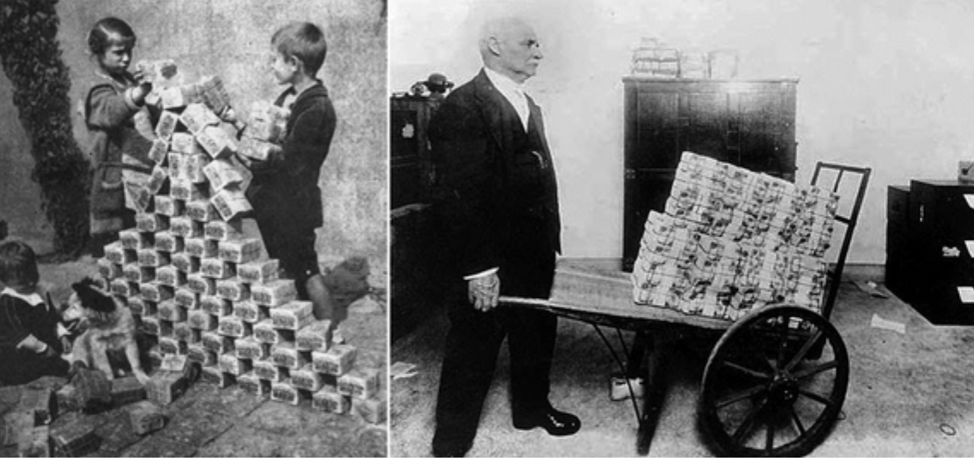
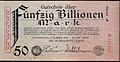
50 trillion (50 Billionen) marks Eschweiler, 1923
Jewish Money Practices
As Thomas Dalton argues in his book The Jewish Hand in the World Wars, the Germans associated Jews with extremist capitalistic exploitation:
Hitler was right to see that the problem is not capital per se, but rather international stock exchange, finance capital—that which exists strictly to produce profits rather than to benefit society. National capital based on productive labor allows an economy to prosper at the service of the people; international capital based on speculation and loan-interest serves only to benefit the rich few—in practice the rich Jew.
It was thought at the time that since Jews are fundamentally nomadic strangers wherever they reside, they have no true interest in the flourishing of the local nation or culture; they can only work to maximize their own profit. And thanks to their self-appointed sense of superiority — dating back at least to the Old Testament — they have little regard for non-Jewish welfare or suffering. Hence the ruthless competitive cutthroat nature of free-market capitalism that so dominated Western life. [13]
Cultural and Moral Degradation
Pre-WWII Germany was overwhelmingly religious, with approximately 97% to 98% of the population identifying as Christian. About two-thirds of the population was Protestant and one-third, Catholic, with religious affiliation deeply embedded in social and political life. Both groups constituted the vast majority of the electorate and party membership. In that religious context, believers hated the Jews for their perceived immorality and for what they were doing to the culture. [14]
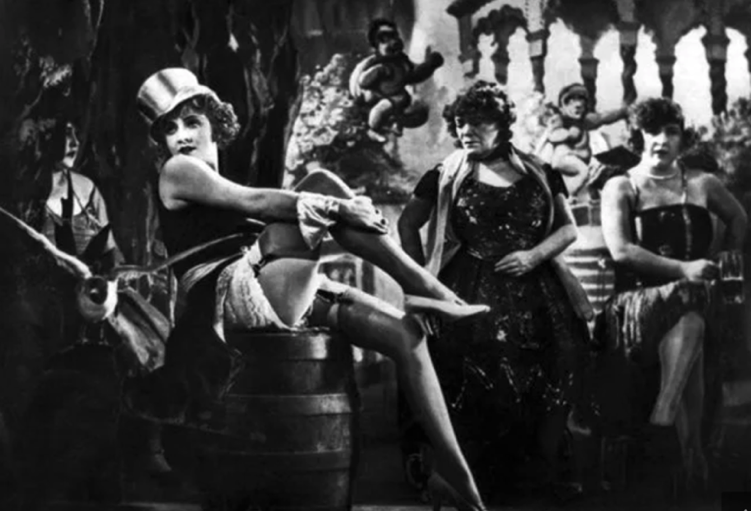
Jews were using their hold on theatre, film, and media to ridicule not only German culture and German ideals, but also Christianity. This was at a time when Weimar Germany was totally dominated by Jews. [15] It was the world’s center of decadence, debauchery, and pornography. [16]
The Jewish surgeon, Magnus Hirschfeld, the thoroughly corrupt Alfred C. Kinsey of his time, was having a field day with his Sex Research Institute of Berlin which was nothing but a “homosexual bordello,” in the words of E. Michael Jones. [17] He was also a racist.
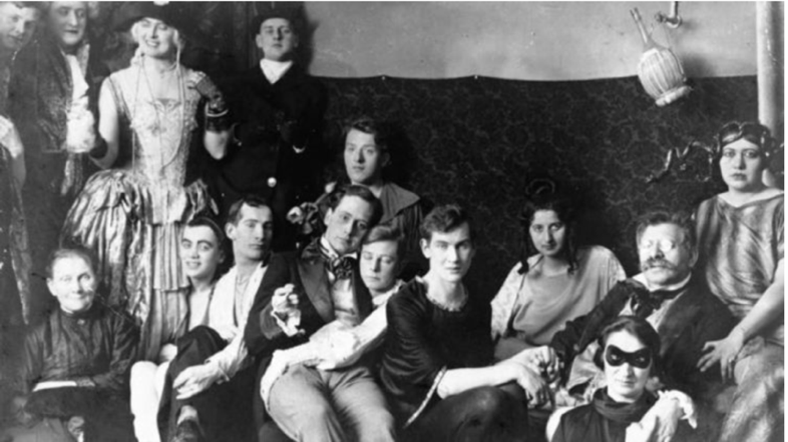
Hirschfeld is the second from the right.
Like today’s Jewish pornographers who monopolize the entire pornography industry,[18] former Jewish bank teller Kurt Tucholsky, who had at his disposal a bottomless pool of unemployed women, was making tons of money with his pornography business and prostitution. This was of course depicted in cartoons and drawings for all to see. [19]
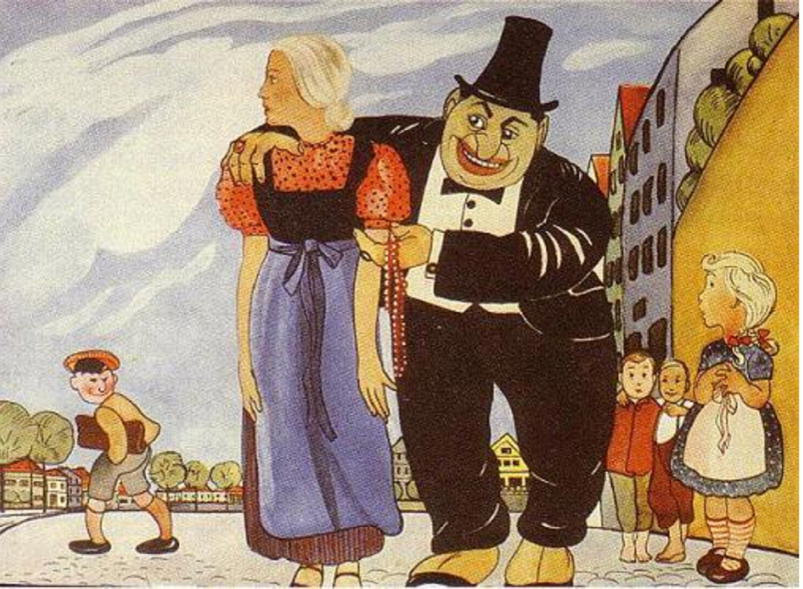
The totally decadent modern art of the pre-Hitler era, which the Jewish liberals sensationalized, inspired only depression, sadness, and discord. It was the era of Dadaism and Cubism; Jewish painters like Hans Ludwig Katz became famous. [20
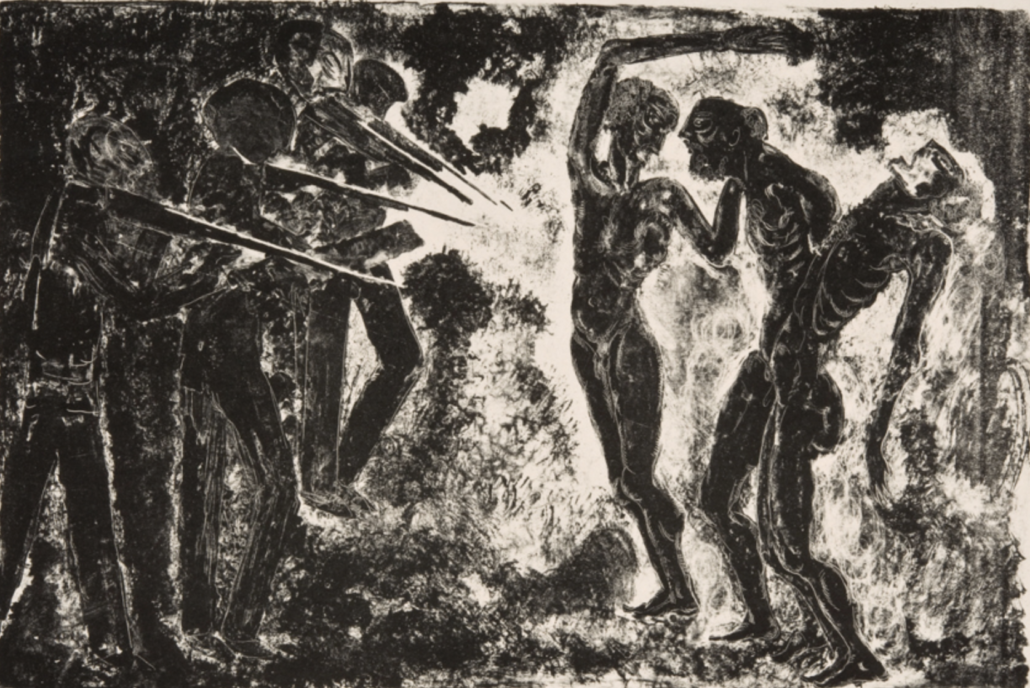
Jewish photographers like Erwin Blumenfeld were already promoting Black and White race mixing in their photos. [21]
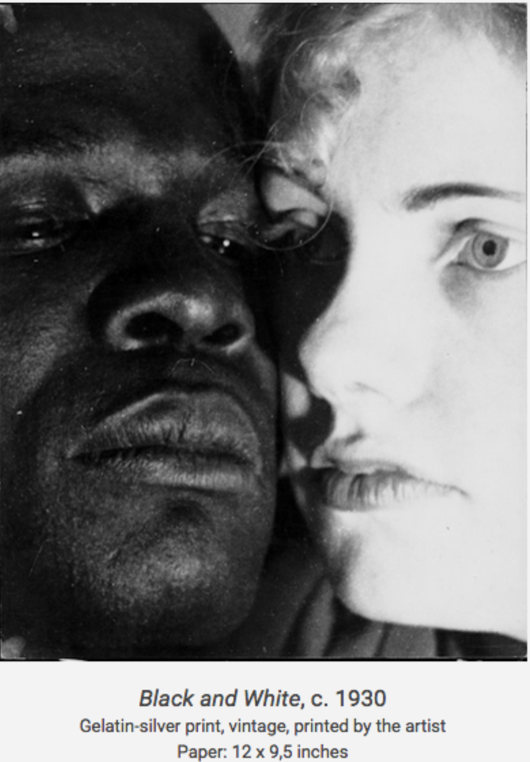
The film industry and the media in the hands of wealthy Jews such as Theodor Wolff, Georg Bernhard, and Rudolf Mosse were—like today—the enemies of the people. Their sole purpose in life was to destroy the moral foundations of German White society and Christianity, the deadly enemies of these Jewish liberal democrats. [22]
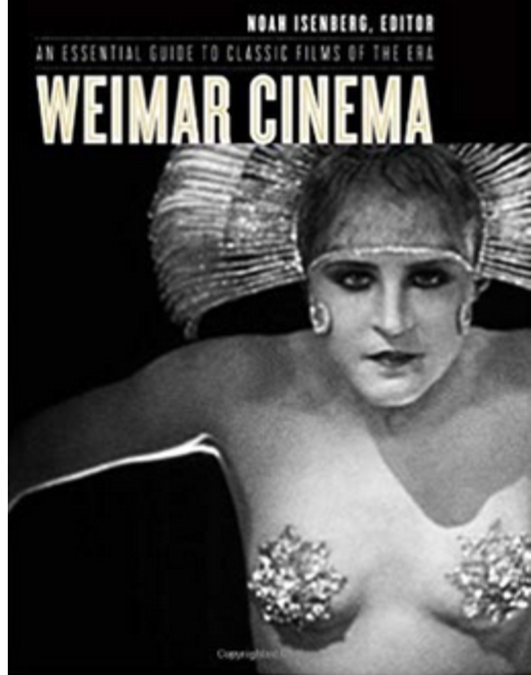
“A prominent feature of anti-Semitism among the Social Conservatives and racial anti-Semites in Germany from 1870 to 1933” notes American evolutionary biologist Kevin MacDonald,
was their belief that Jews were instrumental in developing ideas that subverted traditional German attitudes and beliefs. Jews were vastly overrepresented as editors and writers during the 1920s in Germany, and “a more general cause of increased anti-Semitism was the very strong and unfortunate propensity of dissident Jews to attack national institutions and customs in both socialist and non-socialist publications.” [23]
When the depression of 1929 came, Germany’s first liberal democracy fell into total chaos. Financial scams and scandals were widespread. Jews were not the only ones convicted of war-profiteering and financial frauds, far from it, but combined with the other causes of anti-Judaism catalogued in this article, the context and urgency of the situation, the disproportionate Jewish involvement in these crimes, which made the News on a daily basis did not play well with the Germans: The Jew Sklarek lightened the Berlin Treasury by 12.5 million marks, the Jew Katiuasca defrauded Prussia of 14 million marks, the Barmart brothers cheated the same state out of 35 million, not to mention the inflation profiteer Mendizon, and many others. [24]
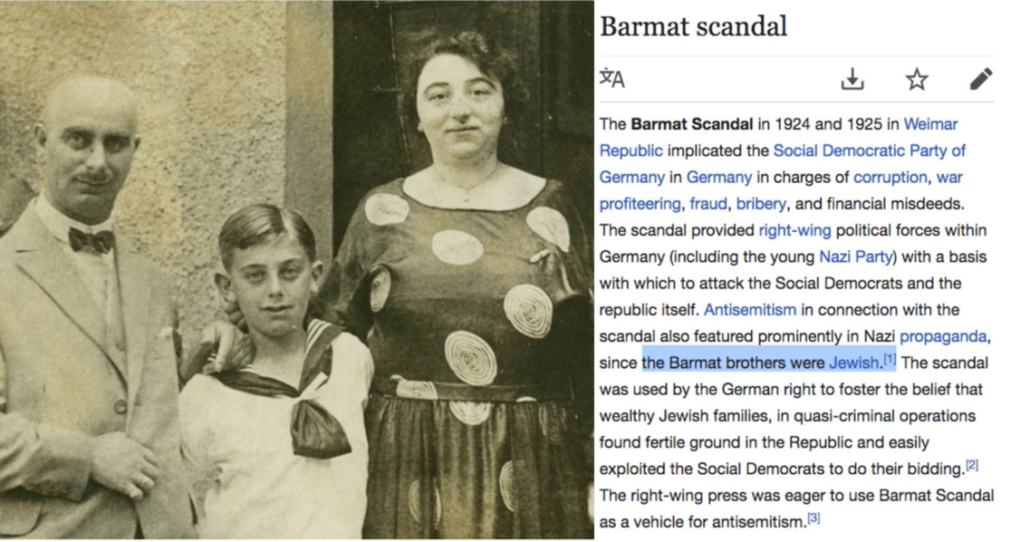
In the following quote, Adolf Hitler—in his widely read best-selling book Mein Kampf—expresses his disgust with the Jews’ moral decadence:
In my eyes the charge against Judaism became a grave one the moment I discovered the Jewish activities in the Press, in art, in literature and the theatre… One needed only to look at the posters announcing the hideous productions of the cinema and theatre, and study the names of the authors who were highly lauded there in order to become permanently adamant on Jewish questions. Here was a pestilence, a moral pestilence with which the public was being infected. It was worse than the Black Plague of long ago. And in what mighty doses this poison was manufactured and distributed. Naturally, the lower the moral and intellectual level of such an author of artistic products the more inexhaustible his fecundity. Sometimes it went so far that one of these fellows, acting like a sewage pump, would shoot his filth directly in the face of other members of the human race. In this connection we must remember, there is no limit to the number of such people. One ought to realize that for one Goethe, Nature may bring into existence ten thousand such despoilers who act as the worst kind of germ carriers in poisoning human souls. It was a terrible thought, and yet it could not be avoided, that the greater number of the Jews seemed specially destined by Nature to play this shameful part. [25]
Rivers of Blood
All the Bolshevik movements which sowed chaos in Germany between 1917 and 1930 were led by Jews. Hitler had personally experienced the short-lived Bavarian revolution of 1919, and this contributed to his anti-Jewish ideas. National-Socialists and the Germans in general were also well aware of the mass murders and atrocities committed in Russia by Jewish Bolsheviks. They knew that this Jewish conspiracy was directed against Christian Western Civilization and that it was threatening not only the very existence of Germany but of Europe. [26]
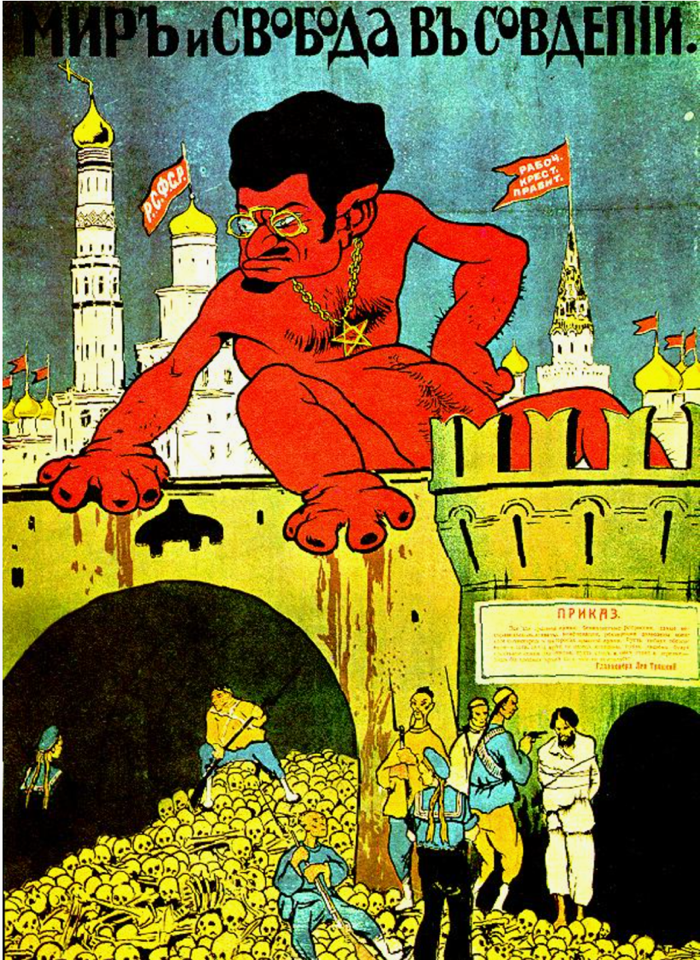
Trotsky dripping in blood
Jewish Boycott of German Goods
Organized Jewry’s boycott of Germany further antagonized Germany against Jews. Jewish leaders of the world launched a boycott of Germany for the purpose of crippling that nation’s already precarious economy in hopes of bringing down the new regime of Adolf Hitler which freed Germany from the grip of predatory international usurers. This was in fact, asserts American investigative journalist, Micheal Collins Piper, “the first shot fired in WW2.” [27]
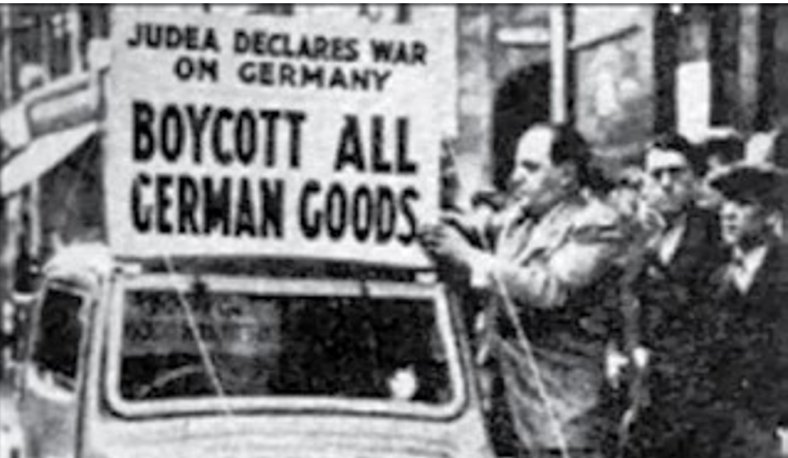
Before the boycott, Jews were not persecuted in Germany. They could come and go freely, and many did leave the country with all their possessions. But this boycott, which was perceived as a declaration of war changed everything. Jews were now Germany’s enemy. And later when Germany was at war with several European countries, it rounded-up the Jews from these countries and shipped them to concentration camps in Germany because It could not tolerate a fifth column in its backyard.[28]
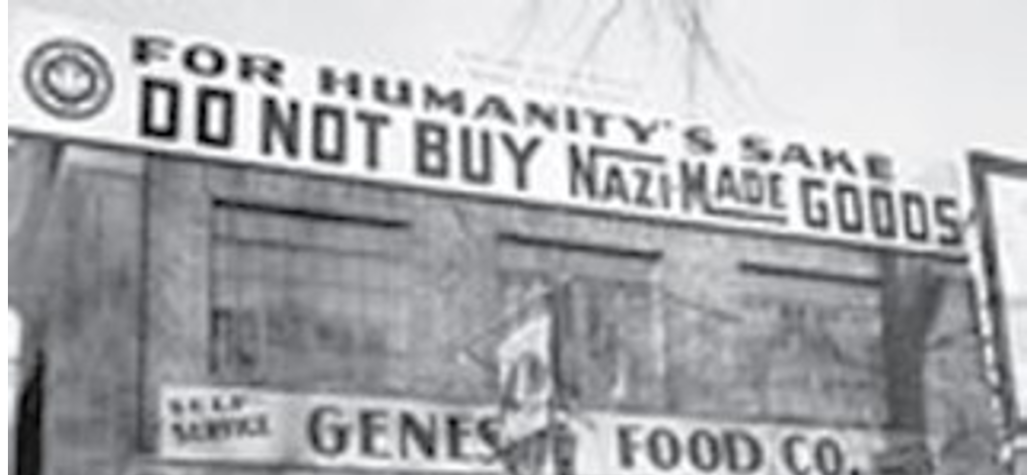
All countries do this in times of war. It’s an accepted procedure, a reality of war that cannot be avoided. Americans and Canadians of Japanese and German background, for example, were also rounded up and locked up in concentration camps for reasons of national security for the whole duration of the war. [29]
Hatred of Germans
Hatred of the Germans was widespread in the Jewish community. Theodore N. Kaufman’s famous book Germany Must Perish (1941) is unequalled in the annals of mankind. This book, which advocated mass sterilization of Germans and was widely known in the United-States, was used by Joseph Paul Gœbels (1897–1945), to galvanize Germans and help the nation expel Jews from the country.
Jewish Betrayal
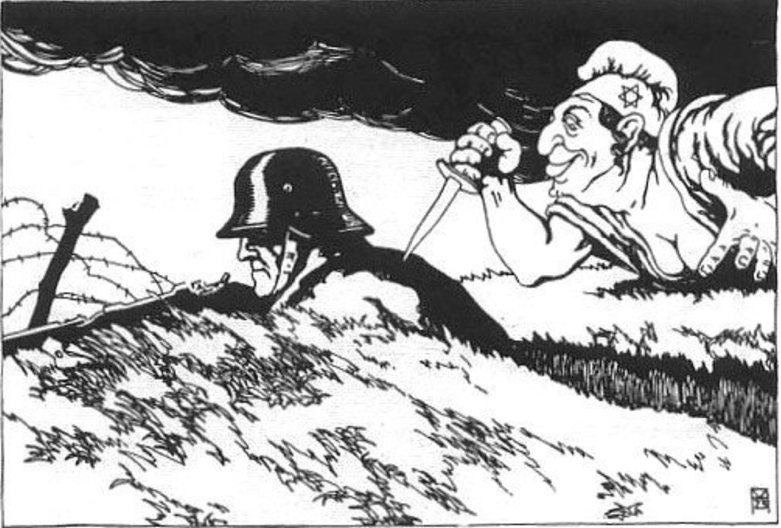
The right-wing of the Nazi party claimed that the German army, undefeated in the field, was betrayed by Jews and socialists on the home front. It was claimed that Jews helped to get the Unites States into the war in exchange for Palestine. It was also thought that it was the Jews, who imposed on Germany several of the more damaging points of the Treaty of Versailles. These powerful accusations were weaponized to argue that “international Jewry” had engineered Germany’s humiliation. [30]
Assassinations
The assassination in 1936 of Wilhelm Gustloff, the leader of the Nazi Party in Switzerland, by David Frankfurter (a Jewish medical student) had a significant effect on anti-Judaism. As well as the assassination of Ernst Vom Rath (Paris, 1938) by Herschel Grynszpan (a Polish Jew) at the German embassy in Paris, a false flag, which triggered Kristallnacht, an event vastly exaggerated in scope by post-war rhetoric. Following these assassinations, Jews were perceived as dangerous aggressors. [31]
To sum up, seen from the above perspective, the rise of Hitler and the National Socialist movement with its extremely strong anti-Jewish sentiments is much easier to understand. In fact, seen from their context, situation, and the dire circumstances they were in as a result of the Versailles treaty, there was nothing irrational or incomprehensible about their anti-Judaism. They acted this way to protect their sovereignty and dignity like dozens of nations have done across history. Anti-Judaism was for them an existential and visceral reaction.
GO TO PART 3
Citations
[1] Adolf Hitler, Mein Kanpf!, p. 127.
[2] Rabbi Dr. Manfred Reifer, “Why Hitler Came to Power. One Rabbi’s Explanation,” The Barnes Review, 2009.
[3] Laurent Guyénot, “Lev Goumilev et ‘la chimère khazar,’” E&R, December 1, 2022. This article is a review of the book by Mark Bassin, The Gumilev Mystique: Biopolitics, Eurasianism, and the Construction of Community in Modern Russia, Cornell University Press, 2016.
[4] Ibid.
[5] Ibid.
[6] The passage comes from Taylor Caldwell’s 1965 historical novel A Pillar of Iron (a fictionalized biography of Cicero). In the book (around page 661 in some editions), Caldwell puts these words in Cicero’s mouth during a fictional speech, sometimes presented as “recorded by Sallust.” While the novel draws on real history and some of Cicero’s actual writings for context, this specific extended passage is fiction—an invention by the author. Information obtained from Grok AI of X.
[7] Nahum Goldmann, Sixty Years of Jewish Life: The Autobiography of Nahum Goldmann (translated from the German Bekenntnisse eines Europäers), Holt, Rinehart and Winston, 1969, pages 144–145.
[8] Frantz Fanon, The Wretched of the Earth, 1961.
[9] Albert Memmi, Portrait du colonisé, précédé par Portrait du colonisateur (The Colonizer and the Colonized), this book prefaced by Jean-Paul Sartre, was first published in French in 1957. It was translated in English in 1965 by Howard Greenfeld. It remains in print with editions published by Orion and Beacon Press.
[10] Eckart Verlag, Jewish Domination of Weimar Germany, appendices compiled by Francis Dupont, Ostara Publications, 2013 (original publication by the League anticommunist associations, Berlin, 1933) p. 48 to 54.
[11] Citation taken from Claudia Koonz, book cited, p. 43.
[12] Richard Tedor, Hitler’s Revolution, Castle Hill Publishers, 2022, pp. 41-44.
[13] Thomas Dalton, PhD, The Jewish Hand in World Wars, Castle Hill Publishers, 2019, p. 151
[14] “The German Churches and the Nazi State,” Holocaust Encyclopedia.
[15] Eckart Verlag, Jewish Domination of Weimar Germany, appendices compiled by Francis Dupont, Ostara Publications, 2013 (original publication by the League anticommunist associations, Berlin, 1933) p. 48 to 54.
[16] Mel Gordon, Voluptuous Panic, The Erotic World of Weimar Berlin, Feral House, 2006.
[17] E. Michael Jones, Beyond the Bomb, Werner Heisenberg and Jewish Science, Fidelity Press, 2019.
[18] Nathan Abrams, “Triple-exthnics: Nathan Abrams on Jews in the American Porn Industry,” Jewish Quarterly, no 196, 2004.
[19] “We Live in Weimar 2.0 — But What Was Weimar 1.0?” Bradford Hanson (Editor), National Vanguard, May 17, 2020. First published by US Revolt, December 10, 2019, WaybackMachine.
[20] Ibid.
[21] Ibid.
[22] Ibid.
[23] Kevin MacDonald, The Culture of Critique, Chapter 1.
[24] The Weimar Republic Sourcebook, 1994, edited by Anton Kaes, Martin Jay, and Edward Dimendberg.
[25] Adolf Hitler, Mein Kampf, Hurst and Blackett ltd, unexpurgated edition first published in 1939, p. 56.
[26] Benton L. Bradberry, The Myth of Jewish Villainy, 2nd updated and revised edition, Money Tree Publishing, 2023, pp. 65-115.
[27] Michael Collins Piper, The Confessions of an Anti-Semite. The First-Ever Critical Analysis of the Linguistic Legerdemain Underlying the Propaganda Techniques of the New World Order, American Free Press, pp. 28 to 35.
[28] Ibid.
[29] David J. Carter, “Prisoner of War Camps in Canada,” The Canadian Encyclopedia, July 27, 2015; Wikipedia, the Free Encyclopedia, Internment of Japanese Americans.
[30] Benton Bradberry, book cited, p. 42.; see also Thomas Dalton, PhD, The Jewish Hand in World Wars, Castle Hill Publishers, for details on Jewish involvement in getting the U.S. into World War I.
[31] Heinz Weichardt, Nazi Terror. A Short Autobiography of a Jewish national Socialist, The Heretical Press, 2004. A PDF version of this book is available on line Under Two Flags.




“Hitler will emerge from the hatred that surrounds him now as one of the most significant figures who ever lived.”
JFK
Very interesting, but mostly old stuff rehashed from secondary anti-NS sources, but I suppose new to younger readers with whom, however, crude caricatures of The Jew Face won’t help, although the article reads like something written by a young person with a restricted library.
The big question is: why did so many Jews love Adolf, work for him, risk their necks for him, finance him, kill people on his behalf and even help him into power?
Goebbels is mentioned – sure wasn’t he part Jewish?
Adolf’s parental surnames are at least sometimes, Jewish names; Hitler and Poelzl. Nobody disputes this.Two villages which contained graves of his Austrian ancestors were closed down and several thousand people evacuated before the war – they are still empty Strones and Doellersheim. Nobody disputes this either, tho’ Wiki will give you ten other explanations as to why the Germans evacuated thousands of people and closed two villages, in peacetime. What a strange thing to do.
As a critic of Judaism it is an advantage to have Jewish ancestry. If Hitler was genuinely anti-Jewish, he would surely have mentioned any possible Jewish ancestry.
Adolf talked a good anti_Jewish talk, but he very often did not walk the walk. He took money from Jews and made them Aryans – he even put them in the SS and in many important jobs. The Lubavitcher Rabbi and his crew got removed from a concentration camp and sent to safety in the US, but ethnic Fritz and Franz were forced to the Ostfront and Adolf forgot to pack winter clothing , causing 250,000 dead in the winter of ’41.
It was common knowledge in the German speaking world. Hennecke Kardel reports that an Arab man called Bahry spotted Eva Braun at a Berlin music venue in ’43. “She’s cute. Who is she?” he inquires of his German hosts. They laughed at him. “Hands off. Fuehrer’s girl. Half jewish, of course, like all his other lovers…Oh, and by the way dear Bahry, you can forget about an Arab Palestine”
Read the book: Adolf Hitler, Founder of Israel. Hennecke Kardel.
If your mind was blown when you read Israel Shahak – Jewish History, Jewish Religion – your mind will be doubly blown when you read Kardel.
“why did so many Jews love Adolf, work for him, risk their necks for him, finance him, kill people on his behalf and even help him into power?”
I challenge you to name these Jews who “risked their necks for HIM” and tell us exactly what other Jews did to “help Adolf.” After that, tell us how many Jews wanted to kill/destroy him, and Germany, and compare the size of the two groups.
No, Joseph Goebbels was not Jewish in any amount. Nor was Eva Braun. Henneke Kardel was a liar and ignoranmus; since you’re recommending him, you are too.
Indeed. The only possible part-Jew in the regime was Hangman Heydrich and he got canceled.
Some Mischlinge served in the German Army during WW2.
“Jewish Domination Of Weimar Germany 1933”
https://archive.org/details/jewish-domination-of-weimar-germany-1933-eckhart-verlag
“It was the era of Dadaism and Cubism; Jewish painters like Hans Ludwig Katz became famous. [20]”
The painting reproduced in the article is not by Jewish painter Hans Katz but by German painter Max Beckmann. I know that as well as I know my name. It’s neither Dada-ist or Cubist, but a stunning example of German Expressionisn. I like Pierre Simon and this article so I’m sorry he got this wrong.
Good catch. It has been replaced by a very ugly painting by Mr. Katz.
Thanks! I didn’t expect that. So good on you, too.
The other mistake with the coin was fixed in Part 3.
Before I became aware of the JQ, I was surrounded by Jews, in college and for years afterwards. Being a nice and extremely well-indoctrinated White, I attributed negative Jewish behavior toward me as due to other factors than anti-White attitudes held by them; as in “She doesn’t like me because she’s my mother-in-law”; “They don’t accept me as their equals because they are wives of the law partners”; “He’s hostile because he’s in competition with my husband”; “She doesn’t like me because I am prettier than her”; and so on, ad infinitum. I can’t believe I was into my 50s before it finally dawned on me what the problem had been! You have to give credit to the talent of the brainwashers for being so damned effective.
Same thing happened to me Susan. You’re not alone.