
July 9, 2026 – Henri Dubost shows us the way and paves the path for us (but we don’t have to follow it)
Henri Dubost was what Americans used to call a “French Matheu”; he was also a nationalist patriot—a racially nationalist one. He was about to turn 75, but on July 9, 2026, he was in Basel, Switzerland, for an AVD—what Swiss law terms “Assisted Voluntary Dying” That is the whole story.
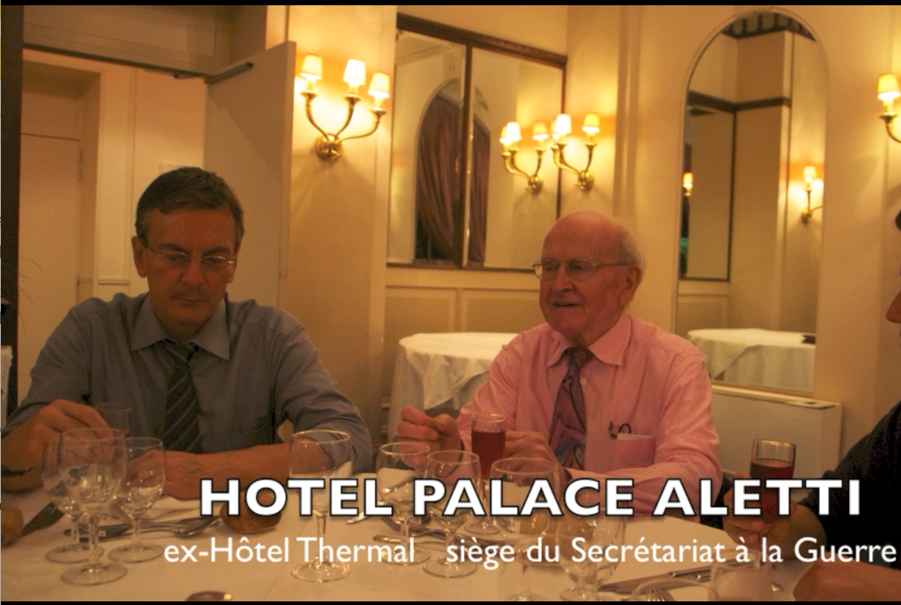 On the left, Henri Dubost with Robert Faurisson in Vichy in October 2012, to celebrate the professor’s birthday
and also to visit the sites associated with Marshal Pétain’s exercise of power in Vichy during the Occupation.
Before Day 1
Field Marshal Rommel used to say: there are only two breeds of men—those who do not know how to die, and those who do.
Henri knew.
It just goes to show—people often make fun of those who talk about it all the time but never actually do it, but in this case…
His first email asking me to accompany him—initially for August 13th—was dated June 22nd; easy to remember, as that’s the start of Operation Barbarossa.
But as early as June 26, at his request, the date was moved up to the first half of July.
On June 29, the new date was announced and set for July 9—meaning a departure from Paris on the morning of the 7th.
Two weeks and a day passed between the first email and the departure by car…
Day 1
On Tuesday, July 7, shortly before 9 a.m., Henri parks his car in the lot below my place.
A bit like setting off on vacation, I head down with my cooler containing four liters of ice-cold water—Vittel, Evian, Contrex—two baguettes, and plastic containers holding slices of cheese, salami, and mountain ham (everything needed to make sandwiches easily), plus nougats with chunks of toffees, Calvados flavored toffees, and even some mini *kouign-amann* pastries to lighten things up.
Heading to Basel—Henri’s car no longer has air conditioning, his mobile phone will serve as the GPS.
He takes the wheel; I let him do it.
A 550-kilometer drive with a driver whose psychiatric file is as thick as the Paris phone book, his head muddled by medication—benzodiazepines, sometimes a cocktail of MAOIs and Theralene (a chemical straitjacket)—and a history of multiple stays in psychiatric facilities; a driver who, incidentally, is taking us to Basel for his AVD (Assisted Voluntary Dying).
I tell myself that even if I were the one behind the wheel, if Henri really did have psychiatric issues, it wouldn’t make much difference.
But I never believed Henri had psychiatric problems. Besides, psychiatrists never forbade him from driving… And to be honest, Henri had already been off the medication for several months.
Naturally, he had not mentioned his psychiatric treatment to the Swiss association, because in the event of a psychiatric issue, the individual’s will is considered impaired, and their consent to assisted suicide is no longer valid.
Moreover, Henri had had a WhatsApp consultation with the association’s psychiatrist that lasted only ten minutes; the psychiatrist was convinced he was dealing with someone in full possession of his faculties.
As far as those around us are concerned, it’s total radio silence. No one knows; there hasn’t been a single sign, a hint, or anything at all.
Those closest to us had heard mention of a date—August 14th at 10 a.m.—but Henri chose to move the date up.
For three days—Tuesday, Wednesday, and Thursday—neither Henri nor I sent a single email, yet no one, it seems, is making the connection.
We set off a little late. We had originally agreed to meet at 8:15; Henri called me back around 8:00 to say he was running a bit behind—he needed to stop for gas and wouldn’t arrive until around 8:20—but he was late even by that revised schedule.
For half an hour, I told myself, “That’s it—it’s cancelled again”; the last time, back in October, he had wanted me to take him to Étretat (and its infamous suicide cliff).
Étretat didn’t sound all that serious, but this time Henri had copied me on the bank transfers to the Swiss association; I was also copied on the hotel reservations, and the association had asked me for some details and a copy of my ID card—all the groundwork was in place—but then again, this wasn’t exactly just a weekend getaway…
Henri kept saying the car trip would be an ordeal for him—as if to give himself a ready-made excuse to back out—but in the end, the journey went pleasantly, even without air conditioning, while the rest of Europe was sweltering in African-like heat. We chatted about various things—not just the main topic; there’s a time and place for everything.
Day 2
The next day, Wednesday morning around 9 o’clock, we had an appointment with the association’s representative at the hotel while having breakfast—or *Frühstück*, as the Germans call it.
She is a very fine lady who made a strong impression on us. She needed a number of original documents concerning Henri, but her role is not merely administrative; the paperwork is actually a rather secondary matter.
First of all, she had to ensure that Henri was indeed there, and that his witness (me) was there too: Swiss law requires the presence of a witness for assisted suicide.
She assures us that her native language is German, yet she speaks French exactly like us. What’s more, she quotes Victor Hugo—the “God the Roaster” (le Dieu Rôtisseur)—to us: “Christian hell: fire. Pagan hell: fire. Muslim hell: fire. Hindu hell: flames. To hear the religions tell it, God was born a roaster.” (Enfer chrétien, du feu. Enfer païen, du feu. Enfer mahométan, du feu. Enfer hindou, des flammes. À en croire les religions, Dieu est né rôtisseur.)
Henri brings up the subject of the cremation that is to follow, innocently asking if she knows how much energy it requires. She doesn’t know, of course. Henri then points out that it is a taboo subject because—as he puts it—if people knew, they would realize that Germany, during the Second World War, while grappling with the three superpowers of the era, could not have diverted that much energy from the war effort. She counters by mentioning IG Farben; not everyone is necessarily familiar with IG Farben.
We change the subject, and she tells us about the anesthetic: 15g of pentobarbital—whereas for general anesthesia, the usual dose is half a gram. That would work for three elephants.
Cheery topics of conversation, as you can see. That was the moment a Swiss-Malaysian—or Swiss-Javanese—man chose to approach us: he was the nurse who would be handling the “operation” the next day. To our eyes, he looked more like a headhunter, complete with blowpipe and curare-tipped darts. Admittedly, given the needle he would insert into Henri’s arm and the pentobarbital involved, the reality wouldn’t be far off.
Poor Henri—he chose to leave because France had become a scene of racial chaos; he was truly pestered right to the very end. Once the nurse had left, he remarked to the lady that he would have preferred a real Swiss person to look after him. In the face of death, hypocritical pretenses fall away. He also expressed regret at not dying in France—the border was only a kilometer away.
Then, to pass the time, we took the bus to Basel (our hotel was in a suburb with an unpronounceable name); we visited the city center and walked past the splendid Rathaus. The central square features magnificent facades—not just in the foreground but in the background too, as Basel is a hilly city where you can see multiple levels.
But Henri isn’t in the mood for that; he doesn’t even have the heart to go as far as the Rhine, barely a hundred meters away. We sit down at a sidewalk café for a drink—still that deceptive atmosphere of tourism and holidays.
His left hand is trembling violently—his body has already grasped what is afoot—and I point this out to him, adding that he had come to Switzerland to turn a thumbwheel, which is something of an understatement.
Henri then brings up a philosophical theme that troubles him: the idea that the world might be nothing more than a representation constructed by our brains. I decide to tell him a story “that, back in the day—a long time ago—had made me burst out laughing.” I stop halfway through: “You see, you’re waiting for the end of the story because you don’t know it, and you’re going to burst out laughing.” Sure enough, the punchline makes him burst out laughing: “You can’t tell yourself a funny story you didn’t know before and laugh at it. … This proves, it seems to me, that I am not a figment of your brain.”
In the evening, back at the hotel, we settle into the lobby in front of the TV. It’s the BBC, with its Pakistani female presenters. On the other hand, Henri had picked out an Indian ready meal from the hotel vending machine…
We part ways, saying “see you tomorrow,” and I know Henri won’t sleep a wink.
Day 3
The next day, Thursday, July 9, at 7 a.m., the woman from the association came to pick us up and drove us to the location that had been kept secret until then—not very far from the hotel, say, a kilometer away.
Henri had to sign several documents regarding his consent; I, too, signed one—the very reason I was officially there: to attest to Henri’s identity to the Swiss authorities, specifically the police and the prosecutor.
Henri was settled into a bed; I was to sit on the bed, angled three-quarters toward the camera, which was recording the final questions put to Henri to prove he knew what he was doing and that he was indeed the one activating the IV drip.
Right up to the last second, I am convinced that Henri won’t turn the intake knob. But he does.
It happens very quickly then—a few seconds, and the gaze turns glassy; Henri, who had been speaking just to hear his own voice as he slipped away, falls silent; a few more seconds, and cardiorespiratory arrest sets in; a few more seconds, and the nurse places a small device on the patient’s fingertip—an oximeter, no doubt—looks up at me, and answers my unspoken question with a nod.
The police are alerted and arrive quickly, the public prosecutor is notified, and the death certificate is issued; the official death record will follow much later—within two months—and will be neutral, meaning the cause of death will not be stated.
As for philosophical-religious concepts and resolutions, nothing holds up anymore; only one question remains in the face of the hole’s pull and repulsion: do I turn the knob or not? That’s all.
The fear of death is so great that all the criteria for limiting a so-called “right to die” strike me as absurd: it is obvious that there will be no abuse.
One has to admit, however, that there is something unhealthy about the operation: I wonder if the members of these associations who assist patients with suicide would be capable of stopping their work overnight—laying a person on a bed, inserting the catheter, watching them tremble and die—it can become addictive.
It can also look like a death cult. It’s funny how the French name of the city, *Bâle*, sounds just like Baal—a god with a pretty bad reputation, what with the human sacrifice and all.
The lady speaks to me of the power of mind over matter, rather like in the Anglican prayer for a newborn: Henry has overcome the flesh, the world, and the devil.
I am thinking of Heidegger’s *Transcendement*—in the phenomenology of being, the kind of gesture that exists in its own enactment. Either it achieves nothing at all because there is no transcendence, or else it is quite simply a matter of suicide: elevating oneself through voluntary death.
After Day 3
A few days later, two satisfaction surveys sent by the hotel arrived in my inbox one after the other—surveys I didn’t answer. What makes me smile is that Henri must have received the same messages, and they weren’t even opened—and for good reason.
The Holiday Inn must be wondering: what did we do to lose two guests? What they don’t know is that, as far as Henri is concerned, they have indeed lost a guest for good. Truly for good.
News of the death is spreading quite rapidly within far-right circles. Henri was a significant figure; people are trying to understand.
The act of a depressed person, or an act of defiance?
Henri suffered from terrible anxiety attacks, but did he commit suicide because he was anxious, or was he anxious because he knew he was drawn to death?
Fortunately, Swiss law does not automatically classify a plan to commit suicide as a psychiatric matter; doing so would come uncomfortably close to the famous “Catch-22” faced by American pilots in World War II: if one has the right to request assisted suicide, yet making that request is deemed a psychiatric issue—implying the person’s judgment is impaired—then the request would have to be rejected, even though the person was ostensibly entitled to it in the first place.
Some believe it is entirely inappropriate to pathologize sadness; in any case, it is clear that benzodiazepines do not make immigrants disappear. Here is the reaction of a correspondent:
To my mind, being depressed means being clear-sighted. When you stop telling yourself stories and lose the ability to bond with others, you’re already dead. I was born in a prosperous, youthful town—teeming with shops, festivals, and markets. It’s been in decline for fifty years; now it’s nothing but a ghost town, or a touristy spa resort with a Super U supermarket. People used to have shared narratives—believing in God, in the nation, in technological progress. What do we believe in now? Sorting our trash and buying an electric car to save the planet? Hoping the post-war social safety net doesn’t collapse completely before we reach retirement or old age? We can’t even be bothered to learn our neighbor’s name (and if his name is Mouloud, we don’t even want to). I’m done with the comfort of illusion; we’re going to die a slow death in mediocrity, and everything is becoming a constant assault.
If France is dead, perhaps the best thing is to find her on the other side.
The most devout Christians, however, are shocked and pained: if Henri’s act is a reproach, it is a reproach directed at God. One of them asked a priest in Lourdes to say two masses—one for the deceased and another for his companion, his accomplice. Scout troops in France, as well as in Ireland and England, have been notified and will be praying until the end of the month.
Impressive, yet we know that God cannot hold it against us for having struggled within a nightmare that was imposed upon us—one we did not create, over which we have not the slightest control, and for which we possess not the faintest key to understanding.
France is in the process of adopting a law on end-of-life care. Henri was in favor of it. With the emergence of so many neurodegenerative diseases, something had to be done; why did it take so long after Switzerland? Perhaps because the authorities fear a wave of suicides—a wave that would serve as a silent yet heavy reproach.
Henri’s departure has a political dimension: even though it is the “depressives” who leave first, it is clear that an irreparable existential catastrophe has befallen France and the West—befallen beauty and intelligence. There will be no survivors—no White survivors. The peak of evolution has passed; we are on the downward slope.




Wow!wow!wow! Laurent Guyenot, thanks for sharing. I just started reading, Mort à crédit…apropos “having struggled within a nightmare that was imposed upon us,” but I am not yet sure that self annihilation is the only answer to the existential catastrophe, or that we are indeed at the bottom of the downward slope. Or that rationality admits optimism and pessimism. Something to think about.
The author is Francis Goumain. My fault.
Disgusting. It starts with abortion and ends with euthanasia. Europeans deserve to die and die they will, at their own hands and the hands of others. Cowards.
Very good point.
Your reaction is intelligible and, what is more important, healthy.
Those who encourage and glamorize euthanasia are most to be abjured. The impulse to, so to speak, normalize euthanasia is as disordered as the impulse to normalize sexual mutilation, whether via state-assisted or self-chosen means, a crime that the aggressively pro-tranny Establishment has been working to compel acceptance of through statute law in many countries and US states.
Perhaps, as you say, Europeans in toto are more deserving of death because many of their number tolerate—often, indeed, connive in—the glamorization of euthanasia. Yet since death comes to all men, the deserving and the undeserving alike, the impulse of the individual who asked a priest in Lourdes to say a mass of reparation for the deceased and another for his accomplice might well be the only truly sensible response to the foolish presumptuousness of the lamented Henri Dubost and like-minded others.
Sure enough, Whites and West are saved with glorious people like you.
Henri’s story is that of an individual death amidst a collective death.
How old are you, and what have you done so far? Nothing, Nothing, Nothing
True to form.
Trump’s take on John McCain seemed to outrage a lot of people, but be was definitely not a war hero.
Schmully lutscher?, yes. War hero?, no.
Revolutions can begin very suddenly. One minute the Schmullies can be playing the Pied Piper as Weissfleisch is being fed into various meat grinders for Jew grandiose psychosis one minute, until something so unforeseenly atrocious happens that it enrages Weissfleisch to snap out of their delusions and sets then off on a pendulum swing in exactly the opposite direction.
At that point, Judenfleisch will be the ones running for cover and Weissfleisch, followed by many other minorities, will be the ones hunting them down.
Henri Dubost will most assuredly have missed that day.
If I had a choice between lamenting a coward’s, criminal establishment assisted suicide, or saluting a criminal establishment labeled, Nazi Antisemite’s well planned and “executed foray” through an Orthodox Schmully wedding party,
I can only answer that with another question:
What’s the difference between minced Lubavitchers and leberwurst? Hint : leberwurst is best on rye bread with pickles.
This. One must not make oneself convenient to the enemy/parasite. If you’re still sane enough to be allowed this gentle Kosher slaughter, you’re able to put some hurt on the enemy. You can fly a plane, drive a car, hell dodder along in a motorized wheelchair, a bit heavier than usual because it’s packed with kaboom. Something. Anything.
Mephisto Waltz in France:
https://www.youtube.com/watch?v=S3Xk4WvWgTE
Thank you for nice writing. Very sobering.
Wish I would have heard about Henri Dubost.
Can’t find a bio on internet even in French.
The needle guy, guess they don’t have one of those meet the staff photos.
Guess better than a blue haired, tatoo’d, pierced, nose ring, new age type.
Thinking good choice with vending machine Indian food probably made with more care than European food nowadays.
His hometown sounds just like America replacing the Super U with Walmart.
Adieu.
“Henri Dubost shows us the way and paves the path for us”
A revolting title. We should cooperate in our erasure like this? Awful.
Good reading, only the first part of the title matters.
But it’s not the title that is revolting; it’s the situation.
You are right. If people can’t stand this life, and I can understand why some might find it intolerable, then let them do it on their own without this disgusting ritualistic method.
Yes. And without the sanctimony, too.