
“A tour in Gaza leaves no room for doubt that the massive destruction was premeditated”
The devastation is truly demonic. The photos alone are worth a look.
Haaretz: As Hamas Rebuilds in Gaza, Israelis Across the Border Once Again Lose Faith in the IDF
Southern community leaders are deeply concerned about a lack of transparency from the military ■ A tour in Gaza leaves no room for doubt that the massive destruction was premeditated ■ The Americans are starting to lose patience with Netanyahu ■ The forever war is preventing the IDF from preparing for future campaigns
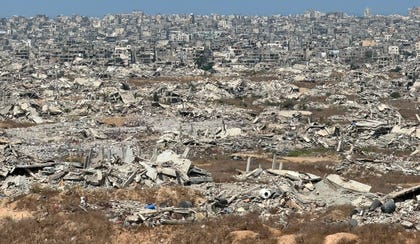
This appears to have been a conscious Israeli decision, even if it’s unlikely to have detailed documentation. The policy of destruction was implemented systematically in the years since then. The devastation was deliberate; only a small part of it “escaped” the commanders.
The ruins stretch almost to the horizon in every possible direction. In a short tour of the Strip on Wednesday, one could see that the work of the bulldozers didn’t stop in the past year. It has also continued after the shaky cease-fire that was declared by the United States, along with the completion of the last hostage deal in October 2025 and in conjunction with the 20-point plan presented by U.S. President Donald Trump.
The Shujaiyeh neighborhood in eastern Gaza City was largely razed in the first months of the Israel Defense Forces’ activity in the enclave, during the fall and winter of 2023-2024. The IDF expelled most of the population from there, and they haven’t returned, other than for brief transition periods. It was from here that the first Nukhba squads set out on October 7, on Toyota pickup trucks and motorcycles, captured Kibbutz Nahal Oz and the adjacent military base without much difficulty, going on to slaughter civilians and kill soldiers for many hours.
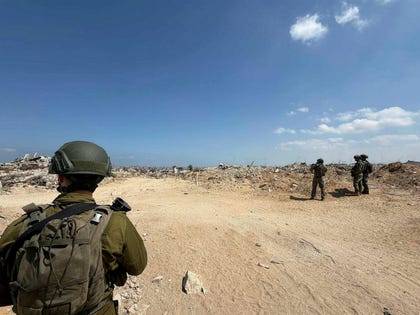
When the IDF subsequently entered Gaza, fierce battles were fought against the Shujaiyeh Battalion of Hamas’ military wing and against the battalions nearby. Dozens of IDF combat troops and hundreds of Palestinians were killed in the fighting.
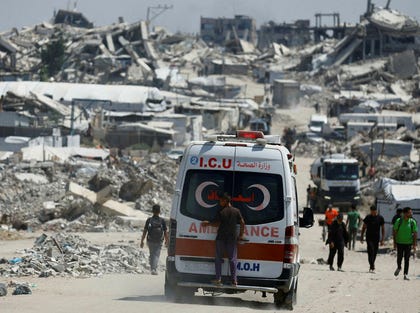
More than two years later, the destroyed neighborhood is deserted, other than a small force of an armed Palestinian militia, which according to Arab media reports is acting in cooperation with Israel. The devastation hasn’t passed over the adjacent neighborhoods, either – not a single habitable building appears to remain in them. Only west of there, in the direction of the center of Gaza City, can one see multistory buildings that are still intact; the damage some of them sustained in the war is visible even from afar.
The line of outposts created by the IDF, known as Meteor, extends up to a kilometer west of the border fence, inside Palestinian territory. In the case of Shujaiyeh, the outpost is situated on the ruins of the neighborhood’s eastern fringes. More than 30 similar outposts have been built, at a cost of hundreds of millions of shekels, from the area of the former Israeli settlements of Dugit and Elei Sinai in the north of the Strip, which were evacuated in 2005, to the Philadelphi route in Rafah in the south. Vast sums of money have gone into building fortifications and setting up masts, cameras and communications systems.
A dramatic change is occurring here. The soldiers constitute a physical buffer between the civilians in the Western Negev and the danger – in contrast to the situation on October 7. The line of outposts along a ridgeline known as the Seventies is slightly higher than the communities on the Israeli side. Hamas militants have been driven away from it. Before the war, a large part of the tunnels that were dug in the direction of the border fence were concealed under Palestinian homes. Clearing the rubble helps expose the tunnel shafts and renders it difficult to dig new routes.
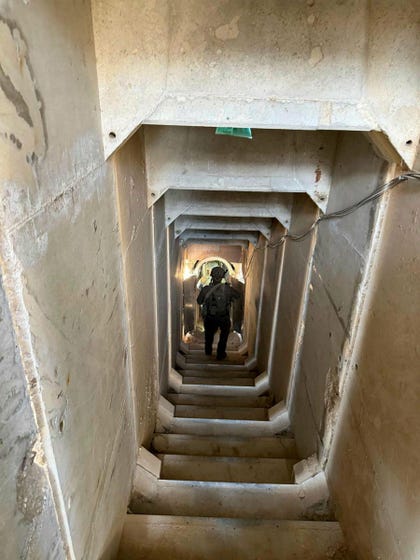
About 3 kilometers (1.86 miles) west of the line of outposts is the Yellow Line, to which the IDF withdrew as part of the agreement last October. That left Israel in control of approximately 53 percent of the Strip, with more than 2 million Palestinians crowded into the remaining area under Hamas’ boot.
Since then, while the Americans haven’t been paying attention to the developments, Israel has moved the Yellow Line westward and to control 60 percent of Gaza’s territory. But at the beginning of this month, the Board of Peace’s high representative for Gaza, Nickolay Mladenov, presented his 15-point plan – an updated version of the Trump plan. Washington stepped up the pressure somewhat, and the IDF moved the Yellow Line eastward, back to the original location.
The IDF has designated the whole area between the line of outposts and the Yellow Line a “kill zone” where it’s permitted to shoot anyone who enters, and usually no special effort is made to ascertain whether those who do are civilians.
In recent weeks, soldiers in the Strip report that somewhat more stringent rules of engagement have been introduced: More rigorous authorizations are now required to respond to suspicious movements in the area under Hamas control, west of the Yellow Line.
During this period, three Hamas-made explosive devices were detonated against IDF units in the area, without causing any casualties. A minor furor erupted in the media, which as usual included allegations that the lessons of October 7 haven’t been learned. But the problem actually appears to be deeper and more complex than is reflected in the sensational headlines. At this stage, the main concern is not the danger of an incursion into Israeli territory, like on the day of the massacre. There is much doubt as to whether Hamas, in its present condition, is capable of executing an ambitious plan along those lines. And the IDF, for its part, is capable of handling a higher level of threat to the outposts, as long as the communities behind them are relatively protected.
The threat lies in Hamas’ force-building processes in the longer term. Hamas is rebuilding its military wing’s battalions and manning them with armed terrorists. A focused drone offensive, along the lines of what Hezbollah has been doing in the north, is not an implausible scenario. The leaders of the Western Negev communities are worried – and constantly complain about the difficulties of communicating with the IDF.
Abandonment issues
First and foremost, the communication issues look like a problem of trust, which was completely lost on October 7, partially restored in the years since, and is now in danger of being eroded again. This is happening despite the IDF’s deployment deep in Gazan territory, despite the line of outposts and notwithstanding the fact that the IDF has more than tripled the size of the forces in the Gaza sector compared to the pre-massacre numbers.
The main complaint of the local community heads is that the IDF is not informing the residents about the full complexity of the security situation and the dangers to them, and doesn’t involve their representatives in formulating policy. The fear is that in these circumstances, the development of a renewed security risk will prompt residents – especially the strongest ones, with the most potential – to abandon the area, after over 90 percent have returned home.
The recurring complains focus on arrogance, excessive complacency and inadequate communication on the part of the army. Stepping into this vacuum is the media, with reports of suspicious movements by Hamas personnel, a training exercise conducted by dozens of Nukhba terrorists and recordings of spotters warning of security deterioration along the line.
All these reports generate anxiety among the Western Negev residents, and they don’t get enough answers. When the army insists that everything is under control, the residents leave it to their imagination to fill in the gaps. And when IDF officers talk in some of their background briefings to the media about the resounding victory that was achieved over Hamas, the residents don’t buy it.
There are also concrete arguments: about the number of reservists stationed in the kibbutzim, about how many reserve-duty days allocated to members of the local first-response teams (the army is suffering from an excess of reserve-duty days and is trying to cut down, including in the scarred front in the Strip), and about the number of observation posts for the communities’ situation rooms (the IDF suggested recruiting young women volunteering for national service instead of the army for this task, but they don’t serve on Shabbat).
The council heads also know all the tricks. Occasionally they bypass the IDF and go straight to Defense Minister Israel Katz, who is eager to position himself as one who is demanding that the army correct its deficiencies.
In June, the heads of the councils in the south sent a letter to Shmuel Ben Ezra, the new chair of the National Security Council, requesting that he act to institutionalize working relations with the security establishment, as a lesson from the massacre. The story is not about the fitness of the defense units and the condition of the security infrastructures in the communities, but about the need for regular joint dialogue. The authors of the letter requested a binding definition of goals, joint steps and a professional attitude toward the communities as a defensive system that is ready and able to absorb enemy penetration and defend the civilian population.
At the beginning of this month, Sha’ar Hanegev Regional Council head Uri Epstein sent a missive of his own to the IDF Chief of Staff Eyal Zamir. “Today I am placing before you a strategic warning about the accumulation of three processes that could bring about a crisis of trust between the residents of the Western Negev and the IDF,” he wrote. “Frequent changes in the defense forces deployed to the communities, the absence of an authoritative picture regarding the threat posed from Gaza, and reports about the possibility that the IDF will withdraw from the Yellow Line, while Hamas’ military and governmental capabilities have not yet been dismantled in accordance with the goals of the war: each of these developments requires a response.”
Epstein further wrote, “The accumulation of developments, without an authoritative explanation connecting the threat, the defense doctrine and the forces that are stationed in practice, the residents might arrive at a dangerous conclusion: that the defense envelope is shrinking even as the threat remains the same, and that they are being called on to bear the danger without sufficient certainty…
“The Western Negev is the first test case for the restoration of the security contract between the state and the communities on its borders. Continuation of the ambiguity could transform the local erosion of confidence into a nationwide process that will be hard to stop.”

Plenty of playing with fire
On Monday, Benjamin Netanyahu met in Jerusalem with Trump’s envoy and son-in-law, Jared Kushner, as well as with Mladenov and Tony Blair of the Board of Peace. Netanyahu’s people were walking a thin line; they leaked that the prime minister reprimanded Kushner for meeting in Cairo the day before with Hamas’ leaders. Yet they intimated that there was no crisis between Jerusalem and Washington; Netanyahu had the president’s full support.
The guests offer a less harmonious picture. The meeting was tense and the Americans are losing patience with Netanyahu’s playing-for-time gimmicks. This ties in with the impression gleaned by Israeli officials. Relations with Washington have been in decline since mid-April, when the first cease-fire was declared in this year’s war on Iran. The president is frustrated by his inability to get the Iranians to surrender, and he’s accusing Netanyahu of selling him a half-baked plan to topple the Tehran regime.
So far, that frustration is being vented in anti-Netanyahu leaks to the U.S. media and occasionally comes out in measures to restrain Israel. But anyone who waited for a resounding confrontation between Washington and Jerusalem is still waiting. It also looks like the guideline that the government gave the IDF at the beginning of the month – ease up on your attacks in Gaza and set a stricter authorization regime for assassinations of Hamas terrorists active on October 7 – quickly faded.

In the past week, against the backdrop of Kushner’s visit, Israel attacked almost daily and killed more than 10 Palestinian civilians, in addition to the assassination targets. Netanyahu seems to be pushing the envelope without being rebuked.
In Mladenov’s 15-point plan, the critical clause is the eighth, which talks about disarming Hamas. The problem is that now the weapons are supposed to remain in Gaza after being collected, in contrast to Trump’s plan. And the document deliberately engages in what used to be called “constructive ambiguity.”
So when does the rebuilding of Gaza begin in relation to the disarming of Hamas? Each side will provide its own interpretation. What’s clear is that Washington is looking for a political and diplomatic achievement. More than 10 months have passed since Trump presented his plan. The president is also the chairman of the Board of Peace. What has happened since then? Nothing.
In recent months, the Americans have pressured Netanyahu to make some small goodwill gestures in Gaza and help the Board of Peace. Quite late, before leaving for Washington late last month, the prime minister approved the deployment of an international stabilization force for Gaza. An area has been stipulated for the headquarters, in a zone under Israeli control in Rafah in Gaza’s far south.
Another major clause is stuck. All the sides went over a list of potential police officers for Gaza, people not linked to Hamas. Some 40,000 candidates were whittled down to about 6,000. But Israel is still delaying their departure for training in Egypt. If it’s up to Netanyahu’s government, this certainly won’t happen before Israel’s October 27 election.
The tension between Washington and Jerusalem is more conspicuous in other arenas. The Americans are often rebuking Israel publicly for the rampaging settlers in the West Bank. American observers are collecting information on incidents of Jewish terrorism against Palestinians.
The bluntest Israeli action was taken this week in Syria and was aimed at Turkey. The air force bombed a Syrian air base near Idlib not far from the Turkish border. What was initially whispered to journalists was later stated directly by Netanyahu’s office: Israel warned Syria not to allow the Turks a military foothold at the base. When this was ignored, an airstrike sent a message.
Trump envoy Tom Barrack, the U.S. ambassador to Turkey, criticized the Israeli attack. Netanyahu is playing with fire on this front, too, and his motives are far from purely strategic. The prime minister is constantly playing to the polls, which are predicting failure for him in the election. A military flare-up and sense of emergency could serve him as an October surprise. Defense officials are well aware of this.

Open-ended fronts
Israelis have largely normalized the longest war in the country’s history. The constant sense of emergency has all but passed, save for communities near the border. The burden is being borne by a relatively thin layer of both reservists and non-reservists, their families and the border communities.
We have to admit that despite everything Israel has absorbed, national resilience remains high. The economy has been affected far less than the pessimists predicted, despite the war’s astronomical cost. (The latest estimate talks about 420 billion shekels, around $140 billion.)
The war atmosphere faded during the current campaign against Iran, as did the threat to the home front, especially when Trump’s threats to relaunch the war big time turned out empty, at least for now. Israel believes it has military superiority over its adversaries, despite October 7 and its aftermath. Some people in the IDF claim that a military victory has actually been achieved, or at least a clear-cut advantage on the fronts.
The problem, as I’ve often noted, is that none of the fronts have been truly wrapped up. This is largely because Netanyahu is avoiding political settlements, fearing that right-wing voters will perceive him as weak. And under cover of the lengthening war, all of Israel’s rivals, with the possible exception of Hamas, have returned to a state of significant military prowess.
In the past three years, the IDF has added 8,000 career-army slots; the career army now has 48,000 officers and noncoms. The current defense budget, at 160 billion shekels annually, is twice as large as before the war. The military possesses 10 times as many munitions and has established 91 new units.
Between 51,000 and 60,000 reservists are serving on any given day. The IDF plans to reduce this in the year ahead to 40,000 or even 30,000, but this depends on security constraints and the maintaining of the security zones that Netanyahu takes pride in – in southern Lebanon, in the Syrian sections of the Golan Heights and Mount Hermon, and in Gaza.
The current cost of maintaining the reservists is beyond belief: 2.17 billion shekels a month. That could buy seven F-35 jets every month and around 70 Merkava Mark 4 tanks, the ones most heavily armored and sophisticated. About 100 days of reserve duty impose an intolerable load on combat troops and erode the economy. This has begun to be understood.
The constant sense of emergency also harms preparations for another high-intensity war. Just recently, two brigades resumed training. The resumption of training is necessary for a rehabilitation that will counter the long war’s erosion of discipline, norms and morality.
Last week I reported on the IDF’s intention to set up a factory to make 100,000 attack drones a year. That’s only part of the plan. A directorate under a major general is slated to be created to manage the whole realm of unmanned vehicles – air, sea and land.
Three critical directions have been targeted in the IDF’s multiyear plan: unmanned vehicles, space and satellites, and artificial intelligence. A large question mark hovers over the scale of American security aid. The current agreement ends in 2028, and Trump is eager to end this affair that costs U.S. taxpayers $3.8 billion a year.
On one of Netanyahu’s recent visits to the White House, he announced that Israel would suffice with half the aid in the coming decade. At the moment, no one knows for sure what will be decided.




The canal plan for Gaza goes way back and Trump Gaza is vomit inducing.
As always, thank you for highlighting this 🧃 wanton slaughter.
They get into some kvetching about security toward the end, and imply the tensions between us and kikeville are theater.
Could I suggest articles from antiwar.com and or Ron Paul?
There is also if Americans only knew.com as well.
None of them seem to be controlled opposition, nor Muzzy.
Thanks again!