
A Commentary on the Life of Daniel Berrigan
It was a little after noon on a warm, sunny spring day on May 17th, 1968 in Catonsville, Maryland, a quiet suburb of Baltimore, when three cars pulled into the parking lot of the Knights of Columbus Hall. A casual passerby wouldn’t have imagined that a draft board was located on the upper floor of the aging clapboard structure. Nine passengers emerged from the cars, two women and seven men, one of them wearing a Roman collar.
The group made their way up the stairs to cabinets containing military draft records—the Vietnam war was raging—and began emptying files into two wire-mesh waste baskets they had brought with them. “My files, my files!” shouted Mary Murphy, one of the clerks, as she tried to take charge of one of the wastebaskets. There was a brief tussle, but one of the men in the group gently subdued her. Another clerk, Phyllis Morseberger, threw a telephone out the window hoping a passerby would notice and intervene, but there was no response.
The group proceeded to the parking lot with the filled waste paper baskets. One of them lit a match and a roar of flames engulfed the paper. Each of the remaining eight struck a match and added it to the blaze. As the fire burned, the nine stood side by side and recited the Our Father. The police soon arrived, and all of them were arrested and handcuffed and put in a van bound for processing and arraignment. According to testimony at the later trial, 378 draft files had been destroyed.
Several reporters, a photographer, and a TV cameraman recorded it all. They had been tipped off that “a remarkable news event” would occur at Knights of Columbus Hall shortly after noon on that day; exactly what was to happen, they had no idea.
A member of the group, a Jesuit priest named Daniel Berrigan, had prepared a statement about the event that gained wide circulation as a manifesto of resistance to the Vietnam War, which included:
Our apologies, good friends, for the fracture of good order, the burning of paper instead of children, the angering of the orderlies in the front parlor of the charnel house. We could not, so help us God, do otherwise. For we are sick at heart. Our hearts give us no rest for thinking of the Land of Burning Children and for thinking of that other Child of whom the poet Luke speaks. The infant was taken up in the arms of an old man whose tongue grew resonant and vatic at the touch of that beauty. Small consolation, a child born to make trouble and to die for it—the First Jew (not the last) to be subject of a “definitive solution.” All of us who act against the law turn to the poor of the world, to the Vietnamese, to the victims, to the soldiers who kill and die for the wrong reasons, or for no reason at all, because they were so ordered by the authorities of that public order which is in effect a massive institutionalized disorder. We say: Killing is disorder. Life and gentleness and community and unselfishness are the only order we recognize. For the sake of that order we risk our liberty, our good name. The time is past when good men may be silent, when obedience can segregate men from public risk, when the poor can die without defense. How many indeed must die before our voices are heard? How many must be tortured, dislocated, starved, maddened? How long must the world’s resources be raped in the service of legalized murder? When at what point will you say no to this war? We have chosen to say, with the gift of our liberty, and if necessary our lives: the violence stops here, the death stops here, the suppression of the truth stops here, this war stops here.
* * *
Daniel Berrigan (1919–2016) was a priest of the Society of Jesus and a poet, writer, university chaplain, teacher, and, most prominently, social activist. The opening paragraphs above were taken from pages 25–30 in Jim Forrest’s 2017 biography of him, At Play in the Lion’s Den: A Biography and Memoir of Daniel Berrigan (Orbis Books). This writing is my response to that book. It isn’t a review of its merits, though I think enough of it to recommend it to you. Rather, it is a report of what the book brought up for me as I read through its pages—about Berrigan, about ideas and people, about my own life (page numbers in parentheses). I haven’t tried to tie things together, paint a complete picture of Berrigan, assess him or put him into perspective, anything like that, though I believe a basic sense of who he was and what he was about emerges in these next paragraphs.

If what’s here piques your interest in Berrigan, you could do what I did, read the Forrest biography and see what it brings up for you. Another possibility is Berrigan’s autobiography, To Dwell in Peace: An Autobiography (Wipf and Stock, 2007). A third possibility is to watch the 1982 film directed by Emile de Antonio, “In the King of Prussia,” which is on YouTube. I saw it on The Criterion Channel, a collection of old films and a smattering of recent ones, around a $100 subscription charge a year, which I highly recommend if you are a film buff.
“In the King of Prussia” is a dramatization of the trial of anti-war activists, which included Berrigan, who on September 9th, 1980 broke into a General Electric weapons plant in King of Prussia, Pennsylvania (odd name for a town) armed with hammers to protest nuclear proliferation. They shattered parts of two Mark 12-A missile shields with the hammers and poured their own blood onto blueprints and equipment before kneeling in a circle holding hands and singing hymns. Police arrived 45 minutes later to arrest them.
The eight protestors were charged with ten felony and misdemeanor counts. During the trial they came to be known as the “Plowshares Eight,” plowshares in reference to the book of Isaiah in the Bible: “And He shall judge among the nations, and shall rebuke many people; and they shall beat their swords into plowshares, and their spears into pruning hooks; nation shall not lift up sword against nation, neither shall they learn war anymore.”
In the film, Martin Sheen plays Judge Salus and the Plowshares Eight play themselves. During filming, Sheen became friends with Berrigan and often visited him in the years that followed and several times was arrested with him. “Mother Teresa,” Sheen has said, “brought me back into the Church and Dan Berrigan kept me there.”
I found it fascinating to see Berrigan in person in the film. Dan (I’ll call him Dan, everybody did) was around sixty at this time and greying. He was smallish, trim, quite handsome, a bit effete but strong, confident, and vital; his was a compelling public presence.
In his testimony on the witness stand in the film, Dan described what inspired the Plowshares’ actions:
The question of why we did our action takes me back to those years when my conscience was being formed, back to a family that was poor, and to a father and mother who taught, quite simply, by living what they taught. And if I could put their message very shortly, it would go something like this: You do what is right because it is right, that your conscience is a matter between you and God, that nobody owns you. If I have a precious memory of my mother and father that lasts to this day, it is simply that they lived as though nobody owned them. They cheated no one. They worked hard for a living. They were poor, and perhaps most precious of all, they shared what they had. And that was enough, because in the life of a young child, the first steps of conscience are as important as the first steps of one’s feet. They set the direction where life will go. And I feel that direction was set for my brothers and myself. There is a direct line between the way my parents turned our steps and this action. (p. 237)
All eight were found guilty. Dan received a three-to ten-year sentence. He served 23 months of it before being released, which is just about the same amount of time he spent in prison for the Catonsville, Maryland protest.
A note about what drew me to read about Daniel Berrigan. While my take on Christianity is generally favorable, I am not a Christian, nor am I religious or even spiritual, so it wasn’t that. I was drawn to Berrigan because of my impression that he was a good, decent, thoughtful, evolved human being and that I might learn something from his ideas and the way he lived his life and be inspired by his example. In particular, I was attracted to what I knew about his anti-war posture. I’ve totally had it with destruction and killing as a way to resolve disputes, I don’t care who’s doing it.
* * *
Dan was particularly close to his younger brother Phil, who also became a priest and peace activist. Phil was in World War II (Dan wasn’t in the military) and spent time in blitzed cities in England. He wrote of confronting the brutal reality of modern warfare, “children suffocated in the rubble, old people burned to death in firestorms, survivors crippled for life.” (p 36)
My much-older brother Walter was in the famous Battle of the Bulge in Belgium near the end of World War II. I remember him recalling his horror extracting a headless body from a destroyed tank.
Dan’s father subscribed to The Catholic Worker, an eight-page tabloid edited by Dorothy Day (1897-1980) which focused on social issues and the creation of a society “in which it would be easier for people to be good.” Dan’s contacts with Dorothy Day as an adult were among the most formative experiences of his life: “She taught me more than all the theologians. She awakened me to connections I had not thought of nor been instructed in, including the equation of human misery and poverty with war making. She had a basic hope that God created the world with enough for everyone, but that there was not enough for everyone and war making.” Day’s radical rejection of war had a profound impact on him. Dan became in large measure the spiritual child of Dorothy Day, committed to a world that excluded no one, from the child in the womb to the prisoner on death row. (p.65)
As I read about Berrigan and Dorothy Day, I asked myself, who influenced me when I was a kid. What popped up in my mind was Chip Hilton. Chip Hilton was the central character in a series of novels for adolescent boys written by a former college basketball coach, Claire Iba. Chip was the star of his high school baseball, basketball, and football teams. What a guy Chip was: the model of the exemplary, clean cut, morally upright, teenage athletic hero. And Chip was handsome too; he didn’t have a bulbous nose, bad case of acne, and skinny bowed legs like some people. The message that came through to me from the Chip Hilton books loud and clear: become Chip Hilton, the dream athlete; that was how I was going to make it in the world. It’ll really be something. All the guys will look up to me and the cheerleaders will give me a side glance like they do and my father will acknowledge my presence. I’ll be a central character in the drama of teenage life like Chip is rather than a nobody over in the corner by myself eating potato chips and drinking Cokes and watching television.
I actually tried to be Chip Hilton, put my all into it, went out for the teams, practiced dribbling a basketball with my left hand, viewed the sport teams and athletes as the main action in my high school, and tried to come on aw-shucks humble and selfless like Chip did so well even as he was hitting home runs to win games in the bottom of the ninth. Oh, I’ll cut this short, you know where it’s going. Dead end. Dorothy Day’s tabloid did infinitely better by young Dan Berrigan than Clair Iba’s Chip Hilton books did by young me.
I’ve never read anything by Dorothy Day or a biography of her. I just now checked Amazon and see a book that looks promising edited by Robert Ellsburg, Dorothy Day: Selected Writings (Orbis Books, 2004). I’ll give it a try.
* * *
Another person Berrigan admired greatly was Thomas Merton (1915-1968), an American Trappist monk whose 1948 autobiography The Seven Storey Mountain (another book on my reading list) brought him acclaim. The two began a correspondence that lasted from 1961 until Merton’s death. They spent time together in retreats on Merton’s property in Kentucky.
Merton wrote of Berrigan, “Father Dan Berrigan is an altogether winning and warm intelligence and a man who, I think, has more than anyone I have ever met the true wide-ranging and simple heart of the Jesuit: zeal, compassion, understanding, and uninhibited religious freedom. Just seeing him restores one’s hope in the church.” (p.120)
One of Berrigan’s letters prompted Merton to author an essay called “The Root of War Is Fear” in which he declared that the duty of the Christian in a world gearing itself for nuclear war is to
strive with all his power and intelligence, with his faith, his hope in Christ, and love for God and man, to do the one task which God has imposed upon us in the world today. That task is to work for the total abolition of war.
Berrigan asserted that Merton was trying to “clear the rubble, awaken people to the truth, save what could be salvaged of lives and dignity, show that atrophied human parts could indeed be turned on, a very space of anger, indignation, joy, ecstasy, that these were the proper functions of the soul awake.” (p. 118)
On the first day of retreats on his property, Merton shared a prayer.
Domine ut videam—Lord, that I might see: these three words, from St. Jerome’s Latin translation of Mark’s Gospel, were the appeal that Bartimaeus made to Jesus to open his blind eyes.
For Merton, peacemaking begins with seeing, seeing what is really going on around us, seeing ourselves in relation to the world we are part of, seeing our lives in the light of the kingdom of God, seeing those who suffer, and seeing the image of God not only in friends but in enemies. What we see and what we fail to see define who we are and how we live our lives. (152, 153)
Merton, Berrigan wrote,
forced us to consider that protest, if it is to have any hope of constructive impact on others, has to be undertaken not only with great care but with a genuine sympathy and compassion for those who don’t understand or who object to one’s protest, who feel threatened and angered by it, who even regard the protester as a traitor. After all, what protest, at its best, aims at is not just to make a dissenting noise but to help others think freshly about our social order and the direction in which we are going. The protester needs to remember that no one is converted by rage, self-righteousness, contempt, or hatred. (p. 99)
Reading about Berrigan and Day and Merton, all of them to the left ideologically and whose ideas I had not engaged until now with this Berrigan biography, reminded me to shuck any self-labeling that keeps me from people of their sort and what they might contribute to me. I’m thinking of categories like, in my case, conservative or dissident right or white advocate, which could make people like Berrigan “other,” “over there,” “not me,” and lead me to think I should only be taking my cues from Russell Kirk and Jared Taylor and such. In whatever time I have left, I’m going to view myself as Walter and Helen Griffin’s son, nothing else, and see where that takes me, which this past couple of weeks—to my benefit, I believe—has opened me up to Daniel Berrigan and some people he connected to. I underscore that in putting this forth I’m only speaking for myself. Others need to do what works for them around self-definition.
* * *
Berrigan:
In order to kill and call the killing politics, you must justify the killing. And the best way to justify killing is to deny that one kills at all. The hand signs the death warrant, the mind rips it up, denies it exists. And someone dies—always, inevitably, the children, the old, the defenseless. Such denials and lies always lay at the root of state creation. The guns have an altogether uncanny tendency to take over. Eventually they rule the gunmen. One kills, after a while, with a high and even euphoric detachment. As though when a body thuds to earth, and the smoking gun is lowered once more, one sees with elation a cleared space, an obstacle removed. A mirage, no doubt, a utopia, but how seductive! The gunman breathes easier, salvation is at hand. (p.215)
* * *
Berrigan:
How are the unborn to live? Have we ever heard of Buddhist abortionists? In the past five years, it is said, some two million nearly born people in our midst have been so disposed of. Perhaps someday soon people who did get born may invade centers, where doctors relieve women of the unwelcome burden named You or I (all of us are fetuses before we are Jim, Laura, Daniel) and burn their files or pour blood and thereby draw a line. Everyone should live. (p.219)
* * *
Berrigan: “I have concluded after 50 years of trying vainly to synchronize with other people’s planets, it is simply no go. I shall have to lose, win or at least run the race on my own.” (p. 359)
I especially related to this quote. I too was about fifty when I came to this same conclusion and it has resulted in a major boost to the level of integrity and honor in my life and to my peace of mind.
* * *
I hadn’t expected to read Berrigan’s criticisms of Jews and Israel in the Forest book. And it wasn’t subtle. He took no prisoners. An example of his rhetoric, Berrigan charged that Jews
have arisen from the dark night of the Holocaust only to turn into warriors armed to the teeth. They took possession of Palestine. They exiled and destroyed Arab communities. They made outsiders of those who were the majority of its citizens. It is a tragedy beyond calculating that the state of Israel should become the repository, and finally the tomb, of the Jewish soul. That in place of Jewish compassion are armaments and more armaments. That in place of Jewish concern for the poor and forgotten, Israel should evict, uproot, imprison, and terrorize. That in place of Jewish peacefulness, Israel should expand violence. That in place of Jewish prophetic wisdom, Israel should launch an Orwellian nightmare of double talk, racism, and fifth-rate sociological jargon aimed at proving its racial superiority to the people it has crushed. (p. 358)
This was in the ‘90s and I don’t remember reading anything of this sort back then. Though this was pre-internet and public discourse was limited to what CBS, NBC, and ABC, The New York Times, The Wall Street Journal, Time and Newsweek magazines, eight Hollywood movie studios, and a few New York publishers saw fit to let me know about. They reported Berrigan’s antiwar activities, I remember reading about those, but they kept his views on Jews and Israel to themselves. It strikes me how different the information and argumentation and imagery flow is now: Joe Rogan, Tucker, YouTubes, websites, podcasts, social media. A public figure’s views on Jews and Israel are out there now. No hiding what’s going on in Gaza now. For that matter, to the extent I exist at all as a public being, including this post you’re reading, is due to the changes in modes of communication in recent decades.
* * *
Another person Berrigan was drawn to was the English Catholic priest, scholar, and biblical translator Ronald Knox, whose book God and the Atom raised troubling questions for Dan. Like nearly every American, Dan had seen the atomic bomb shortening the war and saving tens of thousands of American lives. Knox argued that dropping the atomic bomb on two Japanese cities incinerating their mainly noncombatant populations was a morally atrocious event and made religious faith more difficult, undermined hope, and threatened love among the peoples of the world. What a pity, Knox wrote, that America had not exploded the bomb on an uninhabited island to demonstrate its power without killing the innocent. For Knox the very existence of such a world-endangering weapon is not only a political challenge but an urgent call to holiness. (p. 42)
* * *
The Forest biography is organized chronologically and Daniel Berrigan turns 80 and then 90.
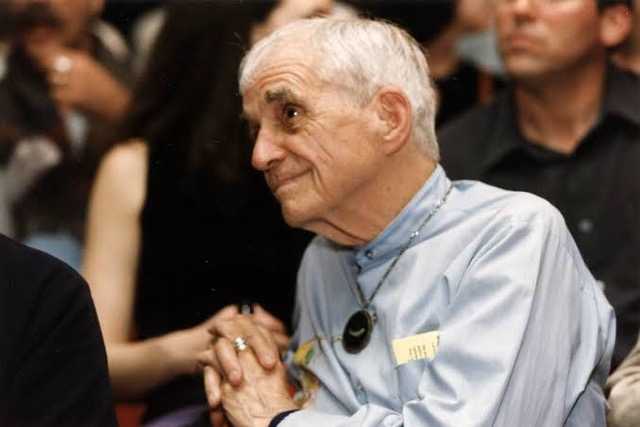
Time was running out for Dan as it is for me at 86. I’ve decided that the only currency that really matters in life is time. Each of us is allocated a certain amount of this currency and we spend it as we do, and when it runs out, it’s over for us, for eternity. Life comes down to how we spend our time. Berrigan believed death isn’t the end and I wish I could get there, but I just can’t.
One of Dan’s most enduring friendships was with the Buddhist monk and peace activist Thich Nhat Hanh (1926–2022). I recommend his book to you, You Are Here: Discovering the Magic of the Present Moment (Shambhala, 2010). Nhat Hanh suggested that Dan’s calmness when confronting death came in good part from his understanding that life and death are interconnected. One cannot exist apart from the other; they are as joined together as two sides of a coin. “That is why,” he wrote, “when one has seen the real nature of things, he will acquire a kind of fearlessness—an attitude of calm—because he knows his death will bring no end to life. His existing does not depend on his ‘being alive’ now.” (p. 359)
Dan recalled his last visit with Thomas Merton not long before Merton’s death. Merton spoke “with joy” as if anticipating his death. He said the only thing that relieved the life of a monk from absolute absurdity is that his life is a joyful conquest of death. The monk lives apart from a world—racist, violent, militaristic—that pays death such tribute, a taxation exacted on people by death itself. Dan said he learned from Merton what a great privilege it is to live a life of faith in which the possibility of the conquest of death is in our midst every day. “Most of us are driven by fear-centered idolatries. Our real shrines are nuclear installations and the Pentagon and war research installations. This is where we worship, allowing ourselves to hear the command that we kill or be killed, a command which seems to me is anti-Christ.” (p. 206)
I’ll add that for me old age has been a time of taking stock in a certain way. I sit on this couch where I spend my life these days–my various health issues have rendered me essentially homebound—and my life from earliest memories to the present time runs through my mind like a movie. In response to the various “scenes,” I experience gratitude and despair, satisfaction and regret, peace and upset, happiness and sadness. Basically, I feel good about my movie in its entirety. Basically, I’ve been responsible to the incredible gift of life I was given. But the operative word is “basically.” Especially, there are scenes of my movie with a young woman and two little boys I would re-shoot if I could.
* * *
It’s 2016 and Daniel Berrigan is 94 and the end is imminent. His friends report that in the last days Dan’s most notable quality was his immense compassion, which guided him when it was a challenge just getting out of bed in the Jesuit infirmary at Fordham University that had become his last home.
His friend Maureen McCafferty, one of the frequent visitors at Dan’s bedside, describes his last day, April 30th, 2016. (p.572)
When I walked into his room about noon, the minute I saw Dan lying in bed, eyes looking upward, breath coming with difficulty, I knew this was it. I texted Joe Cosgrove that if he wanted to be with Dan, now was the time to come. Joe Towle called the family—Liz, Frida, Jerry, and Kate who were all doing a retreat together. They hopped in their car. That these four family members were together was a miracle. Liz was usually in Baltimore, Jerry in Michigan, Kate in California, and Frida in Connecticut. Carla and Marc came down from Syracuse. As Patrick, Joe, and I were sitting vigil, I talked to Dan. I understood that hearing is the last sense to go in a dying person. I told him his family was on the way. He would soon be meeting his mother, Frida, his brother Phil, and his other brothers. I told him that he had led a very good life and that we all loved him and would miss him a lot. Joe left the room. Patrick and I were sitting there and I said to Patrick, “I think he has stopped breathing.” An aide came in, took his blood pressure, and shook her head. Dan had died.




Leave a Reply
Want to join the discussion?Feel free to contribute!