
Review of “Truth, Justice, and a Nice White Country”
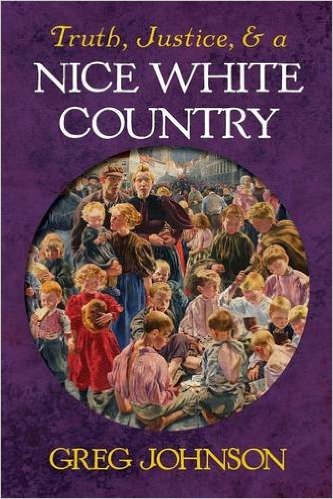 Truth, Justice, and a Nice White Country
by Greg Johnson
The picture on the cover and the title of Johnson’s latest collection of essays may seem at first glance to offer something of a bromide view of White nationalism: “A nice White country” it reads above a somewhat saccharine image representing healthy White demographics from yesteryear. This sets up a current of wistful yearning, which, given our predicament — heading for minority status in our traditional homelands within decades — is discomforting.
But the vision presented by the artful simplicity of the title and cover image is central to Johnson’s whole approach, which I characterize as stating his point as unambiguously as possible, then deploying his considerable powers of reason and evidence to drive it home.
This volume brings together 38 essays, all of which appeared on Johnson’s Counter-Currents site between 2011 and 2015, and cover a wide variety of topics. Most were written in response to the events and controversies of the day, so you might expect them to vary considerably in tone and message, but, once again, as with his previous collection “New Right versus Old Right,” the book has a remarkable consistency. The essays are organized thematically instead of chronologically.
The first section, “The Problem” (9 essays) focuses on the imminent breakdown of the present system, with chapters like “White Extinction” (2014), “The Republican Party Must Perish” (2012), and “Irreconcilable Differences: The Case for Racial Divorce” (2015). The intent seems to be to paint a grim picture of our present condition, with Whites, beset by hostile groups, gradually losing the means to survive, and with nothing but a broken political system to resort to. All this drives home the point that continuing as we are is simply not an option
However, it is interesting to read “The Republican Party Must Perish” in the light of the Trump phenomenon, which was only looming into view when the book was being prepared last year, but Johnson’s essay explains why party outsiders like Trump and Cruz have had such buoyant appeal:
“The Democrats have no problem making explicit appeals to the identity and interests of their constituencies: Jews, non-whites, environmentalists, gays, feminists, etc. But Republicans refuse to make explicit appeals to the identity and interests of whites, even while they pander to Jews and other groups that overwhelmingly vote against them. Nor will Republicans take the necessary steps to preserve the white majority — stopping non-white immigration, addressing higher non-white birthrates — even under the guise of race-neutral programs.” (p. 44)
Johnson’s explanation for the Party’s behaviour is that it has been hijacked by elites – especially rich Jews – with their own agenda that is completely at odds with that of America’s (still) majority White population. As usual following the money tells us most of what we need to know:
“To determine who maintains this suicidal ideological consensus and why, follow the money trail. Half the money raised by Republicans comes from Jews (75% for Democrats) and a large percentage of the rest comes from wealthy non-Jews (an even higher percentage for the Democrats). Capitalist elites, however, do not care about nationalism. They profit from importing non-whites and shipping American jobs to non-white nations […] Both Jews and the plutocracy are threatened by American nationalism and seek to suppress it. Both groups are well aware that that present demographic trends doom the white race in North America and the Republican Party. But both groups do not care.” (p. 44-45)
This grim scenario is the starting point of the book. The rest of the book can then be read as a quest in search of the ultimate solution, namely greater racial awareness and nationalism.
One way to view the book is as a voyage in search of this, as Johnson navigates the various issues and controversies of White nationalism, while tacking ahead in the face of challenging headwinds and disruptive squalls. This certainly explains the book’s structure and destination, its hopeful-sounding final section, “Vanguard Strategies” (6 essays).
The first Scylla and Charybdis navigated is perhaps the most challenging “Nationalism: Petty and Grandiose” (3 essays) as this opens up one of the fundamental disagreements between White Nationalists, that between two forms of Nationalism. Grandiose Nationalism refers to an internationalized form of White Nationalism that seeks to transcend ethnicity, while Petty Nationalism recognizes the fact that White nationalism is most potent when combined with an ethnic component, and seeks to work with this despite certain negatives.
This polarizing debate was brought to the fore in White nationalist and Alt-Right circles in 2014 by two events – the referendum on Scottish Independence and the revolution in Kiev. The third section of the book – “Ukraine & Russia” (4 essays) – therefore represents a continuation on this theme.
Johnson rejects the Grandiose version of Nationalism as too abstract and liable to cooption, preferring to embrace Petty Nationalism with qualifications. For this reason he supports Scottish independence – even under the helm of left-wing civic nationalists like the SNP – and the nationalists in the Ukraine despite their alliances of convenience with more globalist elements.
In Johnson’s view, Grandiose Nationalism – and transnational entities like the USA, the EU, Eurasianist Russia, and even the UK – impose a false unity that leads to “diversity” in a single state, invariably the cause of much unhappiness. In “Why I Support Scottish Independence” (2014) he describes the basic mechanism:
“Ethnic and racial diversity always lead to conflict, resentment, and violence. Diversity is not a strength, but a weakness. Therefore, the best way to insure peace and progress is to break up diverse societies into ethnically and racially homogeneous ones.” (p. 67)
As a Scot who has seen how the protracted existence of the UK has pushed Scots to the left as a defence mechanism and protest against the centralization of power in London, I side with Johnson, and believe that before we can have greater White unity, we must first have greater disunity and a proper framework for addressing our very real and potent ethnic divisions.
With the debris from Brussels still bobbing on the media tide, the next section in the book “The Muslim Problem” (2 essays) is disappointingly brief, although here too there are valid and useful insights, with Johnson making the case that anti-Islam is a way of venting our need for identity politics in a non-identitarian way, and therefore a mechanism for displacing and diffusing our natural nationalist tendencies. In his essay “The Muslim Problem” (2015), he lays this trick at the door of the one group that Johnson identifies as the chief enemy.
“Attacking Islam allows Christians to frame European identity politics as a clash between two universalist religions, Christianity and Islam. But we are not fighting for Christendom, which is now more non-white than white. We are fighting for the white race, regardless of religion. Attacking Islam plays into the hands of the principal enemy, the organized Jewish community, which is happy to reroute white anti-Muslim sentiment into fighting Israel’s enemies abroad, rather than fighting Islam in the streets of Europe. Indeed, when Israel destroys strong Muslim regimes in its neighborhood, this sends new waves of Muslim refugees to destroy white countries, killing two birds with one stone (a stone that we ourselves provide).” (p. 111)
One wonders what would happen if the West disengaged from the Middle East. Would we stop defining ourselves by our sense of civilizational distance from “primitive” Islam and the ridiculous repressive tolerance that we occasionally try to impose on it with guns, bombs, drones, and other sinister methods? Would we start to see ourselves in more nationalistic terms? If we could only turn off the distraction of Middle Eastern chaos for a few years, we might find out.
As if to mock the West’s attempts to impose its degenerate values where they are not wanted, Johnson follows the brief section on Islam with a larger section on “Sexual Politics” (6 essays). This deals with the gay marriage controversy that was so topical a couple of years ago, but which now seems somewhat passé. In addition to gay marriage, Johnson also takes aim at transsexuals, the Left’s new pet cause.
The point for the Left is not actual concern for this or that marginalized group, but simply a psychological, dopamine-fed addiction to signalling some kind of edgy morality. As Johnson points out in “Further Confessions of a Transphobic” (2015), helping transsexuals mutilate themselves in a forlorn quest to achieve their “true gender” leads to dangerous consequences:
“The fact that transsexuals are the latest politically-correct totem group is further proof that liberalism really is a mental disease. Lunatics know their own. And unfortunately the lunatics are running the asylum. My hypothesis is that Leftists are physiologically addicted to righteous indignation, which they arouse by adopting simple and absolute values as the focus of moral fanaticism. The fact that one-dimensional moralism is destructive of other values actually counts in its favor to the addict’s mind, just as sacrificing babies to Baal underscored and elevated the god’s sanctity. And just as drug addicts require ever higher doses to achieve the same effect, Leftists always require new, more extreme and radical crusades. This is how the history of liberalism has been reduced to a long, glorious march from the tyranny of dashing dictators and divinely-anointed monarchs to the tyranny of sniveling neurotics.” (p.140)
Most nationalists and Alt-Righters agree that gay marriage and transsexual issues are relative trivialities that affect only a tiny section of the population, and serve mainly as distractions from more important issues. However, attitudes to the manosphere have proven more divisive, with a large controversy earlier this year principally between Johnson and Roosh V of the Return of Kings site.
While none of the content from that disagreement makes it into this volume, Johnson’s “Be Yourself” (2012) deals skilfully with some of the same issues. The essay is a commentary on a debate between my Alternative Right colleague Andy Nowicki and Matt Forney, then operating under the pen name of Ferdinand Bardamu.
Forney had made the case for the manosphere mantra of self improvement through exercise, confidence building, and game, while Nowicki had rejected this in favour of an ethic of authenticity and a refusal to pretend. Johnson offers a suitable compromise through the Aristotelian concept of self-actualization with reference to Schopenhauer:
“To adapt an example from Schopenhauer, imagine two men, one brawny but not bright, the other brainy and weak. The brawny man would be most satisfied with a physically active life, say being a lumberjack. The brainy man would be most satisfied with an intellectually active life, such as being a math professor. Now switch the two men’s professions. Send the math professor out to cut down trees, and put the lumberjack in the classroom. Both men would be miserable, because they would be required to live in a way that conflicts with their natures. And even if, through a massive act of will, it were possible for both men eventually to perform the other’s job competently, they would still be miserable, because they would be constantly going against rather than with the grain of who they really are.” (p. 152)
This essay reminds us that Johnson is often adept at charting a subtle and sensible middle course between positions that elicit visceral emotions that lead to pointless divisions. The one issue, however, where he takes a hard-line position is that of malevolent Jewish influence on the West. In “White Genocide” (2015) he pushes the question from “Are they really guilty?” to “Are they really not guilty?” also placing politicians and non-Jewish elites in the dock.
“First, the burden of proof needs to be shifted. For is it really plausible that the leaders of dozens of white nations have adopted similar policies antithetical to the long-term survival of their own peoples, yet none of them knew what they are doing? Yes, it is fashionable to deride politicians for thinking only in terms of the next election. But that is not really true. Politicians are, for instance, rather far-sighted when it comes to their personal career ambitions and plans.” (p. 18)
The degree to which Jewish influence is responsible for the trajectory of Western decline is a major question for all of us on the Alt-Right, but I think it is fair to say that our decline cannot hinge solely on the malevolence of one group no matter how powerful they are culturally or financially – even with their allies. Much of what is happening also stems from the inherent nature of modernity and general socio-economic patterns – after all, non-Jewed Japan and China also have below-replacement birth rates.
Because of the importance of the bigger economic picture, it is encouraging to see a substantial section in the book tackling economic issues, as this is an area where the Alt-Right is often criticized as being weak. “White economics” (8 essays) covers a lot of ground, and although I got the impression that this is not Johnson’s favourite area, there were plenty of good ideas and interesting insights – such as the one about printing expiration dates on money to prevent hoarding and promote economic stimulus.
One of the gateways to Johnson’s interest in economics was the American historian and critic of capitalism, Brooks Adams. His essay “Brooks Adams on the Romans” (2011) is particularly interesting for the way it highlights the perennial patterns of socio-economic decline, several of which resonate with our own age. Thanks to their worldly success the Romans too faced the challenge of a kind of globalism, with cheap foreign labour leading to a process of economic hollowing out that prepared the way for Rome’s subsequent collapse:
“Rome’s victories led to the enslavement of entire nations. These slaves provided cheap labor, which allowed large landowners to undercut the prices of small farmers. When Egypt was added to the Empire in 30 BC, its impossibly fertile land tilled by wretched fellaheen spelled doom for the Roman farmer. Adams describes how entire districts of Italy were depopulated. Farmers starved to death, abandoned their lands and drifted to the cities as paupers and proletarians, or simply failed to reproduce themselves.” (p.178)
With blind economic forces pushing us to our destruction and making us easy prey for more predatory groups, it is clearly vital for White Nationalists to develop a keener understanding of economics. Without that, whatever other narratives we develop, we are simply sleepwalking – or to return to our nautical analogy, sailing without a compass and sextant. Only by understanding economics can we hope to dethrone them from the sovereignty and dominion they currently enjoy over us and replace that with the interests of the people. Johnson has a vivid sense of this dichotomy:
“In ancient Rome, as in modern America, the economic system and its imperatives are treated as absolute and fixed, whereas the people are treated as liquid and fungible. Nationalism represents a complete reversal of these priorities. For the nationalist, a people and its interests are absolute and non-negotiable. The economic system must be subservient. Thus for nationalists there are no economic absolutes.” (p.179)
In essence, Nationalism is a human consciousness-raising exercise. If we can achieve that then we’ll have some chance of staving off the blind forces and invisible hands that are conjuring our doom. To do this we will need writers like Johnson who can take readings and chart our course through stormy seas and treacherous shoals with as much precision as the best navigators of our seafaring past.


Comments are closed.