
A Review of “The Mighty Dead” by Adam Nicolson, Part 3 — Indo-European Population Genetics
Indo-European genetics
A major weakness of The Mighty Dead is a lack of any discussion of findings from population genetic studies. In her 2015 book Ancestral Journeys: The Peopling of Europe from the First Venturers to the Vikings, Jean Manco notes that while it has been widely assumed that the shift to Indo-European languages was triggered “by Indo-European speakers establishing themselves as elites among other peoples,” the genetic evidence points to them having a “much larger impact on the population.”[xi] The earliest sample found of the Y-DNA haplogroup R (the one that today dominates Europe) is from a boy who lived 24,000 years ago in Siberia. Manco notes that this boy “carried a genetic component omnipresent in Europeans today, but found only on the eastern fringes of Europe before the Late Neolithic.” This component, named Ancestral North Eurasian (ANE), was also present in a sample from a 17,000 year old male from much further West, and
most significantly, ANE is strikingly present in a group of [the Indo-European] Yamnaya people buried in the Samara region (all of whom carried variants of the R1b haplogroup). A sample of Corded Ware people in Germany has been modeled as approximately three-quarters Yamnaya, clear evidence of migration into the heartland of Europe from its eastern periphery. Bell Beaker people in Germany also carried ANE.[xii]
Another striking fact is the very strong correlation between the distribution of the Y-DNA haplotype R1 and the distribution of the Indo-European languages. Manco notes that “the dramatic genetic heritage of the Indo-Europeans was first suspected from the modern distribution of Y-DNA R1. R1a1a (M17) dominates northern India and is also found in Eastern Europe, particularly in Slavic and Baltic populations, while R1b1a2 (M269) dominates the rest of Europe.” While not the only haplogroup that spread with the Indo-Europeans, R1 is the “part of the picture that leaps to the eye.”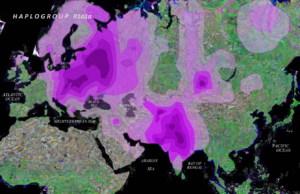
Another clue to the genetic impact of the Indo-Europeans pastoralists from the steppe is the fact that most European adults can drink milk as a result of a helpful genetic mutation that confers lactase persistence. Manco observes that: “It has been proposed that lactase persistence was the genetic edge that allowed the dairy pastoralists to spread.”[xiii] Evidence of the aggressive demographic expansion of the Indo-Europeans, and the consequent displacement of other ethnic groups in Europe is revealed by the fact that non-Indo-European Y-DNA haplogroups like G2a are today found almost exclusively in mountainous regions of Europe. One source makes the point that:
The hilly terrain of southern Europe indeed makes it ideally suited for herding goats, which G2a men brought with them during the early Neolithic period. But the most likely explanation is that mountains provided refuge for G2a tribes after the Proto-Indo-European speakers invaded Europe from the steppes of Russia and Ukraine during the Copper and Bronze Age. Steppe people were almost exclusively cattle and horse pastoralists and first settled flat regions like the Hungarian Plain and the Baltic region. Even after reaching Western Europe, they favored relatively low lying regions like the Low Countries, Western France and the British Isles, where R1b lineages now exceed 60%, and in some places 80% of the population. In fact, the highest percentages of G2a today are found in the regions last invaded by R1a and R1b people.
Despite the apparent link between R1a and R1b and the original Indo-Europeans, these are minority haplogroups in several Indo-European-speaking countries today – including Greece, a nation where today no Y-DNA haplogroup is dominant. While R1a1 appeared at 21 percent in a sample from Macedonia and at lower levels elsewhere in Greece, Manco suggests this is more likely to reflect “Slavic incursions into that area in the Byzantine period,” and argues that R1b is much more likely to have arrived with the Greek speakers. Observing the multifarious historical events (and associated demographic disruptions) that have shaped Greek genetics over the four millennia since the initial arrival of the Indo-Europeans, she notes that “it is a complex genetic picture. What else are we going to expect of a seagoing people at the crossroads of civilizations?”[xiv]
Modern Europeans are the product of three key ancestral subgroups: of the founding hunter-gatherers that settled the continent over 35,000 years ago, and of two subsequent waves of agriculturalists who entered Europe from the Fertile Crescent over 8,000 years ago. European ethnic groups are made up of varying combinations of these foundational genetic elements. The National Geographic Genographic Project reference population of autosomal DNA for contemporary Greeks reveals that the agriculturalist genetic legacy, labelled “Mediterranean” and “Southwest Asian” today predominates over the “Northern European” hunter-gatherer component:
For comparison, consider the Danish reference population where the Northern European hunter-gatherer component predominates:

These genetic differences are reflected in differences in ethnocentrism and other psychological traits. Greece has been identified by the ADL as the most “anti-Semitic” nation in Europe with some 69 percent of Greeks allegedly having anti-Jewish views (including 75 percent of Greek males). By contrast, “anti-Semitism” is lowest in Scandinavia with just nine percent of Danes and four percent of Swedes holding anti-Jewish opinions. Greeks certainly seem to be less prone to that extreme brand of “pathological altruism” that afflicts many Scandinavians. That Greeks are far less individualistic than Danes is confirmed by the Hofstede cultural dimensions country comparison:

The genetic trace of the Indo-European invaders in the Middle East and Central Asia is evident in the Genographic Project reference samples for Iran and Northern India, where the sizable “Northern European” percentages are said to represent an “interaction with people of ultimately European origin, perhaps via the ancient Indo-Iranian-speaking steppe nomads of Central Asia, who are thought to have migrated into India around 3,500 years ago.”


Today Greece is facing a very different invasion from that of four millennia ago: a dysgenic southern invasion of people mainly from the Middle East and North Africa. These migrants are genetically differentiated from Europeans by their comparative lack of the Northern European hunter-gatherer component, and the presence of significant Sub-Saharan African admixture (a legacy of the Islamic slave trade). Consider, for example, the following reference samples:


These population genetic profiles, together with endemic cousin marriage (and resultant inbreeding depression), means that mean IQs for these populations are: Tunisian 83, Egyptian 81, Kuwaiti 86 and Lebanese 82. Thus migrants from these or similar countries entering Europe have mean IQs comparable to (or even lower than) African-Americans — a population characterized by a wide range of social pathologies. Add high fertility, militant Islam, mass illiteracy (in their own language) and an entrenched rape culture to the mix, and you have a demographic disaster in the making.
The Ancient Greeks and Western individualism
The genetic evidence suggests the Indo-European warrior elite that conquered most of Europe (including Greece) had a distinctive genetic profile. After the period of conquest by these berserker aristocratic military units, Duchesne contends that the warrior ethic slowly faded, but individualistic competition and the desire for public acclaim lived on as a key part of their culture. In classical Greece the aristocratic ethos of individualism and competitive conflict was reflected in the intensely combative nature of classical literature and philosophy. “New works of drama, philosophy, and music were expounded in the first-person form as an adversarial or athletic contest in the pursuit of truth. … The search for the truth was a free-for-all with each philosopher competing for intellectual prestige in a polemical tone that sought to discredit the theories of others while promoting one’s own.”[xv] Plato’s dialogues spring to mind. This cultural pattern was subsequently taken up throughout Europe and its colonies.
Individualism, moral universalism and a tendency to develop high-trust societies are undoubtedly distinguishing features of Western culture. The late political philosopher Michael Oakeshott observed that at least by the eighteenth century: “The disposition to regard a higher degree of individuality in conduct and in belief as the condition proper to mankind and as the main ingredient of human ‘happiness,’ had become one the significant dispositions of the modern European character.”[xvi] Clearly, to emerge in the first place, Western individualism had to be evolutionarily adaptive at some level. In accounting for the historical emergence of the individualism and the moral universalism of White people, some, like MacDonald, emphasize genetic factors (our unique evolutionary history as northern hunter-gatherers) while others, like Ricardo Duchesne, emphasize the Indo-European cultural inheritance. These genetic and cultural explanations are certainly not mutually exclusive.
For Kevin MacDonald, the roots of European culture are also to be found in the evolved individualism of hunter-gatherer groups that spread over Europe after the last glacial maximum (~15,000 years ago), labeled egalitarian individualism, in addition to the aristocratic individualism characteristic of the culture of the Indo-Europeans — who were genetically similar to other Northern Europeans anyway. As mentioned, they evidently shared many of the same psychological traits — including heightened individualism and egalitarianism within the peer group. For MacDonald, the Indo-European elite warrior class was thus “a variant on a previously existing culture of northern hunter-gatherers resulting in two quite different cultural strands in Europe: an egalitarian-individualist culture [individualism within an egalitarian social system] and an aristocratic-individualism culture [individualism within the context of a hierarchical system in which there is nevertheless considerable egalitarianism among aristocrats].”
Regardless of origin, Western individualism has been conducive to economic development, and the resultant boost in living standards dramatically reduced child mortality and hugely increased the carrying capacity of Western nations by augmenting supplies of essential resources. In his book Human Accomplishment, Charles Murray stressed the importance of individualism as a key driver for great achievement in the West, noting that: “A major stream of human accomplishment is fostered by a culture that encourages the belief that individuals can act efficaciously as individuals, and enables them to do so.”[xvii]
As well as their highly adaptive culture of “aristocratic individualism,” the Indo-European invaders also brought with them high native intelligence. It has been estimated that the Indo-European invaders probably had, on average, substantially higher IQs than many of the peoples they conquered, including the Egyptians, Sumerians and the various Semitic peoples of the Middle East. This high intelligence is something else they had in common with other Northern Europeans. Those Europeans living in the coldest regions of the continent, over a period of many millennia, evolved higher average intelligence than the peoples living to the south. It was the mild climate of the Fertile Crescent and the greater availability of a range of suitable plants and animals that enabled the inhabitants of the region to develop agriculture before the peoples of northern Europe.
Because of their high intelligence and close proximity to the Middle East and Egypt, the Greeks were the first group to possess the combination of opportunity and natural talent that is prerequisite for great achievement. They were ideally placed to absorb and then far surpass the cultural advances of those earlier civilizations, and their genetic endowment enabled them to quickly overtake the civilizations of the Middle East and Europe. The intellectual achievements of the Ancient Greeks completely dwarfed the achievements of any other ancient civilization. For example, in 1600 the Chinese had not progressed as far in mathematics as the Greeks had in 300 BC.
[i] Adam Nicolson, The Mighty Dead: Why Homer Matters (London: William Collins, 2014), 54.
[ii] Ibid., 218.
[iii] Ibid., 219.
[iv] Ibid., 176-77.
[v] Ibid., 27.
[vi] Ibid., 135.
[vii] Ibid., 144.
[viii] Ibid., 100; 106.
[ix] Ibid., 165.
[x] Ibid., 155.
[xi][xi] Jean Manco, Ancestral Journeys: The Peopling of Europe from the First Adventurers to the Vikings (London: Thames & Hudson, 2015), 145.
[xii] Ibid.
[xiii] Ibid., 157.
[xiv][xiv] Ibid., 152.
[xv] Ricardo Duchesne, The Uniqueness of Western Civilization (Boston: Brill Academic, 2012), 452.
[xvi] Michael Oakeshott, “The masses in representative democracy,” In: Rationalism on politics and other essays (Indianapolis: Liberty Fund, 1991), 366.
[xvii] Charles Murray, Human Accomplishment (New York: HarperCollins, 2003) 394.



Comments are closed.