
Mark Rothko, Abstract Expressionism and the Decline of Western Art, Part 1
Brenton Sanderson


The life and career of Abstract Expressionist painter Mark Rothko is a prototypical Jewish story that encapsulates a range of themes discussed at The Occidental Observer. Central to Rothko’s story is the political radicalism of eastern European Jewish migrants arriving in the United States between 1880 and 1920; the reflexive hostility of these migrants and their descendents to the traditional people and culture of their new homeland, and how this hostility was reflected in the artistic and intellectual currents that dominated Western societies during the twentieth century. Rothko’s story also exemplifies other familiar themes including: the force of Jewish ethnic networking and nepotism in promoting Jewish interests, and the tendency for Jewish “genius” to be constructed by the Jewish intellectual establishment as self-appointed gatekeepers of Western culture.

With Jackson Pollock, Mark Rothko has been accorded a leading place in the ranks of the Abstract Expressionists. If there is such a thing as a cult artist among the liberal Jewish intelligentsia, then Rothko is probably it. Important people stand in grave silence before his empty expanses with looks on their faces that bespeak lofty thoughts. As a critic for The Times noted:

Rothko evokes all that could be criticized as most pretentious, most clannish, most pseudish about his spectators. They stand there gravely perusing something that to the outsider probably looks more like a patch of half-stripped wallpaper than a picture and then declare themselves profoundly moved. And many outsiders will start to wonder if they are being duped, if this Modernist emperor actually has no clothes on and his fans are just the blind followers of some aesthetic faith.

Advertisement

For critics like Ottmann, Rothko’s genius is indisputable and he possessed an “extraordinary talent” that enabled him to transfer his metaphysical “impulses to the canvas with a power and magnetism that stuns viewers of his work… In fact Rothko’s skill in achieving this result – whether intentional or not – perhaps explains why he was once called “the melancholic rabbi.”“[i] For prominent Jewish art historian Simon Schama, Rothko’s “big vertical canvasses of contrasting bars of colour, panels of colour stacked up on top of each other” qualify Rothko as “a maker of paintings as powerful and complicated as anything by his two gods – Rembrandt and Turner.” For the ethnocentric Schama “these [Rothko’s] paintings are equivalent of these old masters… Can art ever be more complete, more powerful? I don’t think so.”[ii]

After experimenting with Expressionism and Surrealism, Rothko arrived in 1949 at the signature style that would typify his work until his death by suicide in 1970 at the age of 66. This consisted of two or three floating rectangles of colour painted against a monochrome background. A pioneer of “colour-field” painting, Rothko claimed that only abstract painting could express the “full gravity of religious yearnings and the angst of the human condition.” His final works became so minimalistic (large black canvasses) as to be almost void of any substance.
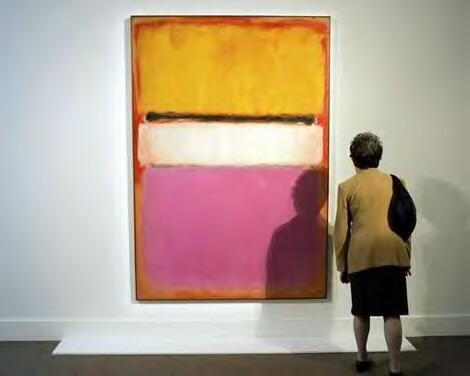
White Centre (Yellow, Pink and Lavender on Rose) by Mark Rothko (1960): Sold at auction in 2007 for $73 million

The Making of Mark Rothko

Born in 1903, Marcus Rothkowitz was the youngest child of pharmacist, Jacob Rothkowitz, and his wife, Anna Goldin Rothkowitz, in the Russian city of Dvinsk (today Daugavpils, Latvia). Dvinsk was located at the time within the Jewish Pale of Settlement. The Pale was then inhabited by five million Jews who were confined there by the Tsar at a time when thousands of Polish Jews came across the border into Russia seeking work. Rothko’s father was the stereotype of the leftwing Jewish intellectual, who presided over a family with an “intense commitment to politics and education.”[iii] He initially preferred secular education for his children, and political over religious involvement. According to Rothko, his father’s relation to formal religion was openly oppositional: “My father was a militant social democrat of the Jewish party, the Bund, which was the social democracy of that time. He was profoundly Marxist and violently anti-religious.”[iv]

That this was chiefly an anti-Christian rather than anti-religious impulse is revealed by the fact that he returned to the Orthodox Jewish fold after Marcus’s birth in response to the pogroms which followed the failed Russian Revolution of 1905. While no pogroms were visited on the Jews of Dvinsk, the town witnessed occasional incidents where Jews were targeted as sympathizers of the Social Democratic and other revolutionary parties.[v] In 1905, according to Rothko’s biographer, Jacob Baal-Teshuva, the young Rothko’s “hometown was under the blanket surveillance of the Tsarist secret police. Jews were the usual victims of reprisals whenever the Cossacks, the loyal followers of the Tsarist state, came into the town to break revolutionary uprisings. Other Jewish communities in the environs of Dvinsk also lived in constant terror of pogroms and massacres. The air was filled with slogans like “Kill the Jews to Save Russia.” This was the atmosphere in which Rothko grew up.”[vi]

While there were no pogroms or mass graves in Dvinsk, Rothko would later say that “as a child he could remember the local Cossacks indulging in their favourite activity – beating up Jews,” and later “claimed to recall dug-up pits in the forests around Dvinsk, where the Cossacks buried Jewish victims they had kidnapped and murdered. These images always plagued him mentally, and he says they exercised a certain influence on his painting.”[vii] Baal-Teshuva forgives Rothko these obvious untruths by pointing out that it is likely “that the child heard adults talking about the pogroms and massacres elsewhere, and in his memory ended up mixing up these stories with his own memories of the nearby woods.”[viii] Nevertheless, he acknowledges that some critics have willingly run with these falsehoods and have “gone so far as to say this explains his preference for rectangular forms in his late works, as a formal echo of the grave.”[ix]

In response to the economic insecurities and political dangers of life in the Pale, Marcus’s father migrated to the United States in 1910. Only in 1913, when Marcus was ten years old, did the rest of the family move to America.[x] Despite the apparent dangers of life for Jews in the Pale, Rothko “referred often to the ‘terrible experience’ of having been torn away from his homeland against his will.”[xi] It has been noted that it was certainly not American culture that attracted the waves of Jewish migrants from Central and Eastern Europe, but only the relatively advantageous conditions created by American economic growth. “They came to America’s shores” notes Muller, “motivated not by religion but in spite of it, their more orthodox leaders being inclined to warn them against the dangers of godless and goyish America.”[xii]

As an educated family and active Zionists, the Rothkowitz family spoke Hebrew in addition to Russian and Yiddish. Whereas the older siblings attended public schools along with many other Jewish children concentrated in one neighbourhood of Portland, father Rothkowitz decided that Marcus would receive a strict religious education. He was sent to a cheder, the religious school run by the synagogue, starting at the age of five, where he was subject to a strict and tiring routine: praying, reading and translation of Hebrew texts, and rote memorization of Talmudic law.[xiii]
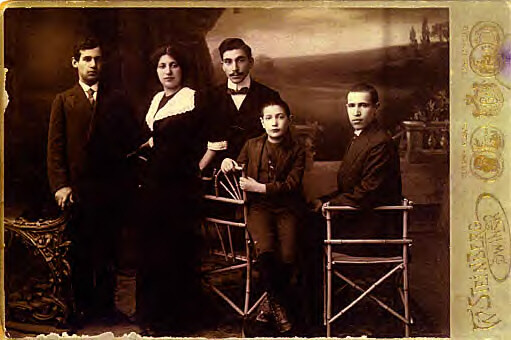
Rothkowitz family portrait: Marcus second from the right
Rothko’s parents saw no contradiction in bringing up their son as an Orthodox Jew, a Zionist, and a Communist. This is quite in keeping with Kevin MacDonald’s observation that “within Russian Jewish communities, the acceptance of radical political ideology often coexisted with messianic forms of Zionism as well as intense commitment to Jewish nationalism and religious and cultural separatism, and many individuals held various and often rapidly changing combinations of these ideas.”[xiv]

Baal-Teshuva relates that “after the family had achieved a degree of economic security in Portland, they began to join local chapters of radical movements. The sensitive and rather nervous Marcus was similarly inclined, and increasingly participated in discussions on current affairs. He argued quite skilfully for the right of workers to strike, or for general access to contraception. His entire family was in favour of the Bolshevik Revolution, as Rothko later said.”[xv] This was, of course, very typical, with Jewish historian Norman Cantor noting that “in the first half of the twentieth century, Marxist-Leninist communism ran like an electromagnetic lightning flash through Jewish societies from Moscow to Western Europe, the United States and Canada, gaining the lifelong adherence of brilliant, passionately dedicated Jewish men and women.”[xvi]

Another “Jewish Genius” Gets Stung by the WASPS

Rothko was, according to Schama, very much one of these brilliant Jewish men, and despite his Orthodox Jewish education, was “no Jewish Trappist, but a much more recognizable type (at least to me): loquacious, exuberant, hot-tempered, deeply immersed in literature and history.” While the Orthodox Judaism in which Rothko was schooled was not directly expressed in his art, Schama insists that “once you”ve done cheder – Hebrew school – it never really goes away, however much you try to banish it; nor did it for Marcus. He was what everyone would call, with smiles, both admiring and pitying, a chocom – a know-it-all. And what do chochoms do if they weren’t going to be rabbis?[xvii] He was, Schama insists, “just your super-educated, ungainly, sentimental Jew. In the grip of mighty ideas, he was desperate to tell you all about them, fidgeting on the sofa and waving his arms all around. A big heart and a big mouth to match – you know the type.”[xviii]

Rothko excelled academically at Lincoln High School in Portland, and was a passionate debater for the radical cause, and “went to hear the firecracker orator “Red” Emma Goldman attack capitalism and sing the praises of the Bolshevik Revolution.”[xix]
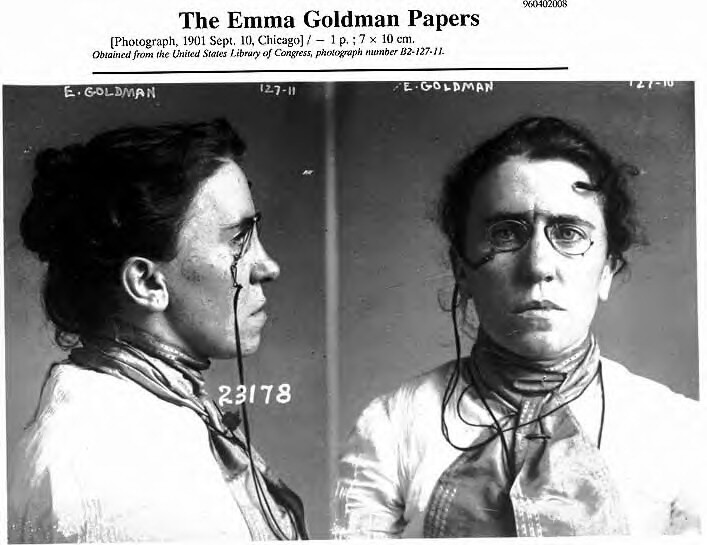
A youthful influence: Emma Goldman

Schama tells us that Rothko was “scholarship material, and won a place at Yale before the Ivy League decided they were about to be inundated by clever Jews and imposed admission quotas. But, Rothko felt the sting of the WASPS all the same. If they couldn’t actually evict the talky-smart kikes, “those people,’ they could at least make it hard for them to stick around.”[xx] According to Baal-Teshuva, Rothko and his fellow Jewish students from Portland soon discovered the difficulties of gaining social acceptance in a setting where “the majority of generally affluent White Anglo-Saxon Protestants were contemptuous of the Jewish minority.”[xxi] Exactly how these WASP students were supposed (or even remotely likely) to embrace a group who feted Emma Goldman, were deeply hostile to their people and culture, and who longed for the day when a violent revolution would consign them and their kind to the dustbin of history, and elevate Jews like Rothko to their supposedly deserved high status is unclear.

At the end of a year spent studying mostly history of philosophy and psychology, Rothko’s scholarship was rescinded and replaced with a student loan – this event being held ever after as a prime example of the systematic anti-Semitism Rothko confronted at Yale. He lived off-campus with relatives in New Haven, and launched a radical underground newspaper called the Saturday Evening Post “which took aim at the college’s teaching methods and fetish for prestige.”[xxii] He dropped out of Yale after his second year, and moved to New York where he took further courses at the Art Students League in 1925 and took lessons in drawing from nature.

Soon thereafter, Rothko enrolled in the class of Max Weber, the Jewish American painter who taught a course in still-life. Weber and Rothko had both come to the United States as Russian-Jewish immigrants at the age of ten.[xxiii] Marcus also gathered experience in advertising, and was hired to draw maps and illustrations for the Graphic Bible by Lewis Browne, a retired rabbi from Portland who had become a best-selling author. When Rothko saw he was not credited as the creator of these works, he sued Browne for $20,000 in damages. In the end, he lost the trial.[xxiv]

When the Wall Street crash came in 1929, followed by the Great Depression, Rothko had little to show for his decade in New York. He was exhibited but not much sold, and when he did sell his work, it was not enough to make a living. “He was married to Edith Sachar, bright and Jewish, whom he had met at a progressive summer camp at Lake George in the Adirondacks: downing dialectical materialism, Freud and Cubism along with the weak coffee.”[xxv]

Living in a Jewish world— New York art scene branch.

Go to Part 2.

REFERENCES

Baal-Teshuva, J. (2009) Rothko, Taschen, Cologne, Germany.

Breslin, J.E.B. (1998) Mark Rothko: A Biography, University of Chicago Press, Chicago.

Cantor, N.E. (1994) The Sacred Chain – The History of the Jews, HarperCollins, New York.

MacDonald, K. B. (1998/2001) The Culture of Critique: An Evolutionary Analysis of Jewish Involvement in Twentieth‑Century Intellectual and Political Movements, Westport, CT: Praeger. Revised Paperback edition, 2001, Bloomington, IN: 1stbooks Library.

Muller, J.Z. (2010) Capitalism and the Jews, Princeton University Press.

Ottmann, K. (2003) The Essential Mark Rothko, Harry N. Abrams, New York.

Schama, S. (2006) Simon Schama’s Power of Art, BBC Books, Great Britain.

Schama, S. (2006a) Simon Schama’s Power of Art, BBC TV Series, Great Britain.


ENDNOTES

[i] Ottmann p. 8

[ii] Schama 2006a

[iii] Breslin p. 14

[iv] Ibid. p. 15

[v] Baal-Teshuva p. 19

[vi] Ibid. p. 19-20

[vii] Schama 2006a

[viii] Baal-Teshuva p. 19-20

[ix] Ibid. p. 19-20

[x] Ibid. p. 20

[xi] Ottmann p. 17

[xii] Muller p. 96

[xiii] Baal-Teshuva p. 20

[xiv] MacDonald (1998/2001) p. 82

[xv] Baal-Teshuva p. 23

[xvi] Cantor p. 281

[xvii] Schama p. 401-402

[xviii] Schama 2006a

[xix] Schama p. 402

[xx] Ibid. p. 402

[xxi] Baal-Teshuva p. 23

[xxii] Ibid. p. 23

[xxiii] Ibid. p. 23

[xxiv] Ibid. p. 24

[xxv] Schama p. 405

Share:
  • Print
  • Digg
  • Facebook
  • Twitter

90 Comments to "Mark Rothko, Abstract Expressionism and the Decline of Western Art, Part 1"

  1. FWM's Gravatar FWM
    September 22, 2011 - 12:01 am | Permalink

    Despicable man. Anti-Life, Sucker of sensibility. A marker for Goyim gullibility. A just universe would disperse him upon conception.

    Mike

  2. Anon.'s Gravatar Anon.
    September 22, 2011 - 12:52 am | Permalink

    The fellow sitting to the far right looks surprisingly like Obama! Ouch!

  3. Hooper's Gravatar Hooper
    September 22, 2011 - 2:56 am | Permalink

    It is remarkable how ‘just-off-the-boat’ eastern European immigrant Jews managed to recalibrate the artistic and political discourse in America practically within one generation. To me that is an indication of two things: the almost rabid energy of early Jewish immigrants who literally overwhelmed the native population with an assimilation approach based on rapidly acquiring the local culture while at the same time working to destroy it. Secondly, the native population was clearly in a vulnerable state to allow such a hostile takeover.

    The Jews’ ability to simultaneously assimilate and destroy is a lethal weapon as it allows them an element of disguise. The Mongols might have conquered us but they would likely not have been leading the New York Philharmonic. And had the Mongols come, we would have known we were being subjugated to alien rule and would have a) resisted b) consciously worked to maintain our culture c) created strong social bonds.

    None of the above is happening now.

    New York, a city I have never cared for in the least, became the epicenter of Jewish modernist culture with its highly idealized, cosmopolitan values, tinged with a destructive political extremism, all of which was thoroughly at odds with the Western tradition. Jumping ahead a little bit, I think the counter-culture of the sixties got its stimulus from the New York Jewish scene. And then the natives, always suckers for a moral crusade, jumped on board and bingo – the 60s in all their ‘glory’.

    How did this manage to happen? It seems that by the turn of the century Western Civilization was sick and exhausted, unsure of where to go next. Zooming out a bit more, I think that the Jews were best suited to take advantage of the Post-Industrial Revolution world. It just took them awhile to get going (and for the native resistance to run down). Ultimately the West unleashed a beast that it was ill-equipped to handle. The 20th century was the perfect environment for a people who could live in a highly industrialized and urbanized world and yet maintain ethnic networks and a strong sense of identity and purpose. The Euro people, despite having created this world, turned out to be vastly less adept at manipulating it for their own benefit.

  4. Mickey Meadows's Gravatar Mickey Meadows
    September 22, 2011 - 5:39 am | Permalink

    LOL – ROFL – I look at that abstract painting in the picture, and fall on the floor laughing and then crying. How is it, that we have been fooled by these people? We invented the scientific and medical revolutions. We produced 95% of the great works of art and literature. We invented the modern society and economy. We created prosperity for the common folk beyond the wildest imaginings yesteryear. We went to the Moon, and sent robots around the solar system. We discovered the origins of the universe and its extent and momemtum in physical space.
    How did we ever get fooled by a picture like that, and all that it symbolizes so well for the other dross we bought. I laugh and then I cry. And then I do something about it.

  5. Richard IV's Gravatar Richard IV
    September 22, 2011 - 8:24 am | Permalink

    @Hooper
    “How did this manage to happen?”

    They went for the control points. Media, Education, Law. They were ambitious, ruthless, and promoted each other. The left do exactly the same thing.

  6. Freedom Fighter's Gravatar Freedom Fighter
    September 22, 2011 - 8:49 am | Permalink

    Interesting article . The modern art is an interesting phenomena and on reflection it seems to be a Jewish driven creation . This is a people without an artistic culture and what better way to describe their art-less culture than to create ‘Art’ that sets about interrogating and dismantling ‘goyem’ culture using the bats and knives of Marxism and Freud-ism .

    Another line caught my eye : Schama tells us that Rothko was “scholarship material, and won a place at Yale before the Ivy League decided they were about to be inundated by clever Jews and imposed admission quotas. But, Rothko felt the sting of the WASPS all the same. If they couldn’t actually evict the talky-smart kikes, “those people,’ they could at least make it hard for them to stick around.”
    This is pretty rich considering affirmative action and ethic nepotism are the Jewish imposed admission quotes against European Americans . Just another little piece of accidental bigotry from histories victims ?

  7. Tom's Gravatar Tom
    September 22, 2011 - 9:04 am | Permalink

    The author is being nice to Rothko the Jew. LOL.

    Rothko the painter had some paint mixing techniques that he took to the grave with him. Some of the color he produced cannot be duplicated even after serious scientific study.

    Unless you are a painter, or a serious hobbyist, you have no idea of the techniques involved, or the difficulty of reproducing Rothko’s colors, layering & washes.

  8. Abe Goldstein's Gravatar Abe Goldstein
    September 22, 2011 - 10:38 am | Permalink

    @Tom: I don’t believe that a unique color qualifies as a great innovation. Let’s face it – most modern art is a big fat con job – no better exemplified by 73 million bucks for that painting. So, a couple of Jews were involved – that doesn’t make us a bunch of Italian gansters. Frankly, whoever buys those paintings should have a big L tatooed to their forehead, and should be laughed at for life.
    Perhaps art critics are just performance artists, amazed that so few figure out they are playing a big joke with their pretentious, overdone rhetoric.

  9. Rehmat's Gravatar Rehmat
    September 22, 2011 - 10:46 am | Permalink

    There is no ‘liberal’ or ‘conservative’ jew. They both are two faces of the same coin – Jewish supremacy over Gentiles – but with different ideologies. Take for example, Dr. Noam Chomsky, who consider himself ‘liberal’ and ‘humanist’ – calls America a terrorist state while confess that terrorist Jew settlers in Palestine have every right to occupy an Arab land.

    http://rehmat1.wordpress.com/2010/07/24/chomsky-a-crypto-zionist/

  10. Petronius's Gravatar Petronius
    September 22, 2011 - 11:00 am | Permalink

    For prominent Jewish art historian Simon Schama, Rothko’s “big vertical canvasses of contrasting bars of colour, panels of colour stacked up on top of each other” qualify Rothko as “a maker of paintings as powerful and complicated as anything by his two gods – Rembrandt and Turner.” For the ethnocentric Schama “these [Rothko’s] paintings are equivalent of these old masters… Can art ever be more complete, more powerful? I don’t think so.”

    The mind boggles… this is as surrealistically “chuzpe” as it gets. How COULD they get away with this?

    Rothko’s masterpieces remind me of these pretty looking New-Age-crap bottles:

    http://www.google.de/search?tbm=isch&hl=de&source=hp&biw=1024&bih=568&q=aura+soma&gbv=2&oq=aura+soma&aq=f&aqi=g9&aql=&gs_sm=e&gs_upl=1095l2232l0l2516l9l7l0l0l0l0l189l791l1.5l6l0

  11. Donald's Gravatar Donald
    September 22, 2011 - 11:07 am | Permalink

    “…Rothko felt the sting of the WASPS all the same (at Yale)…”

    Some backdating is going on here. The earliest printed record of the hate label “WASP” was in 1957 in a famous hate caricature of the diverse white Christian Americans by Andrew Hacker.

    But here we see the usage of WASP being set back in history to Rothko’s two years at Yale which were in the mid-1920s. So why is this blog sending out hints that Rothko even knew the concept of WASP, much less identified it as a definitive label for his classmates. In this regard, the above essay is fundamentally flawed.

    I suspect Rothko felt extremely uncomfortable with the sense of Chistian restraint, morals, and manners in place at that time, but not with the mythical creatures called WASPs. Let’s face it, his ideas, demeanor, values simply did not fit in at Yale.

    Why backdate the hate caricature of “WASP” from 1957 to 1923?

  12. Franklin Ryckaert's Gravatar Franklin Ryckaert
    September 22, 2011 - 11:19 am | Permalink

    @Abe Goldstein:

    …that doesn’t make us a bunch of Italian gangsters…

    Far worse,that does make you a bunch of Jewish gangsters.

  13. M HALBERT's Gravatar M HALBERT
    September 22, 2011 - 12:07 pm | Permalink

    The article brought up an experience I had back in pre-hippie
    San Francisco.

    I wandered into the Museum of Modern Art, which at that time
    was located in the the civic center.

    An award presentation was being made to a painter of
    abstract expression works.

    The award winning canvas was on view for all to see.
    It was a huge canvas and it appeared that the painter
    smeared all the colors into a excrement brown.

    The painter was called upon to explain this work.
    He got up on the podium and summed up all of Abstract
    Expression in these words, “you can tell it is paint.”
    This painter, by the way, was a student of philosophy.

    I’ve never viewed Abstract Expressionism again as
    “Art”.

  14. Tom's Gravatar Tom
    September 22, 2011 - 1:50 pm | Permalink

    @Abe Goldstein:

    Maybe Rothko mixed in the blood of Jewish ritual slaughter victims to achieve his colors, layers & washes. But, whatever he did, he was an innovator of the first rank.

    Here’s a Wikipedia bio that captures much of what the author says: http://en.wikipedia.org/wiki/Mark_Rothko

  15. Pierre de Craon's Gravatar Pierre de Craon
    September 22, 2011 - 3:05 pm | Permalink

    @Donald: You are getting worked up over little or nothing, sir. First, Mr. Sanderson is quoting Schama. Second, you don’t really think, do you, that awareness of the U.S. white establishment’s cohesive Protestantism and overwhelmingly British, mainly English, roots (whether Anglo-Saxon or more likely Anglo-Norman) was a secret before the acronym WASP started being used—at least a decade, incidentally, before Hacker’s article popularized it?

    Rothko and his fellow self-important Tribal immigrants hated and despised all Christians, but as their first targets on these shores they took aim at the ones who were at society’s helm. Calling these targets WASPs is neither here nor there. Please keep your focus on the real issue.

  16. Donald's Gravatar Donald
    September 22, 2011 - 3:27 pm | Permalink

    Pierre, sorry to make you troubled about any of the various labels applied to the diverse white American peoples. It used to be a major concern that each of the demographic groups were allowed to name and describe themselves. But I’m not going to argue with your choice of names for yourself.

    http://en.wikipedia.org/wiki/Pierre_de_Craon

  17. Tom Barnes's Gravatar Tom Barnes
    September 22, 2011 - 4:48 pm | Permalink

    @Hooper: Great comment by Hooper. All I would add is that pre-1900, Western Civilization colonized the world and went around saying “Be like us, we know The Way.”
    But after two World Wars (or Western Civil Wars) we were not so sure of ourselves.
    Civil rights came along a few years later and really kicked our civilizational confidence further down the road.
    A proper assessment of our civilization would be Western Civilization is not perfect but it is better than most.
    But we are not able to do that yet, given the Fifth Column that has a stranglehold on our public discourse.

  18. STARSCREAM's Gravatar STARSCREAM
    September 22, 2011 - 6:03 pm | Permalink

    The guy’s picture makes me not want to log on to the home page. This whole piece reminds me of the Roger Scrunton video posted awhile back.
    - It seems clear that Modern Art is mainly a fraud sustained by the herd’s need to fit in and aspire to be liked and accepted by “elite” groups who, in turn, dictate what’s “in” and “out” via their consensus grounded upon an ANTI-White, Western, Christian-bias. A complete joke for the simple-minded and easily influenced. Its sophisticated and edgy…….because I say its sophisticated and edgy!! LMAO UNBELIEVABLE

  19. Rehmat's Gravatar Rehmat
    September 22, 2011 - 6:20 pm | Permalink

    The statement “son as an Orthodox Jew, a Zionist, and a Communist” remind me Israel’s first President Dr. Chaim Weizmann who asked Mahtama Gandhi to support a Jewish homeland in British occupied Palestine. Gandhi’s response was: “France is for the French, England for the English and Palestne for the Arabs”.

    But before you call Gandhi an ‘anti-Semite’ – remember Gandhi had a Jewish gay as his ‘sex-pot’.

    http://rehmat1.wordpress.com/2011/03/29/gandhi%E2%80%99s-secret-love-for-jews/

  20. Edward's Gravatar Edward
    September 22, 2011 - 6:36 pm | Permalink

    @Rehmat: I thought Muslims were against France being for the French and England being for the English.

  21. Edward's Gravatar Edward
    September 22, 2011 - 6:44 pm | Permalink

    @Richard IV: Religion is the most important control point. They funded an infiltration by crackpots to transform our “anti-Semitic” Christianity into self-hatred and Jew-worship.

  22. September 22, 2011 - 7:04 pm | Permalink

    @Tom

    “he was an innovator of the first rank…”

    Like Marx, I guess, and Freud.

    Or, more to the point, Duchamp (exhibiting a toilet as a work of art was certainly innovative, at the time he did it) or Andrew Warhola (piss-paintings? innovative!)

    So what’s your point?

  23. TabuLa Raza's Gravatar TabuLa Raza
    September 22, 2011 - 7:18 pm | Permalink

    The over-valuation of that painting reminds me of fractional-reserve- another example of jewish inflation.

  24. September 22, 2011 - 7:22 pm | Permalink

    @Tom, again:

    “Rothko the painter had some paint mixing techniques that he took to the grave with him. Some of the color he produced cannot be duplicated even after serious scientific study.”

    Oh really? These colors cannot be photographed? They somehow resist digital reproduction?

    Interesting if true.

  25. Pierre de Craon's Gravatar Pierre de Craon
    September 22, 2011 - 8:13 pm | Permalink

    @Donald: It’s a wise man who doesn’t believe everything he reads and a wiser one still who employs discretion in picking his fights, especially about epithets whose pejorative force is a thing of the now distant past. Perhaps the wisest of all is a man who limits what he takes from what Nicholas Stix calls The Pretend Encyclopedia to little or nothing.

    To put the specifics of the last matter plainly, there was more than one Pierre de Craon, and TPE is unaware of the existence of the admirable man whose moniker I have borrowed for my nom d’Internet.

  26. Bear's Gravatar Bear
    September 22, 2011 - 8:21 pm | Permalink

    @Tom:

    “he was an innovator of the first rank…”

    Maybe there isn’t a word for tosser in yiddish?

  27. Tom's Gravatar Tom
    September 22, 2011 - 8:27 pm | Permalink

    @steve burton:

    @Steve

    “Rothko used several original techniques that he tried to keep secret even from his assistants.” Electron microscopy and ultraviolet analysis have identified some of the materials he used to get his colors, layers & washes.

    You can try it, go out and buy the materials, and see if you can duplicate a Rothko. Even a good copy of a Rothko, should be worth some money.

    I’m sure there is a real Rothko near you to copy.

    Of course if you are into velvet Elvis…the Mexicans make ‘em by the truckload.

  28. Pierre de Craon's Gravatar Pierre de Craon
    September 22, 2011 - 8:33 pm | Permalink

    @steve burton: Actually, Mr. Burton, what Tom wrote shouldn’t be hard to credit. If, like me, you’ve ever bought a shirt online (a shirt any other color than white) and if the color of the shirt emerging from the bag or box was more than a little different from the one in the online catalog, you’ve experienced firsthand the failure of soi-disant sophisticated digital techniques to reproduce pigment colors.

    I am not suggesting, of course, that Rothko’s skill at mixing bits of paint on a palette or on a slab of wood or in a can makes him a genuine and noteworthy artist. Far from it! A recently deceased friend of many years, a skilled painter of a neorealist bent, went to a big-time New York art school back in the sixties and left in disgust after a couple of years. As he said to me a decade or so later, the conformist indoctrination imposed on students by the school’s faculty was stultifying. The illustrative anecdote he used was that if the art history exam was a series of multiple-choice questions, the first one would be this:

    Q. Who was the greatest painter in Western history?
    A. (1) Giotto
    (2) Rembrandt
    (3) El Greco
    (4) Rothko

    An incorrect answer to this question would result in automatic failure of the course.

  29. Tom's Gravatar Tom
    September 22, 2011 - 8:47 pm | Permalink

    @Pierre de Craon: @Pierre de Craon:

    That’s easy: Giotto

  30. Pierre de Craon's Gravatar Pierre de Craon
    September 22, 2011 - 9:09 pm | Permalink

    @Hooper: Here’s one more voice saying thanks for your cogent comment, particularly its second paragraph.

  31. Tom's Gravatar Tom
    September 22, 2011 - 9:18 pm | Permalink

    @Pierre de Craon:

    My desktop is on its last legs, and it is becoming more difficult to use everyday. But, let me say this, the answer is Giotto.

  32. Rehmat's Gravatar Rehmat
    September 22, 2011 - 10:01 pm | Permalink

    @Edward:
    You thought very wrong like an ignorant fool.

  33. Rehmat's Gravatar Rehmat
    September 22, 2011 - 10:06 pm | Permalink

    A few days ago, US Special Envoy for International Energy Affairs, Ambassador Carlos Pascual (receiver of Torch of Liberty Award from National Conference on Soviet Jewry in 2003), “advised” Islamabad to abandon its plans to import gas from Iran.

    http://rehmat1.wordpress.com/2011/09/22/us-threatens-pakistan-over-iran-pakistan-gas-pipeline/

  34. Abe Goldstein's Gravatar Abe Goldstein
    September 22, 2011 - 10:09 pm | Permalink

    @Tom: Problem is, there are expert forgers who could fool the fools who think a Rothko is something special.

  35. Connor Dirk's Gravatar Connor Dirk
    September 22, 2011 - 10:14 pm | Permalink

    With this publication Brenton Sanderson has brought us Part I of a sequence on Mark Rothko. Like everything appearing at Occidental Observer, it is ravishing. There’s no point guessing where the exposition will lead, but thus far we have a chronicle relatively free of judgment one way or another.

    A quote from The Times suggests a critical point-of-view from that quarter, but is followed by an encomium from the opposing camp. Mr. Sanderson, himself, seems to report with a fair amount of objectivity details from a life fraught with drama and cultural richness.

    There’s a passage which considers the disconnect between Mark and his Gentile fellows at Yale, but it’s doubtful his new friends at that time could have had much insight into the treachery which lies behind the Jewish countenance. The absence of rapport likely reflects nothing more than one would expect in mixing Occidentals and Orientals. Mark would have been dark, stormy and urgent with all the intensity of a troubled ancestry, in contrast to the ease and breezy confidence of young people from the ruling class. One thing is certain. With the range of thought fostered by his learned parents and his studious years at Cheder, this young man would have found his companions vapid, silly and uninteresting.

    The course of his life, ending with suicide, bespeaks a soul rendered tumultuous by indoctrination, a jaundiced ethnic history, and hard times all ’round. Our own Kevin MacDonald has illumined the course of Israelite adaptation to the challenges of this earth. Hebrew culture has been afflicted with more invasions and exile, repatriations and defeat than could be conveniently recalled. Yet their greatest tragedy has been the Jehovah Hoax, a hijacking of their faith by corrupt Rabbis, who trick the Jewish folk into supporting a do-nothing caste devoted to “study.” This pretense has resulted in the Talmud Bavli and the Talmud Yerushalmi, generating vicious and predatory “laws” numbering over 500 Mitzvoth. Such rubric weaves a tapestry of psychosis auguring doom with every stitch. Any man who found himself folded into such fetid and claustrophobic bondage might be expected to find suicide a deliverance.

    As regards Art, it’s important to avoid the influence of propaganda. No matter the medium, art is reactionary. Creativity is an endless quest for discovery. If it stops in its tracks it has become static, and is no longer art, but social detritus. Every generation searches out it’s path to the innovative. At the end of the nineteenth century, Europe was discovering Oriental art. The flatness and curvilinear lines of these works gave Post-Impressionists the elements of a new style which set them apart from their predecessors. With the introduction of African art to the capitols of Europe at the turn of the century, came the inspiration for cubism.

    By mid-twentieth century the art of the plane had been well-established, and its plasticity explored through the abstract idiom. It was only natural then that focus should fall upon paint, itself, the medium of description. Through this sequence of discovery we see Art turning in upon itself to observe its own processes, and therein finding ever fresher content.

    For the enlightened eye Mark Rothko’s paintings are a sumptuous feast of new visual experience. That which is called Modern Art is no more radical than any other. In all areas of art every generation creates a vernacular to express its particular experience in the earth. One can look back through history and see this over and over again, in literature, music, and dance. It is not a pattern peculiar to Jewishness, though the fact that Abstract Expressionism was a school originating in New York accomplished the startling result of shifting the power-center of art from Europe to America. No small thing.

    It is true, the art market has come to be dominated by Jews. This has afforded a fertile realm for speculation, and business activity does its part in shaping public favor. But so it is with all things. If Jews have a sufficiently intense engagement with life to rule in their spheres of interest, so be it. Nothing restrains Gentiles except, perhaps, languor, and a spirit of “nothing to prove,” having been the ruling class so long, in everything, throughout Western Civilization.

    Jewish vigor likely has its wellsprings in neurosis, compensation, and excessive greed. Unlimited monetary resources through central banks have afforded an unfair and unpardonable advantage. But there is reason to believe this last factor is about to be changed. However, determination, initiative and inventiveness seem to be inbred from infancy and won’t be going anywhere. These are earmarks of Judaism. The genius of making an industry of cast-off clothing cannot be defeated.

    Fifty years ago Truman Capote remarked, “Thank God for the Jews. The Jews have everything sewed-up.” This will end, but their fecundity will not. It is their heathen condition – the absence of a universal system of ethics – which has caused all the problems. The ungovernable aspects of their passions must be brought under control, but their many-faceted attributes are to be cherished as a vital component of human worth.

  36. Tom's Gravatar Tom
    September 22, 2011 - 10:19 pm | Permalink

    @Abe Goldstein:

    LOL. Abe you really are Jew. Knock yourself out, get some paint, brushes & canvas.

    Me, I enjoy Franz Kline, and Picasso.

  37. Trenchant's Gravatar Trenchant
    September 22, 2011 - 10:46 pm | Permalink

    Beauty, beholder’s eye and all that. Jewish collectors paying outrageous prices for mediocre works seems like an own goal. Will anyone even remember Warhol, Lichtenstein, Koons et al one hundred years hence?

    I don’t get too aerated over modern art and its subversiveness; the popular appeal is just way too low, unlike film or print. It should be noted that the price bubble extends across all genres, Old Masters, too. It’s all part of the fractional-reserve, Wall St bubble, as TabulaRaza rightly points out. (Look at the world of horology for another giant bubble).

    Ben Lewis had a fantastic exposé of the modern art bubble, with some good interviews with the collectors, too. Unfortunately only the first bit seems available free.
    http://www.youtube.com/watch?v=Km5KS7U9aOc

  38. Tom's Gravatar Tom
    September 22, 2011 - 11:13 pm | Permalink

    @Connor Dirk:
    What an excellent summation. The Jews have been able to capitalize on Modern Art, like so may things, an art form & movement that they did not invent.

    You can also look at Rothko as a successful political organizer, pushing for Jewish dominance of the Modern Art movement. Hopefully, that will be in Part Two of the essay on Rothko.

  39. September 22, 2011 - 11:20 pm | Permalink

    Dear Occidental Observer -

    Many make the mistake of lumping their criticism of “modern art” (whether valid or not) with “modern classical music” — that is, “12 Tone” composition.

    I studied the Arnold Schoenberg Composition Course under Professor Joseph Gabriel Maneri, a microtonalist at the New England Conservatory of Music, for 4 years.

    What Schoenberg did, and his disciples, Anton Webern and Alban Berg, was to bring classical music to its next logical step, 12 Tone composition, wherein the TONAL BASE (‘da da da DUM’ kind of thing in Beethoven) was DETHRONED and ALL 12 notes of the scale were made equal in weight — while at the same time, using a new kind of counterpoint with the beauty of form that Mozart, Beethoven, Brahms etc used.

    It was Wagner especially that OPENED THE DOOR for 12 Tone composition with his “roving chromaticism” especially evident in his “Tristan and Isolde” opera. But Wagner always would return to a Tonal Base.

    Arnold Schoenberg then decided, “Why return to the tonal base? Let’s produce beautiful works of composition with no tonal base.”

    And since then, “tonal base” compositions became nothing more than works ‘in the style of’ Beethoven, Brahms, Mahler, etc — basically ‘composition class homework assignments.’

    Incidentally, 12 Tone music has NOTHING to do with the Judaic wreckage of normative forms in society NOR has ANYTHING to do with “egalitarianism.”

    It is simply the logical step in the evolution of music in which the great master, Gustav Mahler (a Jew who became a Roman Catholic and committed Christian) gave the LAST word on tonal music.

    I would think that ‘racial evolutionists’ such as Dr Kevin MacDonald would be among the FIRST to applaud this “evolution” of music that 12 Tone Composition underscores. (Pun intended…)

    +Brother Nathanael Kapner
    Real Zionist News
    Former Jew, Now an Orthodox Christian

  40. September 22, 2011 - 11:20 pm | Permalink

    @Tom:
    Were I to take a crap, right now, on a piece of canvas, it would take scientists many years to figure out how to approximate the exact resulting colors. And even then it wouldn’t be *quite* right.

    So effing what? What the eff does this have to do with artistic achievement?

    “Of course if you are into velvet Elvis…the Mexicans make ‘em by the truckload.”

    Well, yeah Tom. I guess Elvis on velvet is the only available alternative, here.

    Whatever you say.

  41. Tom's Gravatar Tom
    September 22, 2011 - 11:30 pm | Permalink

    @Bear:

    I wouldn’t know. Is tosser a yiddish word?

    I have old friends of mine who are bridge & tower painters. It’s very much like iron working, only they have to drag an air line around with them hundreds of feet up in the air.

    Not all painters are into the fine arts—like you are.

  42. Tom's Gravatar Tom
    September 22, 2011 - 11:43 pm | Permalink

    @steve burton:

    You don’t have a clue. Google “layering” & “washes” in oil painting, acrylic painting or watercolor.

  43. September 22, 2011 - 11:45 pm | Permalink

    P. de C: that’s an amusing anecdote, but highly implausible.

  44. Rich Pearson's Gravatar Rich Pearson
    September 22, 2011 - 11:49 pm | Permalink

    @Trenchant:

    Jewish collectors paying outrageous prices for mediocre works seems like an own goal.

    It’s called “money laundering.” Really, is this so hard to figure out?

    The added excitement of artsy shiksas putting out because they truly believe it is just icing on the cake, so to speak.

    If this is hard to figure out, no wonder we’re losing. For the record, I’ve never heard of this jew before.

  45. September 23, 2011 - 12:43 am | Permalink

    @Tom:

    *Sigh*

    On the contrary – I’m overflowing with clues.

    Try harder next time.

  46. Connor Dirk's Gravatar Connor Dirk
    September 23, 2011 - 12:50 am | Permalink

    @Tom: Thanks, Tom, for the compliment.

    I cut my teeth on Abstract Expressionism and it remains my first love in Art. As with you, Franz Kline is also one of my favorites. I lived in Greenwich Village in the day when these folk hung-out at the Cedar Bar. Though of a different set, Andy Warhol was a common sight on the street and quite accessible.

    You know, Judaism being what it is, I think art in New York is increasingly becoming a Jewish thing, and certainly a hometown affair. As in Berlin prior to WWII, Gentiles are being squeezed-out in favor of the brethren, who slide-in by virtue of the ethnic factor. It’s a dirty game I’d rather not play.

  47. Trenchant's Gravatar Trenchant
    September 23, 2011 - 12:57 am | Permalink

    @Rich Pearson:
    Many of the most prodigious collectors have very high profiles. Unlikely that money be laundered through a record-breaking public auction. It’s conspicuous consumption, after all.

  48. Trenchant's Gravatar Trenchant
    September 23, 2011 - 1:12 am | Permalink

    I enjoyed this article at gut-level, not being a fan of modern art. But it also made me recall the terrible paucity of pre-Reformation art in England, thanks to purging of “papist” art.

    Impressionism, too, was considered iconoclastic in its infancy. Artists ultimately are made by their purchasers/patrons, the Guggenheims make the Rothkos.

  49. Rich Pearson's Gravatar Rich Pearson
    September 23, 2011 - 1:13 am | Permalink

    @Tom

    see if you can duplicate a Rothko. Even a good copy of a Rothko, should be worth some money.

    I’m sure there is a real Rothko near you to copy.

    Of course if you are into velvet Elvis…the Mexicans make ‘em by the truckload.

    “Tom” and his other various personas pose as a “Protestant” and always picks fight with “Catholics” and throws in a spic joke or two.

    But isn’t it interesting he jumps to defend this obvious, hilarious, jew fraud Rothko? Like all those “pro-white” “neo-conservative” jews jumped to defend Roman Polanski?

    Supposedly, this jew “artist” Rothko has some special, particularly jew-genius mix of paint and if we only could understand his amazing art technique, such as “Rothko’s colors, layering & washes” as told to us by “Tom.”

    This is really silly isn’t it? I mean, who really do they think they are fooling?

    And their “opponents” also. Really.

    TOO is at its best when doing these Art pieces. It really separates the wheat from the chaff. It’s the IMAGES that do it. Some people can SEE, and other people can’t. Simple as that.

  50. Rich Pearson's Gravatar Rich Pearson
    September 23, 2011 - 1:16 am | Permalink

    “Brother Nathanael Kapner” the Borat Parody on Orthodox Christians.

    He tells the truth about Jews, therefore we should accept him as a “brother” while he dances around with his freaky hair, parody crosses, and typical jew schtick.

    Really?

    The second-rate “Brother Nathanael Kapner” should spend his time “ministering” to his Jew community and leave it at that.

  51. Trenchant's Gravatar Trenchant
    September 23, 2011 - 1:29 am | Permalink

    @Brother Nathanael Kapner:
    Love your videos!

  52. Trenchant's Gravatar Trenchant
    September 23, 2011 - 1:39 am | Permalink

    @Rich Pearson:
    Is it not sufficient that he tell the truth?

  53. Rich Pearson's Gravatar Rich Pearson
    September 23, 2011 - 2:03 am | Permalink

    @Trenchant

    “Is it not sufficient that he tell the truth? ”

    What? Do you mean BORAT “Brother Nathaniel Kapman” the weirdo Jew holding up crosses and pretending he’s some sort of “Christian” should be taken seriously because he mentions the obvious truth about Jews?

    Would you like a starring role in the new CBS production of American Idol or whatever new reality show there is?

    “Sufficient” for what? I’m not going to hawk his website or his talking points. He’s just a typical Jew. You quote him if you want to. Ugh.

  54. remain's Gravatar remain
    September 23, 2011 - 7:23 am | Permalink

    @Trenchant:

    Disinfo must contain a large quantity of “truth.” Truth is the hook that reels them in. It’s that small percentage of lies and omissions that’s the killer.

  55. monte's Gravatar monte
    September 23, 2011 - 7:24 am | Permalink

    the uplifting fact is that all these modern art giants know at heart that they’re producing a crock of shit. that’s why so many of them do themselves in. as to 12 tone musak, it’s as uplifting as a cat with her tail in the door. i suggest the same remedy.

  56. Luke's Gravatar Luke
    September 23, 2011 - 7:38 am | Permalink

    @Rehmat: I wish someone would explain what you just brilliantly stated to Jared Taylor. I just finished listening to another radio interview with him by Joe Adams of White Voice radio and there old Jared is, still banging that same old drum that he thinks we can ‘trust’ jews who claim to be on our side to be inside our movement, when all that really accomplishes is to allow our mortal enemy to insert moles into our movement to monitor, to censor, and to steer the movement in ways that guarantee our failure.

  57. HSC's Gravatar HSC
    September 23, 2011 - 8:45 am | Permalink

    Excellent article,
    Modern art is so clearly a Jewish Ponzi scheme. The key to this has been the art dealership business which was dominated by jews long before the emergence of modern art.
    Modern art, like modern classical “music”, is simply the symptom of the underlying disease, the product of a jewish infection of our culture.
    But all you need to do is to ridicule it loudly and clearly, pouring scorn on the fools who take it seriously.
    It’s a powerful method of attacking jews: instead of going for them directly and being neutralised with the “racist” and “anti-semite” label, go for the products of their infestation instead, and let people make the connections for themselves.
    This is precisely how they went about their attempted demolition of Western culture in the first place.

  58. Ciaran's Gravatar Ciaran
    September 23, 2011 - 8:53 am | Permalink

    @Tom:

    Oh Jesus Tap Dancing Christ. Here we go with the “if only you knew” crapola. Well – the varnish on the Stradivaruius violin cannot be replicated either. At least the violins produce something of value, and beauty, to this day, and are among the valuable objects in the world.

    The Human Brain seeks order. At least the normal human brain does….Whits have always sought beauty, and truth. Jews spin ugliness and BS. Disorder. Chaos. They thrive in Chaos.

    No matter how amzing and astonishing and “genius” Rothko’s mixing abilities were (perhaps it’s a legacy from his pharmacist father. Jews sure are good at mixing things up!) – his “works” amount ot nothing more than great big, insenel-overhyped color swatches.

    So – if the Fans of Rothko want to achieve a real, lasting, beneficial to thew Greater Good legacy – perhaps you all ought to work in the paint dep’t at Sears, or Home Depot.

  59. Ciaran's Gravatar Ciaran
    September 23, 2011 - 8:56 am | Permalink

    @Luke:

    Luke- amen. Why didn’t any of Jared’s JooPals help him with the routing of his conferences? FYI – the recent Stormfront Conference went off without a hitch…

  60. Ciaran's Gravatar Ciaran
    September 23, 2011 - 9:01 am | Permalink

    @Anon.:
    Ewww! You’re right!

  61. qwert's Gravatar qwert
    September 23, 2011 - 9:15 am | Permalink

    “Exactly how these WASP students were supposed (or even remotely likely) to embrace a group who feted Emma Goldman, were deeply hostile to their people and culture, and who longed for the day when a violent revolution would consign them and their kind to the dustbin of history, and elevate Jews like Rothko to their supposedly deserved high status is unclear.”

    The way they were supposed to embrace this group is the way they did – mumbling to each other, giving cultural ground inch by inch, truckling, then murdering all of Europe for them.

    Many Occidental readers seem to think this evolutionary game being played is a one way street, always with “Jews did this, Jews did that” outlooks. Let’s not forget that “Wasps” overwhelmingly allowed this to happen and they still allow it to happen.

    A culture where a Rothko can exist is one where he will exist.

  62. Boudicca's Gravatar Boudicca
    September 23, 2011 - 9:44 am | Permalink

    @Petronius:

    Petronius:

    LoL, those “artistic bottles” show more creativity, flair with color and coherent, esthetic design than that blocky-looking $73 million dollar POS that looks worse than a finger painting my son made when he was in kindergarten (do you think I could get $73 million for it? How about .73 cents!! — but then I am goyim so anything I do or make is considered “oppressive” to non-Whites!).

    You can be sure that wretched piece of refuse that the Jews pass off as “art” was sold to a goy, or more likely, a Japanese businessman, AND it’s probably a fake as well. Yeah, they’re laughing at us, all the way to the bank!!

    It should go into an incinerator!!

  63. Tom's Gravatar Tom
    September 23, 2011 - 10:14 am | Permalink

    @Ciaran:

    In any serious criticism of an artist you have to acknowledge what he does well.

  64. Tom's Gravatar Tom
    September 23, 2011 - 10:51 am | Permalink

    @Connor Dirk:

    I never met Andy Warhol, even though I knew a number of his classmates & acquaintences from the old Carnegie Tech.

    Andy Warhol was a pop artist, an advertising artist gone wild. I wouldn’t classify Andy as an Abstract Expressionist.

    Did you know that Jack Kerouac painted?

  65. Tom's Gravatar Tom
    September 23, 2011 - 11:05 am | Permalink

    @Rich Pearson:

    I can’t help it you got a Velvet Elvis in your living room. Does it glow in the dark? Is it signed by Juan Gomez Garcia y Vega?

    I didn’t criticize your velvet glow in the dark Holy Mary made in Mexico either.

    In any serious are criticism, you have to acknowledge what the artist does well too.

  66. me's Gravatar me
    September 23, 2011 - 11:56 am | Permalink

    FYI it was revealed when Warhol died, his home was decorated like a 19th century victorian’s – not an abstract piece to be found!

  67. me's Gravatar me
    September 23, 2011 - 12:14 pm | Permalink

    @ tom

    Some of the color he produced cannot be duplicated even after serious scientific study.

    Unless you are a painter, or a serious hobbyist, you have no idea of the techniques involved, or the difficulty of reproducing Rothko’s colors, layering & washes.

    Tom, is this a joke? Please tell me you’re joking. I am classically trained and could whip out Pollack, Rothko or anyone other abstract expressionist in my sleep. If the color ‘cannot be reproduced’ as you claim it is probably because of aging, yellowing, or deterioration- ‘fugitive’ color – or a change in how x color is manufactured (but that has changed in recent years with the reintroduction of older colors) – not any skill on the part of Rothko.

  68. Pierre de Craon's Gravatar Pierre de Craon
    September 23, 2011 - 12:47 pm | Permalink

    @Tom: It wasn’t actually a question. If it were, for purposes of a New York art school curriculum in the sixties, Giotto would not have been the correct answer.

  69. Pierre de Craon's Gravatar Pierre de Craon
    September 23, 2011 - 1:09 pm | Permalink

    @steve burton: I assume you mean the question was implausible. Yes, of course, it is, since there never was any such question. My friend’s point (and now mine, too) was simply that abstract expressionism’s adherents had so come to dominate—i.e.,distort beyond recognition—the art scene that there might as well have been such a question, merely to sniff out “counterrevolutionary” elements before they had a chance to do anything, including apply pigment to canvas, that might affront the delicate sensibilities of the art scene’s Bolshevik masters.

    Neither he nor I, back then, had the wits to see that modern painting and its aesthetic underpinnings had become the first wholly owned and operated Tribal racket. (Cf. my own TOO article from several months back.) Of course, in that twilit pre–KM trilogy era, there was bloody well no one around to explain to us what was going on or even point us in the right direction!

  70. Pierre de Craon's Gravatar Pierre de Craon
    September 23, 2011 - 1:32 pm | Permalink

    I’ve said this before and I’ll say it again: Tom Wolfe’s book The Painted Word is the best primer in existence on the racket that modern painting is today and has been for three generations. It combines information, insight, wit, and lively, frequently stunning prose—if that isn’t a winning combination, I don’t know what is.

    Read it and learn.

  71. Rich Pearson's Gravatar Rich Pearson
    September 23, 2011 - 3:49 pm | Permalink

    I can’t help it you got a Velvet Elvis in your living room. Does it glow in the dark? Is it signed by Juan Gomez Garcia y Vega?

    I didn’t criticize your velvet glow in the dark Holy Mary made in Mexico either.

    Yep, that’s the kind of response I would expect from a “Protestant.” He’s calling me a rube and proclaiming his cultural superiority because, he presumes, I’m Catholic or Mexican. And throws a little dig at the Virgin Mary.

    Yep, how very stereotypically “Protestant” that is. Sounds just like all of the Presbyterians I went to church with.

  72. September 23, 2011 - 6:30 pm | Permalink

    @Tom:

    “In any serious art criticism, you have to acknowledge what the artist does well too.”

    Well, no, not really.

    Not when the “artist” is an out-and-out fraud who has been celebrated for decades by all the dunces as the second coming of Caravaggio, or Velazquez, or Vermeer.

    In the name of justice, he needs to be shat on, for a while – and then forgotten.

  73. Connor Dirk's Gravatar Connor Dirk
    September 23, 2011 - 9:00 pm | Permalink

    @Tom: Tom, if you were to re-read my comment you would see that I did not classify Andy Warhol as an Abstract Expressionist.

    Your post stated, “You can also look at Rothko as a successful political organizer, pushing for Jewish dominance of the Modern Art movement.” My allusion to Warhol was in reference to your term “Modern Art movement,” as I discussed celebrated figures of that day who were present in my neighborhood.

    Andy has certainly been an important figure of the modern art movement, and contrary to your assertion, was not “mad” at all. His work in advertising gave him a close-up, hands-on experience with the commercialism of our times, and he did a brilliant job of satirizing it. Pop Art overlapped Abstract Expressionism about ten years, after which Andy introduced another revolutionary movement – Conceptualism. His floating, helium-filled pillows of mylar were a brilliant spoof of the promiscuity of the New York scene. Andy was also among the first to capitalize on the medium of video, and like everything else he did, these achieved instant fame for their disregard of everything which had come before in “moving” pictures.

    No apologies are needed for Andy Warhol, who achieved more world-wide fame and material success than anyone in the AE school. Not the least of his accomplishments, Andy’s life made an art form of celebrity, itself. And such incidents as his attempted assassination only lent more drama to Warhol’s “fifteen minutes of fame.” And who but Andy – in the history of the world – would have pressed no charges? Pure genius!

    Tom, it’s nice chatting with you, but I do take my work seriously and prefer accuracy in referring to my remarks. I promise to do as much for you.

    Did you know that Adolph Hitler was an artist? Much of his personal pique toward Jews sprang from a rejection of his work by Jew dealers.

  74. Abe Goldstein's Gravatar Abe Goldstein
    September 23, 2011 - 9:55 pm | Permalink

    @Connor Dirk: You can see why I wouldn’t dare argue with this guy – too damn smart!
    Mr. Dirk: Please give me your opinion on immigration reform, or the inherent criminality of black people. We will have to respectfully disagree on my people, though I only disagree on emotional grounds, having no ability to engage you on your level with mere apologetics.

  75. Connor Dirk's Gravatar Connor Dirk
    September 24, 2011 - 2:23 am | Permalink

    @Abe Goldstein: Abe, your compliments are always appreciated. It’s a matter of pleasure that you would be interested in my opinions.

    For starters, the current tenant in the Oval Office should be impeached for a whole host of reasons, not the least for his indifference to Federal immigration law, and the surreptitious way he has granted amnesty to illegal aliens through unconstitional executive orders.

    I think immigration should be halted altogether for the time being, due to widespread unemployment and alleged over-population of the land. When it is resumed – if ever – it should be at a pre-1965 level, with a tightening of restrictions in some categories, such as sensible eugenic considerations regarding those from Third World countries Also, when those Khazars in Israel wake up and realized they’re in no Promised Land, we don’t want the barbarians flooding this country.

    Abe, I grew up in the South surrounded by black servants, even as recently as ten years ago. The case is otherwise now only because I have relocated. Blacks in the South under the old system developed a proper sense of their place, and maintained that. In small towns today none of that has changed.

    Without the negative influences of urban life the Southern Negro is loving and lovable, with a cheer and bright stoicism unequalled in any other peoples. Some of my dearest bonds have been with “the help,” and I can assure you that the vulgarities of that movie are tasteless inventions. Obea is a part of African life and is still practiced in the West Indies where these peoples have gained their independence. The scat trick is used to bring an enemy under one’s control, and could just as well employ fingernails or any of the more innocuous forms of body waste. “Filth” is the term they use. However, Blacks in the rural South remain so intimidated I am confident they could never have considered such things.

    Elsewhere in the course of my life I have had several brushes with Black theft but it hasn’t jaundiced my relations with them. In our home they were loved from the time of my infancy and this has never changed.

    However, I can understand that one whose experiences have been different would feel differently.

    And believe me, I don’t dislike the Yedhudim. If they could ever adopt a universal code of ethics the problems would be over, apart from reparations due from banking and oil cartels. You see, I’m a lover. I’d rather love than fight.

  76. Rich Pearson's Gravatar Rich Pearson
    September 24, 2011 - 4:19 am | Permalink

    @Connor Dirk

    I’m not much of an Andy Warhol fan myself, but it’s CLEAR and OBVIOUS his work had something more to it than this OBVIOUS jew fraud Rothko, whose “art” is worth exactly ZERO outside of whatever jew bullshit his jew followers babbled about.

    Seriously. Warhol is at least INTERESTING. Rothko the jew is NOT interesting.

  77. Franklin Ryckaert's Gravatar Franklin Ryckaert
    September 24, 2011 - 12:55 pm | Permalink

    I think few of us would be willing to pay even 73 cents for Rothko’s “master piece” for which the absurd sum of 73 million dollars was paid. The person who bought it must have been a complete fool (in that case probably a Gentile) or a clever speculator (in that case probably a Jew) who resold it for an even greater price to an even greater fool (in that case probably again a Gentile).Be it as it may,it only shows to what extent Jews are able to expel real artistic quality from the central stage, replace it with their own trash and get obscenely rich in the process to boot.A combination of chutzpah,ethnic nepotism and verbal dexterity ,not artistic ability is the explanation of this success.
    The disconcerting thing with Jews is,not that they are so deceptive,but that their deceptions are so readily accepted,and that throughout history.

  78. Abe Goldstein's Gravatar Abe Goldstein
    September 24, 2011 - 4:28 pm | Permalink

    @Connor Dirk: I too would love to see immigration stopped – I am suprised that during this time of high unemployment it isn’t a popular idea. Also, thanks for your comments on blacks – I’ve never understood until now the upper class Southern felicity for their black servants, but does make some sense from the way you portray it. It is suprising to me that they are so docile in the face of their poverty and deprivation, accustomed as I am to their belligerence.

  79. Connor Dirk's Gravatar Connor Dirk
    September 24, 2011 - 4:32 pm | Permalink

    @Rich Pearson: Rich, your posts have gotten my attention from time to time, and it’s good to hear from you. I’m interested in knowing how you propose dealing with ZOG.

    The heated remarks on Rothko oblige me to tell you, I share your contempt for the Jewish phenomenon. It’s probably the most arresting narrative in history. Typically I refer it as the Jehovah Hoax – the long narrative of a gullible people being misled and exploited by a corrupt Rabbinate. These self-appointed sacred cows have tricked their people into keeping them in a do-nothing life of “study.” Over the centuries – to produce an appearance of serving some useful purpose – these clowns have generated the Bavli Talmud and Jerusalem Talmud, multiplying the “laws” burdening Jewish people to a number well over 500.

    As I see it, we would be well on our way in quieting the Jewish front if we promoted a Civil Rights Movement for Jews! That is to say, expose this big joke and encourage the folk to overthrow these imposters and seize their freedom. All the viciousness, vitriol and criminality we associate with Jewry has sprung from these liars and hate-mongers, alone in their quarters, grinding-out deceptions for the people. They lead a life of luxury and ease on the backs of the community.

    This alternative has occurred to me recently as a way of breaking-up a gang of mobsters. Get their people to do it.

    Rich, as I mentioned in my post, valuation of art is ultimately a matter of individual sensibility. Some respond to one type subject matter, others, to another. Despite what some individuals have asserted in this thread, the market for this style of work is almost entirely among Jews – and New York Jews, at that. Not having access to that sprawling counterfeiting agency, The Federal Reserve, Gentiles aren’t crazy enough to spend that kind of money on any kind of art. Jews have a highly cultivated sensibility and have always loved art, promoted art, and in the natural course of things, they come to dominate the market for art no matter where they are. This love of art and encouragement of art is not a bad thing; not Jews nor anyone else can be all bad. The need to dominate everything is unsavory, but probably good business.

    If I like something, I simply like it; it isn’t necessary to justify it or have someone qualify it for me. Artists are imaginative, expansive souls and often-as-not there are things rattling around in their minds which never show up in their work. This is not important. A painting is a material object and its worth lies in the beauty of this material object of itself – not in how it may reference something in another dimension, either nature or thought. It simply is what it is. ( I am who am.) If we like it we buy it, if we don’t we don’t. A speculator may look around and see that there is a widespread fancy for such objects and buy it as an investment or museum acquisition.

    I am, myself, an artist and have spent much of my life in galleries and museums. So it is not unreasonable that I might see things differently from someone whose main interest is, say, computer technology or journalism. The difference of opinion is not of itself important unless something is being used in a way destructive to society, like extremes of rap or erotic art. My creative bent and experiences with art have given me a wide-spectrum of things to enjoy, many of which might seem poles apart.

    Andy was a non-conformist and had a fresh eye. He was full of mischief and fun and playfulness. There was never any way of predicting what he might come-up with next – but it was always surprising, entertaining and thought-provoking. Never poetic, but that was not his thing. Rothko, in his maturity, was always poetic. And I might say that the paintings included with this article were not among his best. The selection could almost have been made with an intention to repel. Having always been into meditation, I like Mark Rothko’s work for its simplicity, tranquility and lush, unorthodox combinations of color. They are almost an invitation to enter trance. On the other hand, I did not like any of the pieces accompanying this article. No one bats a thousand.

    Rich, it’s easy to see how someone not heavy into the modern idiom might not care for Rothko’s work. For me, this is not divisive. There are not many things I will fight about. But I WILL fight about the Jews. Shall we join forces?

  80. George's Gravatar George
    September 25, 2011 - 12:33 pm | Permalink

    The book by Tom Wolfe, ‘The Painted Word’, describes one aspect of the Jewish takeover in art.

    The US is over-Edomed: Edom is over-represented in Hollywood, Wall Street, US war-making foreign policy, the Supreme Court, the legal system generally, mainstream media-management, the universities and the radical feminist and pro-abortion and pro-gay movements. A century before the birth of Christ, a people utterly condemned by all the major prophets, the Edomites, were converted as a group to become ‘Jews’. According to Josephus the early Jewish historian, ‘They (Edom) were hereafter no other than Jews’ (Antiquities, XIII ix 1; XV vii 9). Roth’s Concise Jewish Encyclopedia says ‘Hyrcanus forcibly converted [Edom]. From then on they were part of the Jewish people..’ (p 154). The Jewish Encyclopedia says ‘Edom is in Jewry’ (Volume5 p41). The evil Herods were Edomites. Jesus twice says ‘those who say they are Jews and are not’ are a ‘synagogue of Satan’ (Rev2:9, 3:9); ‘Because you are not sheep of my flock you do not believe’ (Jn10:24-27). True Israel is hidden within the true hidden Church (Jn14:21 Mt7:14).

    According to the book “Jesus in the Talmud” published by Princeton University Press, written by Peter Schaefer who heads up Princeton’s Judaic studies program, the Jewish Talmud speaks of Jesus being “punished in Hell for eternity by being made to sit in a cauldron of boiling excrement”..
    The Bible itself describes how the Creator of the Universe will respond to this Insult above all Insults, in Isaiah 63:1-6 ‘Who is this who comes from Edom with garments spattered (with blood)’, “I have trodden the winepress.. their blood spattered my garments..”. Marginal references link this with Rev 19:11-16: ‘Behold a white horse.. the one sitting on it.. is clothed in a garment dipped in blood.. He will tread the winepress of the fury of the wrath of the Almighty. On His robe.. he has a name written, King of kings and Lord of lords.”

  81. Connor Dirk's Gravatar Connor Dirk
    September 25, 2011 - 4:42 pm | Permalink

    @George: George, your post is interesting, drawing from many different sources across a wide time frame. Over the millenia Judaism has acquired a tangled and complex history.

    For my part, I do not believe that the devilment of the Jews cannot be stopped. The rest of my life will be devoted to this task.

    While I get involved in many of the discussions at this site, it’s a foolish waste of time to sit around talking and wringing one’s hands like this when it is really action that is needed. If Kevin MacDonald, his assistants, members of TOO are serious about the problems of white identity, nationalism, etc., we should be discussing and devising plans for ENDING Jewish mischief. The Bolshevik agenda of ZOG is no laughing matter, and no sane people would complacently allow this to materialize. If we consider the horrors of the “Russian” Revolution, the firebombing of Dresden, and what was done to the German people after WWII, we are dealing with cutthroats capable of anything.

    Personally, I’m anxious to develop plans for dealing with it. That supposedly intelligent people, in the midst of so much danger, would fritter away their time in such extraneous chat is unbelievable. The most pressing issue before Americans today is to re-capture our government, our Republic, our traditional life.

  82. George's Gravatar George
    September 25, 2011 - 5:56 pm | Permalink

    Connor, one way of fighting against this evil is exposure. To that end the internet is a wonderful medium.

    Dirty Little Secrets – the hidden, awkward origins of World War 2

    - the unexpected views of four key diplomats who were close to events

    Just consider the following:

    · Joseph P. Kennedy, U.S. Ambassador to Britain during the years immediately preceding WW2 was the father of the famous American Kennedy dynasty. James Forrestal the first US Secretary of Defense (1947-1949) quotes him as saying “Chamberlain (the British Prime Minister) stated that America and the world Jews had forced England into the war”. (The Forrestal Diaries ed. Millis, Cassell 1952 p129).

    · Count Jerzy Potocki, the Polish Ambassador in Washington, in a report to the Polish Foreign Office in January 1939, is quoted approvingly by the highly respected British military historian Major-General JFC Fuller. Concerning public opinion in America he says “Above all, propaganda here is entirely in Jewish hands…when bearing public ignorance in mind, their propaganda is so effective that people have no real knowledge of the true state of affairs in Europe… It is interesting to observe that in this carefully thought-out campaign… no reference at all is made to Soviet Russia. If that country is mentioned, it is referred to in a friendly manner and people are given the impression that Soviet Russia is part of the democratic group of countries… Jewry was able not only to establish a dangerous centre in the New World for the dissemination of hatred and enmity, but it also succeeded in dividing the world into two warlike camps…President Roosevelt has been given the power.. to create huge reserves in armaments for a future war which the Jews are deliberately heading for.” (Fuller, JFC: The Decisive Battles of the Western World vol 3 pp 372-374.)

    · Hugh Wilson, the American Ambassador in Berlin until 1938, the year before the war broke out, found anti-Semitism in Germany ‘understandable’. This was because before the advent of the Nazis, “the stage, the press, medicine and law [were] crowded with Jews…among the few with money to splurge, a high proportion [were] Jews…the leaders of the Bolshevist movement in Russia, a movement desperately feared in Germany, were Jews. One could feel the spreading resentment and hatred.” (Hugh Wilson: Diplomat between the Wars, Longmans 1941, quoted in Leonard Mosley, Lindbergh, Hodder 1976).

    · Sir Nevile Henderson, British Ambassador in Berlin ‘said further that the hostile attitude in Great Britain was the work of Jews and enemies of the Nazis, which was what Hitler thought himself’ (Taylor, AJP: The Origins of the Second World War Penguin 1965, 1987 etc p 324).

    etc etc etc

    http://www.rense.com/general92/dirty.htm

  83. George's Gravatar George
    September 25, 2011 - 5:58 pm | Permalink

    It’s now official – there’s been no actual shortage of Holocaust Survivors :

    Quote from The Holocaust Industry by Norman G. Finkelstein of the City University of New York, published by Verso in the year 2000:
    ‘The Israeli Prime Minister’s office recently put the number of “living Holocaust survivors” at nearly a million.’ (page 83)

  84. George's Gravatar George
    September 25, 2011 - 5:59 pm | Permalink

    Interesting arithmetic – the incredible numbers

    Have a look at a typical account by one of the seemingly endless number of survivors: Olga Lengyel’s Five Chimneys: a woman survivor’s true story of Auschwitz (Granada/ Ziff-Davis, 1947, 1972).

    According to Lengyel, ‘After June, 1943, the gas chamber was reserved exclusively for Jews and Gypsies.. Three hundred and sixty corpses every half-hour, which was all the time it took to reduce human flesh to ashes, made 720 per hour, or 17,280 corpses per twenty-four hour shift. And the ovens, with murderous efficiency, functioned day and night. However, one must also reckon the death pits, which could destroy another 8,000 cadavers a day. In round numbers, about 24,000 corpses were handled each day. An admirable production record, one that speaks well for German industry.’ (Paperback edition, pp80-81). [No trace of any remains of or in ‘death pits’ has been found.]

    This implies almost 100,000 corpses per four working days, or a million in 40 days, or six million in 240 days (eight months). Notice the bald precision of the figures without any explanation, the utter confidence in the reader’s credulity.

    The blurb on the cover of the book quotes the New York Herald-Tribune: “Passionate, tormenting”. Albert Einstein, the promoter of the US construction of the bombs used at Hiroshima and Nagasaki, is quoted as offering “You have done a real service by letting the ones who are now silent and most forgotten speak.”

    Could this claim be a misprint?

    Kitty Hart, in spite of her name a Jewish survivor born in Poland, fully confirms these figures:

    ‘Working around the clock, the four units together could dispose of about 18,000 bodies every twenty-four hours, while the open pits coped with a further 8,000 in the same period.’ (p 118; Return to Auschwitz – paperback edition by Granada (1981, 1983).

    According to the cover blurb, ‘The subject of the award-winning Yorkshire television documentary of the same name.’ ‘Both engaging and harrowing…an important addition to the growing holocaust literature, very little of which conveys so courageously both the daily torment and the will to survive’ – Martin Gilbert, The Times.

  85. George's Gravatar George
    September 25, 2011 - 6:01 pm | Permalink

    Arty/artful Elie Wiesel vs Encyclopaedia Britannica

    Wiesel has been one of the most prominent spokesmen for the very sizable group of people known as Holocaust survivors. Wiesel has chaired the US Holocaust Memorial Council and has been the recipient of a Congressional Gold Medal and Nobel Peace Prize..

    Time Magazine, March 18 1985:

    ‘How had he survived two of the most notorious killing fields [Auschwitz and Buchenwald] of the century? “I will never know” Wiesel says. “I was always weak. I never ate. The slightest wind would turn me over. In Buchenwald they sent 10,000 to their deaths every day. I was always in the last hundred near the gate. They stopped. Why?”

    Compare this with Encyclopaedia Britannica (1993), under ‘Buchenwald’:

    “In World War II it held about 20,000 prisoners.. Although there were no gas chambers, hundreds perished monthly through disease, malnutrition, exhaustion, beatings and executions.”

  86. George's Gravatar George
    September 25, 2011 - 6:02 pm | Permalink

    Statement by Richard Lynn, Professor Emeritus
    University of Ulster, December 5, 2005:

    “I’ve checked out the six volumes of Churchill’s Second World War – not a single mention of Nazi ‘gas chambers,’ a ‘genocide’ of the Jews, or of ‘six million’ Jewish victims of the war.

    Eisenhower’s Crusade in Europe is a book of 559 pages; Churchill’s Second World War totals 4,448 pages; and De Gaulle’s three-volume Mémoires de guerre is 2,054 pages.

    In this mass of writing, which altogether totals 7,061 pages (not including the introductory parts), published from 1948 to 1959, one will find no mention either of Nazi ‘gas chambers,’ a ‘genocide’ of the Jews, or of ‘six million’ Jewish victims of the war.”

  87. George's Gravatar George
    September 25, 2011 - 6:35 pm | Permalink

    Jesus was not a Jew, a word meaning ‘Judean, person of Judea’. Jesus was a Galilean (Matthew 26:29, John 7:52) and his disciples were Galileans (Acts 1:11, 2:7). Galilee was separated from Judea by Samaria. The Samaritans thought he was a Jew (John 4:9), but the Jews thought he was a Samaritan (John 8:48). Pilate at the crucifixion described him as Jesus of Nazareth (in Galilee, i.e. Jesus the Galilean) King of the Judeans – like Victoria Queen of England, ‘Empress of India’. Judea was ruled by the Edomite dynasty of the Herods – the Edomites, descendants of Esau, described as a people God hates (Malachi 1:2,3). The Pharisees, repeatedly described by Jesus as ‘hypocrites’ (Matthew 23) and as ‘serpents, brood of vipers’, were associated with the Herodian Edomites (Matthew 22:15,16). Ezekiel prophesied that Edom would usurp the place of true Israel (35:10). Jesus called the usurpers, the ‘synagogue of satan’ (Revelations 2:9, 3:9).

    Christ accused ‘those Jews who believed in Him’ (note this) of being ‘of their father the devil’, and that ‘(they) prefer to do what their father wants.. He was a murderer (blood-letter) from the beginning, he was never grounded in the truth; there is no truth in him at all.. because he is a liar and the father of lies..’ (John 8:31-44). The Concise Oxford Dictionary (1976) says the verb jew means ‘to cheat’. The Penguin English Dictionary (1965) says jew means ‘to defraud, to cheat’. The Holocaust may be the biggest fraud of 20th century history, if not of world history – that other Jewish lie, ‘all races are equal’ is something they have imposed on the Christian Gentile nations without believing it themselves – their treatment of the Palestinian people dramatically shows where their true commitment lies in this matter. Jesus utterly condemned their leaders for their hypocrisy, a situation as clear as daylight today. This in itself confirms the truth of the Bible.

  88. Trenchant's Gravatar Trenchant
    September 25, 2011 - 8:40 pm | Permalink

    @Connor Dirk:
    Great comment. Here’s Walter Block’s take on why Jews are overwhelmingly on the voting Left. (It’s much less harsh than the KM view, even apologetic, but I see it as complementary).
    http://goo.gl/qkg27

  89. Julian Curtis Lee's Gravatar Julian Curtis Lee
    October 1, 2011 - 3:17 am | Permalink

    Wow. Sad. No clothes!

  90. telena helotova's Gravatar telena helotova
    October 1, 2011 - 10:09 pm | Permalink

    picasso himself admitted that his art was basically inferior to natural renditions,and took more skill and talent but he gave them what the avant garde art critics and buyers (wanted)?I heard renoir sic painted his way because he was nearsighted and thats how he saw things .

2 Trackbacks to "Mark Rothko, Abstract Expressionism and the Decline of Western Art, Part 1"

  1. on September 27, 2011 at 2:37 pm
  2. on November 15, 2011 at 4:43 pm

Comments are closed.


