Dada in New York
According to Marcel Duchamp’s own account, in late 1916 or early 1917 he and Francis Picabia received a book sent by an unknown author, one Tristan Tzara. The book was called The First Adventure of Mr. Antipyrine and had just been published in Zurich. In this work Tzara declared Dada to be “irrevocably opposed to all accepted ideas promoted by the ‘zoo’ of art and literature, whose hallowed walls of tradition he wanted to adorn with multicolored shit.”[i] Duchamp later said: “We were intrigued but I didn’t know who Dada was, or even that the word existed.”[ii] Tzara’s scatological message was the catalyst for the establishment of the antipatriotic and anti-rationalist Dada message in New York, and it may well have informed Duchamp’s decision to submit his infamous Fountain to the Society of Independent Artists in New York.
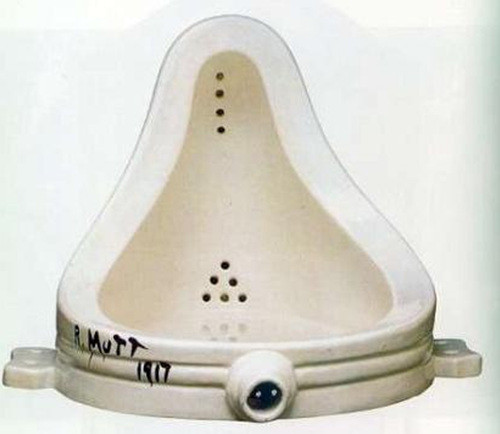
In February 1917 Duchamp famously sent the Independent an upside-down urinal entitled Fountain, signing it R. Mutt (famously photographed by Alfred Stieglitz). By doing so Duchamp directed attention away from the work of art as a material object, and instead presented it as something which was an idea. In doing so he shifted the emphasis from making to thinking.
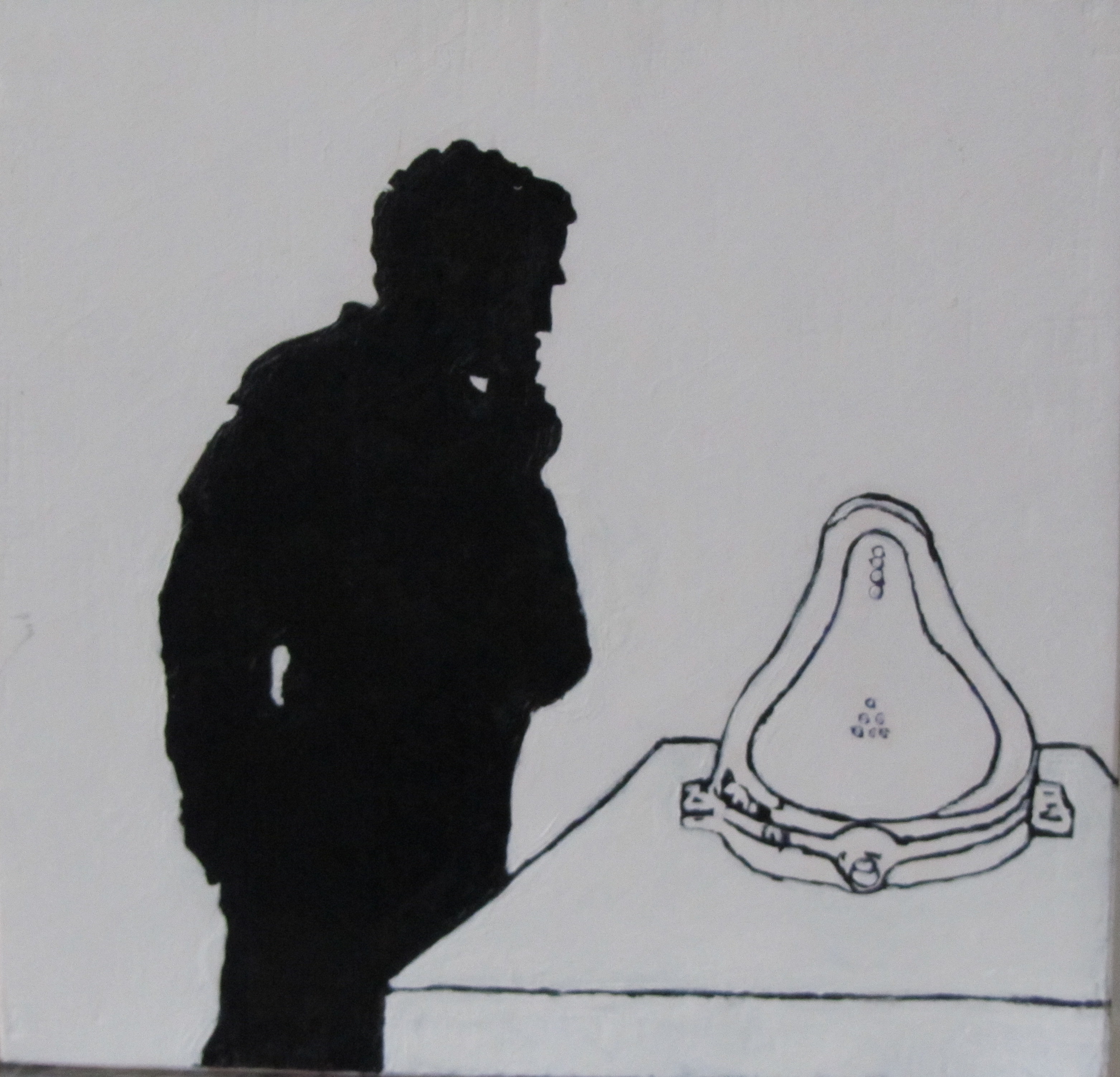
Duchamp later did the same with a bottle rack and other items. Through subversive gestures like these he parodied the Futurist machine aesthetic by exhibiting untreated objets trouvés or readymade objects. To his great surprise these became accepted by the mainstream art world.

Alongside the Frenchman Marcel Duchamp (1887–1968) and the French-born Cuban Francis Picabia (1879–1953) were the American Jews Morton Schamberg (1881–1918) and Man Ray, (1890–1977). The work of the New York Dadaists was focused around the gallery of the Jewish photographer Alfred Stieglitz and his publication 291, and the collectors Walter and Louise Arensberg. Picabia later described this group as “a motley international band which turned night into day, conscientious objectors of all nationalities and walks of life living into an inconceivable orgy of sexuality, jazz and alcohol.”[iii] The group members hotly debated such topics as art, literature, sex, politics and psychoanalysis. Dada in New York stayed in contact with Dada in Zurich, with Stieglitz regularly corresponding with Tristan Tzara who even sent Walter Arensberg his own hand-drawn rendition of the Dada symbol.[iv] The American art critic Thomas Craven, discussing in 1925 the famous Forum Exhibition of Modern American Art of 1916, indicated his displeasure with the number of Jewish artists posing as Americans, and thought that Alfred Stieglitz, “a Hoboken Jew” and major modernist proselytizer was not fit to lead American art.[v]
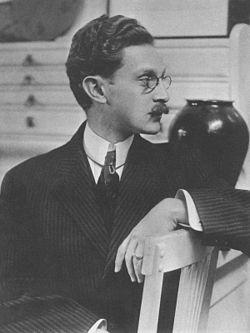
Duchamp’s Fountain directly influenced Morton Schamberg who was born in Philadelphia to middle-class German Jewish parents, and Man Ray, who was born Emmanuel Radnitzky in Philadelphia to Russian Jewish immigrants. Arnason notes that “Relatively unburdened by tradition and always somewhat bumptious toward it” artists like Schamberg and Man Ray had “little difficulty entering into the Dada spirit”. Dempsey notes that “The delight in paradox and interaction of the visual and the verbal are also integral features of Schamberg’s blasphemous God (c. 1917), a plumbing trap on a box.”[vi] Schamberg was to die soon after producing God at the age of 37, a victim of the 1918 Spanish influenza pandemic.

Man Ray was to become a leading figure in the Dada movement. At age seven his father moved the family to Brooklyn to take a higher-paying job in a garment factory. Ray’s father also and ran a tailoring business, and his mother was a seamstress. At the suggestion of his brother the family changed its name to Ray in 1912, and from then onwards Man Ray signed his work with that name. In 1915 Walter Arensberg, a wealthy poet and patron of modern art, took Marcel Duchamp to meet Man Ray, and that same year Ray moved into Manhattan and became involved in the circle of avant-garde writers and intellectuals gathered around the Arenbergs.
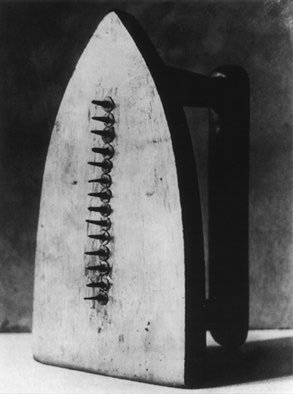
According to one source, Ray tried to disassociate himself from his Jewish family background, but he continued to use props with familiar significance: tailor’s dummies, flat irons, sewing machines, needles, pins, threads and swatches of fabric. An example of this is “Cadeau” (Gift), which is an iron with tacks attached to it. Instead of ironing clothing, Ray’s Cadeau promises to rip it to shreds.
Man Ray collaborated with Duchamp in in the publication of New York Dada in April 1921. This took the form of a large sheet of paper printed on one side only and folded twice. There were several articles, including one by Tzara, translated by Man Ray. However, by 1921 the atmosphere in New York had changed dramatically from wartime, and New York Dada was a flop. Several months after it appeared, Man Ray wrote to Tristan Tzara, complaining that “Dada cannot live in New York. All New York is Dada and will not tolerate a rival, will not notice Dada.”[vii] Most of the artists who had lived there had left the city, and Stieglitz had closed his gallery. Duchamp could no longer extend his residency permit for the United States and prepared to return to Paris where the Dada group had invited him to show his work at their June 1921 exhibition.
Man Ray arrived in Paris in July 1921, shortly after Duchamp, and remained there until
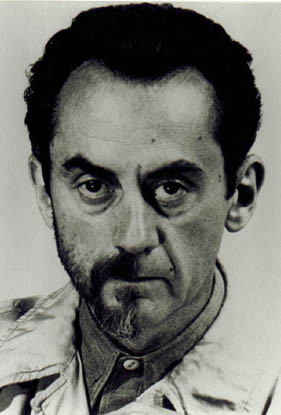
1940, becoming the youngest member of the Paris Dada group, and later of the Surrealists, even though his involvement in the new movement did not reflect any real modification of his art. With the arrival of Duchamp and Man Ray in Paris, New York Dada, which had not engaged in the kind of militant cultural protest seen in the European centers of Dada, effectively came to an end. Duchamp’s and Ray’s experiences were not dissimilar from that of many other Dadaists “who were swept along, as they were, by the vehemence of André Breton into the coils of the new Surrealist movement which was, in many ways, an offspring of Dada.”[viii] Man Ray became an established figure in the Parisian avant-garde, gaining fame and a good living with photographs of artists and art, as well as in fashion photography.
Dada in Germany
Early in 1917, Richard Huelsenbeck, a twenty-four-year-old German medical student and poet, returned to Berlin from Zurich, where he had spent the preceding year in the company of the Zurich Dadaists under the leadership of Tristan Tzara. After the war ended Dada activity in Germany increased as Dadaists dispersed to various sites throughout the country including, most prominently, Berlin, Cologne and Hanover. In Germany alongside George Grosz, Walter Mehring, Johannes Baader, Hannah Höch and Kurt Schwitters were several Jews, including Johannes Baargeld (1876–1955), Raoul Hausmann (1886–1971), and Eli Lissitzky (1890–1941).
The political radicalism of the Berlin Dadaists was even more pronounced than that of the Zurich or New York Dadaists; most of them belonged to the League of Spartacus, a radical socialist group that became the German Communist Party in 1919. German Dada was also closer than the others to developments in eastern Europe where a vigorous artistic avant-garde had existed before the war (led by Jews like Eli Lissitzky and László Moholy-Nagy). The new Soviet state that emerged after the Bolshevik Revolution of 1917 adopted, at least initially, a policy in favor of radical experimentation. Gale notes how “in Berlin, more than anywhere outside the Soviet Union, a direct equation could be made between political reform and artistic radicalism. Despite the seeming absurdity of some of their activities, the Dadas’ reinvention of poetic language and artistic form could be seen as a prelude to reforming the whole of the decayed social system.”[ix]
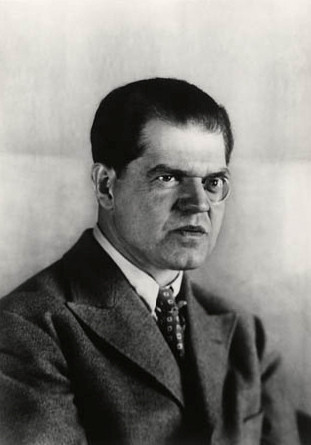
In a new Dada Manifesto by Huelsenbeck and Hausmann, which was published in a Cologne newspaper, they enunciated the purposes of Dada: “Dada is German Bolshevism”[x]; “Dadaism demands: the international revolutionary union of all creative and intellectual men and women on the basis of radical Communism… The Central Council demands the introduction of the simultaneist poem as a Communist state prayer.”[xi] The Manifesto, parodying Woodrow Wilson’s fourteen points, also called for an international revolutionary union of all creative men and women; for progressive unemployment through the mechanization of all fields of activity; for the abolition of private property; for the provision of free daily meals for creative people and intellectuals; for the remodeling of city life by a Dadaist advisory council; and for the regulation of all sexual activity under the supervision of a Dadaist sexual center.[xii]
The Berlin Dadaists condemned the Weimar Republic as representing a renaissance of “Teutonic barbarity,” and held Communism to be the best hope for freedom.[xiii] The Berlin Dadaists were politically vocal and caused a stir not by formulating policies, but by fulfilling their self-appointed role to “react to the contemporary crisis, to seize the moment and to open people’s eyes through their provocative imagery and words which might indeed influence wider decisions.”[xiv] Short notes that among the German Dadaists were those for whom “Dada was a political weapon and those for whom Communism was a Dadaistical weapon. There was a faction which saw anarchy and anti-art as a sufficient programme in itself, and a second faction which saw anarchy as a provisional precondition for the introduction of new values.”[xv]
Falling into the latter category was Johannes Baargeld. Born Alfred Emanuel Ferdinand Gruenwald to a prosperous Romanian Jewish insurance director, Johannes Baargeld was the ironic, leftist pseudonym he adopted (‘Baargeld’ being the German word for cash or ready money). Baargeld grew up in Cologne in a wealthy home, and was exposed from a young age to contemporary art and culture, beginning with his parents’ collection of modernist paintings. He joined the Independent Socialist Party of Germany (USPD), which was the radical left wing of the Socialist Party, and in the process “turned his back on his wealthy bourgeois upbringing and became actively involved in the leadership of the Rhineland Marxists.”[xvi]
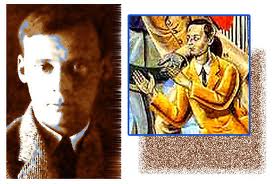
Baargeld (who was also called “Zentrodada”) and Max Ernst cofounded Dada in Cologne in the summer of 1919. Baargeld financed and collaborated with Max Ernst to produce Der Ventilator, a radical periodical which they distributed at factory gates before it came to the attention of the British censors and was promptly banned by the British Army of Occupation. This short lived journal, steeped in radical politics and aesthetics was “a signal moment in the formation of a brief but important avant-garde movement in Cologne.[xvii] According to Hans Richter, Baargeld’s father was anxious about his son’s political leanings and sought the help of Jean Arp and Max Ernst. Short notes that “They succeeded in convincing him that Dada went further than Communism and that its combination of new-found inner freedom and powerful external expression could do more to set the whole world free. In return, Grunewald senior financed the publication of a new international Dada magazine Die Schammade.”[xviii]
Although Baargeld’s initial contributions to Cologne Dada were in the form of political texts and poetry, he later ventured into visual art, preferring non-traditional media of collage, photomontage, assemblage and typography. In his work he subverted traditional systems of structure and logic by simultaneously imitating and undermining them in his artwork. In Ordinaire Klitterung: Kubischer Transvestit vor einem vermeintlichen Scheidewege (Vulgar Mess: Cubistic Transvestite at an Alleged Crossroads) Baargeld “deepens his critique of Western society’s patriarchal structures and founding myths” by conflating the “Greek myth of heroic Hercules at a moral crossroads with the odd drama of a cubistic transvestite.”[xix]
The leading Jewish Dadaist Raoul Hausmann, who was co-founder of Club Dada in Berlin, played a key role in organizing Dada events, including the First International Dada Fair, and numerous Dada matinees and soirées. Kriebel notes that “Hausmann understood himself to be a pioneer for the birth of the new man. The notion of destruction as an act of creation was the point of departure for Hausmann’s Dadasophy, his theoretical contribution to Berlin Dada.”[xx] Hausmann was one of the inventors of photomontage, making up pictures from scraps of photographs. Dada’s destruction/creation dialectic is well illustrated by this medium, and Hausmann’s own artistic contribution to Dada is well represented by photomontages like “The Art Critic.”
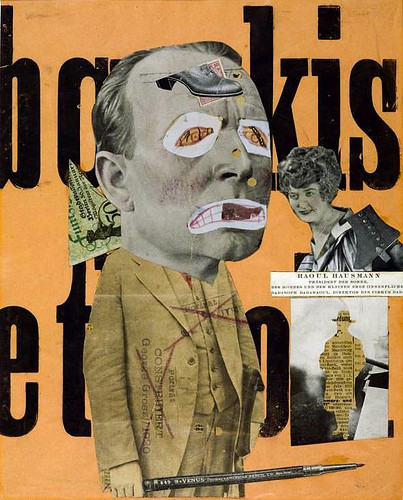
Schnapp notes that it was “the exponents of Berlin’s Dada that developed the expressive potential of the collage on a polemical and political level. In the creation of the photomontage, whether it was the invention of Hausmann and Höch or Grosz and Heartfield, it is implicit that its original purpose was propagandistic. The targets were, variously, the militaristic ruling class that lead Germany to war, the bigoted bourgeoisie, and the spirit of Weimar.”[xxi] For the Berlin Dadaists, the use of photographs and the technique of photomontage became primary tools in their work. They were influenced by the Futurists and the Russian avant-garde, whose artists “had wedded art to the Russian Revolution, and a faith in technology that held promise for their own communist future.”[xxii]
Dada in Hanover was inaugurated (and relabeled MERZ) by Kurt Schwitters who was the dominant proponent and practitioner of Dada in that city. Joining Schwitters at Hanover between 1922 and 1925 was the Russian Jewish artist El Lissitzky. Eliezer Markovich Lissitzky had illustrated the “Chad Gadya” and many Yiddish children’s books, and belonged to the Yiddish publishing house Kultur-Lige. Lissitzky’s main artistic activity before 1916 had been his involvement with a national movement to revive Yiddish secular culture in Russia. His endeavors in this cause gained particular momentum after the Bolshevik Revolution of 1917, an event which Hockensmith notes “resulted in the removal of all Tsarist restrictions on Jews.”[xxiii]
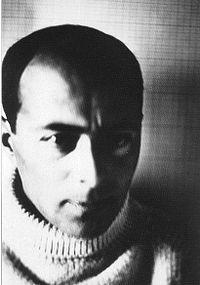
Lissitzky was closely associated with Constructivism which was viewed in the West as the art of the Bolshevik Revolution and associated with the functionalism of engineering. Lissitzky first came to Berlin as Soviet Cultural ambassador in 1921 and while there he actively promoted Constructivism. The desire on the part of the Soviet leadership for more efficient communication with the people brought increasing restrictions which encouraged many Constructionists to move to Germany in the 1920s. These included Lissitzky and the Hungarian Jewish artist László Moholy-Nagy, who were soon drawn into the orbit of the Bauhaus, the pioneering school of art and design at Weimar.
Lissitzsky met Schwitters at the Congress of Progressive Artists in Weimar in 1921 and was invited to Hanover. While Lissitzky initially criticized Dada as anachronistic, and in a review complained that Schwitters was not advancing beyond his artistic beginnings, the two soon formed a collaboration that would last from 1922 until Lissitzky returned to the Soviet Union in 1925. Lissitzky pushed Schwitters work toward a more constructivist style of geometric shapes and gridded compositions. Meanwhile Lissitzky was prompted by the Dadaist sensibility “to accommodate the irrational and the organic within his predominantly technophilic philosophy.”[xxiv] Gale makes the point that “The Constructivists and Dadas shared political beliefs in the imminent triumph of the proletariat over the decayed bourgeoisie of the West.”[xxv]
In April 1920, Cologne Dada staged one of the most memorable exhibitions of the entire movement. It was mounted in the courtyard of the Winter Brewery and could only be entered by way of a public lavatory. Among the “exhibits” in this “Dada Spring Awakening” was a young girl in communion dress reciting obscene verses, Ernst’s destructible object with an axe beside it and an invitation to hack at it, and a bizarre object by Baargeld consisting of an aquarium filled with red fluid from which protruded a polished wooden arm and on whose surface floated a head of woman’s hair.[xxvi] The First International Dada Fair was held in Berlin on 5 June 1920, and remained the most significant artistic event organized in the Berlin milieu. The radical political orientation of the organizers was illustrated by the mannequin of a German officer with the head of a pig hanging from the ceiling (with a notice “Hanged by the revolution”), which triggered fierce debate with its subversive and anti-military character.”[xxvii]
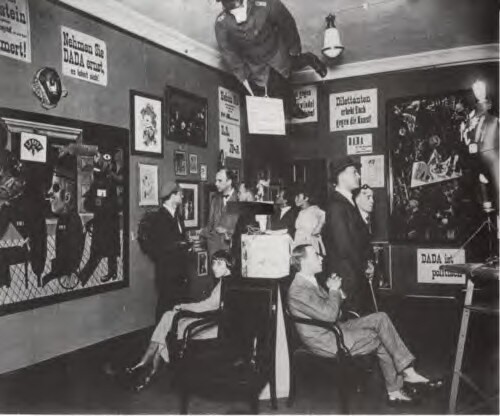
Dadaists at the First International Dada Fair in Berlin in 1920. A mannequin of a German officer with the head of a pig hangs from the ceiling
Given such provocative gestures and the integral and extensive Jewish participation in Dada, it was hardly surprising that, between the two world wars, German nationalists linked Dada and avant-gardism generally to Judaism, claiming these modern trends aimed to destroy the principles of classical beauty and eradicate national traditions. The Dadaists were said to express the “nihilistic Jewish spirit” (a common phrase at the time) if they were not actually mad. In response to the activities of Jewish Dadaists, “calls for ‘degenerate’ art to be banned were widely published in pre-Nazi and later in Nazi Germany, as well as in France.”[xxviii]
Interestingly, Hitler’s Mein Kampf was written just as Dada hit a peak in Paris, and Hitler’s comments about Jewish influence on Western art need be understood in this context. He discusses the “artistic aberrations which are classified under the names of Cubism and Dadaism,” and clearly has the Dadaists in mind when he observes that: “Culturally, his [the Jew’s] activity consists in … holding the expressions of national sentiment up to scorn, overturning all concepts of the sublime and the beautiful, the worthy and the good, finally dragging the people to the level of his own low mentality.”[xxix] Likewise when he recalls how he once asked himself whether “there was any shady undertaking, any form of foulness, especially in cultural life, in which at least one Jew did not participate?” Subsequently he discovered that “On putting the probing knife carefully to that kind of abscess one immediately discovered, like a maggot in a putrescent body, a little Jew who was often blinded by the sudden light.”[xxx]
In 1933 Hitler’s new government announced that “The custodians of all public and private museums are busily removing the most atrocious creations of a degenerate humanity and of a pathological generation of ‘artists’. This purge of all works marked by the same western Asiatic stamp has been set in motion in literature as well with the symbolic burning of the most evil products of Jewish scribblers.”[xxxi]
At the exhibition of degenerate art held in Munich in 1937, Dadaist works were considered the most degenerate of all – the very epitome of Kulturbolschewismus. In that year the Ministry for Education and Science published a pamphlet in which Dr Reinhold Krause, a leading educator, wrote that “Dadaism, Futurism, Cubism, and other isms are the poisonous flower of a Jewish parasitical plant.”[xxxii]
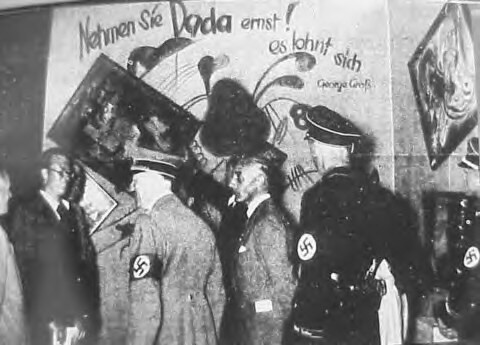
Paul Johnson points out that “Hitler always referred to degenerate art as ‘Cubism and Dadaism’, maintaining that it started in 1910, and the ‘Degenerate Art’ exhibition bore a curious resemblance to the big Dada shows of 1920–22, with a lot of writing on the walls and paintings hung without frames.”[xxxiii] He also notes that the National Socialist campaign against “degenerate art” was “the best thing that could possibly have happened, in the long term, to the Modernist Movement.” This is because since the National Socialists—universally reviled by all governments and cultural establishments since 1945—tried to destroy and suppress such art completely, then its merits were self-evident; anything the Nazis opposed was assumed to have merit – on the illogical basis that the enemy of my enemy must be my friend. “These factors,” notes Johnson, “so potent in the second half of the twentieth century, will fade during the twenty-first, but they are still determinant today.”[xxxiv]
Go to Part 4.
REFERENCES
Adam, P. (1992) Arts of the Third Reich, Harry N. Abrams, New York.
Ades, D. (1974) ‘Dada and Surrealism,’ In Modern Art – Impressionism to Post-Modernism, Ed. By David Britt, Thames & Hudson, London.
Bernard, E. (2004) Modern Art – 1905-1945, Chambers, Paris.
Blisténe, B. (2001) A History of Twentieth Century Art, Fammarion, Paris.
Cabanne, P. (1997) Duchamp & Co., Finest SA/Editions Pierre Terrail, Paris.
Dagen, P. (2011) ‘From Dada to Surrealism – Review,’ The Guardian, July 19. View at: http://www.guardian.co.uk/artanddesign/2011/jul/19/dada-to-surrealism-dagen-review
Dempsey, A. (2002) Styles, Schools and Movements – An Encylopaedic Guide to Modern Art, Thames & Hudson, London.
Doherty, B. (2005) ‘Berlin,’ In: Dada Ed. By Leah Dickerman, National Gallery of Art, Washington D.C.
Gale, M. (2004) Dada & Surrealism, Phaidon, London.
Hitler, A. (2010) Mein Kampf (trans. By James Murphy), Imperial Collegiate Publishing.
Hockensmith, A. (2005) ‘Artists’ Biographies,’ In Dada Ed. By Leah Dickerman, Dada, National Gallery of Art, Washington D.C.
Johnson, P. (2003) Art – A New History, HarperCollins, New York.
Kriebel, S.T. (2005) ‘Cologne,’ In: Dada Ed. By Leah Dickerman, National Gallery of Art, Washington D.C.
Leslie, R. (2005) Surrealism – The Dream of Revolution, New Line Books, London.
Russell, J. (1981) The Meanings of Modern Art, Thames & Hudson, London.
Schnapp, J.T. (2006) ‘The Dada revolution’ In: Art of the Twentieth Century – 1900-1919 The Avant-garde Movements, Skira, Italy.
Short, R. (1994) Dada and Surrealism, Laurence King Publishing, London.
Taylor, M.R. (2005) ‘New York,’ In: Dada Ed. By Leah Dickerman, National Gallery of Art, Washington D.C.
ENDNOTES
[i] Taylor p. 287
[ii] Cabanne p. 115
[iii] Taylor p. 278
[iv] Ibid. p. 281
[v] Washton-Long et al. p. 6
[vi] Dempsey p. 118
[vii] Hockensmith p. 479
[viii] Schnapp p. 412
[ix] Gale p. 120
[x] Blisténe p. 62
[xi] Ades p. 222
[xii] Russell p. 182
[xiii] Bernard p. 86
[xiv] Gale p. 121
[xv] Short p. 42
[xvi] Doherty p. 220
[xvii] Ibid.
[xviii] Short p. 47
[xix] Kriebel p. 229
[xx] Ibid. p. 472
[xxi] Schnapp p. 409
[xxii] Leslie p. 39-40
[xxiii] Hockensmith p. 478
[xxiv] Ibid.
[xxv] Gale p. 158
[xxvi] Short p. 50
[xxvii] Schnapp p. 399
[xxviii] Dagen
[xxix] Hitler p. 281
[xxx] Ibid. p. 58
[xxxi] Adam p. 55
[xxxii] Ibid. p. 12-15
[xxxiii] Johnson p. 707
[xxxiv] Ibid. p. 709






Facing the Future as a Minority
Was the Immigration Act of 1924 Illiberal?


Part 3 implicitly (and wrongly) classifies people like Duchamp and Lissitsky as Dadaists. The author’s broad horizon is interesting, but perhaps somewhat exaggerated. The modernism-postmodernism continuum should primarily not be ascribed to the postwar denazification project alone.
@Geiseric:
The relationship between Kurt Schwitters and Eli Lissitsky is overstated.
Schwitters was interested in Russian Constructivism, and Lissitsky was the Soviet Cultural ambassador.
Constructivism & constructions, were, and, are too mechanical & spatial to be Jewish.
Re: The photograph “Adolf Hitler visits the Degenerate Art Exhibition of 1937″.
Did Hitler design his own costumes, and the costumes of his followers?
I doubt that Hitler bought them off the rack at Macy’s.
When you read in this article that:
you are immediately reminded of the idea of “creative destruction” of Michael Ledeen,jewish neo-con ideologue of America’s pro-Israel policy in the Middle East.Here is a revealing quote from his book The Way Against the Terror Masters :
What is couched here in terms of a political program for change in the Middle East is in reality the expression of a truely destructive spirit,a spirit that sees it as its “historic mission ” to destroy and to destroy completely.Everything has to be destroyed: business,science,literature,art,architecture,cinema, politics,law…and that “both in our own society and abroad”.
The more you study these people the more you come to the conclusion that they have an irredeemable destructive inner core that cannot be explained away as a mere reaction to “persecution”.Destructiveness is their very essence and they see it as their mission to destroy.
@Franklin Ryckaert:
The term “creative destruction” is usually associated with Schumpeter, but the idea is also prominent in Nietzsche’s philosophy.
Schumpeter may be the inventor of the term “creative destruction” but he uses it in an economical sense (more in the sense of “permanent innovation”). Ledeen uses the term in a truely destructive sense (“we must destroy them to advance our historic mission”).Ledeen was one of the many Jews behind the drive to attack Iraq and was pesonally invoved with the forgery of a document that should “prove” that Iraq bought uranium from Niger for its nuclear arms project.
Iraq has now been destroyed,not “innovated” and so will be Iran if Ledeen and his destructive co-ethnics have their own way.
@Tom
I believe that the SA uniforms were originally intended for the British. For one reason or another the NSDAP acquired them cheaply in bulk. Not 100% on that, however.
Hugo Boss designed and produced the majority of SS uniforms. In fact you can still go to the larger American shopping malls and buy clothing from his company.
I usually refrain from posting adulatory comments since they clog up comments sections without contributing anything, but I’m making an exception: this is an excellent series of articles. Well-written, well-researched, intelligent, scholarly. Congratulations!
In the comments section of the second article, there were people urging you to change some of your wordings for propagandistic reasons. Don’t do it. These articles are perfect as they are, and far too much material about the Jewish Question only preaches to the choir.
As they are, I can see these articles being of great interest to students studying art history, as well as their professors.
Prior to reading these articles, if you had asked me to name a prominent Dadaist, the only name that would’ve sprang to mind was Marcel Duchamp.
BTW, my last comment wasn’t to say that Duchamp necessarily was a Dadaist, but to indicate that there is a common perception that he was.
Ever heard of the Bruno Hat exhibition in London around 1930? It was a hoax by a group of young people some of whom went on to become well known writers. Evelyn Waugh, Malcom Muggeridge, Nancy Mitford, Barbara Cartland and others were involved.
They all hated modern art and modern furniture. The married couples began collecting victorian furniture as a statement agains modernist drab.
They were all young and not established in careers. Some of the men were writers on small magazines paid only if their pieces were published. Nancy and Barbara were gossip and society columnists. One of the men worked in a family real estate business. Another worked in some sort of Boys Club.
The idea came together. The gossip columnists began talking about the great new artist, Bruno Hat. He was in a wheelchair, gay and a German. The writers for the magazines began pushing Bruno as the new Salvador Dali.
The girls borrowed their Mother’s mink coats and limos and went to art galleries asking for Bruno Hat pictures. Soon London arty circles were buzzing with Bruno Hat and his innovative ground breaking stick it to the bourgeosie pictures.
But where were the pictures?
The real estate agent had an empty store. The Boys Club director had a supply of boys and teens. So they had an exhibition. They paid trash collectors to dump trash to the store. They bought canvases and glue.
The boys chopped up the trash and spread it around on the canvases. They framed the canvases and opened the exhibition.
Tom Mitford in a wheel chair with long unkempt beard, hair and theatrical make up was Bruno Hat. He grumbled, waved his arms and carried on.
The exhibition was a great success with the arty crowd.
That’s modern art folks. I wonder what prices Picasso’s will bring in 100 years.
“I believe that the SA uniforms were originally intended for the British. For one reason or another the NSDAP acquired them cheaply in bulk. Not 100% on that, however.”
That’s true. They were British army surplus.
@Franklin Ryckaert:
“The more you study these people the more you come to the conclusion that they have an irredeemable destructive inner core that cannot be explained away as a mere reaction to “persecution”.Destructiveness is their very essence and they see it as their mission to destroy. ”
Excellent expression!
@Jim:
I’ve read that the SA uniforms, at least originally, were war-surplus Afrika Corps, hence the brown color.
@Franklin Ryckaert:The quotes you have presented carry the most gripping data I have encountered at this site. Your comments are invaluable and I always look for them. You are a brilliant contributor to the section and I have copies of many of your posts in my documents. Your capability for leadership is apparent, and the Cause definitely has need for leadership.
(Before getting on to my points I am inclined to enter an aside. On the Web, where there is such a preponderance of anonymity, one proceeds with caution and a hefty measure of skepticism. This seems to be a given with pilgrims along the superhighway. There is concern that a chance entity may be dissembling…that we are, in fact, witnessing a deception. I recall that you once entered a brief post entirely in Yiddish. While I, too, can do this, most WN’s cannot. Some of your dialogue with me among these threads has been so polished, so detailed, the declarations might have come right out of a manual. I have preferred to think otherwise since we all need folks we can depend on for authenticity. My first impression on visiting this site was that the saturation of Jewishness here is second only to that at Haaretz.com. These misgivings have not been entirely allayed. Is there anything you can say to put my mind at ease concerning your particular stance? If my query seems forward or untoward, please pardon.)
Regarding Franklin Ryckaert’s idea that Jewish destructiveness must be genetic, many agree with this point of view. However, I have always attributed the trait to indoctrination from cradle-up, often redoubled with Marxist orientation. Companioning this thought is the suspicion that a Jewish child separated from parents at birth, placed among normal folk, and bred in the Western tradition, would be in no respect different from his siblings. In fact, it is my belief that on the American frontier Jewish identity was often lost or deliberately chucked, with the result that progeny simply became faces in the crowd.
What do you think of this explanation?
Compare the degradation and arrogance of Jewish modern “art” with the grandeur and humility of our Euro-Christian patrimony.
http://www.youtube.com/watch?v=MApueKniZJk
Look closely at the eyes of the figures portrayed these paintings. Contrast the insanity and folly of modern life with the serenity and wisdom showing forth in these eyes. Before the Jews could conquer Europeans, they first had to rob us of our previously unrivaled wisdom and sanity.
“Degenerate Art”
Once again, the Nazis hit the nail.
In view of our total Jewish control, banking crisis, collapsing economy, debt enslavement, money destruction and art perversion, it is difficult to see, where the NS ideology was wrong.
Certainly not in their request to separate the tribe from the Aryans.
@Jim: I remember reading somewhere that Hitler designed his own costumes and those of his followers. He may have had some help from Hugo Boss, in the same way he had help from Albert Speer.
I’m of the school that holds National Socialism is precisely the wrong approach to reprise European culture from its leftist/Jewish captors. The burning of books and banning of “degenerate” art was a massive PR own-goal by the Fascists, as Johnson observes. I acknowledge the administration’s prerogative to decide what comes down or goes up in public galleries (of which I disapprove in principle), but censorship in the private sphere has made many a pedestrian artist into a cult figure. Notoriety is a tradeable product, and censorship can create undeserving martyrs. Better to let idiot collectors buy up all the merda d’artista Piero Manzoni can put out; Joe Six-Pack doesn’t need a BA to tell him who’s being had in this transaction.
Today’s mind-control is undoubtedly more pervasive than anything Goebbels could have imagined, but that merely damns both him and his contemporary P-C offspring.
Trying to get subversion out of art is an exercise in futility, in any case. Velázquez is a case in point – I’ve always thought Las Meninas as visually intriguing – but hidden Kabbala symbols?
I’m definitely signing up for Nacho Benjumea’s tour if I’m in Madrid!
http://www.madridmuseumtours.com/The_Prado_Museum_Jewish_Tour.html
http://www.socialaffairsunit.org.uk/blog/archives/001303.php
This has been a great series of articles by Mr Sanderson. I’ve learned much.
@Edward:
A little off the subject, but nevertheless a picturestic contrast.
http://www.flixxy.com/trumpet-solo-melissa-venema.htm
‘Il Silencio’ (The Silence) played by 13 year old Melissa Venema with André Rieu and his orchestra at the ‘Vrijthof’ in Maastricht.
After reading the three articles, and seeing all those pictures of so called art and people, I suddenly realized how nasty the climate in Europe was before WWII. In Europe you lived in the city. You could not escape this climate.
One needs a mental bath, a cleansing of those images and journey back into time. This new Generation is what is on the table/block for destruction again. It makes me sick, to loose this culture, music and orchestra, a cultured people. Are our elites sleeping and being run-over?
The older I get, the more I discover about Jews the more convinced I am we are dealing here not with Humans, but an entirely different species placed on Earth to plague humanity. The Nazis were far too kind to them, something I hope will be remembered when the next uprising against them comes about.
@Trenchant:
“The burning of books and banning of “degenerate” art was a massive PR own-goal by the Fascists, as Johnson observes.”
The Nazi “book burning” is largely exaggerated by the Jewish MSM, both in scope and intentions. It was a symbolic act, the kind our left called “happenings” in the sixties.
After WWII, the victorious democracy “burned” (forbid/censored) more than 35 000 books in Germany alone (including ALL schoolbooks) and this continues until today. All revisionist publications are prohibited, for example. These books have been removed even from public libraries, which was not the case in Nazi Germany.
So the argument of Nazi book burning is pure hypocrisy unless the same standards are applied to Western democracies.
@sylvie: I agree, and believe my comment says as much. I would argue that shunning achieves the same end as State censorship, without carving out a martyrdom for the shunned.
@sylvie: As a segue from degenerate art, many years ago I went to an exhibition entitled “Hitler’s Watercolours” and purchased a print. It was quite a workman-like rendition, no masterpiece, but much better than I’d imagined from the “failed painter”. I had someone take both the Hitler print and another one from a “Jews in Turin” exhibition to be framed. When I got them back, the Hitler print had Indian ink splattered across part of it, the Jewish painting unscathed. The framer was apparently very apologetic, it was an accident, and naturally no charge. I took the explanation at face value – I had had someone else run the commission, so could not judge the person’s demeanour for myself.
Looking back now, I can’t help but think of the real possibility of malicious and wilful damage.
@sylvie: This is an excellent point you made:
All revisionist publications are prohibited, for example. These books have been removed even from public libraries …
We should all make a point of reminding people that there is an equivalence between accusation of book burning by Nazis on the one hand and the actual banning of revisionist history in Europe and Canada on the other. This truly is an abridgement of free speech that actually goes further than burning books, to actual imprisonment of individuals who express forbidden ideas.
Several remains of Dada can be seen in the pop world, especially in 60s and 70s art/music. Most notable are probably Cal Schenkel’s album covers for Frank Zappa and his Mothers of Invention. Schenkel also produced graphic work for other musicians managed by Herb Cohen, including Captain Beefheart.
Across the pond the Bonzo Dog (Dada/Doo-Dah) Band featuring the late Vivian Stanshall and part-time Python Niel Innes can be cited. One gets the idea that, for the Bonzo’s, Dada was simply a way to release a typical adolescent rebellion towards “the system.” In any case, much of their act was comedy based, a different style altogether than the “serious” Dadaists.
@Connor Dirk:
Here are some answers to your comment:
1)I don’t seek a position of “leadership” but of course I am happy to continue to contribute my comments.
2) I am not sure what your aside aims at ,but I suppose you have some lingering doubts that I might be some “agent” or even a Jew (because I wrote some Yiddish) and because my declarations might come from a “manual”.Well,I don’t feel “insulted” if you are cautious,after all we already have exposed some Jews here ( Caleb,Someday),so the danger is real.I don’t remember having written a “brief post entirely in Yiddish”,but I do remember having written one sentence: Es ist schwer zu sein ein Yid (“it is difficult to be a Jew”).I have once read that sentence myself in a book about Jews.It is easy to remember because it is almost identical in German,a language that I know.Yiddish is actually medieval German from the Rhine region plus some Slavic and Hebrew elements.If you know German you can understand a lot of it.For example Elie Wiesel’s book Night is a condensed version of a book originally written in Yiddish called Un die welt hot geshvign (“And the world kept silent”).In German that would be:Und die Welt hat geschwiegen,almost identical.I have picked up only some bits of that language while reading about Jews.
As for me reading from a “manual”,I don’t have any,but I have the habit to think systematically about everything that comes on my way.That’s why it may appear to some that I read from some “manual”.
3)Do you mean with “saturation of Jewishness” on this site that there are many (crypto) Jews commenting here?We already have exposed and expelled two of them.Mr.Goldstein doesn’t hide his ethnicity.May be there are more,I don’t know.I think you can recognize a Jewish commenter if he:1)defends Jews and Israel,2)tries to promote support for Israel,3)tries to promote hatred for Arabs and Muslims (“the clash of civilizations”!),4)promotes the official story of 9/11,5)promotes the official Holocaust story (the latter two might also simply be due to ignorance),6)tries to sow discord,7) tries to incite illegal activities (the latter two may also be true for a governement agent).
4) As for the destructiveness of Jews being due to genes or education (the famous nature/nurture debate!),these two choices are only valid if you have a materialistic philosophy.Suppose people have souls with certain characteristics (positive or negative) who reincarnate.Jews are then a special group of wicked souls who always reincarnate in the same people.That would explain why they behave always the same under whatever circumstances and why they feel so “different” from the rest of the world. Some of these souls may evolve morally (the “good Jews”) but there is a hard core that refuses to evolve,these are the wholly destructive ones.
We already had a peep into their mentality in the quote from Michael Ledeen. Here is another one:
<blockquoteWe Jews,we the destroyers,will remain the destroyers forever.Nothing that you will do will meet our needs and demands.We will forever destroy,because we need a world of our own,a God-world,which is not in your nature to build.
Maurice Samuel,You Gentiles p.155
If you have read the O.T. critically and have seen what a demonic character they ascribe to their “God”,you can imagine what a “God-world” would be like that they want to create on our planet.
Christendom must expel the Jews. It is a life task that all the white nations can agree on.
@Franklin Ryckaert: You can’t guess my pleasure on learning that you took no offense at my comment. Your reply generously touched on every detail I mentioned. My appreciation. It is my hope to maintain an open line of communication with you, as Franklin Ryckaert has captured our attention as a man of penetrating thought and eloquent phrase.
You know, I have recently realized that leadership is thrust on us rather than the other way around. When a man of perception recognizes a crisis no one else apprehends or has the courage to confront, the onus falls on him With the faculty of understanding comes a responsibility for expedient action.
Concerning the Jewish character of this site, it was a matter of intuition. And not mistakenly so. Prof has devoted many years to researching and composing books on Jewish culture, all of which were edited by a Jewish colleague. He teaches among Jews and absorbs their life, interests, criteria, manner… all of which generate distinctive vibrations. I have sometimes sensed that a large percentage of those commenting here are Jewish – posturing, playing a game, ultra-Reform or apostate, but all, interested in some way or other… observing, taking note, participating in varying degrees of sincerity. In your case the subject was sanguine, as I wished to establish a tie. This has been done now and I want to maintain it.
Your ideas about reincarnation provide a new explanation for destructive behavior. As was said about the composer Gabriel Faure, my life transpires somewhere between heaven and earth. So I am not discomfited by the scenario you have described. In fact, I have always thought, the Christ phenomenon was the work of departed Essenes. For me, that is the meaning of Christ: he gives us a formula for breaking out of the cycle of reincarnation. How would you like to be born tonight in Afghanistan?
But placing the issue of Jewish traits on a metaphysical plane leaves it forever in the category of a moot question. Preferring not to be argumentative, I would like to focus briefly on the Jewish practice of sublimation. The suppression of libido produces strange effects on the psyche. It is unnatural, and generates a reserve of energy which must find expression somehow. True, this lifestyle protects one from intemperance… all the hazards of emotion and impulse; it provides a dynamo for intellectual, aesthetic, and spiritual pursuits. Yet it remains unnatural, and likely militates against love, empathy, tenderness and consideration.
According to my thinking, this might become a catalyst for hostility and destructiveness. These, united with isolation, mind-warping indoctrination, and immersion in an insane ethnic group could very well perpetuate madness and boundless revolt.
For your continuing consideration, just tossing out a few ideas from my quarter. We’ll talk again.
@Heather Blue: Heather, you have presented a thought that occurred to me, also, just tonight. I think this is the answer, and I intend to explore the subject further. You do the same.
Huge prayer rallies which now seem to be the trend might be channeled toward this end. My own reflections invisioned the movement as a definitive crusade against New World Order. This concept makes the undertaking more political than racial, and provides a platform most people could readily rally ’round.
One thing follows another and eventually the ultimate purpose would be achieved.
@Connor Dirk: Thank you, Connor.
Most countries of Europe expelled the jews at one time or the other in the past – evidently for religious reasons which had to do with usuary and the Jew’s “sharp practices.” But it was not a unified effort of all the westen nations. The Jews always returned.
This time, White Culture is in a life and death struggle for survival. Jews are forcing “diversity” on us…which is a just a cover word ” genocide.” They would have us believe “diversity” is a moral imperative. Many people do believe it (especially Clergy)….but ask people if genocide of the white people is a moral imperative and they are horrfied. This Jewish progrom of White genocide is what unites the west. They are carrying out this extermiation program in all the white nations. Add to it the systematic swindle of the west by the central banks and thousands of dishonest schemes that fleece us of our savings and goods, the economic collapse, the destruction of the middle and working class, and the war against Christian morality and we have a multitude of legitimate charges to bring against the Jews to support establishing national polices for the expulsion of the Jews.
It must be done. It is the right thing for white Christian people to do and we have always been committed to doing the right thing when we understood what it was.
@Heather Blue: All that you have said is accurate. Like you, I have called for an expulsion of the Jews, on several sites. Like you, I have believed that world unity in this undertaking is appropriate, as the problem is worldwide.
At the moment let us consider the subject from all points of view. It would seem best to proceed in such a way as to encounter least resistance. Sometimes it’s practical to choose terms “diplomatically” – that is to say, couch the initiative in language that works, rather than language which obstructs, even though the latter may be more exact.
Considering the Christian Zionist movement in the U.S., many people of faith conflate Christianity with Judaism, to the degree that they depend on Jews to usher in the End Days through developments in Israel. These people, together with multitudes conditioned to be “politically correct” on racial matters would not join in an effort against Jews, as such. They are not abreast of the sordid details.
On the other hand, if the Crusade – as I envision it being – is defined in another way, these groups could and probably would welcome it and take the lead. That is why I suggested the target be New World Order, Globalism, International Bankers, Banksters, or what have you. It would come to the same thing since Jews are behind all these machinations. Then as matters rock along, critical details would emerge exposing Jews, enlightening the public, and by increments then, the movement becomes a Crusade against Jews, the real enemy. A great, peaceful, nonviolent effort, wielding the power of numbers.
Since the Catholic Church embodies the largest congregation of Christians worldwide, we would wish to make the Church a big part of the movement. Too, the original Crusades sprang from the Church of Rome. You may or may not know that the Catholic Church has been infiltrated by an element of Jews. These individuals are in a position to block any effort against Jews, per se, whereas they may not obstruct an initiative under another guise, such as we have named.
As my thinking on this subject has unfolded I have envisioned as a symbol of the Crusade, a great, purple banner emblazoned with the Templar Cross in white. Altogether beautiful and imposing. Last night in another comment I wrote these words. “Remember, the sign of the Cross is the most powerful symbol on earth. It holds the puissance to exorcise demons, to confer military triumph. You have not forgotten Constantine’s Battle of Milvian Bridge, or Joan of Arc’s victory. Indeed, the Cross has split Time in two. A great purple banner emblazoned with a pristine white Cross is capable of routing Jews forever. That was, in fact, Christ’s mission. He is the Panacea. He is the Panacea forever. He is the ONLY Panacea for solving the problems publicized at TOO.”
So, Heather, these are a few of my thoughts on the subject. Consider them and let me know your feelings and ideas. It has occurred to me that once a plan of action is determined we could compose a statement of purpose, and plan of action, and submit it to headquarters of each major congregation. With global problems being so evident, it should be clear, it’s time for citizen action. Let us present a well defined objective and program for getting there. If one or two groups approve perhaps the rest will follow. Once underway, the movement becomes a Christian effort, an ecumenical enterprise of churches worldwide.
“Under this sign, fight! Victory will be yours.
@Connor Dirk:
You can indeed fight the Jews in a great measure by using proxy terms such as New World Order,Globalists,International Bankers etc.(this is BTW how Alex Jones operates.He never names the Jews,but attacks everything they do wrong).In the process many people will understand it is really about Jews.But then what?You can eventually expell a Mr.Ben Bernanke or a Mr.Lloyd Blankfein but with what reason can you expell the “little” Jews or even the “middle” Jews?If you only expell the criminal top,then the empty places will be filled by the lower ranks of the Jews, whom you cannot expell since you only fight “bankers” and “globalists”.You cannot expell a whole population without naming them.Similarily you couldn’t repatriate all Blacks to Africa if you say that you are not “racist” and only want to expell flash mob “youths”.So it all boils down to ethnic cleansing and for that you need to start with ethnic naming.
I am as much in favor of expulsion of the Jews as you – I have said many times that it is desirable to lock them up for good in an ethnic ghetto on Tierra del Fuego – but, just like you ,I don’t know a practical way to achieve that.Waving purple banners with white crosses certainly will not do the job.
@Franklin Ryckaert: You enjoyed a chuckle at my expense…
Thanks for weighing in. I would like to be joined with you at the hip in solving this problem. A better protege cannot be imagined. You see, I won’t accept the suggestion, we’re stuck with this dilemma. It’s entirely a matter of brains.
A more efficient means of communication is needed. Public venues are hardly ideal, and I’m trying to figure out a better alternative. If you agree, and have any ideas let me know.
Alex Jones’ wife is Jewish and he’s been trying unsuccessfully for some time to set up residency in Israel. He uses a Jewish attorney. Pat Buchanan – on a higher rung – is as slippery as Houdini. He has a couple of Jews who research data for him and come up with the ideas. To read his stuff you would never know, there’s an elephant in the room.
I’m convinced the Jews are a troop of comediens, which is easy enough, I suppose, if they’ve opened the seat of our rompers.
You’ve taken a few liberties in covering my material, Franklin. You’ve left no room for the Spirit…nor space for the genius of participants…you’ve ignored the power of developing events…as well as the favor of Providence. You see, I haven’t worked out all intricacies of the campaign. You implied some things I didn’t say, and overlooked others. The proxy terminology is merely to enlist initial interest as broadly as possible. New World Order is common knowledge now, and can be associated with disintegrating borders, illegal immigration, Nafta, North American Union, the “service economy,” no jobs, economic meltdown, Zionist Occupied Government, The Fed, politicians bought-and-paid-for, bail-out, international banking, the U.N., Unesco, the European Union, etc. These details will emerge gradually as the Crusade is publicized and discussed. When it becomes increasingly evident that all roads lead to the Jews, citizens, themselves, will connect the dots and vocalize the truth. Gradually the watchword will beome “Israel For The Jews!”
Of course, you and I know that most Jews refused to migrate to Israel because they need a host country to parasitize. They are incapable of sustaining themselves through honest, hard work. Well, that’s their tough luck. The Allies gave the Jews a plot of land because they wanted a country of their own. Let them go there now. Jews pledge allegiance to the star of David. They pledge allegiance to no host country. They don’t belong here. We must think positively and act aggressively to get them OUT.
Franklin, I will probably never see the purple banderoles except on T.V. If you’ve never been a Catholic you are perhaps unaware of the power of the spiritual dimension. It isn’t something susceptible to logic or deduction. Nor is it verifiable in a scientific sense. Nevertheless, an individual can achieve faith through personal experience and hagiography. Exorcisms are common and factual. The apparition at the Battle of Milvian Bridge was witnessed by an entire army. On the strength of this, Constantine became sole emperor of Rome, founding Christ’s church, from which all variants have sprung. These phenomena denote the iconic power of the Cross.
Now think about it. The narrative of Man’s presence upon this planet may be nearing a climax. We hope not, but potent deterents must be summoned. An ultimate confrontation between the mightiest forces on earth is due – good vs. evil. Do you think the greater of these will submit to annihilation? No, He will make occasion to emerge…to reveal himself with power…to discover to this earth his undisputed sovereignty.
Against a shimmering field of royal hue
a flash of white does ripple upon the breeze.
Easily it stirs among the folds
of this graceful banderole.
Opening now on a vagrant wind,
the Holy Cross flies dauntless,
supreme, unsullied, pure,
forever proclaiming a King of Kings.
As I see it, citizens of the West languish that their faith has been trampled and suppressed. The Churches sense their drooping spirit. The Church of Rome has been flogged for human frailty, more often than not on spurious charges by unprincipled foes. Compromised and despirited, all should welcome an opportunity to re-assert dignity, to fulfull at last their appointed task.
Franklin, I have no way of knowing that these ruminations will mature beyond these pages. But I can’t excuse resignation so long as I have power of thought, freedom of movement. Because I cannot foresee all details or prophesy outcome doesn’t justify apathy and inaction. The important thing is to ACT, to assert will, to overcome surrender, to accept responsibility, to BEGIN! The enemy is driven by over-compensation. Surely the Master will not be defeated by his boot-black?
Get back with me and stay in touch.
Why is anyone engaging Connor Dirk in conversation, when he has repeatedly accused Kevin MacDonald, as well as everyone associated with running this site and TOQ, of being hucksters who perpetuate what he calls “Jewish lies”?
This bizarre troll-like accusation makes zero sense and flies in the face of all the evidence. And if you think this is remotely true, why on earth are you on this site in the first place? Obviously, this is merely a tactic to disrupt discussion and to sew distrust. In addition, the writing style is all too similar to other trolls we’ve had before (the White Angel, who was sadly successful in taking in a few people).
@Jason Speaks:Jason, your hysteria is becoming more and more shrill. No one would dignify this with a serious reply.
Ask Mommy one more time to pleeeeze remove your hand splints.