
In Post-Mortem of Election, Clinton Learns Literally Nothing
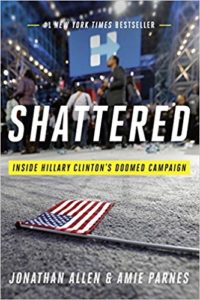 Jonathan Allen and Amie Parnes.
Shattered: Inside Hillary Clinton’s Doomed Campaign.
New York: Crown, 2017.
The left, Clinton, and the media are defiant, and refuse to learn anything from the 2016 presidential election — root causes, messaging, or anything else which would hint at self-awareness. They still want us to believe that the Russkies did it. Or they point towards breaches against PC doctrine about race and gender they think somehow proves their case. How can we get through to people who are at once so sensitive about words and speech, and yet so dull in perceiving cause and effect?
Some documentation has emerged recently which gives us a more intimate look into the Clinton campaign’s strategy and the thought process of Clinton herself, both post-election and during the campaign. Some of this we already know: that she is arrogant, entitled, and so forth; but what is in particular amusing is that she still seems to think that the “argument” of referring to Trump and his supporters as “racist” is an a priori proposition — no evidence needed, rather than a contentious characterization of which people have grown weary.
For example, it may be underestimated how devastating Clinton’s “basket of deplorables” speech was to her campaign. This is described in Shattered, a book which gives an inside look at the Clinton campaign (though through an annoyingly partisan Democrat perspective). The authors, Jonathan Allen and Amie Parnes, compare “basket of deplorables” to Romney’s “47 percent” remark, which may well have cost him the election: “Hillary had become the 2016 cycle’s Mitt Romney […] For all the messaging she’d done on inclusiveness, she now sounded like not only an elite but an elitist” (316). While it was hard to gauge the political effects at the time due to the constant spin from the MSM, that may well have been the moment that she lost the election. Shattered shows that the Clinton campaign was more cognizant of her mistake than they let on. At any rate, the remark certainly demonstrated Clinton’s cavalier attitude towards non-ethnomasochistic Whites (for those who weren’t already aware).
Perhaps it all started with Clinton’s strategy to appeal almost exclusively to minorities and other assorted misfits in the Democrat party:
She’d become the candidate of minority voters on social justice issues while Bernie hit her as a corrupt Wall Street-loving champion of the “rigged” financial system that took advantage of working-class voters. Whether she was perceived as hostile to working and middle-class whites or just indifferent, it wasn’t a big leap from “she doesn’t care about my job” to “she’d rather give my job to a minority or a foreigner than fight for me to keep it.” She and her aides were focused on the wrong issue set for working-class white Michigan voters, and […] it wasn’t at all clear to them that she was on their side. (178)
This is the fundamental problem of the left in the multicultural West. On one hand, they champion immigration and all things multicultural with nothing but slogans like “diversity is our greatest strength” to try to appeal to White voters. The result has been that politics has become increasingly racialized throughout the West, with White voters voting for parties seen as less positive about immigration- and diversity-related issues. In the US, that means Whites vote Republican.
While Hillary failed to attract Whites, she swept the minority vote. It was always my impression that these groups could not grasp the subtlety of Bernie Sanders’ message vis-à-vis the “rigged financial system.” And as thoroughly documented, Clinton continued to have anemic support from the White working class throughout the primaries right through to the election. Shattered recounts how she quite deliberately shunned White suburbs in order to focus on heavily populated cities to run up the tally of the minority vote against Sanders during the primary. Yeah, White people noticed that.
As Rebecca Traister writes in a puff piece for New York Magazine about Clinton’s post-election ruminations, the Democratic primaries consisted of “badly framed conflicts between identity politics and economic issues,” with Clinton obviously capitalizing on identity politics and Sanders focusing on economic issues. Sanders naively thought that his economic pitch would also appeal to minorities, who are after all largely low-income. But again, his pitch was too abstract, and perhaps he failed to placate their wounded sense of victimhood to the degree that Clinton did so flagrantly. Incidentally, Republicans make the same naïve mistake as Sanders in assuming that a universal good will also appeal to minorities, such as charter schools, or even a border wall. Instead, Blacks, perhaps accurately, perceive politics as a zero-sum game, wherein only gestures made exclusively to their racial group are appreciated.
Shattered posits that Trump thrived because of the simplicity of his message; whereas Clinton, who is such a prodigious retainer of information, had trouble sometimes communicating the nuance and complexity of her understanding of the issues. This is of course a humble-brag: “I’m so smart that I come off as wonkish,” and we’ve heard it from many Clinton surrogates. A more simple explanation is that people did not agree with her arguments on a variety of fronts, most notably trade, immigration, and foreign policy. And again, her win of the popular vote was a matter of raw identity politics, not actually persuading thoughtful voters.
Parallel to the complaints of “racism” are the complaints of “sexism” in her defeat. This topic merits perhaps its own treatment, but suffice it to say that Clinton and the left show a cluelessness in this area which is perfectly analogous to their cluelessness on race. Quoted in the New York Magazine article mentioned above, Clinton expounds upon the alleged sexism to which she attributes her defeat, and places it more broadly into the context of an ignorant and biased electorate:
“There’s always been this rearguard movement against expanding the circle of opportunity,” she says. “And I believe that a lot of what’s happening now is a resurgence of the anxiety, the fear, the bias that still affects people who are worried that change is coming even faster, that it will have even more consequences.” The unwillingness to acknowledge this backlash, says Clinton, is “part of the reason we are, if not going backward, certainly stalled.”
So in effect, our rejection of her is a rejection of “progress” itself — the arrogant self-image of the left as moral beacon to humanity which all right thinking people must accept. She talks about the “fear,” “anxiety,” and “bias” of Trump voters, but never comes to grips with the self-interest of these voters — self-interest that our hostile elites have equated with the above pejoratives. Her lack of awareness is nicely reflected in New York Magazine with a picture of her in her Midtown office, standing in a garish yellow pantsuit watching a monitor of CNN rant about “Russian collusion.” What we have here is a veritable hall of mirrors, where even the erstwhile leader of the movement has begun believing her own lies — both on Russia and on her self-exonerating, self-serving version of the 2016 election.
Shattered’s basic thesis is that the blame lies squarely on Clinton’s shoulders; or more specifically, the flawed strategy of the Clinton campaign. Clinton’s campaign, run by Robert Mook, sought to use computer models to determine strategy almost to the exclusion of all other methods of voter persuasion; and that model apparently projected that Obama’s “coalition of the ascendant” (to use a vile phrase) would get her past the finish line. Not everyone was on board with that approach:
They understood the value of slicing and dicing voters to make efficient decisions, but they also felt that Hillary should be doing more to show that she wanted every vote. Some of them believed that instead of basing her campaign on Obama’s core coalition, she should have begun with the working-class whites and Latinos who fueled her 2008 run and built out. (398)
This is the critical view of Mook’s strategy from inside Clinton’s campaign, a view shared by many of the old-school politicos and Bill Clinton himself. Mook ultimately felt that it would be a waste of time and expenditure to persuade what I refer to as “thoughtful voters” —those who actually consider issues and policy rather than base self-interest or racial identification. Instead they just focused on getting out the base, which encompasses fewer and fewer White people who vote Democrat. That entailed a form of (reverse?) race-baiting which was by definition alienating to White voters.
Shattered explains that Bill Clinton had an empathy with White voters that Hillary lacked:
Hillary couldn’t grasp the sentiment of the electorate, the resentfulness white working-and middle-class Americans felt watching the wealthy rebound quickly from the 2008 economic crisis while their families struggled through a slow recovery. Her team didn’t really get it, either. (129)
However, these social class resentments seem more to match the concerns of the White Bernie Sanders voter. Other Whites may have been equally turned off by Clinton’s rhetoric on hot-button issues, such as immigration, or her insinuation during the first debate with Trump that literally every White person—not just the police—has an “implicit bias” that they need to address. Blacks presumably have no such pressing need towards self-improvement.
Bill Clinton yearned to be deployed to persuade voters in “small towns in northern New Hampshire, Appalachia, and rural Florida” (131) where he could show his trademark empathy and put some points on the board with White voters. Yet Mook did not feel that would be a good investment, and instead wanted him deployed to speak to “white liberals and minorities in cities and their close-in suburbs.”
I’m not saying that White voters would have been, or should have been appeased or persuaded by Bill Clinton’s words—because after all, that was all he was offering. Instead, the point is to demonstrate the brazen and wholesale abandonment of the White working-class and rural vote by the Clinton campaign as a matter of campaign strategy.
Even the internal debate about strategy within the Clinton campaign missed the point. It is not a matter of using certain talking points to assuage White working-class voters, or showing up at the local diner with the same spiel offered elsewhere. The point is that the particular policies, not to mention the rhetoric, of Clinton was tailored for the benefit of minorities and urban guilt-ridden White liberals who relish statements targeting the supposed deficiencies of Whites. It is indeed a zero-sum game; and at this point, there is no political spin that will make any but the most liberal Whites fail to recognize what is in their own interests.
***
Clinton now refuses to take any responsibility for losing because she “will not point fingers at her own team in assessing her loss,” as if her posturing is out of loyalty to her staff. This is an oblique rebuttal to the criticisms in Shattered. Indeed, Clinton and the media refuse to assess the results of the election with any candor, and instead have heaped scorn on Trump and his voters. They have subjected us to a hostility which is even more alienating than before, a sentiment I imagine most White Trump voters share. Clinton has even added “voter suppression,” presumably of minorities, to her list of alibis. Meanwhile Judicial Watch is meeting much resistance in its effort to uncover not voter suppression, but rather illegal voting by non-citizens and other criminals. What is truly exasperating is that Clinton continues to blame the media as somehow conspiring against her, despite the recent Harvard study which demonstrated the press has had negative coverage Trump by a measure upwards of 90 percent!
As to the issues Trump won on, namely trade and immigration, we can argue about whether he is effectively implementing policies to fulfill his campaign promises. He has certainly tried, and the extent to which he has failed can be attributed in large part to liberal activists in the judiciary and congressional intransigence. Prominent voices in the alt-right now voice real skepticism towards Trump; but they doth protest too much, with apparently too little attention and knowledge as to the nuts and bolts of how our government works, with its enumerated powers.
Regardless, at least we know why Trump won, which as we see above, Clinton does not. Meanwhile, the left, the judiciary, and Congress are brazenly defying the will of the voters. This is particularly the case with the court’s blocking of Trump’s travel ban, and Senate Democrats promising to shut down the government before allowing funds to be allocated for the Wall. In doing so, they further alienate an already alienated group of people—the forgotten man, if you will. And so now we are on the brink of a “dream deferred,” and all the explosion which that foreshadows.
Follow Malcolm Jaggers @malcolmjaggers; contact him via email




Comments are closed.