
Sociology as Religion, Part 2
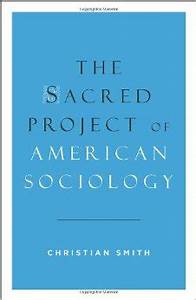
The author returns to the Project’s origins in Chapter Four, and here is where I diverge from Smith’s analysis. As mentioned in discussing Chapter One, the author sees the Project as perhaps the ultimate stretch of Western liberalism and individualism. I see the Project more as a discontinuity, not only from Western tradition generally, but specifically from the men who established sociology as an academic discipline in the late nineteenth and early twentieth centuries.
First, consider that liberalism, and the Enlightenment were products of the minds of Western White men; while the Project is explicitly anti-Western, anti-White, and anti-male. Second, though the Enlightenment celebrated the individual, it did so in a restrained way. Here it is useful to look at the political and social applications of Enlightenment thought, rather than the Enlightenment as a purely philosophical movement. In Western Europe and North America the Enlightenment can be represented by the republicanism of the Founding Fathers and their antecedents. These men often wrote and spoke of the need for virtue and self-control, and the requirements of the common weal, the common good. In Central and Eastern Europe the Enlightenment was embodied by the Enlightened Despot, the absolute monarch who would reform his society from the top down. Both variants were far removed, if not the antithesis of the snowflake, “do your own thing” individualism of the Project. A third factor – the Enlightenment developed in tandem with the Scientific Revolution. One of Smith’s motifs is the loss of scientific objectivity in sociology. The Project is faith based, a secular religion. It is not scientifically based. It indulges in a sophisticated manipulation of the social and life sciences to serve its agenda. The Dissident Right is more firmly based on science then the contemporary Left.
The author briefly discusses Lester Ward, Edward Ross, and other “early American sociologist pioneers and textbook authors” (122). What Smith chooses to ignore is the profound influence that evolutionary theory, racialism, and eugenics had on the nascent social sciences of the period.[5] Take Lester Ward, the first name on Smith’s list. Ward established the sociology department at Brown University, and served as the first president of the ASA. Born in Illinois from New England stock, he saw heavy combat with the Union army during the Civil War. Yet Ward had a well-developed racial conscious. He “drew a distinction between ‘historic’ or ‘favored’ races which originated in Europe, and other great groups of black, red, and yellow races. . . . He spoke frankly of ‘superior,’ ‘inferior,’ and ‘decadent’ races.”[6] And despite his background Ward appeared to have a sincere concern for the safety of Southern White women.
The lower races, Ward maintained, experienced an unusual amount of sexual desire for members of the higher races because they dimly and instinctively realize that improvement of their own race is involved. A Negro who rapes a white woman, Ward declared, is impelled by something more than mere lust. ‘This is the same unheard but imperious voice of nature commanding him at the risk of lynch law,’ said Ward, ‘to raise his race to a little higher level.’ On the other hand, the fury of the white community in which such an act takes place is equally natural.[7]
Sentiments of the first president of the American Sociological Association.
In the past when the establishment was confronted with the racialism of foundational figures such as Ward they often tried to minimize or dismiss such beliefs as simply outdates prejudges of an earlier age that society has discarded along with erroneous views on medicine or astronomy. In today’s more polarized environment such beliefs are seen as proof of pervasive individual and institutional racism, past and present, that must be extricated root and branch. White racial consciousness and preference was, of course, taken for granted in the past. His experiences fighting for the Union did not lessen Ward’s concerned for the welfare of White women in the South. Blood is thicker than regional differences. It is obvious that he thought deeply about the issue and analyzed it from an evolutionary perspective.
Another name on Smith’s list, Edward A. Ross, was even more explicated in his racial views. A strapping six foot six advocate of the strenuous life and a friend of Teddy Roosevelt, Ross coined the term “race suicide” later used by Roosevelt and Madison Grant. Ross received a PhD from Johns Hopkins and went on to help establish the sociology department at the University of Wisconsin where he taught for 31 years. He also served as the third president of the ASA. Ross was skeptical about giving Blacks the franchise: “One man one vote does not make Sambo equal to Socrates.”[8] He also vigorously pushed for limiting immigration. He believed “Hebrew money . . . was financing the anti-restriction campaign, which pretended to benefit all immigrants, but was, in fact, ‘waged by and for one race.’ According to Ross, the Jews had repaid the gift of American asylum by undermining America’s capacity to control its own racial destiny.”[9] Ross also authored one of the early introduction to sociology textbooks, Foundations of Sociology (1905). Sections of this book could have been written by Madison Grant. It needs to be repeated that men such as Ward, Ross, and even Grant were progressives who fought corporate interests and went to bat for the working man. They were true progressives whose study of social science led them to race realism. I cannot understand why today’s writers on the Right refer to their opponents as progressives.
It would appear from the evidence presented above that there has been a sharp discontinuity in sociology during the twentieth century. The Project is indeed revolutionary. There has been a 180 degree turn on social issues, especially involving race and sex. While Smith concedes the influence of Marxism and feminism on contemporary sociology I do not believe he fully appreciates, or at least does not acknowledge, the profound changes that have occurred. The Project has adopted elements of Trotsky’s permanent revolution of social transformation along with the continuous Cultural Revolution of Mao, with no end in sight.
Smith ends Chapter four by stating that sociology’s embrace of the Project was not inevitable. Again, the evidence above would definitively support that conclusion. The social sciences as a whole could have continued with their naturalist approach, one informed by the life sciences, especially evolutionary biology, throughout the twentieth century. There is a natural tendency to read history backwards, to see events or developments that occurred decades or centuries earlier as inescapably leading to present conditions. A more balanced view of the past sees numerous turning points when alternative paths could have been taken.
Chapter five is entitled, “Consequences,” but in keeping with Smith’s religious motif I think a better title would have been, “The Seven Deadly Sins of Sociology.” The sins are: Dishonesty – “the discipline is being dishonest with itself, its students, their parents, college and university administrators and donors, and American taxpayers” (134). Sociology is too often propaganda disguised as social science. Hypocrisy – “For a discipline that is obsessed with social inequality as a moral wrong American sociology turns out to be just as structured and driven by status hierarchy, rankings, elitism, excluding social processes, and protection of privilege as just about any other institution in society” (136).
The next four sins are closely related: “Standardized Thinking” – excludes dissenting ideas; “Myopic Socio-logic” – the inability to think outside the box; “Corruption of the Peer-review Process” – the Weitzman scandal is an example; “Alienated Sociologists” – the alienating and purging of dissident students and scholars from the discipline. The seventh deadly sin is “Self as Blind Spot.” The Project’s “very obvious righteousness in the eyes of those committed to it tends to make it invisible to its disciplines. For them it is just self-evident reality” (176).
Chapter seven’s title asks: “What Is Sociology Good For?” Smith has trouble answering this question. At times the author thinks “that sociology as an enterprise should simply be shut down,” or perhaps just “downsized” (184). Sociology can be very good at describing social characteristics, problems can come with the interjection of ideology and politics, “under the guise of theory and interpretation,” that distort sociological research. The obvious solution is to replace the perverse and destructive ideology of the Project with a healthier, more objective orientation that serve the needs of society.
Chapter eight “Conclusions,” is largely a summarized restatement of Smith’s main points. There is then an appendix where the author briefly describes his personal beliefs. Earlier in the book Smith states that while he opposes the sacred project, which I clearly identify with the Left, he is no conservative, and he is definitively not man of the authentic Right. His own ideology – Critical Realist Personalism – emphasizes “the person over the individual and community solidarity over atomization” (200). It is unclear from this short description how the author defines community. Critical Realist Personalism is described in more detail in Smith’s To Flourish or Destruct: A Personalist Theory of Human Goods, Motivations, and Evil (2015).
So what can we take away from this book? First, if you are teaching or studying sociology, or plan to, you should read this book. Obviously a short review cannot fully develop Smith’s thesis, nor discuss all of his evidence. Plus, my interpretation of this work any not be the same as yours.
For the layman the main points are: (1) The contemporary Left is a secular religion. This is clearly the book’s main message, and it is really nothing new. Commentators a hundred years ago were comparing the Bolshevik party to a religious order. Religions, secular or sectarian, are largely based on faith, so reason or empirical evidence will not dissuade true believers. They do not want dialog or debate. The social justice warriors of today are as fanatical as any religious zealots of the past.
(2) The book points out that those opposed to the Project’s takeover of sociology have largely acquiesced, offering passive resistance at best. This has also been true in the larger political/social arena. Science and reason are not enough. Something spiritual is required. The Right needs the “intense emotional commitment” to a common cause, and the “subordination to a higher collective purpose” that Smith notes on the Left. Conservatives do not have this spirit and never will. It is obvious that unless the Left can be confronted by a greater counter force it will prevail.
(3) Academic departments are closed systems that medieval guilds could not match. Especially in the liberal arts and social sciences grad students are often recruited and faculty are hired and promoted on ideological grounds. These departments are subject to little or no oversight or accountability.
One last note, the increasing number of books such as this one, critical of the academy, may indicate that more people are finally taking notice of the Left’s corrosive effect on Western scholarship. However, of all the institutions in society, higher education may prove to be, for some of the reasons cited above, the most difficult to restructure.
[5] See: Thomas C. Leonard, Illiberal Reformers: Race, Eugenics, and American Economics in the Progressive Era (Princeton, NJ: Princeton University Press, 2016). Reviewed in: The Occidental Quarterly 16 no.2 (Fall 2016) 105-113.
[6] Thomas F. Gossett, Race: The History of an Idea in America (Dallas TX: Southern Methodist University Press, 1963). 164.
[7] Ibid, 166.
[8] Ross quoted in Leonard, Illiberal Reformers, 50.
[9] Ibid. 158.



