
Jews and the May 1968 attempted revolution in France
The U.S. State Department said it is watching closely the case of a French far-right activist killed by suspected hard-left militants (i.e. supporters of Hamas, immigration etc.) suggesting it might count as terrorism, in comments that may stir fresh tensions between Paris and Washington.
And indeed, Feb 22, France will summon the US ambassador to France, Charles Kushner, over comments on the killing of a French far-right activist Quentin Deranque last week, French Foreign Minister Jean-Noël Barrot said on Sunday.
Sending in a Jewish Ambassador to France named Kushner is a bit rich, since in France, we already have one of interest: Bernard Kouchner, the French Doctor – Médecins sans Frontières.
Before becoming a prominent figure in French politics, Bernard Kouchner was a charismatic figure of May ’68.
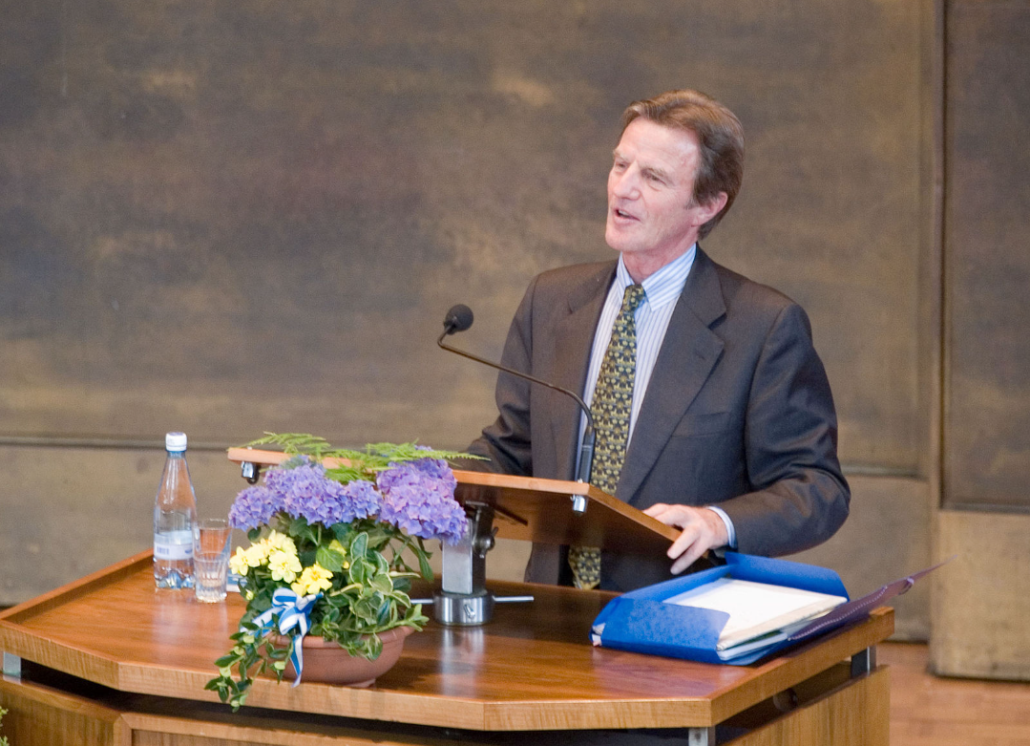 Bernard Kouchner, the French Doctor, Médecins sans Frontières
Nowadays, a lot of French far-right activists like Quentin Deranque tend to chant “Islamo-leftists out of our universities!”. Poor Quentin was killed for this essentially Israeli slogan.
They forgot two points:
1 – In 1936, the entire nationalist right was outraged by the Jewish control of the National Education system: Léon Blum, President of the Council, was Jewish; Jean Zay, Minister of National Education, was Jewish; Cécile Brunschvicg, Under-Secretary of State for National Education, was Jewish; Jules Isaac, Inspector General of Public Instruction, was Jewish—he was also the author of the famous Malet and Isaac history textbooks, yes indeed. (Cécile Brunschvicg at least had the merit, in the eyes of schoolchildren, of serving as a benchmark for cubic meters and quintals…).
2 – In 1968, they could have chanted: “Judeo-leftists, out of our campus!” – but they didn’t
One can advise them to read the book by Yaïr Auron, translated (from Hebrew…) by Katherine Werchowski: Les Juifs d’extrême gauche en Mai 68 — The far left-wing Jews in May 68.
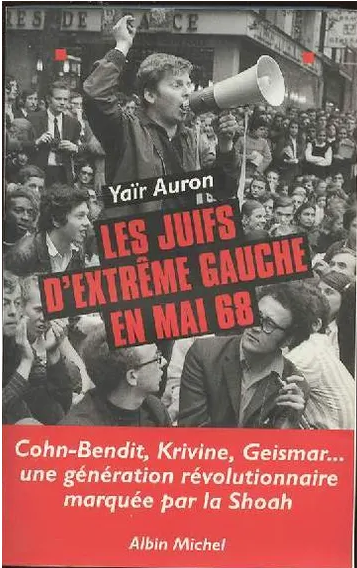
The book is not available as a PdF, but we can consult this short 2-minute video on the same subject: https://ok.ru/video/1491805407906
It starts like this: “As in 1917, during the Bolshevik revolution, the Jews were the leaders of the failed revolution of May 68.”
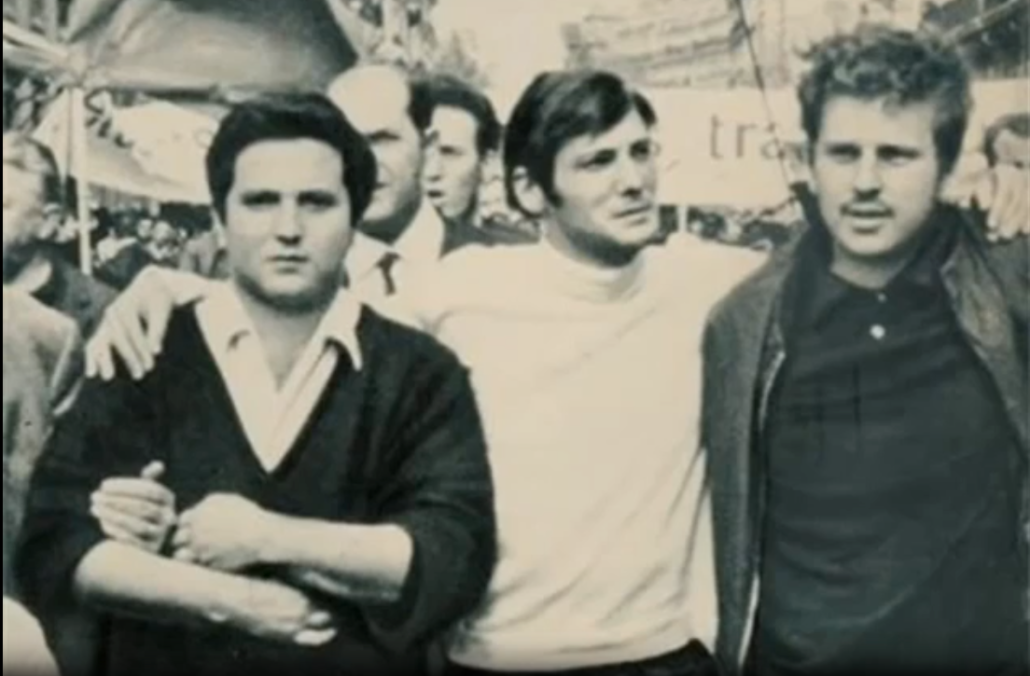
I started from this video and expanded it through the various linked sources as we went along – which also allowed us to correct two or three inaccuracies in the video. Here are the main leaders of May 68. First observation, 3 of the 4 spokespersons of the May 68 movement are Jews: Alain Geismar, Daniel Cohn-Bendit, Michel Recanati, but not Sauvageot (in the center of the photo)
Daniel Cohn-Bendit, born on April 4, 1945 in Montauban, is 80 years old. Cohn-Bendit is an emblematic figure of this period, born to German Jewish parents who had taken refuge in France since 1933. In May 1968, he was 23 years old and studying in the 2nd year of sociology at Nanterre. Nicknamed “Dany the Red”, he ended up being expelled from France to Germany, his parents’ country. He did not immediately commit himself to new political action. From 1968 to 1973, he became an educator in kindergartens in Frankfurt [a pedophile cat among the pigeons?] and then worked at the Karl Marx bookstore in that same city until 1980. He co-founded in 1970 the magazine Pflasterstrand [under the cobblestones, the beach = sous les pavés, la plage, the most famous of the slogans of May 68] and managed its editorial staff until 1984. He was deputy mayor of Frankfurt from 1989 to 1997.
Alain Finkielkraut, born June 30, 1949, in Paris, is 76 years old, the only son of a Polish Jewish leather worker deported to Auschwitz. Thinker of the movement.
Roland Castro, born in Limoges on October 16, 1940, was born to a Jewish family originally from Salonika
Militant pro FLN, member of the PSU (Parti socialiste unifié), he joined the Communist Party in 1961 before evolving in 1967 to the Maoists of the Marxist-Leninist Communist Youth Union. In May 1968, he was the representative at the School of Fine Arts.
In the video, he is mistakenly quoted as Olivier Castro, who also participated in the events of May 68, but does not seem to be Jewish.
Danièle Schulmann, girl-friend of Yves Fleischl. The video mistakenly mentioned Daniel Schulmann.
Yves Fleischl, born in Hungary, not particularly known except for being in the famous photo of Daniel Cohn-Bendit facing a CRS officer in front of the Sorbonne (CRS = Compagnies républicaines de sécurité, the anti-riot police, the other side of the barricade, during May ’68 CRS were nicknamed CRS SS).
Bernard Kouchner, born in Avignon on November 1, 1939. Activist of the Union of Communist Students, editor at Clarté, he led in May 1968 the strike committee of the Faculty of Medicine of Paris. In 1969, he left for Biafra and then judged that the Parisian May was ‘it was a comedia dell’arte’. Leader of MSF (Médecins Sans Frontières = Doctors Without Borders) in 1971, he began a political career that led him several times to the government, sometimes on the right, sometimes on the left.
Benny Lévy (alias Pierre Victor), born on August 28, 1945 in Cairo and died on October 15, 2003 in Jerusalem. A student of Louis Althusser at the École normale supérieure, he joined the Union of Communist Students, and then was one of the leaders of the Union of Leninist Marxist Communist Youth with Robert Linhart. He founded after May 1968 the Gauche Prolétarienne, whose newspaper La Cause du Peuple received the support of Jean Paul Sartre. He went into hiding in 1973 when the proletarian Left was banned, became secretary to Jean-Paul Sartre until 1980 and taught philosophy at the Sorbonne. He emigrated to Israel in 1997 and became a rabbi before dying in 2003.
André Glucksmann, born on June 19, 1937 in Boulogne-Billancourt to a Jewish Ashkenazi family; died on November 10, 2015 in Paris. He was a philosopher, a Maoist activist between 1968 and 1974, and ardent defender of the Chinese Cultural Revolution.
Robert Linhardt, born on April 30, 1944 in Nice (and not in 1943 as indicated in the video). Linhart comes from a Jewish family of Polish origin that settled in Paris. His father, Jacob Linhart, left Poland before the Second World War and joined France after a few years spent in Italy (“chased by Mussolini’s handshake with Hitler”). He was head of the Marxist-Leninist Communist Youth Union, which tended toward Maoism. In 1966 he founded a Maoist movement whose objective was to send students to the factory in order to get closer to the workers in order to teach them to fight bourgeois ideology. In May 68, Linhart was hospitalized for overwork when the workers went on strike; the revolution took place without him. This did not prevent him from spending the following year at Citroën to manufacture 2CVs (a painful experience that he narrated in 1978 in the impressive “L’établi”). After ten years of writing, he attempted suicide in 1981, then stopped speaking for twenty-four years.
Tiennot Grumbach, born in Paris 17th on May 19, 1939 – died on August 17, 2013. (photo to the right with Cohn Bendit and Kravetz). He was a member of the Union of Communist Students (UEC) and the Union of Young Marxist Communist Leninists (founded by the disciples of Louis Althusser who were excluded from the UEC). With Roland Castro he founded the Maoist movement ‘Vive la Révolution’. Nephew of Pierre Mendès France, lawyer, he was president of the Union of Lawyers of France (SAF) and became in 1986-1987 president of the bar at Versailles. He was director of the Institute of Social Sciences of Work (ISST) in Sceaux.
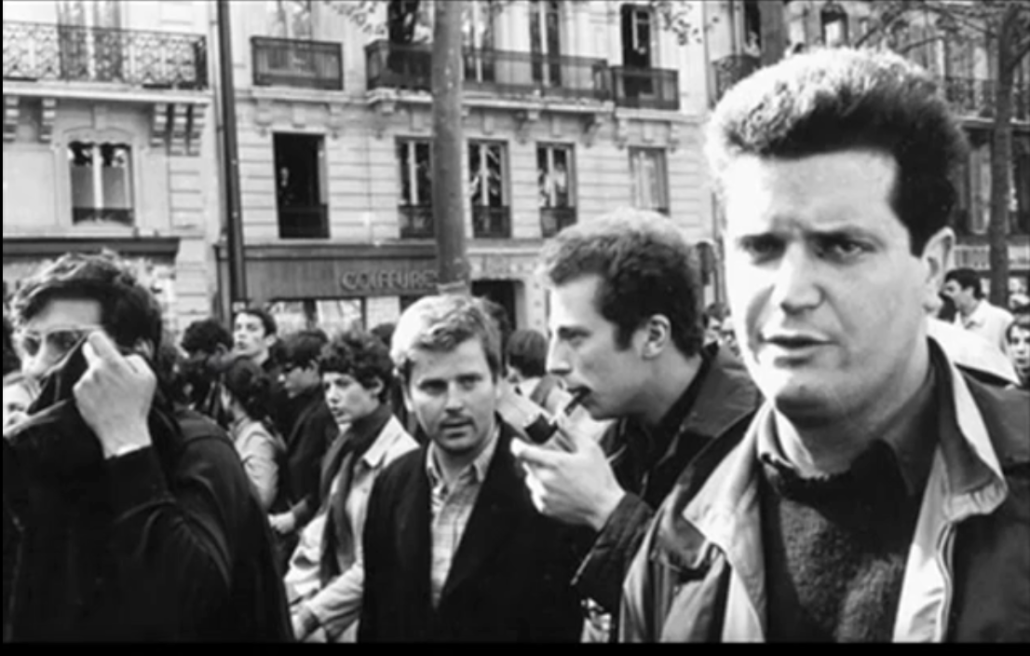
Marc Kravetz, born on October 2, 1942 in Neuilly-sur-Seine and died on October 28, 2022, in Paris. Militant of the Communist Youth, general secretary of the National Union of Students of France, he made a stay in Cuba in 1967. In 1968, he was an editor at Action and a leader of action committees. Twenty years later, he was head of the foreign service at Libération (a French left wing daily newspaper).
Alain Krivine, born in Paris on July 10, 1941, from a Jewish family of Ukraine; died on March 12, 2022, in the same city. The head of the LCR (Revolutionary Communist League) is one of the few leaders of the revolt of May 1968 to have retained the same political line and the same commitment. Leader of the Sorbonne-Lettres sector of the Union of Communist Students in 1964, he founded in 1966 the Revolutionary Communist Youth (league dissolved by the government in June 1968). In 1968, he showed himself to be a supporter of escalation and continuous harassment of the police. Founder in 1969 of the Communist League (dissolved in 1973), then of the Revolutionary Communist League in 1974, he presented himself for the first time to the presidency of the Republic at the elections of 1969. Out of 12 candidates, he came in 9th, with 239 106 votes. He is the author in 2006 at Flammarion of a book beautifully titled “It will pass you with age”.
Michel Recanati, born on September 29, 1950 in Boulogne-Billancourt; died on March 23, 1978 (suicide following the death of his wife suffering from cancer). He is the eldest son of Suzanne Rodrigue, from a Jewish family. The Recanati couple mentioned their Jewishness to their children during their adolescence, after having “long lived it as a disgrace”. The grandparents, from an immigrant Jewish family from Salonika who became merchants in the 9th arrondissement of Paris, were deported in 1942 by the Vichy regime and perished in the Nazi camps.
Michel Recanati is a Trotskyist who in 1968 led the Comité action lycéen (CNAL, Lycée = High School), then became an active leader of the LCR (Ligue communiste révolutionnaire). He was acquitted by the court in the investigation of the serious burns suffered by police officers during the counter-demonstration on June 21, 1973, at a meeting of Ordre nouveau in Paris, decided by the political bureau of the Communist League and organized with three other extreme parties-left — without the PSU (Parti Socialiste Unitaire).
Daniel Gluckstein, was born on March 3, 1953, in Paris. Co-founder of the OCI (International Communist Organization)
Pierre Lambert, born Boussel on June 9, 1920 in Paris; died on January 16, 2008. He comes from a family of very poor Russian Jewish emigrants. His father, Isser Boussel, is a tailor and his mother, Sorka Grinberg, is a housewife. From 1953, he was one of the main leaders of the international Trotskyist movement and founder of the Trotskyist OCI (International Workers’ Party)
Daniel Bensaïd, born on March 25, 1946 in Toulouse; died on January 12, 2010. He is a Sephardic Jew, like Recanati; they are the only two Sephardic members of the movement. He was a Trotskyist philosopher and theorist.
Henri Weber, born in Leninabad in the Soviet Union on June 23, 1944 and died on April 26, 2020, in Avignon. In 1968, he played a very important role in the animation of the student revolts. Co-founder of the Revolutionary Communist League in 1968, he was director of its weekly Rouge until 1976. He pursued an academic career as a teacher in political science. A subject on which he himself has done many… practical works. Socialist Senator of the Seine maritime from 1995 to 2004, Member of the European Parliament since 2004, he had written, with the support of the CNPF (the representative organization of French bosses!), a book entitled Le parti des patrons: le CNPF 1946-1986. He was then a researcher at the Research Centre for Industrial Change (CRMSI).
Alain Geismar, born in Paris in July 1939 to a Jewish Alsatian family. In May 1968, he was assistant professor at the faculty of sciences in Paris and Secretary General of the SNE-Sup (National Union of Higher Education – needless to say, a hot bed of leftism) where he represented the leftist current. He was, along Cohn-Bendit and Sauvageot, one of the figures of the revolt. In 1970, condemned for reconstitution of the dissolved movement (La Gauche prolétarienne), he spent 18 months in Fresnes (a jail located in the town of Fresnes, near Paris). He then uttered a very committed sentence: “Summer will be hot and we will chase the bourgeois into their pigsty.” General Inspector of National Education since 1990 (whose function, as its name suggests, is control of the teaching world), in charge of mission or technical advisor to several ministers of National Education; he has been an advisor to the mayor of Paris since 2001, responsible for education.
Blandine Kriegel, was born in Neuilly-sur-Seine on December 1, 1943. Daughter of Maurice Kriegel-Valrimont from a Jewish family. She is the cousin of Danièle Kriegel. Her political career began with the PCF (French Communist Party). Daughter of the communist activist Maurice Kriegel (Kriegel-Valrimont, after his resistance), she was an activist in the Union of Communist Students before joining the Marxist-Leninist (Maoist) Communist Youth Union. She then collaborated at the May School and was very active in 1968 in the Maoist agitation at the École normale supérieure de Fontenay aux Roses. A renowned academic and specialist in political philosophy, this graduate of philosophy and Doctor of State in Letters was appointed to the mission at the Élysée, called in 2002 by the President of the Republic Jacques Chirac. With her husband Alexandre Adler, political columnist and director of Courrier International, she was close to Philippe Séguin, president of the National Assembly from 1993 to 1997. She advocated voting for Jacques Chirac in the presidential election of 1995, because she says, “the left disappointed me.” She is an officer of the Legion of Honor and a commander of the national order of Merit.
§§§§§
concluding remarks
1 – The video ends as it began, with a parallel with 1917: “Do the French know they have escaped the Gulag?” (but not the Migratory Gulag).
2 – In May 68, the watchword was ‘Imagination takes power’; today it is rather ‘Immigration takes power’, but the two are linked. Even if Quentin mainly had in mind the second of these watchwords, we must not forget the first one, nor those who were the authors: they are still in our schools – on both sides of the chair (see the case of Alain Geismar who becomes Inspector General of National Education!).
3 – The case of Recanati allows us to make an easy connection with Quentin: on one side, the Antifas that breaks the skull of an identity activist, on the other, a case of severely burned CRS (French anti-riot forces).
4 – Yaïr Auron puts a banner of his book A Revolutionary Generation marked by the Shoah. But apart from the case of Recanati, whose grandparents died in camps, and that of Finkielkraut, whose parents have returned from deportation (since he was born in 1949…), we are rather surprised to see all these figures of 68 born everywhere in France during the war, or a little before, or after, in families that were not even affected by the deportation.
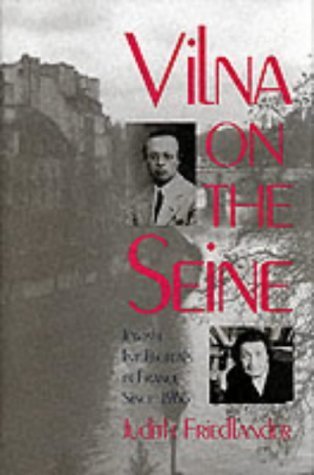
5 – Let us point out this other book signed by a Jewish intellectual, Judith Friedlander: Vilna on the Seine – Jewish intellectuals in France since 1968.
Version 1.0.0




Every single time. Is the New Man workers utopia online yet?
It should be by now after two centuries.
It’s amazing to think that a mere 150 years ago France was preeminent in Chemistry, Physics, Philosophy and manufacturing. Thanks Jews!
Vilna on the Potomac or Jerusalem on the Potomac.
Great article. Never could understand the “Is Paris burning” book, Sartre, Beauvoir, etc. This article helps immensely.
Nonetheless Gabriel Cohn-Bendit, the brother of Daniel Cohn-Bendit,
was a Holocaust Denier… Si, si – sorry, yes, yes, just as I say.
The claim of Zionism in the May-June ’68 events has a stronger basis that the over-representation of Jews in the ‘revolutionary leadership’, as revealing as that was.
For a start, this observation was made by the Greek Michael Raptis (‘Pablo’), former Secretary of the Fourth International, who regarded the French Far Left (‘Trotskyists’) as riddled with Zionism.
And the attitude of the then patriotic, French led, Communist Party of France (PCF) was reported by a Communist journalist in the Australian Left Review (the ‘open’ theoretical journal of the Communist Party of Australia which split from the Russian ‘hard liners’ on the basis of former’s support for the “Prague Spring” of 1968 (prelude to the Velvet Revolutions?).
Malcolm Salmon – AUSTRALIAN LEFT REVIEW June-July, 1969, p.15 (available on line)
“The French-domestic and the international considerations determining the PCF refusal to move against the Gaullist regime at this moment which seems to me to have been a decisive one, will certainly be studied for a long time to come. It should only be noted here in passing that there were very lively fears in the minds of PCF leaders at the time that the Gaullist regime would only in the prevailing circumstances be succeeded by another with a less anti-American foreign policy orientation. Certain reticences in the Soviet press coverage of the crisis at the time would seem to indicate that the Soviet Foreign Ministry had made a similar appraisal. (One responsible PCF official told me in a conversation in Paris in June 1968 that in his view “US imperialist and Zionist influences” had played a determining role in the orientation of the student Left during the crisis.)”
Cohn-Bendit (in ’68 as ‘Danny the Red’ to later as Danny the Blue and White’) didn’t arrive at his Zionism – a decent – long time after May-June ’68. In fact he actively supported the Zionist state in the 1967 Six Day War. His subsequent development in the Sorosian Greens has been totally in keeping with his former political life.
DeGaulle condemned the Zionists for their actions in 1967. There was certainly a lot at stake…
Wiki
http://en.wikipedia.org/wiki/Charles_de_Gaulle
“Six-Day War[edit]
With tension rising in the Middle East in 1967, de Gaulle on 2 June declared an arms embargo against Israel, just three days before the outbreak of the Six-Day War. This, however, did not affect spare parts for the French military hardware with which the Israeli armed forces were equipped.[127]
This was an abrupt change in policy. In 1956 France, Britain, and Israel had cooperated in an elaborate effort to retake the Suez Canal from Egypt. Israel’s air force operated French Mirage and Mystère jets in the Six-Day War, and its navy was building its new missile boats in Cherbourg. Though paid for, their transfer to Israel was now blocked by de Gaulle’s government. But they were smuggled out in an operation that drew further denunciations from the French government. The last boats took to the sea in December 1969, directly after a major deal between France and now-independent Algeria exchanging French armaments for Algerian oil.[128]
Under de Gaulle, following the independence of Algeria, France embarked on foreign policy more favourable to the Arab side. President de Gaulle’s position in 1967 at the time of the Six Day War played a part in France’s newfound popularity in the Arab world.[129] Israel turned towards the United States for arms, and toward its own industry.”
There was a LOT more to deGaulle’s position on Israel than this as shown here (he tried to use all of France’s diplomatic muscle to marshal Europe and the World against the Zionist state): see (page 44)
http://books.google.com.au/books?id=6nGivth3FqMC&pg=PA44&dq=De+Gaulle+condemned+the+Zionists+for+their+actions+in+1969&hl=en&sa=X&ei=GeSaU56rB46ikgXCkYGYCw&ved=0CCkQ6AEwAg#v=onepage&q=De%20Gaulle%20condemned%20the%20Zionists%20for%20their%20actions%20in%201969&f=false
Thanks for the education, from both you and the author.
‘Thanks for the education, from both you and the author.’
It is also true that this same PCF leadership had a strong policy on limiting ‘immigration’ into France and its inevitable associated effects (like ghetoisation and displacement of the existing working class, the driving down of wages and working conditions and the creation of tensions between working people). They were able to implement this policy through their considerable control of very large numbers of French provincial cities.
For this they were attacked by the ‘Far Left’ both at home and abroad as well as by sinister forces within the party. These policies were eventually reversed and with it, the working class support for the PCF, much of which went to those of the political ‘right’ who took these issues seriously.
I researched this in greater detail over 15 years’ ago but these are the broad outlines.
I’d also add that the betrayal of the Left throughout the West on these issues has been central to the catastrophe we now face. Had they fought it, their popularity would have massively increased.
Some substantiation of the white-anting of the PCF line on ‘immigration’ as represented by Georges Marchais versus the white-anter-in-chief, Mélenchon (originally a follower of the aforementioned (((Pierre Lambert))) and a member of the Trotskyist movement), acting on behalf of the dark forces behind it.
https://www.youtube.com/watch?v=LG2BA9SxClM
Some comments:
‘Quand on écoute les pro immigrés le pcf serait facho’ (‘When you listen to pro-immigrant voices, the French Communist Party (PCF) is considered fascist.’)
‘On avait des couilles, en ce temps-là…'(‘We had balls back then…’)
‘La vidéo qui te met en PLS n’importe quel gauchiste.’ (‘The video that will leave any leftist speechless.’)
I learnt of the death of Quentin Deranque when our Channel 4 News (C4) had its foreign correspondent Paraic O’Brien did a feature that invoked images of the Brownshirts in Germany in the 1930’s, “Hobnail boots”.
Given this was a death of a French patriot one would assume O’Brien would be investigating the irrefutable and factual violence of the ‘anti’ fascists(?)
How quickly was I disabused of the idea of impartial reporting!
One poster that I removed from near my local tube station has the imploring slogan of “Smash the fash” in an agit-pop black inky figures on a red background that illustrates the extreme (self) hatred the leftists have for the very concept of country populated with English people of a fair skin.
“Smash the fash” –> Thank you for that sheer piece of rhyming slang.
–> Note that in the 1930s there was also the same inversion of blame: street violence was never the work of communists, even in the case of Horst Wessel, similar to that of Deranque, left-wing violence was underplayed.
How? How do they always end up in charge, in influence, every where??
How is it that nobody notices?
The amount of planning, collusion, conspiring to pull this off necessarily is immense, yet, again, nobody (likely even us) is aware of extent of it
@Frank
‘How? How do they always end up in charge, in influence, every where??
How is it that nobody notices?
The amount of planning, collusion, conspiring to pull this off necessarily is immense, yet, again, nobody (likely even us) is aware of extent of it.’
If a group has an ‘idea’ and a Plan that they stay constant to over decades/millenia even, along with the lack of any countervailing and constantly held ideas and planning on the part of their >>selected<< opponents will surely mean that they and their Plans will prevail.
The summation of all this becomes History.