
Cabbages and Kingfishers: An Appreciation of a Jewish Literary Giant
The book I remembered; the author I forgot. Not that I ever read the book. I just read about it in Anthony Burgess’s Ninety-Nine Novels: The Best in English since 1939 – A Personal Choice (1984). One of the choices was called Riddley Walker and Burgess lavished praise on it. He described how it used a kind of mutated future English, being set two thousand years ahead after a civilization-smashing nuclear war. I liked the idea of the mutant English but wasn’t enticed by the execution, to judge by the quotes Burgess chose.[1] So I never sought the novel out and I forgot the author’s name, although I did remember the title and the praise Burgess lavished on it.
Tuning in to beauty
Decades later it’s March 2026 and I’m in a second-hand bookshop. I come across two slim books in the Penguin Classics series. I vaguely recognize the author’s name: Russell Hoban. And I like the unusual titles: The Medusa Frequency and Mr Rinyo-Clacton’s Offer. Each has blurbs for more of Hoban’s books at the back and one of these is Riddley Walker, with a snatch of the mutant English. Ah, I think, this is the author praised so highly by Anthony Burgess. Then I see how Hoban was described by the London Times after his death in 2011: “perhaps the most consistently strange writer of the late 20th century.” That sounds good. So I buy the books and take them home to try.
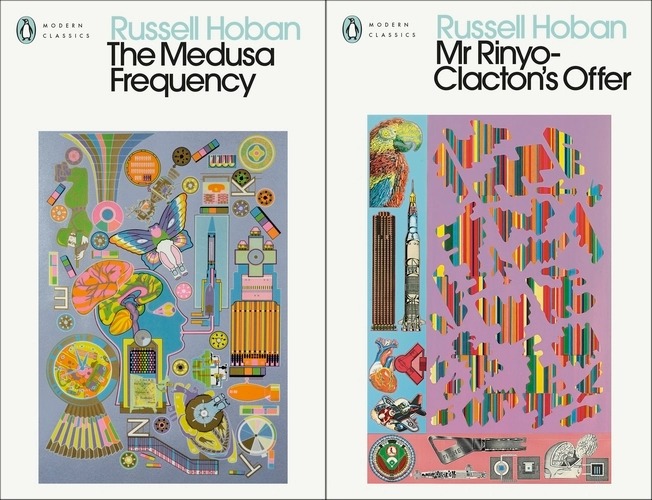 Open for enchantment: the covers of The Medusa Frequency and Mr Rinyo-Clacton’s Offer}
And what happened next? Well, at first I was disappointed with my new purchases, first trying the early pages of The Medusa Frequency (1987), then switching to Mr Rinyo-Clacton’s Offer (1998), then switching back. Yes, the writing was strange but also seemed shapeless, disjointed, arbitrary and unfocused. Then all at once I tuned in, as it were. I was suddenly struck by the beauty of the sentences in The Medusa Frequency, their lucidity, their luminance. They suddenly seemed like long brushstrokes in enchanted paint, glowing in the mind as the eye passed over them, fading in the memory as the eye passed on. Or like streaks of phosphorescence excited in a night-dark, blood-warm tropical sea by the sleek form of a speeding dolphin, surfacing and submerging and surfacing. It was as though I had been twiddling the knob of an old-fashioned radio and had suddenly passed from hissing, buzzing static to an ear-blessing of Mozart or Vivaldi, clear and calm and beautiful.[2] That’s what it was like tuning into the beauty of Hoban’s sentences, of his prose as a whole.
Slithe & Tovey
And the prose itself was acutely aware of natural, artistic and female beauty. Try this: “The flight of the kingfisher opened in the air above the river a blue-green iridescent stillness in which a dragonfly, immense and transparent, repeated itself with every wingstroke.” And this: “Looking down into the water I saw rising a vast and ivory nakedness and a woman’s face of terrifying beauty.” The prose was indeed as strange as the Times had promised, and seeded with humor, and self-knowing, sometimes self-mocking. Here’s another quote from The Medusa Frequency: “I came to [my new job] via an advertising agency called Slithe & Tovey where I used to write copy for Orpheus Men’s Toiletries, Hermes Foot Powder, Pluto Drain Magic, and several non-classical accounts.”[3] Here’s a longer quote:
My desk is a clutter of stones written upon and not; sea-shells, acorns and oak leaves, china mermaids from long-gone aquaria, postcards of medieval carven lions, clockwork frogs and photographs of distant moments. It’s a good desk, there’s a lot of action even when I’m not there. Propped up amongst the stones and clutter are two books open at colour plates of Vermeer’s Head of a Young Girl; there are also a postcard of it stuck on the edge of the monitor screen and a large print over the fireplace. Night and day in all weathers she looks out at me from her hereness and her goneness. Even the ageing of the painting seems organic to it; one can see in the reproductions how the reticulation of fine cracks follows lovingly from light into shadow the curve of her cheek, the softness of her mouth, the glisten of her eyes, the fineness of brow and nose, the delicacy of her chin. (“The Vermeer Girl,” chapter 3 of The Medusa Frequency)
After I’d tuned in and read on, Hoban seemed not only like my kind of writer – “The reality that interests me is strange and flickering and haunting” – but also like my kind of man. I’ve had desks with the same eclectic clutter of art and nature. And I love Vermeer, just as I love kingfishers and dragonflies. I love a lot of the other things Hoban crams into The Medusa Frequency. But without seeming to cram them, because his writing is as light and effortless as Mozart or Vivaldi, yet full of meaning and mind-meat in a way that music isn’t. The Medusa Frequency bubbles and burgeons with poetry and Greek myth and nature and the sea and lucid dreaming and word-play and London-as-it-used-to-be. That is, White London, properly English London, before it was submerged by the mud flood of mass migration from the Third World. Yes, Russell seemed to me not just a beautiful writer and a highly intelligent and deeply learned writer, but a very White writer too. He seemed in love not just with London and England, but with Europe as a whole, with her civilization, her literature, art, music and myth. And I was right: he was a Europhile. When I went online to look for more information about him, I discovered that he once said this: “It is art and the creation of art that sustains me. Things like Conrad’s Nostromo or Schubert’s Winterreise or Haydn’s Creation or paintings by Daumier make me feel it is a good thing to be part of the human race.”
American, not British
So he loved White European art and artists. But one of the reasons I went to look for more information is that a question had occurred to me after I had tuned in to the beauty of his prose and decided that he was a very White writer. I suddenly asked myself: Was he Jewish? I don’t associate beauty and Europhilia with Jews, but I do associate high intelligence and deep learning. I also associate sleaziness and subversion with Jews. True, I haven’t come across anything yet in Hoban’s writing that I would call sleazy or subversive, but I didn’t like the way the narrator of Mr Rinyo-Clacton’s Offer is buggered by the biblionym within the first few pages.
 Russell Hoban with some of his books in 2005 (image from the Guardian)
Amid the narrator’s loving descriptions of women and female beauty, that came as an unpleasant surprise. And although the descriptions of women were loving, there was lust in the writing too and a certain sexual explicitness. All of that made me suddenly ask myself: Was he Jewish? Yes, it turned out, he was. He was also American rather than British, as I’d assumed from his easy command of British English. Russell Hoban was born in Pennsylvania in 1925 to Yiddish-speaking parents from what is now Ukraine. I assume the experience of hearing one language at home and another outside fed into the logomania and logophilia that are so evident in The Medusa Frequency.
Two gentile gents
I also assume that Hoban’s mother-tongue must have been Yiddish and not English. There’s no trace of that in his writing. Yes, it’s strange writing but not with the strangeness of someone using a second language, instead it’s the strangeness of someone completely at home in English and completely in love with English. The strangeness is that of someone playing with English, turning it one way and another, juggling with words, setting words spinning like tops so that they whirr and jingle and glitter. And it was two very gentile Anglophones that The Medusa Frequency most reminded me of. There’s joy in the writing there and I felt happy as I read it. So I thought of P.G. Wodehouse. And there’s enchantment in the writing there, as though the words were conjuring deep things beneath the page. So I thought of Robert Aickman.
Hoban is a lot more cerebral than Wodehouse and a lot more light-hearted than Aickman, but those are the two comparisons that first came to me. Aickman in particular, because, like him, Hoban was a word-magician, blessed with the ability to conjure far more in the mind than seems possible with what’s there on the page. After all, what is on the page? Just black ink on white paper. How can that conjure a world in the head? Yet it does even in the work of bad writers. In the work of word-magicians like Aickman and Hoban, the world conjured by ink-on-paper makes the real world fade around as you read. And I come back to that word enchantment. It’s what the great German sociologist Max Weber (1864-1920) felt had been banished from life by the industrial revolution, by commerce and the rise of modern science. He called this die Entzauberung der Welt – “the disenchantment of the world.”
“Their song of distance”
Part of what Hoban was trying to do in books like The Medusa Frequency was to re-enchant the world. And not by a kind of literary Luddism, not by ignoring or minimizing disenchanting things like technology, electricity and electronics. No, even computer monitors and streetlights are enchanted in The Medusa Frequency. So are a cabbage and a soccer-ball, both of which serve as the severed head of Orpheus at one time or another (as one website puts it: “the Head of Orpheus manifests before him as a talking cabbage in his fridge”). As for an older product of the Industrial Revolution, here’s another of Hoban’s beautiful sentences: “The train wheels, now authorized to take up their song of distance, clacked and clattered their traditional shanty of miles.” And here’s more from Hoban’s description of that mere mundane train-journey:
An ordinary mirror is silvered at the back but the window of a night train has darkness behind the glass. My face and the faces of other travellers were now mirrored on this darkness in a succession of stillnesses. Consider this, said the darkness: any motion at any speed is a succession of stillnesses; any section through an action will show just such a plane of stillness as this dark window in which your seeking face is mirrored. And in each plane of stillness is the moment of clarity that makes you responsible for what you do. (Chapter 13, “The Hague”)
If that seems to slide into the sententious, well, in context it doesn’t. And I’ll never travel on a night train again without thinking of it. In the book, the narrator’s night train carries him to a ferry from England to Holland, where he tries to see the original of his reproductions of Vermeer’s Head of a Young Girl. But the painting is on loan to America and instead of seeing the girl, he converses with Gösta Kraken. That’s the pretentious director of an avant-garde film about “the head of Orpheus swimming up the Thames.” The narrator isn’t impressed by Kraken’s jargon: “I’m not taking that from you, nor ‘self-consuming antistrophe’ either. Don’t you come the deconstructionist with me, you ponce.”
Life-enchanter and life-enhancer
Reading that, I did what I often did with The Medusa Frequency. I laughed. Hoban is not only an enchanted writer, he’s a very funny one. But there’s awe and sublimity in his writing too. Gösta Kraken is a joke, but the Kraken itself isn’t. It’s a character in the story just as the Head of Orpheus is. Although there’s humor in Hoban’s descriptions, the Kraken retains the majesty and mystery of the poem by Tennyson that was one of the book’s inspirations:
Below the thunders of the upper deep,
Far, far beneath in the abysmal sea,
His ancient, dreamless, uninvaded sleep
The Kraken sleepeth: faintest sunlights flee
About his shadowy sides; above him swell
Huge sponges of millennial growth and height;
And far away into the sickly light,
From many a wondrous grot and secret cell
Unnumbered and enormous polypi
Winnow with giant arms the slumbering green.
There hath he lain for ages, and will lie
Battening upon huge sea worms in his sleep,
Until the latter fire shall heat the deep;
Then once by man and angels to be seen,
In roaring he shall rise and on the surface die.
Tennyson was an enchanted writer too, conjuring far more in the mind than seems possible with what lies on the page. Hoban’s love of his poetry is further proof of Hoban’s Europhilia. Russell Hoban was Jewish but he wasn’t an ugly, disenchanting kvetcher in the Culture of Critique. No, he was a Jewish giant of the strange and surreal, a life-enchanter and life-enhancer, re-magicking the everyday with all the riches and richness of White European art, culture and history. I’m very glad to have learnt what a good writer he is and very happy to acknowledge him as one of the individual Jews who love the West and have contributed great things to the West. But alas! Hoban and his beautiful, enchanted prose don’t alter the fact that Jews as a tribe are ancient enemies of the West and are still doing their best to wreck the West.
[1] Inter alia, the English didn’t seem altered enough in two millennia: “Stoans want to be lissent to. Them big brown stoans in the formers feal they want to stan up and talk like men.”
[2] I was trying to write like Hoban himself in those three sentences. And failing miserably.
[3] “Slithe & Tovey” is a nod to Lewis Carroll’s poem “Jabberwocky.” The title of this article, “Cabbages and Kingfishers,” is a nod to Carroll’s poem “The Walrus and the Carpenter.”




Leave a Reply
Want to join the discussion?Feel free to contribute!