
“One Battle After Another” (2025): Radical Politics & Fetishized Miscegenation, Part 1
Max West writes at Logical Meme and on X at @Logicalmeme. He is the author of Normism: The Philosophy of Norm Macdonald (2021).
NOTE: Spoilers ahead.
9023 words
I. Overview
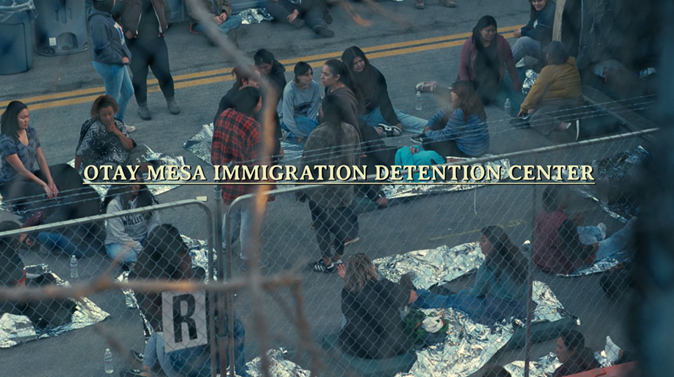
One Battle After Another opens with a prologue set 16 years prior to the current day, which sets up the decades-long chain of events that are to follow. We see a fictional, far-Left, militant, revolutionary group called the French 75 (based on a fusion of the Weather Underground and the Black Liberation Army) engaged in the violent ‘liberation’ of the equivalent of an ICE detention facility. The establishment shot to this first sequence is the Otay Mesa Detention Center in San Diego (a real federal detention facility), which is denoted in a title card, and the film’s soundtrack provides the requisite swelling-strings stylization, the sort of conveyor-belt “feel sad here” cue we’re accustomed to in Hollywood’s endless production of Holocaust films featuring gaunt prisoners in concentration camps (except in the case of Mexican illegals, the body type is generally the opposite of gauntness).
In the wake of the violent January 2026 anti-ICE protests in Minnesota that further divided the nation, One Battle subsequently received a slew of Academy Award nominations, winning Best Picture, Best Director (Paul Thomas Anderson), Best Adapted Screenplay (Paul Thomas Anderson), and Best Supporting Actor (Sean Penn). These outcomes come as no real surprise, given Hollywood’s penchant for trendy political content and public virtue-signaling.
However, at its core One Battle is a White male liberal’s glorification of radical Black politics and, to an odd and striking degree, Black female hypersexuality. Anderson awkwardly enmeshes his film with a miscegenation fetish and a portrayal of militant Leftwing radicalism as having a racialized sexual dimension, of sexual ‘liberation’ being an essential component of revolutionary politics. Secondarily, the film elevates Mexican illegal immigrants to a near-sacred status. Collectively, these representations of non-White groups amount to a cringe-inducing romanticization of the Other, all of which is further amplified by a one-dimensional and mystifyingly juvenile caricature of the police and military as ‘fascist’ thugs wantonly committing summary executions and getting sexually aroused by Black women pressing loaded guns against them. It’s all so very strange.
Such characterizations are informative, however, in revealing the modern Left’s current morality play. Here lies a paranoid, conspiratorial mindset, and an emotional rendering of Black and Brown groups’ respective ‘persecutions’ in a ‘fascist’ America. In today’s Cultural Marxism, which might be more accurately called Identity Marxism, traditional Marxist conflict theory (of oppressor vs oppressed) is applied to identity groups rather than just economic classes. This post-1960s trend centers on identity politics — focusing on race, gender, and sexuality — to create a matrix of oppression, a blueprint from which one can restructure society.
Beyond its boilerplate agitprop qualities, One Battle is more interesting when looked at as just one more instance of Hollywood’s many liberal revenge fantasies against White America. One Battle does this in much the same way that films such as Jordan Peele’s Get Out (2017) or Ryan Coogler’s Sinners (2025) do.[1]
Liberal film critic Richard Brody describes One Battle as “a work of grand symbolic design” and speaks for many progressive fans of the film when he interprets Anderson’s alternate history narrative in hyperbolic terms. Anderson, he writes, “looks profoundly beyond the immediate terms of his fiction to reach powerful insights regarding the horrors of the moment” (Brody, 2025). The film attempts to juxtapose absurdist political satire (primarily of conservatism, à la Kubrick’s Dr. Strangelove) with earnest Leftist preaching and hand-wringing, but the stark contrasts in style — correlated with the respective political positions — only serves to highlight the film’s didacticism. In short, One Battle captures the contorted, paranoid psyche and moral framework of today’s Left and stands as the most influential liberal moral panic film of the past year.
II. Age of Anxiety and The Leftist Moral Panic
It is not exactly a new nor controversial thesis to say that our culture feels unmoored. Among the Western nations, the crisis of post-industrial late modernity is real and its causes multifold. We can divide these causes into internalized and externalized factors. The external factors are objectively external (e.g., atomization & social fragmentation; mass third world immigration; feminization of culture; digital information overload; A.I.) while the internalized factors are just that: attitudes and beliefs altered within individuals and, by extension, society as a whole. From a Voegelinian perspective[2], we can see a loosely causative and almost circular relationship to these internal factors, some of which include: alienation => digital anxiety => narcissism => epistemic instability => conspiracy theorizing => gnosticism => radicalization (i.e., activist transformation of the world). The Left and the Right of course react to the external factors in vastly different ways, and so internalize their subsequent anxieties differently. With respect to how the Left reacts to these external factors — that is, how they internalize associated anxieties into their psyches (and their art) — One Battle serves as an archetypal example.
In The End of Ideology (1960), Daniel Bell argued that in prosperous democracies, the grand, transformative political ideologies of the nineteenth and early twentieth centuries — the ideologies which aimed to radically reshape society (e.g., Marxism, Nazism) — no longer inspire mass commitment. Revolutionary appeals to the working class were effectively diffused by Keynesianism and an expanding welfare state. Bell and likeminded thinkers anticipated that, in the West, politics would shift toward pragmatic, incremental, piecemeal problem-solving — technical adjustments, expert-driven reforms, and pluralist negotiation — rather than sweeping ideological visions or eschatological promises of utopia. In the U.S., this has largely been true: the Leftist radical activism of the 1960s–1970s (e.g., Weather Underground, Black Panthers) faded into insignificance, eventually becoming little more than touchpoints of cultural nostalgia, much like the Hippies.
Unlike in the 1960s, among today’s influential Leftists there is no explicit call for revolution per se, at least none with any real traction, no political manifesto akin to Marx’s to rally behind and serve as a foundational organizational text. Leftist propaganda today is delivered in a more personalized and individualized form, commensurate with our social media age of curated information flows. If there is anything resembling a unifying ideology for today’s Left, it is Wokeness. This presents itself as a hazy and inexact form of moral indignation, one that collectively coalesces around Anti-Whiteness. Far more so than class, today’s Left is animated by identity politics surrounding race and gender.
In The Opium of the Intellectuals (1955), Raymond Aron argued that Leftist ideology functions like a secular religion, immune to evidence and hostile to dissent. Marxism became the “opium” of Western intellectuals, offering moral exaltation, historical certainty, and a sense of belonging while obscuring the layers and complexities of political reality. Aron argued that the Left had become a moral identity rather than a coherent political program: intellectuals equated “Left” with justice and “Right” with reactionism, fascism, racism, and the like. While Aron’s book is chiefly a dissection of French left-wing conformism and intellectual life in the 1940s–1950s, it has predictive value when evaluating the modern Left in the U.S., which has in many ways begun to parallel the trajectory of 1960s French Leftism, not so much in revolutionary ambitions (e.g., May 1968) but in the spiritual despair, nihilism and narcissism that underlies it.[3] The influential conservative philosopher Roger Scruton, who witnessed the May ’68 riots while in Paris, has described them as “a kind of adolescent insouciance, a throwing away of all customs, institutions, and achievements, for the sake of a momentary exultation which could have no lasting sense save anarchy” (Scruton, 2003).
So, might we be in the early stages of a resurgent, 1960s-style, radical activism among the Left… a Version 2.0? The Far Left has made serious inroads toward control of the Democratic Party: younger generations adept at social media (AOC, Mamdani, etc.) are shaping the Party’s intrinsic national message, which in turn changes the Party’s platform, actualized policies, and lastly and sometimes reluctantly, the stated positions of the Party’s elders themselves. (As an example, one need only look at the radical leftward change in position on illegal immigration that figures such as Joe Biden, Barack Obama, and Hilary Clinton have displayed from the mid-1990s to the present). Particularly among the young, there is also the Left’s increasing propensity and willingness to use violence to achieve political goals (Antifa rioting; George Floyd rioting, the assassination of Charlie Kirk; two assassination attempts on Donald Trump; the Left’s lionization of Luigi Mangione, who murdered UnitedHealthcare CEO Brian Thompson; numerous attempts to murder ICE agents; etc.), which comports with the political message of One Battle.[4]
III. Weather Underground + Black Liberation Army = French 75
In One Battle, the fictional, far-Left, militant, revolutionary group called the French 75 is based on a fusion of the Weather Underground and the Black Liberation Army. The title One Battle After Another was itself taken from a Weather Underground missive written by Bernardine Dohrn in 1969. In a February 2026 interview[5], the ever-unrepentant Weather Underground terrorist (and Obama mentor) Bill Ayers effusively praises Paul Thomas Anderson’s film One Battle After Another (2025) and asserts that Anderson “obviously read everything about the Weather Underground. He obviously listened to our son Zade Dohrn’s podcast Mother Country Radicals. He obviously researched Assata Shakur and the Black Liberation Army.” Ayers argues that Anderson, in taking the now-mythic iconography of 1960s radicalism and placing it in a contemporary timeframe, un-freezes this chapter of American history from cultural nostalgia and makes it relevant for our current times, almost as a call to action.
“The title One Battle After Another,” Ayers says in an eye-opening part of the interview, “is taken from a speech Bernardine [Dohrn] gave. … The context of the speech was explaining how we can be defeated but we have to keep going,” i.e., we must fight one battle after another.[6] What Ayers is referring to isn’t a traditional speech but a revolutionary statement written by Dohrn in the October 21, 1969 edition of FIRE!, the Weather Underground’s propaganda-style publication that became associated with the terrorist group after it literally went underground.[7] The statement reads:
On Monday, October 6, a pig statue honoring the murderers of Chicago strikers was blown to bits. On Tuesday, October 7, the head of the Chicago Pig Sergeants Association said that “SDS has declared war on the Chicago Police — from here on in it’s kill or be killed.” On Wednesday, October 8 a white fighting force was born in the streets of pig city. … We came to Chicago to join the other side — to stop talking and start fighting … to destroy the motherfucker from the inside.
There were only 500 of us, but we forced Pig Daley to call in the Guard… We did what we set out to do, and in the process turned a corner. FROM HERE ON IN IT’S ONE BATTLE AFTER ANOTHER — WITH WHITE YOUTH JOINING IN THE FIGHT AND TAKING THE NECESSARY RISKS. PIG AMERIKA — BEWARE: THERE’S AN ARMY GROWING RIGHT IN YOUR GUTS, AND IT’S GOING TO HELP BRING YOU DOWN. DID THAT PIG SAY KILL OR BE KILLED?
What can we infer from this? Well, it would appear that Anderson either named his film One Battle After Another after encountering Dorhn’s rant himself or after someone in his circle of family/friends suggested the title after they had read Dohrn’s rant. In either case, it is implausible that Anderson did not know of Dohrn’s rant when deciding to name his movie. Given Anderson’s auteur status as a writer/director, and the absolute (and rare) creative control he has over his filmmaking process, it would be far too coincidental otherwise. Furthermore, any doubts can be laid to rest when we consider that Anderson’s script has the Perfidia character use a phrase from the above Dohrn rant: In her “declaration of war” to the guards of the migrant detention facility, she characterizes her violent activism as itself a natural reaction. “We’re here to right your wrongs, motherfucker. You got an army growing in your fucking guts, and you put it there.”
This, in turn, leads us to wonder if Anderson’s militant radicalism is far deeper than he publicly reveals. It’s either that or his turning a blind eye to the Weather Underground’s ideological justification for violence signals a stunning naivety. In any event, the film in no uncertain terms depicts domestic terrorism committed by militant Leftists in a sympathetic light.
It is important to remember the extent to which the Jewish-dominated Weather Underground leadership sanctioned genocidal levels of violence, when the time came. Larry Grathwohl, an FBI informant who infiltrated the highest ranks of the Weather Underground, reported how the group’s leadership estimated that, once the Revolution had succeeded in the United States, they would need to kill 25 million people. Grathwohl writes: “I want you to imagine sitting in a room with 25 people, most of whom have graduate degrees from Columbia and other well-known educational centers, and hear them figuring out the logistics for the elimination of 25 million people. … And they were dead serious” (Kengor, 2013).
It is also important to remember how the Weather Underground’s leadership believed it to ultimately be their duty to step aside and allow Blacks and Browns to be the revolutionary vanguard. Some of this sentiment was driven by frustration with the reactionism of the Nixon-era White working class, but the stronger sentiment was that this willful dispossession of leadership was a moral imperative. “We believed that the revolution led by Black and brown people was imminent,” notes one former Weather Underground member, “and it was our job to convince working-class whites to act as foot soldiers” (Reeves, 2026). Lastly, it cannot be overemphasized just how pathologically anti-White the Weather Underground was in their ideology and rhetoric, which in many ways anticipated our own Woke era’s anti-Whiteness.
Of course, none of this is on display in One Battle, just milder, coded allusions within an overall irresponsible liberal revenge fantasy of a film. “This fantasy may coincide with contemporary turmoil,” writs Armond White, “but its mixture of political absurdity, comic bloodshed, and racial farce merely exploits Millennial confusion” (White, 2025). For example, among the coded references is how, throughout the film, saying “Green Acres, Beverly Hillbillies, Hooterville Junction!” serves as a passcode for French 75 members to identify one another. Within the film, that’s as far as the reference goes, but in the 1960s, these sitcoms (with “Hooterville Junction” being a substitute for “Petticoat Junction”) were set in rural White locales, antithetical to Black urban locales, and so became a target of rage by Black militants. This exact phrase (along with other cultural references to Whites) is used in Gil Scott-Heron’s 1971 black liberation song “The Revolution Will Not Be Televised”, which can be heard in One Battle and which, lyrically, drips with resentment against Whites and their culture:
Green Acres, Beverly Hillbillies, and Hooterville Junction
Will no longer be so damn relevant
And women will not care if Dick finally got down with Jane
On Search for Tomorrow
Because black people will be in the street looking for a brighter day
The revolution will not be televised.
With various cultural references like this, Anderson doesn’t come right out and directly broadcast his radicalism, but rather provides the select viewer with a wink and a nod. The closest reveal of Anderson’s true political philosophy is via the minor character of Howard Sommerville (Paul Grimstad) who isn’t in the film very long and serves as an incongruous placeholder for Anderson to briefly articulate his own meta-level political ideology. We see Sommerville sitting alone in a café drafting the speech he’ll eventually deliver over guerrilla radio airwaves (that we hear in voiceover).
 Paul Grimstad as Howard Sommerville in One Battle
We also see Sommerville engaging in Will Stancil-styled barrio activism (handing out pamphlets to Mexicans at a bus station, etc.) during this voiceover. Howard’s diatribe is comprised of standard-issue Marxism, blank-slate race denialism, open borders ‘asylum’ rhetoric, and a call for what Voegelin delineates as the activist transformation of the world:
… maybe starting to see how corrupt to the core this whole fucking charade is. This great noble experiment in self-government. Bought and sold by billionaires. The Davos crowd. Openly racist, fucking Bell Curve Nazis.
It’s bedtime for democracy, comrades … good night. So, you’re feeling, like, maybe your mind is starting to erode? Good. This is happening on the ground, through coordinated effort and strategic lines of resistance. Every day, working through dedicated teamwork, to take it directly to the capitalist overlords, who are extracting value from your life this very second.
Go ahead. What, you think this is Facebook? This is gonna happen on your Instagram? It’s gonna happen on a hashtag somewhere? I think not. And don’t forget, while you’re doing it, that this is a nation that gives asylum. Don’t think they’re separate. Don’t break them apart.
IV. Influences & Pynchon’s Conspiratorial Mindset
Paul Thomas Anderson’s overall body of work contains an impressive array of films packed with immediacy, visual flair, and stylized mise-en-scène: Hard Eight (1996), Boogie Nights (1997), Magnolia (1999), Punch-Drunk Love (2002), There Will Be Blood (2007), The Master (2012), Inherent Vice (2014), Phantom Thread (2017), Licorice Pizza (2021), and now One Battle After Another (2025).[8] Anderson’s films are driven by intense and often damaged individuals whose inner longings collide with grand American mythologies (fame, family, capitalism), and his narratives often unfold in loosely episodic structures taking place within sprawling, operatic arcs. Among his immediate influences, Robert Altman and Martin Scorsese are most apparent. From Altman we get the ensemble storytelling, the overlapping dialogue, and the chaotic feel of fractured families, and from Scorsese we get the streetwise shot-compositions, kinetic camera movement (Anderson is also a fan of Max Ophüls in this regard), and the popular music needle drops that underscore a scene’s desired emotional effect.[9] There is also the noticeable influence of Stanley Kubrick’s precision and emotional austerity in films such as There Will Be Blood and Phantom Thread. With respect to One Battle, Anderson has cited the following as key influences in the making of the film[10]:
- Days of Rage: America’s Radical Underground, the FBI, and the Forgotten Age of Revolutionary Violence (2015): Bryan Burrough’s seminal book details the radical underground in the 1970s, documenting a largely forgotten era of intense domestic terrorism in the U.S. He details how groups like the Weather Underground, the Black Liberation Army, and the Symbionese Liberation Army conducted thousands of bombings and killings.[11]
- Les Misérables (1935): Anderson cites Richard Boleslawski’s 1935 film adaptation of Victor Hugo’s novel, particularly its mad, cacophonous first act that serves as the backdrop and setup for the core human conflict in the story: Inspector Javert’s (Charles Laughton) obsession with capturing ex-convict Jean Valjean (Fredric March).
- Vanishing Point (1971): Anderson cites Richard Sarafian’s underrated mythopoetic road movie, which I have previously written about.[12] In Vanishing Point, the protagonist is determined to drive from Denver to San Francisco in record time, for an unspecified goal, and his urgency in the matter acts as a purpose-in-itself, where the ultimate telos of one’s ‘vanishing point’ – eyes fixed as far as one can see down the road — symbolizes the annihilation of being that comes with death.
- Midnight Run (1988): Anderson absolutely loves this witty, buddy-action-comedy-road-movie starring Robert De Niro and Charles Grodin, made in the heyday of the 1980s buddy films craze (e.g., 48 Hrs. (1982), Beverly Hills Cop (1984), and Lethal Weapon (1987)). Anderson says it is both his personal favorite film and his family’s favorite film, which they watch at least twice per year.[13]
Relative to Anderson’s earlier films, with One Battle we have a more frenetic pace that reflects the confused, paranoid, and desperate mindset of today’s Left, where ‘fascism’ is everywhere — in every institution of authority, and even hidden underneath the seemingly benign, trimmed lawns of the suburbs. It is here where Anderson’s literary influences come to the forefront. The majority of Anderson’s films are based upon his own original screenplays, but in the case of There Will Be Blood, Anderson adapted his screenplay from Upton Sinclair’s socialist novel Oil! (1927), and in One Battle After Another (as with Inherent Vice) we have Anderson adapting a screenplay loosely based on the novel Vineland (1990) written by his most significant and lasting literary influence: Thomas Pynchon[14].
Pynchon is one of the founders (and giants) of postmodern fiction, a satirical genre that — through devices of irony, self-referentiality, and non-linear narrative — parodies modernist fiction just as modernist fiction parodies realist fiction. Pynchon’s oeuvre is replete with conspiracy theories, usually fanciful and ridiculous, and the conspiracies in his novels are typically layered and, despite remaining largely unseen and in the background, serve as the magnetic center of the novels’ events. Countercultural anti-hero protagonists, often burned-out pot-smoking 60s-era radicals, stumble through the novel’s plot and life in general, but then also stumble onto actual conspiracies they soon find themselves caught up in. The harrowing realities of the conspiracy, the upending of one’s conventional ways of understanding the world, take their toll on characters’ psyches, leading to an ever-worsening paranoia. In many ways, Pynchon’s novels, characterized by hidden connections and multiple interpretive levels, provide interwoven, gnostic systems of meaning to the characters and to the reader. Contours of ‘The System’ are delimited. It is most interesting, then, when Harold Bloom characterizes Pynchon’s novels as Kabbalistic.[15]
The conspiracy-theory-as-plot-device is itself greatly influenced by early American detective fiction (e.g., Hammett, Chandler), a genre that in a more straightforward literary manner involves mystery and unknown forces which the hero does not fully understand. Over the course of typically three acts, a slow and suspenseful unraveling of a conspiracy takes place. Of course, the conspiracy itself may be relatively low-level, and not necessarily part of a particular, more macro-level one, but a conspiracy nonetheless. As with the genre of classic film noir — which inherits all the essential tropes of detective fiction and was often helmed by liberal Jewish émigré directors — there is a darkened moral atmosphere to the world and a growing skepticism toward institutions. Gone is the clean moral universe of classic whodunits. Instead, justice is compromised, authority corrupted, truth rarely restores order, and the protagonist (often a grizzled and jaded private detective) uncovers guilt without being able to meaningfully correct it. The fatalism inherent in this worldview (and the arc of conspiracy theories in general) coincides with the explosive growth in the twentieth century, particularly since World War II, of both the federal government and large corporations, i.e., the prevailing dominance of the bureaucratic-administrative state and its nexus with corporate interests.[16] The institutions that effectively control us have become ever more faceless, unaccountable, and remote from the average citizen, and in One Battle this type of dark and cloaked entity — as it is imagined by the Leftist’s conspiratorial mindset — is the fictional White supremacist secret society called the Christmas Adventurers Club.
V. Characters+
Bob Ferguson
Leonardo DiCaprio plays Bob Ferguson (aka “Ghetto” Pat Calhoun aka “Rocketman”), a former 60s radical who was an explosives expert for the film’s fictional domestic terrorist group French 75.[17] In the film’s aforementioned opening sequence, we see Bob in his earlier activist/terrorist years as he participates in ‘liberating’ a migrant detention facility. Whether intended by Anderson or not, we witness the pathetic spectacle of this out-of-place, White, ‘60s revolutionary surrounded by Black radicals and Mexican illegals, screaming insults to the DHS soldiers whom the French 75 has just placed inside the very ‘cages’ that minutes ago held illegal aliens:
We are a political organization that is free from the eyes, the ears, and most importantly, the weapons of the imperialist state, and this fascist regime! You are a political prisoner of the French 75, motherfuckers! You’ve been captured by the French 75! Fuck the police! Viva La Revolución!
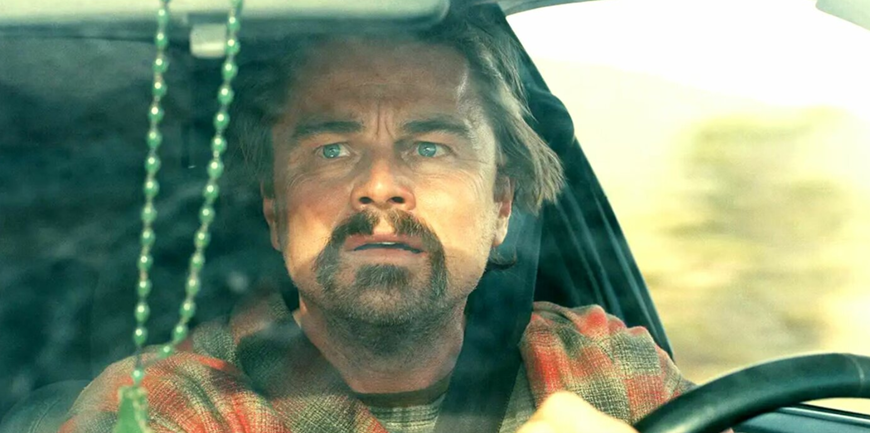
Leonardo DiCaprio as Bob Ferguson (aka “Ghetto” Pat Calhoun aka “Rocketman”)
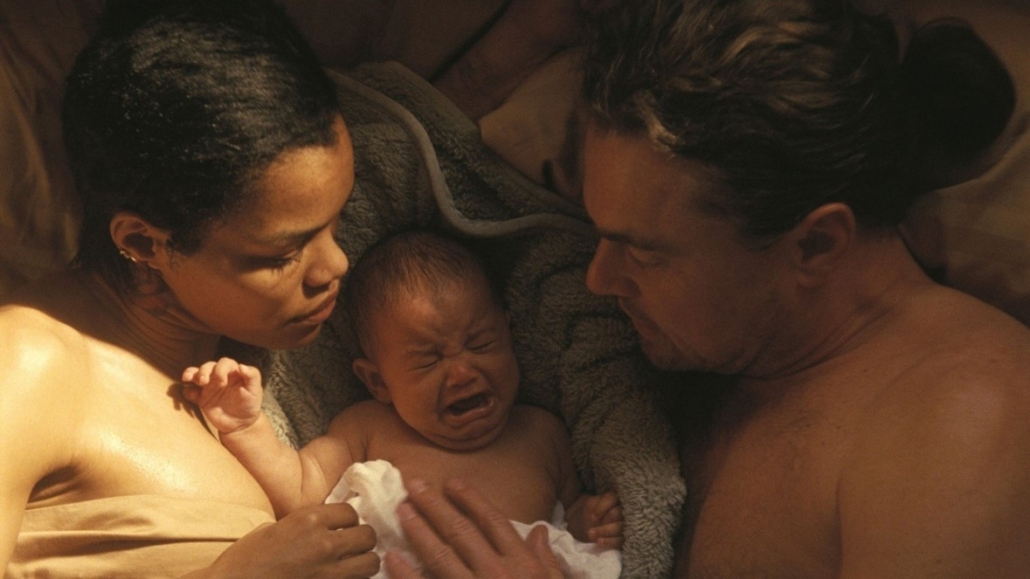
In the 16 years since the film’s opening sequence timeline, Bob has changed his identity and fled to the fictional town of Baktan Cross in Northern California, but his identity and sense of self are still inextricably linked to his past revolutionary activities and political philosophy. However, he’s now a man-bun-sporting, paranoid burn-out dressed in Jeffrey Lebowski bathrobe attire, who spends his days smoking pot, vaping, and watching Battle of Algiers. His existence now is nothing more than as a vessel of nostalgia, save for him being the (cucked) “father” of his mixed-race daughter Willa. In fact, Bob has been cucked thrice-over. First, he doesn’t realize that he’s not the biological father of Willa (though Perfidia surely does). Second, he’s been cucked by the Revolution, as Perfidia abandons him and Willa to “do the revolution.” Third, he’s been cucked by his own feminism, reflected in his inability to be a stern and responsible father to his daughter.
 DiCaprio has commented on his character’s old-school hippie/libertarian streak, of the type one finds in certain Northern CA towns such as Eureka:
Bob is what I like to call a don’t tread on me, anti-establishment, hippie revolutionary who is paranoid about anything and everything. He doesn’t want to be taxed. He doesn’t want to be monitored. He’s incredibly skeptical of everyone and everything around him. He hides himself off in the middle of the woods and stays home, watches movies like The Battle of Algiers, smokes pot and drinks, but has one objective, and that’s to protect his daughter (Bowie, 2025).
Through Bob, we see a previous-generation Leftie feeling awkward around the new generation Lefties: namely Generation Pronoun & Generation Snowflake. When his daughter’s friends arrive at their home to take her to a school dance, there is this exchange:
Bob: Now, who’s the one with the lipstick? What’s that one’s name?
Willa: Bobo.
Bob: Bobo … Now, is that a he or a she or a they?
Willa: Dad, come on.
Bob: No, are they transitioning? I wanna know if…
Willa: They’re nonbinary.
Bob: Okay, I just wanna be polite…
Willa: It’s not that hard! … They/them.
Later in the film, when Bob is on the run, we see him on the phone with French 75 headquarters, trying to determine the arranged rendezvous point with his daughter. He’s talking to a whiny guy (“Comrade Josh”), but because he cannot remember the password code to the question “What time is it?,” Josh does not give him this information. Bob pleads with him to make an exception, but Josh repeatedly refuses. After Bob explodes in rage at Josh, cursing at him and threatening him, they have this exchange:
Josh: Okay, this doesn’t feel safe. You’re violating my space right now.
Bob: Violating your space?! Man, come on… What kind of revolutionary are you?! We’re not even in the same room here! We’re talking on the phone, like men!
Josh: Okay, there’s no need to shout. This is a violation of my safety. These are noise triggers.
At an important level, Bob belongs to the pantheon of the Hapless Male trope, namely the endless drumbeat of predictably inept men (almost always White) that Hollywood and Madison Ave churn out in movies, sitcoms, and TV commercials. Invariably, these bumbling and not-all-that-smart males serve as comic relief, but are eventually guided, rescued, or otherwise saved by either a Strong Woman (aka the Mary Sue trope), a non-White, or the intersection of both.[18] Even the New York Times, ever late to noticing cultural trends it did not itself create, has put One Battle into this context. In a piece entitled “Dramas Keep Showing Us Hapless Men—and Hypercompetent Women,” Diego Hadis discusses several recent movies, including One Battle, where the three male protagonists all “fit the archetype of the schlemiel: irredeemably inept, an accident of a person, the butt of some great cosmic joke” (Hadis, 2026). These clueless males are eventually teamed up with ‘hypercompetent women’:
The women they come across, on the other hand, seem ready for anything. They might see several chess moves ahead of both the protagonists and antagonists. They know how to affect the world of the movie, and they do so with ease — exactly what the actual “hero” of the story is completely unable to do. …
They are ever-present — and they are usually so capable, so confidently efficacious, that if they were the story’s focus, the movie would be over in 15 minutes. (Hadis, 2026).
In the case of One Battle:
Perfidia is the film’s driving force, directing the group’s strategy and taking Bob as a lover; her actions push the story forward even after she leaves. All through the film, though, so many of the women Bob encounters have things together in ways that put him to shame — say, the nurse doing intake at a police station after Bob is arrested in a military raid, who hands him off to another nurse, at a hospital, who calmly, unflappably leads him to freedom. Even Bob’s teenage daughter, Willa, is the responsible one, a purple belt in karate who effectively parents her own father. (Hadis, 2026).
Rather than criticizing these tired girlboss tropes for being as formulaic as the Waif-Fu trope (i.e., action movies where a 100 lb. girl handily beats up 250 lb. men), Hadis not surprisingly adopts the New York Times’ “it’s time for women to run the world” approach:
The fact that these figures are so often women may be a way of suggesting that men have had their run, and look where it has gotten us. … We should not be surprised if the coming years bring more films like these — all dreaming that there is somebody out there with whom we might throw in our lot, somebody competent enough to tell us what to do to make the world right (Hadis, 2026).
This last sentiment is very much a feminist call-to-action-for-women in One Battle’s final scene.
Perfidia Beverly Hills
Perfidia Beverly Hills (Teyana Taylor) is the Strong Black Woman trope par excellence and the leader of the French 75. And while one of the world’s most famous movie stars is in One Battle, it is Perfidia who Anderson deems the film’s main character. He notes:
I had a feeling like, Perfidia needs to feel like she’s the protagonist, the hero of the movie. You know, Leo might be in it, Sean might be in it, all these well-known actors are in it, but you see Teyana and it’s like: That’s the star of the movie. I wanted audiences to feel like, this is really a movie about a Black revolutionary (Fear, 2025).
In the film’s opening illegal-immigration-liberation scene, when she first encounters Lockjaw and has a gun pointed at him, she declares her aforementioned political mission, which Anderson has clumsily written to shoehorn in a pro-abortion sentiment:
My name is Perfidia Beverly Hills, and this is a declaration of war. We’re here to right your wrongs, motherfucker. … You didn’t count on me. You didn’t count on my fight. The message is clear: free borders, free bodies, free choices, and free from fuckin’ fear!
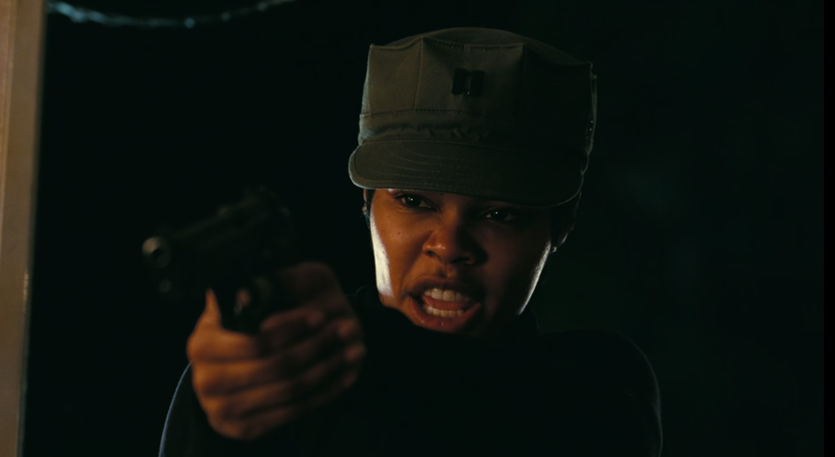 Teyana Taylor as Perfidia Beverly Hills
The very name ‘Perfidia’ literally means betrayal, which is apropos in this case: Ultimately, she betrays Bob by being attracted to, and having sex with, Lockjaw. She betrays the French 75 in a plea deal with authorities that involves her ratting out their names and locations. And she betrays her daughter by abandoning her. (Naturally, despite all of this irresponsibility and dysfunction, her daughter Willa still ‘relates’ to her in the film’s ending). Her middle and last name of “Beverly Hills” should not be overlooked either: this is Anderson situating one front of the revolutionary vanguard (at least nominally) within the manicured lawns of Beverly Hills, and perhaps giving Hollywood liberals a jab for not being sufficiently committed to Leftist causes and the associated ‘direct action’.
Anderson writes Perfidia as experiencing post-partum depression, and she abnegates her maternal role to her newborn infant Willa as a result, with Bob carrying the load. When Bob scolds her, reminding her that they “are a family now,” Perfidia uses her revolutionary politics to justify her abandonment of the mother role: “This is a new consciousness. I’m not your udder buddy. I’m not your mother. You want your power over me, the same reason you want your power over the world. You and your crumbling male ego will never do this revolution like me.”
Anderson no doubt based Perfidia on Assata Shakur, who joined the Black Panther Party in the late 1960s before becoming involved with the Black Liberation Army. She gained notoriety after a 1973 shootout on the New Jersey Turnpike that resulted in the death of a state trooper. She was convicted of murder in 1977 and sentenced to life in prison, but in 1979 escaped with the help of supporters. She then lived in the underground until 1984 when she was granted asylum in Cuba, where she lived until her death in 2025 at age 78. As an example of the standard hagiography heaped on Shakur by the Left, Nikole Hannah-Jones (of the ‘1619 Project’ infamy) was granted a New York Times op-ed slot to celebrate Shakur. The piece is full of gems, including this quote from Angela Davis, the more famously feted Black Female Revolutionary:
Angela Davis, the activist who was wrongly imprisoned during that same tumultuous period, told me women were the backbone of Black radical movements and “the government probably recognized more than even our own people did the power of Black women. (Hannah-Jones, 2025)
In One Battle, after a bank heist goes awry, and which involves Perfidia killing a bank guard, she is apprehended by the police. (Anderson cowardly casts a Black male to play the murdered bank guard, so as to deflect attention from the prevailing Black-on-White nature of violent crime in America). We then see an all-White gaggle of cops cheering and flipping her off while taking selfies.
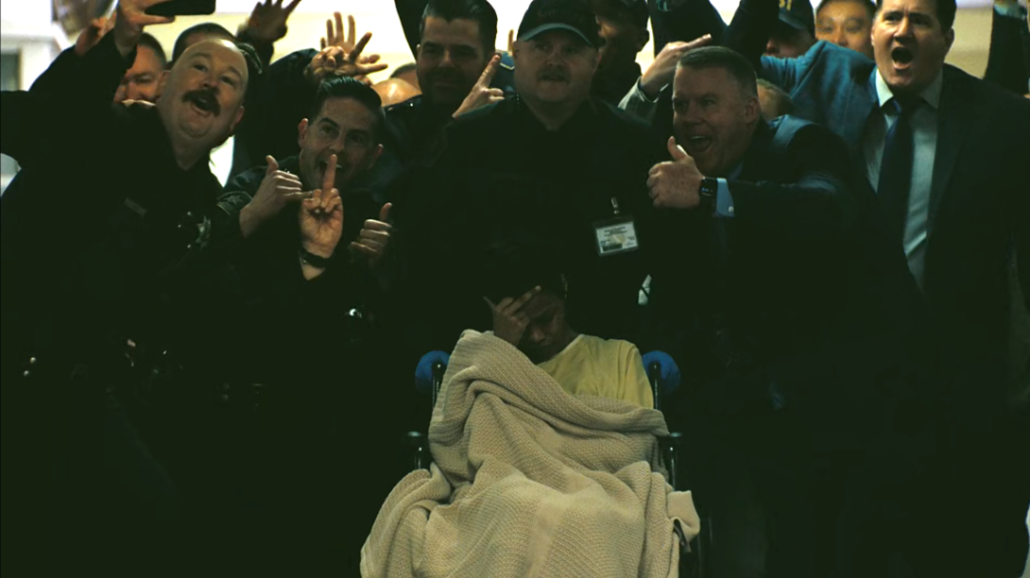
Lockjaw, thoroughly smitten with her, arranges for her to get a witness protection plea deal, in exchange for beginning an illicit affair. She puts up with this for a certain duration before fleeing (ironically through an official border crossing into Mexico) for a destination that, we learn later in the film, is either Cuba or Algiers, both being locations that actual 1960s Black radicals fled to when U.S. authorities were on their tail.
Willa Ferguson
The progeny of Perfidia and (shockingly) Lockjaw, Willa (Chase Infiniti) is nonetheless raised by Bob alone, given that Perfidia abandoned the family when Willa was an infant. As the film fast-forwards sixteen years later, we see Willa now sixteen herself, receiving karate instruction from Sergio St. Carlos. Steely Dan’s “Dirty Work” is playing on the soundtrack, which lyrically signifies the degradation of Bob and Perfidia’s revolutionary romance into a domestic aftermath where Bob is the sole parent, having ‘cleaned up’ Perfidia’s mess. (Bob once imagined himself as part of History; now he’s an exhausted man left holding the child, the guilt, the secrets, and the consequences).
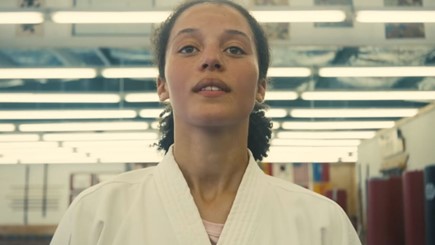 Chase Infiniti as Willa Ferguson
Willa is now a rather typical American teen female. She has a cell phone that she hides from Bob (who has forbidden them), They/Them friends, and Girl Power attitude. In terms of both cultural attitudes and Leftist political strategies, Willa represents the notable generation gap relative to Bob’s generation. She is described to Bob as a natural ‘leader’ by her high school history teacher, which leads Bob to cry tears of pride.
In terms of plot, Willa is the aforementioned hyper-competent female forced to deal with Bob’s rather inept ‘dumb White guy’ persona. (The father-daughter dynamic between Bob and Willa is a central aspect of One Battle, no doubt partly a function of Anderson’s own relationship with his three biracial daughters).
Signifying where her future will lead after the movie ends, and with Lockjaw and his men searching for her, Willa is offered protection by a group of young, Black, radical, pot-smoking, ghetto-speaking, machine-gun-toting nuns called the “Sisters of the Brave Beaver” (inspired by Sisters of the Valley, an actual hippie convent), the name of which is yet another of Anderson’s bizarre sexualization of radical politics. At this ‘convent’ Willa learns how to shoot. (It’s significant then that Anderson cast both Maya Rudolph and one of his daughters to play members of this Sisterhood).
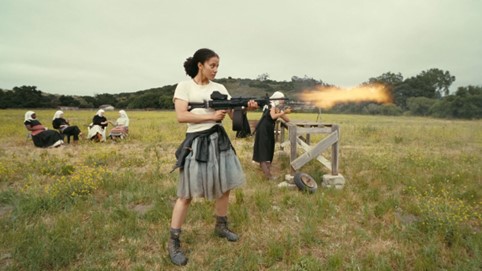 Willa at the Sisters of the Brave Beaver
After narrowly averting death at the hands of both Lockjaw and the Christmas Adventurer Club’s hitman, when Bob finally finds her on a remote California desert highway, Willa (having recently learned who her biological father is) screams “Who are you?!” to Bob, who replies to her plaintively by saying “It’s your dad,” which reconciles the two of them. (There may be an undercurrent here of Anderson’s own biracial daughters possibly questioning aspects of their racial identity as well as their father’s). Of this sequence, Anderson has said: “Coming up with the situation for Willa, where she is finally able to take agency over a situation — to turn the tables, be the aggressor, take the high ground — this became very exciting for us” (Fear, 2025).
In One Battle’s final sequence, Bob and Willa are back home safe and sound. Bob decides to finally give Willa a letter that Perfidia had written to her years ago, but that Bob has kept hidden from her. “I wanted to protect you,” he tells Willa, “From all your mom’s shit, from all my shit. I suppose I wanted to be the one that you came to for help. … The cool dad that you could say anything to, even though I know that’s impossible.” Bob gives her the letter and as Willa reads it in her bedroom, we hear the letter’s content being read in voiceover by Perfidia. The letter contains some verbatim lines from an actual letter a Weather Underground member wrote to their family, as shown in the 2002 documentary The Weather Underground.[19] At the 1:16:19 marker of this documentary, we similarly hear one of these letters being read in voiceover: “Hello from the other side of the shadows. I don’t mean to shock you, but I have been contemplating writing you for a long time. … Often I wake up and find it completely inexplicable how and why I am where I am today and disconnected from my family.”
Sergio St. Carlos
A secondary character to One Battle, Sergio St. Carlos (played by Benicio del Toro) — aka “Sensei” — acts as a calm balance to Bob’s frantic and paranoid nature. “Ocean waves,” he often says as a mantra during tense moments. Sergio is both a karate sensei and a ‘coyote’ of sorts for Mexican illegals in the fictional sanctuary city of Baktan Cross. “I’ve got a little Latino Harriet Tubman situation going on at my place,” he tells Bob.[20] With Lockjaw in pursuit of both him and Willa, Bob has reached out to Sergio for help in rescuing Willa. Sergio agrees and, along the way, introduces Bob to his family as the “Gringo Zapata.”
In one rather creepy moment, as Sergio and Bob and driving through a downtown Baktan Cross that is undergoing a fiery battle between protesters, police, and Lockjaw’s forces, Sergio pauses next to a dozen or so Mexican kids on skateboards. “Bee Gee,” he says to one of them he recognizes, “what’s the word?.” With a gloating smile on his face, the kid tells Sergio “It’s fuckin’ World War III out there, yo!”
One Battle has several digs at contemporary cell phone culture, one of which is when Sergio — almost out of character — takes a selfie with Bob. In another scene, when Sergio has to rush the illegals temporarily hiding above a Mexican-operated corner store to a sanctuary church, he yells several times at a Mexican teen minding the store to get off his phone, after Sergio has told him to watch the front door. Soon after, in Sergio’s ramshackle apartment above the store, he tells one of his daughters to get off her phone. In yet another room, we see two more Mexican teen girls on a couch not talking to each other but both staring at their phones. In all these instances, there is a blank look upon each teen’s face as they are staring at their phone.
Del Toro’s most memorable line in the movie takes place after he’s distracted the police away from Bob. Both had been drinking beers earlier. When the police pull Sergio over, they ask him if he’s been drinking. “I’ve had a few,” he says. “A few what?” asks one of the cops. “Few small beers” Sergio replies.
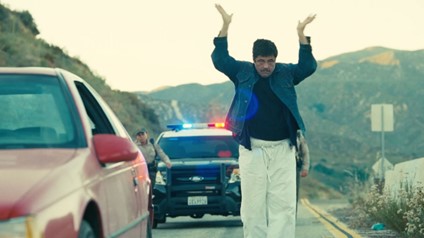 Benicio del Toro as Sergio St. Carlos
Colonel Steven J. Lockjaw (Sean Penn)
The film’s one-dimensional villain is Colonel Steven J. Lockjaw (Sean Penn). A military man who dutifully follows orders, Lockjaw is nonetheless a corrupt military officer without scruples. He stands as a cartoonish representation of White Christian society, White supremacism, and reactionary politics — all rolled into one. He is depicted as perpetually angry and violent. His surname is, of course, meant to convey a clenched jaw and Penn portrays Lockjaw with a stilted, tight-ass gait, as well as an undercut ‘fash’ hairstyle that — when he meets with the Christmas Adventurers Club, a White supremacist secret society — is combed to be Hitler-like. (There isn’t much in the way of subtleties with One Battle). Sean Penn’s rumored years on steroids serves the role’s physicality well, although he seems to overact here (but in his defense the script probably called for an over-the-top military racist).[21]
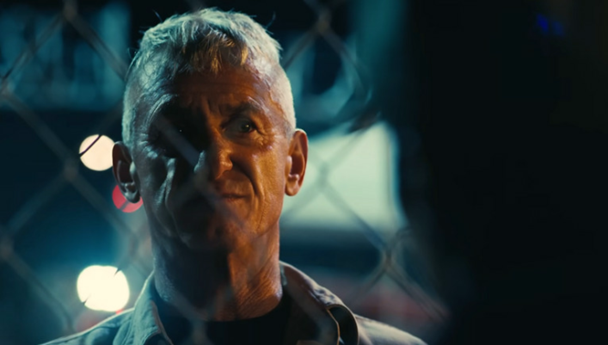 Sean Penn as Colonel Steven J. Lockjaw
Reflecting how the Left often sees all uniformed law enforcement entities as one monolithic army of ‘fascism,’ One Battle blurs the lines between police, traditional military, and paramilitary law enforcement roles. Lockjaw is the commanding officer of a fictional paramilitary group called the “MKU” (Mankind United). While his role involves overseeing an immigration detention center on the U.S.-Mexico border, MKU functions as a distinct, specialized government organization rather than a traditional branch of the military.[22]
At one point in the film, we see what appears to be the FBI or some other element of the DOJ awarding Lockjaw with the ‘Bedford Forrest Medal of Honor’ for his work hunting down members of the French 75. (Forrest was a Confederate general during the American Civil War who later served as the first Grand Wizard of the Ku Klux Klan).
Despite his White supremacism bona fides, Lockjaw secretly harbors a largely repressed sexual obsession with Black women, so a miscegenation element also becomes crucial to the motivations of the film’s villain. Early in the film, Lockjaw is sexually humiliated by Perfidia but depicted as enjoying it, as it leads to his sexual arousal and then his “reverse rape” (as he later describes it). This display of a conservative White alpha male enjoying sadomasochistic submission to an angry, armed Black woman (complete with a gun pointed at his crotch) serves as a caricature of Second Amendment gun rights advocates and, more importantly, as a humiliation ritual for White males. If there is one grand metanarrative to One Battle, it is as a liberal revenge fantasy against conservative White men. Lockjaw symbolizes this class, first through his depicted arrogance and coldness, then later through ritual humiliation, disfigurement, and death.
In the film’s only scene between him and Bob, we see Lockjaw use very few words to indirectly articulate his jealousy that Bob has Perfidia and not him. “You like Black girls?” he asks Bob. “I love ‘em. … I LOVE ‘EM!” One X user has aptly memed this exchange as emblematic of how poorly drawn Lockjaw is from the standpoint of character depth:
In yet another tired trope of Leftist ‘explanations’ of conservatism, the film makes implications that Lockjaw is a closeted homosexual.[23] In one exchange — after Lockjaw has abducted Willa and deploys a DNA test to prove (or disprove) that she is, in fact, his biological daughter — it’s implied that Lockjaw is a repressed homosexual:
Willa: Why is your shirt so tight?
Lockjaw: I’m not gay, if that’s what you’re saying.
Willa: I didn’t say that.
Lockjaw: I’m not a homosexual.
Willa: I did not say that … but I see the lifts in your shoes.
Such is the sort of dialogue that wins the Oscar for Best Adapted Screenplay.
In this same scene between Lockjaw and Willa, he says to her at one point, in an over-the-top display of White-against-Black racial hostility: “You shut up! JUST SHUT UP, YOU FUCKING MUTT!!”. In addition to being a racial insult, this dialogue also serves to express the Left’s absurd notion that Blacks are being held in silence by the ‘institutional racism’ of White society. One can only wonder if Anderson is conveying his own daughters’ real (or, more likely, imagined) experiences, his own fears about what his daughters may face in the future, or whether through the character of Lockjaw he’s clumsily articulating his own inner demons on his daughters’ mixed-race status.
Having determined through a DNA test which he’s administered to Willa that she is in fact his biological daughter, and hence a threat to his acceptance into the Christmas Adventurers Club, Lockjaw decides to kill her, but not before mocking and insulting her further:
I am a Christmas Adventurer! Do you know what that is? I have a higher calling. It is a higher honor than having you. I loved her, in case you were wondering. Best goddamn-looking witch I ever saw. Yeah, she was possessed. … She was insane. Like you. You have it in you. I smelled it from within her, and I can smell it from within you.
Lockjaw binds Willa’s hands and drives her out to a remote canyon location where he meets Avanti (Eric Schweig), whom from their exchange we easily infer has done this sort of contract-killing work for Lockjaw numerous times in the past. “I don’t do kids,” Avanti says, even after Lockjaw offers to double his rate. Lockjaw then tells Avanti to instead take Willa to a remote private militia actually called…. drumroll… “1776,” fully confident that they will have no compunction in killing Willa. And, in case the didactic allegory here isn’t yet clear, we have Avanti the American Indian ultimately deciding to sacrifice himself by killing all the 1776 members and saving Willa, before dying himself in the gun exchange. (We know that Avanti is Indian not only from his physiognomy, but because one of the evil 1776 members derisively refers to him as “Wagon-burner”).
In a myriad of ways, and from absolutely every angle, Lockjaw is the bogeyman that a Jewish-dominated Hollywood fear most. Thus, despite Lockjaw being a comically one-dimensional character (and Sean Penn’s performance being almost camp), what Lockjaw represents resonates with Hollywood’s political imagination. It isn’t surprising then that One Battle wins a bunch of Oscars, including Sean Penn winning for Best Supporting Actor.
End of Part 1.
[1] With the 2026 Academy Awards, Sinners laughably received the most Oscar nominations of any film in history. Coogler, who is Black and is best known for the Black Panther movies which inspired the emergent Wakanda mythos, constructs Sinners with a Black-centric orientation and a didactic plot involving White vampires who prey upon Blacks, ‘turning’ these Black victims into vampires themselves. In a racialized variation of From Dusk till Dawn (1996), the social-justice messaging in Sinners is hilariously heavy-handed.
[2] Voegelin’s The New Science of Politics: An Introduction (1952) provides a useful lens for understanding the political implications of widening conspiracy theories and totalizing ideologies. Voegelin views the ideological pathologies of modernity to be gnostic in structure. Such ideologies often claim access to special knowledge (gnōsis) which reveals the hidden truth of history, and promises that salvation can be achieved within the world rather than beyond it.
[3] We can see this despair and self-absorption in such films as the Maoist director Jean-Luc Godard’s La Chinoise (1967) and being satirized by Wes Anderson in The French Dispatch (2021).
[4] For empirical data on the Left’s growing willingness to use violence, see Rufo (2025) and Dulberg & Horder (2025).
[5] Bill Ayers interview, AirGo podcast Episode 386 (“One Battle After Another, Fascism, and Activism During the 60s”), https://youtu.be/XbB40aRz8bg?si=cqUkawiHyESaQbE7, uploaded to YouTube on February 12, 2026 by Respair Production & Media.
[6] Bernardine Dohrn (born Bernardine Rae Ohrnstein) was a leader of the Weather Underground and is the wife of Bill Ayers. Her son Zayd Ayers Dohrn also asserts that the movie title One Battle After Another comes from his mother. See Dohrn (2026).
[7] See Varon (2004), pp. 107–108. Mark Rudd, a prominent SDS leader at Columbia in 1968 who went on to become one of the original leaders of the Weatherman / Weather Underground, and who is himself Jewish, has written about the significant overrepresentation of Jews in the New Left, particularly in leadership positions (Rudd, 2005). Lichter & Rothman (1981) estimate that Jews accounted for approximately 60% of the New Left in the mid-1960s. See also MacDonald (1998, Ch. 3 “Jews and the Left”) and Rudd (2009).
[8] Magnolia (1999) was already on the pulse of where our culture has been drifting for quite some time. The randomness and contingency of life is explored through a series of rather sad and lonely characters, almost all of them male, desperately seeking love and connection. One outlet for this state of affairs is the charismatic and cultish self-help guru Frank T.J. Mackey (Tom Cruise), who preaches a misogynous ethos (ala Andrew Tate) which teaches men how to “Seduce and Destroy” and whose manosphere seminar’s intro music is Strauss’s Thus Spake Zarathustra.
[9] As with Scorsese, music is central for Anderson. In One Battle, this is accomplished through existing songs such as Steely Dan’s “Dirty Work” and Tom Petty and the Heartbreakers’ “American Girl”, as well as through original sountrack compositions. Jon Brion’s anxious, percussive experimentation and Jonny Greenwood’s jarring modernist score (solo piano doing staccato drone patterns and then dissonant passages aurally representing a character’s paranoia) deepen a scene’s psychological tension.
[10] https://www.youtube.com/watch?v=S8Q35vXE9bI.
[11] For a brief summary of Burrough’s book, see Van de Camp (2020).
[12] Max West, Vanishing Point (1971). https://logicalmeme.com/vanishing-point-1971/
[13] https://www.youtube.com/watch?v=E8WW4jJ59d4.
[14] Development of a Vineland adaptation has been a pet project of Anderson’s since the early 90s when he first read and became obsessed with the novel. Anderson’s film Inherent Vice (2014) is a relatively faithful adaptation of Pynchon’s novel of the same name, and The Master (2012) contains elements based on Pynchon’s novel V (1963), such as the protagonist being a discharged sailor who connects with a cult-like group of individuals. (See Arblaster, 2022).
[15] Bloom shares Pynchon’s liberal paranoia that White Christian Fascists lurk behind every tree and every lawn ornament, aligning him with the pronounced history of Jewish antagonism to Christianity and Gentilism. “The not unimpressive polemic of Norman Mailer — that Fascism always lurks where plastic dominates — is in Pynchon not a polemic but a total vision” (Bloom, 2003, p. 2). Jews love Pynchon, not only because of his radical Leftwing idealism but also because of these Kabbalistic-style attempts to placate a lingering paranoia and persecution complex with elaborate gnostic conspiracy theories. See, for example, Mendelson, Edward (ed.). Pynchon: A Collection of Critical Essays (1978). Pynchon is not himself Jewish but was raised both Catholic and Episcopalian.
[16] See, for example, James Burnham on the managerial–bureaucratic class and the writings of Samuel Francis and Curtis Yarvin (aka Mencius Moldbug).
[17] DiCaprio notes that his own father was a 1960s counterculture radical and bombmaker who “hung out with Abbie Hoffman.” In preparation for his role, DiCaprio cites as influences the book Days of Rage, Gillo Pontecorvo’s The Battle of Algiers (1966), Al Pacino’s nervous Sonny Wortzik character in Sidney Lumet’s Dog Day Afternoon (1975), and Lumet’s Running on Empty (1988), about a couple who are continually on the move with assumed identities, after having committed terrorist acts as part of a Weather Underground-like group. (As noted in Tom Wolfe’s fascinating Radical Chic & Mau-Mauing the Flak Catchers (1970), Lumet hosted a high-end party for the Black Panthers before Leonard Bernstein’s soiree for the Black terrorist group, the latter being the focus of Wolfe’s essay). See https://www.youtube.com/watch?v=Q_cV9ciktoQ.
[18] The ‘White Men Are Stupid In Commercials’ account on X (@StupidWhiteAds) catalogs some of the countless TV commercials that adopt this trope.
[19] http://www.theweatherunderground.info/
[20] It was Del Toro’s idea to have Sergio be a ‘protector’ of Mexican illegals. The scenes with Del Toro were shot almost entirely in El Paso, TX, a city that is today a de facto satellite of Mexico. Anderson “adores” this city and its people. “Being in El Paso, at the center of immigration,” Anderson says, “gave us so much material and local talent to work with. It became the centerpiece of the film and certainly the best time I’ve ever had going to work” (Abramovitch, 2026). Del Toro has said that he and Anderson visited a church in El Paso that serves as a sanctuary for illegals until they get their “paperwork processed”.
[21] Like many on the Left, Anderson seems to equate extreme physical fitness with Rightwing politics and, childishly, homoeroticism. In the film’s opening sequence, many of the soldiers under Lockjaw’s command are physically buff and shown with their shirts off.
[22] MKU is likely modeled after the Border Patrol Tactical Unit (BORTAC), an elite, highly trained special operations unit within the U.S. Border Patrol Special Operations Group. Established in 1984, BORTAC provides national/international response to high-risk incidents, including counter-narcotics, hostage rescue, and riot control. One Battle’s closing credits confirm that MKU stands for Mankind United.
[23] Other notable examples of this trope include the repressed homosexual Col. Frank Fitts (Chris Cooper) in American Beauty (1999) (who also collects Nazi memorabilia to boot) and Major Weldon Penderton (Marlon Brando) in the movie Reflections in a Golden Eye (1967). Bertolucci’s The Conformist (1970) has special relevance here as well. Bertolucci was a Marxist and the visually stunning ‘Fascist aesthetics’ of The Conformist frames the protagonist Marcello’s troubled psyche. However, the narrative assumes a facile Marxism-Freudianism: Marcello’s childhood trauma from sexual abuse and consequent sexual dysfunction serve as a Freudian ‘explanation’ of his political extremism and willingness to assassinate an ‘anti-Fascist’ professor on behalf of the state. Repeatedly, we see the Left’s simplistic depictions and explanations of Rightwing political sentiment as psycho-sexual drama within the bourgeoisie.
Paul Thomas Anderson’s overall body of work contains an impressive array of films packed with immediacy, visual flair, and stylized mise-en-scène: Hard Eight (1996), Boogie Nights (1997), Magnolia (1999), Punch-Drunk Love (2002), There Will Be Blood (2007), The Master (2012), Inherent Vice (2014), Phantom Thread (2017), Licorice Pizza (2021), and now One Battle After Another (2025).[8] Anderson’s films are driven by intense and often damaged individuals whose inner longings collide with grand American mythologies (fame, family, capitalism), and his narratives often unfold in loosely episodic structures taking place within sprawling, operatic arcs. Among his immediate influences, Robert Altman and Martin Scorsese are most apparent. From Altman we get the ensemble storytelling, the overlapping dialogue, and the chaotic feel of fractured families, and from Scorsese we get the streetwise shot-compositions, kinetic camera movement (Anderson is also a fan of Max Ophüls in this regard), and the popular music needle drops that underscore a scene’s desired emotional effect.[9] There is also the noticeable influence of Stanley Kubrick’s precision and emotional austerity in films such as There Will Be Blood and Phantom Thread. With respect to One Battle, Anderson has cited the following as key influences in the making of the film[10]:
- Days of Rage: America’s Radical Underground, the FBI, and the Forgotten Age of Revolutionary Violence (2015): Bryan Burrough’s seminal book details the radical underground in the 1970s, documenting a largely forgotten era of intense domestic terrorism in the U.S. He details how groups like the Weather Underground, the Black Liberation Army, and the Symbionese Liberation Army conducted thousands of bombings and killings.[11]
- Les Misérables (1935): Anderson cites Richard Boleslawski’s 1935 film adaptation of Victor Hugo’s novel, particularly its mad, cacophonous first act that serves as the backdrop and setup for the core human conflict in the story: Inspector Javert’s (Charles Laughton) obsession with capturing ex-convict Jean Valjean (Fredric March).
- Vanishing Point (1971): Anderson cites Richard Sarafian’s underrated mythopoetic road movie, which I have previously written about.[12] In Vanishing Point, the protagonist is determined to drive from Denver to San Francisco in record time, for an unspecified goal, and his urgency in the matter acts as a purpose-in-itself, where the ultimate telos of one’s ‘vanishing point’ – eyes fixed as far as one can see down the road — symbolizes the annihilation of being that comes with death.
- Midnight Run (1988): Anderson absolutely loves this witty, buddy-action-comedy-road-movie starring Robert De Niro and Charles Grodin, made in the heyday of the 1980s buddy films craze (e.g., 48 Hrs. (1982), Beverly Hills Cop (1984), and Lethal Weapon (1987)). Anderson says it is both his personal favorite film and his family’s favorite film, which they watch at least twice per year.[13]
Relative to Anderson’s earlier films, with One Battle we have a more frenetic pace that reflects the confused, paranoid, and desperate mindset of today’s Left, where ‘fascism’ is everywhere — in every institution of authority, and even hidden underneath the seemingly benign, trimmed lawns of the suburbs. It is here where Anderson’s literary influences come to the forefront. The majority of Anderson’s films are based upon his own original screenplays, but in the case of There Will Be Blood, Anderson adapted his screenplay from Upton Sinclair’s socialist novel Oil! (1927), and in One Battle After Another (as with Inherent Vice) we have Anderson adapting a screenplay loosely based on the novel Vineland (1990) written by his most significant and lasting literary influence: Thomas Pynchon[14].
Pynchon is one of the founders (and giants) of postmodern fiction, a satirical genre that — through devices of irony, self-referentiality, and non-linear narrative — parodies modernist fiction just as modernist fiction parodies realist fiction. Pynchon’s oeuvre is replete with conspiracy theories, usually fanciful and ridiculous, and the conspiracies in his novels are typically layered and, despite remaining largely unseen and in the background, serve as the magnetic center of the novels’ events. Countercultural anti-hero protagonists, often burned-out pot-smoking 60s-era radicals, stumble through the novel’s plot and life in general, but then also stumble onto actual conspiracies they soon find themselves caught up in. The harrowing realities of the conspiracy, the upending of one’s conventional ways of understanding the world, take their toll on characters’ psyches, leading to an ever-worsening paranoia. In many ways, Pynchon’s novels, characterized by hidden connections and multiple interpretive levels, provide interwoven, gnostic systems of meaning to the characters and to the reader. Contours of ‘The System’ are delimited. It is most interesting, then, when Harold Bloom characterizes Pynchon’s novels as Kabbalistic.[15]
The conspiracy-theory-as-plot-device is itself greatly influenced by early American detective fiction (e.g., Hammett, Chandler), a genre that in a more straightforward literary manner involves mystery and unknown forces which the hero does not fully understand. Over the course of typically three acts, a slow and suspenseful unraveling of a conspiracy takes place. Of course, the conspiracy itself may be relatively low-level, and not necessarily part of a particular, more macro-level one, but a conspiracy nonetheless. As with the genre of classic film noir — which inherits all the essential tropes of detective fiction and was often helmed by liberal Jewish émigré directors — there is a darkened moral atmosphere to the world and a growing skepticism toward institutions. Gone is the clean moral universe of classic whodunits. Instead, justice is compromised, authority corrupted, truth rarely restores order, and the protagonist (often a grizzled and jaded private detective) uncovers guilt without being able to meaningfully correct it. The fatalism inherent in this worldview (and the arc of conspiracy theories in general) coincides with the explosive growth in the twentieth century, particularly since World War II, of both the federal government and large corporations, i.e., the prevailing dominance of the bureaucratic-administrative state and its nexus with corporate interests.[16] The institutions that effectively control us have become ever more faceless, unaccountable, and remote from the average citizen, and in One Battle this type of dark and cloaked entity — as it is imagined by the Leftist’s conspiratorial mindset — is the fictional White supremacist secret society called the Christmas Adventurers Club.
V. Characters+
Bob Ferguson
Leonardo DiCaprio plays Bob Ferguson (aka “Ghetto” Pat Calhoun aka “Rocketman”), a former 60s radical who was an explosives expert for the film’s fictional domestic terrorist group French 75.[17] In the film’s aforementioned opening sequence, we see Bob in his earlier activist/terrorist years as he participates in ‘liberating’ a migrant detention facility. Whether intended by Anderson or not, we witness the pathetic spectacle of this out-of-place, White, ‘60s revolutionary surrounded by Black radicals and Mexican illegals, screaming insults to the DHS soldiers whom the French 75 has just placed inside the very ‘cages’ that minutes ago held illegal aliens:
We are a political organization that is free from the eyes, the ears, and most importantly, the weapons of the imperialist state, and this fascist regime! You are a political prisoner of the French 75, motherfuckers! You’ve been captured by the French 75! Fuck the police! Viva La Revolución!
In the 16 years since the film’s opening sequence timeline, Bob has changed his identity and fled to the fictional town of Baktan Cross in Northern California, but his identity and sense of self are still inextricably linked to his past revolutionary activities and political philosophy. However, he’s now a man-bun-sporting, paranoid burn-out dressed in Jeffrey Lebowski bathrobe attire, who spends his days smoking pot, vaping, and watching Battle of Algiers. His existence now is nothing more than as a vessel of nostalgia, save for him being the (cucked) “father” of his mixed-race daughter Willa. In fact, Bob has been cucked thrice-over. First, he doesn’t realize that he’s not the biological father of Willa (though Perfidia surely does). Second, he’s been cucked by the Revolution, as Perfidia abandons him and Willa to “do the revolution.” Third, he’s been cucked by his own feminism, reflected in his inability to be a stern and responsible father to his daughter.
DiCaprio has commented on his character’s old-school hippie/libertarian streak, of the type one finds in certain Northern CA towns such as Eureka:
Bob is what I like to call a don’t tread on me, anti-establishment, hippie revolutionary who is paranoid about anything and everything. He doesn’t want to be taxed. He doesn’t want to be monitored. He’s incredibly skeptical of everyone and everything around him. He hides himself off in the middle of the woods and stays home, watches movies like The Battle of Algiers, smokes pot and drinks, but has one objective, and that’s to protect his daughter (Bowie, 2025).
Through Bob, we see a previous-generation Leftie feeling awkward around the new generation Lefties: namely Generation Pronoun & Generation Snowflake. When his daughter’s friends arrive at their home to take her to a school dance, there is this exchange:
Bob: Now, who’s the one with the lipstick? What’s that one’s name?
Willa: Bobo.
Bob: Bobo … Now, is that a he or a she or a they?
Willa: Dad, come on.
Bob: No, are they transitioning? I wanna know if…
Willa: They’re nonbinary.
Bob: Okay, I just wanna be polite…
Willa: It’s not that hard! … They/them.
Later in the film, when Bob is on the run, we see him on the phone with French 75 headquarters, trying to determine the arranged rendezvous point with his daughter. He’s talking to a whiny guy (“Comrade Josh”), but because he cannot remember the password code to the question “What time is it?,” Josh does not give him this information. Bob pleads with him to make an exception, but Josh repeatedly refuses. After Bob explodes in rage at Josh, cursing at him and threatening him, they have this exchange:
Josh: Okay, this doesn’t feel safe. You’re violating my space right now.
Bob: Violating your space?! Man, come on… What kind of revolutionary are you?! We’re not even in the same room here! We’re talking on the phone, like men!
Josh: Okay, there’s no need to shout. This is a violation of my safety. These are noise triggers.
At an important level, Bob belongs to the pantheon of the Hapless Male trope, namely the endless drumbeat of predictably inept men (almost always White) that Hollywood and Madison Ave churn out in movies, sitcoms, and TV commercials. Invariably, these bumbling and not-all-that-smart males serve as comic relief, but are eventually guided, rescued, or otherwise saved by either a Strong Woman (aka the Mary Sue trope), a non-White, or the intersection of both.[18] Even the New York Times, ever late to noticing cultural trends it did not itself create, has put One Battle into this context. In a piece entitled “Dramas Keep Showing Us Hapless Men—and Hypercompetent Women,” Diego Hadis discusses several recent movies, including One Battle, where the three male protagonists all “fit the archetype of the schlemiel: irredeemably inept, an accident of a person, the butt of some great cosmic joke” (Hadis, 2026). These clueless males are eventually teamed up with ‘hypercompetent women’:
The women they come across, on the other hand, seem ready for anything. They might see several chess moves ahead of both the protagonists and antagonists. They know how to affect the world of the movie, and they do so with ease — exactly what the actual “hero” of the story is completely unable to do. …
They are ever-present — and they are usually so capable, so confidently efficacious, that if they were the story’s focus, the movie would be over in 15 minutes. (Hadis, 2026).
In the case of One Battle:
Perfidia is the film’s driving force, directing the group’s strategy and taking Bob as a lover; her actions push the story forward even after she leaves. All through the film, though, so many of the women Bob encounters have things together in ways that put him to shame — say, the nurse doing intake at a police station after Bob is arrested in a military raid, who hands him off to another nurse, at a hospital, who calmly, unflappably leads him to freedom. Even Bob’s teenage daughter, Willa, is the responsible one, a purple belt in karate who effectively parents her own father. (Hadis, 2026).
Rather than criticizing these tired girlboss tropes for being as formulaic as the Waif-Fu trope (i.e., action movies where a 100 lb. girl handily beats up 250 lb. men), Hadis not surprisingly adopts the New York Times’ “it’s time for women to run the world” approach:
The fact that these figures are so often women may be a way of suggesting that men have had their run, and look where it has gotten us. … We should not be surprised if the coming years bring more films like these — all dreaming that there is somebody out there with whom we might throw in our lot, somebody competent enough to tell us what to do to make the world right (Hadis, 2026).
This last sentiment is very much a feminist call-to-action-for-women in One Battle’s final scene.
Perfidia Beverly Hills
Perfidia Beverly Hills (Teyana Taylor) is the Strong Black Woman trope par excellence and the leader of the French 75. And while one of the world’s most famous movie stars is in One Battle, it is Perfidia who Anderson deems the film’s main character. He notes:
I had a feeling like, Perfidia needs to feel like she’s the protagonist, the hero of the movie. You know, Leo might be in it, Sean might be in it, all these well-known actors are in it, but you see Teyana and it’s like: That’s the star of the movie. I wanted audiences to feel like, this is really a movie about a Black revolutionary (Fear, 2025).
In the film’s opening illegal-immigration-liberation scene, when she first encounters Lockjaw and has a gun pointed at him, she declares her aforementioned political mission, which Anderson has clumsily written to shoehorn in a pro-abortion sentiment:
My name is Perfidia Beverly Hills, and this is a declaration of war. We’re here to right your wrongs, motherfucker. … You didn’t count on me. You didn’t count on my fight. The message is clear: free borders, free bodies, free choices, and free from fuckin’ fear!
Teyana Taylor as Perfidia Beverly Hills
The very name ‘Perfidia’ literally means betrayal, which is apropos in this case: Ultimately, she betrays Bob by being attracted to, and having sex with, Lockjaw. She betrays the French 75 in a plea deal with authorities that involves her ratting out their names and locations. And she betrays her daughter by abandoning her. (Naturally, despite all of this irresponsibility and dysfunction, her daughter Willa still ‘relates’ to her in the film’s ending). Her middle and last name of “Beverly Hills” should not be overlooked either: this is Anderson situating one front of the revolutionary vanguard (at least nominally) within the manicured lawns of Beverly Hills, and perhaps giving Hollywood liberals a jab for not being sufficiently committed to Leftist causes and the associated ‘direct action’.
Anderson writes Perfidia as experiencing post-partum depression, and she abnegates her maternal role to her newborn infant Willa as a result, with Bob carrying the load. When Bob scolds her, reminding her that they “are a family now,” Perfidia uses her revolutionary politics to justify her abandonment of the mother role: “This is a new consciousness. I’m not your udder buddy. I’m not your mother. You want your power over me, the same reason you want your power over the world. You and your crumbling male ego will never do this revolution like me.”
Anderson no doubt based Perfidia on Assata Shakur, who joined the Black Panther Party in the late 1960s before becoming involved with the Black Liberation Army. She gained notoriety after a 1973 shootout on the New Jersey Turnpike that resulted in the death of a state trooper. She was convicted of murder in 1977 and sentenced to life in prison, but in 1979 escaped with the help of supporters. She then lived in the underground until 1984 when she was granted asylum in Cuba, where she lived until her death in 2025 at age 78. As an example of the standard hagiography heaped on Shakur by the Left, Nikole Hannah-Jones (of the ‘1619 Project’ infamy) was granted a New York Times op-ed slot to celebrate Shakur. The piece is full of gems, including this quote from Angela Davis, the more famously feted Black Female Revolutionary:
Angela Davis, the activist who was wrongly imprisoned during that same tumultuous period, told me women were the backbone of Black radical movements and “the government probably recognized more than even our own people did the power of Black women.” (Hannah-Jones, 2025)
In One Battle, after a bank heist goes awry, and which involves Perfidia killing a bank guard, she is apprehended by the police. (Anderson cowardly casts a Black male to play the murdered bank guard, so as to deflect attention from the prevailing Black-on-White nature of violent crime in America). We then see an all-White gaggle of cops cheering and flipping her off while taking selfies.
Lockjaw, thoroughly smitten with her, arranges for her to get a witness protection plea deal, in exchange for beginning an illicit affair. She puts up with this for a certain duration before fleeing (ironically through an official border crossing into Mexico) for a destination that, we learn later in the film, is either Cuba or Algiers, both being locations that actual 1960s Black radicals fled to when U.S. authorities were on their tail.
Willa Ferguson
The progeny of Perfidia and (shockingly) Lockjaw, Willa (Chase Infiniti) is nonetheless raised by Bob alone, given that Perfidia abandoned the family when Willa was an infant. As the film fast-forwards sixteen years later, we see Willa now sixteen herself, receiving karate instruction from Sergio St. Carlos. Steely Dan’s “Dirty Work” is playing on the soundtrack, which lyrically signifies the degradation of Bob and Perfidia’s revolutionary romance into a domestic aftermath where Bob is the sole parent, having ‘cleaned up’ Perfidia’s mess. (Bob once imagined himself as part of History; now he’s an exhausted man left holding the child, the guilt, the secrets, and the consequences).
Chase Infiniti as Willa Ferguson
Willa is now a rather typical American teen female. She has a cell phone that she hides from Bob (who has forbidden them), They/Them friends, and Girl Power attitude. In terms of both cultural attitudes and Leftist political strategies, Willa represents the notable generation gap relative to Bob’s generation. She is described to Bob as a natural ‘leader’ by her high school history teacher, which leads Bob to cry tears of pride.
In terms of plot, Willa is the aforementioned hyper-competent female forced to deal with Bob’s rather inept ‘dumb White guy’ persona. (The father-daughter dynamic between Bob and Willa is a central aspect of One Battle, no doubt partly a function of Anderson’s own relationship with his three biracial daughters).
Signifying where her future will lead after the movie ends, and with Lockjaw and his men searching for her, Willa is offered protection by a group of young, Black, radical, pot-smoking, ghetto-speaking, machine-gun-toting nuns called the “Sisters of the Brave Beaver” (inspired by Sisters of the Valley, an actual hippie convent), the name of which is yet another of Anderson’s bizarre sexualization of radical politics. At this ‘convent’ Willa learns how to shoot. (It’s significant then that Anderson cast both Maya Rudolph and one of his daughters to play members of this Sisterhood).
Willa at the Sisters of the Brave Beaver
After narrowly averting death at the hands of both Lockjaw and the Christmas Adventurer Club’s hitman, when Bob finally finds her on a remote California desert highway, Willa (having recently learned who her biological father is) screams “Who are you?!” to Bob, who replies to her plaintively by saying “It’s your dad,” which reconciles the two of them. (There may be an undercurrent here of Anderson’s own biracial daughters possibly questioning aspects of their racial identity as well as their father’s). Of this sequence, Anderson has said: “Coming up with the situation for Willa, where she is finally able to take agency over a situation — to turn the tables, be the aggressor, take the high ground — this became very exciting for us” (Fear, 2025).
In One Battle’s final sequence, Bob and Willa are back home safe and sound. Bob decides to finally give Willa a letter that Perfidia had written to her years ago, but that Bob has kept hidden from her. “I wanted to protect you,” he tells Willa, “From all your mom’s shit, from all my shit. I suppose I wanted to be the one that you came to for help. … The cool dad that you could say anything to, even though I know that’s impossible.” Bob gives her the letter and as Willa reads it in her bedroom, we hear the letter’s content being read in voiceover by Perfidia. The letter contains some verbatim lines from an actual letter a Weather Underground member wrote to their family, as shown in the 2002 documentary The Weather Underground.[19] At the 1:16:19 marker of this documentary, we similarly hear one of these letters being read in voiceover: “Hello from the other side of the shadows. I don’t mean to shock you, but I have been contemplating writing you for a long time. … Often I wake up and find it completely inexplicable how and why I am where I am today and disconnected from my family.”
Sergio St. Carlos
A secondary character to One Battle, Sergio St. Carlos (played by Benicio del Toro) — aka “Sensei” — acts as a calm balance to Bob’s frantic and paranoid nature. “Ocean waves,” he often says as a mantra during tense moments. Sergio is both a karate sensei and a ‘coyote’ of sorts for Mexican illegals in the fictional sanctuary city of Baktan Cross. “I’ve got a little Latino Harriet Tubman situation going on at my place,” he tells Bob.[20] With Lockjaw in pursuit of both him and Willa, Bob has reached out to Sergio for help in rescuing Willa. Sergio agrees and, along the way, introduces Bob to his family as the “Gringo Zapata.”
In one rather creepy moment, as Sergio and Bob and driving through a downtown Baktan Cross that is undergoing a fiery battle between protesters, police, and Lockjaw’s forces, Sergio pauses next to a dozen or so Mexican kids on skateboards. “Bee Gee,” he says to one of them he recognizes, “what’s the word?.” With a gloating smile on his face, the kid tells Sergio “It’s fuckin’ World War III out there, yo!”
One Battle has several digs at contemporary cell phone culture, one of which is when Sergio — almost out of character — takes a selfie with Bob. In another scene, when Sergio has to rush the illegals temporarily hiding above a Mexican-operated corner store to a sanctuary church, he yells several times at a Mexican teen minding the store to get off his phone, after Sergio has told him to watch the front door. Soon after, in Sergio’s ramshackle apartment above the store, he tells one of his daughters to get off her phone. In yet another room, we see two more Mexican teen girls on a couch not talking to each other but both staring at their phones. In all these instances, there is a blank look upon each teen’s face as they are staring at their phone.
Del Toro’s most memorable line in the movie takes place after he’s distracted the police away from Bob. Both had been drinking beers earlier. When the police pull Sergio over, they ask him if he’s been drinking. “I’ve had a few,” he says. “A few what?” asks one of the cops. “Few small beers” Sergio replies.
Benicio del Toro as Sergio St. Carlos
Colonel Steven J. Lockjaw (Sean Penn)
The film’s one-dimensional villain is Colonel Steven J. Lockjaw (Sean Penn). A military man who dutifully follows orders, Lockjaw is nonetheless a corrupt military officer without scruples. He stands as a cartoonish representation of White Christian society, White supremacism, and reactionary politics — all rolled into one. He is depicted as perpetually angry and violent. His surname is, of course, meant to convey a clenched jaw and Penn portrays Lockjaw with a stilted, tight-ass gait, as well as an undercut ‘fash’ hairstyle that — when he meets with the Christmas Adventurers Club, a White supremacist secret society — is combed to be Hitler-like. (There isn’t much in the way of subtleties with One Battle). Sean Penn’s rumored years on steroids serves the role’s physicality well, although he seems to overact here (but in his defense the script probably called for an over-the-top military racist).[21]
Sean Penn as Colonel Steven J. Lockjaw
Reflecting how the Left often sees all uniformed law enforcement entities as one monolithic army of ‘fascism,’ One Battle blurs the lines between police, traditional military, and paramilitary law enforcement roles. Lockjaw is the commanding officer of a fictional paramilitary group called the “MKU” (Mankind United). While his role involves overseeing an immigration detention center on the U.S.-Mexico border, MKU functions as a distinct, specialized government organization rather than a traditional branch of the military.[22]
At one point in the film, we see what appears to be the FBI or some other element of the DOJ awarding Lockjaw with the ‘Bedford Forrest Medal of Honor’ for his work hunting down members of the French 75. (Forrest was a Confederate general during the American Civil War who later served as the first Grand Wizard of the Ku Klux Klan).
Despite his White supremacism bona fides, Lockjaw secretly harbors a largely repressed sexual obsession with Black women, so a miscegenation element also becomes crucial to the motivations of the film’s villain. Early in the film, Lockjaw is sexually humiliated by Perfidia but depicted as enjoying it, as it leads to his sexual arousal and then his “reverse rape” (as he later describes it). This display of a conservative White alpha male enjoying sadomasochistic submission to an angry, armed Black woman (complete with a gun pointed at his crotch) serves as a caricature of Second Amendment gun rights advocates and, more importantly, as a humiliation ritual for White males. If there is one grand metanarrative to One Battle, it is as a liberal revenge fantasy against conservative White men. Lockjaw symbolizes this class, first through his depicted arrogance and coldness, then later through ritual humiliation, disfigurement, and death.
In the film’s only scene between him and Bob, we see Lockjaw use very few words to indirectly articulate his jealousy that Bob has Perfidia and not him. “You like Black girls?” he asks Bob. “I love ‘em. … I LOVE ‘EM!” One X user has aptly memed this exchange as emblematic of how poorly drawn Lockjaw is from the standpoint of character depth:
In yet another tired trope of Leftist ‘explanations’ of conservatism, the film makes implications that Lockjaw is a closeted homosexual.[23] In one exchange — after Lockjaw has abducted Willa and deploys a DNA test to prove (or disprove) that she is, in fact, his biological daughter — it’s implied that Lockjaw is a repressed homosexual:
Willa: Why is your shirt so tight?
Lockjaw: I’m not gay, if that’s what you’re saying.
Willa: I didn’t say that.
Lockjaw: I’m not a homosexual.
Willa: I did not say that … but I see the lifts in your shoes.
Such is the sort of dialogue that wins the Oscar for Best Adapted Screenplay.
In this same scene between Lockjaw and Willa, he says to her at one point, in an over-the-top display of White-against-Black racial hostility: “You shut up! JUST SHUT UP, YOU FUCKING MUTT!!”. In addition to being a racial insult, this dialogue also serves to express the Left’s absurd notion that Blacks are being held in silence by the ‘institutional racism’ of White society. One can only wonder if Anderson is conveying his own daughters’ real (or, more likely, imagined) experiences, his own fears about what his daughters may face in the future, or whether through the character of Lockjaw he’s clumsily articulating his own inner demons on his daughters’ mixed-race status.
Having determined through a DNA test which he’s administered to Willa that she is in fact his biological daughter, and hence a threat to his acceptance into the Christmas Adventurers Club, Lockjaw decides to kill her, but not before mocking and insulting her further:
I am a Christmas Adventurer! Do you know what that is? I have a higher calling. It is a higher honor than having you. I loved her, in case you were wondering. Best goddamn-looking witch I ever saw. Yeah, she was possessed. … She was insane. Like you. You have it in you. I smelled it from within her, and I can smell it from within you.
Lockjaw binds Willa’s hands and drives her out to a remote canyon location where he meets Avanti (Eric Schweig), whom from their exchange we easily infer has done this sort of contract-killing work for Lockjaw numerous times in the past. “I don’t do kids,” Avanti says, even after Lockjaw offers to double his rate. Lockjaw then tells Avanti to instead take Willa to a remote private militia actually called…. drumroll… “1776,” fully confident that they will have no compunction in killing Willa. And, in case the didactic allegory here isn’t yet clear, we have Avanti the American Indian ultimately deciding to sacrifice himself by killing all the 1776 members and saving Willa, before dying himself in the gun exchange. (We know that Avanti is Indian not only from his physiognomy, but because one of the evil 1776 members derisively refers to him as “Wagon-burner”).
In a myriad of ways, and from absolutely every angle, Lockjaw is the bogeyman that a Jewish-dominated Hollywood fear most. Thus, despite Lockjaw being a comically one-dimensional character (and Sean Penn’s performance being almost camp), what Lockjaw represents resonates with Hollywood’s political imagination. It isn’t surprising then that One Battle wins a bunch of Oscars, including Sean Penn winning for Best Supporting Actor.
[1] With the 2026 Academy Awards, Sinners laughably received the most Oscar nominations of any film in history. Coogler, who is Black and is best known for the Black Panther movies which inspired the emergent Wakanda mythos, constructs Sinners with a Black-centric orientation and a didactic plot involving White vampires who prey upon Blacks, ‘turning’ these Black victims into vampires themselves. In a racialized variation of From Dusk till Dawn (1996), the social-justice messaging in Sinners is hilariously heavy-handed.
[2] Voegelin’s The New Science of Politics: An Introduction (1952) provides a useful lens for understanding the political implications of widening conspiracy theories and totalizing ideologies. Voegelin views the ideological pathologies of modernity to be gnostic in structure. Such ideologies often claim access to special knowledge (gnōsis) which reveals the hidden truth of history, and promises that salvation can be achieved within the world rather than beyond it.
[3] We can see this despair and self-absorption in such films as the Maoist director Jean-Luc Godard’s La Chinoise (1967) and being satirized by Wes Anderson in The French Dispatch (2021).
[4] For empirical data on the Left’s growing willingness to use violence, see Rufo (2025) and Dulberg & Horder (2025).
[5] Bill Ayers interview, AirGo podcast Episode 386 (“One Battle After Another, Fascism, and Activism During the 60s”), https://youtu.be/XbB40aRz8bg?si=cqUkawiHyESaQbE7, uploaded to YouTube on February 12, 2026 by Respair Production & Media.
[6] Bernardine Dohrn (born Bernardine Rae Ohrnstein) was a leader of the Weather Underground and is the wife of Bill Ayers. Her son Zayd Ayers Dohrn also asserts that the movie title One Battle After Another comes from his mother. See Dohrn (2026).
[7] See Varon (2004), pp. 107–108. Mark Rudd, a prominent SDS leader at Columbia in 1968 who went on to become one of the original leaders of the Weatherman / Weather Underground, and who is himself Jewish, has written about the significant overrepresentation of Jews in the New Left, particularly in leadership positions (Rudd, 2005). Lichter & Rothman (1981) estimate that Jews accounted for approximately 60% of the New Left in the mid-1960s. See also MacDonald (1998, Ch. 3 “Jews and the Left”) and Rudd (2009).
[8] Magnolia (1999) was already on the pulse of where our culture has been drifting for quite some time. The randomness and contingency of life is explored through a series of rather sad and lonely characters, almost all of them male, desperately seeking love and connection. One outlet for this state of affairs is the charismatic and cultish self-help guru Frank T.J. Mackey (Tom Cruise), who preaches a misogynous ethos (ala Andrew Tate) which teaches men how to “Seduce and Destroy” and whose manosphere seminar’s intro music is Strauss’s Thus Spake Zarathustra.
[9] As with Scorsese, music is central for Anderson. In One Battle, this is accomplished through existing songs such as Steely Dan’s “Dirty Work” and Tom Petty and the Heartbreakers’ “American Girl”, as well as through original sountrack compositions. Jon Brion’s anxious, percussive experimentation and Jonny Greenwood’s jarring modernist score (solo piano doing staccato drone patterns and then dissonant passages aurally representing a character’s paranoia) deepen a scene’s psychological tension.
[10] https://www.youtube.com/watch?v=S8Q35vXE9bI.
[11] For a brief summary of Burrough’s book, see Van de Camp (2020).
[12] Max West, Vanishing Point (1971). https://logicalmeme.com/vanishing-point-1971/
[13] https://www.youtube.com/watch?v=E8WW4jJ59d4.
[14] Development of a Vineland adaptation has been a pet project of Anderson’s since the early 90s when he first read and became obsessed with the novel. Anderson’s film Inherent Vice (2014) is a relatively faithful adaptation of Pynchon’s novel of the same name, and The Master (2012) contains elements based on Pynchon’s novel V (1963), such as the protagonist being a discharged sailor who connects with a cult-like group of individuals. (See Arblaster, 2022).
[15] Bloom shares Pynchon’s liberal paranoia that White Christian Fascists lurk behind every tree and every lawn ornament, aligning him with the pronounced history of Jewish antagonism to Christianity and Gentilism. “The not unimpressive polemic of Norman Mailer — that Fascism always lurks where plastic dominates — is in Pynchon not a polemic but a total vision” (Bloom, 2003, p. 2). Jews love Pynchon, not only because of his radical Leftwing idealism but also because of these Kabbalistic-style attempts to placate a lingering paranoia and persecution complex with elaborate gnostic conspiracy theories. See, for example, Mendelson, Edward (ed.). Pynchon: A Collection of Critical Essays (1978). Pynchon is not himself Jewish but was raised both Catholic and Episcopalian.
[16] See, for example, James Burnham on the managerial–bureaucratic class and the writings of Samuel Francis and Curtis Yarvin (aka Mencius Moldbug).
[17] DiCaprio notes that his own father was a 1960s counterculture radical and bombmaker who “hung out with Abbie Hoffman.” In preparation for his role, DiCaprio cites as influences the book Days of Rage, Gillo Pontecorvo’s The Battle of Algiers (1966), Al Pacino’s nervous Sonny Wortzik character in Sidney Lumet’s Dog Day Afternoon (1975), and Lumet’s Running on Empty (1988), about a couple who are continually on the move with assumed identities, after having committed terrorist acts as part of a Weather Underground-like group. (As noted in Tom Wolfe’s fascinating Radical Chic & Mau-Mauing the Flak Catchers (1970), Lumet hosted a high-end party for the Black Panthers before Leonard Bernstein’s soiree for the Black terrorist group, the latter being the focus of Wolfe’s essay). See https://www.youtube.com/watch?v=Q_cV9ciktoQ.
[18] The ‘White Men Are Stupid In Commercials’ account on X (@StupidWhiteAds) catalogs some of the countless TV commercials that adopt this trope.
[19] http://www.theweatherunderground.info/
[20] It was Del Toro’s idea to have Sergio be a ‘protector’ of Mexican illegals. The scenes with Del Toro were shot almost entirely in El Paso, TX, a city that is today a de facto satellite of Mexico. Anderson “adores” this city and its people. “Being in El Paso, at the center of immigration,” Anderson says, “gave us so much material and local talent to work with. It became the centerpiece of the film and certainly the best time I’ve ever had going to work” (Abramovitch, 2026). Del Toro has said that he and Anderson visited a church in El Paso that serves as a sanctuary for illegals until they get their “paperwork processed”.
[21] Like many on the Left, Anderson seems to equate extreme physical fitness with Rightwing politics and, childishly, homoeroticism. In the film’s opening sequence, many of the soldiers under Lockjaw’s command are physically buff and shown with their shirts off.
[22] MKU is likely modeled after the Border Patrol Tactical Unit (BORTAC), an elite, highly trained special operations unit within the U.S. Border Patrol Special Operations Group. Established in 1984, BORTAC provides national/international response to high-risk incidents, including counter-narcotics, hostage rescue, and riot control. One Battle’s closing credits confirm that MKU stands for Mankind United.
[23] Other notable examples of this trope include the repressed homosexual Col. Frank Fitts (Chris Cooper) in American Beauty (1999) (who also collects Nazi memorabilia to boot) and Major Weldon Penderton (Marlon Brando) in the movie Reflections in a Golden Eye (1967). Bertolucci’s The Conformist (1970) has special relevance here as well. Bertolucci was a Marxist and the visually stunning ‘Fascist aesthetics’ of The Conformist frames the protagonist Marcello’s troubled psyche. However, the narrative assumes a facile Marxism-Freudianism: Marcello’s childhood trauma from sexual abuse and consequent sexual dysfunction serve as a Freudian ‘explanation’ of his political extremism and willingness to assassinate an ‘anti-Fascist’ professor on behalf of the state. Repeatedly, we see the Left’s simplistic depictions and explanations of Rightwing political sentiment as psycho-sexual drama within the bourgeoisie.




If you apply the system of “democracy” to a team, all the players run in different directions and act according to their own rules. That way, the game will be won by the opponent at best. It would be the same if everyone were to set and follow their own rules on the road. It ends in chaos, suicide, and destruction.
So-called “democracy” is a ship doomed to sink, on which everyone wanted to be captain. You can’t be the conductor and want to play first violin at the same time. Or let the guests decide instead of the chef, with everyone wanting to throw their own ingredients into the pot. It just doesn’t work; time will prove it (yes, it already has long ago).
The “freedom” (from all rea-
son) that they mean: extre-
mely sick “liberal” garbage.
https://archive.is/vse5w
Hollywood in the dirty nazi movies era….now it is dirty lefties that has achieved show biz profitability. Reminds me of Bonnie and Clyde, surely a transition stage from nazis to lefties. Next will be leftie Whites battling righty Whites with Jews as victims of course. Niggers and beaners will also be featured as tears are required, especially when it gets harder to for Whites, both left and Right, to give a shit about kikes.
From France
Press release dated 2 May 2026
https://the-key-and-the-bridge.net/Press-release-dated-2-May-2026.html
One dares not imagine the nightmare that
awaits the dwindling white race if, as pre-
dicted, the population of sub-Saharan
Africa continues to explode unchecked.
https://www.youtube.com/watch?v=CkrJprS1Q9M