
Determined to Know: Free-Will, Randomness and the T.B.Q.P.
Fish swim in water; humans swim in philosophy. But I doubt that any fishes ponder what surrounds and sustains them as fish, just as I know that few humans ponder what surrounds and sustains them as humans. We humans think and know, talk and exist, yet few of us think about thought, think about knowledge, language and existence. Either way, questions are bubbling up endlessly from the depths of being, big ones and small ones, bursting and bifurcating. What is the meaning of life? What is the meaning of “meaning”? What is the meaning of “of”?
The Biggest Three
All of that is philosophy, but one of the fascinations of philosophy is the way it turns back on itself. You could say it’s sometimes omphaloskeptic — it gazes at its own navel. Take epistemology, the branch of philosophy devoted to knowledge. As humans, we know things and we seek to know things, but what do we know about knowing? How do we know what we know is true? What ways of knowing and truth-seeking are most trustworthy, efficient, refinable? And so on. As for me, I’m particularly interested in the collision between epistemology and one of the T.B.Q.P. — the Three Biggest Questions of Philosophy. What are those questions? Well, each to his own, but my T.B.Q.P. run like this:
1) Why is there something rather than nothing?[1]
2) What are the nature and mechanism(s) of consciousness?
3) What is free-will and does (or can) it exist?
I’ve ordered them by what I think is their importance, but perhaps I’ve got the order wrong. In a way, the third question is the biggest of the three, because if we need free-will to know truth and free-will doesn’t exist, we’re up a Socratic creek without a paddle. But hold on: that reasoning is absurd, because if it’s true, we couldn’t know so, because it claims we can know that we can’t know anything. In other words, it claims we can have true knowledge that true knowledge is impossible. That is, true knowledge would be impossible if free-will doesn’t exist and true knowledge depends on free-will. But does epistemology depend on free-will? Are logic, reason and true knowledge possible in an entirely deterministic and material universe? But is absurdity back when I ask that last question? The German mathematician David Hilbert was determined to know when he said “Wir müssen wissen, wir werden wissen!” — “We must know, we will know!” But was he determined to know — or not know — in another sense? After all, in a deterministic universe all questions and all answers are preordained, fixed and unalterable in advance like the routes taken by trains on a network of tracks. In a deterministic universe, the truth-trains will always go here or here, and never go there or there. But what if truth always lies there and never here? Then truth-trains would be travesty-trains. And we’d be helpless permanent passengers, never able to get off, change our tickets or influence the drivers.
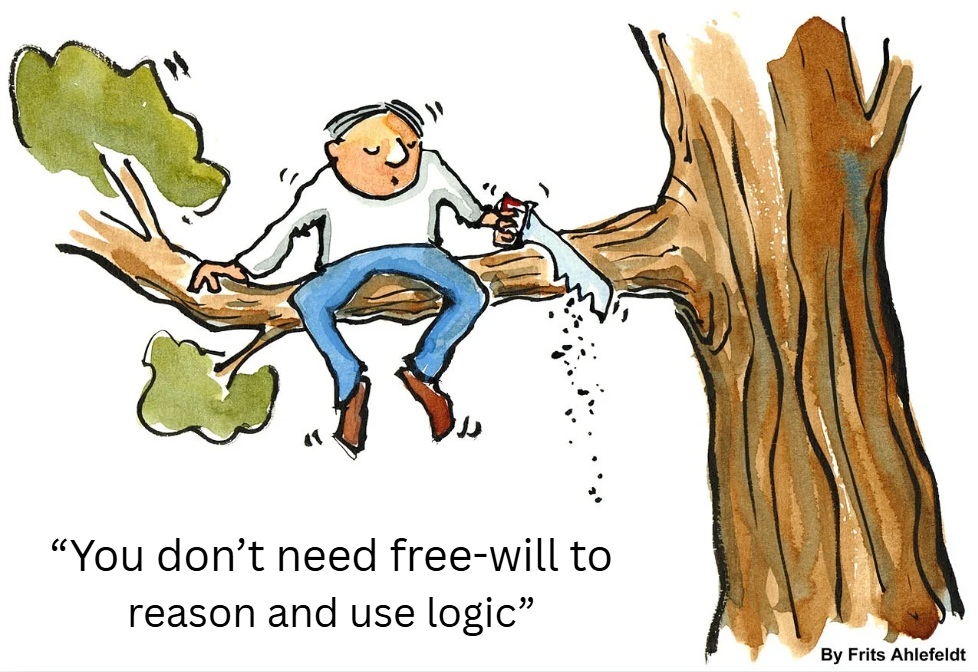 “I Came, I Sawed, I Cankered”: Is arguing against free-will an absurd exercise? (image by Frits Ahlefeldt at Pixabay
Yes, some philosophers would say that “Does free-will exist?” is an ansker — an asking that answers itself, a self-answering question.[2] The answer would have to be “Yes.” Without free-will, it would be absurd to ask anything at all, let alone ask about free-will. Without free-will, we couldn’t reason or have true knowledge of the world. I don’t agree. Or I partly don’t agree. That’s because one of the compelling things about reason is that it’s a compelling thing. In clear, simple reasoning you don’t have a choice about whether to accept it or reject it. No, you’re compelled to accept or reject, by design. We can’t exercise free-will when it comes to propositions like these:
- All men are mortal and Socrates is a man, therefore Socrates is mortal.
- 2 + 3 – 1 = 6
Try to exercise free-will about those two propositions, rejecting the first and accepting the second. It’s impossible. Well, impossible for the sane and rational, that is. But sanity isn’t a question of free-will.[3] Even those who insist that free-will is necessary for reason and seeking truth have to accept that determinism is also necessary for those things. The point of logic is that it’s a deterministic route to truth: “If X, then Y, therefore if not-Y, then not-X.” That’s good logic, compelling belief in those who understand logic. Compare this bad logic: “If X, then Y, therefore if Y, then X.”[4] Such bad logic can compel belief only in those who don’t understand logic for one reason or another: stupidity, ignorance, insanity.
Marine Mind
And who chooses to be stupid, ignorant or insane? Well, some people choose to be ignorant. That’s a real choice if free-will exists, but I have doubts that it does. I can’t see any mechanism for it in a material brain. Or in an immaterial spirit. For me, either determinism reigns or a mixture of determinism and randomness does. But to me randomness seems as impossible as free-will. Indeed, to me the concepts of randomness and free-will seem intimately related, in part because both depend on a putative mechanism that evades or escapes determinism.[5] I can’t see how any such mechanism could exist. Then again, I can’t see any mechanism for consciousness in a material brain. Or in an immaterial spirit. Yet I know by introspection that consciousness exists. Can I not know by introspection that free-will exists?
No, not in the same way, because I can’t be fooled about consciousness. To be conscious of being conscious is to be conscious. To be conscious of having free-will is not necessarily to have free-will, because consciousness can be fooled and free-will can’t be guaranteed if something unconscious is at work too. And I also know by introspection that consciousness is not all there is inside my head. Consciousness isn’t the only thing underlying my actions, my beliefs, and my supposed free-will. The mind is like an ocean, with a sun-struck surface atop brightly lit water atop a twilight zone atop a zone of ever deepening darkness. Consciousness swims on the surface and looks down into the water. It can usually see what’s in the brightly lit water and can glimpse what’s in the twilight, but the darkness hides marvels and monsters from its gaze — marvels like the mechanism of our senses and our physiology,[6] monsters like our true selfish or self-serving motives.[7]
Light and liquid
In other words, the Mind-Mere, the Mind-Ocean, has a conscious zone, a semi-conscious zone, and an unconscious zone. It doesn’t matter that the mechanism of my consciousness is down in the dark, because consciousness of consciousness is consciousness. That doesn’t apply to free-will. It doesn’t matter that I’m not conscious of a mechanism for my own consciousness, but it does matter that I’m not conscious of a mechanism for my own free-will. If I can’t examine the mechanism, how can I know whether it’s really supplying me with free-will? I’d draw this analogy: Suppose you enter a room and find an electric lamp and a glass sitting on a table. The lamp is lit and the glass is full of a clear liquid that looks and smells (or unsmells) like water. Now, do you know that the systems supplying power to the lamp (which represents consciousness) and the systems that supply the liquid (which represents free-will) are working as they should? In the first case, yes: the proof is in the pudding. If the lamp is lit, then all is obviously working as it should be.
In the second case, no: the proof isn’t in the pudding. Just by looking at the liquid and smelling the liquid, you can’t be sure it really is water. But let’s suppose it is water. Can you now be sure the water is not contaminated with invisible bacteria or an odorless, tasteless, slow-acting poison? No, and drinking it wouldn’t immediately enlighten you either. You don’t need to confirm the credentials of the power-supply if the lamp is lit. Like consciousness, light is its own guarantee.[8] Like free-will, a glass of water is not its own guarantee, because you do need to confirm the credentials of the water-supply. With the water, you need to examine the supply to know that there’s no deliberate or inadvertent contamination and so on. Similarly, with free-will you need to examine the mechanism to know that it isn’t deterministic. But what is the mechanism of free-will? It’s as mysterious as the mechanism of consciousness. But I would suggest that perhaps the mechanism of free-will is mysterious because free-will doesn’t exist.
Reasoning that reason is impossible
If free-will exists, then there must be a mechanism of free-will, something that receives information and supplies a choice based on, but not determined by, that information. But how could that be possible? How can a mechanism receive and process information without the operation of that mechanism being in some full sense determined by the information? How could one have an indeterministic mechanism for something like free-will?[9] Standard theory in physics claims that atomic decay is indeterministic, but it doesn’t claim that atoms exercise free-will about whether or not to decay. And the marker of the supposed indeterminism is randomness. For its proponents, free-will represents the complete opposite of randomness. For opponents of the concept of free-will like me, the complete opposite of randomness could only be strict determinism.
But am I an opponent of the concept? I would once have said that I was. Nowadays I’d say that I’m only a skeptic about free-will. Or maybe an agnostic. I’m skeptical about free-will for the same reason as I’m skeptical about infallibility: because I can’t see a mechanism for it. I can’t see a material mechanism and I can’t see an immaterial one. But I’m also skeptical about the rejection of free-will. There are two reasons for that. First, I recognize the possible absurdity of arguing against free-will and for determinism or (if standard theory in physics is true) a mixture of determinism and randomness. Arguing against free-will sometimes feels like reasoning that reason is impossible. Inter alia, both determinism and randomness would seem to render agency irrelevant, yet how can we reason without being agents? I certainly feel like one as I think about these topics, apply logic and try to reach conclusions.
“The whirl of the infinite”
And thinking — or thinking about thinking — has supplied my second reason for being skeptical about rejecting free-will. I’ve thought more about epistemology and hope I understand it better. Or rather: understand better that I don’t understand it. As I asked in “White Rites: Meditations on Mathematics and Materiality,” how is it possible that a material brain, occupying a speck of space and a blink of time, can supply a human being with certain knowledge about all space and all time? The great Arthur Conan Doyle described one of his characters as a “poor impotent atom with his pin-point of brain caught in the whirl of the infinite.” Yet the pin-point of a human brain can conquer the infinite. With our minute, material brains, we can know things that are true of, say, all triangles and all circles anywhere and anywhen. And we can grasp more than trivial truths-by-definition, such as that all triangles have three sides and that all points of a circle are equidistant from its center. No, we can grasp profounder truths, such as that the internal angles of any Euclidean triangle sum to 180° and that the ratio of the circumference of a circle to its diameter is a constant called π or pi, which is both infinitely long and infinitely complex.[10]
We can know that of all triangles and circles with our minute, material brains. How? I don’t know. Well, we know it with our immaterial minds, our immaterial consciousness, but they’re generated by our minute, material brains, aren’t they? And are they truly immaterial? Again, I don’t know. Are minds and consciousness immortal, as theology and some branches of philosophy would claim? Yet again, I don’t know. I can’t account for consciousness or universal knowledge within materialism (or immaterialism, for that matter). But I know by introspection that they exist, which is why I’m now only skeptical about free-will, not rejectional. I don’t know by introspection that free-will exists, but perhaps there’s a mechanism for it, down in the deepest dark. And whatever the ontology of free-will, there are interesting implications for politics and White nationalism. But that, as Rudyard Kipling would have said, is another story.
[1] “Why is there something rather than nothing?” packs more puzzle into fewer syllables than anything else I know. It’s Leibniz’s puzzle, originally posed in Latin, according to Wikiquote, as Cur aliquid potius extiterit quam nihil? Heidegger later asked: Warum ist überhaupt Seiendes und nicht vielmehr Nichts? Das ist die Frage. — “Why are there beings at all rather than nothing? That is the question.”
[2] Here are two more examples of anskers or self-answering questions: “Is this question in English?” « Est-ce que je pose cette question en allemand ? »
[3] Sanity isn’t usually a question of free-will, that is. But a sane person could choose to take a drug that drives him insane. Or could he? Would not voluntarily abandoning sanity be in itself an insane or irrational act? And so on — as usual, philosophy makes me feel like the Sorcerer’s Apprentice.
[4] The bad logic commits the fallacy of affirming the consequent. Compare “If human, then mortal, therefore if not mortal, then not human” (good logic) with “If human, then mortal, therefore if mortal, then human” (bad logic).
[5] Randomness, defining it, detecting it — these are more fascinating topics.
[6] We see, hear, taste, touch and smell, but we don’t know how our senses supply our consciousness, just as we don’t know (by introspection) how we voluntarily control our limbs or involuntarily regulate our heart-beat, digest our food, monitor our hormone levels, and conduct the myriad other tasks of house-keeping a human body.
[7] One of the sorrows of owning a brain is that the mind-monsters sometimes swim up into the light, but the marvels never do. In other words, we can become conscious of our previously unconscious bad motives and so on, but we can never become conscious by introspection of how our senses work. The physical mechanism of the senses is being explained by science, but not the mechanism of how that physical mechanism supplies aphysical consciousness, which remains as mysterious as ever. As I said in my article “Magnissimum Mysterium: Pondering a Huge but Hidden Factor in Politics and White Nationalism”: “everything that science knows and understands about [consciousness] could be written on the full stop at the end of this sentence.”
[8] “Like consciousness, light is its own guarantee.” — in some sense, this statement is redundant. It really says: “Like consciousness, consciousness-of-light is its own guarantee.
[9] I’ll go further: I don’t see how there be an indeterministic mechanism for anything at all, which is why I don’t believe that atomic decay is truly indeterministic or truly random. Some companies claiming to supply truly random numbers use atomic decay and other quantum effects to generate them, one company uses lava lamps. But lava lamps are chaotic, not indeterministic, so perhaps atomic decay depends on chaos or something other pseudo-random, entirely deterministic process.
[10] The digits of pi are entirely deterministic but also, in a sense, entirely random. The decimal of 1/7 = 0·142857142857142857… is infinitely long but entirely predictable, because it falls into a repeating pattern. The decimal of pi = 3.1415926535897932384626433832795… is infinitely long and also infinitely unpredictable, because it never falls into a repeating pattern. You can compress the infinite decimal of 1/7 into “0·142857…” You can’t compress the decimal of pi like that.




This excellent article raises the three most important questions in philosophy and indeed about our human presence in the cosmos; they are not worthless or trivial “pseudo-profundities from a college dorm” as one pompous contributor phrased it. Thankfully, the people some of whose ancestors copied the first chapter of the Torah from ancient Aryans are not dragged in by this particular author (Philo, Spinoza, Bergson, Wittgenstein, Bohr, Putnam, notwithstanding).
I offer only a few tangential comments:
It is certainly curious that the immense cosmos eventually produce brains on a small planet at the edge of a galaxy that can not only observe itself but wonder why it exists itself; the “anthropic paradox”.
Free will: we can be free from restraint to make a choice, but the strongest motive determines the choice, and we do not feel compulsion because the choice is always seductive.
The Christian dogmas of Creation, Trinity, Incarnation and Hell are incompatible with a Self-Existent Monad.
Some modern theories of science dispel the notion of Nothing.
I’ll write something a bit more profound and useful later, but for now I’m going to say that I correspond with a friend 1000s of miles away and I’ve become very anti-Israel/Zionism/Judaism. He got mad and accused me of “logical inconsistencies” so I said to please explain them to me, that I depend on him to show me where I’m wrong, please teach me, etc.
I’m no Kurt Godel but I’ve taken a 100-level college course in logic, putting me ahead of about 99.99% of the American populace.
I suspect that my friend being about as pure an example of a Jew-dazed, propagandized, brainwashed, American as can be found, simply thinks that my disagreeing with him on the subject of Jews and Israel, constitutes logical falsity.
He has not replied with any examples of where I’m logically inconsistent. He’s not able to.
Alex, you’re wasting your time. Get rid of him.
Anyone who can’t see what’s going on right now, has had it’s free will partly or whole conquerd. But it’s easy to wash off. Just decode what the push’news’ slanderheadlines stands for, start reading altmedia.
I think, god laughs.
Oh dear! Mr Langdon writes a formidable metaphysical essay asking the three chief questions: why ‘existence’; what is ‘consciousness’; is there ‘free will’? And all we get so far is – the Jews. Poetic justice for your regular contributor, but as there are other problems in the massive universe, a disappointing discussion. Not even a chance to have a go at Roger Scruton’s “frauds” – Marcuse, Derrida, old Freddy Ayer, and all.
Whatever ANYONE thinks of either of them or both, the “New Testament” depends on the (((“Old Testament”))). No “Jesus” without “Moses”. If Jesus was a real person, was he in any sense Jewish?
One of your regular contributors once called (((Zelensky))) “a nasty little Jew” which is what, I suppose, the Aryan Procurator of ancient (((Judea))) probably thought of Jesus (John 19.19).
On the origin of the cosmos, there is “A Universe from Nothing” by the physicist Lawrence Krauss, but then he is not only one of (((Them))) but a former friend of (((Jeffrey Epstein))), so it must be (((wrong))) and not worth reading.
I use the brackets to assist the understanding of a regular French reader.
It so happens that I have acquired an autumnal interest in the philosophy and sociology of religion, and have read the book by Lawrence Krauss which is mostly (not entirely) a load of shallow wandering waffle, well below the standard of recent popular atheism set by for example Daniel Dennett (who is not a Jew). There are theists with science backgrounds like Paul Davies, Frank Tipler, John Polkinghorne and Robert Spitzer. The trouble is that arguments for God linked to cosmological or quantum discoveries will weaken over time, as happened after Galileo and Darwin.
The concept of a Self-Existent Creator may “explain” the existence of a “contingent” cosmos, but not why it would need or want to create anything (out of “nothing”), or whether this is the best of any possible worlds. It doesn’t seem to take any obvious interest in the “debate”, and its alleged brief intervention 29-33 CE doesn’t seem very compelling.
Perhaps I should give up useless worrying or pointless praying, and just get on with the garden, listening to classical music, reading quality literature, keeping fit, and playing with the grandchildren. Oh, and fighting wokery in print and on screen.