
1922 – 1942 – 1992: The Three American Food Aid Efforts That Saved Russia
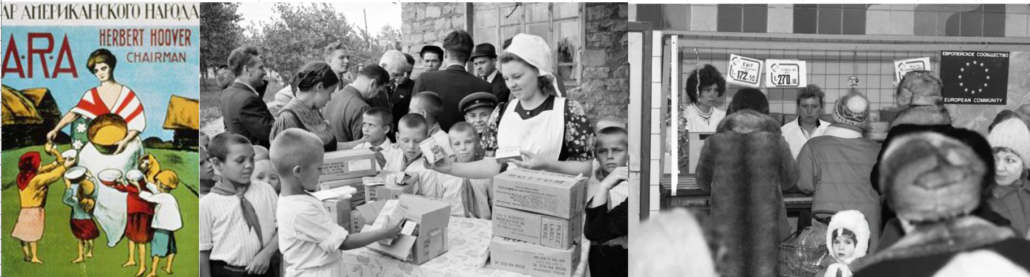
If America and Russia were truly sworn enemies, it is hard to see why the former would have stepped in to save the latter at three key moments in its history:
– In 1922, as the civil war between the Reds and the White Russians plunged the country into chaos and famine,
– In 1942, when the Wehrmacht achieved the feat of routing an army ten times more powerful,
– in 1992, as communism collapsed under its own weight of imbecility.
To trace the history of this aid is to recount the unsettling story of the ambivalence characterizing Russian-American relations—an ambivalence that likely persists to this day in the war in Ukraine.
That is why it may be useful to revisit these three episodes, doing so based primarily on Russian sources to avoid interference from potential American propaganda.
1 – 1922, the intervention of the ARA (American Relief Association)
At the end of World War I, under the aegis of Herbert Hoover—the future president, who was then director of the American Relief Administration (ARA)—massive food aid was provided to Europe. The populations of northern France, Belgium, and Poland were among the primary beneficiaries.
In 1921, to address the devastating famine striking the Russian Socialist Federative Soviet Republic (RSFSR)—a consequence of the Soviets’ “War Communism” policy—Walter Lyman Brown, the ARA’s director for Europe, began negotiations in Riga (in Latvia, which had not yet been annexed by the USSR) with Maxim Litvinov (born Meir Henoch Wallach-Finkelstein…), Russia’s First Deputy People’s Commissar for Foreign Affairs. An agreement was reached on August 21, 1921, followed by the signing of a supplementary implementing agreement by Brown and the People’s Commissar for Foreign Trade, Leonid Krasin, on December 30, 1921. For its part, under the Russian Famine Relief Act passed in late 1921, Congress appropriated $20 million (~$375,000,000 in today’s dollars) in funding.
At its peak, the ARA employed 300 Americans and over 120,000 Russians, providing more than 10 million daily food rations. Its operations in Russia were led by Colonel William N. Haskell. The ARA’s medical division operated from November 1921 to June 1923, helping to stem the typhus epidemic then ravaging Russia.
ARA activities in Russia ceased on June 15, 1923, after it was discovered that Russia, under Lenin, had resumed grain exports.
The Russians and Americans do not much like people being reminded of this aid.
In May 1922, the Chekist A. Eyduk, assigned to the American Relief Administration (ARA), wrote in *Pravda* that the American organization was then feeding 6,100,000 Soviet citizens. The American Quaker Society was providing for 265,000 people, the International Save the Children Association for 260,000, the Nansen Committee for 138,000, British trade unions for 92,000, the Swedish Red Cross for 87,000, International Workers’ Aid for 78,000, and the German Red Cross for 7,000.
However, in the 1950 Great Soviet Encyclopedia, the story has already been revised: “America took advantage of the permission granted to the ARA to operate in the Soviet Union to engage in espionage, subversion, and support for counter-revolutionary elements. The actions of the ARA provoked a resolute protest from the broad masses of the working people.”
On the American side, Wikipedia states that:
Hoover harbored a deep aversion to Bolshevism but believed that American aid would demonstrate the superiority of Western capitalism, thereby helping to stem the spread of communism.
The logic behind the idea that one should help one’s mortal enemy in order to weaken him completely eludes us. It is worth noting that the Americans negotiated only with the Reds, never with the White Russians. Likewise, it should be noted that the Americans never attempted to help the German populations during the famines of 1918–1919.
We may therefore reasonably conclude that America contributed to the rise of a Judeo-internationalist power—a choice it would have cause to congratulate itself on twenty years later, when the time came to overcome German and Aryan nationalism.
2 – 1942, The Lend-Lease Program
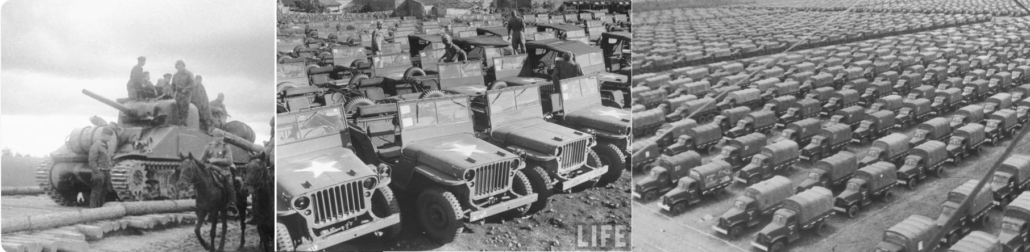
First, a note: some readers may have been shocked earlier to read that the Wehrmacht had routed a Red Army ten times more powerful. Here is confirmation from the Russians:
More than 20,000 tanks were lost by the end of 1941 alone, and it was impossible to rapidly replenish this arsenal due to the loss of the country’s western industrial regions.
The fact that the Russians had 20,000 tanks to lose suggests that Viktor Suvorov was right: on the eve of Operation Barbarossa, the Red Army possessed 30,000 tanks (and 3,000 aircraft). The question, of course, is why the Soviets had built up such a war machine, given that the Reich—even at its peak—never had more than 4,500 tanks; indeed, it lacked the fuel to keep many more than that running.
And yet, the Red Army’s initial, staggering losses made Anglo-American support on an unprecedented scale essential. The scope of this aid was immense, encompassing not only weapons but also machine tools, locomotives, marine equipment, raw materials, and foodstuffs.
America supplied the bulk of the aluminum and aviation fuel; in other words, without American aid, Russian aviation would simply have ceased to exist. America also supplied vast quantities of radio sets and telephone equipment—essential for air-ground combat (coordinating armor, aircraft, and artillery) and for coordinating mobile warfare involving large units over long distances.
In total, the United States and Great Britain supplied the USSR with more than 35,000 radio sets, 380,000 field telephones, and over a million kilometers of telephone cable. Thanks to this, in 1943, the Soviet Air Force was able to deploy a network of forward observers, enabling the army to call in strikes promptly and accurately, thereby significantly increasing the effectiveness of air operations. That same year, five distinct radio battalions began operations, intercepting, decoding, and jamming German messages. Without reliable portable radios, it would not have been possible to form Soviet infantry assault groups, which played a decisive role in capturing German strongholds in 1944–1945.
Approximately half of Soviet explosives, 80% of the copper, and more than half of the aviation aluminum and aviation fuel were supplied under Lend-Lease. About 40% of tires and roughly 80% of new locomotives, rolling stock, and rails came from abroad. Food supplies played a significant role, and American stewed meat alone accounted for 17% of the meat produced in the USSR.
Assistance regarding aviation fuel (35%) and aluminum (69%) was more significant. Problems arose due to the loss of production from Ukraine within the USSR.
“The Americans really helped us with gunpowder and explosives,” acknowledged Marshal Georgy Zhukov. The fact is that artillery shells and mines were loaded with trinitrotoluene (TNT). Early in the war, the domestic shortage of the substance worsened significantly. Consequently, 53% of the TNT in Soviet shells was directly or indirectly imported.
The second important element is gunpowder. The USSR had no issues with pyroxyline powder derived from cellulose. However, nitroglycerin was more powerful—a necessity for the Katyusha, for instance. Approximately 66% of the raw materials for nitroglycerin-based powders came from Lend-Lease.
American vehicles accounted for 70% of the Red Army’s fleet—a decisive factor in its mobility. … G.K. Zhukov, highlighting the role of imported vehicles in the war, noted: “Without the Studebakers, we would have nothing to transport our artillery.”
According to experts, Western equipment accounted for 32.4% of the Soviet Navy’s total armament… Many domestically built ships and vessels from the war era were primarily equipped with gear supplied under Lend-Lease.
From July 1, 1942, to June 30, 1943, 623 drilling machines, 69,121 boring machines, 2,736 grinders, 58 planers, 5,306 lathes, 3,000 metal-cutting machines…
622,000 tonnes of rails, 1,900 steam locomotives, and 66 diesel-electric locomotives were delivered.
In terms of food, the aid included:
238 million kg of frozen beef and pork, 218 million kg of canned meat (including 75 million kg of stew), 33 million kg of sausages and bacon, 1,089 million kg of chicken, 110 million kg of egg powder, 359 million kg of vegetable oil and margarine, 99 million kg of butter, 36 million kg of cheese, and 72 million kg of powdered milk. Imported sugar amounted to 66% of domestic production, canned meat to 480% of domestic production, and animal fat to 107% of domestic production.
To round off this brief description, we can do no better than to quote General-in-Chief Georgy Zhukov, who led the Red Army throughout the war:
Today, people say the Allies never helped us, but it is undeniable that the Americans sent us so much equipment—without which we could neither have built up our reserves nor continued the war,” the Marshal said—words recorded by the KGB in 1963. “We had neither explosives nor gunpowder. There was nothing to load rifle cartridges with. The Americans really helped us out with gunpowder and explosives. And the sheer amount of sheet steel they shipped to us! Could we have rapidly ramped up tank production without American steel? We received 350,000 vehicles—and what vehicles they were! Without them, we would have had no way to transport our artillery. They essentially handled our frontline transport. Not to mention the high-octane fuel for the MiGs. Nowadays, people imagine we had all of that in abundance.
Corroborating Zhukov’s statements, Anastas Mikoyan—who during the war served as chairman of the Committee for Red Army Food and Clothing Supply and as a member of the State Defense Committee (GKO)—declared:
In the autumn of 1941, we lost everything; without Lend-Lease—without American supplies, weapons, food, and warm clothing for the army—it remains an open question how things would have turned out.
We should note that here, too, America chose to support the Judeo-internationalist power rather than Germany.
3 – 1992, Operation Provide Hope, the final rescue
In 1992, for the third time, America would come to the rescue of its favorite rival and once again prevent it from collapsing completely.
On February 10, 1992, a large-scale delivery of humanitarian aid from the United States and its allies to the countries of the former USSR, known as Operation Provide Hope, began.
On January 23, 1992, during a conference in Washington on coordinating Western aid to the republics of the former USSR, President George W. Bush announced the largest humanitarian operation since Lend-Lease. Following the collapse of the USSR, there was an acute shortage of food and other essential goods in the former Soviet republics. Japan, Great Britain, Germany, and other European countries joined the American initiative.
The delivery of humanitarian aid began on February 10, 1992. On that day, 12 U.S. Air Force military transport aircraft—Lockheed C-5 Galaxies and Lockheed C-141 Starlifters based in Germany and Turkey—delivered the first shipment of food and medicine to 12 cities in the former USSR: Moscow, St. Petersburg, Kyiv, Minsk, Chisinau, Yerevan, Almaty, Dushanbe, Ashgabat, Baku, Tashkent, and Bishkek.
During the first phase of the operation, which lasted until the end of February, the US Air Force flew 65 sorties and delivered 2,274 tons of humanitarian supplies. The operation involved not only US Air Force aircraft but also civilian planes chartered by the US Department of Defense. Initially, the aid came from stocks remaining from the Gulf War.
Just as in the heyday of Lend-Lease, England has joined forces with America to help Russia—but also Germany and Japan, the two countries the Red Army had taken such pleasure in crushing fifty years earlier.
A total of 282 airlifts carrying 7,012 tonnes of cargo were conducted as part of Operation Provide Hope up to August 1993. The *Yubileyny*—the 500th aircraft—arrived in June 1997.
4 – Today, Lend-Lease is working in Ukraine’s favor.
The new development is that today, for the first time, an adversary of Russia is being aided by America. Here are the details of the aid identified so far (as of March 2026):
* 80 aircraft, about half of which are F-16s;
* 70 helicopters;
* 1,000 tanks, a few hundred of which are of Western design;
* 1,500 infantry fighting vehicles and similar armored vehicles;
* 4,000 armored vehicles;
* 8,500 armored cars of various types;
* 1,200 towed and self-propelled howitzers;
* 300 radars;
* 500 engineering vehicles;
* dozens of air defense batteries.
Moreover, not all deliveries can be quantified—for instance, Starlink satellite internet has become the primary communication system for the Ukrainian Armed Forces, playing a role as significant as that of Western radio stations in 1942–1945.
Conclusion
It is as if, far from being enemies, America and Russia were acting as rivals dividing up the world—or at least the West—between them.
In this cooperation, Russia acts as a watchdog for America, keeping the old European powers in check.
This is still working very well today, with the war in Ukraine forcing Western Europe to rearm by signing massive arms contracts with the US.
As for Russia, it certainly won’t seek to crush America and NATO in Ukraine—for who, then, would come to its rescue next time?
The thing is, regarding the war in Ukraine, we do not know the real cards the protagonists are holding; what’s more, we do not even know what game they are playing. Hence the need to step back and take a historical perspective in order to try to understand.
The war in Ukraine may be nothing more than the latest episode in the good cop/bad cop routine that America and Russia have been playing out for nearly a century now.
But for some, a new hypothesis is emerging: Russia is now being attacked for real because it is no longer communist or Marxist and it destroyed the political power of the Jewish oligarchs; and it is becoming Christian again.
Sources
1 – Did the USSR save Lend-Lease? Comparing US aid to the Red Army with supplies to Ukraine.
https://www.gazeta.ru/science/2026/03/11/22618933.shtml?ysclid=mqf6lapoi2277829494
2 – Profitable Lend-Lease
https://expert.ru/ekonomika-pobedy/dokhodnyy-lend-lease/?ysclid=mqf6pi4i3k31908563
3 – Without Lend-Lease, we would have lost: fact or myth—what Stalin said about it
https://dzen.ru/a/aB0b87a0QUj2R5xJ?ysclid=mqf6rsd68m251094822
4 – “We wouldn’t have won the war without the United States”: how Lend-Lease helped the USSR
https://www.gazeta.ru/science/2020/08/20_a_13204369.shtml?ysclid=mqf6szteh1668883069
5 – Could the USSR have won the war without American Lend-Lease? By supplying millions of tons of cargo, the United States was primarily helping itself.
https://www.kp.ru/daily/27685.5/5074900/?ysclid=mqf70mft3l401927116
6 – Lend-Lease,“ or the truth about the ”disinterested nature” of American aid to the USSR during the Great Patriotic War
https://www.drive2.ru/b/3170477/?ysclid=mqf76jhtb1795767669
7 – From America with hope
https://www.kommersant.ru/gallery/5206202?ysclid=mqf7879lgv813577195De l’Amérique avec espoir
8 – Thirty years ago, America began transporting food to Russia via an airlift. It was a monumental undertaking.
https://novayagazeta.ru/articles/2022/02/09/bort-v-pomoshch?ysclid=mqf79wwg8l669666192
9 – What is Lend-Lease, how does it work, and why was it necessary during the war?
https://auto.ru/mag/article/lendleaseusarussia/?ysclid=mqf7bikgwa64715054
10 – What the USSR sent to the United States and Great Britain under reverse Lend-Lease during World War II
https://kulturologia.ru/blogs/141022/54410/?ysclid=mqf7eudkjy864590918




https://amgreatness.com/2026/06/30/europes-climate-first-policies-fuel-resistance-to-air-conditioning-as-more-than-1300-die-in-heat-waves/
The last sentence:
“Russia is now being attacked for real because it is no longer communist or Marxist and it destroyed the political power of the Jewish oligarchs; and it is becoming Christian again. ”
Each of these four examples favored jews
Judeo Bolshevism, obviously
Eliminating Hitler, obviously
1992, ‘The Harvard Boys’ jew commandeering of Russian economy
Of course, Zelensky / Koloymskyi throwing some little country against a country that dared to go against the jewish commandeering.
Yep, one day you’re walking down the street, masks were on all the tele-screens, abruptly the next day all the tele-screens had Ukraine flags.
The level of jew control cannot be contemplated.
Bang on target Frank,
Frank, Jacob Frank?
I’m kidding…
Couldn’t be Leo, LoL, he rather got noticed, and hard
Leo Frank committed a horrible crime, but it was “just” a crime.
Jacob Frank was a different kettle of fish; he sought global power because he believed himself to be the Messiah. And he had thousands of followers. The Turks were forced to rein him in and tell him to choose between death and conversion to Islam.
This gave rise to the *Dönme*—the equivalent of the *conversos* (or Marranos) in Spain.
Applying the principle:
We cause the problem and provide the solution!
Canada and USA supplied $11.3 billion dollars from 1941 according to AI.
During the Cold War USA also sent food shipments to the former workers utopia.
I’m old enough to remember US grain shipments to the USSR being a thing. It was always in the news, how much we were going to send them, in exchange for … I dunno, those nesting dolls or something.
The meatgrinder of White Ukrainians and Russians in Ukraine only serves the Jews. I see no reason, at this point, after the war entering its fifth year, to believe that Kremlin is not indeed in on this. They seem to have made no real attempts at winning the war, just half-assing it ever since they made that strange retreat from Kiev very early on.
Shhhhhh Rabbi Putin might hear you.
Russia knew what was up.
You can’t occupy enemy territory, see the U.S. and Afghanistan, U.S. and Iran.
Russia knew ZOG was going to bleed it dry, that’s what they do.
Iran is the current ‘bleed it dry’ exhibit.
The US is the Jews’ golem. It was we goyim being taxed and starved (Great Depression, no Jews went hungry then) to preserve “Russians” (actually Russian Jews) and WWII as a massive operation to kill off goyim and secure a Jewish foothold in Palestine.
That’s exactly what they did.
Started far earlier, WW I.
I’d urge readers to go thru Randolph Bourne’s writings; The State, War and Intellectuals, etc.
Your jaw will drop off your face, war propaganda is verbatim today’s war propaganda.
He doesn’t mich talk about jews, but tears their narrative apart.
Antiwar.com is run by the Randolph Bourne Institute
Sutton’s “Wall Street & the Bolshevik Revolution”, Levinson’s “Vodka Cola” & Wikipedia’s “Russian Oligarchs” should be read with care.
Also worth mentionning, the “Great Grain Robbery” (or “Great Russian Grain Robbery”)
https://en.wikipedia.org/wiki/1973_United_States%E2%80%93Soviet_Union_wheat_deal
The 1973 United States–Soviet Union wheat deal was a series of large Soviet purchases of American wheat and other grains. It was negotiated with private U.S. exporters during July and August 1972, with deliveries scheduled through August 1973.[1] The Soviets contracted for about 440 million bushels of wheat (roughly US$700 million) along with additional grain purchases, tightening world supplies and contributing to sharp rises in grain and food prices in 1972–1973.
The sales were facilitated by a July 1972 U.S. government credit agreement making up to US$750 million available over three years for Soviet purchases of U.S. grains, and by export-subsidy mechanisms that supported contracting at fixed export “target” prices despite rising domestic market prices. In the United States the episode became widely known as the “Great Grain Robbery” (or “Great Russian Grain Robbery”), and Congress subsequently mandated an export sales reporting system in 1973 to improve transparency around large agricultural export transactions.