
Sweden and Multiculturalism: A Terminal Condition?
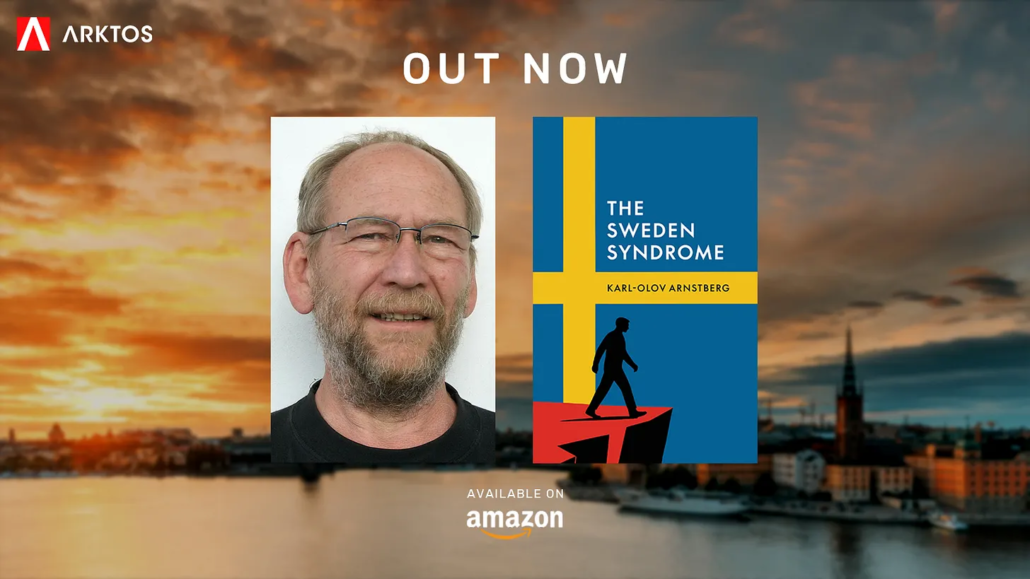
Arktos: The Swedish Syndrome: How Elites Commit National Self-Destruction (Amazon)
Karl-Olov Arnstberg
Arktos Media, 2025.
In 1973 a bungled bank robbery in the Swedish capital led to an extended hostage situation. Over time the hostages, four bank employees, came to sympathize with their captors, felons who were putting their lives at risk. The phenomenon where captives identify with their captors has been termed the Stockholm Syndrome. Swedish ethnologist Karl-Olov Arnstberg sees parallels to the wider Swedish society where the populace is held in psychological captivity by a hostile elite. The author’s thumbnail description of the Swedish Syndrome is: “an identity-based social psychosis, an illness that takes the form of cultural self-harm.”
This book is a case study of how Swedish society became woke. The affliction has now spread to all Western societies, but various factors led Sweden to become an early and extreme adopter. Today the national ideology is explicitly multicultural. Of course this was not always the case.
The seeds of destruction were planted decades earlier. We see again how pivotal World War II was in Western history, in World history. Sweden was neutral during the war, so they emerged from the conflict with their population and infrastructure intact. While Germany was made to feel guilty for what it did during the war, Sweden was made to feel guilty for what it did not do. Rather than oppose Germany, it was a major trading partner. On a deeper level Swedes needed atone for the purported excesses of National Socialist Germany. While the ideology of the NSDAP was specifically nationalistic, it promoted the Aryan or Germanic ideal. Sweden, being a Nordic nation, was required to accept that alleged war crimes had been perpetrated in the name of their race, creating feelings of guilt.
The post-war years produced a society as peaceful, prosperous, and progressive as humanly possible. So in addition to vicarious war guilt, affluence brought anxiety about unearned privilege. Why should Swedes enjoy the good life while millions in the Third World suffer from malnutrition and disease? This mentality was most pronounced among the elite as most Swedes continued to be patriotic and productive citizens.
In 1960 Sweden had one of the most homogeneous populations in Europe. The few immigrants were European, mostly neighboring Finns. But it was a society with no great cause to work for, no larger projects to accomplish, and a leadership that was becoming estranged from their own people. It turned out that paradise was rather dull. That was soon to change. It began with a change in the zeitgeist that can be illustrated in the work of two Swedish public intellectuals: Gunnar Myrdal (1898–1987) and Vilhelm Moberg (1898–1973).
The economist Myrdal is best known as lead author of An American Dilemma: The Negro Problem and Modern Democracy (1944). This social research tome (1500pp) sold over 100,000 copies. It laid out the sociological blueprint for a multiracial American society. To summarize: U.S. Blacks are oppressed by the White majority leading to poverty, ignorance, and vice. These characteristics reinforce White negative attitudes towards Blacks. However, if Whites provided Blacks with better housing, education, and health care, they would achieve White cultural standards facilitating racial integration. Thus, the so-called Negro problem was really a problem of White racism. This was the basic reasoning behind the early civil rights movement, and An American Dilemma was cited in the 1954 Brown Supreme Court decision outlawing racial segregation in public schools.
Yet years earlier Myrdal had different concerns. In 1934 he, along with his wife Alva, wrote Crisis in Population. Sweden was hit hard by the Great Depression. Birth rates plummeted raising the possibility of population decline. Arnstberg quotes from the Myrdals’ book:
The consequent decline in population would signify the degeneration of the race and “the suicide of the family.” As population pressure was reduced, the country would be flooded with immigrants from foreign races with higher fertility rates. By right of the strong these would take over and reshape our precious cultural heritage.
The genesis of the modern welfare state, the Folkhemmet—the people’s home, the national community—lay in pronatal policies designed to save the race.
Between 1935 – 1939 the well-known Swedish novelist Vilhelm Moberg wrote a semi-autobiographical folk and soil trilogy published in English as a single volume, The Earth is Ours (1940). Without romanticizing them, Moberg praised the rural folk who were rooted in the land and part of an authentic community. In contrast were the alienated urbanites of Stockholm.
Both Myrdal and Moberg identified with the Left, but their 1930s versions would be considered ethno-nationalist by current standards. This raises the question of how the Left became explicitly anti-White as it did so starkly in Sweden. Unlike many European countries Sweden did not have a nationalist mass movement during the interwar period, though there was some support among the bourgeoisie for National Socialism as a bulwark against communism. Had Germany prevailed against Bolshevism their influence on postwar Swedish culture and politics would have been immense.
Politically Arnstberg notes a postwar transition from popular rule to elite rule in Sweden. And as non-White immigration increased during the 1970s and 80s there was a shift from assimilating newcomers to multiculturalism. This was inevitable because culture is, in part, genetically based. Assimilation is only possible if the immigrants do not deviate too greatly from the culture and ethnicity of the host population—10,000 Estonians small: problems; 10,000 Somalis: big problems.
The implementation of multiculturalism required a soft totalitarian regime that could turn hard if met with resistance. Important factors were the full cooperation from the mass media and censorship of dissent including internet censorship by both government and private surveillance groups. Labor unions, schools, churches, and NGOs were coopted. Swedish history and culture needed to be deconstructed. Many in leadership actually “despise and deny Swedish culture.” And there was the politicization of the law, resulting in a two-tiered legal system.
It seems that one would need to be in denial to believe that multiculturalism has increased the quality of life for the average Swede. Yet in international surveys Sweden always ranks among the top ten happiest countries. One can image the mindset: “Well, I can’t complain; things could be worse. And think of all the exotic cuisine and football stars we have.”
The book characterizes Swedish society as statist individualist – a strong state plus personal autonomy. The country scores high on both individualism and conformity—what one might call the paradox of individualism (see also Kevin MacDonald’s Individualism and the Western Liberal Tradition on Scandinavia). There is tolerance for individual idiosyncrasies and respect for personal space. But on boarder social issues, Swedes are very compliant, with “no other opinions in the public sphere than the prevailing ones.” In a high-trust society there is trust not only between people, but between the people and the government. Arnstberg references the theories of Belgian psychologist Mattias Desnet on mass formation psychosis leading to groupthink.
Prof. Arnstberg (b. 1943) is old enough to have witnessed the full trajectory of his country’s decline, and The Swedish Syndrome supplies statistical and antidotal evidence to support his thesis (30 percent of the population is foreign-born or children of foreign-born). The author is quite pessimistic about the future. In the last paragraphs of the book, he lays out two future scenarios for Sweden. One, “more of the same,” leading to a poorer and more dangerous country. “There is an even scarier alternative: … In a decade or so we may have civil war-like conditions in Sweden.” Both of these possibilities are tragic, but at least the latter offers some hope for a Swedish instauration, and there is still a lot worth saving.
The Swedish edition, Sverigesyndromet, (2022) was published just as a center-right coalition government came into office promising to limit immigration and crack down on crime. This has led some to believe that the fever has broken and the country has stepped back from the abyss. In the English edition (2025) editor and social psychologist Josh Neal tempers Arnstberg’s gloom. He believes that “Trumpism” has had a positive international impact. There is now a “new intellectual climate” and Arnstberg’s book “will usher in a new era of Swedish conservative intellectualism.” Perhaps, but it will take more than a tepid conservatism to save the nation. In the end it may depend on how much of the spirit of the Varangian Vikings and the pikemen of Gustavus Adolphus still resides in the hearts of the Swedish people.




Sweden has been the pilot project for socialism/communism/multiculturalism since the end of WWII exactly because of the homogeneous population. Roland Huntford has some things to say about the transformation of Sweden in his ‘The New Totalitarians’.
We know that the British pledged a ‘New World Order’ to the jews as soon as the war had ended and they started their ruinous campaign.
I remember living in Italy in the seventies Italians rating each other for seducing ladies. Not very nice maybe but it tells something. Seducing a Swedish girl gave you 1 Point meanwhile an Italian girl earned you 8 or 9 and a Spanish girl 10 points. The Swedish women had already been manipulated is easy sex. What a tragedy!
We know that in communism women are a ‘common good’.
The Jews Do. Not. Like. Aryans living in peace and harmony among fellow Aryans. They’ll do anything to destroy that, as we are seeing.
https://www.theoccidentalobserver.net/2013/01/14/the-jewish-origins-of-multiculturalism-in-sweden/
Those immigrants ain’t goin’ nowhere. There’s enough brainwadhed natives to throw a spanner in any of those plans, and you’ll never get leadership that does anything but make wild gesticulations.
It’s bevome clear that all of the [your country here] foirst types were nothing but jewops, Milei, Trump, etc. We’ve already discussed the Black Cube installments in South America.
Time to start a local movement.
You.
Yep. Don’t forget the prophetic words of Barbara Lerner Spectre. This bug-eyed jewess claimed that Europe “must become multicutlural, otherwise it won’t survive”.
https://www.youtube.com/watch?v=Pp38upAHpfs
Never lose sight of the (((bullseye))), folks. The migrants can all be remigrated… but the (((tumor))) which let them into our countries must be excised.
The Spectre of Multiculturalism – not “bug-eyed” but bean-spilling. Tumors are removed by cauterization.
Not mentioning jews is like watching Glenn Diesen interview defense boomers. Twist and contort in every direction but the central cause.
yep, 💯
I was in Norway about 6years ago driving around. I shot my mouth off always to Norwegians about the Muslims, etc. the locals tolerated me but that was about it. As I keep on about, there is no rational argument that will work. The only hope is civil war and depression.
If you want to travel there bring piles of money. I car camped and it was still a problem. Food is expensive and cafes, etc are few since buying dinners, etc is very expensive, even for Norwegians. As half Swedish thru my mother, lots of people looked like me, an interesting experience. Everybody speaks perfect English and the scenery is great. Probably better to wait for Depression which will bring down prices. Also, go in the summer …obvious I guess.
Fortunately(?) the Jews are doing their best to bring on worldwide depression and war. I think they’ll hoping to pull off a Bolshevik Revolution.
That would be “revolutionary socialism” ruled over by Jews of course, but there’s also “Fabian” or slow/creeping socialism and no that’s not Pell Grants for white kids who are poor but smart, it’s importing tons and tons of immigrants from the most crime-ridden, backward parts of the world etc.
Keep in mind that the brilliant painter set up all kinds of things for the common working-class German which is but one of the reasons he was adored.
Programs that undet ZOG in the US are called “socialism” like a national health service, making sure elders are fed and housed, etc., work great under normal, natural, homogeneous populations. The Jews know the quickest way to throw a monkey wrench into this is to import millions of low-IQ and oppositional immigrants. So they do.
Programs under the brilliant painter were nationalsocialism, programs today in Europe/the West are socialism.
H.G. Wells nailed the Scandinavians in the Eloi of the Time Machine. I would prefer somewhere where I could raise a swastika flag for memorial day without people freaking out. India not an option.🤣
Wells was an unbelievably prolific writer of fiction and science, a mixed bag over time from the viewpoint of “racial nationalism”, but much useful and interesting stuff. One of my favourites is Oswald Cabal[lero], the black-shirted inventor of Wings Over the World, aircraft run by whites that dropped anaesthetics on tribal conflicts, and whose peroration at the end of the movie version “Things to Come”, the white world of the future, is an impressive piece of cinema soliloquy (despite Raymond Massey’s mad eyes). Wells was a eugenicist. See Bryan Cheyette, “H.G. Wells & the Jews”, Patterns of Prejudice (1988), National Library of Israel (on-line).
H.G.Wells was also a founding member of the Party in George Orwell’s NineteenEightyFour. What people don’t get is that, that Party is a real entity.
When in doubt, consult KM. His Individualism and the Western Liberal Tradition, Chapters 2, and 3. Aristocratic Individualism and Egalitarian Individualism have both contributed to our present disaster by weakening kinship ties strengthening selection of outsiders to join our group, in the case of IndoEuropean warrior societies, and in the case of northern European peasant family life, to reduce larger kinship associations to individual families as the center of social life.
Both contributed to the weakening of tribal ties and emphasized individual merit and in the case of marriage, to considerations of beauty and emotional compatibility becoming more important then what extended family had to say, and fostered individual initiative in work/farming, and warfare and ambition to achieve reputation/prestige.
What Whites have been known for over the succeeding centuries, is high intelligence, hard work, fighting spirit (from the Indo Europeans ) and more personal freedom.
These chapters by KM are fascinating , a great read, and lead me to speculate on the genetics that supported such developments in the first place. Selection is slow but can be accelerated by foundational characters like Genghis Khan and White chiefs/kings/princes who simply took the women they wanted, and victory in battle. In primal times, warfare killed men and prisoners were killed and women were taken. Pretty simple basically. Still goes on, like in WW2 when Soviets murdered Germans and raped the women.
KM is careful in making large claims and lets the facts speak for themselves. Clearly he sees these “cultural” tendencies in every day social life and in warfare as very important in genetic selection.
So. Our Individualist traits served us well until recently. We conquered the world, more or less and here we are being conquered by jews, niggers and wogs generally. and our own women. Our openness to strangers which once served us to get talent and more personal freedom, now has let the niggers into the woodpile, let women try to think, and destroyed male confidence and warrior, “toxic”masculinity, robust fighting spirit, and what’s left of it, squandered on the jews thanks to the Trumps and seductions of money and Jew porn, etc. (OF course, Trump may yet save us, by his colossal mistakes in war, economics, and the Master/Slave shitty little country in the ME. Thank you and may you rot in jail.)
The only thing left to us is civil war, as I keep on about. not sorry.
No, whites were always and still are in charge!
It is unacceptable that the Jewish Bonnier family was not mentioned. They’re a big part of the problem.
As for whether its terminal: Pelagius of Asturias didn’t think it was terminal in Iberia. He just said F off to Muslims and that was that. It’s a good attitude for Swedes to adopt.
The Swedish parliament has 8 parties – none of them is right wing! They are all either liberal or far-left. The media usually designates the Moderates (Moderaterna) as “right wing”, but after the 70s they simply became Liberal as everybody else, praising immigration, Pride and multiculturalism. The Sweden Democrats (SD – Sverigedemokraterna) was nationalistic in the 90s (then outside the parliament) but is now mostly a liberal party that favors “Swedish openness” — anyone can become a Swede with a Swedish identity if only they learn Swedish, imitate Swedish behavior and worship Israel, but Wikipedia erroneously characterizes them as “National conservatism
Right-wing populism”.
The only party that might be characterized as right wing is Alternative for Sweden (AfS – Alternativ för Sverige, https://alternativforsverige.se), with only a fraction of a percent of the votes. They want Sweden to exit EU and Nato. There exists a National Socialistic party called Nordic Resistance Movement (Nordiska Motståndsrörelsen, https://motståndsrörelsen.se) that you actually can vote for, but that organization has been designated a terrorist group by the USA (they are absolutely NOT terrorists) so they are not allowed to have any bank accounts in Sweden.